
By Todd Wilkinson with Chris Servheen
Here’s a headline we could have attached to this story—were it our objective to dangle it front of you like tabloid clickbait catnip. It might have declared: “Animal attacks on humans continue to soar! Be very afraid! Public safety in grave danger! No end in sight! Don’t let your children outside!”
Based on the compelling statistics below, even that level of hyperbole would not have been justified.
Last year, an estimated 4.5 million incidents involving people being bitten by the canid fangs of certain aggressive omnivores happened in the US. Around 800,000 of those cases necessitated medical attention just in the US, and 84 of them in the US and Canada were fatal. They occurred in every state and province, in cities, suburbs, along hiking trails and in parks and schoolyards. They’re likely to reach a similar tally this year, and the next and next.
In terms of economic impact, insurance companies handled an estimated 28,500 claims totaling $1.86 billion in medical bills. On top of this, there were an estimated 21,800 lethal attacks by these animals on cattle, 13,000 on sheep, resulting in millions of dollars’ worth of livestock losses, and more than 13,000 human pets being killed.
Now the punchline: All of these are connected to a specific kind of animal—not wolves, cougars or bears, but domestic and feral dogs.
In spite of this, Texas statistician Mike Dickerson sounded an alarm in 2026 with bears, implying with his new database that we ought to be worried. In 2026 in North America, he has documented 73 encounters between people and either black bears or grizzly bears, with 64 resulting in human injury and 13 in death.
As if not to miss a beat in helping to fan the flames when Mr. Dickerson circulated his list, Outside magazine and our friends at Cowboy State Daily published stories about his numbers, which not only conjure an exaggerated misperception about the real level of human danger pertaining to bears; but it feeds into the rhetoric of fact-challenged politicians seeking to tout more lethal control of wild carnivores in general. We are not diminishing nor callous to the potential danger grizzlies pose to people, and certainly Mr. Dickerson is going to add a recent likely fatal bear incident in British Columbia in which a woman and her adult daughter were killed while hiking on a trail near Bella Coola.
At this moment in time, however, hyped up fear plays into the narrative that grizzlies need to urgently be removed from federal protection under the Endangered Species Act in the Lower 48 so that they can be “managed” by states which, in turn, want to be able to control bear numbers by allowing hunters to shoot them. As Dr. Christopher Servheen, who oversaw grizzly recovery for the US Fish and Wildlife Service for 35 years in the Lower 48 before retiring a decade ago, says both contentions are nonsense: in fact, states are co-managing bears, and the suggestion that hunting bears will result in fewer conflicts is unproven conjecture.
For her story in Outside, writer Madison Drapevich writes; “Between 1990 and 2019, North American black and grizzly bears have killed at least 150 people, and more people have died in recent decades than a century ago.”
Missing, Dr. Servheen says, are a few salient facts and context. First, in 1990 there were a lot fewer bears and a lot fewer people in bear habitat. Second, now , not only are there a lot more people but they are invading places where recovering bear populations have previously found secure habitat. Third, historically, there are not a lot of examples of grizzlies exhibiting predatory behavior on people; though it does exist with polar bears and in some places, with black bears—the latter prompting a question with Dr. Servheen, below.
Increasing conflicts are happening because a lot more people are building homes and recreating in prime bear habitat but no state or federal agencies or many conservation organizations are trying to control sprawl—that is negatively impacting all wildlife—nor limiting the intensity of outdoor recreation.
This week, in our regular column, “Conversations from the Green Thicket,” Servheen and I discuss these latest examples of spurring bearanoia. Servheen has some experience with grizzly attacks on people having chaired eight Interagency Boards of Review on human fatalities due to grizzly bear attacks in the Lower 48 states. These Boards of Review produce detailed reports on how and why each fatality occurred, and in four cases produced detailed recommendations on ways to minimize such human fatalities from bear attacks in the future.

Todd Wilkinson: Well, Dr. Servheen, here we go again. For every one step forward our society seems to take in becoming more enlightened about wild nature, another spasm of hyperbole results in us taking two, three or four steps backward. I’m sure that you, having spent 35 years in the hot seat defending grizzly recovery as being a sound idea, have some thoughts to share about those who spread fear.
CHRIS SERVHEEN: Certainly, people are interested in animal attacks, especially when it involves wild animals. For most people, the only time they hear about bears is when there is a media story about an attack or a human fatality. No one writes a news story on the tens of thousands of times that humans and bears interact at close range, and no one is attacked or injured. We cannot underestimate the corrosive impact on human attitudes about bears that such news bias has on the general public.
TW: Let’s make it clear that you and I both grew up hunting and we are fans of dogs. We highlighted the stats above within the context of negative human-dog encounters, to serve as a reference point for comparison to incidents involving bears. If you don’t mind, I’d like to share some relevant stats to emphasize that point. There are an estimated 90 million dogs in the US, maybe 900,000 black bears and 50,000 grizzly bears in North America. When you consider the numbers, what comes to mind?
SERVHEEN: In the Northern US Rocky Mountains from 2001 through 2026, there have been 14 human deaths due to grizzly bear attacks. That averages 0.53 fatalities per year from grizzly bear attacks over the past 26 years. There are millions of visitors each year to our national parks with grizzly bears and hundreds of thousands more people who live, work, and recreate in grizzly habitat on public and private lands in the Northern US Rockies. A fair estimate is that at least a million people including residents and tourists enter and use some portion of grizzly bear range each year in the Northern US Rocky Mountains and overlap with the estimated 2,200 grizzly bears who live here.
Given these numbers, we can reasonably estimate that between 2001 and 2026 perhaps 25 million people have overlapped with the grizzlies that live here. The probability of dying due to a grizzly attack is then 14 deaths out of the 25 million people who were within grizzly range over the past 26 years, or a risk of death of 1 in 1,785,714. Compare those odds to the odds of dying in a motor vehicle accident in the United States which is 1 in 101 according to the National Safety Council. One could reasonably conclude that a person is far safer in grizzly habitat than driving to the trailhead to go into grizzly habitat.
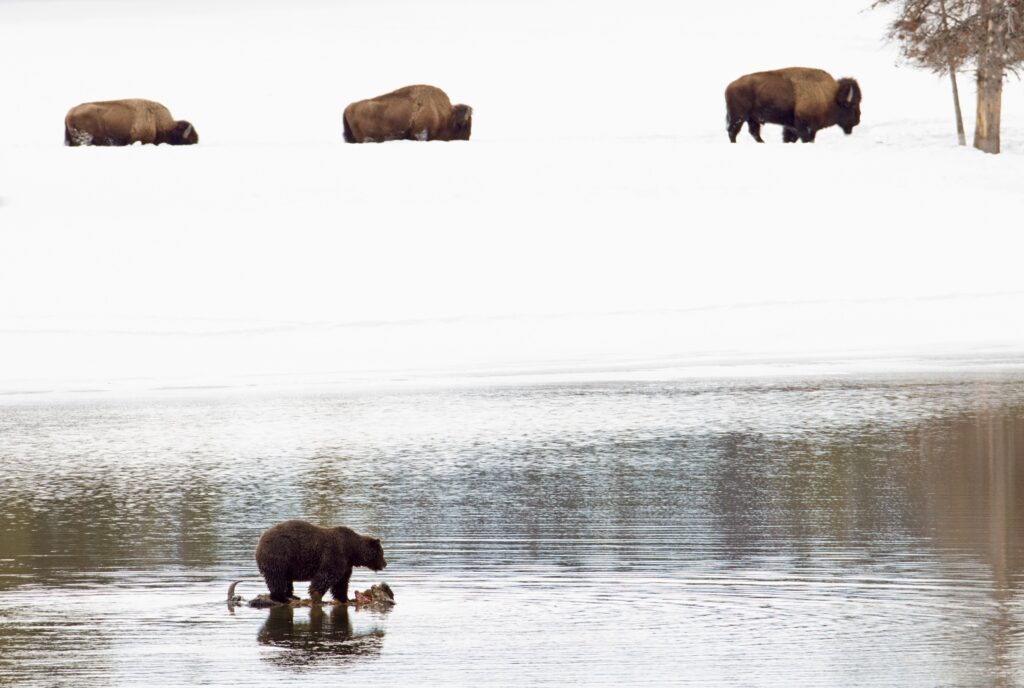
TW: And yet, like sharks, wolves and other carnivores, we demonize them. We respond lethally or subdue or remove or are intolerant about things that give us fear, yet our fear is often driven by things we don’t understand or are uneducated about. Bison in Yellowstone regularly injure a lot more people in Yellowstone than bears do.
SERVHEEN: So, why is it that people tend to focus on danger and risk when they speak of bears yet seemingly ignore the vastly greater danger of driving in a vehicle? That happens because of what is called the normalization of risk. Normalization of risk is when people are exposed to some dangerous situation repeatedly and nothing bad happens. People in much of the world ride in vehicles all the time without appreciating any sense of the danger involved because they have done it so much.
We have all normalized the risk of vehicle travel. Being in grizzly habitat is fairly rare for most people and they tend to exaggerate the risk from bears when they are there because it is such a rare experience for them. The risk of injury or death from a bear is minimal in the entirety of risk from many things in life that we regularly take for granted.
TW: What do you make of Mr. Dickerson’s list? It’s kind of strange given the media coverage it generated because for years there have been various sources that track bear maulings and fatal incidents involving black bears, grizzlies and polar bears. I’ll repeat a theme we at Yellowstonian have been highlighting over and over. I’ve been a journalist writing about the environment for 40 years. Why do you think few media outlets ever pick up on the fact that one of the real reasons for human-bear encounters isn’t “more bears looking for trouble” but a lot more people moving into and recreating in important natural habitat used by bears?
SERVHEEN: Good question. The number of human/bear encounters is a function of the number of bears and the numbers of humans on the landscape with those bears. While grizzly numbers have increased with the grizzly recovery program, the numbers of people in grizzly range have dramatically increased as more people recreate and move into grizzly range with new homes. Talking about increases in incidents between bears and humans without clearly stating the fact that much of this increase is due to more humans on the bear landscape is not telling the full story. We are not living in a static environment.
More people are moving into black bear and grizzly bear habitat every day across North America, and more recreation users are in bear habitat every year. Even if bear numbers were stable or decreasing, the numbers of human/bear encounters and resulting attacks and injuries or deaths would be increasing simply because there are more people on the landscape. As I’ve said before, bears never get a day off from human disturbance and encounters with humans that they have to try and avoid as they try to make a living.
“More people are moving into black bear and grizzly bear habitat every day across North America, and more recreation users are in bear habitat every year. Even if bear numbers were stable or decreasing, the numbers of human/bear encounters and resulting attacks and injuries or deaths would be increasing simply because there are more people on the landscape. As I’ve said before, bears never get a day off from human disturbance and encounters with humans that they have to try and avoid as they try to make a living.”
—Chris Servheen
TW: Mr. Dickerson stated in his Facebook post that, and I quote, “Wildlife managers predicted this would be a bad year for bear attacks, and they were right.” He added that, “The most surprising thing in this endeavor has been seeing just how many people don’t want you to know the truth about bear attacks.”
Indeed, you predicted this could be a challenging year, but let us repeat what you’ve been saying in this ongoing series, which is that in years with poor abundance/availability of natural foods, bear incidents spike 2026, with the effects of drought, has been a classic example of this. But what you did not say is that it would be “a bad year for bear attacks.” Your thoughts?
SERVHEEN: I never said it would be a bad year for bear attacks, and I know of no bear managers who said such a thing. What we said is that in poor food years there will be more bears searching for foods and to do so they will travel more and likely encounter humans more with resulting increases in human/bear conflicts. Natural foods vary naturally in abundance based on weather, temperature and other natural factors.
Climate change appears to be accelerating these extremes in food availability. Bears have always dealt with annual changes in natural food abundance by searching more widely for natural foods in poor food years. Now, with more people on the bear landscape, these searching bears encounter humans and human “stuff” like garbage, fruit trees and chicken coops more often with predictable results.
TW: You and other biologists often note there are behavioral differences between black bears and grizzlies. What are those?
SERVHEEN: Both species generally eat the same foods. Black bears are more prolific than grizzly bears as they breed earlier in life and have cubs more often than grizzlies. Because of this, black bears are more resilient than grizzlies and can sustain higher levels of mortality. Black bears have smaller home ranges than grizzlies and know the distribution of foods in their smaller ranges very well. They tend to use that small home range more intensively than grizzlies use their larger home ranges. Grizzlies have larger home ranges, and they use the foods in their larger home range less intensively as they more around more as they forage.
To use a general analogy, think of grizzlies having several grocery stores in their home range while black bears have only one grocery in their home range. If one grocery fails, a grizzly can go to the next one it knows about within its home range. A black bear has less flexibility, so if the one grocery in its range fails, it does not know of another, so it has to move to “new” places to look for foods. This moving to new places in poor food years can increase human/bear conflicts, especially for black bears, when more and more people are now living in places when the bear is looking for foods in a poor natural food year.
TW: What is the danger, to bears, wolves and cougars, of media, politicians and certain segments of the public, including trophy hunting organizations, continuously portraying them as being extraordinarily aggressive and what kinds of problems/pressures does it create for bear managers?
SERVHEEN: It is harmful to portray these animals as aggressive because it sours public opinion. These animals are just normal native species trying to make a living in a landscape that is increasingly dominated by more and more humans. The extraordinarily aggressive species in this mix is humans. One could go on for hours about all the ways that humans are extraordinarily aggressive and even sadistic in their treatment of animal species and even each other. Bears and other carnivores do not kill for pleasure or because of boredom.
“It is harmful to portray these animals as aggressive because it sours public opinion. These animals are just normal native species trying to make a living in a landscape that is increasingly dominated by more and more humans. The extraordinarily aggressive species in this mix is humans. One could go on for hours about all the ways that humans are extraordinarily aggressive and even sadistic in their treatment of animal species and even each other. Bears and other carnivores do not kill for pleasure or because of boredom.”
—Servheen
TW: You’ve often noted how people, especially those moving to the Northern Rockies, have a responsibility to become educated about resident wildlife and adjust their lifestyles and how they exert their imprint on the land accordingly so that animals don’t suffer as a consequence of their ignorance. This year 14 black bears north of Bozeman were euthanized because, according to Montana Fish Wildlife and Parks, someone or some people were feeding them. The public was horrified.
SERVHEEN: Bear managers continually have to speak and educate about bears as normal species and try to explain what bears are doing to survive in the complex human-filled world they live in. Bears are not an inconvenience or a burden. Instead. living in bear range requires humans to live responsibility. Living with animals like bears requires that humans do extra things to reduce conflicts like secure attractants and put up electric fences. Bear managers work hard to try to convince people to put in that extra effort to successfully live in bear range. There are not many bear conflicts with people. Instead, there are human-caused conflicts with bears.
TW: We are in yet another record-breaking year for grizzly deaths in the Greater Yellowstone Ecosystem—81 to date—most of them human caused, and the elk hunting season is only beginning, which usually results in more bear mortality. (And the total above doesn’t include an equal number of bear deaths attributed to poaching). We’ll return to this topic later, but what are your thoughts about the tally?
SERVHEEN: To a great degree, these deaths are due to increased encounter frequencies due to more bears and more people overlapping. Some issues, like livestock related grizzly deaths, are due to the complex issues of having lots of livestock in bear range. As we see more bears on the landscape, we expect more human-caused mortalities. The GYE grizzly population is generally stable and may be slightly decreasing in range now because we now have bear densities where subadult survival is lower due to bear-bear conflicts. Grizzly populations will regulate their own numbers due to density dependent changes in survival. I am not too concerned right now, but we do need to carefully watch the trajectory of the population, which is driven primarily by adult female survival.
Given what we have talked about earlier in this discussion, we are now seeing increased numbers of humans in bear range with resulting increases in human-bear conflicts and bear deaths. This is not a static situation because as more and more people pour into grizzly range, our ability to manage healthy grizzly populations becomes more challenging. Add to this, the cumulative impacts of agency budget and personnel cuts; threats to science and monitoring budgets; hostile state politicians who want to reduce the numbers and range of any grizzlies outside core recovery areas; threats to rescind the roadless rule and motorized travel management on USFS lands; weakening of the Endangered Species Act and the other laws that allowed us to increase grizzly numbers and protect grizzly habitats; increasing recreation pressure in grizzly range; and the relentless impacts of climate change on bear foods and habitats.
All of this uncertainly makes this a perilous time to consider removing ESA protections and hoping for the best under state control.
Other installments of the Yellowstonian column, “Conversations from the Green Thicket” relevant to the topic above. If you find stories like this informative, fascinating and useful, please consider supporting us. It’s a depth of content that doesn’t exist about the future of America’s greatest wildlife-rich ecosystem anywhere else. Also sign up for our free newsletter so you never miss our original stories.
Mauling The Law That Rescued American Grizzlies
If you find stories like this informative, fascinating and useful, please consider supporting us. It’s a depth of content that doesn’t exist about the future of America’s greatest wildlife-rich ecosystem anywhere else. Also sign up for our free newsletter so you never miss our original stories. Thanks for being here. We value you.