
by Todd Wilkinson
Head spinning to consider, it’s been two decades—a human generation— since Jackson Hole Grizzly 399 first emerged on my radar screen as a journalist, when Dr. Charles Schwartz, then head of the Interagency Grizzly Bear Study Team and I paid a visit to a forested area in Pilgrim Creek on a summer day much like this.
At the time I was writing a story about the first of two (unsuccessful) attempts to delist the Greater Yellowstone grizzly population. The handoff would turn federal oversight of bears by the US Fish and Wildlife Service over to the states, who have expressed an eagerness to restore trophy hunting of the species, which was banned in this ecosystem in 1975.
399 was then just an anonymous numbered bear with a radio collar around her neck and the public had no idea she existed. Schwartz suggested her as a through-line subject because data showed where she was moving through northern reaches of Jackson Hole. A theme of the story was the fact that grizzlies had been largely absent from Jackson Hole for many decades because they were killed to protect livestock, hunted, shot for alleged self-defense and poached.
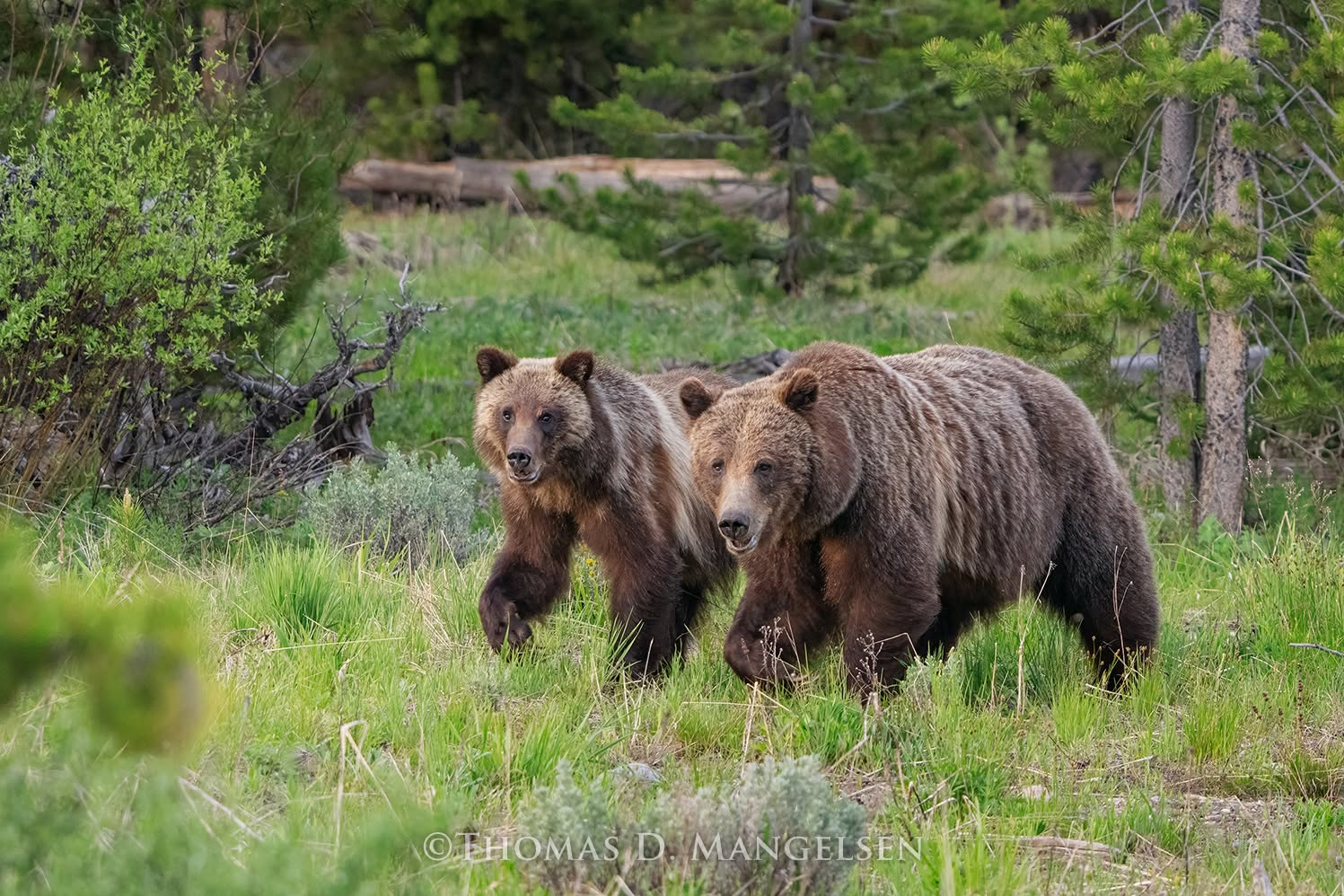
399 had been born in 1996, and though she lost her first cub, likely to a male grizzly, she mothered a set of triplets, one of which—Grizzy 610— still survives and has another litter of cubs herself.
In the years that followed that morning with Schwartz, as 399 demonstrated remarkable longevity, had visibility near roadside areas, and mothered (amazingly, in total) 18 cubs, I provided the narrative for a couple of books about her set within the context of grizzly conservation, featuring the imagery of renowned Jackson Hole nature photographer Tom Mangelsen.

I don’t need to elaborate here on the phenomenon of excitement—not fear—that 399 and the presence of grizzlies in Jackson Hole generated around the world. And how the level of mass fascination transformed the formerly prevailing cultural premise that: grizzlies loom as a constant menace; that they need to be “managed” (controlled, which, by the way, they already are), and that they have exacted a huge economic net burden on the states of Wyoming, Montana and Idaho (which is false).
During my years of writing about her, I remember vividly a conversation I had with Dr. Susan Clark, co-founder of the Jackson-based Northern Rockies Conservation Cooperative (a non-profit scientific thinktank that focuses on applied conservation), and who for several decades was a professor at the Yale School of the Environment.
What few realize is that Clark spent the first half of her career as a field researcher who studied wildlife on different continents and, in her early days, after black-footed ferrets were “rediscovered” and brought back literally from the dead (they were thought to be extinct), she and Dr. Franz Camenzind did census work looking for evidence that more individuals existed near Meeteetse.
Regarding Grizzly 399, Clark shared this observation with me, accompanied by a blush of astonishment: Every time 399 wanders toward a busy road often in the company of cubs and wants to cross it, Clark said, she was making numerous consequential decisions—assessments of what she should do next, based on trying to size up the unpredictable complicated behavior of primate bipeds, sometimes contained in hazardous contraptions on wheels moving at fast speeds, swarming toward her.
Notably, except for one incident that occurred on an elk carcass near Jackson Lake Lodge where 399 and her first group of triplets were feeding—in which she non-fatally mauled a school teacher from Lander who ventured too close—399 and her many broods have proven themselves to be non-aggressive, incredibly tolerant of people (all things considered), very capable in mothering cubs of their own, and generally in navigating through a chaotic maze of humanity.
(How many of us would have been able to replicate the journey of survival demonstrated by 399)?
Clark is known for being a policy wonk who has devoted her adult life to examining how Greater Yellowstone as a beacon of conservation came into being, the role that government land management agencies play with safeguarding public lands over time, the intensifying threats to current management systems in place that have kept the region ecologically intact (for now), and what needs to change.
She also is fascinated by an issue journalists seldom write about, which is the individual motivations of land managers who sometimes avoid making hard decisions because bold thinking and applying their years of accrued experience is seldom rewarded by “the system;” in fact, politicians and their staffs, who often suffer from ecological incapacity, frown upon civil servants who take visionary stands because it makes them, in thinking mostly about short-term re-election cycles, nervous.
This is a serious problem in our representative democracy not only for grizzlies but with lots of conservation issues where politics—and special interests to whom politicians are beholden— hobbles the ability of professionals in charge to speak the honest truth.
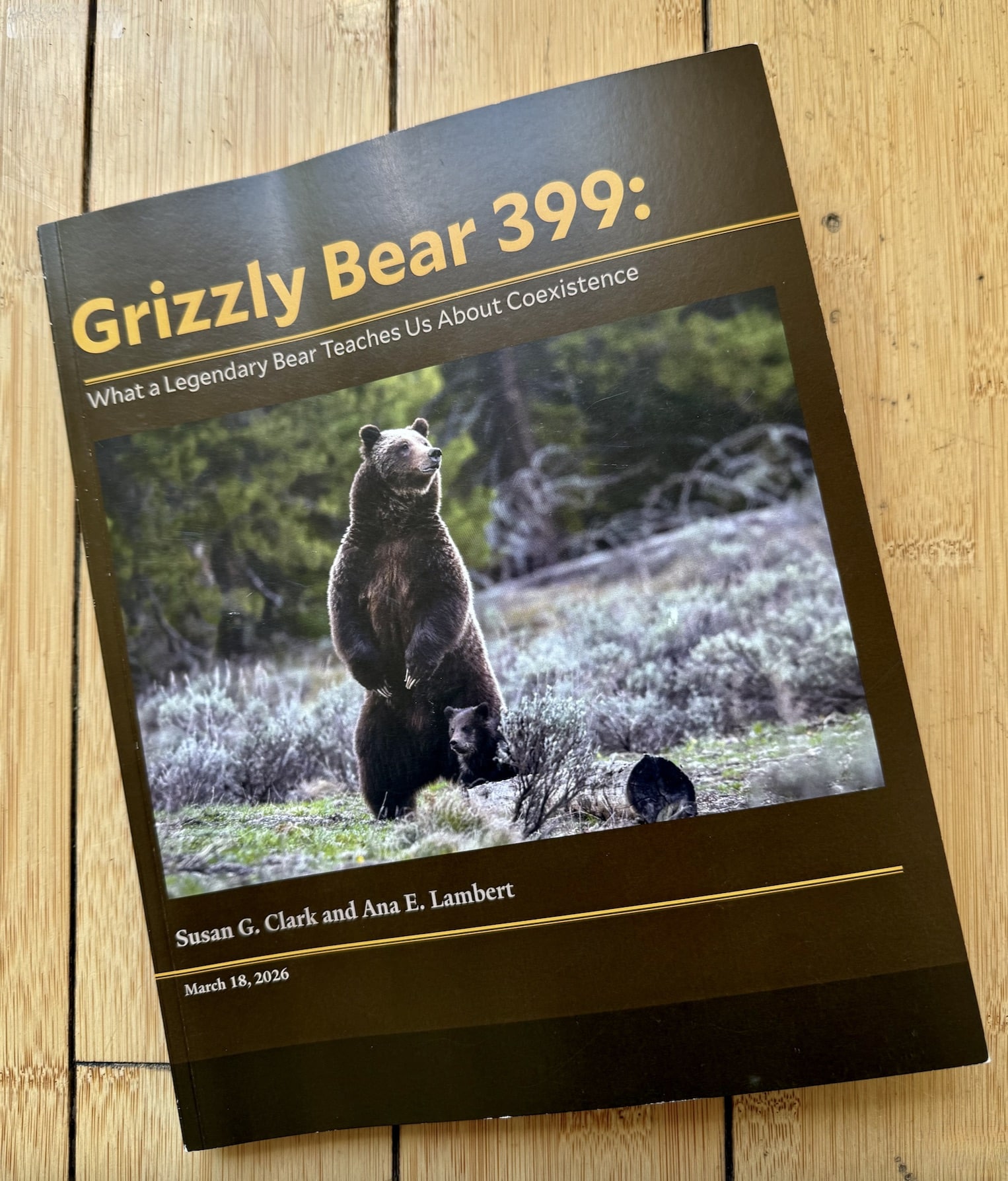
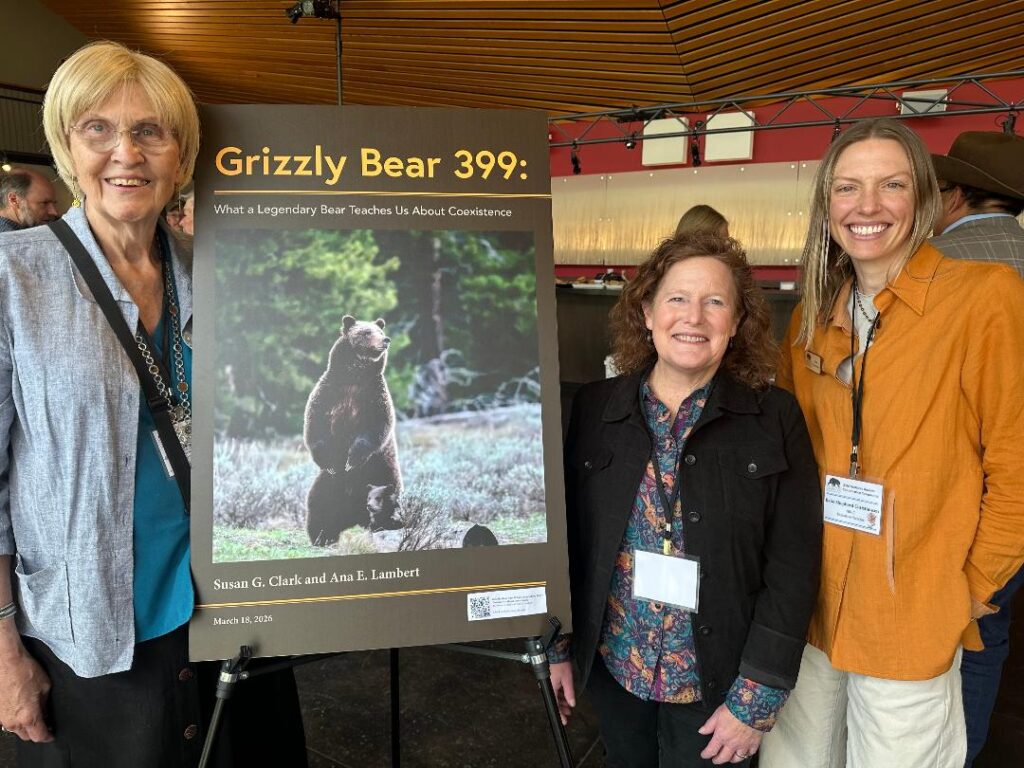
No one to date, until now, has tried to make sense of how the late Grizzly 399 provides a lens all of us can use for pondering that amorphous and sometimes fleeting watchword called “co-existence.” Clark provides plenty of fodder in a new (free) book published by the Northern Rockies Conservation Cooperative which she co-wrote with Ana E. Lambert titled “Grizzly Bear 399: What a Legendary Bear Teaches Us About Co-existence.”
The paperback isn’t long, only 150 pages with citations, and one can breeze through it in an evening. Petyon Curlee Griffin, board chair of the Northern Rockies Conservation Cooperative, says by design the publication is non-commercial, produced as a public service. Any reader can download a free electronic copy simply by clicking on this link.
The paperback isn’t long, only 150 pages with citations, and one can breeze through it in an evening. Petyon Curlee Griffin, board chair of the Northern Rockies Conservation Cooperative, says by design the publication is non-commercial, produced as a public service. Any reader can download a free electronic copy simply by clicking on this link.
More than anything the book raises provocative questions we need to be asking but often evade. The onus of saving Greater Yellowstone isn’t a challenge that belongs to “others;” the fate of this place, right now, rests in our hands, together, and we need to move consideration of decisions from the metaphorical, conflict-avoidant back burner to the front of our conscious awareness.
Honestly, seriously, let’s not kid ourselves: If you are reading these words then you know in your gut and heart how fast the pace of change is and it’s accelerating. Driven largely by differing aspects of more people inundating the region, the notion of waiting around for salvation, or what Clark calls “a grand vision” to arrive, is folly. For Clark, who is now in her 80s, action wouldn’t matter if there wasn’t so much at stake.
All you need to do is peruse the long list of stories that have appeared at Yellowstonian since it was launched in 2024, based on the realization that piecemeal reporting was neither informing the public, nor providing a context for considering the larger seismic forces in play and how status quo approaches were—and are—grossly inadequate.
“Conservation debates often quickly shift from events to opinions and then to proposed solutions. During crises, attention tends to focus on what should be done next, sometimes before everyone fully understands what is happening,” Clark and Lambert write. “While this urgency is understandable, it can make it difficult to see how conservation systems function in practice and why well-meaning efforts sometimes fail to achieve lasting results.”
No one can deny, considering the decisions Grizzly 399 made, that she was a sentient being, possessing of intelligence and emotional tender caring for her offspring—nor can we claim that observing such behavior in her did not stimulate something relatably profound in all of us. Creatures such as her are not mere ears of corn, raised for yield, and that bonus bears, labeled “surplus,” should be treated as “expendable resources” whose “value” can be best realized through more harvest opportunities.
Read the above, again, and soak in the absurdity, yet it persists. This is not an anti-hunting statement; it is instead an example of how we in the 21st century need to move beyond shallow mindsets still left over from the 19th century frontier.
The life and lessons of Grizzly 399 will be diminished, her importance squandered, if she becomes little more than a reference point in the rear view mirror of fellow travelers; if measured only in quantity of photo ops she allowed, size of crowds in mass viewings, postings on social media and stated concern for her welfare if they do not translate into more vigilant and informed advocacy about the future prospects for her species in the wild backyard of the American West.
If discussions of delisting only involve numbers of bears, like figures on a profit and loss statement; if proponents of delisting continue to ignore the fact that critical habitat on private land, once conducive to bear movement, is being permanently lost at an alarming rate at the same time public roadless lands are slated for logging; if the whole point of recovering a species is rendered down to providing hunting opportunities, then it will prove we as a society really didn’t learn much from the 18 years of 399’s 28 years when she and her cubs were most visible to us.
The book by Clark and Lambert seeks to make sure that doesn’t happen. Consider it a starting point for a better public discussion long overdue. Click here to learn more about Northern Rockies Conservation Cooperative.