
by Todd Wilkinson with Chris Servheen
A new scientific analysis led by two wildlife researchers who previously studied the value of carrying bear spray, recently examined what happens when our pets, allowed to roam off leash, meet up with grizzly bears.
In this installment of “Conversations from the Green Thicket,” Yellowstonian chats with Chris Servheen about the proliferation of dogs, joining outdoorspeople on established trails and bushwacking, as being yet another extension of growth-related issues that are taming wild country. In this case, venturing into the outback with dogs is another form of outdoor recreation.
Treating wildlands as dog parks brings with it a whole range of concerns, from canine excrement tainting water quality and being vectors for disease, to even heightening stress levels for humans as dogs intermix on the trail. These issues will be left as topics for another day.
Our conversation, below, uses the new study published in the Journal of Wildlife Management to focus on the kind of triggering behaviors that happens between dogs and wild bruins. The phenomenon, however, is not only applicable to grizzly and black bears but can be extended wolves, mountain lions and even large ungulates.
An example of this is a 2024 incident in which a six-year-old dog, bounding off leash with a 24-year-old female trail runner, was killed by a mountain lion in the Bridger Range. The dog was attacked and carried off.
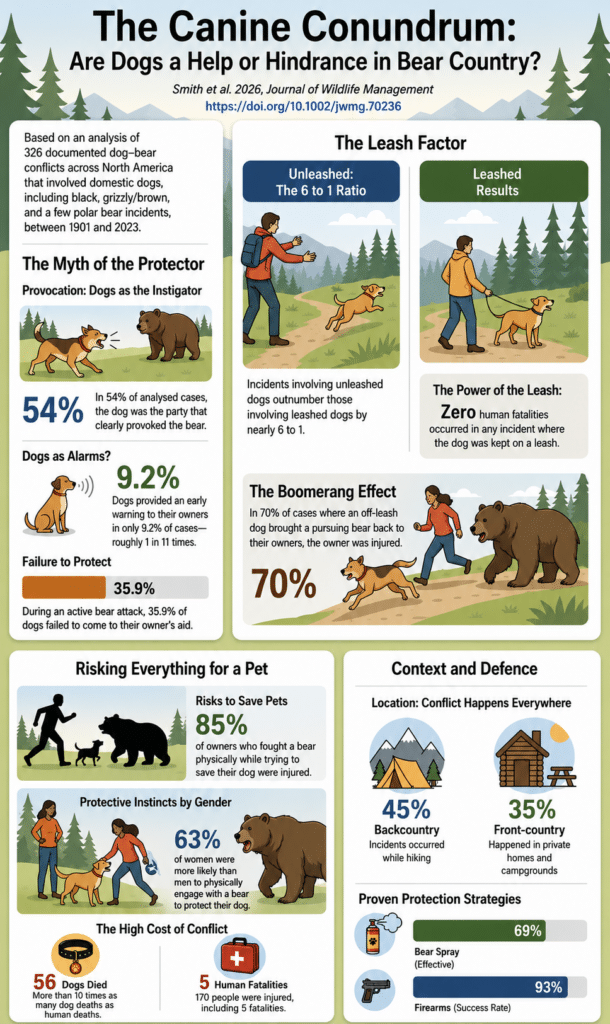
A timely coincidence, per the recent study, is that this month (July 2026), hikers from Washington state who traveled to Banff National Park, Canada are facing a potential $25,000 fine for allowing their dog to run off-leash after they had an encounter with a grizzly. In a press release, park officials stated: “Failing to keep your pets leashed in the national parks poses risks to pets and wildlife. Bears and other wildlife may react aggressively toward dogs they view as threats, resulting in their injury or death. Off-leash dogs can also cause wildlife stress, leading to them avoiding important habitat and sources of food. Always keep your pets on leash when visiting national parks.”

Todd Wilkinson: Let’s be clear: this is not intended to be interpreted as “anti-dog” nor are we “anti-recreation.” Would you describe yourself as one of the countless self-identifying “dog persons?” out there? And, if yes, then what do you most appreciate of their companionship?
CHRIS SERVHEEN: Yes, I am a dog person and have always been. The friendship and company of a dog is a wonderful thing, and it adds quality and contentment to anyone’s life.
Wilkinson: Perhaps most places could be described as having people who are crazy about their animals, yet “most places” do not possess the caliber of wildlife diversity, particularly sensitive and potentially aggressive and dangerous large mammals that we have here in the Northern and Canadian Rockies. Why is that important for resident and visiting dog owners to consider?
SERVHEEN: Dogs are human companions who also have primal urges to chase wildlife. These urges can complicate how people interact with nature and wildlife when they are with their dogs. Certainly, dogs can be trained not to chase wildlife, but many people do not possess the skills to be successful with such training or the desire to adhere to it. Being a responsible dog owner means controlling your dog to not be a “problem” when out in the natural world.
Wilkinson: Before we get into the heart of what we’re about to discuss, I’d be grateful for your thoughts on this observation: Outdoor recreation appears to be last frontier of our society that refuses to embrace limits on numbers of users in the name of protecting wildlife. In fact, the industry readily marshals resistance to acknowledging impacts. Similarly, some dog people are highly sensitive, and get passionately defensive, when it comes to admitting that dogs roaming off leash in both front- and backcountry can have serious impacts on wildlife. Why is that?
SERVHEEN: That certainly is the crux of the issue—people being willing to acknowledge that they (and their pets) can have a serious impact on wildlife. Pets can be significant predators on wild animals. A paper in Nature Communications in 2013 estimated that free ranging domestic cats in the United States kill between 1.3 and 4.9 billion wild birds and between 6.3 and 22.3 billion wild mammals each year. Many of these predatory cats are feral but a significant number are domestic cats that are “let out” for the day or night without any consideration of the carnage on wild animals that result from their outside excursions.
Wilkinson: How much conscious awareness exists among the public, and is it enough to cause the human caretakers of pets to adjust their behavior when it registers that the impacts are persistent and serious?
SERVHEEN: The acceptance of the public about the impacts of domestic animals on wildlife varies. Some people are concerned and do their best to control their animals, but many—most— do not. Some people think that the happiness of their domestic animals depends on their being “wild and outdoors.” These people tend to ignore or deny the damage their pets inflict on the wild birds and animals around their homes or in the places they recreate.
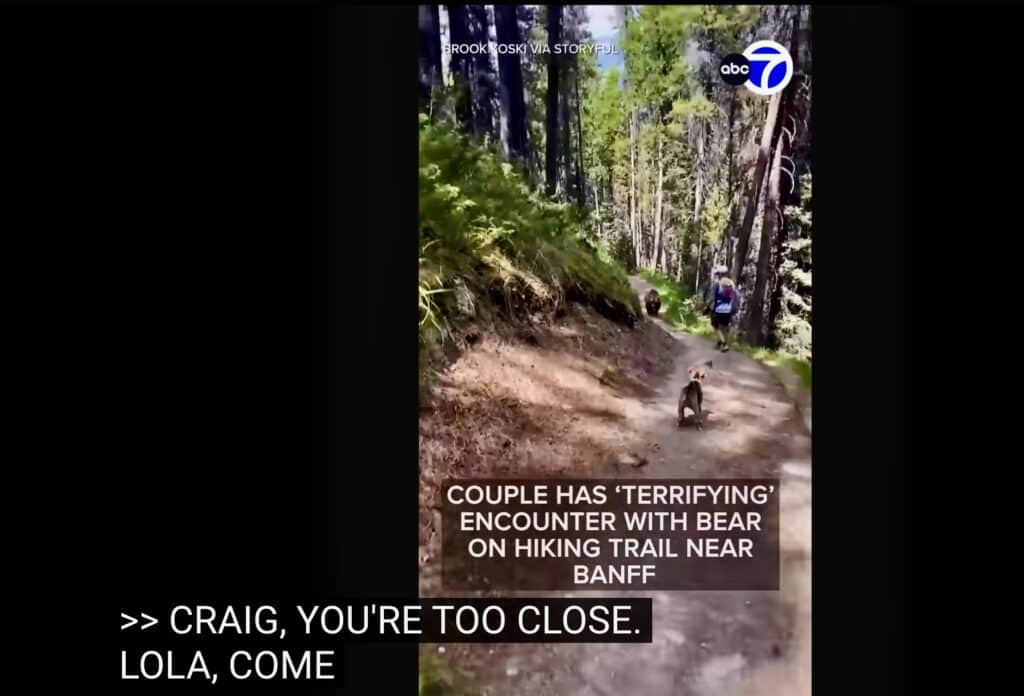
Wilkinson: You recently shared on social media an illustration for the study mentioned above that we, in turn, are availing to readers here. It is provocatively titled “The Canine Conundrum: Is the dog a help or hindrance in bear country?” You had no role in collaborating on the study but you think it’s a timely addition to the growing canon of scientific evidence. In a nutshell, please share some of its conclusions..
SERVHEEN: This study compiled 326 reports of interactions between bears and people with dogs throughout North America. The purpose was to better understand how dogs relate to bears and bear safety because dogs are a common companion animals for people in bear country.
Wilkinson: Indeed, this is yet another important puzzle piece that factors into discussions of how grizzly populations in the Northern Rockies, despite optimistic portrayals of them being recovered, are actually facing significant negative impacts on habitat. Growing numbers of human outdoorspeople with dogs moving through public lands with dogs off leash is an example We should note that dogs are not allowed to accompany people on trails in national parks but they are permitted to join humans on national forests, BLM lands, national wildlife refuges and state lands. Please share the study’s main points that resonate with you as a person who oversaw grizzly conservation for the US government for three and a half decades.
SERVHEEN: Here are a few takeaways:
° Based on the 326 dog/bear incidents that were examined, dogs initiated more than half of the bear conflicts involving dog walkers (at least 54% of the time)
° In these incidents,170 people were injured and 5 people died. Some 56 dogs died.
° Dogs rarely alerted owners that bears were nearby (that happened in just 9.2 percent of incidents);
° When people were attacked by bears, only 35.9 percent of the dogs came to their owner’s aid;
° Overwhelmingly, 85 percent of the incidents with bears involved unleashed dogs;
° Off-leash dogs brought bears back to their owners 27 times, and of these cases, owners were injured by these provoked bears 70% of the time;
° Dogs are not a reliable bear alarm system;
° Owners who rushed to aid their dogs involved with a bear were injured by the bear 85 percent of the time;
° About 45 percent of the dog-bear incidents occurred while hiking;
° It’s not just backcountry. Some 35 pecent of the dog-bear incidents occurred in front-country such as homes, campgrounds and developed sites;
° Dogs frequently escalated conflicts with bears;
° Never assume your dog will let you know a bear is nearby or that a dog will protect you from a bear.
Wilkinson: I suspect many readers will be surprised by some of those findings. Are there any caveats worth mentioning?
SERVHEEN: It is important to realize that these were domestic pet dogs and not trained bear dogs like Karelian Bear dogs that are quite effective around bears and used to protect livestock.
It is also important to realize that this paper is from people who had dogs with them and who reported incidents with bears. Obviously, there are thousands of times people hike with dogs and nothing happens with bears or something does happen with a bear and it is not reported by the embarrassed or freaked out dog owner. Keep all that in mind.
Wilkinson: Interestingly, the lead author is Tom Smith, a researcher at Brigham Young University, who is known for his earlier examinations into the efficacy of bear spray in thwarting aggressive bruins. And a co-author is Dr. Stephen Herrero who wrote the classic, “Bear Attacks: Their Causes and Avoidance.” Is it significant that they’re casting light on dogs and their effects on wildlife?
SERVHEEN: Yes, because dogs are such common companion animals for people in bear country and domestic pets for people who live in bear country. There is a common misconception that dogs will alert their owners to the presence of bears and will protect owners from bears or deter bears from attacking people. Neither of these beliefs is true. In fact, in 27 cases, unleashed dogs brought bears back to their owners and in 70 percent of such cases the owners were injured by the bear brought back by their unleashed dog. Again, 85 percent of incidents with bears involved unleashed dogs. Carrying a deterrent like bear spray matters even if you have a dog. In these bear and dog events, 56 dogs died, 170 dog owners were injured and five of these dog owners were killed by the bear.
Wilkinson: Could you elaborate on the two main aspects of dog impacts that we’ve discussed over the years: the first being that dogs will give chase to animals and injure or kill them or at the least, force them to expend energy. Especially vulnerable are young animals like elk calves, deer fawns and ungulates and even nesting birds. The second is that in the case of carnivores and protective mothers with young, they will pursue dogs and kill or injure them.
SERVHEEN: Dogs that are off leash will often chase wildlife like deer or elk or bears. This is very stressful for the wild animals and is especially harmful to wintering wildlife that have low energy reserves. In fact, in most states it is illegal for domestic dogs to harass wildlife. Deer and elk on their winter range are often concentrated closer to human use areas than they are in summer. This makes them very vulnerable to domestic dogs.
In Missoula, where I live, there are wintering elk on Mount Jumbo right next to town and this area is closed to human and dog entry in the winter and spring so these animals can avoid the stress of being chased by pet dogs. Dogs off leash can also, as you say, chase and kill fawns. All this animal chasing is by unleashed dogs. People can prevent such damage to wildlife by always walking their dogs on a leash. Leashed dogs don’t chase wildlife.
Wilkinson: Let’s talk about grizzlies in particular. How do bears respond to dogs racing toward them and then, realizing what they’re dealing with, retreating?
SERVHEEN: Grizzlies can be agitated by dogs and will chase them. The dog will usually go back to its owner, thus the “boomerang effect.” An unleashed dog will range ahead of its owner and if it finds a bear, it may just bring that bear back to you. A leashed dog cannot bring a grizzly back to you. Bears try to stay away from humans and are pretty good at it, but an unleashed dog can confound that and bring an agitated grizzly right to you. This is due to unleashed dogs in wildlife habitat.
Wilkinson: If the dog sprints back to seek refuge among humans, what happens and how should people respond?
SERVHEEN: This is why it is so important to carry bear spray and be ready to use it because your unleashed dog can bring a bear back to you in just a few seconds. Bear spray was effective in deterring bears agitated by dogs 69 percent of the time, but the presence of unleashed dog and an agitated bear likely complicated the use of spray because people may have been reluctant to spray their dogs close to the bear. The best way to avoid bear confrontations is to not have them in the first place. A leashed dog won’t agitate a bear or bring a bear back to you. Remember that your unleashed dog is very likely to agitate any bears it encounters and may bring that agitated bear back to you.
If it’s a small dog and a bear, wolf, mountain lion or coyote is giving chase, biologists have told me the animal locks in on the dog and can be hard to distract. Should we pick up the dog into our arms and stand our ground in that case?
Wilkinson: If it’s a small dog and a bear, wolf, mountain lion or coyote is giving chase, biologists have told me the animal locks in on the dog and can be hard to distract. Should we pick up the dog into our arms and stand our ground in that case?
SERVHEEN: That is a good question. My guess is that you may save your little dog, but you also have some small risk of attack by a predatory animal fixated on your dog. A leashed dog is unlikely to be pursued by a carnivore if it is close to you, whereas a free ranging, unleashed dog is much more vulnerable.
Wilkinson: If people are camping with their dog and keeping the animal in the tent with them at night, the dog can serve as a sentinel. Is it also an attractant?
SERVHEEN: Dogs in tents are not attractants in my experience. Most bears stay away from humans and tents. It is extremely rare for a bear to become predatory and approach a tent. If that happens, which is super rare, the dog is not the primary attractant.
Wilkinson: There was a recently published study, focused on a drainage that’s located on the eastern edge of Jackson, Wyoming that examined interaction between various kinds of recreationists and wildlife. It came out in spring 2026, appears in the journal Conservation Science and Practice (published by the Society for Conservation Biology) and is titled “Neighbors to nature: a case study of recreation-wildlife co-existence in the Greater Yellowstone Ecosystem.” It deployed 27 trail cameras in the heavily-used Cache Creek drainage that delivered a huge volume of images over a period of two and a half years.
Surprising to some is that the findings allegedly suggest some species are tolerant of dogs. Others in the outdoor recreation world are also now citing it and trying to claim, “See, outdoor recreation, even outdoor recreation with dogs, has only a negligible impact on wildlife.” Still, one of the study’s recommendations is that public land managers are encouraged to implement “comprehensive monitoring procedures” and “considering uncertainty regarding the long-term impacts of recreation on wildlife, a precautionary approach is warranted.”
When you read that study, does it jibe with what you’ve observed and what is represented more broadly in the scientific literature?
SERVHEEN: I am not sure what to make of those results and the researchers were not either it seems. They said: “Moose and red foxes had higher habitat use in areas with higher dog activity, although red foxes were mostly active at night when they would not encounter many dogs. For moose, we expect that habitat needs are stronger than the need to avoid people and dogs, and we may also be detecting a few individuals who have become habituated to trail use. However, we could not examine the effects of off-leash dogs that ventured beyond the trail, so the true effect of dogs on wild-life in this system may be much greater.”
If some of the animals were habituated to humans and associated dogs, there would be less avoidance response over time. But the study raises far more questions about its methodology and any hard conclusions that can be drawn and extrapolated than it answers. And it contrasts with the findings of the study we’re discussing here centered on outdoor recreation with dogs and wildlife. This study says there can be serious consequences for people, dogs and bears.
Wilkinson: Of course, vital to consider is the cumulative effects and what they add up to over time, including areas heavily traversed by dogs that result in habitat avoidance by wildlife. Every day in Greater Yellowstone, in the Northern Rockies and on many public lands flanking mountain valleys, for that matter, humans arrive at trailheads with dogs and justify letting them run off leash by saying they need exercise and fun just like people do. Dogs accompany hikers, trail runners, mountain bikers, skiers, boaters and there are obviously bird hunters with dogs. Yet when negative encounters happen, it is often the wildlife that gets blamed, with those animal inhabitants maligned as being aggressive.
SERVHEEN: Those depictions are common and unfortunate. Wildlife only want to be left alone and, no pun intended, not hounded or bothered by dogs.
Wilkinson: In our ecosystem alone, probably thousands of dogs are out on public lands today and likely their owners haven’t any idea of the personal responsibility they have to be respectful to wildlife. Is it strange to you that just as there’s never, ever been a comprehensive examination or study done initiated by public land managers on the cumulative effects of outdoor recreation—which are significant—we also treat prolific dog presence almost as a non-issue. Is this a mistake, given a variety of significant human pressures coalescing in our region? What should the response be?
SERVHEEN: Just as with our domestic cats and their enormous impacts on wild birds and other animals and our inability to appreciate these impacts, we humans have the tendency to “normalize” the impacts of our unleashed dogs on nature and our environment. That doesn’t mean there is no impact, just that we have come to ignore it or assume there is none. This is the shifting baseline syndrome.
The way we now see things in nature we assume is the way it has always been, but the fact is that our massive human recreation presence on the landscape has shifted the baseline so what we now see is not really normal anymore. Remember my story of mountain bikers saying they’ve never seen any bears so they must not have an impact on bears since they never see bears (anymore) where they ride? This is an example of the shifting baseline syndrome in action. Their self-serving perception is not grounded in reality, and it’s a problem.
Do you find content like this to be informative? If yes, and you’d like more, please consider supporting Yellowstonian. And sign up for our free newsletter by clicking here so you never miss a new story.
Other recent installments of “Conversations from the Green Thicket“