by Todd Wilkinson with Chris Servheen
Photos by Thomas D. Mangelsen
For Americans of millennial age or younger, who have grown up with the reality of having a stable population of grizzly bears present in the Greater Yellowstone Ecosystem, it might be difficult to understand just how close the region came to losing its most recognizable symbols of wildness.
But it almost happened not very long ago when this writer was your age. Bears were dying faster than the population was able to reproduce caused by a number of factors. As Dr. Christopher Servheen and I have tried to illuminate in this on-going column (read all of the installments to date at the end of this one), it isn’t easy being a grizzly having to navigate a world dominated with all kinds of human uses that only continue to grow in areas where bears either have had secure habitat or places once thought safe for the population to expand.
Often, politicians, agrarians and hunters hoping for a chance to stalk a grizzly as a trophy talk about numbers of bears out there now compared to when the species was listed. While it provides irrefutable evidence that bear numbers have grown, not considered is that it started at a nadir—low point—at which bear experts like Servheen thought the population could actually disappear.
Focusing only on numbers also deflects from a larger and more essential issue in conservation biology. Two things sustain populations and it’s especially true with a species like grizzlies known for having slow reproduction rates: having plenty of secure habitat and, equally as vital, keeping female bears of reproductive age and teaching their cubs how to navigate humans, alive.
Again, once upon a time, the number of reproducing mother grizzlies in Greater Yellowstone was in free-fall, and even today, it doesn’t take losing very many healthy mother bears over a relatively short period of time before a regionwide population—or subpopulations inside it—can go from being stable to ones in decline.
Something to remember from Servheen’s observations below is his recognition of “bear culture”—a way of living, ursid style, moving through time and space that is part of a larger milieu of wildlife presence and yet distinctive, just as it is for wolves, bison, otters, ungulates, avians and other species. When we displace animals from the neighborhoods they inhabit, it is not without consequence.
In this installment of Conversations from the Green Thicket, Servheen and I discuss why making sure that having female bears alive and giving them plenty of habitat is essential to the grizzly recovery story in Greater Yellowstone and the Northern Continental Divide Ecosystem. We, of course, make reference to the late Jackson Hole Grizzly 399.

Todd Wilkinson: The Greater Yellowstone Ecosystem is roughly 34,000 square miles though it’s not all occupied by resident grizzlies. Yellowstone National Park is roughly 3,500 square miles but data shows that the grizzly population that lives in and around the park has reached its carrying capacity or is in slight decline. How big is a typical home range for an adult male bear compared to a female and what determines the size?
CHRIS SERVHEEN: An adult male’s home range can be 300 to 600 square miles and is usually about two to three times as large as a female’s home range. The size of a male’s home range is large enough to contain the range of two to three adult females because the average female bear comes into estrus and is ready to breed every two to three years. Thus, a male’s home range usually contains two to three females so there is a possibility of a male finding a female in estrus every year.
Wilkinson: Before we proceed further, let’s point out something you often say as a caution to those who sit down with a pen and napkin and then calculate the number of bears that will “fill up” Greater Yellowstone and then need to be “controlled.” Those same folks also like to say that if you have X number of wolves eating X number of elk, it will only take so long before all the elk are gone and it obviously doesn’t work that way.
SERVHEEN: Yes, that’s right, a bear population is something that’s fluid but it correlates to having solid habitat that can sustain it amid all kinds of things that can result in the death of individual bears.
Wilkinson: I’ve heard scientists describe Ursid mothers as “the real heroes of the bear world.” They reproduce cubs, attentively raise them, keep them out of harm’s way, and they serve as role models, just as their mothers did for them. Could you please expand upon this, as a grizzly bear scientist, why you have admiration for them?
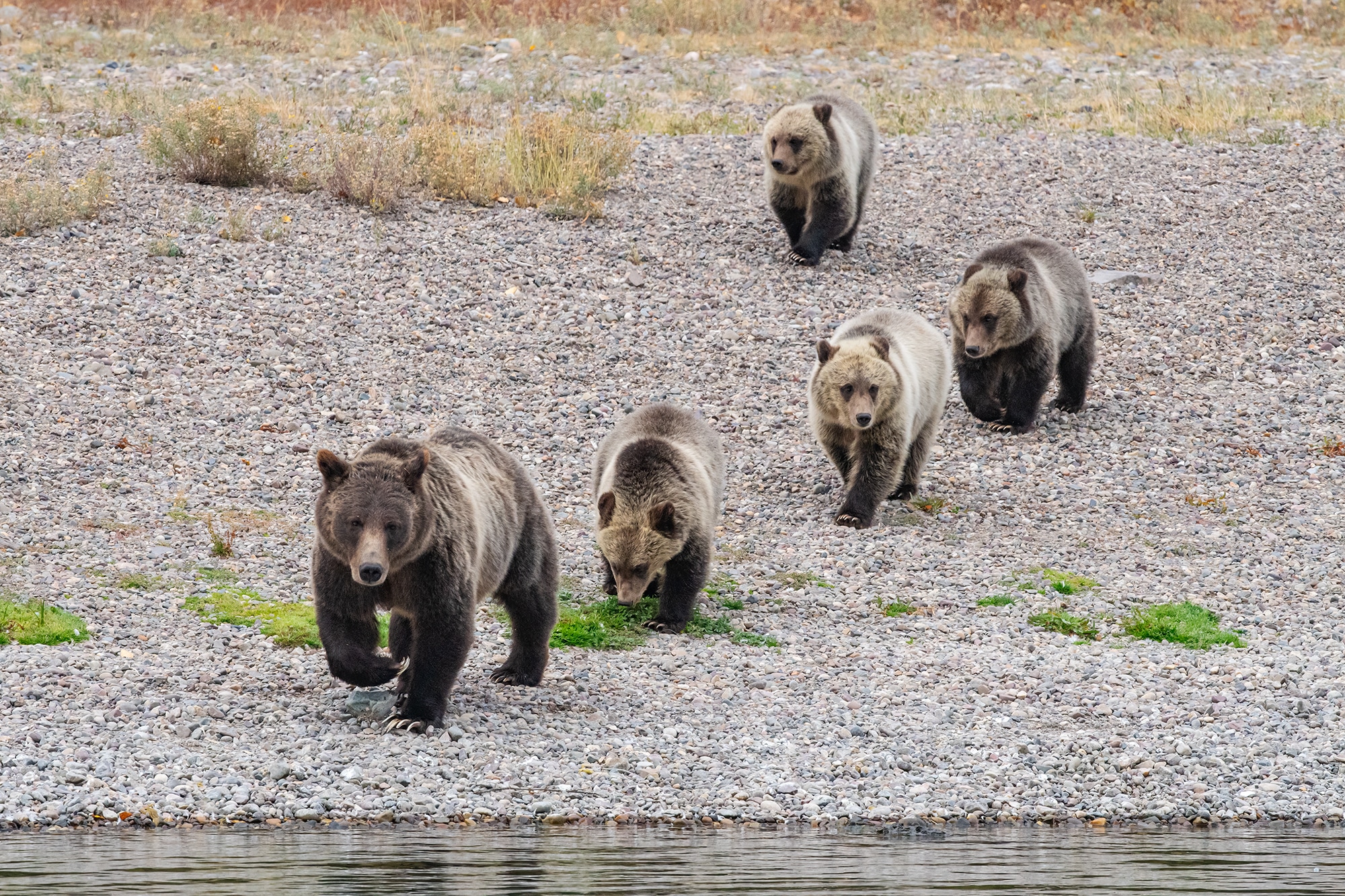
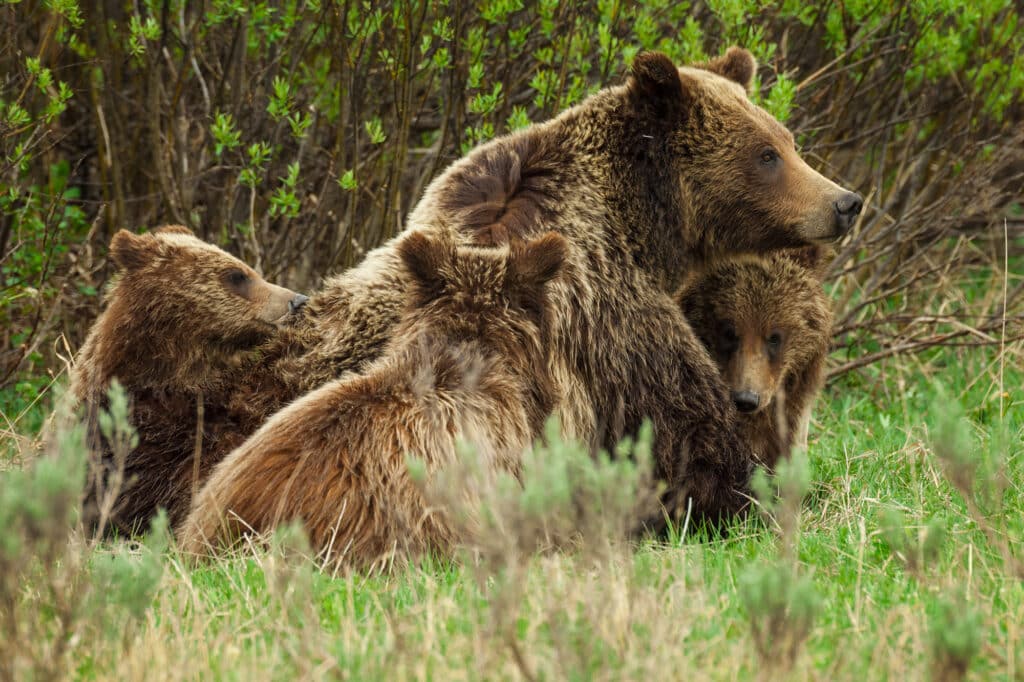
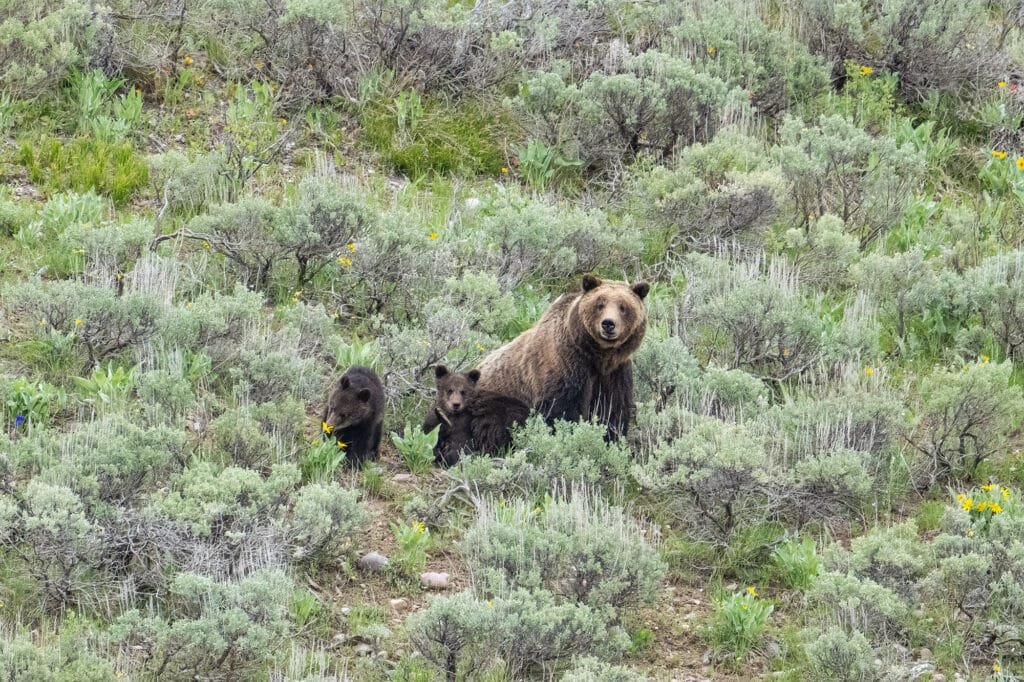
SERVHEEN: Female bears do all the work of raising the young cubs and teaching them how to live successfully. The males do nothing to help raise the cubs and are in fact a danger to cubs because males can kill cubs. Everything a bear knows when it leaves its mother it learned from mom. A mother bear teaches her cubs what to eat and where to find what to eat in different seasons. She also teaches her cubs what to avoid, like humans, residential areas, and roads. If she has learned from her mother to seek foods close to humans, like garbage or fruit trees, or to cross highways, she will teach this to her own cubs if she survives long enough to have cubs.
“Female bears do all the work of raising the young cubs and teaching them how to live successfully. The males do nothing to help raise the cubs and are in fact a danger to cubs because males can kill cubs. Everything a bear knows when it leaves its mother it learned from mom.”
—Chris Servheen
Wilkinson: Grizzlies are not recreational users of wild and pastoral lands. They don’t use them and then go home to someplace else where they have a roof over their heads, plenty to eat and no threats invading their space. What does a bear’s life entail?
SERVHEEN: A bear’s life is spent learning about where to find food and remember those places. That means that in addition to what a young bear has been taught by its mother, a bear continues to learn by experience throughout its life. If a young bear has been taught to avoid humans and residential areas and garbage, it will be less likely to frequent such areas as an adult and learn about food in such areas. Bears that frequent human use areas are less likely to live long lives and have many cubs in comparison to bears that have been taught to avoid humans and our attractants.
Wilkinson: Today in Greater Yellowstone, the rough estimate for total population size is around 1,100 individuals or nine to ten times where it was when the population was in trouble and bears existed in a small area. How many of those out there now are females and what’s the typical ratio of male vs. female bears?
SERVHEEN: The male to female sex ratio in Greater Yellowstone is about 50:50 so about half the grizzly population is females. That is typical for a grizzly population. In general, we see about 10 percent of the total bear population are females with cubs of the year. The most recent data from the Interagency Grizzly Bear Study team shows that in any year, about 29 percent of the adult females have cubs of the year. That makes sense since grizzly bears in Greater Yellowstone generally have cubs every three years, so about a third of the adult females have cubs in any year.
Wilkinson: Let’s go back several decades in time, to the years in the late 1970s and early 1980s just following listing of the Greater Yellowstone grizzly population. Recount how dire things were—in terms of overall population, distribution, the direction it was headed and where we were in terms of numbers of female bears in the landscape.
SERVHEEN: The exact number of grizzly bears remaining in the Yellowstone ecosystem at the time when the dumps were closed in the 1970s was unknown, but an accepted estimate was perhaps 140 to 160 bears. In the early 1980s, we thought there were only 30 or so adult females left in the entire ecosystem. It was very likely that this small population was still declining. Many of the risk factors like open garbage dumps outside the Park, sheep allotments on Forest Service lands around Yellowstone Park, and no sanitation efforts in backcountry camps were still killing grizzly bears into the 1980s.
Wilkinson: Please drill deeper into that answer and illuminate for readers here just how low that number of females was, and how it translated into cub production vs. mortality.
SERVHEEN: If there were as few as 30 adult females in the early 1980s, and 10, or one third of them, had cubs each year, that meant that there were only about 20 cubs produced every year. If we assume survival of young bears with their mothers was like what we see today, then of the 20 cubs born each year, only about 6 young bears would be alive at the end of their third year.
“If there were as few as 30 adult females in the early 1980s, and 10, or one third of them, had cubs each year, that meant that there were only about 20 cubs produced every year. If we assume survival of young bears with their mothers was like what we see today, then of the 20 cubs born each year, only about 6 young bears would be alive at the end of their third year.”
Wilkinson: That’s a breathtaking observation and its reality should never be forgotten. On the one hand, it’s an example of how hope, driven by aggressive conservation action, can make a difference. On the other, it’s a warning of what happens when the need for vigilance is taken for granted or abandoned. What is the general survival rate of cubs and what are the causes of their death?
SERVHEEN: About 50 percent of the cubs die before their second year. There are many causes of mortality for young bears like drowning when crossing rivers and creeks (especially at high water in the spring), being killed by other bears, injury due to the risks of travel across rough terrain, and other risks like being hit by vehicles. Cubs are about 10 pounds when they emerge from their dens with mom. Their mothers try hard to protect and defend them, but the wild is a risky place.
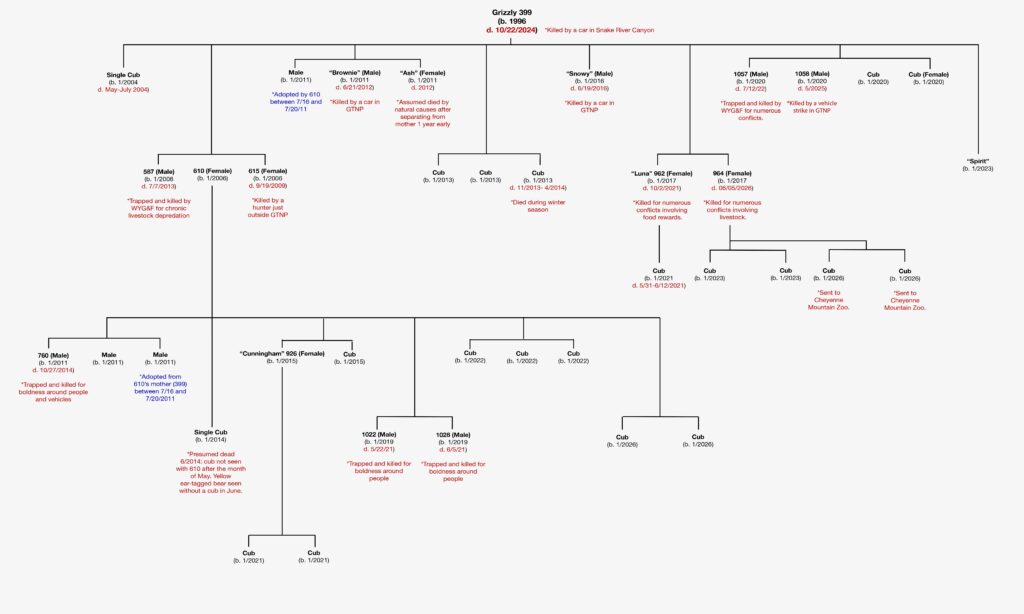
Wilkinson: Ironically, for much of my reporting career in interacting with bear managers, there was a general tendency to de-emphasize the importance of individual bears, often accompanied by this refrain: “We manage to recover populations of species. Our efforts are not directed at saving individual animals.” And yet the late Jackson Hole Grizzly 399 had a long life—28 years—and during it she gave birth to 18 cubs and today there are cubs born to her cubs and likely a generation inhabiting the landscape after that. To many, her life illustrates the importance that individual females can have not only in reproduction but teaching her cubs to stay out of what we humans call “trouble.” This one bear produced more grizzlies over her life than were being successfully produced annually 40 years ago. Your thoughts?
SERVHEEN: Bears have a culture that they learn from their mothers. Culture is a set of learned behaviors passed from generation to generation. Bears display behaviors toward humans and food habitats that they learned from their mothers, who learned their culture from their mothers, and so forth. What we see as bear behaviors is the product of generations of mother bears teaching those behaviors to their offspring.
Wilkinson: As for 399 in particular….
SERVHEEN: Bear 399 was very successful at raising young and she lived a very long life. But some of her offspring did get into conflicts and had to be removed. She was exceptional in many ways because she lived in busy Grand Teton Park and in and around busy Jackson and surrounding communities. We cannot expect that all grizzly bears can be like 399. She lived in a very risky environment and had a lot of people working to keep her alive because of her visibility and her long life. We as humans need to take a lesson from the life of 399 that while certain bears can survive in our risky human landscape, it is the exceptional bear that can manage what 399 did.
Wilkinson: If she was extraordinary, then what does it mean for other mother bears out there?
SERVHEEN: We cannot expect every bear to be a 399. We need to do everything that we can to make our activities compatible with grizzly bears and black bears. Most bears will not survive what 399 survived. Her lesson for us is that we need to go the extra mile to keep our attractants like garbage, bird feeders and moose feeders, and pet food secure from all bears. We need to think like a bear when we see road-kill carcasses along a busy highway, when we think about hanging a bird feeder, and when we go into wild places where bears are seeking security with our mountain bikes and our trail running. We cannot count on every bear being as savvy as 399 was because most are not.
Almost every other grizzly bear with cubs would have gotten into serious conflicts and been destroyed if they lived like 399 lived. We need to do everything we can to keep such bears out of harm’s way by doing what we can to make our risky human landscape safer for bears.
“Bear 399 was very successful at raising young and she lived a very long life. But some of her offspring did get into conflicts and had to be removed. She was exceptional in many ways because she lived in busy Grand Teton Park and in and around busy Jackson and surrounding communities. We cannot expect that all grizzly bears can be like 399. She lived in a very risky environment and had a lot of people working to keep her alive because of her visibility and her long life. We as humans need to take a lesson from the life of 399 that while certain bears can survive in our risky human landscape, it is the exceptional bear that can manage what 399 did.”
Wilkinson: Four decades ago, you, the heads of local federal land management agencies, state wildlife departments and the Grizzly Bear Study Team, implemented a strategy for trying to keep bears out in the wild for as long as possible, including translocating them to other areas if they came into conflict with livestock operations or ventured too close to towns and people. Please explain how that went because even then, in the same of saving the population, there was some concern and resistance.
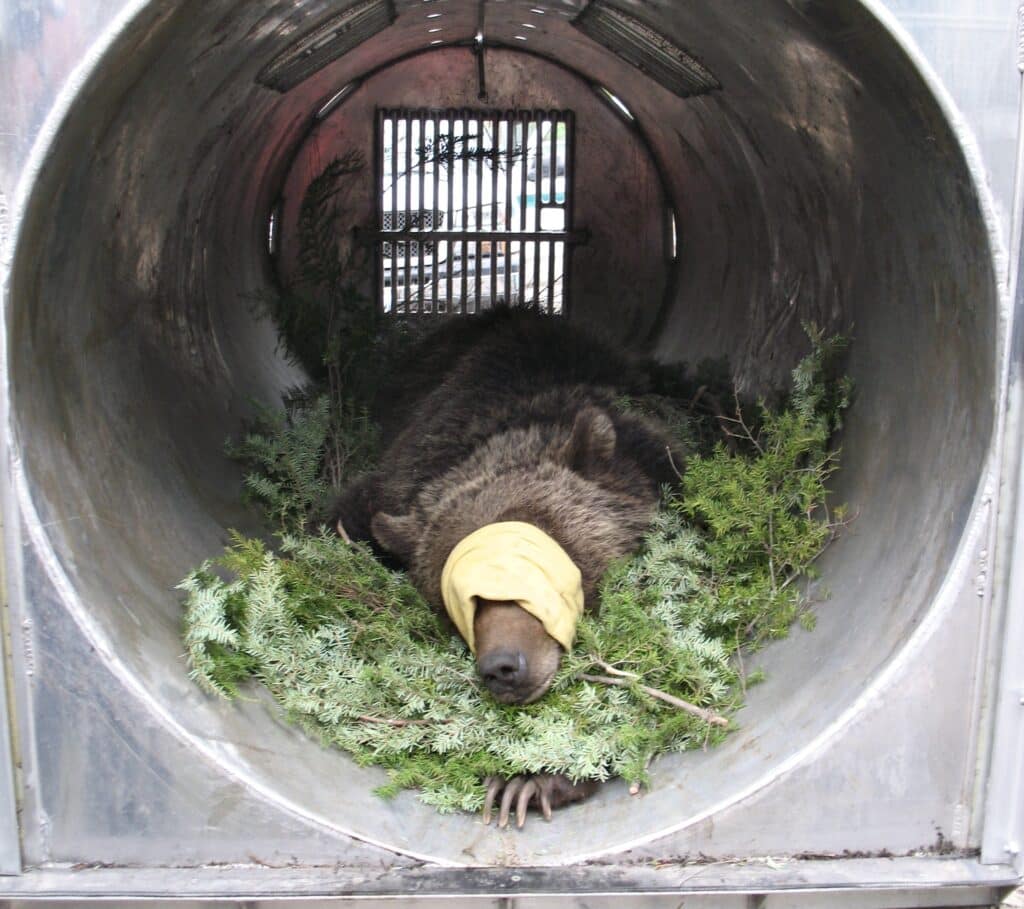
SERVHEEN: We built a set of grizzly bear management guidelines that detailed when and why we would capture and relocate grizzly bears that got into human-bear conflicts. Rather than just kill every bear, we moved bears, especially female bears, to try and get them away from the conflict site and give them a second or third chance while trying to secure the site where the conflict occurred. We collared and tagged every such bear, so we knew if they came back or got into a human-bear conflict again.
Wilkinson: Did it work?
SERVHEEN: It was usual for bears to return to their origin site after relocation, particularly with adult bears. We have learned that it is often best to not relocate the bear too far but instead relocate it within her home range but away from the conflict site. Sometimes they would repeat their conflict, but many times they do not get into a conflict again. Sometimes these human-bear conflicts were caused by low natural foods like this one so that hungry bears do things they had to do to eat, especially if the human-related attractants were not secured so the bear could easily get into them.
Sometimes bears that got into human-bear conflicts were old animals with broken teeth or injuries. Such bears were doing what they could to survive. There is no hard and fast rule however, and every case was different. We tried to give bears a second or third chance and many of these bears stayed out of conflicts and survived and reproduced.
Wilkinson: Of course, as a follow up, it’s important to hear your thoughts about how inefficient, ineffective and chaotic it would be if bear managers, hailing from agencies with limited resources, poured as much effort into keeping all bears alive as was afforded 399. Where is the sweet spot between paying special attention to a bear like 399 and treating all females the same, when they obviously are not?
SERVHEEN: As I said, there was an exceptional amount of effort that went into keeping 399 alive and we can’t do that with every bear because we don’t have the people or resources. The front line of defense against human-bear conflicts are the state bear managers who work pretty much 24/7 to help prevent conflicts and mange human-bear conflicts by either working with the humans at the conflict site or catching the bear or both.
Wilkinson: We’ve discussed this in some of our other columns and you’ve said it’s an insulting misnomer for politicians and others to claim that bears need to be delisted “so that they can be managed.”
SERVHEEN: The state bear managers have been managing grizzly bears and human-bear conflicts for 40-plus years. They work on education and assistance to help avoid conflicts and do all they can to avoid having to capture a bear. I don’t know that the agency bear managers can get much better at this than they are now. The challenge ahead is to get the public to do everything they can to secure attractants as much as possible. Livestock allotments on public lands in grizzly habitat are a continual issue and are difficult to solve.
“The state bear managers have been managing grizzly bears and human-bear conflicts for 40-plus years. They work on education and assistance to help avoid conflicts and do all they can to avoid having to capture a bear. I don’t know that the agency bear managers can get much better at this than they are now. The challenge ahead is to get the public to do everything they can to secure attractants as much as possible. Livestock allotments on public lands in grizzly habitat are a continual issue and are difficult to solve.”
Wilkinson: All of us share the Northern Rockies with wildlife. What does a female grizzly need most to reproduce and survive?
SERVHEEN: A female grizzly needs habitat security where she can go and be secure from human encroachment and displacement. She also needs humans in her home range to secure all attractants like garbage, bird feeders, fruit trees and pet foods as much as possible, so she is not drawn in with her offspring to conflicts with humans. She needs a low density of forest roads in her home range because roads and motorized trails have significant damaging impacts on grizzly bears including direct mortality due to being shot, displacement from preferred habitat because most grizzlies avoid forest roads, and fragmentation of habitat by excessive numbers of forest roads.
Wilkinson: That’s poignant, because the fact-based trendlines show efforts by the Trump Administration to undo protections for roadless Forest Service lands and allow for cross country (off-trail) motorized travel in sensitive wildlife. There are also a lot more recreationists out there and sprawl, every day, is permanently removing habitat on natural private lands important seasonally and vital to safe bear movement. Yes, numbers are up but mothers are having to navigate an expanding amount of human-related impacts that are never going to shrink.
SERVHEEN: Humans are the cause of most grizzly bear deaths. Almost all bears killed illegally or mistakenly by humans are shot and almost all bears shot are killed close to roads. It well established that grizzly bears suffer high human-caused mortality in roaded portions of their habitat. That is why forest roads can be so damaging to female grizzly bears trying to raise young and survive.
ENDNOTE: Below is a new free book about Grizzly 399 by Dr. Susan Clark as well as other installments of “Conversations from the Green Thicket.” We hope you enjoy them and find them useful in pondering the future of grizzlies. Please share them with your friends and if you value this kind of content we’d be grateful for your generous support.