
by Todd Wilkinson with Chris Servheen
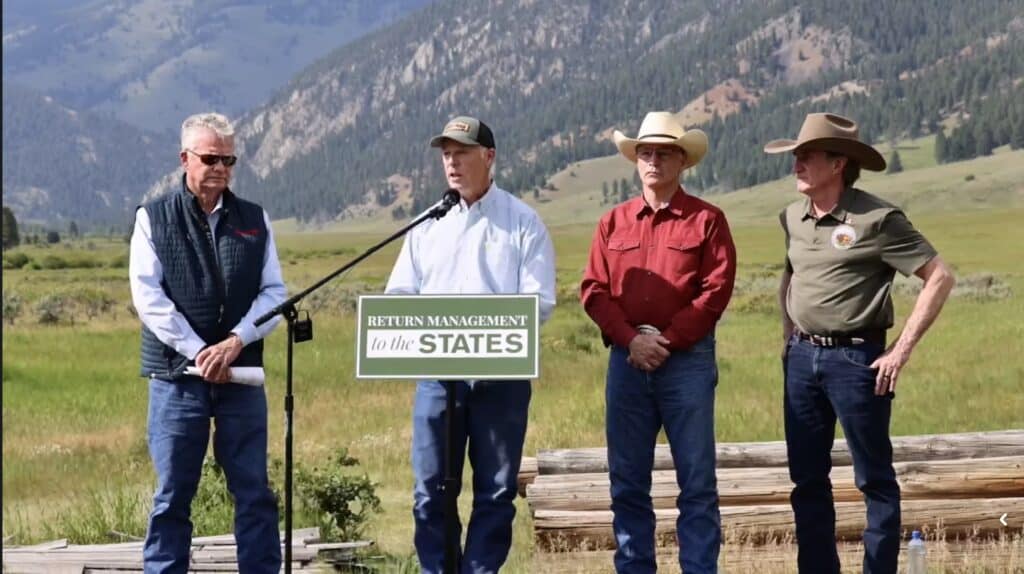
Flanked by US Interior Secretary Doug Burgum and fellow governors from neighboring Wyoming and Idaho on a hillside in Big Sky, Greg Gianforte of Montana referenced grizzly bear recovery as one of the greatest wildlife success stories in history. And he said recovery is ongoing and that states should be trusted to have the torch of grizzly “stewardship” given back to them from the federal government.
Yet quickly after acknowledging that the rescue of Greater Yellowstone’s iconic grizzly population is a feat heralded around the world owed to the federal Endangered Species Act, the governor of the Treasure State quickly shifted his narrative. Essentially spinning the equivalent of a Little Red Riding Hood portrayal of grizzlies, he claimed—falsely—that they have wrought huge impacts on the livestock industry, that they are dangerous menaces to outdoor recreationists, and then, using a few rare anecdotes to extrapolate a larger misleading picture, Gianforte implied that countless people in his state fear for their lives
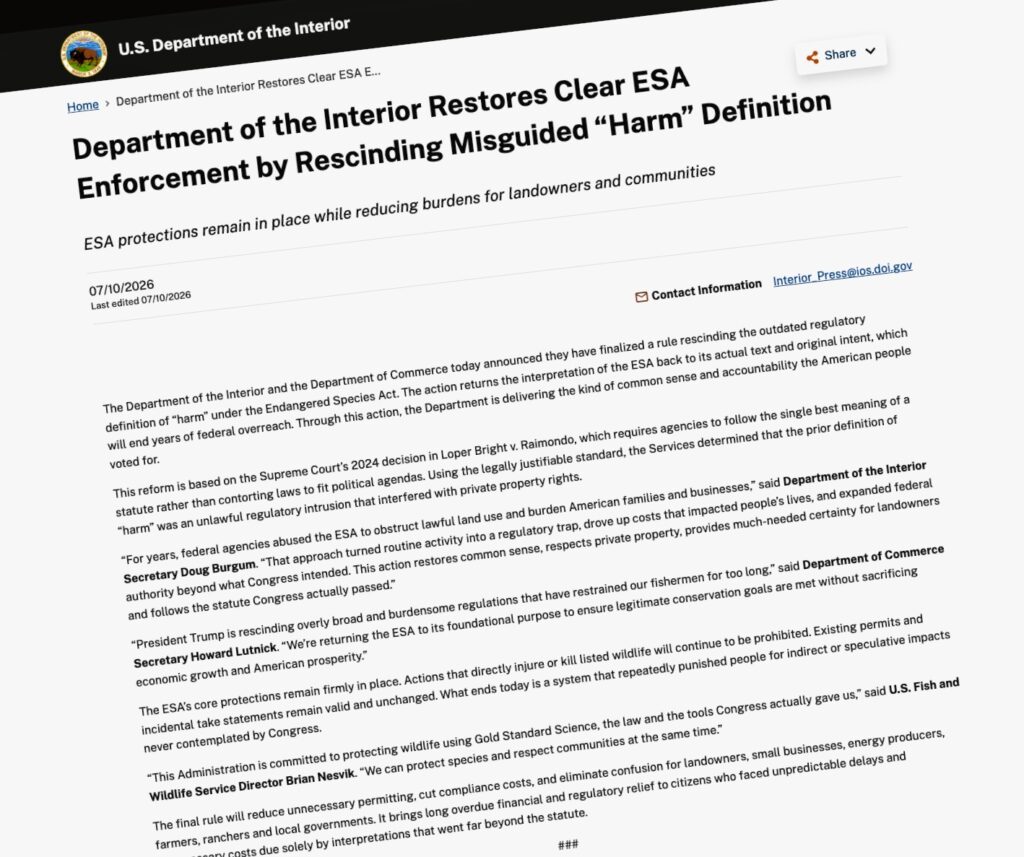
Building on a surprising, controversial announcement made by Burgum last week, that habitat destruction to imperiled species will no longer be considered a form of “harm” jeopardizing their survival, Gianforte used his bully pulpit to claim he is joined by President Trump in believing it’s time to remove bear populations in the Northern Rockies from federal protection. While saying states are concerned about the welfare of the bear, one of the main motivations is to lay the groundwork for bringing back trophy sport hunting of grizzlies, which hasn’t existed in the Lower 48 for 50 years.
“I fear that there is a dark future for the grizzly bear because of the destruction underway by the Trump Administration. If this continues, and what they are doing gets cemented in place, grizzly bear recovery will be dead in a few years. The numbers and range of the grizzly will soon be declining across the Northern US Rockies.”
—Dr. Chris Servheen
Notably, one expert who has pondered the meaning of biological recovery for grizzlies, the political power plays at work in promoting their delisting and the challenges facing bears on the ground is Dr. Chris Servheen (who is a co-contributor to this weekly column at Yellowstonian).
For 35 years, Servheen led American grizzly bear recovery in the Lower 48 for the US Fish and Wildlife Service. He wrote the original bear recovery plan and crafted an agreement between the federal governments and states called for”the conservation strategy” that twice was used in earlier attempts at delisting that were overturned by federal judges.
Servheen himself was a vocal proponent of delisting. But now he stridently opposes delisting. Retired from government service for a decade, he can speak freely without any worries of political retaliation against scientists which was a signature maneuvering by the Trump Administration in early 2025 when it unleashed the short-lived Department of Government Efficiency (DOGE) led by Elon Musk to purge civil servants not in lockstep with the Adminstration’s policy priorities.
Today, Servheen says the rhetoric invoked by Gianforte and members of Congress that demonizes grizzlies as not only being absurd but inconsistent with what ought to be an honest, open and transparent discussion about the outlook for bear conservation informed by science. Here is a post made by Montana Fish Wildlife and Parks and its director Christy Clark on Instagram in the wake of the press conference.
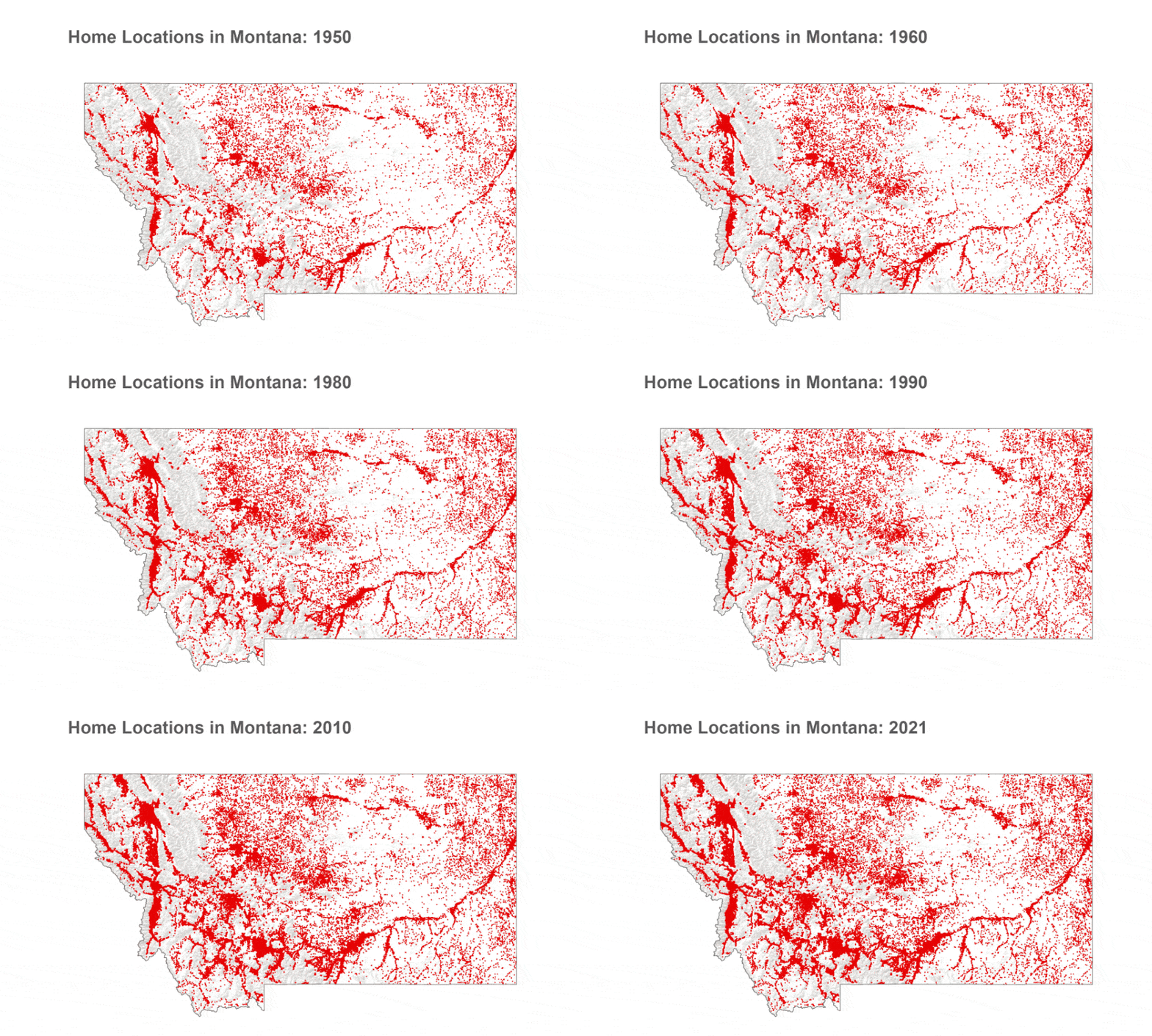
Servheen predicts that given trends of habitat loss for bears and other wildlife species owed to sprawl on private lands, efforts to open Forest Service roadless lands to bulldozers building access roads for timber sales and facilitating more motorized recreation, and the recent impetuous move to say no harm comes to bears from habitat loss, the Trump Administration will be remembered for destroying US grizzly bear recovery.
In other stories with Yellowstonian, Servheen has said that by removing protection for roadless areas and allowing motorized recreation, road-building and clearcut logging to proliferate on Forest Service lands, the Trump Administration will be violating terms of the conservation agreement that is bedrock to any discussion about delisting.
In this week’s installment of “Conversations from the Green Thicket,” I asked Servheen to fact-check a number of assertions made by Burgum, Gianforte and other western politicians.

Todd Wilkinson: US Fish and Wildlife Service Director Brian Nesvik, former recent director of the Wyoming Game and Fish Department, was quoted in a Trump Administration press release stating that he adheres to “using Gold Standard Science.” His righteous assertion seems kind of far-fetched because on earlier issues Mr. Nesvik in Wyoming staked positions that are blatantly antithetical to not only science but professional wildlife management. Two that come to mind are his rationalizing the still-allowable and highly-criticized practice in Wyoming of running down wolves and coyotes with snowmobiles, and his efforts to block the halting of artificial feeding of elk that is condemned by renowned epidemiologists, professional wildlife managers and wildlife vets in the Fish and Wildlife Service. They say feedgrounds are vectors for spreading deadly Chronic Wasting Disease. CWD did spread widely under Nesvik’s watch in Wyoming and it is now present on state-run feedgrouns and the National Elk Refuge, a crown jewel federal wildlife refuge that’s now under Nesvik’s command with the Fish and Wildlife Service.
So, let me ask you this question about Mr. Nesvik’s credibility as it relates to Biology 101, and which is a fundamental tenet of true “Gold Standard Science.” Without having adequate habitat and protecting it from “harm,” what happens to a species?
DR. CHRISTOPHER SERVHEEN: Habitat is the foundation for the survival of all species on the earth. Imagine having cold water fish like cutthroat trout without cold water or great grey owls without a forest or grizzly bears without the diverse foods and habitats they depend on. These animals exist because the places they live provides what they need to survive. One cannot invoke science and then ignore wildlife habitat.
Wilkinson: The Administration’s announcement represents a radical shift away from modern professional wildlife management and Mr. Nesvik and Interior Secretary Doug Burgum know it yet they are doing it anyway. Why does doing away with the “harm” provision matter?
SERVHEEN: The “harm” provision in the Endangered Species Act basically and traditionally acknowledges that species can be harmed if their habitat is destroyed or reduced significantly. Think about cold water fish. If the fish were only protected from being caught and there was no security for the water and the quality of the water they swim in, would we still have fish? Removing the harm provision from the ESA is like ignoring the water the fish live in and saying you are still effectively conserving the fish. Species listed under the ESA are protected from “take” which is direct harm to the animal like shooting or trapping. The “harm” provision of the ESA is meant to protect the habitat that the animals and healthy populations of a species need to survive. Removing the “harm” provision makes a mockery of species protection and effectively destroys the ESA.
Wilkinson: The Endangered Species Act seems complicated to many Americans. So let’s make this easy for readers to conceptionally understand what we’re talking about with the proposed re-interpretations of “harm” and “take.” You have said that even if grizzlies aren’t being directly killed, habitat loss can severely affect the carrying capacity of aa landscape to support a viable population and that habitat destruction can also fuel more conflict that results in more dead bears. Please elaborate.
SERVHEEN: Grizzly bears need space and a diversity of foods; and they need habitat that accommodates them in spring, summer, fall and during denning, and they need the habitat to be reliable and secure and inside it have access to the foods in them without being displaced by human activity. Most grizzly bears avoid humans and human activity like developments, roads and recreation areas. More development destroys prime habitat causes grizzlies to avoid areas that supported their survival. Removing the harm provision from the ESA eliminates considering all this.
Wilkinson: Politicians like to cite numbers of bears and then they use numbers to imply that just because there are more bears alive today than in the past, that growth trend will continue. But you’ve become more vocal in saying that’s a deceptive assumption because numbers are a function of conditions that support a population and prevent bears from getting into conflict with people and dying.
SERVHEEN: In the public debate about delisting and what true biological recovery means, this is never discussed and it, along with biologically connecting bear populations in geographically isolated ecosystems, this is the very essence of the discussion we should be having.
Wilkinson: You’ve intersected with many different Republican and Democrat administrations and discussed grizzly conservation with all of their representatives.How would you characterize the Trump Administration’s maneuverings and what do they portend for bears and other imperiled species?
Servheen: In my 40-plus years of being a conservation practitioner, I have never seen the callous disregard for nature, animals, and wild places that we have in this Administration. Every single policy of this Administration is destructive to wildlife, wildlife and fish habitat and the cherished wild lands we are so fortunate to have in America. If they have their way, we will be living in a smoking ruin of America where our public lands and public wildlife are exploited for the financial gain of the corporate donors who support this administration.
Wilkinson: I’ve heard widely respected wildlife scientists, including you, say that Interior Secretary Burgum, Commerce Secretary Howard Lutnick, who has been called ecologically ignorant, and Mr. Nesvik are making a mockery out of the intent of the Endangered Species Act.
SERVHEEN: The ESA is widely supported by most Americans and it wasn’t broken before but they are moving rapidly and deliberately trying to break it. This Administration and its supporters in Congress are exhibiting contempt for public support of the ESA and the need for science-based management of wildlife and wildlife habitat and clean waters. The result of this will be pushing many species to the verge of extinction and a dark future for the natural heritage of this country. All this is being done for reasons that are obvious to anyone paying attention: to maximalize profits for big business and the already-wealthy.
“In my 40-plus years of being a conservation practitioner, I have never seen the callous disregard for nature, animals, and wild places that we have in this Administration. If they have their way, we will be living in a smoking ruin of America where our public lands and public wildlife are exploited for the financial gain of the corporate donors who support this Administration.“
Wilkinson: Having been writing about grizzlies since the 1980s, and interviewing you, we’ve had many conversations about what grizzly recovery means biologically and according to the law. It’s fair to say those who control the rhetorical narrative control public perception of the issue—unless they are called out and their claims subjected to scrutiny which is supposed to be the job of journalists. In its press release, the Administration states that “ESA protections remain in place while reducing burdens for landowners and communities.” Is that accurate?
SERVHEEN: That is a lie said to deceive the public. We cannot recover and conserve wildlife without some regulation of human activities. You can’t eliminate regulation of human activities and conserve wildlife. Think of cold-water fish again: if you allow the cold, clear water they need to be drained off by agriculture or polluted by human activities or warmed by unmitigated global warming, you will not have the fish anymore.
Wilkinson: While we’re on this topic, let’s explore some other contentions that are reported on by the media yet seldom investigated—assertions made by states, including Mr. Nesvik when he headed Wyoming Game and Fish, elected officials like Gov. Gianforte and US Sen. Steve Daines, livestock interests and even a few so-called sportsmen’s groups. Contention number one: that grizzly recovery has been a huge burden imposed by the federal government on states. Generally true or false?
SERVHEEN: Grizzly recovery has not been a burden imposed on the states. The state economies gain millions of dollars more from tourism by people who come to see wild species like grizzly bears and wolves and the wild country they live in. This tourism income to local communities and thousands of state residents and businesses is millions more each year than the states spend to manage these species and reimburse ranchers for any livestock losses. Remember that if it wasn’t for the ESA, the grizzly bear would be all but gone from the Yellowstone ecosystem and the Glacier-Bob Marshall complex and there would be less tourism draw to support the local communities.
“Grizzly recovery has not been a burden imposed on the states. The state economies gain millions of dollars more from tourism by people who come to see wild species like grizzly bears and wolves and the wild country they live in. This tourism income to local communities and thousands of state residents and businesses is millions more each year than the states spend to manage these species and reimburse ranchers for any livestock losses.“
Wilkinson: Contention two, made by Gianforte: that bringing back bear populations in Greater Yellowstone and the Northern Continental Divide ecosystems has had huge negative impacts on human livelihoods and ways of life? True or false.
SERVHEEN: This is untrue, too. There is nothing to support such a statement.
Wilkinson: Contention three: that enabling the grizzly population to expand beyond the tiny boxes of habitat they inhabited then they nearly winked out 50 years ago has made the Northern Rockies a markedly more dangerous place for humans to wander? True or false.
SERVHEEN: If the objective is to make wild country safe for humans, then we have a lot to do to remove all the possible dangers out there like grizzly bears, and cow moose with calves, and all bison in Yellowstone campgrounds, and stream crossings in high water, and falling trees and trails with sharp drop offs, and steep terrain where people can slip and fall, and stop thunderstorms with lightning strikes, etc. The list is a long one. If on the other hand, the objective is to have some few places where people can experience wild country, where humans have not tamed and degraded nature to a human-dominated landscape, then having places with grizzly bears is acceptable. Remember, grizzlies only remain in about 5 percent of their former range in the conterminous US. They are showing up in more places where historically they existed but it needs to be considered in context. It is not happening in a lot more space nor with a large number of bears. And, by and large, those bears are not causing conflicts.
Wilkinson: Contention four: that the presence of bears has been disastrous for local natural resource economies. True or false.
SERVHEEN: False. There is zero evidence of significant harm to local economies from grizzly bears. Again, tourism income due to people who come to see grizzlies and the wild country they live in brings millions of dollars to local communities and thousands of state residents and businesses. It’s partly what gives the states and those communities mystique. Bears on the land should be a source of pride not constantly mis-portrayed as liabilities.
Wilkinson: Contention five: that grizzly recovery has thwarted energy development and mining on public lands. True or false?
SERVHEEN: False.
° ° ° °
Wilkinson: Contention six: that grizzlies aren’t currently being “managed” and that only by delisting them and/or gutting the ESA and then enlisting people to hunt them will bears be “better stewarded.” True or false.
SERVHEEN: False. There is so much wrong in this statement it is hard to know here to begin. Under ESA listed status, the states in cooperation with FWS have removed more than 690 grizzly bears in the Northern US Rockies between just 2002 and 2025 due to conflicts with livestock and humans. If that isn’t management, what is? What the states want to do is make the bears go away and allow bears to be labeled “conflict bears” so more can be hunted. There is not a single grizzly bear that the states wanted to remove due to conflicts that has not been removed. Grizzly bears are intensively managed as a listed species. They are not strictly protected. The state bear biologists I know have done a good job of dealing with conflicts without hunting. To say that bears haven’t been managed is an insult to their hard work.
Wilkinson: Regarding the timber industry, the states claim that because of grizzly bears and habitat provisions limiting density of roads and regulations governing the scale of logging to reduce habitat disturbance it resulted in the end of commercial logging. The Trump Administration is abolishing those cautions and conveniently now doing away with the “harm” clause. As you say, habitat loss harms species whether an animal is listed or not. Could you explain what really happened in Greater Yellowstone and other parts of the Northern Rockies during the 1980s and 1990s?
SERVHEEN: The history of the decline of the timber industry is a complex issue driven by multiple factors like timber supply, competition with imported lumber, timber price volatility, declines in available easy to access timber because all the easy to access timber was gone, the economics of running mills combined with the need for costly investments in older mills, and increased emphasis on the multiple use mandate of the forest service as opposed to the historic timber first, everything else second approach. Grizzly bear recovery was a small part of the decline of the timber industry.
Grizzly bear recovery required reducing road density and changing road management so that roads for new sales were temporary and then closed after sales. The big impacts of timber sales on grizzlies were road impacts and the need to manage road density of we were going to maintain grizzly bears.
“As mountain valleys fill with people and residences, it becomes increasingly unlikely that animals like grizzly bears can live successfully and cross these valleys. We can’t continue the distribution and rate of residential development on private lands in grizzly habitat and still maintain grizzly bears on the landscape. No one can possibly think that the current level of private land development is sustainable for the wildlife of the Northern Rockies.”
Wilkinson: As we’ve discussed in the past, grizzly recovery is focused on federal public lands and getting agencies to reduce or prevent habitat loss and conflicts. One fourth of Greater Yellowstone, however, is comprised of private land and rural lands in particular have been pivotal to the bears biological recovery but the ESA does not require habitat protection on public lands that would also impart dividends for lots of other species.
SERVHEEN: Yes, this is central to thinking about biological recovery not only now but what it faces in the years ahead.
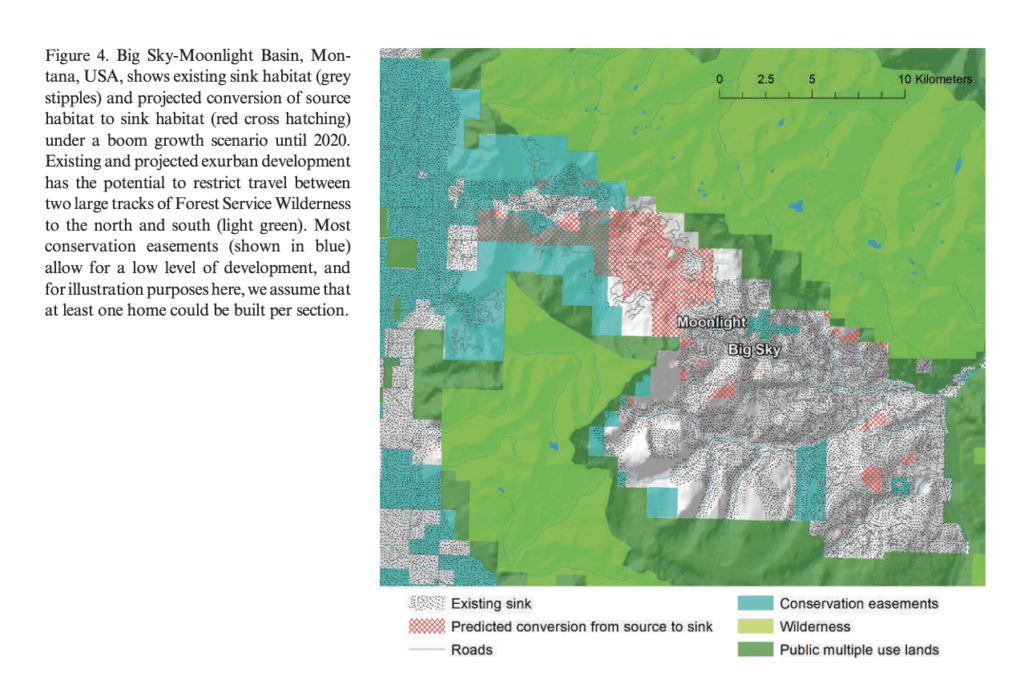
Wilkinson: Your former colleague, Dr. Chuck Schwartz, who oversaw the Interagency Grizzly Bear Study Team, contributed to a study that showed bears will exhibit avoidance behavior if there is human activity on a section of land—640 acres. Other species, too, are displaced by that kind of human footprint especially at higher densities. That paper noted in 2012 that Greater Big Sky was a rapidly expanding “sink” for grizzly bears rather than a source, in that quality habitat that otherwise was valuable to grizzlies was being usurped by development and causing harm, in addition to bear removals or dead bears. It’s ironic that Interior Secretary Doug Burgum, who owns property in The Yellowstone Club, would use Big Sky as a backdrop for his announcement with Gianforte and other governors, defending his decision to claim habitat loss does not bring harm to wildlife.
What happens when you apply the analysis by Schwartz and others across mountain valleys throughout the Northern Rockies where grizzlies are, or where there is the potential of maintaining biological connectivity between ecosystems?
SERVHEEN: As mountain valleys fill with people and residences, it becomes increasingly unlikely that animals like grizzly bears can live successfully and cross these valleys. We can’t continue the distribution and rate of residential development on private lands in grizzly habitat and still maintain grizzly bears on the landscape. No one can possibly think that the current level of private land development is sustainable for the wildlife of the Northern Rockies. A subdivision that springs up in exceptional wildlife habitat is a glaring example of harm being done to bears aand other wildlife. By the way, conflicts aren’t happening simply because there “are more bears;” often it’s because of a lot more people inundating bear habitat—in addition to hazards bears already face from encountering livestock on public lands and hunters and a lot of subdivisions where people aren’t taking care of trash and other bear attractants. These are persistent threats that will ever go way.
Wilkinson: Returning to the assertion made in the Administration press release of “reducing burdens for landowners and communities.” By far, the biggest loss of habitat for grizzlies is happening right now on rural private lands. It’s a permanent loss that will never be restored. Yet neither Gianforte and the governors of other states, nor does Brian Nesvik, acknowledge this significant and growing threat to bears. They don’t factor into the equation of perpetual threats to bear recovery. Millions of acres have been lost since the bear was listed in 1975 and the rate is accelerating. How has grizzly recovery slowed sprawl and negatively impacted the construction and real estate industry?
SERVHEEN: No, and let me reiterate what I said earlier.
Wilkinson: It seems like the proponents pushing radical ESA reform cite obscure examples of where the Act is, in their minds, failing and then extrapolate it to everything the Act does. Yet in most cases, with high profile species like bald eagles, grizzlies and others, the Act has worked well. Do you find their characterization of it being grossly flawed disingenuous?
SERVHEEN: Yes, it is very disingenuous. The ESA works if it is funded and adequately staffed to work. These people don’t want it to work and want to malign the ESA so they can weaken and eventually destroy it.
° ° ° °
Wilkinson: Former Fish and Wildlife Service Director Dan Ashe said the problem with the ESA isn’t that it’s “too burdensome”—a contention oft made by the property rights-first thinktank PERC in Bozeman—but that Congress has starved the agency of funds it needs to carry out the ESA. PERC has condemned the litigiousness of conservation organizations yet it sued the government arguing that species recovery should be based on “voluntary conservation” and incentives not regulatory mechanisms. Burgum considers PERC to be an important ally of the Trump Administration.
In fact, Ashe said there are incentives that reward property owners for having species on their land. Ashe said attempts to taint the credibility of the ESA and people implementing it hack been part of a clear ongoing malevolent strategy to hobble government conservation agencies so that they can’t do their jobs and then they are labeled as being incompetent. Which then sets the stage for privatization or hollowing out of the agency. The motive is to destroy the ability of agencies to function. Do you agree with PERC’s claims or Ashe’s assessment?
SERVHEEN: I agree with Dan’s assessment completely. There are many private incentives in the implementation of the ESA. They, PERC, the Heritage Foundation and others, don’t want the ESA to work, so they can destroy it. They despise regulation and they can’t admit that it’s been government regulation, not the free market running wild, that is why we still have wildlife. Voluntary conservation doesn’t work when the real incentives are to monetize natural resources as fast as you can and not really think about the consequences.
Wilkinson: You were once an unwavering optimist about the outlook for bears and you pushed back against conservation organizations who were suspicious of the states. Considering the above, where will “grizzly bear recovery” be in another few years?
SERVHEEN: I fear that there is a dark future for the grizzly bear because of the destruction underway by the Trump Administration. If this continues, and what they are doing gets cemented in place grizzly bear recovery will be dead in a few years. The numbers and range of the grizzly will soon be declining across the Northern US Rockies.
Wilkinson: So, engage in some time travel. Pretend that you are a biologist 25 years in the future and you’re looking back at this crucial moment in time. What would you be saying to Brian Nesvik and Burgum and to those aggressively working in tandem with this Administration, like PERC, to dismantle the ESA in order to accommodate the profit motives of resource extraction industries and developers?
SERVHEEN: In 25 years, people will be lamenting that this administration destroyed the grizzly recovery program and started the decline of the numbers and range of the grizzly in the Northern US Rockies. They are destroying something that took 40 years and millions of dollars to accomplish—that is recovering the grizzly in the 5 percent of its former range where they had a chance to survive. And they did it not out of concern for bears, but to maximize profits for industry and the already-wealthy from public lands and resources. That is a sad legacy and something to be ashamed of.
° ° ° °
Other recent installments of “Conversations from the Green Thicket” and other stories you might like to read: