
by John Marzluff and Colleen Marzluff
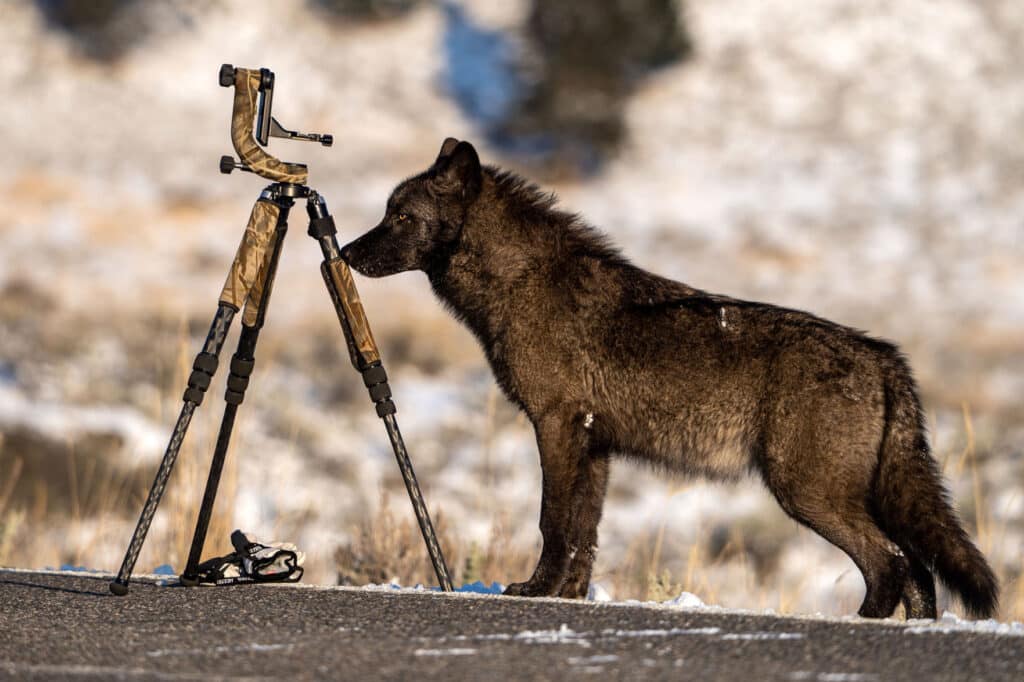
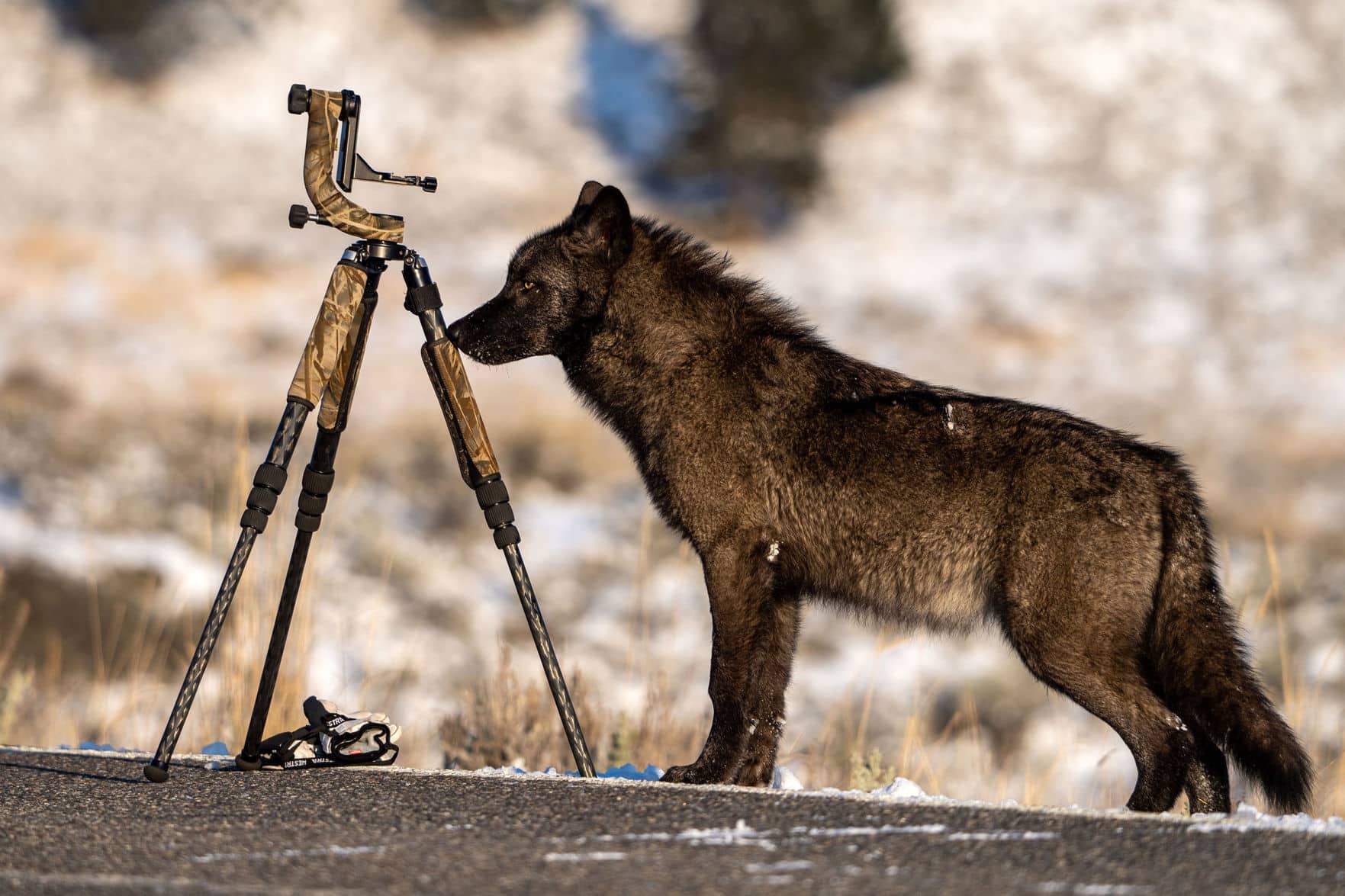
He had followed our path, step by step, for about a quarter of a mile before stopping on a small rise only a few yards away to stare down at us. We barely noticed the white chest patch on his otherwise black coat. His bright, curious amber eyes held our attention. His demeanor was neither fearful nor aggressive. Ours was of stunned wonder. It remains a signature moment in our careers as field biologists. As amazing as this encounter with one of Yellowstone’s wolves was, we knew the animal’s behavior needed to change, so we discharged our bear spray.
We knew “our” wolf had been in trouble since he was born in 2019. His delinquency was not his fault, but rather the result of illegal encounters with photographers and wolf watchers who edged too near his mother’s den. During these encounters, the pups became habituated to humans. Before he was a year old, our wolf had multiple run-ins with park visitors and staff. Managers showered him with paintballs and cracker shells whenever he misbehaved. The growing pups paid little mind to traffic that whizzed through their home in the Lamar Valley. That poor decision cost two of their lives as they were struck and killed on the park’s roadway. Our wolf dodged that bullet.
“Before he was a year old, ‘our’ wolf had multiple run-ins with park visitors and staff. Managers showered him with paintballs and cracker shells whenever he misbehaved. The growing pups paid little mind to traffic that whizzed through their home in the Lamar Valley. That poor decision cost two of their lives as they were struck and killed on the park’s roadway. Our wolf dodged that bullet.”
He was barely a year old when we bear-sprayed him in late spring of 2020, and afterward he seemed to finally understand that people were to be avoided. His bad behavior stopped, and within months he and other male packmates struck out on their own. Before leaving home, the reformed bad boy was captured and radio-collared. Now identifiable as wolf 1273M, visitors and scientists could follow his life. He was the first to encounter and convince a group of nearby females to join his roaming male companions, forming a new pack. His status rose as he aged, and he eventually became the pack’s beta to his alpha brother. The two striking black males led the Rescue Creek pack for the next three years. Whenever we glimpsed him, it was banner day.
He didn’t dodge the next bullet. A hunter legally harvested 1273M just north of Yellowstone National Park eight days after the 2026 hunting season opened.
As biologists, we are used to death. Death of the old and sick can enable survival of the young and healthy. Death of a single individual usually has little impact on the survival of the whole. But this is not certain when an older, experienced wolf is killed. The loss of 1273M has put the Rescue Creek pack’s survival at risk. Losing an elder halves their odds of holding on in skirmishes with similarly sized packs, and a lost leader substantially cuts their odds of persisting another year. The pack’s social and genetic structure is now vulnerable, as only one male is unrelated to the lead female. Losing this visible pack will reduce the experience for millions of visitors who hope to glimpse a wolf.
“As biologists, we are used to death. Death of the old and sick can enable survival of the young and healthy. Death of a single individual usually has little impact on the survival of the whole. But this is not certain when an older, experienced wolf is killed. The loss of 1273M has put the Rescue Creek pack’s survival at risk. Losing an elder halves their odds of holding on in skirmishes with similarly sized packs, and a lost leader substantially cuts their odds of persisting another year. The pack’s social and genetic structure is now vulnerable, as only one male is unrelated to the lead female. Losing this visible pack will reduce the experience for millions of visitors who hope to glimpse a wolf.”
Those visitors pump millions of dollars into our economy each year ($85 million annually per a recent study) and support over three thousand jobs in Park County. A wolf tag brings in just a few bucks. Banning wolf hunting in the two small units (313 and 316) that border Yellowstone would help balance the equation and assure the public that Yellowstone’s wolves were not regularly targeted. The current quota in each of these regions is only a single wolf, but even one is too many.
Reducing Montana’s harvest of Yellowstone wolves would not burden others. Just beyond the units we propose for closure, hunters can legally take up to 33 wolves. Yellowstone’s wolves rarely kill livestock, and they disproportionately prey on old, weak elk, not those sustaining the herd. Wolves that spend most of their days in a reserve present little challenge to a hunter. Groups like the Boone and Crockett Club decry giving hunters an undue advantage, as is already the case, as wolf hunters can use bait, night-lights, and recorded calls. If we are going to hunt wolves, then the chase should be fair.
Wolf 1273M outlived most wolves. In the park, his howls silenced millions of awe-struck watchers. He added wildness to many a winter day. His death is our loss, and it should awaken greater respect for his kind and what they provide for us all. When the hunter reached old 1273M, we hope he saw the fierce fire die in his amber eyes. Maybe, like Aldo Leopold, they thought killing this wolf would send a message and allow for more elk. But as they watched the amber eyes lose their glow, we want them to know that neither the wolf, the ecosystem, nor the local economy agrees with that view.