
by Matt Barnes
Montana’s wolf population is lower than previously thought, and has been declining since its peak in 2013, according to the new annual report by Montana Fish, Wildlife & Parks.
This is a huge revelation for the state’s official wildlife management agency to make.
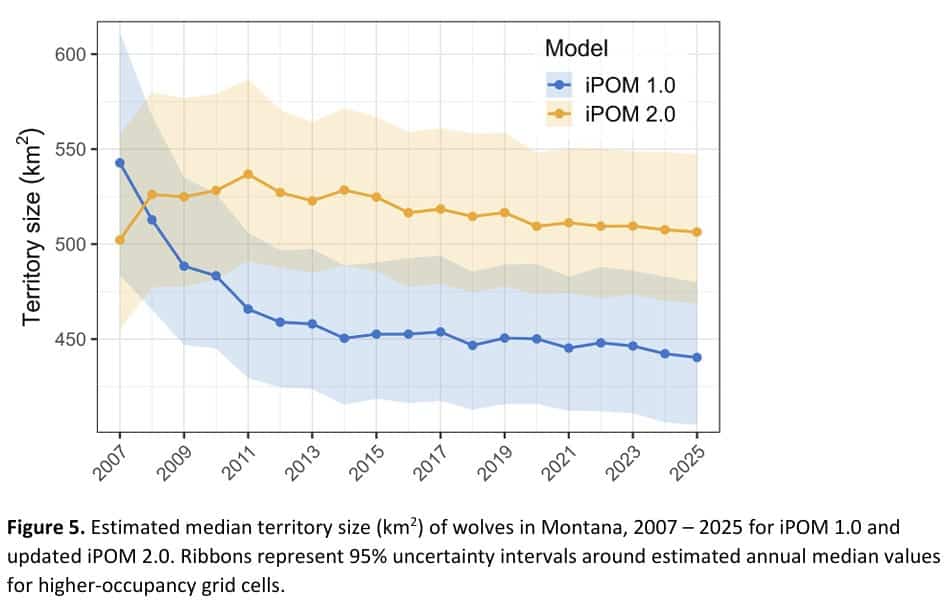
Montana’s updated population estimation model, called iPOM 2.0, incorporates changes to some of the major inputs, including calculations of wolf pack territories (larger than previously thought) and wolf pack size (lower than previously thought, and even decreasing over recent years).
The tweaks in accounting are not insignificant. They have resulted in a a new reduced statewide population estimate, down from nearly 1,100 wolves (as reported in the last several years using iPOM 1.0) to about 725 today These numbers matter. How—and why? Because the higher the estimated number of wolves the more the state can justify higher killing quotas through sport hunting and trapping.
To put it all in perspective, 725 is below the state’s population of wolves when they were delisted from federal protection under the Endangered Species Act by Congressional fiat in 2011, but still above the state’s minimum population objective of 450 wolves.
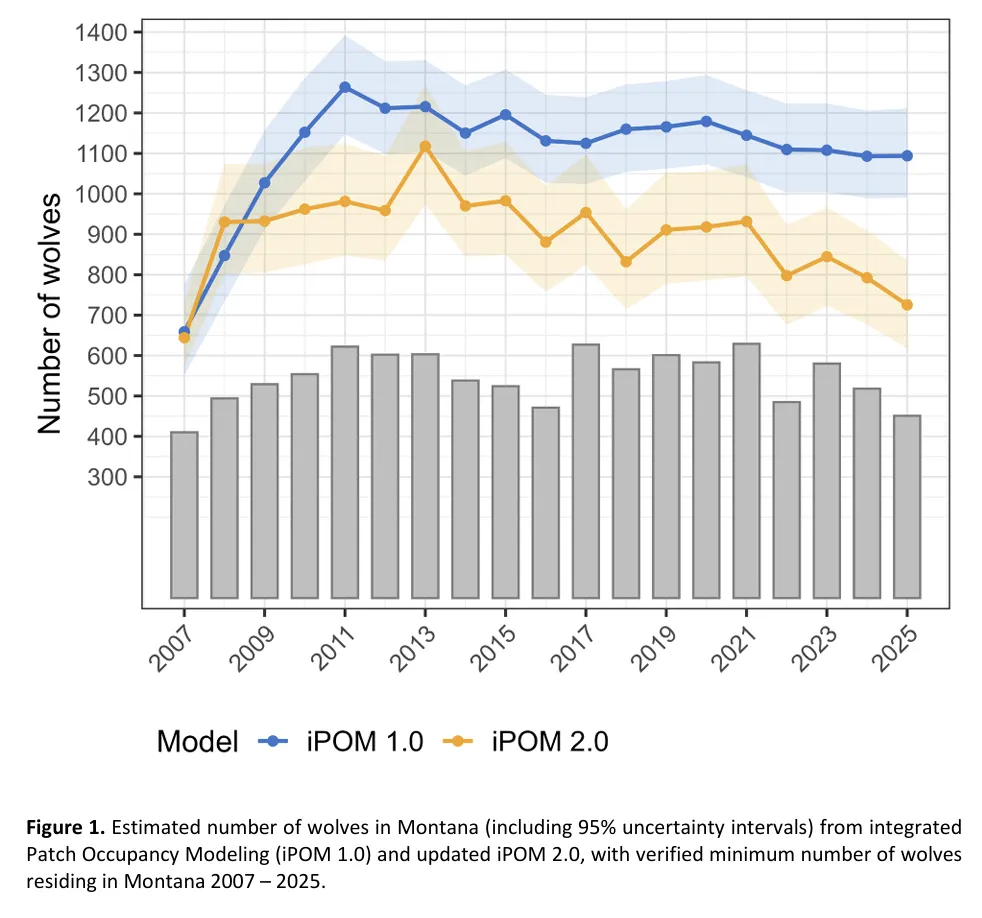
This is not to say that the earlier iteration of IPOM was “wrong,” except in the sense that “all models are wrong, but some are useful.” Models are intended to produce reliable estimates of population size and distribution. Note that both iPOM models, the new and old, produce a higher estimate than the verified minimum number. Minimum counts are reasonably accurate when the population is small, but as populations grow, minimum counts are increasingly undercounts.
Various kinds of modeling in western states are also employed to estimate population sizes for lots of species—for example, ranging from grizzly bears, mountain lions and elk to pronghorn, bighorn sheep, mule deer, Greater Sage-Grouse, and trout.
Montana and Idaho started using models to estimate wolf populations many years ago; Idaho’s modeled numbers (figures derived to support its aggressive program of reducing wolf numbers) are almost certainly overestimates, but for different reasons than Montana’s.
States with smaller wolf populations, including Wyoming and has implemented policies that allow for liberal killing of wolves across the majority of the state, still rely on minimum counts.
Overcounting as a rationalization to overkill?
The iPOM model in Montana, developed by the USGS Montana Cooperative Wildlife Research Unit, integrates wolf distribution, territory size, and pack size. The model had been previously challenged by independent scientists with backgrounds in canid research, including Dr. Scott Creel of Montana State University Department of Ecology, who argued that iPOM 1.0 underestimated territory size of individual packs.
Dr. Robert Crabtree of the conservation research nonprofit, Incline Conservation (and formerly Yellowstone Ecological Research Center) argued that the way the model relies on hunter observations is problematic, and that the model doesn’t sufficiently account for wolf movement between “grid cells” that serve as a basis for the state’s estimates. Read Crabtree’s 2025 post on Incline Conservation’s Substack page).
The creators of iPOM, in turn, contented that Crabtree’s critique was based on erroneous assumptions.
While I’m not a modeler, I hold all of the scientists involved in high regard, and I’m not taking sides here. But I’ll note that Montana Fish Wildlife and Parks’ iPOM 2.0 does adjust territory size upward, much as Creel suggested. And the reduced population estimate from iPOM 1.0 to 2.0 is proportionately greater than the putative overestimate in iPOM 1.0 that was argued by Creel (35 percent) but significantly less than was argued by Crabtree (150 percent).
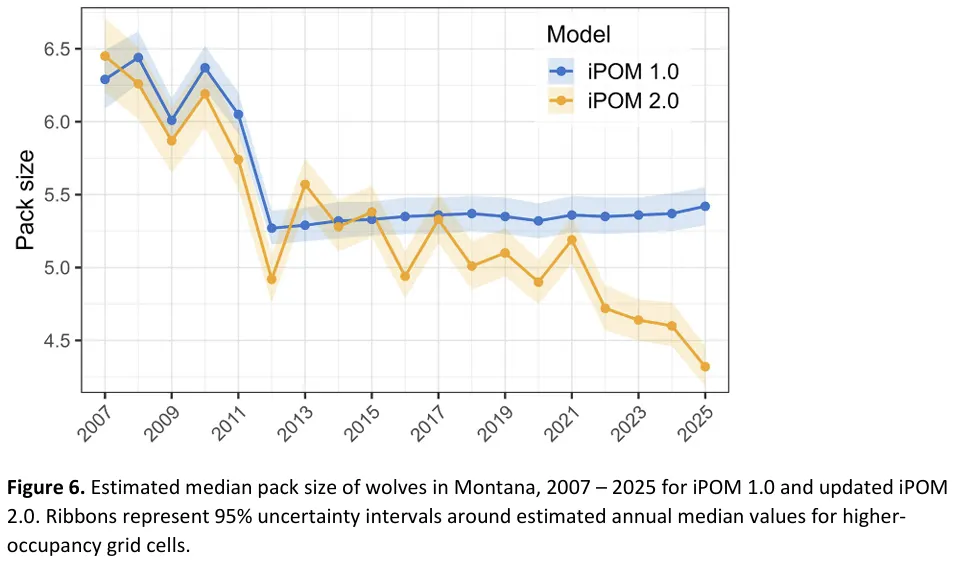
Montana’s updates to the model don’t directly reflect the critique of Crabtree and others, so if they are correct, even iPOM 2.0 would overestimate wolf populations, which then has implications for state policy pertaining to allowable wolf hunting and trapping. It’s worth pointing out that such “harvest” does not include lethal control in response to, or to prevent, livestock depredations.
Wolf hunting and trapping
Many more wolves are killed by hunting and trapping than all other sources of human-caused mortality, including lethal control in response to livestock predation. Human-caused mortality dwarfs natural mortality, which is lumped under a category labeled as “other.”
Montana’s wolf hunting and trapping had appeared to be almost sustainable (if using iPOM 1.0), even though the state was actually trying to reduce the population (for reasons more political than biological). But now, using iPOM 2.0, it is clear that it has been reducing the population for over a decade.
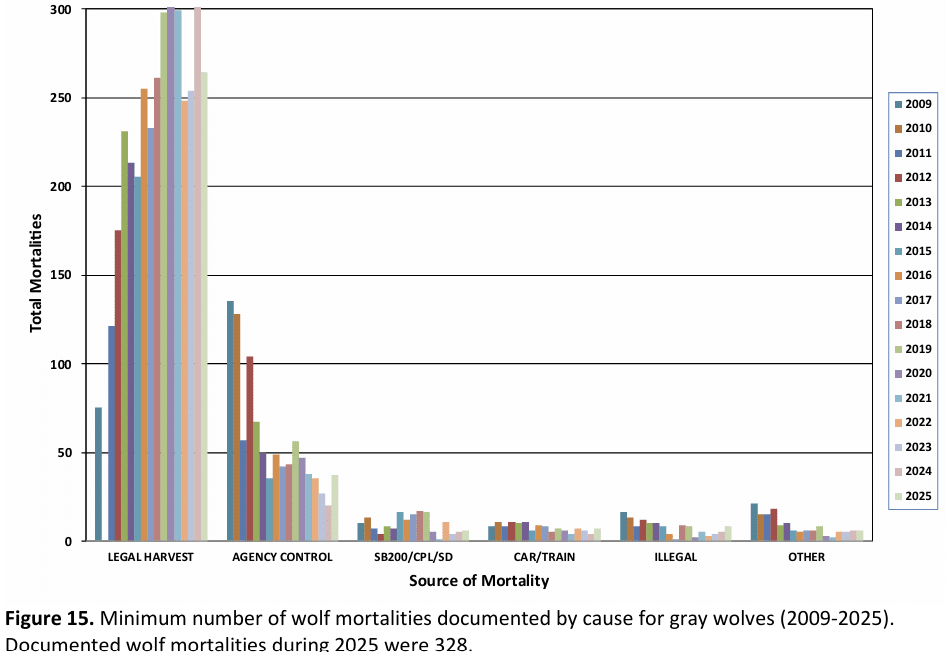
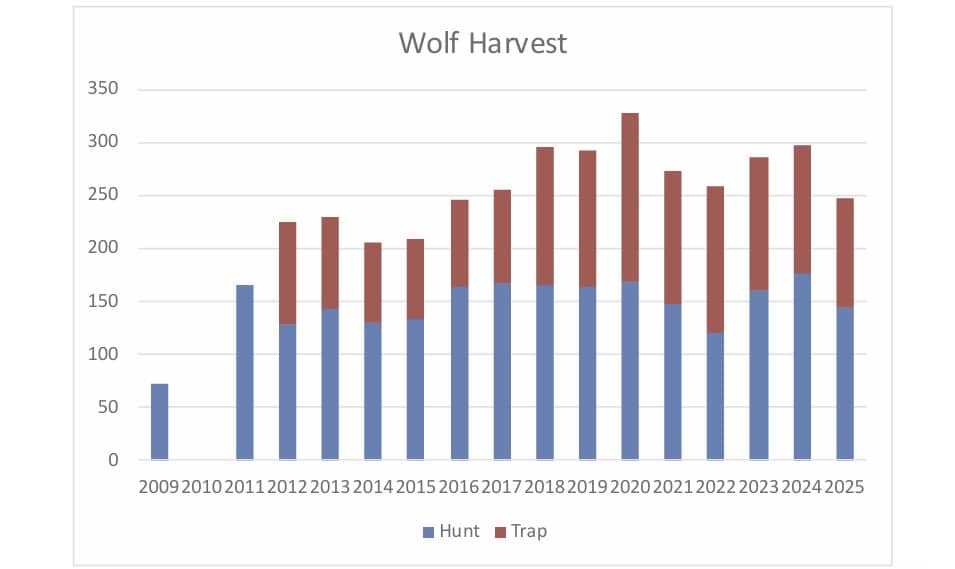
Montana’s wolf hunting and trapping season occurs throughout the winter, spanning two calendar years. The last season 2025-26 (license year 2025), had a quota 452 wolves and a harvest of 247, the lowest in a decade. The calendar year 2025 harvest, from portions of two seasons, was 264, which equates to fully one-third of the state’s newly calculated wolf population estimate.
Montana Fish Wildlife and Parks’ new model reduces the license year quota for lethal take of wolves to 250. But it’s important to note harvest was below that threshold until 2016, then above it from 2017-2024, and dropped just below it in 2025. Many will remember the controversial winter of 2021-2022 when roughly one fifth of Yellowstone’s wolves were killed by hunters and trappers in Montana just north of the park.
iPOM 2.0 is supposed to deliver a more accurate representation of wolf numbers. In considering sustainability statewide from a numbers standpoint on paper, it makes sense to reduce the quota, because if the state actually harvested over 450 wolves, the population would be reduced well below the Montana’s minimum population of 450 (based on 15 breeding pairs, per the state’s wolf plan.
A harvest of 250, however, is not the same as a reduction of 250, because there is also reproduction. Nevertheless, lethal allowable removal of 250 wolves would bring the population to about 475, or just above the bare minimum—assuming that iPOM 2.0 is accurate.
So, what’s really behind all of this?
Montana’s proposed reduced quota is not intended to make the harvest sustainable; it is actually intended to reduce the wolf population further, but not enough to risk re-listing and losing state wolf control again to the federal government. The Montana state legislature mandated liberalized wolf hunting and trapping in 2021 (§ 87-1-901, MCA), despite the objections of many biologists and conservationists (including me).
This intensive wolf harvest isn’t primarily about harvesting and selling wolf pelts for fur. And it has nothing to do with carrying capacity. Nor is it really about growing the elk population, which Montana’s own data shows to be at a record high of over 157,000 elk in 2025. Of course, on a finer scale, there are areas where long-term elk abundance has increased, and others where it has decreased, including parts of northwestern Montana. But across the map, the preponderance of elk hunting units are solidly at or above population objectives set by the state.
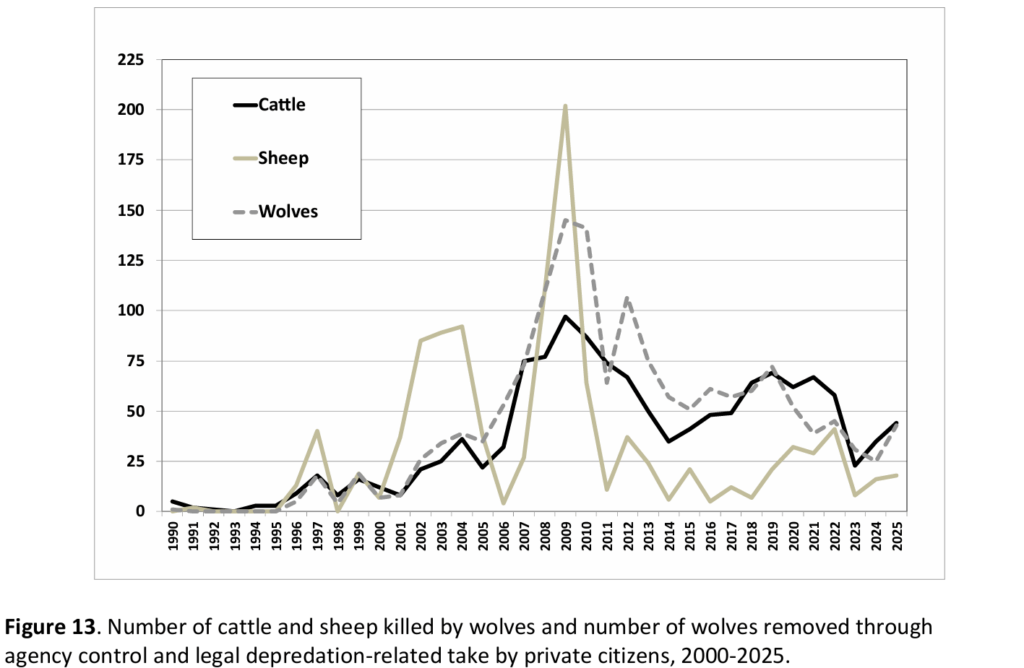
It must also be noted that the intensive wolf harvest has even less of a relationship with reducing wolf-livestock conflicts. Only about one of every five packs is known to kill one or more head of livestock each year. Wolf-livestock conflicts have, in fact, been declining since 2009, and especially after the state took over management after federal delisting and ramped up lethal control efforts, often with full-pack removal if even one or a few domestic animals were preyed upon.
Agency lethal control is far more effective at reducing conflicts (at least at a local scale and temporarily than public hunting, because the former is targeted, the latter is indiscriminate.
What is the debate over Montana’s intensive wolf harvest tally really about? It’s not about a compelling need to control wolves. It’s about competing worldviews (traditional, modern, postmodern), their attendant values (utilitarian, pluralistic, mutualistic), and how those manifest as different visions for the future of the American West.
Wildlife policy decisions are always about so much more than science, but we need strong science to inform those decisions. The updated wolf population model is most likely stronger science. But as is usually the case with science, it probably isn’t the final word.