
EDITOR’S NOTE: The following is an essay written Yellowstonian founder Todd Wilkinson and Dr. Mark Fiege, former Wallace Stegner Chair of Western American Studies at Montana State University for Montana: The Magazine of Western History. It grew out of a lecture they delivered together at the annual convention of the Montana Historical Society in Helena.
By Mark Fiege and Todd Wilkinson
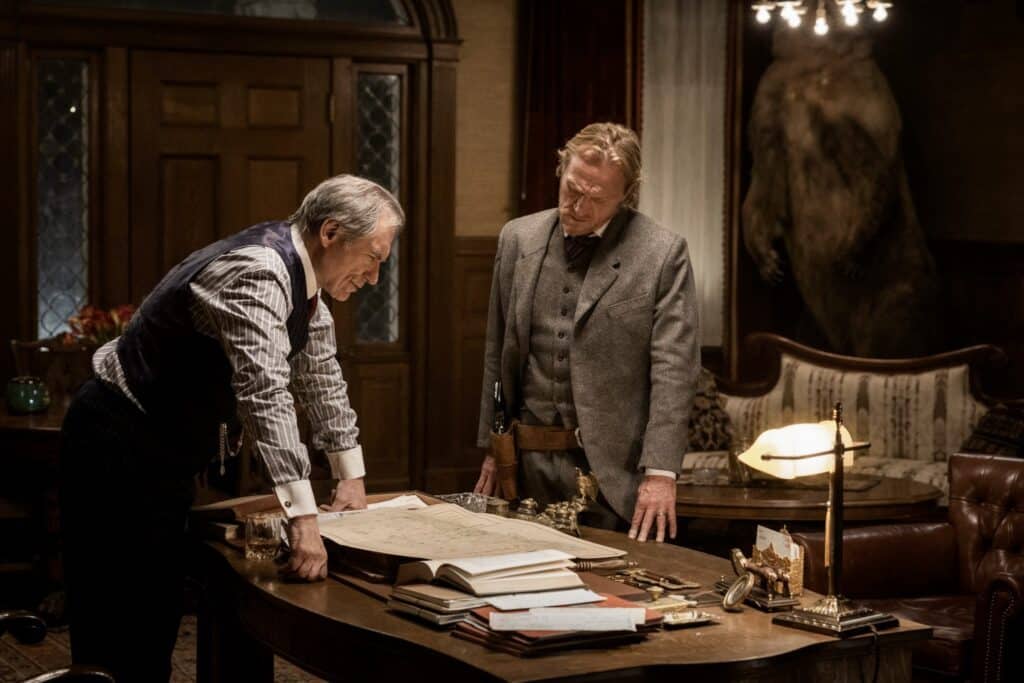
In the television series 1923, a spinoff of the better-known Yellowstone, scriptwriter Taylor Sheridan and his colleagues composed a snippet of dialogue that speaks volumes about the unwelcome attention and development those programs have brought to Montana in recent years. The scene is a campfire—a powerful symbol in the popular culture of the American West—around which sit the elderly rancher Jacob Dutton (Harrison Ford), John Dutton Sr. (James Badge Dale), and Jack Dutton (Darren Mann). Earlier that day, the Duttons brutally drove off a group of interlopers on their ranch, and the incident now moves the old man to reflect.
“You got to understand what this ranch’s greatest enemy is,” he tells the younger Duttons. “It’s not wolves, or drought, or blizzards, or Texas fever—it’s other men. Man will choose to take what you build rather than try to build it for himself.” The propensity is ancient, he says. “Every civilization in the world is built on top of the one they conquered,” with Rome, Jerusalem, and Paris serving as examples of cities “stacked on top of towns, stacked on top of villages, on top of one’s man’s house, built on top of one man’s cave.”
There is no escaping this reality. “We wish it wasn’t so, but it is,” he concludes. He then delivers what he sees as the logical outcome of his history lesson—and the reason for the Duttons’ ruthlessness: “Your enemies have got to be so terrified that their fear is greater than their greed . . . I gave those men a chance ’cause I wanted them to tell the world what happened when they cross me.”
Dutton’s implications are plain, but we can aim the words right back at their authors. Is it Montana’s destiny to be conquered by, and buried beneath, the will of Taylor Sheridan and other moguls or wealthy developers who seek to impose their ideas on us? Is it appropriate for any citizen who has lived and worked here for a decent interval to ask such a question?
Resenting newcomers is practically a Montana tradition. Indigenous people have justifiably resented settlers for over two centuries. Ever since, waves of new residents have established themselves and, in turn, denounced the next population influx and the changes that it brings. A. B. Guthrie’s 1947 novel The Big Sky captures the dilemma as the old mountain man Zeb Calloway laments the demise of his familiar way of life: “She’s gone, goddam it! Gone! The whole shitaree! Gone, by God, and naught to care savin’ some of us who seen ‘er new. This was man’s country onc’t. Every water full of beaver and a galore of buffler any ways a man looked, and no crampin’ and crowdin’. Christ sake!”
The growth and development that has swept over Montana over the last thirty years and especially since 2020 certainly gives its longer-term residents reason to complain. Citizens are fed up and angry. The transformations of late have been breathtaking and demoralizing, with the worst manifestations in and around communities such as Kalispell, Whitefish, Helena, Missoula, Bozeman, and Big Sky.
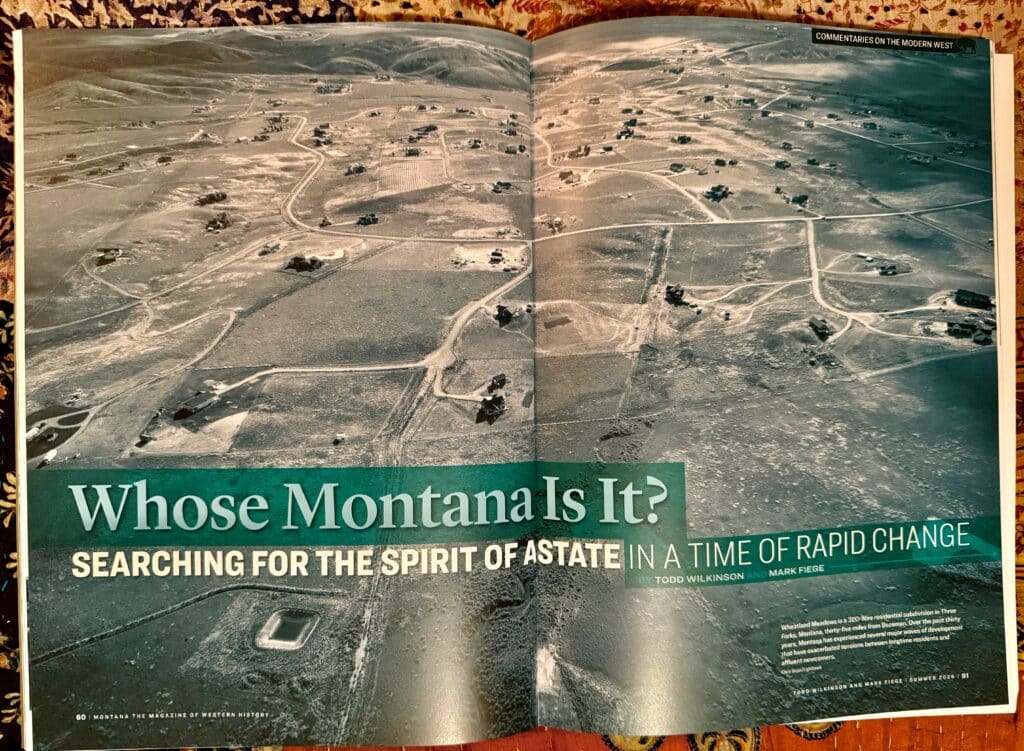
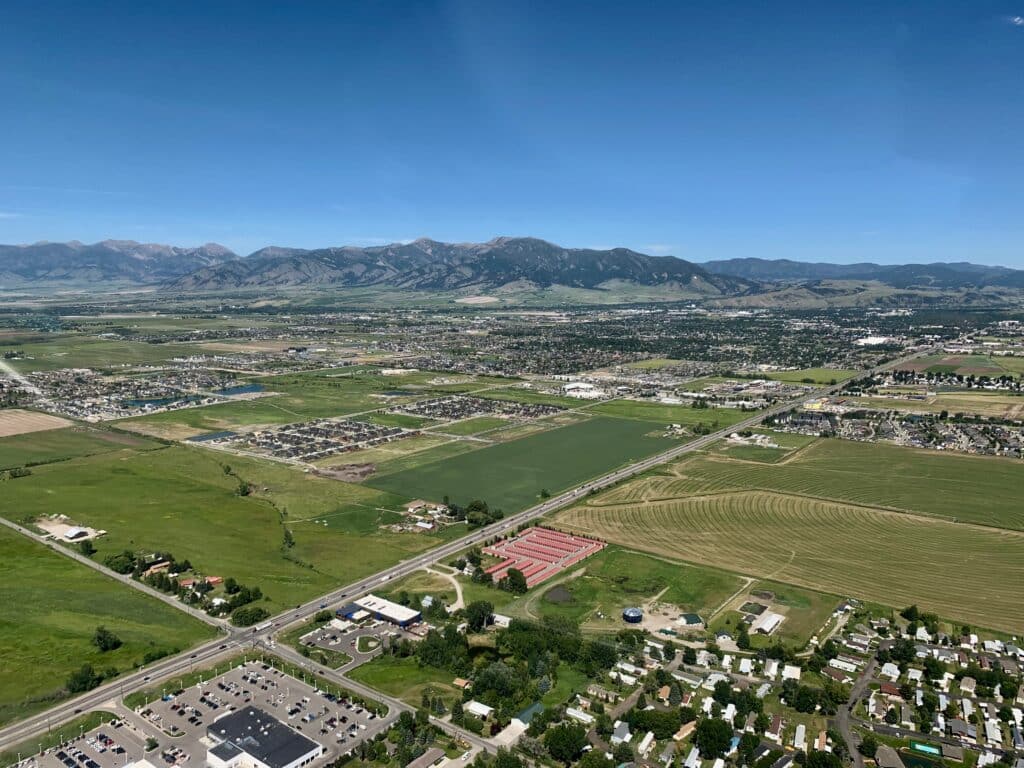
Tightly packed housing developments crowd onto former fields, pastures, and wildlands. Luxury hotels, large infill houses, and apartments overshadow existing residences, small businesses, and public buildings, disrupting the character of neighborhoods. Mobile home park residents—people who do much of the essential labor of Montana’s trendy locales—find themselves displaced by increased lot rent or more lucrative development of the land on which their modest domiciles sit. Air and water quality degrades along with the viewsheds. Real estate values and living costs skyrocket as homelessness increases. Traffic has become a nightmare, with stoplights and speed limits treated as optional. No wonder Montana citizens curse the developers and their enablers in city councils and planning departments.
The development—and with it, disgust—spreads through the countryside and beyond. Bit by bit, the losses mount. Open space, wildlife habitat, and dark skies give way to sprawl and nighttime skyglow. Ranchette “homesteads” replicate. The changes render the familiar unfamiliar, and the mind vividly recalls when, but a few years ago, the landscape was more lightly settled, open, and free. Meanwhile, the super-wealthy consolidate ranches into huge spreads, often blocking access to public land in the name of a made-up “legacy.”
A good portion of the immense toll of growth and development in the state lies largely hidden and rarely reported in the media. These are stories of heartbreak that, unacknowledged and unreconciled, divide the citizenry. In far-flung rural areas, antipathy toward wolves and grizzly bears becomes a proxy for the pain of marginalization, isolation, and decline.
The condition manifests in the increasing average age—now the late sixties—of ranchers and farmers. In feelings of failure when, after so much hard work, costs of production soar, and pillars of communities erode. In the sense of abandonment and invalidation when children leave and don’t come back. In the yearning of people on the land to have someone hear them, but who, out of pride, don’t want to be portrayed as victims. In some of the highest suicide rates in the country, especially among men, and in the number of tombstones going up in rural cemeteries outpacing local live birth rates.5
If it’s acceptable to lament unwanted change in Montana, then can it be prevented, slowed, redirected, managed, or stopped? If not, are citizens left to wring their hands in despair as the flood washes over them like old Zeb Calloway? But if yes, then how?
In the fierce, defiant spirit of Jacob Dutton? Dutton’s made-up words are rooted in Montana’s history. Violence, after all, even of a low-grade sort directed against property, has been integral to the western regional experience up to the present. Witness the recent vandal who traveled along the upper Madison River—one of Montana’s world-famous “blue ribbon” trout fisheries—and stopped at every fishing access site to slash the tires of vehicles with out-of-state plates. Or can Montanans resort to peaceful, lawful, constructive methods of responding to newcomers pushing the development that frustrates and infuriates them?
To get at these questions, it pays to revisit what Montanans are trying to protect. In polls and surveys, its citizens—across urban and rural residence, age groups, partisan leanings, and socioeconomic conditions—have been unwavering in their commitment to a Montana that they know through lived experience and that they now see threatened by growth and development. They see their way of life, in particular what is happening to the natural landscapes around them, degraded by rapid change. They value wildlife, open space, small towns, rural communities, volunteer fire departments, lightly traveled roads, clean water and air, and affordable housing for young people who want to remain in the state. They think that unmanaged, market-driven development is a problem, and they want to do something about it. No matter the groups in which they claim membership, Montanans overwhelmingly value public lands. They see those lands as vital to democracy, as a shared heritage and pathway to civic participation. State and federal public lands, they believe, are basic to the broad Montana commonwealth. Access to public lands is integral to what it means to call oneself a Montanan.
These values are durable and rooted in our shared history. They are central to what it means to live and “stick” here, as Wallace Stegner would say. If we are to find a path forward from chaos and anger to an updated version of “the last best place,” it is important to know where those values and politics came from and when growth and development began to threaten them. The politics that Montanans fashioned from these values coalesced in the aftermath of World War II and reached a high point in the 1970s and 1980s. The story is powerful, and we will be better off if we hold it fast and never forget it.
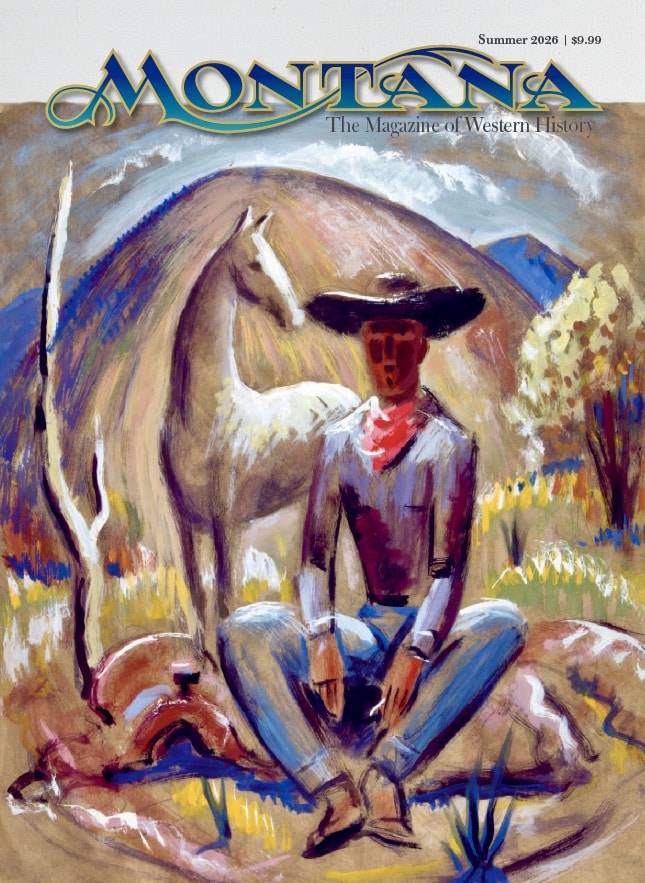
By the postwar era, Montana was home to a sizeable number of people born here. Those people knew about hard work, struggle, and sacrifice in mines, mills, and forests; on ranches, farms, and railroads; in kitchens, classrooms, hospitals, and cribs; and on foreign battlefields in service to the United States and its allies. By choice or because they had no choice, many of the Montana-born remained while others moved on. This was especially so during World War II, when thousands of its citizens joined the military or left for defense-industrial jobs in Washington, Oregon, and California. Wallace Stegner observed many “stickers” in real life. Being a Montanan meant hard work, often on the land and bearing the scars to show for it. Montanans built a sense of themselves by staying put.
From this seedbed of struggle and sticking, Montanans fashioned shared methods for sorting out their political priorities. Their long opposition to decades of economic and political domination by industrial giants, especially the Anaconda mining corporation, sharpened their organizing skills and heightened their sense of group identity and solidarity. Boosted by the labor movement and progressive reforms of the early twentieth century and by the New Deal programs of the 1930s, the people established unions, won labor strikes, built public facilities of all kinds, regulated access to land and other public resources, restored wildlife populations, and bettered their circumstances.
From the largest to the smallest public project—from Fort Peck Dam to the Madison County Fairgrounds—the people had reason to vote for platforms and programs that challenged corporate power and strengthened public goods. A loose nonpartisan consensus prevailed, built on the shared legacies of labor and agricultural unionism, the New Deal, World War II, the Cold War, patriotism, participation in civic organizations, and the realities of life in this state. The citizenry infused that consensus with a live-and-let-live libertarian or independent streak enabled by the openness of the landscape. Central to Montana values and identity, that nonpartisan consensus—vote for the best candidate regardless of party—in recent years has eroded in the face of rapid demographic growth and change.
Undergirding this loose political consensus were practical realities among family, friends, and neighbors. To endure, to thrive, people had to get along in a harsh, arid, fire-prone, sparsely populated land with punishing winter weather far from basic services. People learned the necessity of mutual aid and cooperation. Men and growing numbers of women served as volunteers for rural fire districts, for example, but underlying the camaraderie they enjoyed was a shared recognition of a practical neighborly principle that leavened libertarian impulses: I will help you if you help me. “Montana is a small town with very long streets” goes an expression popular among established residents. How many newcomers, especially the wealthiest and most privileged, understand this reality?
Many of those same newcomers find public lands, waterways, and wildlife an especially appealing feature of Montana, especially for recreation. How many understand, or are even dimly aware, of the backstory? Public lands and waters hold intrinsic value far above recreation or extraction. Montanans developed a close attachment to those lands, waters, and animals from need. State residents depended—and still depend—on these lands for livestock forage, timber, irrigation, and food. Hunting on public lands was in part recreational, a chance to be with friends and family. More important, hunting put meat in the freezer and reinforced a key feature of Montana identity, that citizens were producers who lived on the land and knew how to provide for their families.
Developers who gobble open space and habitat miss something basic about Montana as they both chase and foster consumer demand. They conform to the state’s long experience with the gold rush ideology of extracting wealth from the land. In the throes of hasty development, communities such as Bozeman seem like nothing so much as latter-day boomtowns. What such avaricious people miss is that alongside the extractive legacy, Montana’s citizens quietly cultivated a conservation ethic that understood the herds, flocks, and shoals, even on private land, to be public goods, as well as creatures with an intrinsic value that gives them a warrant to exist on their own terms.
Montanans expressed their sense of place, self, and polity in various ways, including an astonishing literary, artistic, and intellectual outpouring after 1945. One of the most powerful themes in Montana’s literature is struggle in the face of awesome natural beauty. Heartbreak and beauty generate the friction that powers the beating heart of this magnificent state. That theme, perhaps Montana’s great governing trope, runs through its stories like a seam and is present in the work of authors such as Norman Maclean, Ivan Doig, James Welch, Judy Blunt, and many others. It is impossible to overstate the significance of this vital feature of Montana culture. It speaks to the anger and despair that many citizens feel, especially those in the countryside. Above all, it conveys the sense of struggle and hardship amid natural splendor that has been so central to Montana identity.14
In our judgment, the state constitution, promulgated and ratified in 1972 and later amended, holds the greatest expression of Montana values. Impressive and memorable in every way, it replaced the original 1889 constitution, so filled with loopholes that it enabled corrupt lawyers and politicians to ensure the corporate domination of the state. Signed by all one hundred delegates to the drafting convention—every Democrat, Republican, and Independent—the new constitution drew on over a century of experience to summarize what Montana citizens thought they were about.
The Montana Constitution is a composite of scars and soaring aspirations. The first major part, Article II, is a “Declaration of Rights” that secures an impressive list of individual and collective liberties. An array of guarantees and constraints follows, including IX:1—a reaction to a century of destructive resource extraction—on the responsibility of the state and its citizens to “maintain and improve a clean and healthful environment for present and future generations.” Perhaps the best part of the constitution is its opening words. In one simple, beautiful, declaratory sentence, the preamble summarizes the deepest, most profound sense of what Montana means to its citizens: “We the people of Montana grateful to God for the quiet beauty of our state, the grandeur of our mountains, the vastness of our rolling plains, and desiring to improve the quality of life, equality of opportunity and to secure the blessings of liberty for this and future generations do ordain and establish this constitution.”
Such were—and still are—the values and politics of Montana’s long-standing citizens. But here’s the rub. Even as the delegates to the constitutional convention emerged from their bipartisan space of shared values with a great gift to their fellow citizens, changes already were underway that would challenge the integrity of their state and its very meaning. The people of Montana had long resisted the corporations that had plundered the state since the nineteenth century. Before the ink dried on the new constitution, another phase of that recurring struggle had begun.17
By the 1960s, aided by a phenomenal burst of wealth production and accumulation at the national level, corporations and moneyed individuals eyed Montana’s prairie and mountain resources for a fresh round of exploitation. Corporations moved into the eastern part of the state to strip mine coal for generating electricity, a project that the historian K. Ross Toole, always fiercely loyal to his state, its people, and their values, labeled “the rape of the Great Plains.” Responding to that threat, ranchers and other small producers acted on their sense of right and wrong and organized the Northern Plains Resource Council in 1972, the same year as their new constitution, which soon included in IX:2 a provision for land reclamation paid for by a tax on resource extraction.
Wealthy investors’ efforts to develop mountain landscapes for exclusive resorts and residences based on natural beauty and isolation were more insidious. NBC newscaster Chet Huntley, originally from Cardwell in the lower Jefferson Valley, used his stature and connections to round up investors who purchased mountain ranches in the Madison Range south of Bozeman for a resort that opened in 1973.
Taking its name from A. B. Guthrie’s classic novel, Big Sky eventually included ski resorts, lodges, hotels, restaurants, and residences, forming an exclusive community that the Wall Street Journal recently dubbed “Montana’s most expensive zip code.” Although unincorporated, the town of Big Sky instituted a special district government that used tax revenues to finance infrastructure, creating a growth engine in the mountains. Through its insatiable need for service workers and trades people, most of whom lived in and worked from the Gallatin Valley around Bozeman and Belgrade, elite development at high elevation reproduced urban growth lower down. The pattern repeated around Montana wherever wealthy enclaves appeared.
CONTEXT
Big Sky impressed other developers who catered not to the merely wealthy, but to the nation’s growing class of billionaires. Adjacent to Big Sky, investors in the 1990s purchased tracts of the original Northern Pacific federal land grants and, in combination with acts of Congress that allowed exchanges of private and public land, organized what became the Yellowstone Club. After opening in 2007, the enclave soon had a membership that included some of the most famous, wealthy, and powerful people in America if not the world. Montanans reacted with alarm and horror as Big Sky and the Yellowstone Club fragmented key wildlife habitat and degraded water quality in the Gallatin River with sewage discharge. Even the service employees and tradespeople who made a living from those developments exchanged shocking stories of decadent excess alien to the state’s hardworking citizenry. As a friend and neighbor said to one of us after leaving his job as a window installer and his stressful daily commute up the Gallatin Canyon, “If I never lay eyes on the Yellowstone Club again, it will be a beautiful thing!”
Soon not only the landscapes of Montana, but the very idea of the state came up for grabs. A pivotal event that drew much attention to the state and stimulated unwanted growth and development was the 1992 release of Robert Redford’s film A River Runs Through It. Redford was an inadvertent villain. Despite his movie star looks, charisma, fame, and wealth, he opposed rampant growth and aligned himself with indie filmmakers and environmentalists. Redford adapted his film from a 1976 novella of the same title by beloved Montana author Norman Maclean, who grew up in Missoula, became a professor at the University of Chicago, and returned regularly to his family’s cabin at Seeley Lake.
Maclean’s austere and beautiful prose, the story of his family’s fly-fishing obsession and his brother’s heartbreaking death, and the novella’s mystical final sentences appealed to Montanans who knew well the meaning of loss in the face of an enchanting natural environment. In Redford’s hands, and despite his intentions, Maclean’s classic made Montana synonymous with fly-fishing and sparked a consumerist mania that brought thousands of newcomers into the state. Ever after, rueful Montanans demarcated their sense of loss in terms of before and after Redford’s movie.
Which brings us back to Taylor Sheridan, Yellowstone, and 1923, and the latest Montana-themed melodrama, The Madison. Like Redford, his production has encouraged yet another land rush that threatens to overwhelm the sturdy values that Montanans fashioned from their hard labor and the wreckage of their mistakes and defeats. Unlike Redford, an avowed environmentalist who tried to foster an ethic of connection to nature by honoring a Montana author and his authentic story, Sheridan and other super-wealthy people are attempting to hijack the state and impose upon it their outsider fantasies. They are not alone in their conceit; they are like every land-grabber or politician who has shown up to exploit the state’s openness, freedoms, and goodwill and then presumes to speak on behalf of Montanans while also telling them what to do and how to live.
Unlike Redford, an avowed environmentalist who tried to foster an ethic of connection to nature by honoring a Montana author and his authentic story, Sheridan and other super-wealthy people are attempting to hijack the state and impose upon it their outsider fantasies. They are not alone in their conceit; they are like every land-grabber or politician who has shown up to exploit the state’s openness, freedoms, and goodwill and then presumes to speak on behalf of Montanans while also telling them what to do and how to live.
We, the people of Montana, do not have to put up with this. Empowered by our knowledge of history, equipped with a remarkable constitution and the durable values that inform it, we have the means to remake our state in a manner that acknowledges and honors the past while recognizing the need to move beyond it. Everyone who cares about Montana must accept that we cannot recover much of what we have lost. It’s too late. Newcomers arrive every day and, like it or not, recreation and tourism—not labor on the land and in primary industries—are now the basis of the state’s economy. Nor should we want to go back to a time that included too much human and environmental ruin. We must accept reality, pick up the pieces, hold fast to the best of our shared values, and look forward.22
Building on those shared values, we must honor three groups with transcendent significance to Montana. One group is the Indigenous peoples whose histories are inextricably tied to the state’s wildlife going back millennia, back to the end of the Pleistocene and beyond. Article X:1:2 of the state’s constitution recognizes the heritage of Montana’s Indigenous sovereign nations and the importance of their cultural integrity to the state’s educational objectives. This is an important basis—with immense transformative potential—for all citizens to understand, support, and learn from the tribes in their efforts to retain their independence and recover lost land. Such an effort “is not a call to go back to the old ways that Native Americans lived before Pilgrims arrived on these shores,” writes anthropologist Sally Thompson. “The rest of us cannot simply adopt Indian ways of being, and even if we could, there is no ‘back’ to go to. Instead this is a call to reconsider attitudes and beliefs about the nature of the living world and our relationship to it.”
All citizens also must honor the people, many of them in rural areas, who do the thankless work of keeping this state going and making it what it is. Much of the older resource extractive economy is gone, but pieces of it remain and are integral to the prosperity, well-being, and identity of Montana. We must acknowledge that the backbone of this state remains the people who do hard physical labor and carry the scars of it. Their concerns differ from the newcomers who enjoy an abundance of financial resources, including investment income, and whose most difficult decisions are how they will spend their leisure time. Will they first notch one hundred days skiing Big Sky or one hundred days casting on a river? Such concerns are alien to the people who made—and still make—this state and its core values.
Last but not least, it is imperative that Montanans honor the state’s wildlife and its powerful will to live according to its sovereign imperatives. Everyone, from old-timers to the most exploitative newcomers, associates the state and its quality of life with these magnificent creatures. We have the means to enable their survival. We cannot stop growth, but through taxation and conservation easements, we can require growth and consumer-driven recreation to pay the cost of sustaining the animals and the habitat that makes the state so appealing to us all.
Last but not least, it is imperative that Montanans honor the state’s wildlife and its powerful will to live according to its sovereign imperatives. Everyone, from old-timers to the most exploitative newcomers, associates the state and its quality of life with these magnificent creatures. We have the means to enable their survival. We cannot stop growth, but through taxation and conservation easements, we can require growth and consumer-driven recreation to pay the cost of sustaining the animals and the habitat that makes the state so appealing to us all.
Finally, everyone—especially affluent newcomers—must give effort and resources to Montana’s venerable institutions. Consider devoting labor and money to the state’s historical societies, arts programs, conservation groups, volunteer fire departments, search and rescue teams, libraries, independent bookstores, and other nonpartisan civic institutions. Read the classics of Montana history and literature, including the state constitution. Subscribe to your local newspapers and journals. Send your children to public schools and support the teachers. Learn the name of your local US Forest Service or Bureau of Land Management district ranger and attend scoping meetings. Recognize the people who struggle to make a living as the economy transitions to recreation and tourism. Become aware of Montana’s rich Indigenous history and culture. Talk to hardworking rural Montanans of modest means. Value wildlife beyond their immediate utility to humans. If you are wealthy, consider emulating Ted Turner, the billionaire on the other side of the Spanish Peaks from Big Sky and the Yellowstone Club who realized that some things in life are worth more than money and dedicated much of his fortune to large landscape conservation. Being a Montanan is not given or bought, but earned. Do you know what is at stake?
As much as people make this place, the nature of this place makes the people. Most of us are here by choice. We want to be here, we’ll scrape just to get by, and when we do it together, there’s a sense of honor and dignity in humbly being part of something bigger than ourselves. We feel immense personal responsibility for the landscapes and communities that we share, and we don’t want to damage what we love and drain public resources in the process. We have our favorite places under the Big Sky, but we hold them close to ourselves and our hearts and allow others to discover them for themselves. Above all, we aspire to something large and immensely important on a planet filled with eight billion people and counting. More than anything else, we insist—by means humane, fair, democratic, and legal—that this magnificent state retain enough openness such that all citizens, now and into the future, have the room necessary to define for themselves the meaning of freedom.26
We end by flipping Taylor Sheridan’s words right back at him again. An episode of Yellowstone features a soliloquy in which John Dutton (Kevin Costner), a descendant of Jacob Dutton, is running for governor and stands against the powerful developers who want to buy his ranch and transform it into a resort. “The question,” Dutton asks, “is what you do and who you are. I’ll tell you the land’s only hope is for [the developers] to be a steward. The ugly truth is they want the land, and if they get it, it will never look like our land again. That’s progress in today’s terms. So if it’s progress you seek, don’t vote for me. I am the opposite of progress. I’m the wall that it bashes against. And I will not be the one who breaks.” It’s time for us to consider who we are as Montanans and to whom this state really belongs.
° ° ° °
For further reading