
by James Huffman
A few decades ago the economist Richard Stroup described the vast land holdings of the federal government in the American West as “political lands,” reflecting that the management of those lands is unavoidably subject to the politics inherent in lawmaking and distinct from the market forces that guide private land management.
Despite numerous laws intended to limit political influence by directing federal land management agencies to rely on science and a fair public process, the raw politics of special interest can still prevail. There could be no better illustration than the Bureau of Land Management’s recent revocation of grazing permits held by American Prairie.
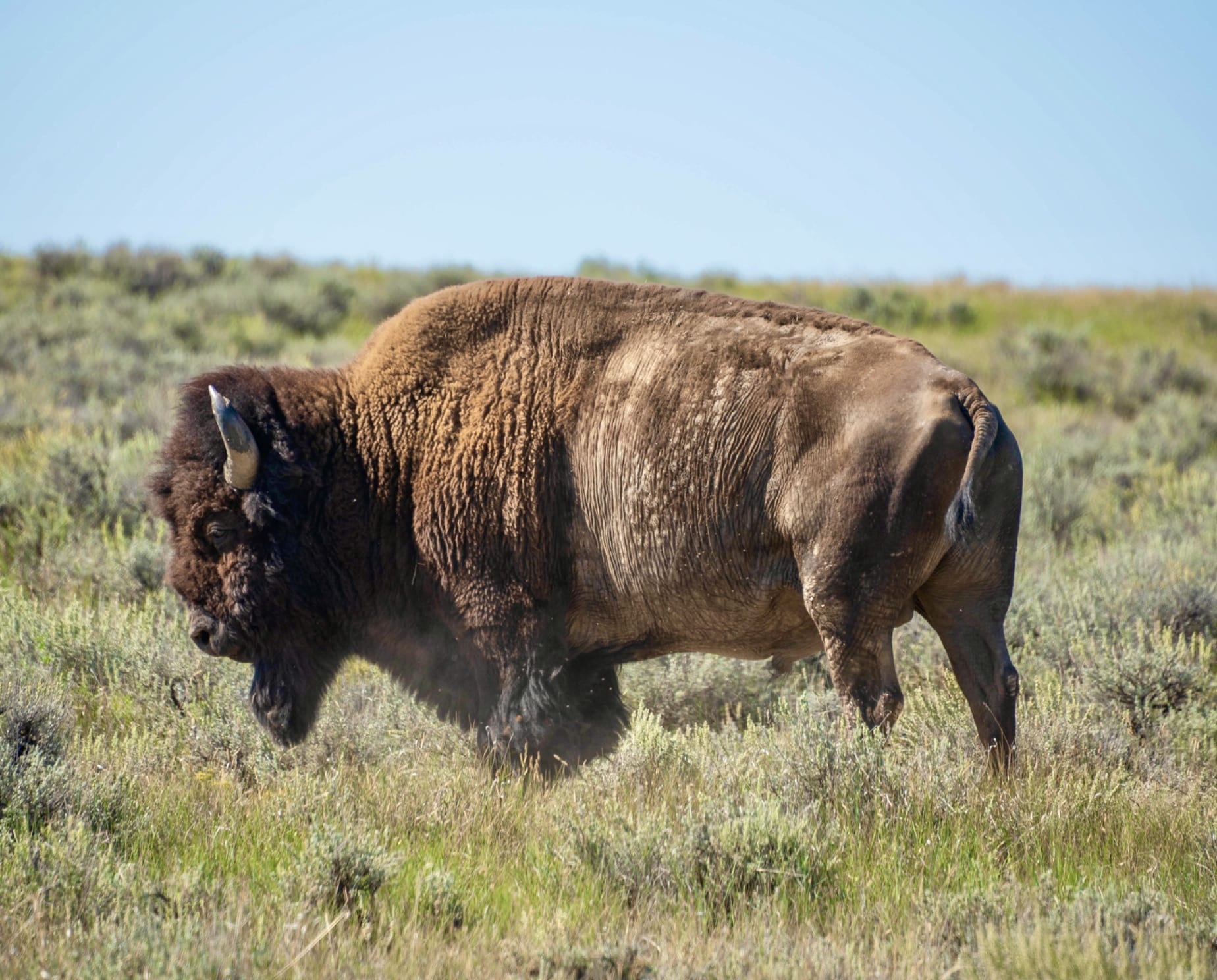
American Prairie is a not-for-profit conservation organization dedicated to restoring and preserving the last best piece of America’s once vast prairie grasslands. Rather than lobby the federal government to create a reserve through regulation and eminent domain, AP’s method is the purchase from willing sellers of ranches located in the midst of already existing federal, state and tribal reserves.
The goal is a three-million-acre expanse of public and private lands on which bison thrive, the prairie grasses bloom, a multitude of native flora and fauna prosper, and the American public can experience the beauty and serenity of the wild prairie.
The ranches purchased by AP have long-held grazing permits on public lands under the bipartisan Taylor Grazing Act of 1934. As the new owners of what the BLM calls base ranches, AP applied for a change of use from cattle to bison.
The BLM’s unprecedented contention that “the animals to be grazed … (must) be used for production-oriented purposes” overturns the settled expectations of generations of permittees and discounts entirely AP’s economic impact in the region.
As long ago as 2009 the BLM concluded that AP’s purpose in grazing bison (domestic livestock under Montana law) is not the agency’s concern. After lengthy review the agency approved several permits in 2022.
Numerous parties, including Montana’s governor and attorney general, appealed and were denied a stay by both the Interior Case Hearings Division and the Interior Board of Land Appeals. The permits were issued in March 2023.
Some ranchers and local community leaders have objected that American Prairie threatens their livelihoods and way of life, despite the reality of rural economic decline long before AP’s acquisition of any properties.
An option for the objectors would have been to outbid AP and purchase lands when they came up for sale. Instead, they have appealed to the state legislature, state regulators, the governor and representatives in Congress to kill the AP project by whatever means can be found.
After several failed efforts in the Montana Legislature, AP’s opponents have finally achieved a victory in BLM’s cancellation of seven grazing leases. In December of last year the Secretary of Interior assumed jurisdiction over the ongoing appeals of the BLM’s 2022 decision.
Barely six weeks later the BLM revoked AP’s permits that had been 13 years in the making. And in May it became final.
The revocation of AP’s grazing permits ignores that conservation was a central objective of a grazing system instituted in 1934 to prevent overgrazing of the public domain. It ignores that AP leases over 500,000 acres for cattle grazing and that other conservation organizations (The Conservation Fund, Grand Canyon Trust, The Nature Conservancy) hold BLM grazing leases.
American Prairie is appealing with strong arguments on both process and the merits. The reversal on six weeks consideration of a decision reached over more than a decade is, if anything, arbitrary and capricious and therefore a violation of due process.
The BLM’s unprecedented contention that “the animals to be grazed … (must) be used for production-oriented purposes” overturns the settled expectations of generations of permittees and discounts entirely AP’s economic impact in the region.
Since 2020, AP has provided 22 local jobs, $7 million in payroll, $877,000 in property taxes and an estimated $17 million to the local economy. Statewide the impact is 44 jobs, $22 million in payroll and an estimated $44 million to the economy.
The revocation of AP’s grazing permits ignores that conservation was a central objective of a grazing system instituted in 1934 to prevent overgrazing of the public domain. It ignores that AP leases over 500,000 acres for cattle grazing and that other conservation organizations (The Conservation Fund, Grand Canyon Trust, The Nature Conservancy) hold BLM grazing leases.
The ruling will require BLM to reconsider the many permittees who have implemented conservation measures or who graze livestock, horses for example, not raised for “production-oriented” purposes.
The Secretary of Interior’s assumption of jurisdiction in the wake of pressures from Montana’s governor, attorney general and representative in Congress confirms Richard Stroup’s apt description of public lands as political lands.
But political realities should not be allowed to override a century of laws designed to assure that our public lands are managed in the public interest and in accordance with an open, informed, and fair process.