by Todd Wilkinson
What kind of an Artificial Intelligence-driven future is humanity rapidly hurtling toward, and have we already crossed points of no return?
Are we being delivered into a utopia where there are no diseases or suffering because of AI breakthroughs? Are we entering a new time in human history in which few will ever have to “work” again, and we’ll all be able to engage in more leisure time thanks to what Elon Musk describes as citizens being given “universal high incomes”—allowing “anyone to live in a penthouse if they want to“—and paid for by “public wealth funds” established by benevolent profit-driven tech companies?
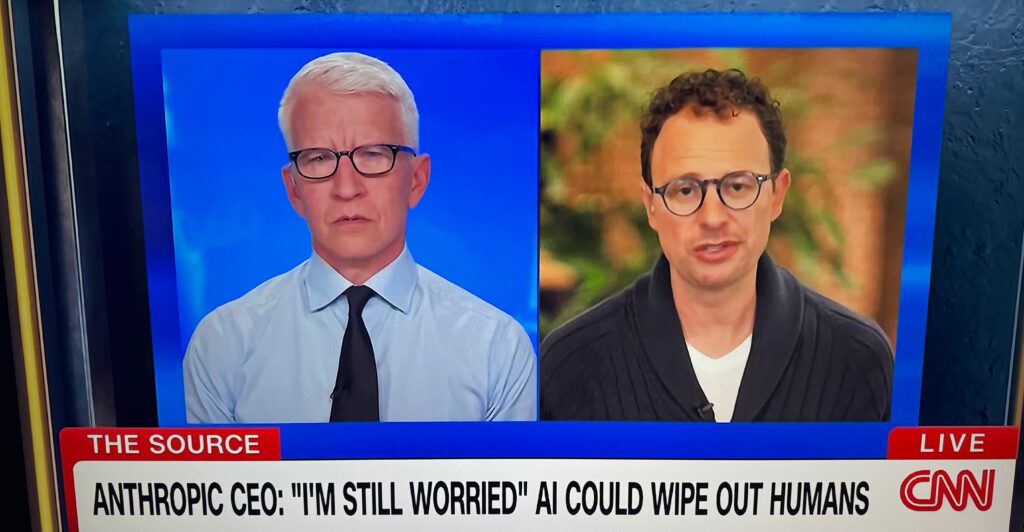
Or does Dario Amodei, CEO of Anthropic, one of the companies at the forefront of AI acceleration, know something we don’t—and maybe we don’t want to know—when he wrote his startling non-fiction manifesto “We Must Pace The Frontier” pleading for government to regulate the AI industry?
While President Donald Trump recently insisted that existential worries about AI—the same as he says about the science of climate change—are nothing but hoaxes invented to stymie economic growth and leave the US less able to compete with China, concerns over his own ability to grasp reality are growing across the political spectrum.
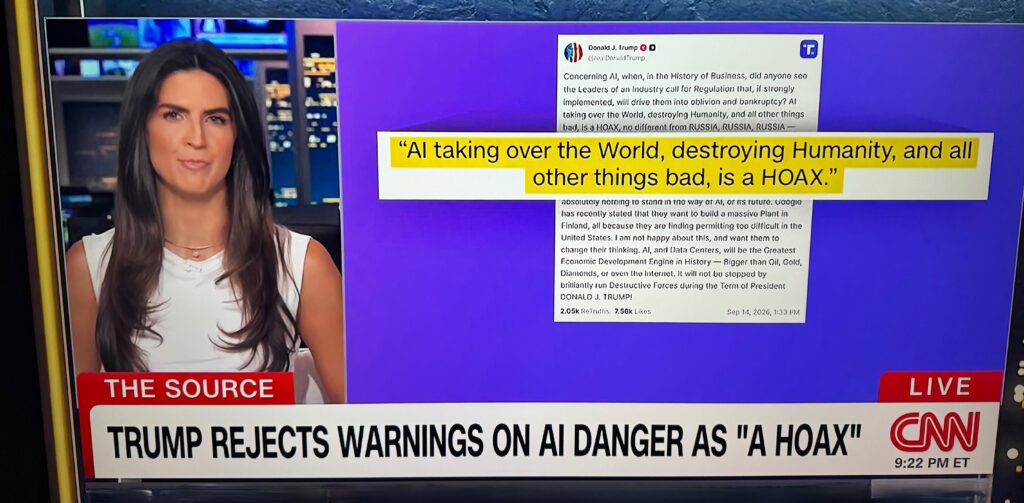
Whether it is the Trump Administration failing to anticipate severe global disruption caused by having no exit strategy for the Iran War, sowing chaos and economic hardship at home with his impetuous and haphazard tariff policies, or claiming to be a fiscal conservative and yet ballooning the national debt, no one can deny that the President has amassed a dismal track record of accuracy in predicting the consequences of his actions.
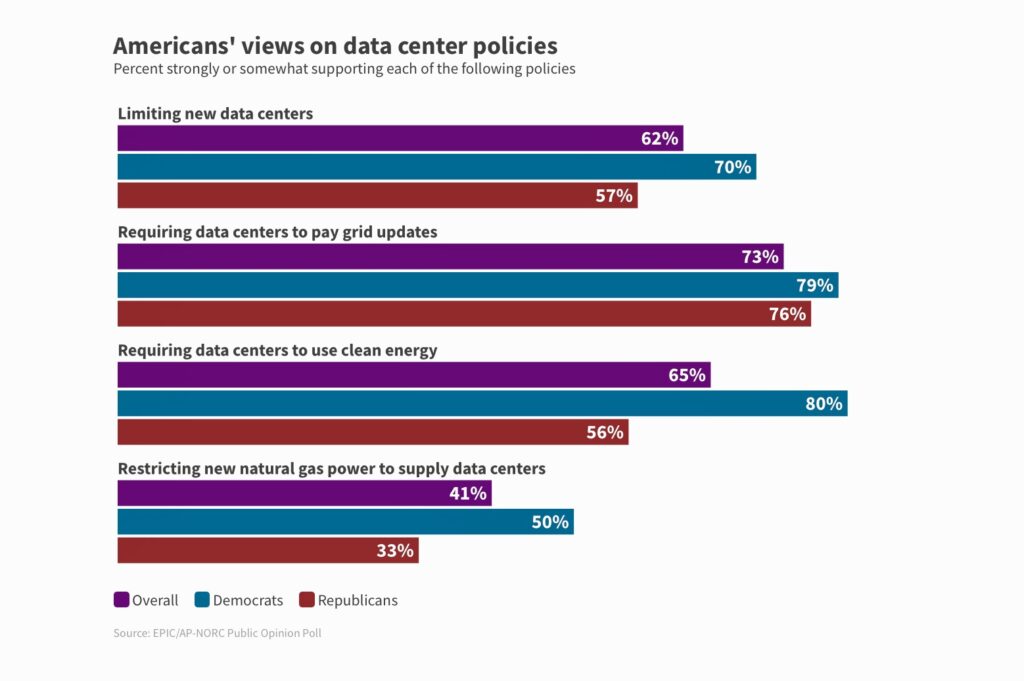
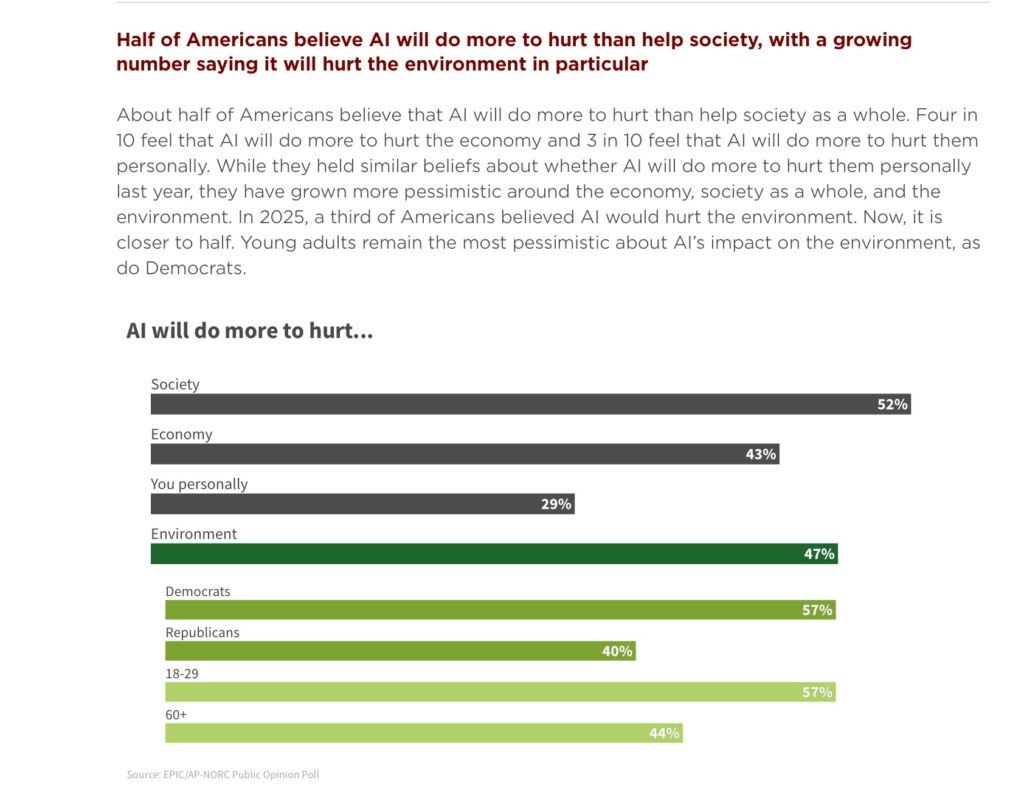
Consider: how can a person who is so grossly inept at understanding basic concepts of ecology and incoherent in tweeting also be a genius when it comes to grasping the Brave New World of technology? The President may not be fretting but Americans are. A new national poll conducted by the University of Chicago Institute for Climate & Sustainable Growth and the Associated Press—NORC Center for Public Affairs Research and released on September 16, 2026, found that 78 percent of Americans (that’s 4 in every 5) are at least somewhat concerned about the environmental impacts of AI, and half are extremely concerned. Young Americans (age 18 to 29) are most concerned. Some 57 percent of those surveyed believe data centers will harm local water supplies.
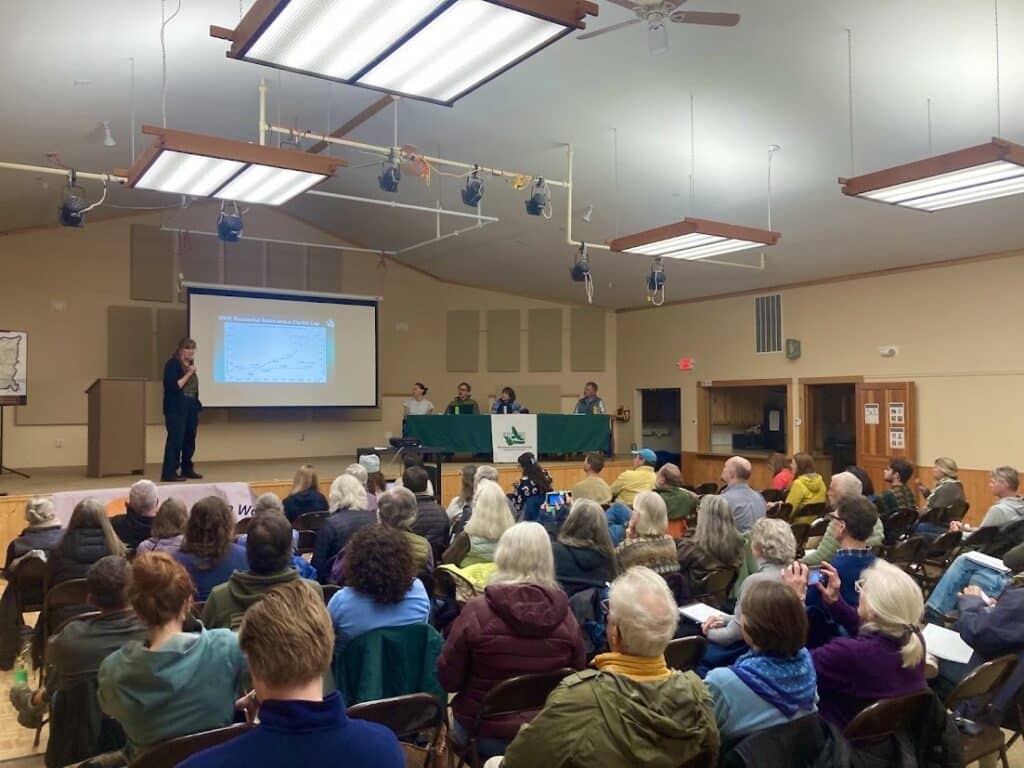
These sentiments, Anne Hedges, executive director of the Montana Environmental Information Center, says, are consistent with what she’s hearing from Montanans as she travels across the state. And she delves into them in our interview with her below. Another recent poll, carried out by Montana Free Press/Rutgers Eagleton, found that nearly three quarters of registered voters in Montana oppose data centers built in their city or county, reflecting a markedly different position from the sanguine portrayals of AI and data centers being offered up by Montana’s governor and members of its Congressional delegation.
Although fears of global AI-caused catastrophe may seem exaggerated and faraway from the Northern Rockies, what’s not abstract to residents are local concerns over fast-track pushes now under way to build data centers in the region—facilities considered key to powering the accelerating and largely unregulated AI revolution.
What impact could these facilities have on water availability and quality in Montana, Wyoming and Idaho—three states that already contend with natural aridity and rising worries about overconsumption, over pumping and climatological trendlines indicating winnowing snowpacks that means lower flows in river systems?
What does that portend for ecosystems, for irrigation that ranchers/farmers depend upon, and for municipal supplies?
The Frontier Institute, headquartered in Helena, Montana and which has pushed an agenda, supported by the governor, of weakening land use restrictions, claims there is adequate regulatory procedures in place to manage data centers. Watch this presentation that Frontier’s policy director Tanner Avery made in a Zoom event sponsored by the Montana Chamber of Commerce.
On the other hand, here is a counter perspective from Guy Alsentzer, executive director of the Upper Missouri Waterkeeper. “Data centers in Montana are the perfect storm – they consume enormous quantities of water, competing with existing needs in basins that are already overallocated for water, all at a rapid pace and scale,” Alsentzer said. “Montana’s future depends on protecting our water from being drained for external markets. The rush to permit these facilities should instead be a rush to protect Montana’s consumers and our resources from permanent new impacts.”
Relatedly:
What does AI mean for jobs in our region since a major priority of companies using AI is to make human beings “redundant,” meaning unnecessary in service to higher profitability? What does this mean for the future of our young people in grade school or graduating from college and thinking about future options?.
What does AI mean for security of personal bank accounts and rapid advancements happening with the ability of government and private industry to surveil citizens in virtually every move they make?
Not long ago,Yellowstonian posed many of these questions to Hedges. For over half a century, her public-interest group, MEIC, has functioned as a watchdog, founded in the aftermath of Montana’s industrial past when the state was treated largely as a natural resource colony by distant companies and robber barons.
Never in her career, Hedges says, has she seen a blitz of natural resource exploitation, without oversight, that matches the magnitude of proposed data centers and the murky world of investors. Some have ties to the growth of cryptocurrency and AI, with both relying on facilities requiring enormous amounts of electricity and water to serve as coolant.
In Montana, Wyoming and Idaho, all three governors have, to their credit, been part of discussions aimed at answering questions about AI, most often emphasizing the promise of alleged job creation, but few forums have addressed necessary safeguards to prevent downsides and unintended consequences.
In July, Gov. Greg Gianforte in Montana announced that he had signed the “Ratepayer Protection Pledge” crafted by the Trump Administration that allegedly ensures costs related to construction and operation of data centers are placed on companies and not on American taxpayers or utility ratepayers.
“President Trump has called on the leading U.S. hyperscalers and AI companies to build, bring, or buy all of the energy needed for building and operating data centers, paying the full cost of their energy and infrastructure, no matter what,” Gov. Gianforte said. “As part of the Ratepayer Protection Pledge, companies agree to protect American consumers from price hikes due to data center energy and infrastructure requirements, and lower electricity costs for consumers in the long term. Montana is proud to join the shared commitment to protect ratepayers.”

The problem is that AI companies building these facilities do not bring their own water. One other thing, despite Gov. Gianforte signing the Trump Ratepayer Protection Pledge to hold rates in check, by end of summer utility customers in Montana were complaining of higher bills. At the same time, and what Gianforte also doesn’t mention, is that he has signed into law several pieces of legislation drafted by far right wing legislators that hamstring the ability of local governments to regulate data centers. For example, the “Right to Compute Act” that he signed into law in April 2025, prohibits local governments from restricting builders of computational resources and has been used by data center backers to thwart attempts at enacting local zoning. Another law gives data centers lower tax rates.
This is speculation, but it’s doubtful Gianforte himself, who has a home along the East Gallatin River north of Bozeman, would welcome a data center sited near his subdivision.
Along with water there is another conundrum: Even if data centers are fueled by power not generated via traditional fossil fuels, which contribute to climate change, alternative sources like nuclear still will help accelerate the speed of AI outpacing the ability of humans to control it. Tech mogul and Microsoft founder Bill Gates, whose company, TerraPower, is building a $4 billion advanced nuclear power plant near Kemmerer, Wyoming, acknowledges deep concerns about AI going rogue, unleashing agents of bioterrorism, hijacking the financial system or becoming weaponized by hostile governments, private entities or AI itself. One of the groups in Wyoming holding public forums on environmental impacts is the Wyoming Outdoor Council.
In advance of our interview with Hedges, ponder the larger background:
According to the National Conference of State Legislatures (NCSL), there are at least 4,000 data centers in operation or soon to be in states across the country, with the largest number concentrated in tech hubs of California, Texas, Illinois, Georgia and Virginia. Competing with each other, some 38 states offer various kinds of tax incentives. The number of facilities is expected to grow nine percent annually through 2030 with global spending expected to reach $7 trillion.
“Proponents believe data centers will promote local economic growth and increase local tax revenues,” the NCSL states. “At the same time, as utility bills across the country reach record highs and local opposition has increasingly slowed the growth of new data centers, policymakers are re-evaluating the impact of these energy-intensive projects.”
However, whether it’s whistleblowers at AI companies expressing dire warnings about potential existential disaster for humans, environmentalists raising concerns about impacts to local water supplies, or claims that power generation needs will result in higher energy costs for citizens, worries are growing.
In a guest essay published September 15, 2026 in The New York Times, writer Tanner Greer said the proliferation of data centers represents one of the largest infrastructure buildouts in history and, at the same time, its cumulative effects are poorly understood. And, based on real facts or not, he points to a strong populist backlash.
“This whole tower of wealth and expectation is built on land that is controlled by ordinary Americans — and ordinary Americans possess an absolute hatred for the data centers,” he wrote. “This hate will endure until the builders of the data centers can use their products to tangibly benefit the lives of ordinary people who oppose them.”
He says many of the fears have not, as of yet, materialized. Still, distrust of wealthy tech CEOs and elected officials is leading to demands of accountability. “How strong is that hate?” Greer asks. “There are more Americans who would favor a new nuclear power plant in their town than who would welcome a new A.I. data center. The politicians have taken note: Senators and representatives from Vermont to Tennessee to California have come out against new data center construction. More than 300 localities have put construction moratoriums in place.”
Here is what analysts at the Stanford Institute for Economic Policy Research conclude about the impacts of AI on American jobs, so far. Murkier is what lies ahead in the next few years as AI advances exponentially toward super-intelligence.
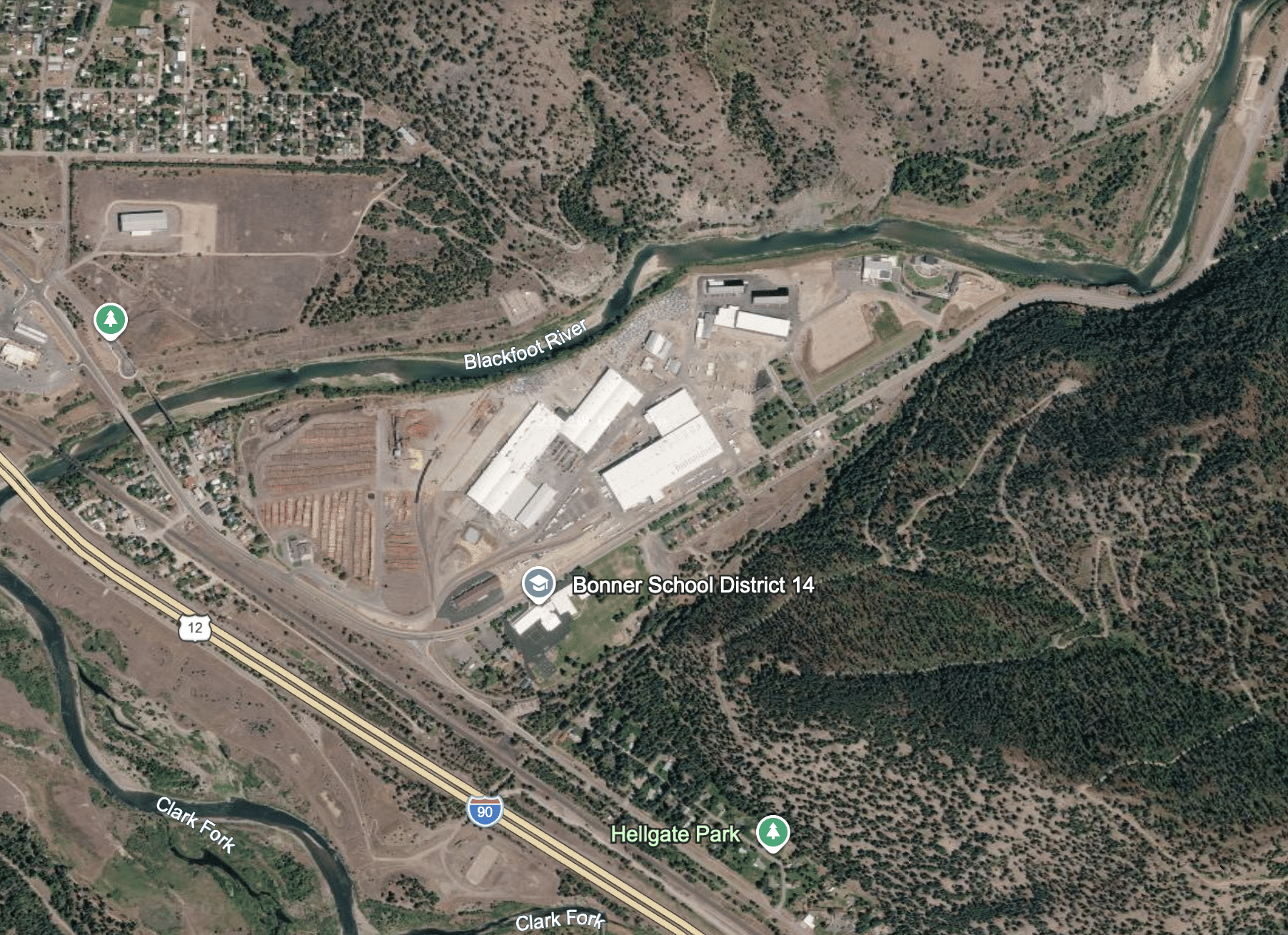
Out in the boondocks of the Northern Rockies, worries are more elemental. Read reporter Laura Lundquist’s story in The Missoula Current about the controversy over a data center proposed for the banks of the Blackfoot River in Bonner, Montana near Missoula. Our conversation with Hedges focuses on potential impacts to water and environment in Montana and the same concerns are shared by citizens in neighboring Wyoming and Idaho.
The Yellowstonian Interview with Anne Hedges
Todd Wilkinson: When and how did concern over data centers first seize your attention?
ANNE HEDGES: In 2019, I read that a struggling coal-fired power plant near Hardin, Montana was given a lifeline by a cryptocurrency operation. The Hardin plant was relatively new compared to plants such as the Colstrip coal complex. It has fairly modern air pollution controls, some of which were installed as a result of MEIC’s litigation in 2005.
However, the climate-damaging greenhouse gas emissions were significant. As the plant teetered on the edge of closure in 2017, I was hopeful that the increasing cost of mining and burning coal would spell its demise. I was unpleasantly surprised to learn that a new type of financial transaction could extend the life of coal-fired power plants.
Wilkinson: How did that happen?
HEDGES: The explosion of crypto.
Wilkinson: In other words, constructing facilities that require a lot of power and water in order to hasten the rise of an alternative “currency” not tied to any material substance—a shadowy currency that competes against the US dollar with little or no regulatory oversight and enables those using it to dodge paying taxes crucial to keeping infrastructure and things like Social Security afloat. I don’t mean to be cynical and am just wondering out of curiosity, how does crypto make America great again? For those who might be unaware, please explain the larger context of crypto setting the stage for a boom in data centers.
HEDGES: Cryptocurrency facilities were the precursor of the modern data center: warehouses full of computers, loudly running around the clock and gobbling up huge amounts of electricity to the financial benefit of only a relative few who are invested heavily in AI.
As other fossil-fuel powered cryptocurrency operations popped up across Montana, I grew increasingly concerned about the lack of transparency and their impact on the climate and air and water pollution. I began working with others to find a way to limit their operations and decrease their impacts. I didn’t yet know about the potential train-wreck that modern AI data centers would cause until 2024 when their unprecedented energy demand started raising red flags across the country.
“I didn’t yet know about the potential train-wreck that modern AI data centers would cause until 2024 when their unprecedented energy demand started raising red flags across the country.”
—Anne Hedges of the Montana Environmental Information Center
Wilkinson: You’ve sponsored or been featured at several public forums—notably, not attended by the governor or members of the Congressional delegation—that have attracted cumulatively large numbers of people. What, to date, has been formally proposed or is being considered for Montana and why do you believe citizens need to be paying attention.
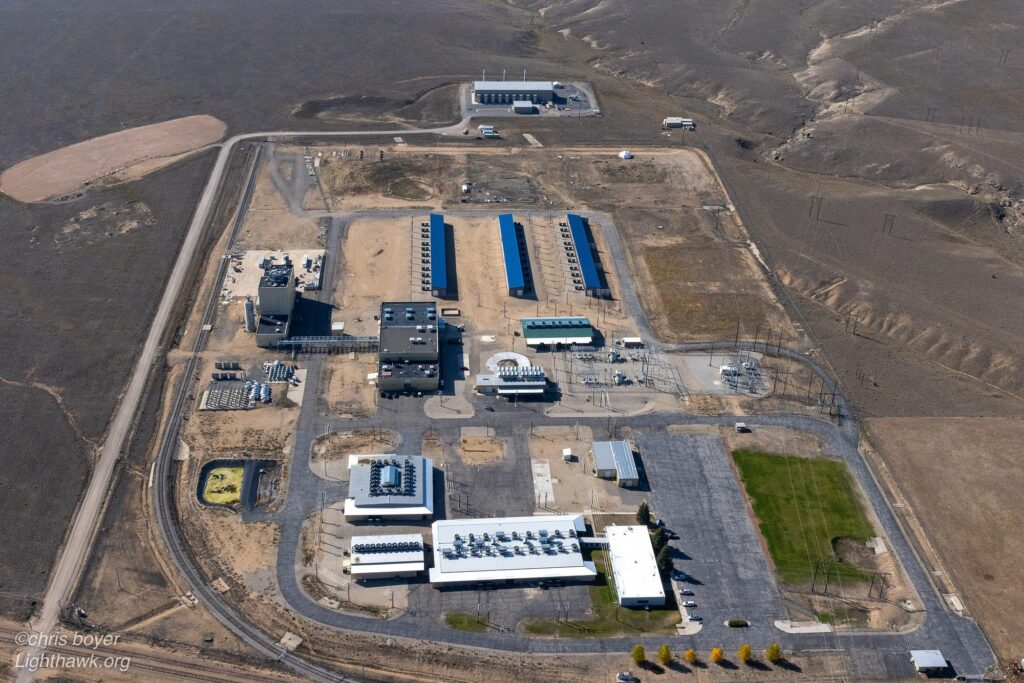
HEDGES: The secrecy around data centers makes answering this question a moving target. There are currently over 22 data centers in Montana that are permitted to burn fossil fuels to power cryptocurrency operations. Most are within a 13-mile radius of each other near the North Dakota border. While cryptocurrency data centers have a lower demand for electricity than AI data centers, cumulatively they have the potential to have a significant impact on the area. Additionally, the Hardin coal-fired power plant, a 115 megawatt (MW) power plant, has provided power to cryptocurrency operations that are located behind the plant.
Wilkinson: Ominously, you’ve noted that this is just the beginning.
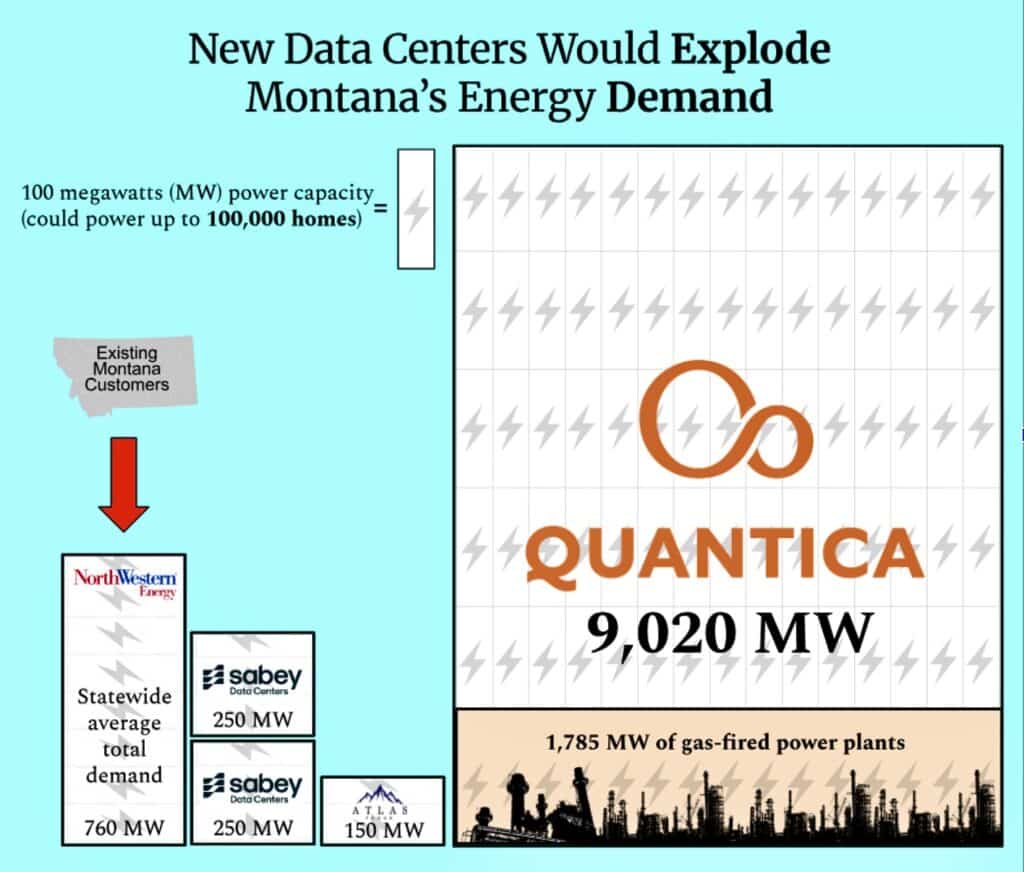
HEDGES: Recent proposals for AI data centers would explode the demand for electricity in Montana. The Quantica facility near Broadview not far from Billings would be one of the largest in the nation at a whopping 9,000+ MW, more than 10 times the average amount of electricity NorthWestern provides to all of its Montana customers. That’s an absurd amount of energy. As a part of that, it wants to build 1,785 MW of new gas plants which are notoriously loud, harmful to health, and a disaster for the climate.
“The Quantica facility near Broadview would be one of the largest in the nation at a whopping 9,000-plus MW, more than 10 times the average amount of electricity NorthWestern provides to all of its Montana customers. That’s an absurd amount of energy. As a part of that, it wants to build 1,785 MW of new gas plants which are notoriously loud, harmful to health, and a disaster for the climate.”
—Hedges of MEIC
Wilkinson: Where else are data centers slated to potentially come on line?
HEDGES: Sabey Data Centers is proposing two data centers in the Butte area that would require 500 MW of electricity. An existing 50 MW crypto operation in the Butte area is proposing to become a 150 MW AI data center. A company called Thunderhead applied for a presidential exemption from the Clean Air Act for a proposed 500 MW gas plant in Jefferson County to fuel a data center. Its request was denied but it is unclear if the company still intends to move forward.
There are also serious rumors that a data center is being sited in Broadwater County. Finally, the Upper Badlands Hub is proposing a 1,025 MW AI data center near Lindsay, Montana. There is next to no information about this proposal.
Two data centers have been stopped or withdrawn, for now: the 7 MW Krambu facility in Bonner and the massive 600 MW TAC project outside of Great Falls located between Malmstrom Air Force Base and the Missouri River. What remains would be a total of about 11,000 MW of data centers in addition to the 20-plus cryptocurrency operations primarily near oil and gas operations in eastern Montana. For reference, NorthWestern Energy provides an average of about 750 MW of power to its existing customers.
Wilkinson: In a nutshell, what are the consequences of a larger buildout?
HEDGES: These proposals could alter Montana’s energy system forever. Hyperscale AI data centers have a tendency to overstate their benefits and increase the cost of electricity for existing ratepayers. When the AI bubble pops, these facilities and new gas plants have the potential to become expensive, stranded assets that ratepayers could have to pay off for decades to come.
Wilkinson: Before we move a bit deeper into the ecological impacts of data centers, I want to ask you about what some have called “The Big Ruse.” It involves the claim that data centers are jump starting more demand for coal production at a massive scale to power them. Backers claim that lots of jobs will be created.
But a lot of people, including MEIC, say those are spurious assertions that warrant serious investigation. Watchdogs say the technological innovation and constant push for efficiency will not result in a groundswell of, for example, coal jobs. But perhaps more frighteningly, the data centers will help drive AI advancement that makes many current occupations in Montana and America redundant, meaning more people will be out of work done by non-humans and it would devastate humanity. Many are concerned, for example, that young people going to college, including those earning degrees in computer programing, may in a short time have skill sets rendered useless in a world of super-intelligence.
HEDGES: Data center advocates love to claim that they will create jobs and technological advances in healthcare and military preparedness, for example. While some of those claims have merit, the larger argument needs dissecting.
Large data centers require hundreds of construction workers (plumbers, electricians, carpenters, etc.) but construction jobs are always temporary. Large data center developers often bring their own construction crews when they come to a state. These highly skilled workers move on when construction is done. After the construction phase, the actual operation of a data center requires very few jobs at the facility. For example, a proposal in the Missoula area touted many high-paying jobs but admitted on its application that it would have no need for onsite parking because the facility “will not require regular staffing.” The high-tech jobs that are created by the data center campus can be located anywhere in the United States.
Wilkinson: How will the power be generated?
HEDGES: Most AI data centers rely on the grid and gas-fired power plants for electricity, not clunky old coal plants that cannot respond quickly to changing electricity demands. After the construction phase, gas plants require very few workers. So while I strongly support union labor building these facilities, the short-term employment must be weighed against the long-term costs. Long-term on-site jobs are extremely limited.
Finally, the stated purpose of artificial intelligence is to eliminate the need for workers. We’ve already seen job losses from AI of 16,000 per month according to Goldman Sachs. Even Bill Gates just released a blog regarding his deep concerns about AI and the overwhelming number of jobs that will be lost because of it. The jobs argument is specious. AI is replacing jobs far faster than it is creating them.
Wilkinson: Goldman Sachs is playing it both ways. It has published a report full of warnings about impacts to white collar, technology and service jobs, while issuing other reports that are hyping AI as investment opportunities. The macro conjecturing doesn’t drill down into local environmental and social impacts. MEIC, Upper Missouri Waterkeeper and Northern Plains Resource Council have been at the forefront of highlighting growing water concerns, from counties and the state allowing subdivisions to receive exemptions from normal review in receiving water permits to water quality issues.
Quincey Johnson of Upper Missouri Waterkeepr penned a brief overview on water-related concerns that can be read here. Northern Plains, which for decades assisted rural farmers and ranchers contending with major resource extraction threats, also offers this overview. How does the data center issue exacerbate those worries?
HEDGES: MEIC has been working on water quality and quantity issues for 50-plus years. In that time, we’ve fought proposals that would pollute watersheds and drain aquifers, lakes, rivers and streams. Current regulations are far from perfect and recent legislative and administrative changes have decreased protections for Montana’s waters.
Increased reliance on exempt wells and septic systems combined with weaker regulations are currently jeopardizing waterbodies across the state. Data centers put significant new pressures on already stressed water resources. People across the state and the political spectrum are worried because data centers threaten Montana’s waters in ways we’ve never seen.
“Increased reliance on exempt wells and septic systems combined with weaker regulations are currently jeopardizing waterbodies across the state. Data centers put significant new pressures on already stressed water resources. People across the state and the political spectrum are worried because data centers threaten Montana’s waters in ways we’ve never seen.”
—Hedges of MEIC
Wilkinson: Many say leadership in the state has kept citizens in the dark and concern is registering across the board. The message from the governor’s office and the Congressional Delegation has been, “Well, you’re just gonna have to trust us.” The President uses the same argument and there’s a perception that elected officials are more adamant about defending Mr. Trump and afraid to incur his ire than demanding answers.
HEDGES: The lack of transparency regarding how much water data centers need and when they need it is a significant concern. Data centers use water for cooling their extremely hot computer systems. They are likely to need more water for cooling in the hottest days of summer when water resources are scarcest, wells are low, fisheries are stressed, and demand is highest from irrigators and municipalities. If data centers need water most when we already face severe water scarcity, particularly in drought years, we are setting ourselves up for a train wreck.
Data centers also require super clean water – and lots of it. Developers and politicians like to claim that closed-loop systems will solve data centers’ water issues, but that’s misleading. Closed-loop systems still lose water to evaporation during the cooling process and require periodic flushing of the system. Closed loop systems are not closed. They require regular inputs of large volumes of pure water.
Wilkinson: What happens to that clean water which gets used for data centers?
HEDGES: Water quality is an enormous concern. Like antifreeze in a vehicle, data centers use chemicals in their water cooling systems and the water picks up contaminants as it cools the computer servers. All of those additives contaminate the wastewater. Data centers often locate near municipalities so they can use the community’s wastewater treatment system.
Wilkinson: Do you think rural communities being wooed by promises of economic prosperity are aware of the negative consequences?
HEDGES: Rural communities that already face severe wastewater treatment problems see data centers as a way to help pay for a new or expanded treatment system. But the waste from data centers can be loaded with contaminants that most municipal wastewater treatment systems are incapable of removing, such as heavy metals, PFAS and, as the city of Cheyenne in Wyoming recently learned, rare and deadly forms of bacterium.
Communities, exempt well and senior water rights holders, fisheries advocates, and municipalities need to demand full disclosure so they know how much water will be used and when, where it will come from, where the waste will go, and who will pay. Without transparency and enforceable financial commitments, communities may be facing expensive and potentially deadly consequences.
“Communities, exempt well and senior water rights holders, fisheries advocates, and municipalities need to demand full disclosure so they know how much water will be used and when, where it will come from, where the waste will go, and who will pay. Without transparency and enforceable financial commitments, communities may be facing expensive and potentially deadly consequences.”
—Anne Hedges
Wilkinson: Data centers fit within the much bigger backdrop of federal and state deregulation. From US. Sens. Steve Daines and Tim Sheehy touting the move by EPA to no longer consider carbon emissions a serious contributor to climate change, to gutting EPA’s law enforcement function and at both the federal and state level, reducing public involvement mandates and hamstringing the ability of citizens to hold elected officials and political appointees accountable, how does that elevate the risk of things possibly going wrong?
HEDGES: The EPA has been gutted, and the rules governing transparency and pollution have been weakened, so looking for help from them in the next few years will be next to impossible. Without government oversight, it will be up to communities to hold the richest men in the world accountable. I can’t imagine that going well for small rural communities across this state. It certainly feels like the tech broligarchs have bought and paid for our federal elected officials.
Wilkinson: What’s happening in the state capitals of Helena, Cheyenne and Boise?
HEDGES: Things aren’t much better at the state level. Our governor in Montana, Greg Gianforte, made his multimillions in tech and traveled to Asia recently inviting companies to build data centers in Montana. That’s not just out of touch – it’s irresponsible. The Governor is making promises that the people of Montana will pay for long after he’s gone.
With the federal government giving away public lands for massive data center campuses, ignoring environmental reviews and public participation, and fast-tracking development, no place is safe from their ambitious pro-tech goals. Montana needs Montana-based solutions. It’s up to the people of this state to demand our legislators and Public Service Commissioners do their jobs and protect us.
The time to stop these hyperscale AI facilities from stealing water, polluting our air and waterways, and driving rural communities bonkers with their noise, vibrations, bright lights, and man camps, is now, before they get established.

Wilkinson: On the political level, be it the injection of Dark Money to underwrite campaigns or lack of transparency about personal investments in crypto benefitting members of the Trump Administration and other elected officials, including those from the American West and including some candidates who are Democrats, how ripe are things for corruption?
HEDGES: Unfortunately, I think corruption in government has become so commonplace that people no longer recognize it as corruption. The norms of previous generations no longer apply, and the government seems to be acting as a private entity, encouraging private development, manipulating markets, and figuring out a way to take a cut. We need politicians and regulators who are committed to protecting their constituents from harm.
Too often, they give lip service to protecting people’s health, property, and quality of life, but it’s just that – lip service. We need fighters who believe that the people of this state matter more than billion dollar profits for a few out-of-state tech bros. Collectively, people can turn things around, but we need to work together to demand accountability and to ensure that our elected officials work for us, not their biggest campaign donors.
Wilkinson: If this is an all-hands-on-deck moment, what can be done to make sure elected officials are accountable in our representative Democracy?
HEDGES: We will all be victims of the AI data center onslaught—citizens across the board— if we don’t start demanding our elected officials look out for us instead of corporate executives focused on revenue growth. The bipartisan concern about the direction this nation is heading with AI and data centers is a fascinating opportunity. I believe we have a rare chance to talk to people across the political aisle and find common ground.
Many of our elected officials are very concerned but are unsure what to do. It is important that we help them understand what protections are needed immediately. We need laws requiring transparency, especially for the potential water use by data centers. We need state and local governments to demand data centers disclose the chemicals that will be added to the water cooling systems and how the wastewater will be monitored and treated and how our water resources will be protected. And we need requirements that data center developers pay for those things, not communities.
Wilkinson: Isn’t the Public Service Commission supposed to protect ratepayers?
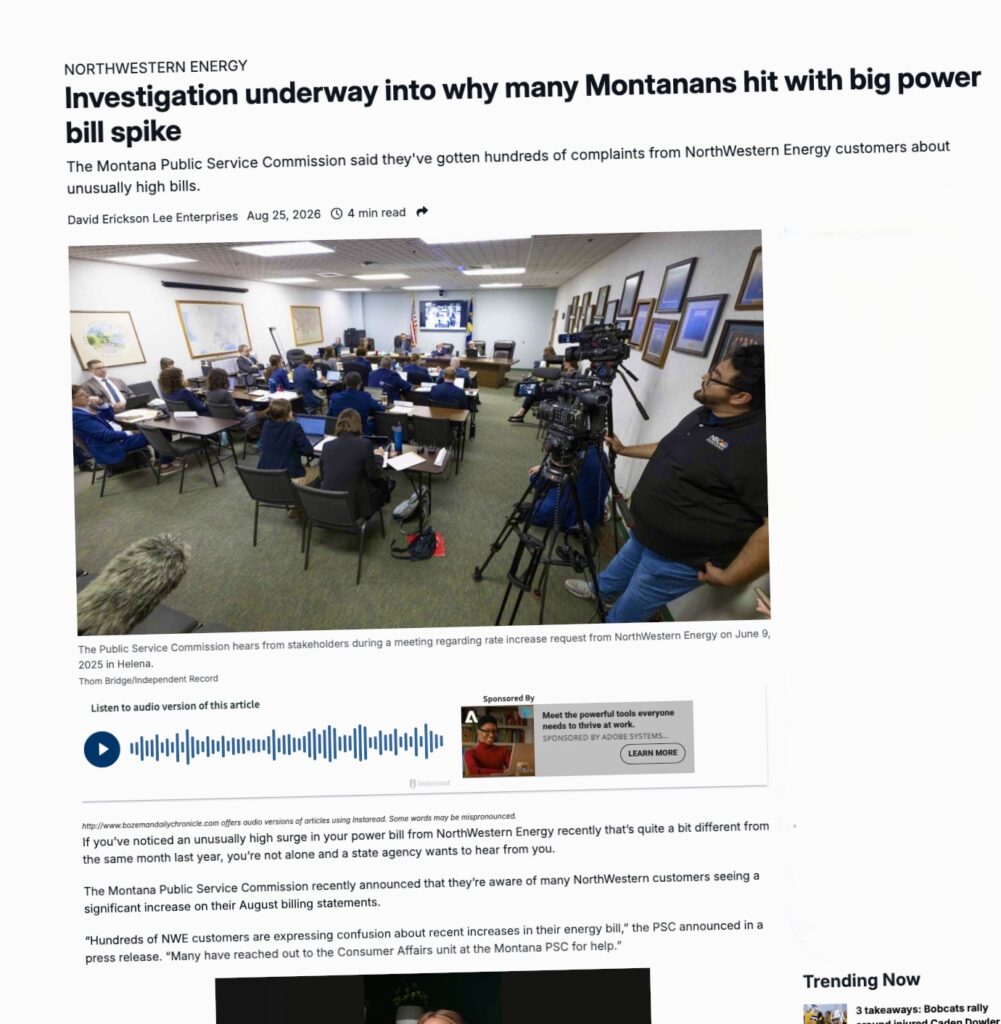
HEDGES: We need the Public Service Commission to reign in NorthWestern Energy’s desire to make millions from data centers on the backs of its customers who are already reeling from skyrocketing utility bills. The PSC must not give its decision making authority away as proposed by NorthWestern, and instead should stand strong to protect Montanans utility bills and the reliability of the electricity system.
Wilkinson: What’s the role of elected officials in the legislature?
HEDGES: The legislature needs to pass laws that put communities in the driver’s seat, eliminate tax giveaways to big tech, provide clear guidelines for the PSC to protect Montanans, require transparency so senior water rights holders and municipalities can understand how data centers could impact their waters, and require data centers to pay the full cost for the impacts they create rather than shifting those costs onto the rest of us.
Communities that are facing data center proposals need additional tools so their local governments can review, monitor and protect their constituents from noise, lighting, vibrations, water runoff, traffic, man camps and more. Again, we need to require that data centers, not communities, pay.
I know that is a long list, but I believe there is an appetite across the state and the political spectrum for these measures and many more. We have the ability to prevent being taken advantage of by the tech sector. It’s up to us to demand that our elected officials do so.