“The trophy-recreationist has peculiarities that contribute in subtle ways to his own undoing. To enjoy he must possess, invade, appropriate. Hence the wilderness that he cannot personally see has no value to him. Hence the universal assumption that an unused hinterland is rendering no service to society. To those devoid of imagination, a blank place on the map is a useless waste; to others, the most valuable part…Recreational development is a job not of building roads into lovely country, but of building receptivity into the still unlovely human mind.” —Aldo Leopold in the last pages of A Sand County Almanac
by Todd Wilkinson
To peruse websites devoted to promoting the outdoor recreation industry, a reader greeted with the economic statistics cannot help but be impressed. Recent estimates are that the amount of economic impact generated in America from outside leisure activity surpasses $1.3 trillion annually. That’s a lot of toys purchased, jobs created and unforgettable memories stored in the cloud.
For comparison, the total annual value of the US hardrock mining and rare earth minerals industry is $112 billion. The total annual value of the oil and gas industry is between $500 billion and $1.7 trillion, with the value-added effect of developing fossil fuels, as a contribution to gross domestic product, being $2.1 trillion.
The total market size of the US coal industry, meanwhile, is around $68.8 billion and about double in its asset value. The total value of the public lands timber industry, which generates just four percent of total annual wood products, is between $100 million and $300 million.
One thing about the mining, energy and timber industries is that on public land they are regulated; less so nowadays but in modern times since the 1970s major mines, tree felling and full field energy development on public lands have been subjected to environmental review, public comment and the right of citizens to sue to stop or improve projects.
Nothing close exists with the outdoor recreation industry because the effects of outdoor recreation are diffuse and only interpreted with a favorable ledger sheet in mind.
To keep outdoor recreation’s $1.3 trillion juggernaut growing, which is the aim of all industries, access to more land and water, and accommodating more users has become a rare unifying rally cry, promoted by both the political Right and Left, by local chambers of commerce, by state tourism boards, by outfitters and guides, prominent paid funhog ambassadors and even by many mainstream conservation organizations who claim that outdoor recreation has made the public land protection movement a lot stronger and resilient.
One word seldom mentioned and, if so, then only generically among other virtuous sounding terms like “balance,” “common ground” and “sustainability,” is “wildlife.”
Were a person to do an extensive reading of outdoor industry messaging—and we have, hundreds of thousands of words worth—one would discover that almost never mentioned or acknowledged are impacts to wildlife being caused by the growing deluge of sheer multitude of recreation users, and, correspondingly, the rapidly-expanding infrastructure of roads, trails, parking lots, river put-ins and take outs, front country and backcountry facilities and amenities.
What is the end game of this massive build out? What does it mean for America’s most iconic wildland ecosystem? At its current unconstrained trajectory, what will all wild country in America look and feel like in another generation?
Why aren’t these questions being asked by more professional “conservationists?”
What is the end game of this massive build out? What does it mean for America’s most iconic wildland ecosystem? At its current trajectory, what will all wild country look and feel like in another generation? Why aren’t these questions being asked by more professional “conservationists?”
Billions of federal dollars are now flowing to federal land management agencies and states with the mandate of packing more humans into Western wildlands. Yet lacking on the Public Square are strong voices demanding that the effects of outdoor recreation on wildlife, at the local and macro scales, be quantified; and that if use is shown to be surpassing carrying capacities for species populations to persist, then limits in human numbers be considered.
In fact, in reading executive orders being issued by the Trump Administration and tweaks to federal laws being proposed, new liberal policies allow public land managers at the local level to bypass scrutiny of impacts and greenlight trail and infrastructure expansion at their own discretion. A century ago, Aldo Leopold, sage of the modern land ethic, warned about those promoting industrial outdoor recreation as a panacea alternative to the era of public land robber barons who are now back with more horsepower and financial backing than ever before.
For a long time, the outdoor recreation industry has asserted there’s an absence of evidence that connects industrial recreation to impacts on wildlife. But today, in the wake of Covid and the inundation of people it brought to sensitive areas in the Greater Yellowstone Ecosystem and other parts of the Lower 48, impacts can no longer be denied. Outdoor recreation, combined with rural sprawl degrading wildlife habitat on private land, is now widely recognized as a major concern, though employees of federal and state wildlife management agencies are afraid to speak up.
What kind of evidence exists? Every month, it seems, a new study emerges that shows how differing species of wildlife are being displaced but there has never been a significant hearing held in the halls of Congress or state houses about the toll.
A few years ago, conservation biologist, Dr. Courtney L. Larson, who now works for the Wyoming State Chapter of The Nature Conservancy, had been part of a landmark study while she was earning her PhD at Colorado State University. Larson’s research team completed the largest summary of studies gauging the effects of recreation and human activity on wildlife.
Some 93 percent of the studies found at least one significant effect of recreation on wildlife, most of which were negative: “…there is growing recognition that outdoor recreation can have negative impacts on biological communities. Recreation is a leading factor in endangerment of plant and animal species on United States federal lands and is listed as a threat to 189 at-risk bird species globally.”
This is especially relevant now because the Trump Administration, in league with free market property rights groups like PERC based in Bozeman, have pushed for having the “harm” and “take” provision stricken from enforcement of the Endangered Species Act. The net effect is that habit loss, which harms the health of a species or species population, will no longer be a priority in biological recovery plans. This has particular consequences in pondering the impacts of outdoor recreation.
Larson and other authors wrote in the 2016 study wrote: “Effects of recreation on animals include behavioral responses such as increased flight and vigilance; changes in spatial or temporary habitat use; declines in abundance, occupancy, or density; physiological stress; reduced reproductive success; and altered species richness and community composition. Many species respond similarly to human disturbance and predation risk, meaning that disturbance caused by recreation can afford trade-off between risk avoidance and fitness-enhancing activities such as foraging or caring for young.”
“Effects of recreation on animals include behavioral responses such as increased flight and vigilance; changes in spatial or temporary habitat use; declines in abundance, occupancy, or density; physiological stress; reduced reproductive success; and altered species richness and community composition. Many species respond similarly to human disturbance and predation risk, meaning that disturbance caused by recreation can afford trade-off between risk avoidance and fitness-enhancing activities such as foraging or caring for young.”
—A synopsis of impacts following an examination of hundreds of studies focused on how outdoor recreation affects wildlife
In an article of explanation for The Conversation, Larson along with Sarah Reed and Jeremy Dertien who were co-authors in the studies above, explained that “we examined 330 peer-reviewed articles spanning 38 years to locate thresholds at which recreation activities negatively affected wild animals and birds. The main thresholds we found were related to distances between wildlife and people or trails. But we also found other important factors, including the number of daily park visitors and the decibel levels of people’s conversations.”
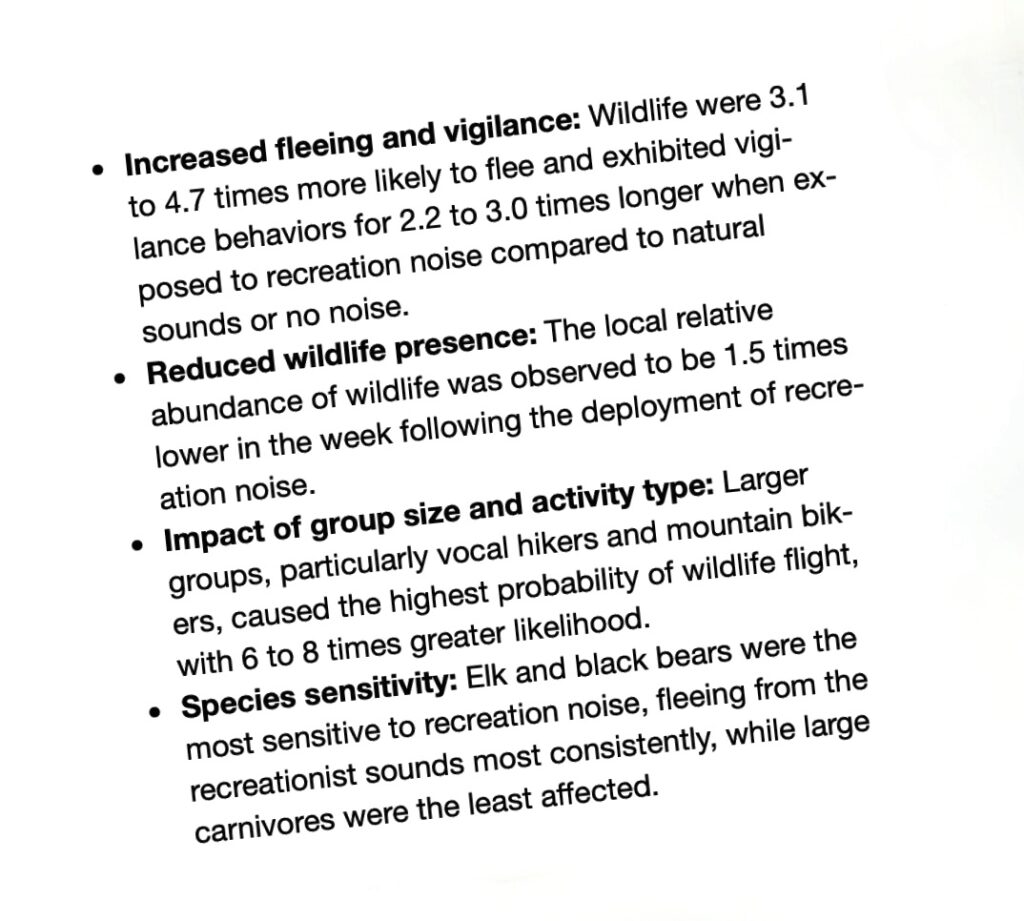
The latter was corroborated by a noise study published in 2024 focused on the Bridger-Teton National Forest around Jackson Hole that found wild animals are more likely to run away from sounds made by hikers and mountain bikers than ATVs. In other studies, motorized recreation has shown to be more disruptive.
Corroborating evidence goes on and on—if a reporter, federal land manager, or conservationist is willing to look for it—and it points the finger not at one use, but the combined effects of all that cannot be ameliorated by simply focusing on a singular cause of disruption and then solving for it.
For example, in a recent analysis, scientists found that”elk were nearly half as likely to occur in locations during summer weeks where the model-based recreation estimate exceeded 22 people/day and the camera-based recreation estimate exceeded 2 people/day. These findings support recent work indicating that low levels of recreation have the potential to displace wildlife species.” Another study concluded “that elk avoided areas where humans were recreating. This avoidance resulted in habitat compression. All-terrain vehicle use was most disruptive to elk, followed by mountain biking, hiking, and horseback riding. When exposed to these activities, elk spent more time moving rather than feeding and resting.”
Creeping sprawl and recreation pressure in Colorado have been cited in elk declines around the development colossus that is Vail, and the surrounding White River National Forest that notches between 14 million and 15 million recreation visits annually—the most of any national forest in the country. The most formidable predator of elk and other ungulates is not wildlife predators, but habitat loss. A headline in the Vail Daily newspaper, based on interviews with state wildlife officials, said this: “Colorado wildlife officials say elk herds may not be sustainable over the next 20 years. While elk look plentiful in areas, data tell a different story.”
Read this analysis from Backcountry Hunters & Anglers that expressed concern about efforts pushed by the Outdoor Alliance to markedly expand trails on three national forests in Colorado, representing a parallel to what it has been doing across the West.
Another study showed that mule deer may experience increased predation risk when they shifted toward nocturnal activity in response to human recreation. Another study noted that human activity resulted in elk foraging less and showing increased signs of stress. Research has shown that higher levels of human activity reduced habitat suitability for bobcats, gray fox, mule deer and raccoons. Human activity has also been linked to declines in reptile species. Recreation has been cited as a factor in endangerment of plant and animal species on federal lands, and of all U.S. states, California has the greatest number of listed species that are threatened by recreation.
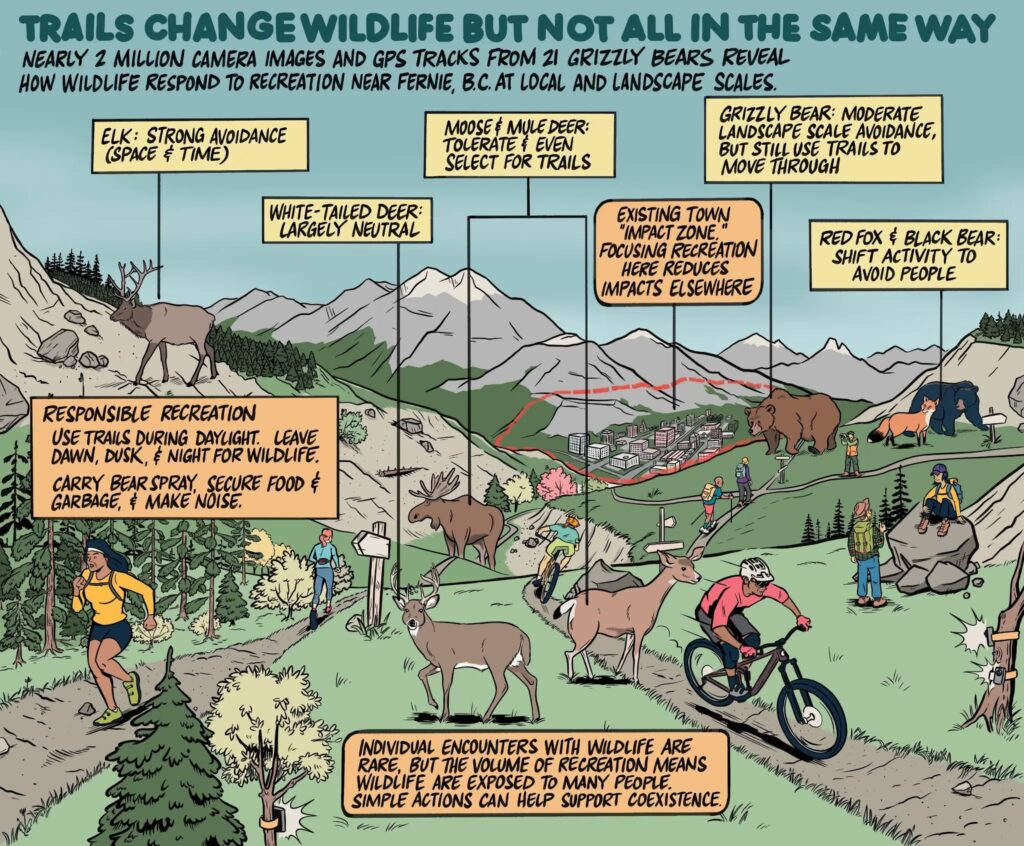
Plus, there’s an additive agent of displacement—outdoor recreation in the company of dogs. But not all correlation is linear and responses vary, depending on species, type of use and other factors. This study, authored by Clayton Lamb and Emily Chow, published in the Journal of Mammalogy, focused in the Canadian Rockies near Fernie. Fernie is a mountain town in the Elk Valley of British Columbia and a destination for outdoor recreationists, akin to others in Montana, Wyoming and Idaho where wildlife values are high. Their study involved multiple species and showed that elk exhibited the most avoidant behavior to recreation, while the response from grizzlies and other species was more nuanced. In some cases, wildlife prefered using recreation trails rather than game trails.
“Mitigating the negative effects to Elk and Grizzly Bear could be accomplished by concentrating recreation in high-use, predictable areas such as those around existing towns. Such an approach reduces the spatial extent of disturbance because the towns themselves already have a buffer of impacts around them and provides low use refugia for more sensitive species in the areas outside the concentrated recreation areas. Seasonal or spatial closures may be warranted in areas that overlap with key habitats or during vulnerable periods such as Bighorn Sheep lambing areas or bear dens,” the authors wrote. “To protect the nocturnal and crepuscular periods that wildlife often begin to use as pressure increases during the day it is recommended to concentrate recreation pressure during the summer daylight hours between 9 AM and 7 PM. The very low rate of near encounters between recreationists and wildlife, particularly large carnivores, suggests that current patterns of recreation do not pose a high risk of conflict, though proactive measures such as signage, concentrating use during the day, and education remain important to keep people safe. Wildlife in the Fernie trail network frequently adjust their behavior to minimize interactions with recreationists, likely as a means of reducing risk. Given that animals are modifying their behavior to coexist with human use, it is equally important that recreationists do what they can to coexist with wildlife.”
Despite such advisements, federal land management agencies in the US continue to approve expanded recreation without establishing a baseline of how wildlife behave in largely undisturbed settings, how that changes with differing use levels, how populations have already been impacted, and how much tolerance wildlife has and how populations are affected over time. No such analysis occurred when the Custer-Gallatin National Forest completed a management plan update expected to guide growth in recreation for decades to come. The plan mentions “adaptive management” but forest officials have admitted two things: first, they do not have adequate staffing to adequately manage recreation and stop illegal trail construction as it is, and it’s exceedingly rare that the forest, absent a lawsuit brought by conservationists on behalf of wildlife, has severely restricted recreation access, once established, if it is shown to have negative impacts on wildlife.Right now, the Bridger-Teton National Forest is revising its management plan which covers a huge swath of southern portions of Greater Yellowstone.
“Leave No Trace” is a movement that evolved in response to utilitarian attitudes toward recreation. It focuses on seven principles, including keeping a clean camp and packing out trash, with principle number six being “respect wildlife.” But its recommendations, tiered to an urban audience, are soft, vague and superficial at best for how not to displace wildlife.
Often, wildlife disappear or negative impacts ensue even before land managers become aware that they have created a threat by enabling the number of human users to swell. A study on recreation in British Columbia documented impacts. “We found that recreational activity is displacing wildlife and mountain bikers are doing it more than hikers and horseback riders,” Cole Burton, the lead researcher at the University of British Columbia’s Coexistence Lab, told Men’s Journal. “But we don’t know why.”
Burton noted to the reporter that cyclists disturbed wildlife on par with dirt bikes and ATVs. The reporter wrote that “the findings back up other research that suggests self-propelled recreation might not be as good for the wilds as many would like to believe.” And, according to Burton, the findings align with other studies that show the presence of backcountry skiers and hikers in Canada have a negative impact on mountain caribou, bighorn sheep, and grizzly bears.
Just because self-propelled recreation is healthy for humans, the research noted, doesn’t mean it’s benign. Individual episodes of displacement are not by themselves significant, but over time, they can add up exponentially and users, especially new residents and tourists from out of the region coming to the Northern Rockies to play, are oblivious to what’s being lost, says Chris Servheen, the former US national recovery bear recovery coordinator of the US Fish and Wildlife Service.
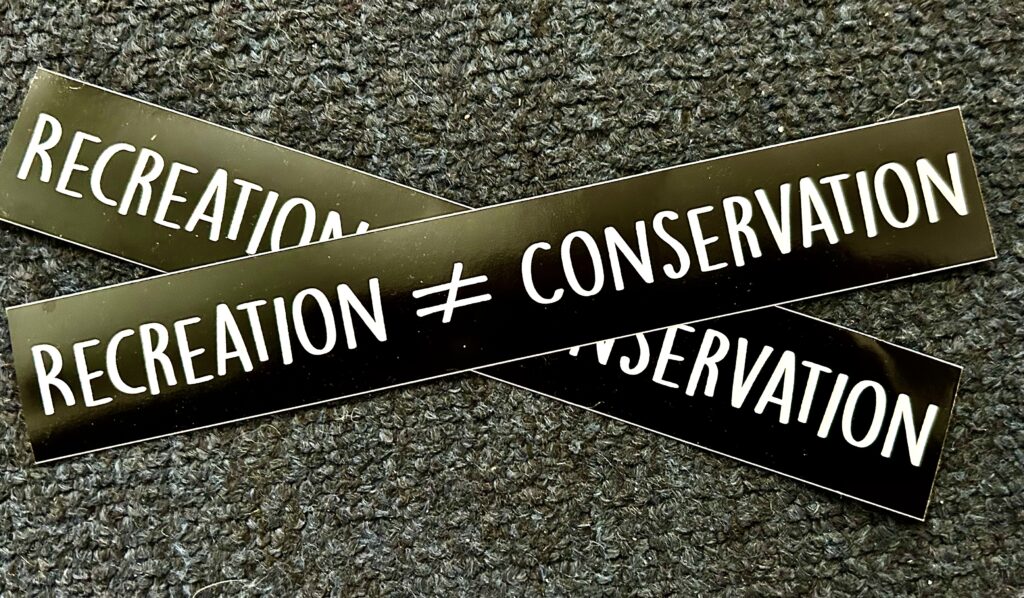
Other areas of the West dealing with crushing outdoor recreation pressure need to be viewed as harbingers for Greater Yellowstone and other parts of the Northern Rockies, Servheen and a sizable number of conservation biologists say. Part of the problem is that younger generations coming into the region, including young staffers working for conservation organizations, are not being taught to empathize with the plight of wildlife, nor do they recognize just how remarkable a wildlife-rich ecosystem like Greater Yellowstone is. We’ve witnessed numerous examples of where wildlife advocates have been labeled by outdoor recreationists to be extremists.
One Forest Service resource specialist with the Bridger-Teton Forest told me that each year new generations of gung-ho young people arrive and each carries with them boundless desire to seek out more terrain and boast of where they’ve been. They have been taught through marketing messaging from gear companies to seize the day and reject limits. Few are sensitive or conversant in wildlife ecology and within their user cohort groups extreme athleticism is celebrated. Even Yvon Chouinard, founder of iconic clothing company Patagonia, in a profile about him for The New Yorker magazine, made a disparaging reference to Outside Magazine for its superficial boosterism of outdoor recreation.
The Forest Service employee in Jackson Hole, who spoke on condition of anonymity, said recreationists are more demanding and more vocal than wildlife advocates and, over the years, they’ve openly flauted restrictions such as riding in wilderness and wilderness study areas. Rather than hold the line on land protection, the Forest Service acceeds to pressure organized by local user groups and supported by the outdoor recreation industry. The employees are too afraid to raise concerns about impacts. Rules put in place to protect wildlife are portrayed by the outdoor recreation industry and its paid representatives as onerous examples of over-reach by the federal government. Recreationists claim they are being picked on or discriminated against. It creates an attitude of smug resistance to wildlife conservation that is also present among recreationists in Teton Valley, Big Sky, and Bozeman.
While federal land managers in the US are often compelled, as a part of the National Environmental Policy Act, to carry out an Environmental Impact Statement to assess the consequences of a major proposed timber sale, mine, or oil and gas field, seldom have they, in a broad way, studied or informed the public about the diffuse yet prolific impacts of outdoor recreation. And, tellingly, there have never been calls from conservation organizations in Greater Yellowstone, which has one of the highest per capita concentrations of paid wildland environmentalists in the US, to assess the magnitude and cumulative effects of outdoor recreation which affects wildlife on millions of acres of public land. This is, in addition, to activities such as energy development and predator control occurring on public lands to protect livestock.
Often, wildlife disappear or negative impacts ensue even before land managers become aware that they have created a threat by enabling the number of human users to swell. While federal land managers must, as a part of the National Environmental Policy Act, carry out an Environmental Impact Statement to assess the consequences of a major proposed timber sale, mine, or oil and gas field, never have they, in a broad way, informed the public about the diffuse yet prolific impacts of outdoor recreation.
Problems in Greater Yellowstone are compounded by the unprecedented development pressure on private lands adjacent to public land. Sprawl is transforming former farms and ranches, which used to provide vital wildlife habitat, such as winter range and migration corridors, into suburban and exurban landscapes. (Also read these recent Yellowstonian stories: What Happens When Greater Yellowstone’s Conservation Movement Goes MIA On Sprawl? and this one, Subdivisons: As Impactful To Wildlife Over Time As Clearcuts, Mines And Energy Combined.
In 2025, a district ranger with the Custer-Gallatin National Forest authorized construction of a new mountain biking connector trail to be blazed into the West Pine area of the Hyalite-Porcupine-Buffalo Horn Wilderness Study Area accessible via Paradise Valley south of Livingston. It was done because the ranger was able to invoke administrative categorical exclusion from intensive review. Some say it ordinarily would violate federal law because it did not uphold wilderness study area protection nor undergo any significant public comment or ecological analysis. Grizzly bears are known to inhabit the area and it’s an area important for cow elk and calves.
Part of the above, ironically, was carried out by the national forest with support from the Gallatin Forest Partnership (comprised of the Greater Yellowstone Coalition, Wilderness Society, Montana Wild, the Southwest Montana Mountain Bike Association, the Outdoor Alliance lobbying group and Winter Wildlands Alliance). While only Congress can undo a wilderness study area—which prohibits mechanized recreation—the Custer-Gallatin can reclassify parts of the WSA so that mountain biking, normally prohibited, is allowed. That’s exactly what the national forest, under pressure from user groups did, by creating a new classification it calls “backcountry” written into its forest plan revisions.
North of Bozeman in Bridger Canyon along the eastern face of the Bridger Mountains and astride of the heavily-used Custer-Gallatin Forest, Bridger Bowl Ski Area and adjacent Crosscut Mountain Sports Center recently approved many miles of new trail to be built in important wildlife habitat and a wildlife migration corridor. More is on the way. Trail proponents cast shade at wildlife conservationists and seem to be tone deaf in heeding concerns raised about wildlife. Read the so-called “environmental analysis” that “The Dirt Concern,” an affiliate of the Southwest Montana Mountain Bike Association, filed with Montana Fish Wildlife and Parks claiming the project would have no impact on wildlife.
None of this reporting should be misconstrued as being “anti-recreation” because it’s not. It’s more one of trying to understand the impacts of blindly promoting and approving intensifying outdoor recreation pressure in a region with world-class wildlife. And it’s essential that outdoor recreation impacts not be categorized as a standalone concert but connected to a convergence of many transformative threats to a range of species.
Much of the recreation/wildlife dynamic is contextual. Ballooning the grid of mountain biking trails in, say, Durango, Colorado or Moab, Utah, or Santa Fe, New Mexico is certainly consequential than it is in Greater Yellowstone because those places do not contain the same bounty of wildlife.

Still, places in southern Utah do have huge problems with a high volume of recreationists descending upon the desert. Not long ago, a study by Dr. Joel Berger (who earlier did research on pronghorn and moose in Greater Yellowstone) and Kira Cassidy (yes, the same field scientist of Yellowstone wolf fame) examined why bighorn sheep demonstrate such adverse behavior to a variety of outdoor recreation users, both inside national parks and on adjacent Bureau of Land Management lands that in just 20 years have experienced a 14-fold increase in motorized recreation.
They describe the scene: “Because of differing federal and state policies, recreationists in southeastern Utah can engage in many activities without some prohibitions found in national park units. An estimated 100,000 mountain bikers come annually, in spring. Motorcyclists, all-terrain 4-wheeled vehicles, electric bikes, road bikes, and hikers use the land; kayakers and rafters are in rivers and equestrians are on trails. In the air are drones without restriction. Noise emanates from tourist-sponsored scenic aerial overflights in commercial helicopters and planes, and private charters,” Berger and Cassidy write. “The monetary cost for rentals or guides for these different activities is substantial and underscores recreational privilege (Table 2). So do resorts that provide high-end glamping (i.e., glamorous camping) with nightly prices from $500–$7,000/night. Many recreationists have the financial means to bring their own bicycles, motorcycles, and all-terrain vehicles, and use trailers for transport with large expensive trucks.”
It’s not a traditional resource extraction industry getting called out. Berger and Cassidy note it’s how people of privilege spend their leisure time. “Given sensational growth in global visitation to wild places, including recreation on America’s public lands, conservation challenges fall into 2 primary realms: for animals, the ability to sustain disturbances without inimical consequences; for humans, a willingness to accept mitigation such that negative effects at the wildlife-biodiversity interface can be dampened. Burgeoning recreation brings activities and exposes wildlife to unfamiliar items such as drones, paragliders, hot air balloons, and increasingly specialized forms of electric and non-motored vehicles that only 2 decades ago were uncommon or non-existent. Novelty can engender strong anti-predatory responses, which can be mitigated with some level of tolerance or habituation; however, animal sufferance should not be the sole solution to human disruption of wildlife.”
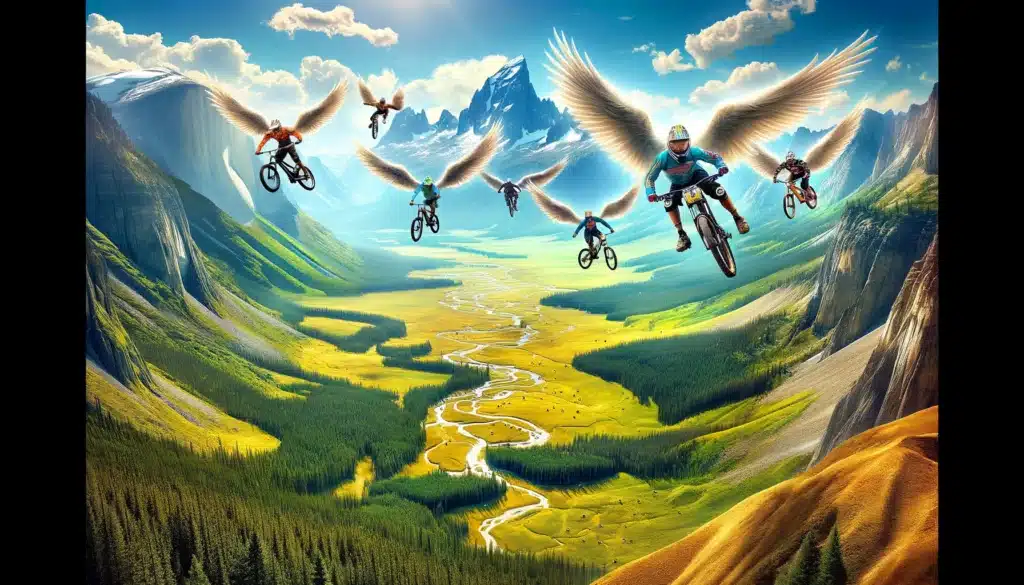
When subjected to scrutiny, the argument advanced by the outdoor recreation industry that worries about impacts on wildlife are only recent, are refuted by history. In 1999, the Montana Chapter of the Wildlife Society produced a 301-page report to provide resource users, managers, and decision-makers with access to the best available scientific information about the effects of recreation on wildlife and to foster good stewardship of Montana’s wildlife resources for current and future generations.
A companion website was developed to allow ready online access to the bibliographies of literature used to develop this document. The website allows searches by year, word, phrase, or wildcard and can be filtered by the following 18 categories and viewed onscreen or exported to Excel: Amphibians and Reptiles (813 articles); Birds (1,325 articles); Small Mammals (293 articles); Semi-Aquatic Mammals (79 articles); Ungulates (704 articles); Carnivores (736 articles); Domestic Animals (109 articles); Aircraft (117 articles); Energy Development (75 articles); Exotic Species (45 articles); Habitat Disturbance and Human Development (907 articles); Hunting and Fishing (202 articles); Non-motorized Recreation (584 articles); Pollution (152 articles); Recreation and Tourism (999 articles); Roads and On/Off-road Vehicles (938 articles); Water Recreation (203 articles); and Winter Recreation (255 articles).
That was a quarter century ago and members of The Wildlife Society chapter say a rigorous update is long overdue.
Dr. Servheen, when he headed U.S. grizzly recovery from his home base in Missoula, had been a proponent of removing grizzlies from federal protection. But together with anti-predator sentiments flaring in the states of Montana, Wyoming and Idaho, and the combination of expanding recreation and development pressures on public and private land, such factors have caused him to reverse his position and his optimism. As co-chair of the North American Bears Experts Team for the International Union for the Conservation of Nature, he has noted that grizzlies are being squeezed out of important habitat, undermining the outlook for bear recovery.
As I type these words stacks of printed scientific studies (in addition to the citations above), news articles, and interview notes with scientists sit before me, and they are complemented by links to many other studies. One notable study that appeared at the onset of Covid and is well worth the read is a special issue of the California Fish and Wildlife Journal, published by the California Department of Fish and Wildlife. It is titled “Effects of Non-consumptive Recreation on Wildlife in California.” Together with the analysis of Courtney Larsen and colleagues, this document provides a compelling starting point for pondering the consumptive impacts of recreation everywhere, and it is replete with examples.
Counted among the most aggressive user groups, dismissive of discussing impacts on wildlife, has been mountain bikers and their representative groups, some of whom have tried to undermine the Wilderness Act, or prevent more lands from becoming wilderness lands and they have aggressively pushed to build more trails. Click here to read what scientists had to say about the impacts of mountain biking on wildlife. This is relevant to Greater Yellowstone and the Northern Rockies because mountain biking pressure and conflicts with other users continues to rise.
Nationally, mountain bikers already have thousands of miles of trails and unpaved public land roads to ride. And, by the Forest Service’s admission, many additional miles of trails been built illegally. Bear expert Servheen has found that soaring numbers of mountain bikers threaten bear and human security in the Northern Rockies. Because bicyclists ride fast, quietly, unpredictably, and have their eyes down on the trail, the likelihood of human-bear encounters is higher. In addition, human activity of all kinds causes bears to flee habitat where they otherwise want or need to be. Notably, grizzlies are a kind of bellwether. One peer-reviewed study led by Dr. Charles Schwartz, former head of the prestigious Interagency Grizzly Bear Study Team, found that a grizzly will exhibit habitat avoidance behavior if a single house and its related infrastructure sprouts on a section of land (640 acres or equal to a square mile).
Another peer-reviewed study in Yellowstone led by Kerry Gunther, Schwartz, Scott Creel and Tyler Coleman found that grizzlies in some of the remotest corners of the park will stay away from backcountry campsites if even a few human hikers are present. Again, the point is not to portray an anti-human attitude; it is to accentuate the fact that every species of wildlife has threshholds of tolerance when humans enter their habitat, beyond which they will abandon those areas for areas that might not be as conducive to their survival.
“I think sometimes people have trouble accepting that recreation has impacts because it’s an activity that ‘we’ [meaning conservation advocates] typically engage in. It was easier when we could point fingers at those building developments or extracting resources, but it’s harder to place blame on ourselves. The impact is also much less visible. Trails do not have a large footprint on the landscape, so it’s easy to think that there are few impacts. Impacts such as wildlife avoidance, stress, and reduced reproductive success are not easily seen by the public.”
—Scientist and researcher Courtney L. Larson who congealed a large body of studies examining recreation impacts on wildlife
Crowded trails became a new norm during the Covid pandemic. This should serve as a wake-up call, scientist Larson told me. “I do think there is more and more attention being paid to this topic of outdoor recreation, especially in the last few years,” she said. Also read this essay she wrote while doing her research at Colorado State University.
I asked Larson, who is a deep-thinker working for The Nature Conservancy in Lander, Wyoming, why the conservation movement turns a blind eye to conservation? “I think sometimes people have trouble accepting that recreation has impacts because it’s an activity that ‘we’ [meaning conservation advocates] typically engage in. It was easier when we could point fingers at those building developments or extracting resources, but it’s harder to place blame on ourselves. The impact is also much less visible. Trails do not have a large footprint on the landscape, so it’s easy to think that there are few impacts. Impacts such as wildlife avoidance, stress, and reduced reproductive success are not easily seen by the public.”
Such pressures can leave wildlife populations further stressed at a time when resilience is important, especially as climate change alters habitat in myriad ways. In fact, some groups claim, showing little evidence to support their contention, that blanketly promoting outdoor recreation is a compelling strategy for confronting climate change.
As Servheen and other wildlife experts note, resilience means wildlife having access to more habitat – because climate change is going to put more animals on the move. Unfortunately, habitat that is secure from human pressures is in decline. “When we recreate, we are doing activities that are optional,” he said. “It’s a way to spend our leisure time. Our lives do not depend on us having to do things in a certain place or else we’ll die. But that’s what wildlife face by necessity.”
For more reading:
Part One in this series:
Part Two in this series:
Part Three in this series: