
by Lois Red Elk
The house of portals takes my story from once upon a time
to this present room where a resurrected eagle and hawk have
winged their way to my personal space. Their essence perches
in the living room context and listens for something moving,
as dreams take a quantum leap into my sunrise.
°
The Grandpas were out hunting and decided to move toward the river, hoping to surprise deer drinking from the backwaters of the Missouri River. They had been out on the flat land all day and hadn’t seen any game. They drove down the gravel road and headed south past Parkers’ old abandoned log house then turned east. As they drove under the high wires that crossed over the woods, Grandpa Eddie saw a dark shadow in the ditch that looked like some dog had been hit.
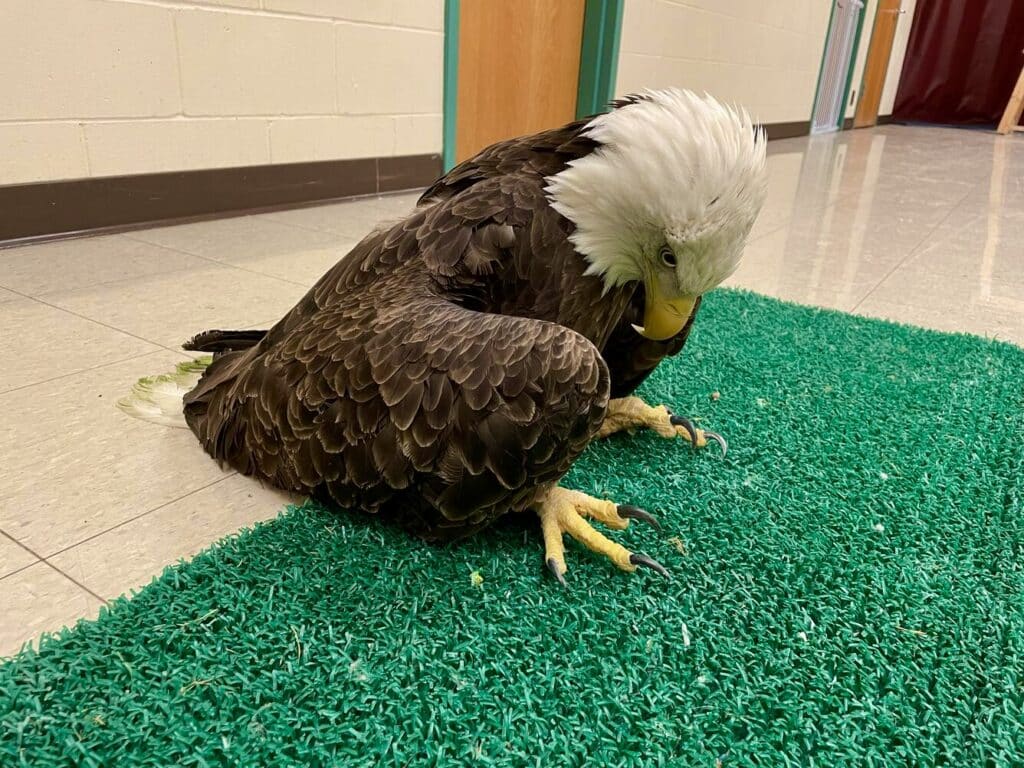
He slowed and as they got closer they noticed a large wing laid out across the spear grass. Grandpa knew immediately what it was and what happened. Many times eagles and hawks sit up on the tall electrical poles and once in a while one of them would be shocked to death when their claws create a short circuit.
That is what happened. The large eagle lay silent below the power pole, its wing fanned out like it was ready to bless a ceremony or ready to lead a head man dancer into the dance arena. Both the grandpas jumped out of the truck and slowly made their way down the ditch toward the eagle’s body. They always carried sage and tobacco in their pockets, never knowing when a thank you offering would be made to the earth or the sky.
Grandpa Eddie looked at the beautiful winged one, the one who so dutifully carries prayers and protects the sacred walk of holy ones. He knew what to do. As he and his cousin spoke in Dakota, he opened his pouch of tobacco, they bowed their heads and proceeded to acknowledge the spirit that was surrendered at that place. One of the Grandpas sang a short song and offered the tobacco.
They stood and observed the magnificent bird and remembered all the stories they had heard about the flying relatives. Grandpa took off his jacket and gently wrapped the eagle, covering the head and folding the wings. I remember one of my grandmas telling how large the eagles can grow. This one was three feet tall and weighed several pounds.
When they brought the eagle home, more prayers were said. They had to wait for a few days before they took the feathers and removed the head. After several family members came to the house to look at the eagle, It was decided that one of the grandsons needed a staff and this eagle would go to that young grandson.
Later, the young man went to Korea and when he returned he shared with the elders all his dreams and how the eagle spoke with him and guided his walk all through that foreign land. His family passed the staff on down to the descendants and to this day it is carried respectfully by the family.
My home, on the rez in Northeastern Montana, has been the portal entrance for this present journey through space. Some call my stories myth, well myth works for me and continue to be the encyclopedia for my life. I entered this zone from stars to this star, through a unique atmosphere, from a zygot produced by Back Tracks His Horses and Rattling Leaves Woman.
In this HUD home are stories carried on ash poles. One pole supports the head of a sacrificed Eagle along with all the sacred feathers. The pole is secured to the wall by nails and screws.
The eagle head is not dead, the spirit remains according to tradition. The eyes of the eagle search the room, the air, and has vision through the walls and into the air surrounding my home. It is always the movement of other spirits that trigger the eyes to wake from a dream space that exists in our parallel world.
°
This yard, this house, this open heart accepts their prayers
and welcomes the carved cottonwood bowl to my hair for
cleansing with sage smoke. It is then I know we are all one
for this early morning nourishment of earth presence where
no famine lingers, only the domain of harmonious spirits.
°
Prayer exists in this home, prayer that includes the energy of all the spirits who live here.
I welcome and encourage all these entities by preparing a container of sage that I pick every summer out in the country. Sage is for cleansing the area of harm or all things that is negative. It is important for myth to work according to ritual and my ritual has been practiced for thousands of years. This ritual not only acknowledges that there is negative, but there is also positive energy that needs to be thanked. I know this as my tradition instructed me so that all will balance for this day. These aromas fed my spiritual hunger so that I am filled with eternal love and respect. This myth keeps me alive, I will never know hunger. I will only know other energy that is fed the same way.
In our Ospaye (family) all the members dance the traditional style. Grandma says it is one of the best ways to keep the culture alive. Every time I went to visit Grandma she was beading or making a dance outfit for one of the family. She kept all her beads sorted by color, stored in old mason jars and stacked on a little bookshelf next to her work table. Her work table. It was a maze of wood, deer hide beads and stones.
I would sit at the table and look at the pieces of tanned hide in a shoe box. Some were about 6 x 6 inches, others were twice that size, neatly folded, and other pieces still had the fur of the animal on the edges. I asked her what she was going to make from all the pieces and she would always tell me the designs hadn’t come to her yet.
One piece she was beading was going to be a rosette. She had already made four of them, each a little larger than the other. I always wanted to touch the dyed quills, they were so shiny and colorful, but I learned a lesson about barbs so left them alone. On the side of the table next to a wooden loom she had a small wooden bowl made from the knot of a tree. Inside the bowl I noticed the residue of burned grass. I wanted to ask her what she was burning but my mother told me to stop asking so many questions. I do remember the slight aroma of sweet grass in her hair when she lifted me into her arms, hugged me and whispered to me in Dakota.
°
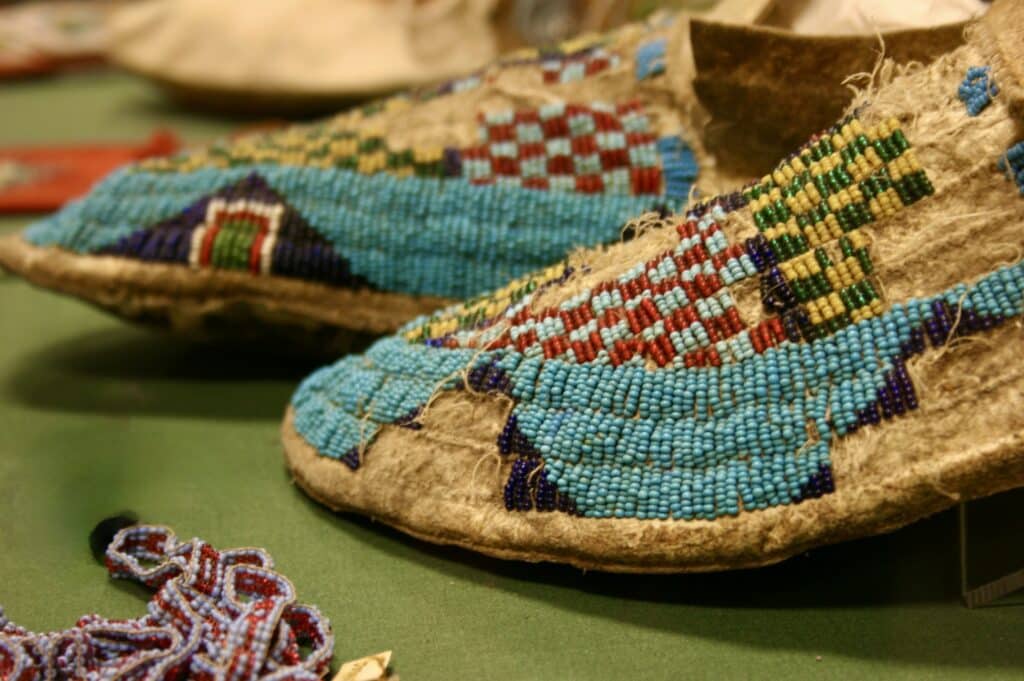
I walk in moccasins made of sacrificed deer hide, not for running
or escaping but walking purposefully down the hallway that daily
transforms from a rug to a path of fresh grass where I recognize
an echo off limber air next to grandma’s vibrating neutrinos.
They have assembled and greet me at my bedroom door.
°
To walk this earth in a sacred manner I must connect the skin of my feet or the skin of the deer with the surface of the earth. The deer sacrificed its life for my nourishment and for my protection. The deer know this. Through the connection between me and Mother Earth my energy becomes renewed by the everlasting energy radiating from Mother to me.
She was and will always be my umbilical cord, keeping me close to her heart, feeding me with breast food, water, herbs, breath and fire. With this attachment I have no need to flee or hide. All that fear is taken away, all I need do is walk the good red road laid out for me in my stories. This connection, this road, this path can then transcend this space to the parallel world and back to me. That which exists there comes alive with its own vitality, own vision and opens my eyes to that another space. The vibrating coming from this space enters my body and allows me to make my way to the place where I can enter another world, the place where my grandmother has planned to meet me in eternity.
“Mother (Earth) was and will always be my umbilical cord, keeping me close to her heart, feeding me with breast food, water, herbs, breath and fire. With this attachment I have no need to flee or hide. All that fear is taken away, all I need do is walk the good red road laid out for me in my stories. This connection, this road, this path can then transcend this space to the parallel world and back to me. That which exists there comes alive with its own vitality, own vision and opens my eyes to that another space. The vibrating coming from this space enters my body and allows me to make my way to the place where I can enter another world, the place where my grandmother has planned to meet me in eternity.”
I learned how to bead watching my grandmas and my mother. As a child I would sit hours at a time observing them select colors, draw designs, cut shapes, pull sinew apart into threads and then start with five beads at a time on one edge of the deer skin. Weeks later I was always amazed at how fast and even all the rows of beads lay flat over the entire moccasin.
One day Grandma gave me a piece of deerskin and a threaded needle. There was no question in my mind about what to do, where to start. I was excited to be sitting with grandma; doing was she did so proficiently. Of course I would do well; sitting next to her was like sitting next to the one who could do everything. She hummed, she was steady, she was patient, she accomplished so many projects, she guided me through a world of creation and she prayed always. I watched as she would glace at the staff hanging off the wall, her lips moved as if she was talking to someone she knew well, as if she was listening and then responding.
°
We unite as our energy embraces a common cloak, a common
mind of belief and love, and instantly I am standing next to her
at the wooden table in the log house grandpa built, where she
sews quilt pieces made into blankets that yawn prayers over all
lives she protects. My life, too, shielded in the stitches and blood.
°
The coming together of two minds in understanding belief is the direction toward being one, where our love expands in volume for now. I no longer am distant but am inside the veil of truth where our meeting place and time becomes present in our breath and being. I gently lift her blanket and see her face in space and in my present eye as she prays my thoughts into her Lakota words for my understanding. The fabric in my hand is smooth, the weight is light, her hands are soft and small, her dress is flowered and colorful, her apron has pockets full of thread and her braids are slim and long. All she is, is present in my vision waiting for me to sit and partake of her patience and gifts. Where I am ready has come forward and accepted the story as my relativity, my life, protected by her belief and knowledge. We are one.
When I was in my teens, my aunt shared with me an amazing story that I will always cherish as part of my being as a Lakota. I had been having many dreams about relatives that seemed like riddles that needed to be solved. I shared the dilemma with my father who took me to my aunt. What she revealed to me was the knowledge that our family belonged to a dream society and that my Grandmother was known as a dream interpreter. Dreams were an important and integral part of the Lakota life. I remember as a child the excitement and celebration that followed after we children shared a dream. It was taken for granted that this was the routine. It was in my teens that the dreams became more complex. Again, grandma’s knowledge was reaching me, and my aunts and parents were the conduit for translating what it all meant. The D/Lakota culture embraces many kinds of societies. The purpose of these societies is to aid individuals, and warrior and women’s groups with spiritual support. This belief honors the spirits and prepares us for any questions or difficulties we may have in this earth life. The societies also aid us to accept, face and welcome the unknown.
°
I close my eyes as she brings forward her presence where we
sense and listen to thoughts as they synchronize from similar
genes. We speak in her dialect, the words I dreamed last night,
then feel the beginnings that keep us connected, make us whole
for this road of uneven forces and odd events.
°
The Dream culture of the Lakota is complex. I don’t claim to understand the entire culture. I do know that there is another part of our lives that our people identify as ‘our other selves’ and that we have to take care of that life just like we care for our daily awake life because it is sacred. The D/Lakota language is unique in that it contains words that explain the sacred world or dream world. Sometimes I dream in Lakota and hear words that are unfamiliar. I am told that only a spiritual leader can interpret the words. When the grandparents spoke in D/Lakota, or when they prayed, they sometimes moved into a different language briefly then moved back to the common language again. They did that to acknowledge among themselves and the spirits that they were in a sacred realm and trusted that their language and prayers would keep them focused.
°
We speak this way, mind to mind, and have done so all my life
as planned from the other world. Now it is the moment, time to
burn cedar for her precious words and burn sweet grass for her
grace as I accept this oath, this unbreakable love between all space
and all that moves. We bring presence where our portals open.
°
During WWII, my parents moved to Seattle to look for work. They were both talented ingenious people who could easily participate in any setting. They were both survivors. Father was an arc welder and found work quickly in the shipyards. Mom, seeing how easily Dad found work and how well he was paid asked Dad to teach her to weld. The family moved back and forth between the West coast and the reservation. One year my father was notified that he was needed back home, his aunt had passed away. She was like a mother to him and it was difficult to not be a part of the last days of his elders. We children did not know the grandmas were passing away. We didn’t understand the concept of human death. When we arrived back to the reservation the first person I wanted to see was my favorite grandma. I was told that she went visiting down the river and over the bridge to see her other relatives. I immediately wanted to go.
I had at one time been taken for a ride on an old ferry near the Poplar River and in my mind that would be an exciting trip. I was told that it would take a long time and that we had to go back to Seattle. I kept asking about grandma, when was she coming home, would it be tomorrow? I was assured that I would see again later and that she just might come and visit us in Seattle. For many months I wondered how she was, what she was doing and was always assured that she was fine. In my young mind I set the matter aside. Eventually public school, reservation life and prejudice over took all my attention. I lost track of time.
Eventually I learned of death and funerals, but never thought that death had taken my grandmas. One night I dreamed of my grandmother. She was with several other elderly ladies. I described the dream to my dad and he told me those were my relatives and that my grandmother came to visit me in my dream and that was the way all the relatives would visit. And it has been that way since.
I experienced and became aware of how important the dream world is to us. I still have the little moccasins she made for me, the quilled hair ties she made and placed on my braids, and have the little kettle she used to carry her soup in. And our family has the eagle staff that has guided the relatives through the years. These handmade pieces are connections that stand for history, culture, spirit and most of all guide us to our portals and bring us closer to the ancestors. Always when I dream of the grandmas, I light sweet grass. It pleases them.
©Lois Red Elk

Also enjoy these poems by Lois Red Elk: