A Yellowstone Winterkeeper Settles Into Solitude And Meets A Hungry Local
51 years, 7 months; Oct 1, 1973 to May 1, 2025; 18,840 days, 2,691 weeks. Unnoticed. Time flies, Steven Fuller says. Here he reflects on a time when winters were long and summer tourist seasons short
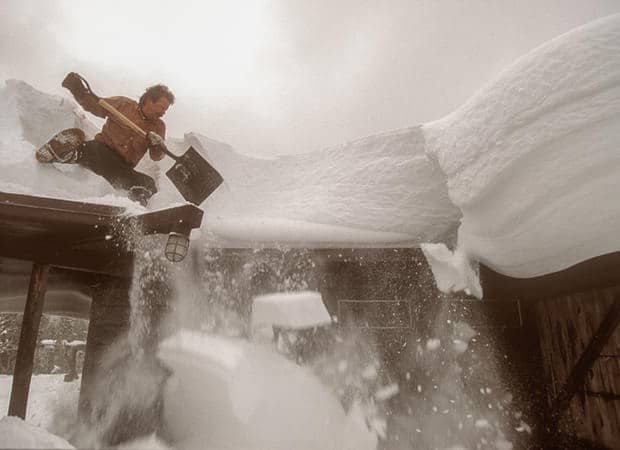
Winterkeeper Steve Fuller in the early years at Canyon Village in Yellowstone National Park. Photo courtesy the author
by Steven Fuller
Our second winter unbeknown to us was to be the last of a long line of traditional solitary winterkeeper lives lived at the outpost known simply as “Canyon.” For those two inaugural winters we lived as isolated as our unremarked predecessors going back literally to horse carriage days.
Our worn-out primitive snowmobile was unreliable. A trip to Lake 16 miles upriver to see our neighbors let alone to travel to town 40 miles west was practically unthinkable.
At home there was no TV, no radio, and only rare opportunities for mail in or out. The only communication to the outside was via a YP Company landline telephone to call into park headquarters to confirm we were still alive.
That first winter brought the harshest wind-blown snow accumulation of all my subsequent winters, 50 of them at Canyon, and established a base line of learned wary expectations of subsequent winters.
The winters that followed came to be characterized with the routine challenges of the season, that trumped the usual. Weather, the season-long cycles of snow and cold came to orchestrate my life.
Work—when the burdened roofs in Canyon Village a mile away began a collective groan and call; ski when the base was great and the sky blue, and the roofs had been tended and were relaxed. Paying close attention to the weather characterized a century long history of snow depths and temperatures kept by all Canyon ‘keepers, most recently on a record of winters’ past written in different hands, like spare journal entries, and hung on the kitchen wall.
That and official records reflect the historic variant swings in winter snowfall and temperatures that were “normal” through my time at Canyon— until my last few decades.
Historically weird winters were normal but symptoms of more erratic than normal abnormal warmer—drier, less snow, earlier spring melt-out, and spring emergent animals’ behaviors all whispered increasingly more audibly at the periphery of my awareness.
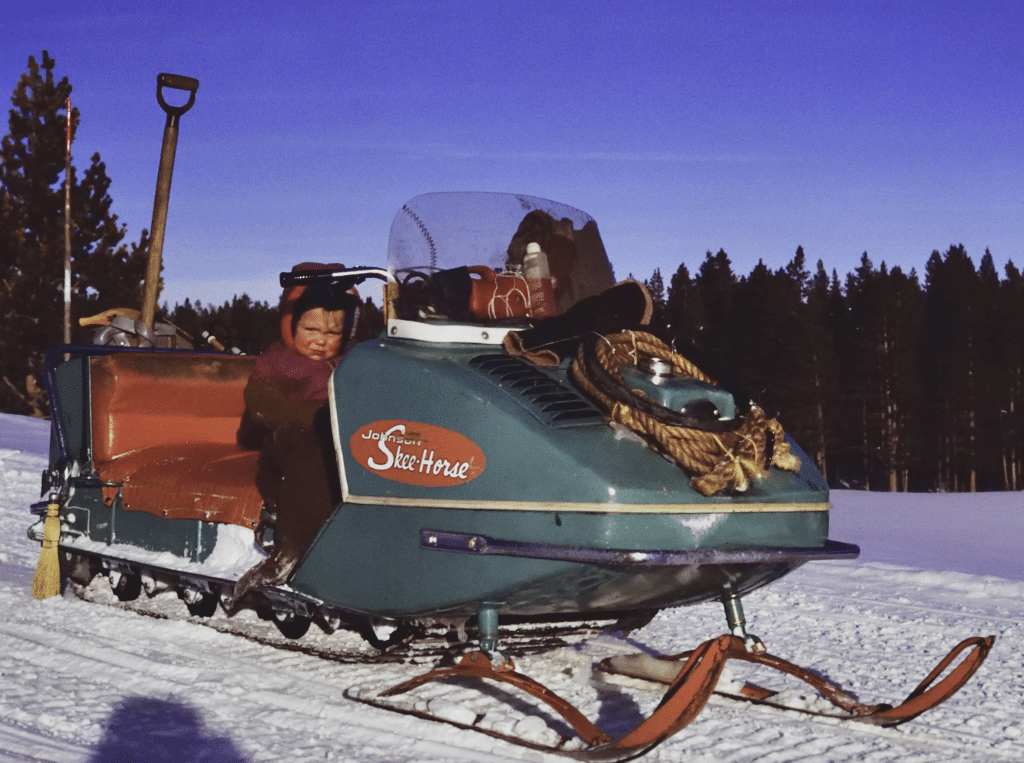
The Fullers’ daughter, Emma, on a Johnson Skee Horse snowmobile. Mechanized horsepower has come a long way in a half century. Earlier iterations of snowmobiles were unreliable, heavy, could get easily stuck in deep drifts and they bear little resemblance to the high-marking rigs that proliferate across more and more of backcountry areas in Greater Yellowstone and the Northern Rockies. Less capable machines, Fuller says, made the solitude of Yellowstone winters more sublime. Photo courtesy Steve Fuller
And a real-life awareness that these consequences resonate throughout the natural Yellowstone world from top to bottom. But that understanding was unrealized in those innocent early years when attention was focused on family and work but became increasingly significant as the years of seasons accumulated and intimacy nourished awareness
But this is now, looking back over five decades now past when with a man-powered six-foot-long crosscut saw mounted on an oak D-shovel handle and its mate, a similarly mounted steel coal shovel, I single handedly faithfully dibridged the snow cornices from off eighty/eight-plex cabins, four two-story high dormitories, and cleared the snow acreage from off the main lodge roof.
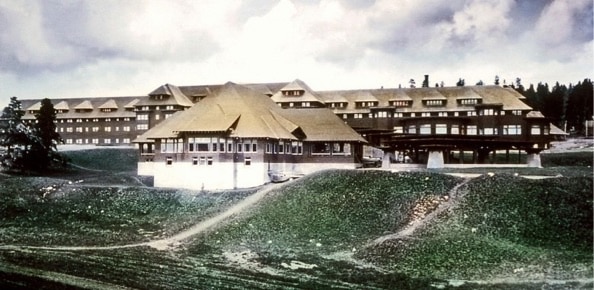
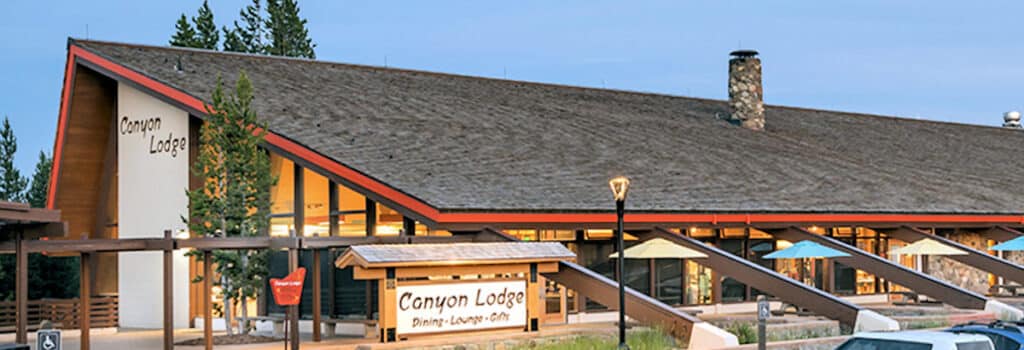
The lodge, a product of the notorious Mission 66 era, was architecturally under-designed due to ignorance of the prevailing winter weather patterns and forever after was an insidious snow catcher. It’s style was called “Mid-century modern” and it was a counterpoint to the historic Canyon Hotel designed by Robert Reamer (the same architect who created the Inn at Old Faithful) and stood (next to my winterkeeper;s residence from 1911-1959).
Top: The grand Canyon Hotel, designed by Robert Reamer, was kind of twin to Old Faithful Inn and Lake Hotel, also created by Reamer. It was located on a sloping hill above the Grand Canyon of the Yellowstone and while it can’t be seen in this photo, Steven Fuller’s winterkeeper’s home would be just to the right. The Canyon Hotel burned in 1959. Photo just above: the Canyon Lodge that replaced the hotel. Built in the 1950s, it has never offered overnight accommodations but rather restaurants and gift shops and was accompanied by wings of poorlypbuilt cabins. Fuller was in charge of shoveling deep snowfall, by hand, off of all of them. In recent years, those cabins were replaced by new guest lodges.
Snow loading at the Canyon Lodge had damaged its massive roof rafter beams and were still vulnerable despite there having been retrofitted with massive structural steel “sisters”/“scabs.”
One of my predecessors had been fired (it was claimed “he was fonder of whiskey than shovels”). He was held responsible for the failure of architectural flaws of the grand building. And so I was assiduous in my tending that beast of a roof. My own version of the Brooklyn Bridge… you get to the end of it and the start again, shoveling snow where you began not long before removing it.
Many years later I was sent a photograph of the weathered overgrown grave marker of my predecessor. Its was located just outside of Cooke City with his name, dates, and an inscription that summed up his life: “Canyon Winterkeeper.”
For recreation those early winters I cross-country skied wearing pak-boots secured by cable bindings to my seven-foot wooden Laplander skis. Experienced old timers insisted this was the only way to go in the Yellowstone backcountry. I recall the autumnal ski prep and especially the olfactory pleasure of torching the pine tar applied to the base of the skis in preparation to hard wax them. ( brought a mostly depleted tin of pine tar with me to and may posit a visit to the garage in retirement to snort a pinch).
For recreation those early winters I cross-country skied wearing pak-boots secured by cable bindings to my seven-foot wooden Laplander skis. Experienced old timers insisted this was the only way to go in the Yellowstone backcountry.
At work and at play I wore Dutch army surplus woolen jackets and pants, and Angela’s homemade sheep skin mittens and her crafted thigh-high gaiters. And through my work I became physically strong and gradually more personally grounded. I pleasured returning home after a day of labor on the roofs to hear the clatter of icicles in my hair hitting the shower floor. Our marriage in those early years, despite our earlier emergence from out the 60s cultural revolution, due to the reality of our circumstance, engendered traditional gender roles.
My life, if described by others of the era, was centered by necessity on physical “manly” things; Angela to wifely nurturing of our child and of me, of homemaking and housekeeping, in the best reverence for both. In years to come, she became a local executive with the main concessionaire.
In the remoteness, we were partners in an appropriate division of labor given the realities of our challenging environment and we were well paired. Her alpha personality and dedicated feminist convictions appropriately re-emerged in the course of our subsequent lives evolved and here were appropriate, but her identity at this earlier time was per the rustic conditions of living and personally enriching.
For nine months that first winter I was my own boss, overseen by no one while I labored and learned the craft of a winterkeeper and the pleasures of healthy hard work. I learned to work with the weather and I began to understand the complex properties of snow. As a novice rooftop quarry man working with simple manual tools in time my understanding grew and required less effort for the same results.
As the winter wound down, in a reversal of its progression last autumn, the pristine albino snow desert receded revealing more and more of the sodden grey brown waste of the previous vibrant season of life that shrouded the approaching bloom of Spring. Winter killed many animals, and as the winter snow mass ebbed, the shadow of its shrinkage was pursued by a progressive bloom of new green shoots. And then the diminishing remnants of rotten winter snow flipped and the bloom of new life and animals imbedding themselves on it became dominant.
Then, as the gentle transformation began to unfold, the peace of revelation was interrupted! The snow plow arrived at our door in mid-April and the “naughty world” (“naughty world” referring to the wicked, corrupt, immoral dark, dishonest world in a line spoken by Portia in William Shakespeare’s The Merchant of Venice, Act 5, Scene 1) followed close on its heels and soon blitzed our Swiss Family Robinson enclave.
My identity as a Jeffersonian yeoman was dispelled that spring and by necessity I “shape-shifted” to become a “summer maintenance man,” a seasonal “working stiff” required by the YP Co to work a mandatory six days a week through the course of the summer season. It was then that I started my morning ritual, carried on over many decades of trying to be in the nearby Hayden Valley for sunrise.
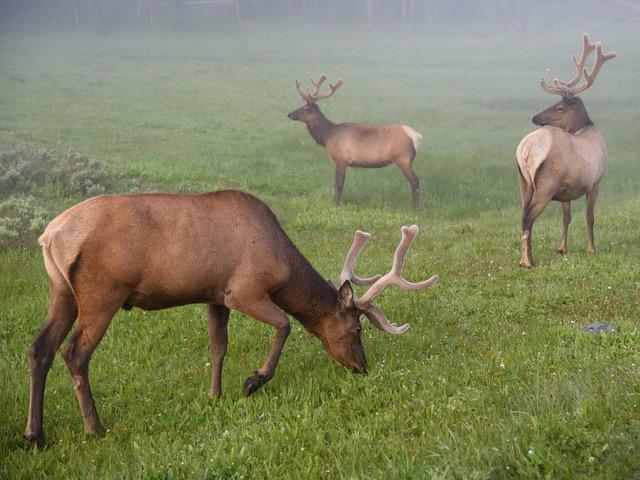
Challenging winter conditions could be hard on wildlife in Yellowstone but greenup in spring and longer warmer days bring new life back into a frenetic pace. While elk shed their antlers in late winter, a plenitude of nutritious grasses fuel rapid re-growth. This photo was taken by Steve Fuller near Hayden Valley not far from the rustic home he inhabited for 51 years.
Still, there were Sundays and the pleasures of family outings as novices we explored the outer edges of the outback and enjoyed the delights of our two-year-old daughter’s explorations of the natural worlds of Yellowstone.
In those early days the summer tourist season was short and ended before Labor Day for Canyon Village. Then the summer maintenance crew and I worked to winterize the tourist cabins, the lodge, and dormitories for another turn into seclusion.
We drained all the water lines, shuttered the doors and windows, shut down the heat and the electricity and when the work was done the summer crew left, leaving all of Canyon Village cold, and dark. The brief surge of salmon (summer tourists) was over. The NPS seasonal staffs were all gone, too. Only our house remained again isolated and alive, warm and full of light.
Autumn on the central Yellowstone Plateau is glorious. The cleansed clarity of the air, the progressive color transitions, elk rut, the appearance of muskrat lodges and of swans on the Yellowstone River, the mist nurtured crystalline frost extravaganza revealed at sunrise. Periodic snow storms would pass through, some light, others heavy, but under Indian Summer sunny days they would shrink except in shadowed places. But by mid October autumn snows gave way to the first of winter snows which increasingly claimed more and more of the landscape.
The comforts of wife and the joys of child lived amid the glories of autumn were the backdrop to the many mundane chores (“chop wood and carry water”) to be done by a keeper and partner before winter sets in. (@ Aesop, ants anticipate, grasshoppers prevaricate. Negligent keepers later in the winter have regrets).
Spring is mating season and so in due course of our first summer we discovered Angela was pregnant and so a second child would be born to us near the Winter Solstice in latter December of our second winter.
Feeling well prepared and settled in we accepted the deepening cold and the dark isolation it brought. Then on Guy Fawkes’ night, November 5, while the three of us were eating dinner a sow grizzly bear broke out the small kitchen window, reached in, and attempted to take our pot of dinner stew off the stove.
Feeling well prepared and settled in we accepted the deepening cold and the dark isolation it brought. Then on Guy Fawkes’ night, November 5, while the three of us were eating dinner a sow grizzly bear broke out the small kitchen window, reached in, and attempted to take our pot of dinner stew off the stove.
In an instant ancient roles took charge. Angela, a heavy six weeks to term, and young Em fled to the back bedroom and I, uncertain which end of a grizzly is larger and so given— if she could get inside the kitchen through the smallish window—advanced to confront the bear. The she-bear was quite indifferent to my attempts at confrontation and continued to pull herself in through the window in an attempt to remove the pot of stew
It appeared she had a good chance of pulling herself through the window and into the kitchen, though given retrospect and a lot more experience I would not have been so alarmed…but, even so having the big triangular piggy face inside my kitchen was alarming.
My efforts to intimidate her having obviously failed I rejoined A and Em in the back bedroom, kicked the window open and we beat feet to our car where I found it difficult to insert the key into the driver door lock. First and last time I had a radio I called the legendary Lake ranger, explained the circumstances, and sitting in the car overlooking the Hayden Valley we watched his patrol car lights flashing and speeding up to us.
To be continued…
° ° ° °
Read Steven Fuller’s earlier columns under the banner A Life in Wonderland.
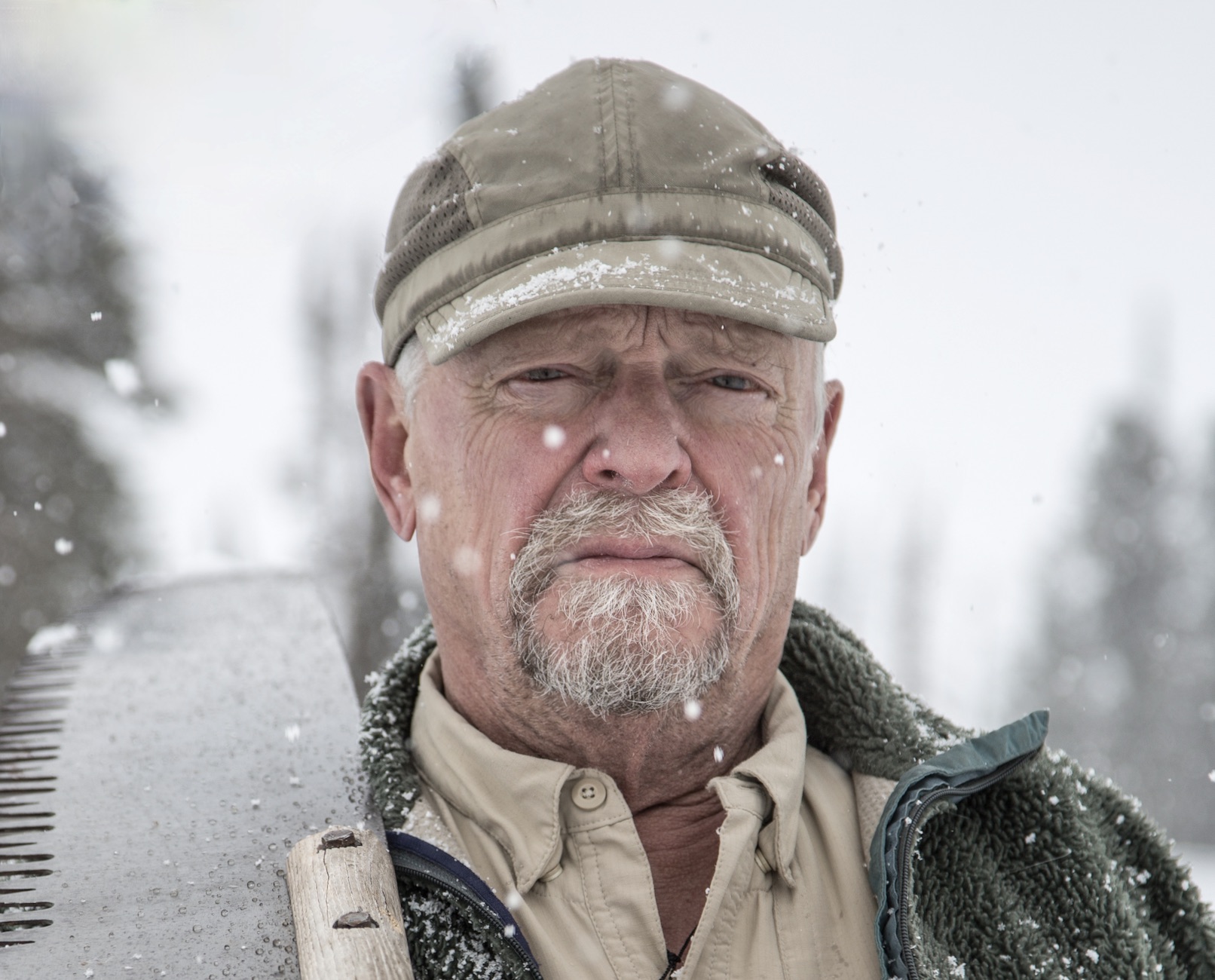
Steven Fuller was the "winterkeeper" at Canyon Village in the center of Yellowstone National Park for more than 50 years. He lived a short stroll away from the famous Grand Canyon of the Yellowstone. In summer, he served as chief engineer overseeing the function of behind-the-scenes infrastructure of Canyon's multi-faceted guest services. As for the poetic part of his tenure in Yellowstone, when he wasn't shoveling deep snowfall off the rooftops of hundreds of buildings, he was, and remains, a keen nature photographer, well-traveled, well-read and known for possessing his own language in describing Yellowstone. Fuller has been been invited to deliver photo programs in venues as diverse as the Royal Geographical Society in London and the Smithsonian in Washington DC. He is at work on a memoir and is a special correspondent for Yellowstonian.
Luther Propst says we need to stop averting our eyes away from the obvious ongoing loss of Greater Yellowstone's natural character. And start having adult conversations. This Teton County Commissioner is one of the few demonstrating leadership
In this essay for Writers on the Range, Ted Kerasote, a lifelong sportsman and Wyoming resident, makes the case for why toxic ammunition needs to go when alternatives are available
Water is our lifeblood in the West and William Kleindl, a nationally-known scientist, says we need to treat it with the preciousness it deserves. A lot is now at stake