by Todd Wilkinson
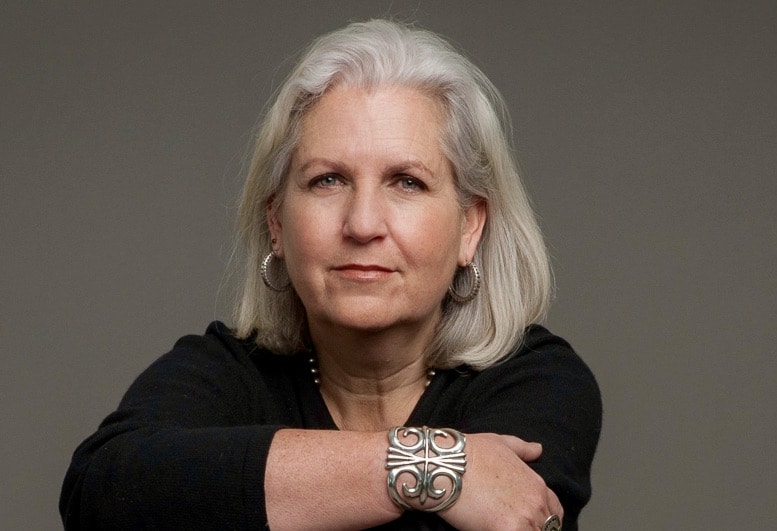
Terry Tempest Williams is back home again —in her native American West—and it’s precisely where she belongs and most presently needed.
While her heart never left the realm that shapes the language of place she speaks as fluently as any other living nature writer, she’s been on an extended sabbatical—as a writer in residence—at Harvard Divinity School since 2017.
Willliams has spent summers in Utah, where she was born and raised, and, with author-husband-conservationist Brooke, made visits to Montana and Jackson Hole where her family secluded for generations, but her school-year commitments in Cambridge prevented her from being an advocate with presence she wanted to be.
Advocate, as in reminding rattled Westerners that there’s power, healing and inspiration when one stands unwaveringly on the side of nature, even when loss brings heartbreak. Williams’ new critically-acclaimed book The Glorians: Visitations from the Holy Ordinary is not only her most important but is also her most timely.
There might be no better tribute than the one coming from Richard Powers, author of the Pulitzer-Prize-winning, The Overstory, who said, “I go to Terry Tempest Williams for the reasons I go to Whitman and Thoreau: to recover a capacious spirit and to rejoin the urgent living world. She gives me something bigger than hope.”
Williams appeared before an inspired overflow crowd in Livingston, Montana on April 4 in an event sponsored by Elk River Books and its related arts and lecture series.
One doesn’t need to recite the accolades she has earned it’s important to note that Williams’ is constantly exploring ways that transform aspects of nature from being muted or obscured into visible and poignant.
Williams said the word and concept of “glorians” came to her in a dream. While defying strict definition in an ineffable way, Glorians are spirits of our world and the cosmos, the seen and perceptible expressions of Nature that are part of us and all around; they apply to what they conjure in our full sensual experiences of life.
“This book is my own spiritual awakening to a life of greater intention in the midst of epic changes. I am seeking grace,” she told Nina Simons, co-founder of Bioneers in a recent interview. We strongly encourage you to read their conversation by clicking here.
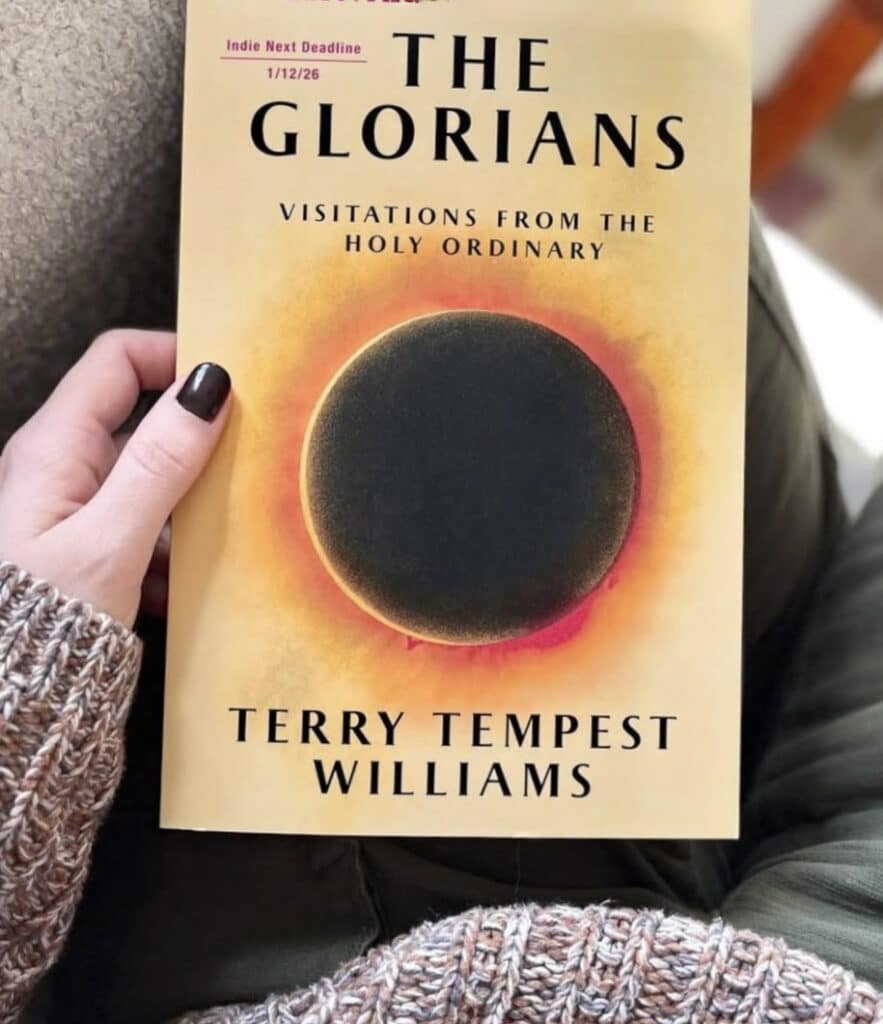
To say Williams has been homesick for the West has been an understatement, though communing with faculty, students and others in the firmament of Harvard Divinity, exploring the multiple dimensions of spirituality has brought an expansion of her own being. The Glorians moves the reader with vignettes of transformative experiences she’s had in recent years, whether its coming together as a community in Castle Valley, Utah following a sudden flash flood or mourning the felling of an old growth tree literally within view of Harvard Divinity.
What is the secret to sacredness? For her it is connection. Still, Williams has lost none of her restless and, when needed, feisty spirit for advocacy.
What the West faces now is nothing short of a crisis. With free-market forces in charge, we are witnessing an irreversible dismantling not only of landscape protection but of the democracy values that give citizens a voice in public lands that belong to them.
Williams’ book serves as a catalyst for bringing people who love the West together.
“We have made the mistake of confusing democracy with capitalism and have mistaken political engagement with a political machinery we all understand is corrupt,” she says.
“It is time to resist the simplistic utilitarian view that what is good for business is good for humanity in all its complex web of relationship — including the web of life for all species,” she noted in her interview with Simons. “Ecology reminds us again and again that the ecotones are where diversity flourishes— the edges where the forest meets the meadow; where the tides rush up to dune grasses on a sandy beach; where the edge of the river becomes a tributary that refreshes the wetlands. We, too, can be edgewalkers finding what binds us together rather than what tears us apart in these moments of great and grave uncertainty.”
NOTE: You can order an audio version of the book, read by Terry, by clicking here. Williams will also be appearing in Jackson Hole on Aug. 6, 2026 at the Jackson Hole Center for the Arts. Ticket info here.
Also read: