by Todd Wilkinson
These are, to state the obvious, times of palpable unease, when so many things citizens value about the American West, the country, our democracy and the way we inter-relate to each other are undergoing severe stress tests. It’s no exaggeration to say the implications could be dire.
Or, like a mountaineer high on an alpine ice sheet, starting to slip and slide down a steep slope without protection and a rocky end awaiting hundreds of feet below, hope resides in the ability to take action and expedite a self-arrest.
How do we as a society do this now? How do we prevent systems holding things together from becoming further frayed and falling apart?
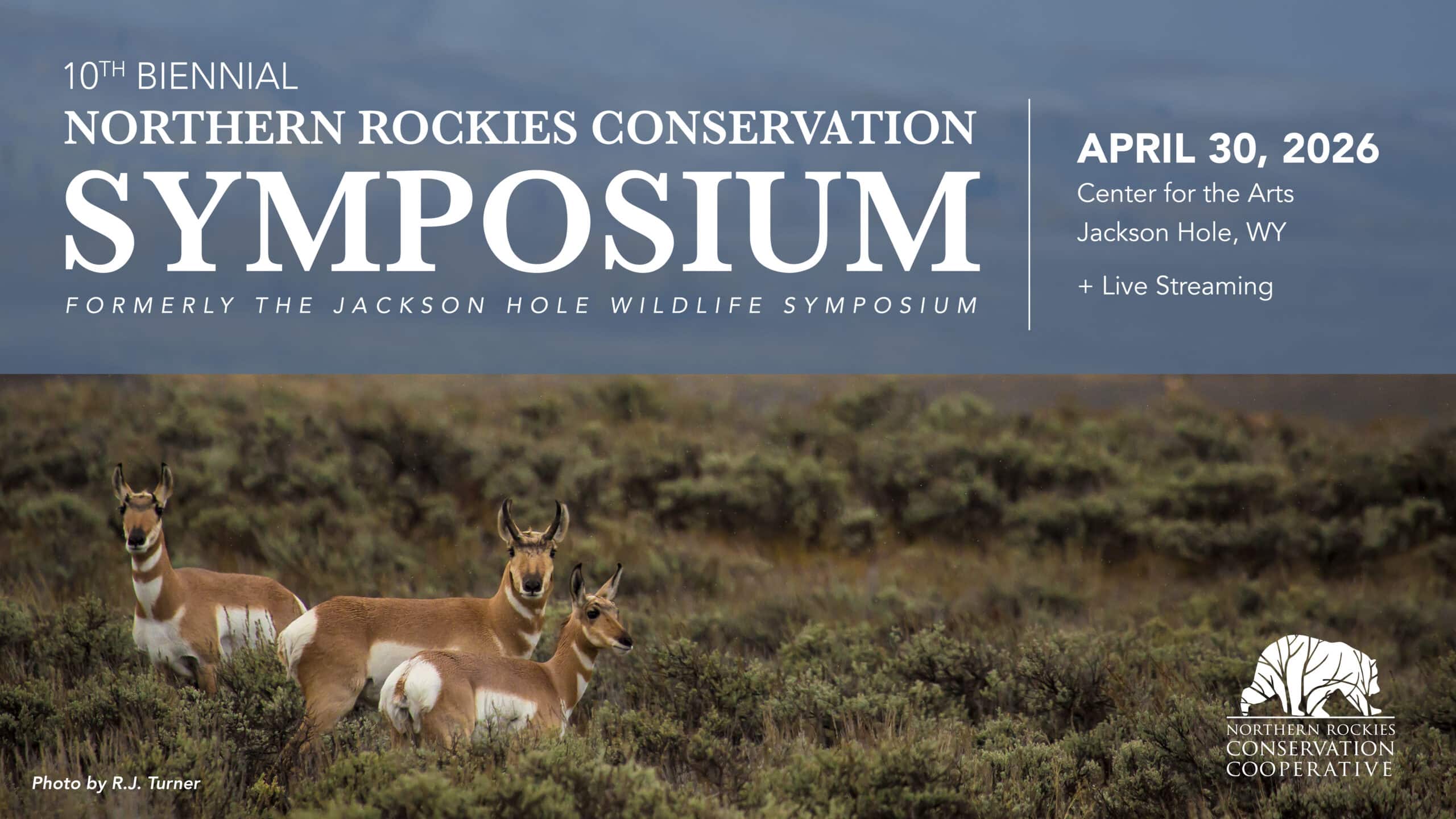
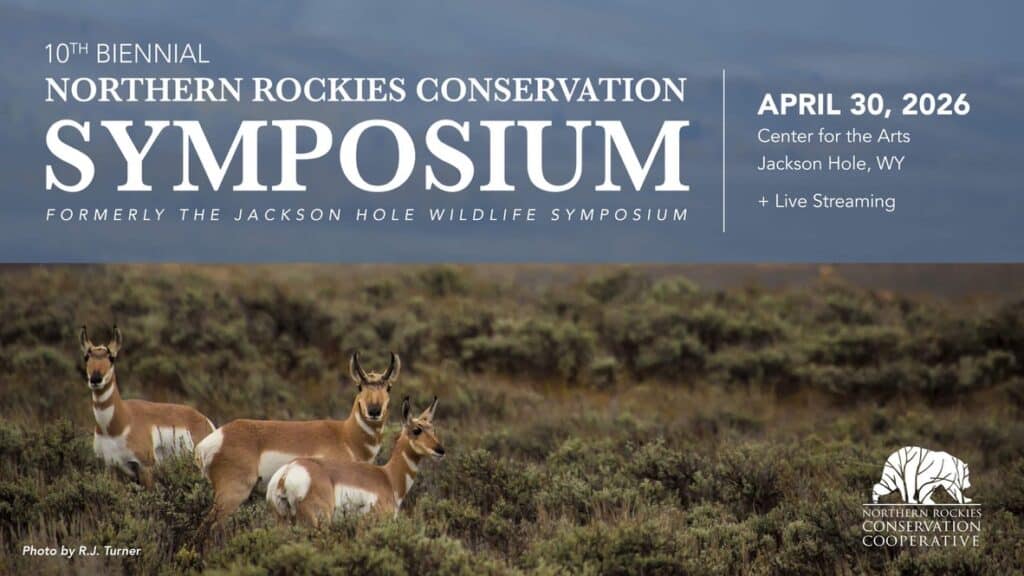
On Thursday, April 30, 2026 in Jackson Hole, Wyoming, the Northern Rockies Conservation Cooperative is hosting a one-day event—Building Resilient Networks for Conservation in a Changing Democracy— intended to pull people together in pondering how to save a microcosm of the above—the Greater Yellowstone Ecosystem. More broadly, the GYE represents a symbol of how, more broadly, individuals and groups can harness agency in rallying on behalf of wildlife and wild places.
“These presentations represent the diverse network of people and projects on the frontlines of Greater Yellowstone’s conservation efforts. They are the brute-force energy keeping conservation in progress, they are innovators, finely tuned to their specialty, but connected in network to one another and the larger goal of preservation of the Northern Rockies. They are the faces of hope.”
—NRCC Executive Director Katie Shepherd Christiansen
The event—sign up and view the entire agenda here— is being held at the Jackson Hole Center for the Arts, 240 South Glenwood Street, beginning at 8 am. The fee which covers the entire day includes a networking lunch, multiple ways to become informed throughout the day and culminates with an evening keynote. What’s the value of being inspired? Priceless.
For NRCC, which over the last four decades, has operated as a science-first advocacy organization that brings a cross-disciplinary approach to large landscape thinking, this year’s event is a specially-designed alternative to its popular biennial Wildlife Symposium. Those events have had distinguished experts in conservation with global reach and this will do the same.
Dr. Susan Clark, an octogenarian who co-founded NRCC and until recently used Greater Yellowstone as a reference point for teaching policy classes as a professor at Yale University’s School of the Environment, says we are in the midst of an era filled with unforeseen challenges and unparalleled consequences.
Many involve deliberate unraveling of institutions and laws, erosion of the ecological integrity of public and lands from human pressures, and obvious documented shifts involving precipitation from water demand and climate change.
Look no further than a snowpack throughout the Northern Rockies this winter being near the lowest on record; the current dire reality of water in the Colorado River System, whose tendrils reach into Greater Yellowstone via the Green River; or the triage being directed toward the Great Salt Lake that is not only dying, but if it dries up will leave behind serious public health concerns about toxic dust from the lake bed whipping across the Salt Lake Valley.
Meanwhile, in Greater Yellowstone, decades of trying to bring a cohesive strategy for protecting its world-class wildlife, rivers, and sense of place, are being set back by what prominent historians have described as radical ideology advanced by free market thinktanks, that are anti-public lands, anti-science when it doesn’t affirm its agenda, and has an aim of weakening public land agencies and environmental laws at the behest of resource extraction industries. On top of it is a pervasive, morale depleting atmosphere of fear inside land management agencies.
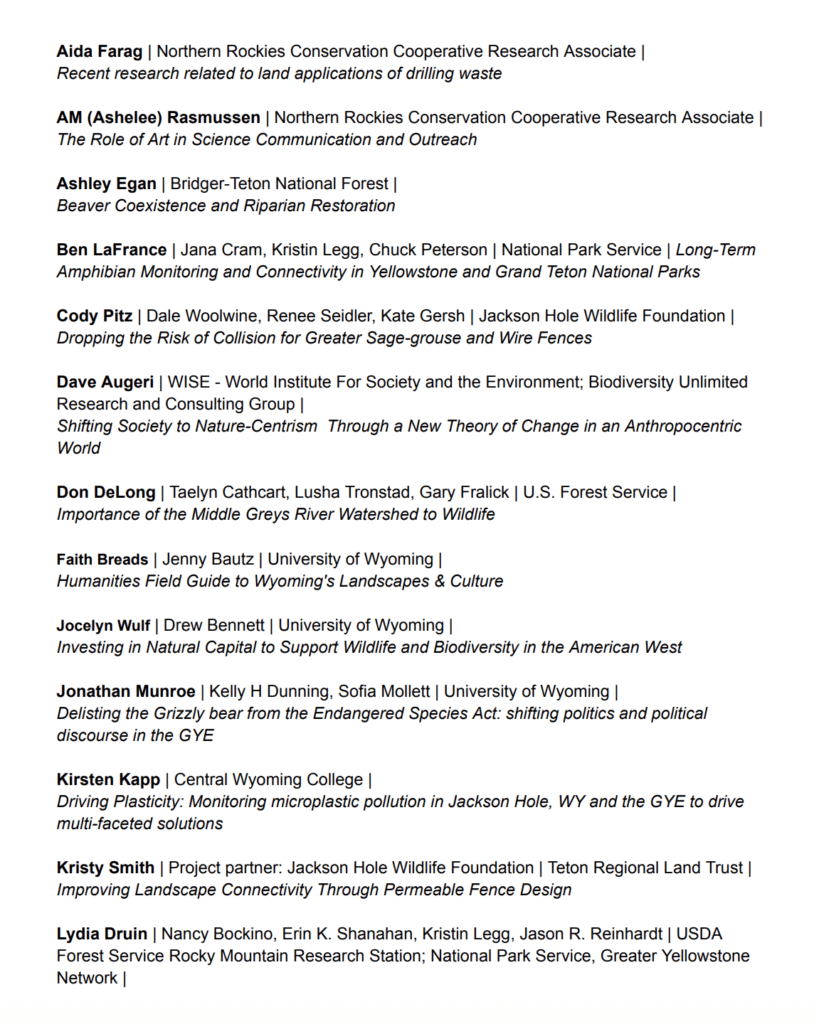
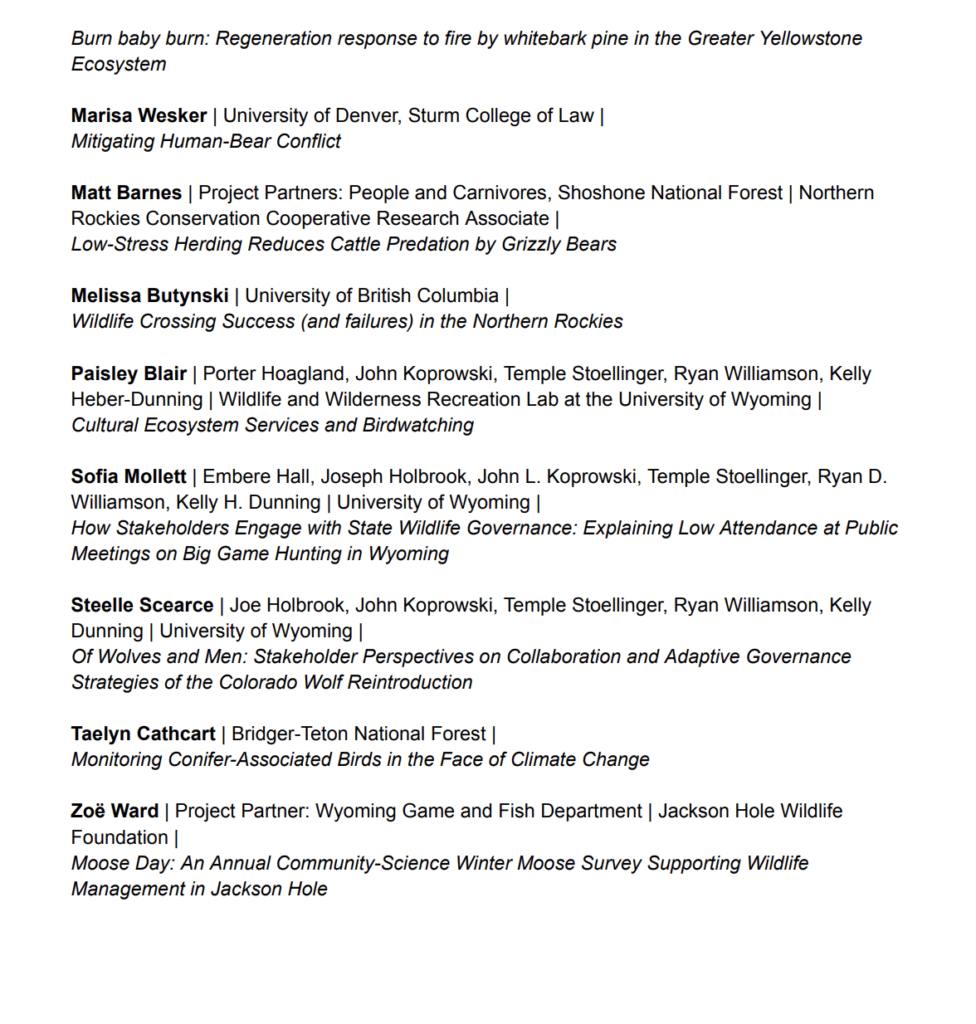
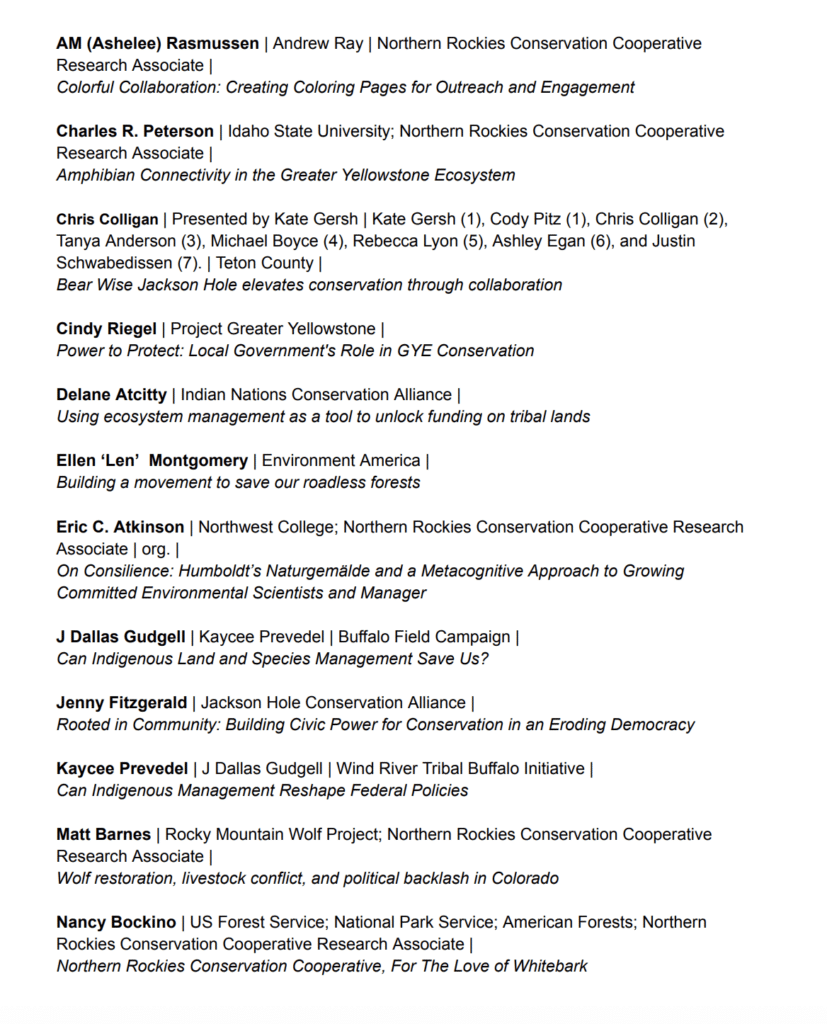
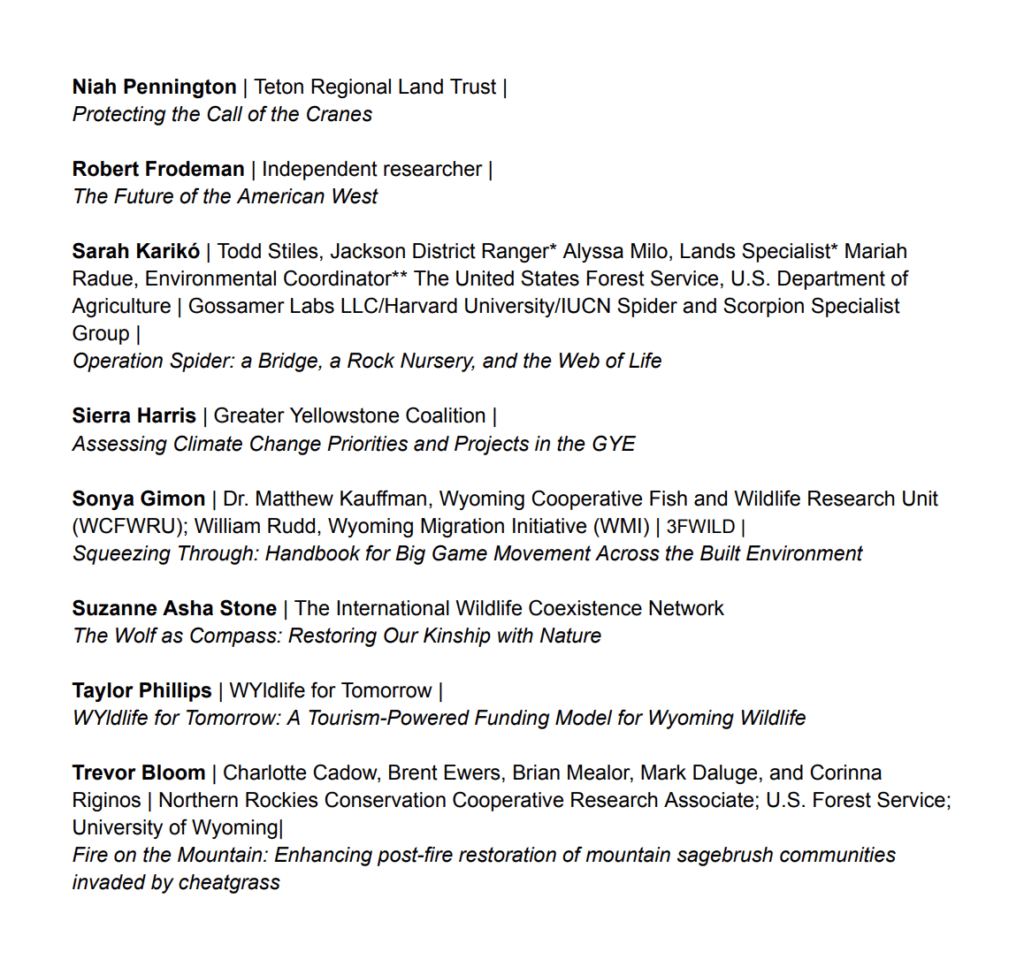
While tackling all of this head on in the morning, the NRCC conference also will again feature what has been a popular expression of hope—a series of rapid-fire QuickTalks featuring representatives from Greater Yellowstone conservation groups, scientists and thought leaders deliver short and fast overviews that are exciting and informative. It is a true all-star team. In just a single day, 50 presentations spanning 30 different organizational affiliations, plus poster presentations in the lobby about some of the latest wildlife research and nature artists showing their work.
Remembering the early years of the Greater Yellowstone Coalition when it as a membership organization and its annual spring meetings were always a much anticipated event of education and building human cohesion, NRCC wants the event in Jackson Hole this year to do the same. Yes, events will be live-streamed but you need to sign up in advance, and while you’re at it, please spread the word and share this link.
The Yellowstonian Interview About What’s Happening At The NRCC Symposium
Todd Wilkinson: This is an untraditional symposium because it speaks to immediate chaotic forces now at work in how we think about conservation. In past years the Wildlife Symposium has featured elevated discussions about the science of wildlife conservation, and a lot of that is happening in the fan-favorite QuickTalks and Poster Sessions. But the larger conversation is being elevated.
One of themes being emphasized this year is the critical importance of maintaining scientific integrity and hard-won democratic principles such as transparency, having a functional professional civil service, and, along with it, upholding the established right of citizens to comment on land decisions. Please elaborate on how these times are different and why it has necessitated a shift in the symposium’s approach?
DR. SUSAN CLARK, co-founder of NRCC: Now is a time of profound opportunity, despite all of the bad trends, but it will only be realized if we engage in action and have a positive goal in order to re-realize the personal agency we all need to be effective in doing the urgent work before us now. What’s at stake? Everything. From Jackson Hole, where we’ll be gathering, all of the challenges facing us are in view. The first thing we need to do is come together, reinforce one another and ponder a strategy.
“What’s at stake? Everything. From Jackson Hole, where we’ll be gathering, all of the challenges facing us are in view. The first thing we need to do is come together, reinforce one another and ponder a strategy.”
—Dr. Susan Clark, founder of NRCC and retired Yale professor
TW: Katie, you are roughly a year into being executive director of the Northern Rockies Conservation Cooperative and a lot has happened. What excites you most about the 2026 Symposium and elaborate on some of its essential elements.
KATIE SHEPHERD CHRISTIANSEN: We are living in a moment— in a time of rapid change. Though the vital signs for nature such as wildlife populations, species diversity, climate change, and loss of open space, have been trending towards collapse since long before I stepped into this role, the turmoil and destruction marking this last year has taken us to the edge of an even more precipitous decline.
This is a decline in the function and form of our environment, and a decline in essential protections thereof. It is also a decline in civic decorum, a decline in liberal democracy, and a decline in community cohesion. A decline in the opportunities for the future of humanity and nature on our finite planet. These realities are interrelated.
TW: NRCC is not what could be described as a traditional conservation non-governmental organization. It’s had a novel niche even within a region that has one of the highest per capita concentrations of conservation-related non profits.
Christiansen: NRCC has long advocated for the inter-connections between human dignity and conservation. Our mission, “Conservation for the Common Good,” acknowledges that healthy natural systems benefit everyone, that nature is a shared common good, and that our work must support the procurement of human dignity, mutual respect, and well-being for all. The sphere of our work, then, is not siloed by the bounds of any category some may consider “conservation.” Rather, we are interested in underlying and pervasive obstacles to the common good—problems that interfere with both human and natural communities achieving stability, security, and health.
TW: Unfortunately, there aren’t many organizations in the private sector that hold conferences like this anymore. Many people I’ve spoken to relish the opportunity for them, as individuals, or the conservation and science entities they’re a part of, to converge and know that strength exists in numbers. What does your 2026 look like?
Christiansen: Our Northern Rockies Conservation Symposia, now in its tenth year, has been a place to explore this integration of people, big ideas and good work.
Our morning panel is ready to engage at this level. Our panelists represent the highest level of expertise in our region’s ecology, economics, social and political sciences, natural resource management, and history. All together, they represent over 150 years of direct experience considering these essential veins of knowledge in the GYE. The facilitated discussion amongst the group will be grounded in recommendations for tangible and collective actions we can take today.
At the conclusion of the day, our keynote presentation will make the explicit case that the existential threats facing democracy are directly connected to the future of sustainability and stewardship in the Greater Yellowstone region. For those of us who care about wildlife, lands, and waters, we must step beyond our far-too-narrow titles of “environmentalists” and engage in our communities as citizens, for upholding democratic norms and institutions is fundamental to the future of the wild.
TW: Peyton, you’ve been a researcher, a board member at NRCC and a longtime part of its leadership. What does NRCC do that few, if any of the other conservation related organizations in the GYE and Northern Rockies do? And how is this a reflection of Susan’s belief of science existing in service to the public interest and in illuminating the wonders of nature beyond mere empiricism.
PEYTON CURLEE GRIFFIN: NRCC is unique for many reasons, not the least of which is our long-term commitment to the joint creation of reliable data (or evidence) and the facilitation of better social, policy, and decision processes so that the common good – for all people and the earth – is prioritized. We combine many ways of knowing and valuing to give voice to aspects of nature that are often unappreciated.
By integrating conventional science, social science, narrative, and art, we allow more people to connect to our incredible natural heritage. We strive to improve relationships between people/groups and between people and the natural world. As Susan says, conservation “isn’t out there,” it’s all in our heads and how we view one another and the realities we are witnessing in a time of dramatic change. With more comprehensive understanding, and better mental models and skills, we stand a much better chance to improve how we respond to everything from climate change to explosive growth and development.
TW: Susan Clark, you are one of the most published scientists I know on matters surrounding Greater Yellowstone and used the ecosystem as a platform for thinking about real-world conservation challenges. During the Covid epidemic your magnus opus policy book, Yellowstone’s Survival: A All to Action for a New Conservation Story, was published. You recently co-authored an analysis on the lessons about the life of the late Jackson Hole Grizzly 399. That book will be out around the time of the symposium. Please give us a sneak preview.
Clark: 399 as a real living grizzly bear mother, with a long life, lots of cubs and being visually accessible to lots of people, galvanized public interest in a way no other bear has. But how she lived, how land managers and agencies responded to her, how they viewed her, serves as a window for thinking about our larger relationship with nature and whether, at present, we have a capacity to confront the changes upon us.
TW: Another question for Peyton which will resonate with a lot of people out there in the West. You are married to a government employee who spent several years working at the National Elk Refuge and arguably nowhere else in Greater Yellowstone is there such a variety of civil servants for so many different public land agencies woven into the community as in Jackson Hole. You hope this symposium will provide some gravitational support at a time when staffs and hollowing out of agencies has created huge morale problems. Please share a few thoughts.
Griffin: Federal natural resource agencies are being weakened in unprecedented ways—they have lost more than 20 percent of their employees and they’re losing their ability to use bedrock environmental laws, science, and public consultation in so many ways that have been the norm since the 1970s and 1980s. Morale is not good when career professionals are being told to undermine their knowledge and experience, not to mention their core beliefs about what is right for the American public and our irreplaceable wildlife and wildlands.
As a spouse to someone who spent decades in the National Park Service and US Fish and Wildlife Service, and as a parent of two offspring who work with federal resource agencies, I’m especially worried about the toll on federal employees and their families. There are very few good days for people who feel like the work they’ve committed their lives to is being discounted and even destroyed.
“Federal natural resource agencies are being weakened in unprecedented ways—they have lost more than 20 percent of their employees and they’re losing their ability to use bedrock environmental laws, science, and public consultation in so many ways that have been the norm since the 1970s and 1980s. Morale is not good when career professionals are being told to undermine their knowledge and experience, not to mention their core beliefs about what is right for the American public and our irreplaceable wildlife and wildlands.”
—NRCC’s Peyton Griffin, married to retired civil servant
TW: One of my favorite parts of the symposium are the Quicktalks that showcase voices and projects described by participants in their own words. They’re kind of like conservation PechaKuchas. They’re always inspiring and even more so because they feature work by younger people and offer a counterpoint to the weightiness of larger challenges. You said you had a record number of groups wanting to take part. Tell us why these are important.
Christiansen: These presentations represent the diverse network of people and projects on the frontlines of Greater Yellowstone’s conservation efforts. They are the brute-force energy keeping conservation in progress, they are innovators, finely tuned to their specialty, but connected in network to one another and the larger goal of preservation of the Northern Rockies. They are the faces of hope.
TW: I wish that college and high school students around the region could watch them because they’re uplifting.
Christiansen: Our 50 QuickTalk presentations this year come from over 30 unique institutional affiliations. Their topics range from local government’s role in conservation, to indigenous land and species management, to a movement opposing the roadless rule, to building civic power, to large carnivore restoration, to climate change in the GYE, to the role of art in conservation, to innovative conservation funding opportunities, to stakeholder collaboration, and so much more.
These presentations range in scope from the conservation of a single species, to the future of the American West. The presenters are seasoned conservationists, students, academic and independent research scientists, former elected officials, tribal members, authors, and agency employees. Together, they represent conservation-in-action, and the power of networks for change.
TW: You’ve been pondering this conference for several months and without giving anything away here you want to light a fire and get people to rally about the necessary big ideas which need to happen if we truly have any hope of saving/preserving this miracle called the Greater Yellowstone Ecosystem. A crucial element is having courage in the face of adversity.
Clark: That’s right, and it’s one of the reasons why we’ve invited Christina Cromley Bruner, who founded the group, For250More (devoted to ensuring we have another 250 years of American representative democracy) and who, among her leadership posts, worked in the Department of Interior Office of Inspector General that functions as a watchdog of government. But that office has been gutted and there are implications of losing oversight, accountability, and transparency with it comes that that department and land management agencies under its jurisdiction. Christina will give us the insight story and what it means for Greater Yellowstone and the public land American West.
TW: Over the years, what’s made an impression on me are the number of individuals going back to the days of the Muries and others, when everything bout the future of Jackson Hole was on the line, and they stepped forward to advocate for creation of Grand Teton National Park. Even though it was unpopular to some locals in power and who erroneously claimed it would bring economic calamity. Adolph Murie, a biologist, also spoke up for carnivores at a time when it cut against the grain of then prevailing culture and politics. He was proved right over time. My point being that people we venerate today as being courageous and heroic stepped up when it mattered and did not approach doing the right thing for the public good as a popularity contest. Arguably, the conservation movement has fallen into retreat. It’s crystal clear that what we treasure about Greater Yellowstone today will not be saved in time if timidness prevails over bold foresighted thinking.
Clark: The Muries and others stayed human amid the growing turmoil around them. That doesn’t mean they were timid because they rose to confront the challenges. They knew that those who were causing the challenges were being forceful and determined to get what they wanted. The Muries had a broader vision. They had “faith with Nature.” They had agency, not an agency that was given to them but which they earned, and they went to work and we and Nature are the beneficiaries. They were pragmatic and operated with truthfulness and accepted responsibility and had a moral compass. They were largely individuals, not part of any fair-weather bandwagon. These kinds of people have an inner resilience that enables them to withstand conflict and still maintain a moral compass. There are very few people like that, and we obviously, desperately need more like them now.
TW: Katie, we’ve talked about a deep desire people who care about the natural world and conservation have to gather in way that there’s still a centrifugal force of humans who want to do something….
Christiansen: Given the interconnected political, social, and environmental context of the day, I think many people are looking for such places of integration. I’m most excited to be able to provide a setting and space that meets the yearnings in so many concerned community members and professionals for holistic assessment and interdisciplinary thinking required to fully orient to – and meet – this moment.
Remembering the Muries of Jackson Hole
by Todd Wilkinson
They were just like us.
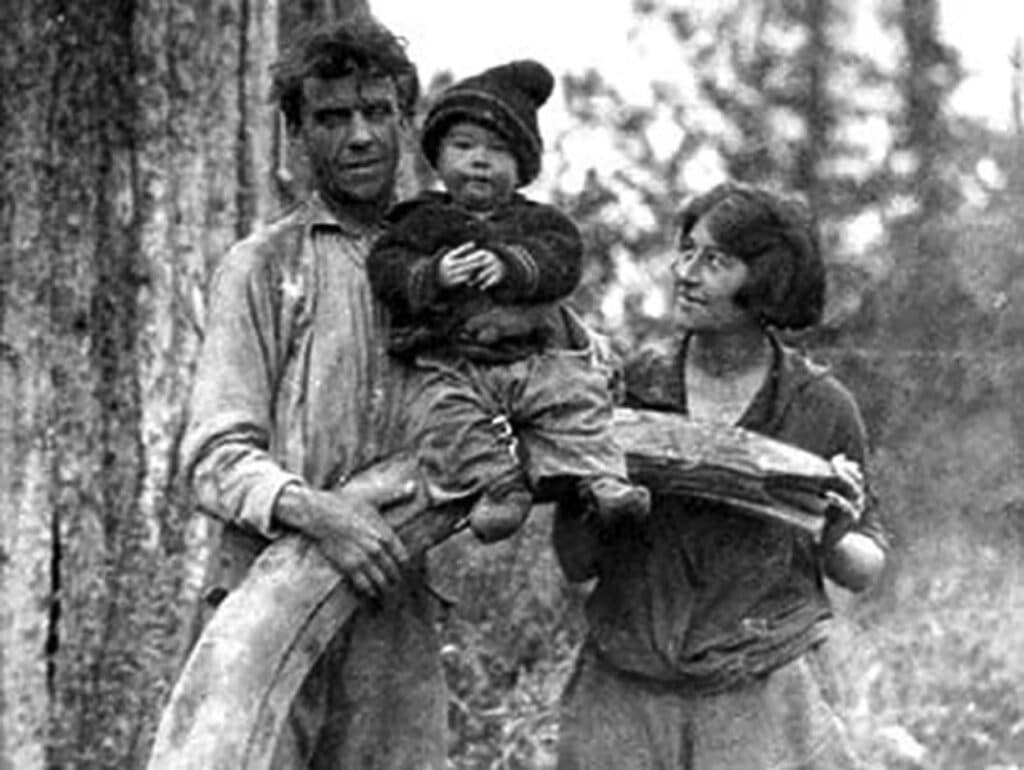
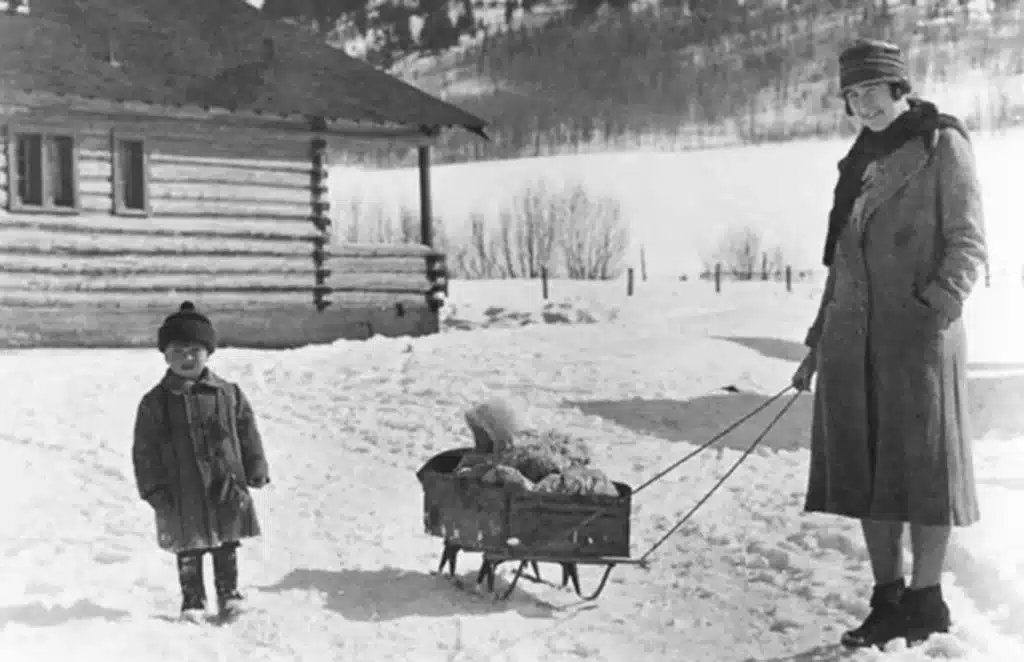
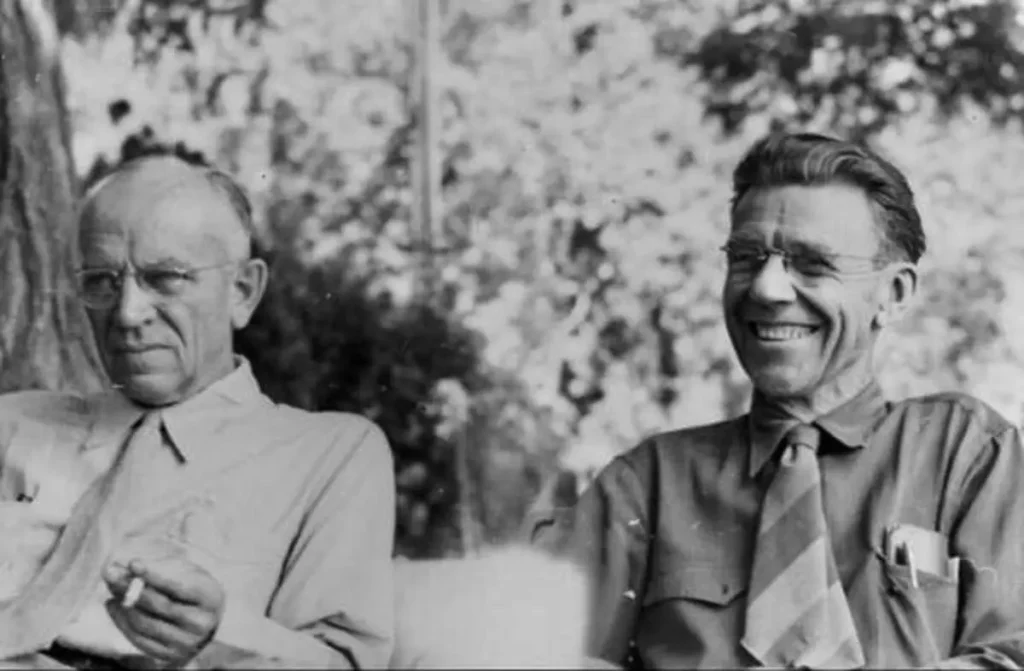
No local family in the West is more closely associated with American conservation than members of the Murie clan of Jackson Hole. It’s poignant that the 2026 NRCC Symposium is being held here, in a valley they considered spiritually sacred, and were they alive they would not only attend the gathering but be called upon to deliver rousing opening addresses.
Half brothers Olaus and Adolph were forerunning ecologically-minded wildlife scientists who, against fierce resistance from their employer, the federal government, pressed for the designation of wilderness as an effective way to preserve wildlife, they strongly advocated for expansion of Grand Teton from a monument into a full-fledged national park, spoke out to safeguard habitat for elk against sprawl, risked their careers to say the wanton killing of wildlife predators had no compelling scientific justification , and they helped lead a movement to conserve the fragile tundra of Alaska.
No less by any means were the convictions of their partners/wives, half-sisters Mardy Murie (married to Olaus) and Louise (married to Adolph). The foursome hosted prominent conservation advocates at the Murie Ranch in Moose, from ecologist Aldo Leopold to US Supreme Court Justice William O. Douglas, Avis and Bernard DeVoto and Howard Zahniser—who like Thomas Jefferson for the Declaration of Independence, was the wordsmith behind The Wilderness Act.
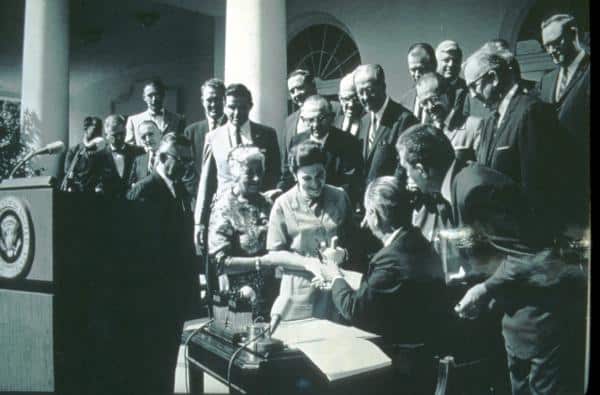
Indeed, the spirit of wilderness protection in America and the world flowed through the Muries, and although Olaus had passed, Mardy Murie was there, in 1964, when President Lyndon Johnson signed it into law. Later, President Clinton award Mardy the Presidential Medal of Freedom, the highest civilian honor for her work in conservation but she said she really accepted it on behalf of her family and devoted friends.
The Muries were not gods nor humans without fault but they are heroes in retrospect for creating a better future beyond their own time that we now inhabit. They stepped up when it mattered and when it would’ve been far more convenient to stay silent, not ruffle feathers or risk not being invited by those holding the trendy cocktail party of the hour. “The Muries were crusaders who never gave up fighting for wild things and wild places,” states a description from the Wyoming Game and Fish Department.
Through their pluck, they put down a foundation of thinking about the importance of courageous conservation, making Jackson Hole a center for thought and action in Greater Yellowstone and the larger American West and Alaska. Once upon a time, the Muries were twentysomethings, no different from the gung-ho young people of today invigorated to be here and eager to play. But a necessary component, the Muries would say, is defending wildness and respecting wildlife that has no voice, being an advocate as a matter of noble conviction. This is the difference between being a mere taker, acting only on self-interest, and giving back to something bigger than yourself, which is the common good. This is the spirit of convergence behind the 2026 NRCC Symposium.
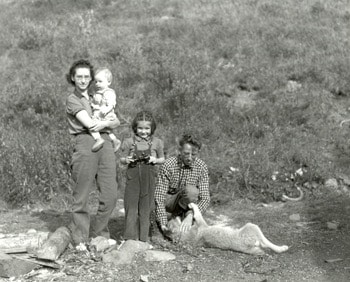
Louise Murie, at left, holding son, Jan, next to daughter Gail and Adolph Murie.
All-Star Roster of QuickTalk Presentations At 2026 NRCC Symposium
NRCC Poster Sessions— You Can Meet Inspiring Scientists In Arts Center Foyer!