
by Todd Wilkinson
Of all his ranches in the American West, Ted Turner considered the 113,000-acre Flying D outside of Bozeman, Montana to be his flagship. Stretching 20 miles between the Gallatin River on the east and the Madison on the west, it was a living breathing landscape painting where his pathfinding ideas about wildlife conservation on private land started to take shape, at scale.
All of it can be traced to his desire to bring back bison—and not as “domesticated production animals” but his original hope was to let them roam wild and unencumbered by fences. State livestock laws, however, quickly disabused him of that notion.
The Flying D, if it instead had been purchased by capital investment firms, could have become the mother of all real estate development plays in the Northern Rockies. Instead, Ted voluntarily put a conservation easement on the ranch, forever keeping sprawl at bay, and while Tim Blixseth, founder of the Yellowstone Club, said such a move was foolish, Ted today is seen by the public as a hero.
° ° ° °
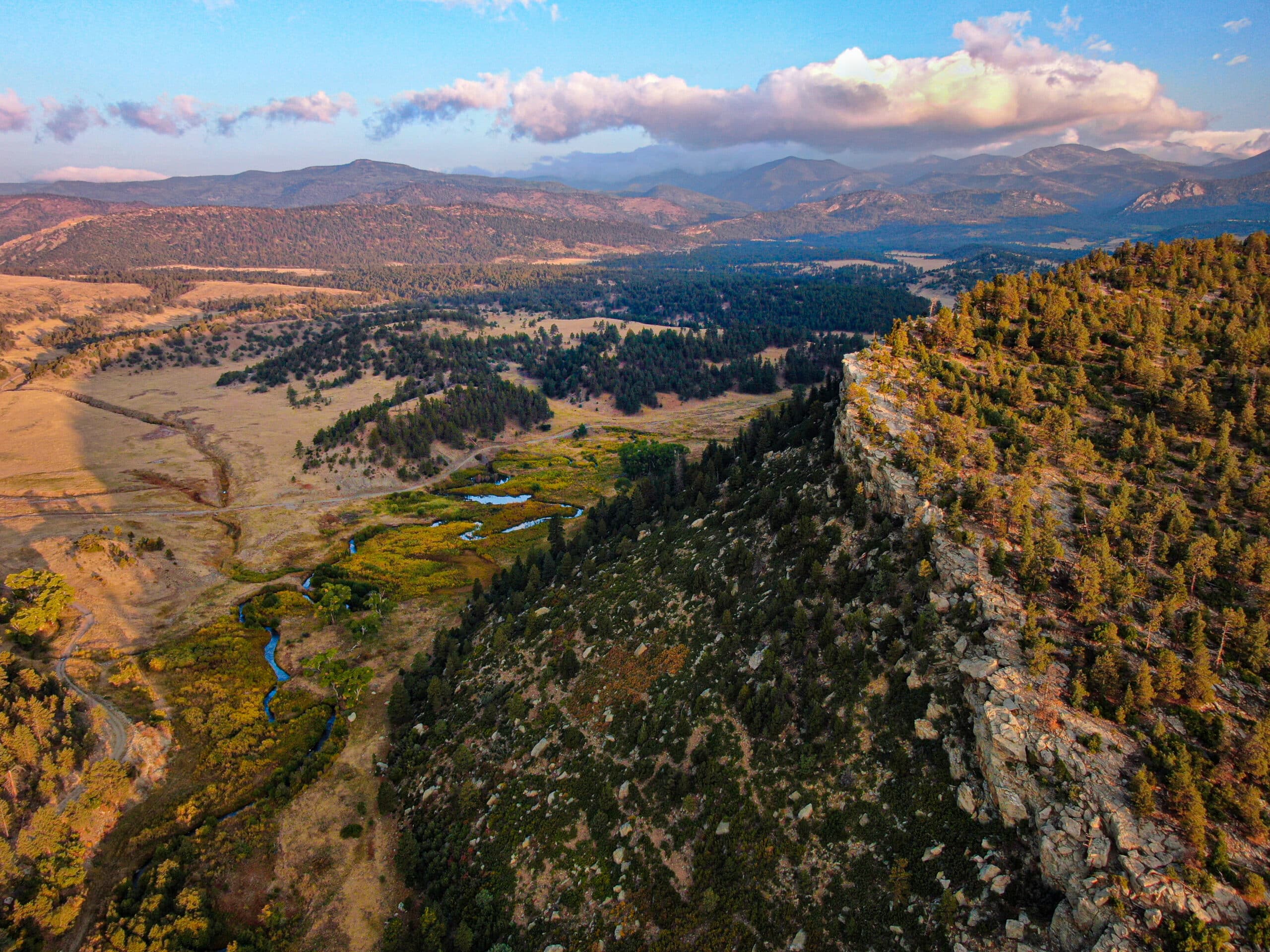
There is another sweep of terra firma, the mammoth-sized and rangy Vermejo Park Ranch in New Mexico, where the vison of modern “re-wilding” and true co-existence also has a starring role in Turner’s legacy of stewardship. And to gain a fuller picture of Ted, it’s essential to consider his actions beyond Greater Yellowstone.
At 558,000 acres, nearly five Flying Ds could fit inside Vermejo’s diverse panoply of terrain. Located near Raton, New Mexico north of Taos, it descends from the crest of the Sangre de Cristos in northern New Mexico and southern Colorado down to the tributaries of the Arkansas River, which feeds the Mississippi. Think of it: melting snow in the Sangres, for as long as it continues to fall, has a chance of reaching the Gulf of Mexico!
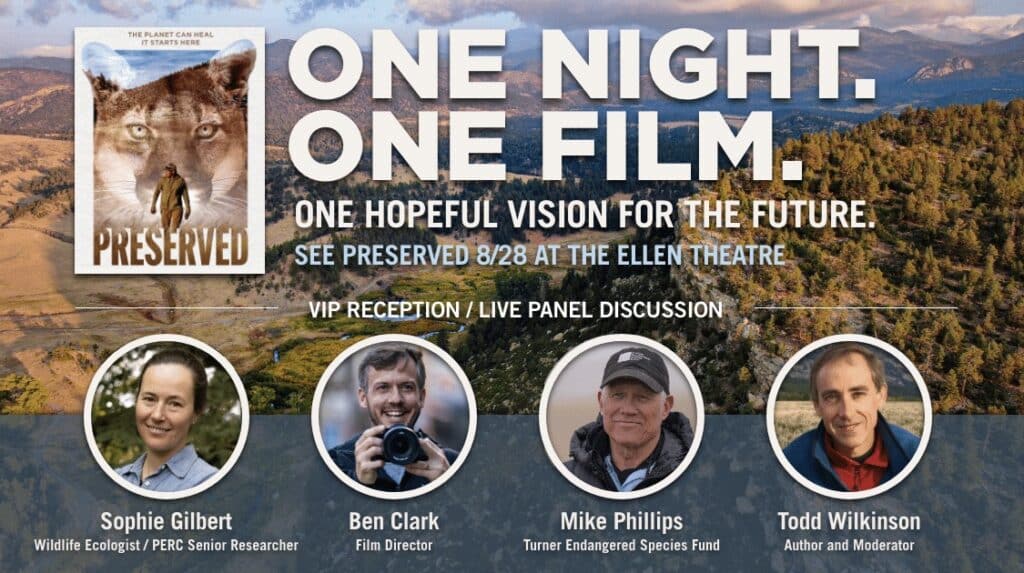
Vermejo is another venue where Turner made conservation history and part of that story is celebrated in the new film, Preserved, by director Ben Clark and editor-creative cohort-wife, Mary Anne Potts. The documentary is being screened Friday, August 28 at the Ellen Theatre in Bozeman. Public is invited but tickets required.
Joining Clark for a live discussion of Turner, Vermejo and the film is noted conservation biologist Mike Phillips, best known for helping to lead the reintroduction of wolves to Yellowstone in the mid 1990s, for co-founding the Turner Endangered Species Fund with Ted and for serving several terms in both the Montana House and Senate as an elected official. Alongside them will be wildlife ecologist Sophie Burke, who is a senior researcher with the Bozeman-based property rights and conservation thinktank, PERC, sponsor of the film showing. I will serve as discussion moderator.
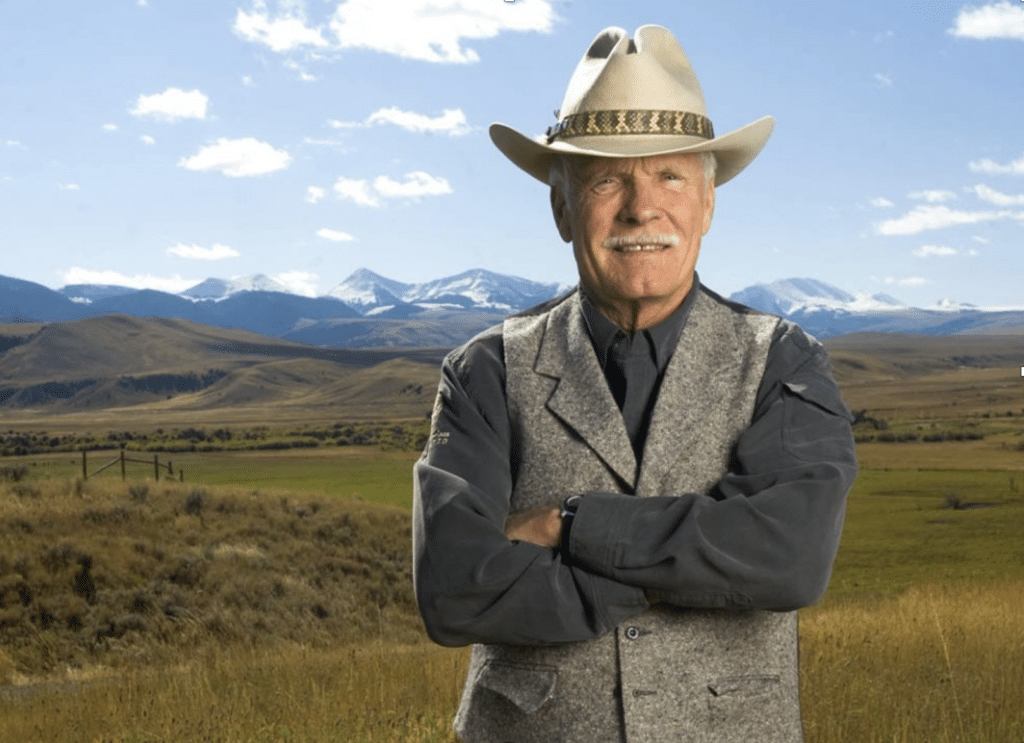
Just this last week, at an event called the Saving Yellowstone Summit hosted by businessman and fellow bison rancher Joe Ricketts in Wyoming, PERC’s president Brian Yablonski noted how Turner, who passed away this spring at age 87, was America’s forerunner in setting the modern course of private land stewardship.
Phillips was also there and he said the crowning accomplishment of Turner was not merely owning or generally “conserving land,” but showing, with deliberate intent, and contrary to claims made by some, that recovering threatened and endangered species on one’s land need not be viewed solely as a liability or at odds with making profit.
Phillips said Turner saw it as an investment in holding on to a better world.
Many Bozemanites, especially newer arrivals, may be unfamiliar with the scale of Turner’s legacy, which I explored in my book Last Stand: Ted Turner’s Quest to Save a Troubled Planet. While the book highlighted Turner’s efforts in southwest Montana, much of the narrative transported readers elsewhere, including to a trio of his significant properties in New Mexico—the Ladder, Armendaris and Vermejo ranches.
Preserved highlights how Vermejo is a destination for luxury travelers in search of outdoor adventure, hunting, fishing, rustic pampering and immersing themselves in a rare place that, at Turner’s insistence, had a strong focus on ecological recovery. One of the issues Ted devoted much time to pondering in the latter decades of his life was how to advance conservation in a way that would be perpetual and supported by non-destructive ways of generating revenue.
The quest led Ted and his grown children to create a new entity called Ted Turner Reserves overseen today by company president Jade McBride. The operation allows people to be guests at Vermejo, Armendaris, Ladder and a spa called Sierra Grande in Truth of Consequences, New Mexico.
By design, Ted wanted clients to become inspired ambassadors for wildlife conservation and know that proceeds generated through their stay would be channeled back into an array of significant wildlife protection projects. Vermejo itself is under the direction of ranch manager Gus Holm who has decades of experience advising many working ranches in the Southern Rockies on how to remain economically viable and doing good by the land.
Both Vermejo and filmmaker Clark, who interviewed McBride, Holm, Phillips, landscape conservationist Kris Tompkins and others in the film, have intriguing backstories.
At one point, Vermejo commanded stature as a historic 20th century working guest ranch, especially for Texans. Originally established as part of the historic Maxwell Land Grant during the Spanish colonial era, it was seriously considered for possible addition to the US National Park System. However, coal mining and high-graded logging targeting only commercially merchantable trees in its old-growth forest took that option off the table—and exacted an ecological toll. That industrial era has been erased.
For several years, the energy company Pennzoil, prior to Turner’s acquisition, operated Vermejo as a corporate retreat and among its wildlife treasures was a bison herd, descended from survivors in Yellowstone, that still maintained genetically pure strains of the species not holding traces of inter-breeding with cattle. Only tiny numbers of such animals persisted through the near extermination of the species.
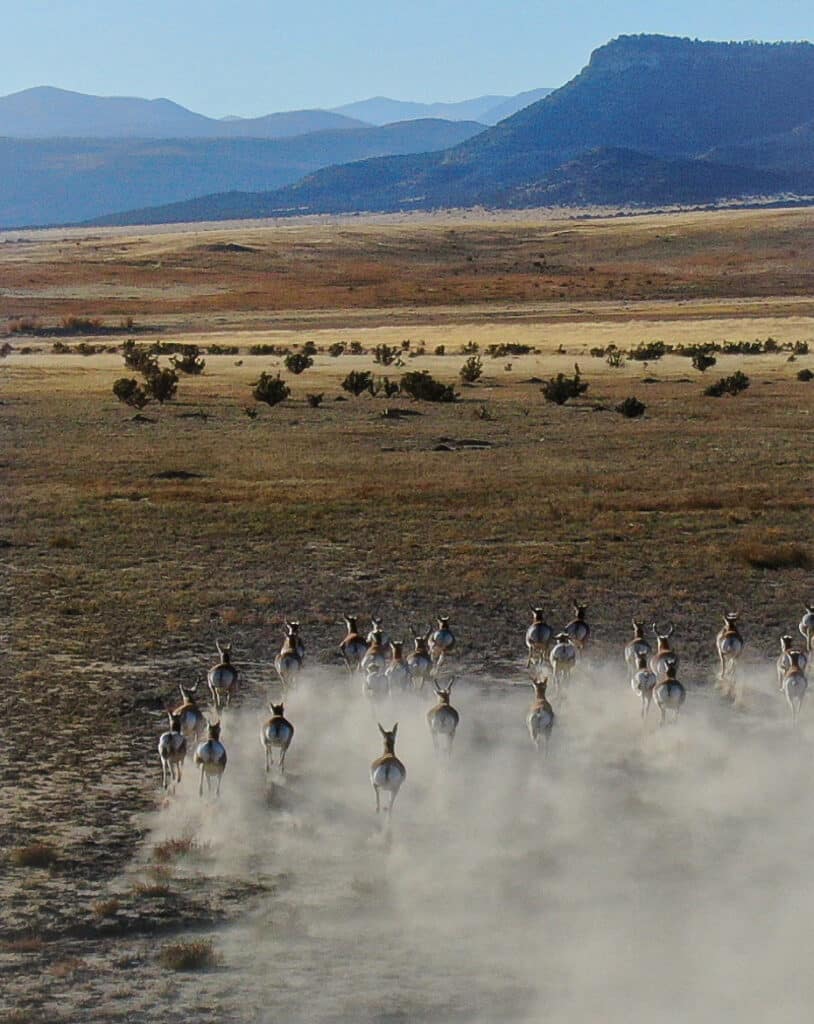
What Turner and his Bozeman-based property manager Russ Miller recognized was possibility—of not only having acreage at Vermejo to help bolster Turner’s massing of bison, but carry out healing recovery of a spectacular landscape in desperate need of more tender loving care. Subsequently, when noted conservation biologists like Phillips, fisheries guru Carter Kruse (current director of science and conservation programs for Turner Enterprises) and others were turned loose, Vermejo under a succession of ranch managers has become a prominent living laboratory for re-wilding carried on private lands.
While Vermejo ranches buffalo, they are not the sole focal point. It is home, thanks to work by Kruse, to one of the most ambitious and successful native fish restoration efforts in history with recovery of Rio Grande cutthroat trout; it’s also been a place where prairie dog conservation set the stage for aiding in the comeback of North America’s most endangered land mammal, black-footed ferrets; where beaver have recolonized some formerly channeled streams; where huge numbers of wild public elk inhabit mountain valley and that, one day, may support the return of wolves, which was always one of Ted’s dreams; and where native forest restoration, that looks a century into the future, is underway anticipating shifting conditions brought by climate change.
In addition, Vermejo has been on the front lines of navigating “split-estate issues” involving deeds where there is a division of property rights between what’s above the ground and what’s beneath it. Some own both rights; Turner did not. When a company with rights to Vermejo’s subsurface wanted to extract natural gas, Turner couldn’t stop it; instead he and his team led by son-in-law attorney Rutherford Seydel drafted a novel agreement in which Turner earned royalties from production and those proceeds went back into advancing conservation. The deal also included dramatically minimizing the footprint of development that has been referenced across the West as other landowners contend with split-estate issues.
° ° ° °
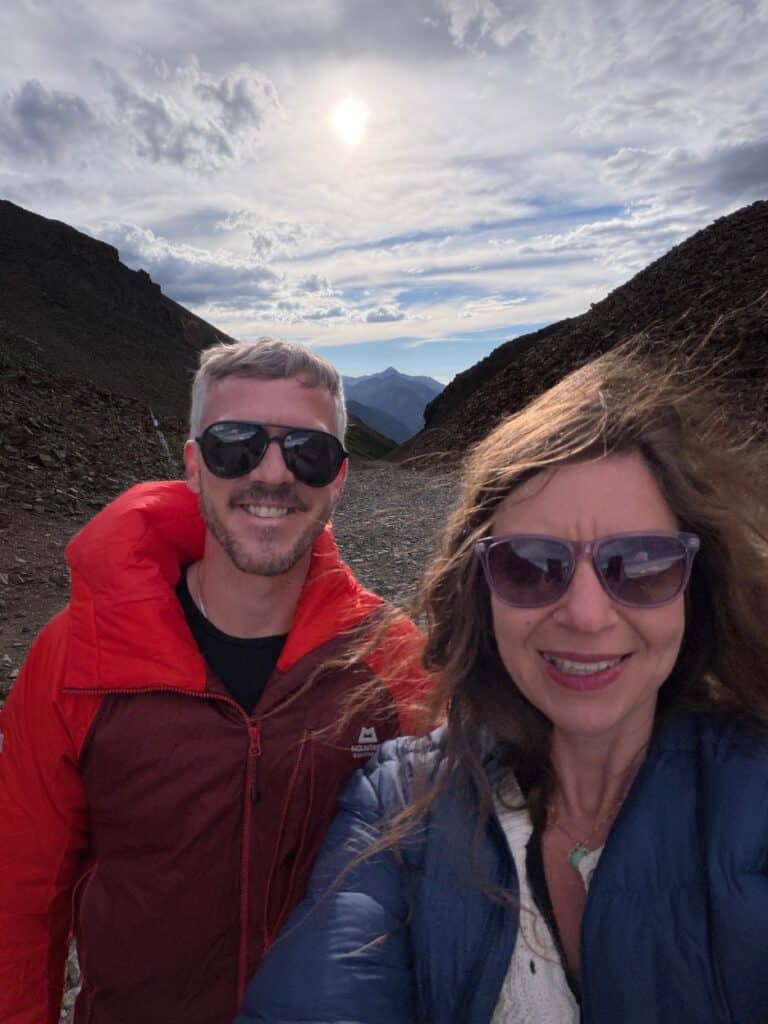
For filmmaker Clark, making Preserved was, in a way, mind-blowing. Legendary himself for being an extreme outdoor athlete driven by pursuit of high adrenaline, he became in 2002, at age 23, the youngest American ever to summit Everest. He subsequently charted new climbing routes in the Himalayas, and still partakes in ultra long distance hikes and runs.
After he and Potts were living in Brooklyn, New York, and then his home state of Tennessee during and after Covid, the couple moved West. Their attitude started to shift. Earlier, Mary Anne had worked for the National Geographical Society and still as a high-end content editor. Initially, Clark made films about thrill-seeking funhogs but then their interest turned to telling environmental stories and ultimately to celebrating the multi-faceted elements that converged around Ted at Vermejo.
Clark and I talked on the phone about how the outdoor recreation industry has often been missing in action when it comes to advocating for wildlife conservation on public and private lands, aggressively instead favoring personal access over pondering impacts to non-human species. He acknowledged that even he suffered from that blind spot but his eyes have been opened.
“After we resettled in Colorado, Mary Anne and I were like, ‘Wow, we need to hit ‘Pause,” and whatever we do it needs to involve something more meaningful,” he said, knowing that part of the impetus was starting a family. “How Vermejo came on my radar is that I started out as an extreme sports guy, a former pro athlete who was shooting films about outdoor recreation for the last three decades, and then I experienced this place. It hit me, and it changed me.”
Clark says he only once experienced a similar sense of wildness after he had climbed Mount Kilimanjaro in eastern Africa and traveled across the Masai Mara far off the beaten path of roads and people. “Vermejo made me more fascinated, thinking about happening in a square foot of ground than staring at a mountain and seeing it as a challenge to be overcome. It ignited a deeper curiosity for working landscapes. I came from the perspective of being a frothing bro who wanted to slay any obstacle nature put up, but this film has caused me to appreciate what I’m able to notice when I slow down and am completely still.”
° ° ° °
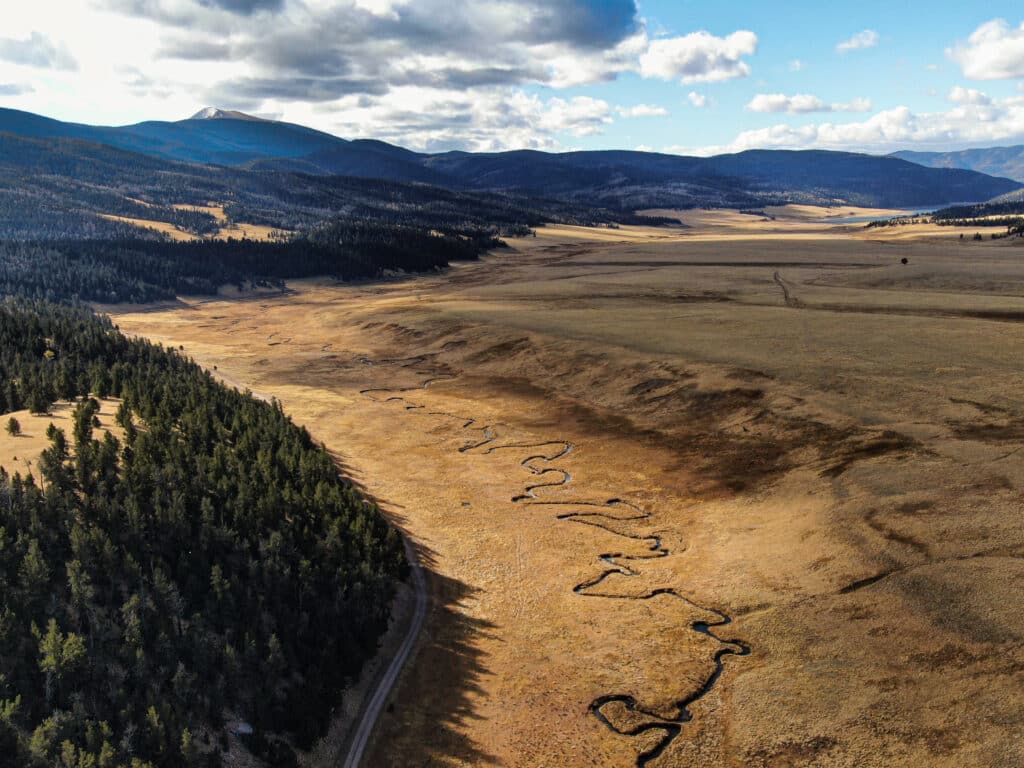
What separates Vermejo from a national park is that it limits the number of people allowed to move through it at any one time. Conservation on private land also does not generally need to maneuver reams of red tape, the whims of dense, short-sighted politicians, and a manic public constantly pressing to create more roads and trails in the name of access. However, the danger of total laissez-faire, free market thinking is that while some may choose to be conservation champions, others will use the freedom to destroy because they either aren’t ecologically aware or don’t care. Although he subscribed to the mantra of private landowners being able to do things faster, better and cheaper than government, he also said rules needed to be in place to prevent shameless plundering.
Ted once told me in the last years of his life that one of his favorite words in the human language was “enough” it corresponded to his bumper stickers, “Save Everything.”
Knowing when we have enough, he said, is the difference between being driven by selfish unbridled greed and recognizing that the good of the planet, which benefits all, is a force far greater than oneself.
There are thousands of lesser heroes in what’s been called “the Turnerverse,” involving a diversity of individuals whose efforts could never be chronicled in one film, or 1,000. And while he had pride in what he did, he valued the contributions made by every member of his staff, on every property, at CNN, TBS and the film studios, in his foundations, staff at his many Ted’s Montana Grill restaurants that he started with George McKerrow and, of course, to his kids, grandkids, ex wives and lifetime friends whom he affectionately called “my pals.”
Even in death, Turner is still changing the attitudes of younger generations like Clark and people he never knew. “Preserved” as a movie is a way to reach a lot more people who may never get to Vermejo, and to inspire other large landowners who realize Turner defied those who simplistically portray the well-being of nature as being a contradiction of their business and livelihood ambitions.
Once, several years ago now, Phillips and I were standing in the backcountry of Vermejo. Not long after, we were scheduled to rendezvous with Ted and his friends Tim Wirth (the former US senator from Colorado tapped to head the UN Foundation Ted created) and Mike Finley, former Yellowstone superintendent who presided over Turner Foundation. Our destination was the Ladder Ranch where Phillips, Ted, ranch manager Steve Dobrott and team were restoring imperiled Chiricahua Leopard Frogs and, at Ladder and Armendaris, Bolson tortoises that had been absent from the US southwest for thousands of years. Ladder also played a critical role in Mexican wolf recovery. All of this was happening with the willing, voluntary, solicitous approval of Ted Turner.
In the morning at Vermejo, Phillips showed me the facilities where black-footed ferret kits were being raised in captivity and bound for eventual release in the wild, and then we passed Castle Rock in Vermejo’s interior where there were bison, and across streams where Kruse was performing his magic making the ranch a renowned refugia for imperiled Rio Grande cutthroat trout on over 60 miles of streams. We arrived in the remote Costilla Valley set beneath the Sangres and watched a herd of elk stream through below.
Between 6,000 and 8,000 public elk, unbounded by wildlife-unfriendly fences, live on the ranch or move seasonally across it.
Just like at the Flying D in southwest Montana following wolf reintroduction to Yellowstone, Ted, in his own mind, had put out a welcome mat for wolves to reach Vermejo if it was ever possible. “If wolves ever reach this place on their own,” Phillips said, “they will have believed they died and went to heaven.”
Last week, Mike reminded me how Ted had the rarefied ability to gaze into the future of positive possibility even when the world seemed headed in the opposite direction. Could Vermejo ever become another reference point in US wolf recovery, adding to one of the greatest modern wildlife successes in history? Could it one day become a place of wolf viewing as fine as that found today in the Lamar Valley of Yellowstone Park or as compatible with the operation of a private working ranch as on the Flying D outside of Bozeman?
Clark’s and Potts’ film, Preserved, will get you thinking; it will help transform the way you think about wildlife, land, the false notions of frontier capitalism, the downsides of conquest, and allow you to see a better way forward. You, too, can become a virtuous ambassador for nature just as Ted and his family envisioned.
EDITOR’S NOTE: Below is the recording of a sold-out free event titled “Ted Turner & Friends: Stories from the Wild Edge of Co-Existence” hosted by Gallatin Valley Earth Day and Yellowstonian, held at the Emerson Cultural Center in Bozeman in January 2026. It showcased individuals in the Greater Yellowstone Ecosystem influenced by Turner and was intended to honor Ted while he was still alive. Turner could not attend the event in person. He passed away on May 6, 2026.