
by Dorothy Bradley
My father, Charles Bradley, who was one of the founders of the Montana Wilderness Association, had a word of caution: “Don’t be so open-minded that all your brains fall out.” His never did, which is not to say he had no compromise in him. He relied on the power of his thinking, his brain.
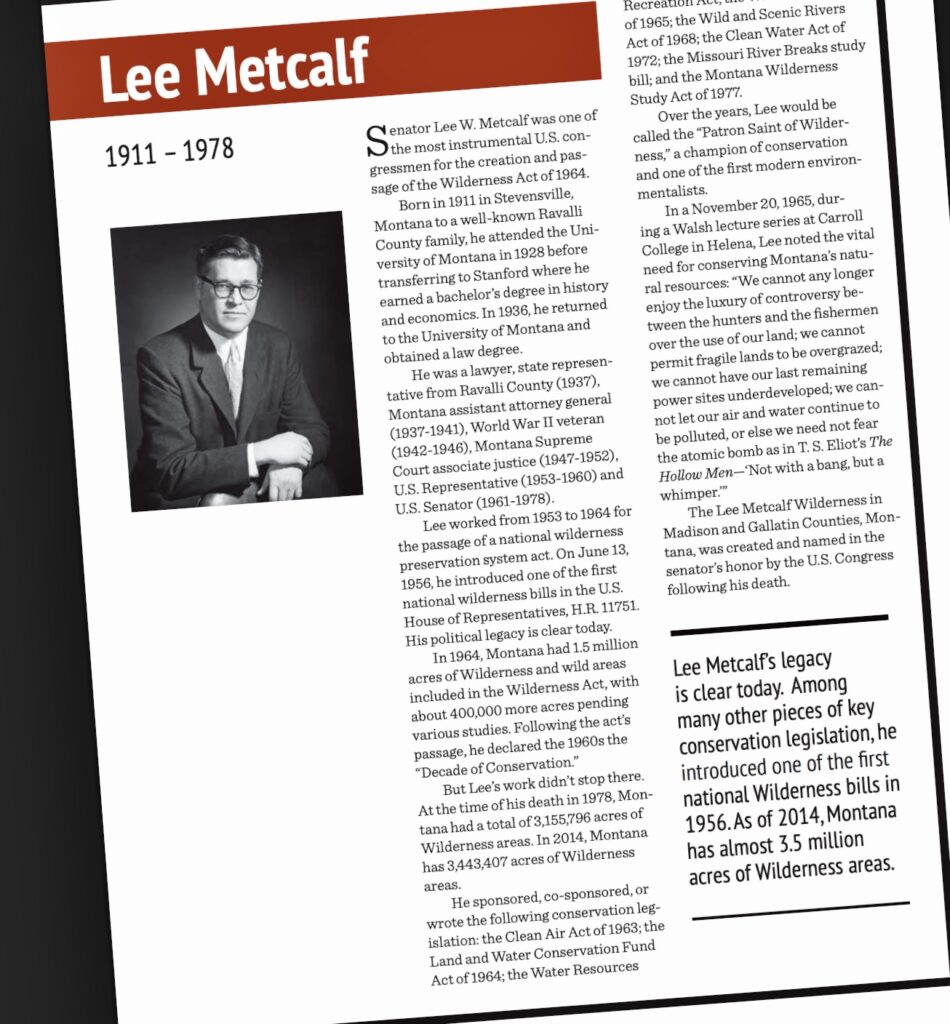
And he worked with giants. This was the time of Montana wilderness leaders like Cecil Garland and Doris Milner. In turn, they worked upward with those who are considered the “True Greats”—US Senators Lee Metcalf of Montana and Frank Church of Idaho. We have beloved protected wilderness today because of them.
But, wth the lengthy time it took to turn maps into wilderness, they were not able to complete their vision. So they protected seven Wilderness Study Areas (WSAs) for our generation to finalize because they knew such lands would be even more important in speaking to the character of our states that we cherish. And just as they passed along a legacy to us, what, through our old bold thinking, will we be paying forward?
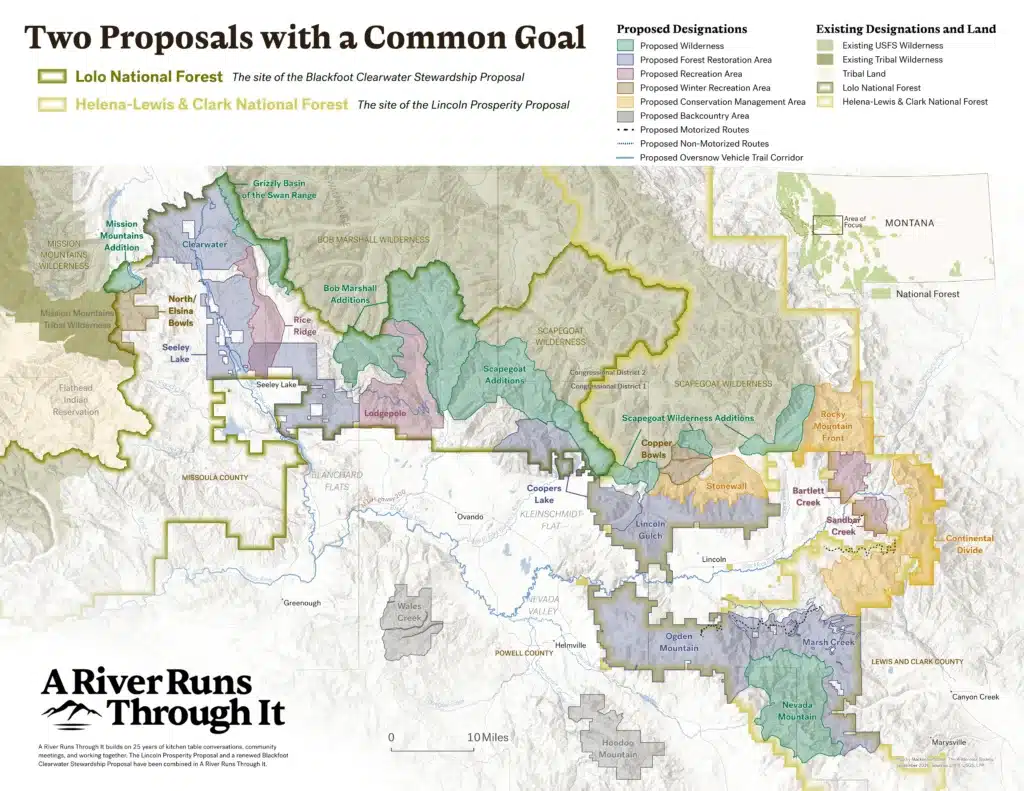
Now comes Congressman Ryan Zinke of Montana with A River Runs Through It Act, just as he is about to exit as a lame duck.
° ° ° °
° ° ° °
If one tries to sort out the variations of this effort following the success of Cecil Garland and the Scapegoat Wilderness in the 1970s which added an honorable 240,000 acres to the famed Bob Marshall, one gets lost in a maze of logging, forest health, snowmobile trails, new roads, biking, and motorized loops.
I have not read anything about prioritizing the protection of critical wildlife migration corridors or big game calving areas that need it if they are going to persist. I have not heard of advice being sought by proponents of that bill from wildlife scientists nor do they recite established scientific studies showing that the more industrial uses and roads we try to pack into these wildlands, the worse for wildlife it will be.
The bill he submitted is deserving of very close scrutiny. I have learned of the 410,000 acres of roadless land covered by the bill along with 20,000 acres currently in a Wilderness Study Area. However, only 30 percent of this defacto wilderness (130,000 acres) would be designated as wilderness. Notably, 100,000 of these acres are located on the southwest side of the Bob Marshall on slopes too steep to be logged, snowmobiled, or biked and undesired by industry anyway.
So, in terms of high quality wildlands put in the permanent protection column, it translates into 30,000 acres of productive wildlife habitat but it comes at a high cost of giving a lot of great wild country away and whose superlative values will be lost forever.
Mr. Zinke, I knew Lee Metcalf, and you are no Lee Metcalf.
° ° ° °
° ° ° °
I’m thinking of the earlier giants of the Montana Wilderness Association, and the greats with whom they linked arms—many of them earning entry into the hallowed Montana Outdoor Hall of Fame. And honestly, I see them crumbling into dust and blowing away. They gave us unimaginable opportunities, and 50 years later we are squandering them.
If ever we saw the need for protecting acreages essential for our wildlife survival, it is now. How do we reconcile the desperate flight of the bears into our urban backyards with our insistence on recreating in their backyard? How can we brag endlessly about our “iconic wildlife” and yet be so willing to give away their habitat? Where is our sense of gratitude and our sense of obligation to future generations?
Robin Wall Kimmerer writes about indigenous teachings of a culture of gratitude, and honoring the limits of Mother Earth.
She describes a symbolic ceremony when a big bowl of berries and a single big spoon are passed to each person. Each gets a taste from the same bowl with the same spoon. The berries in the bowl are the gift of Mother Earth.
But, she reminds us, the gifts of the earth are not limitless. “The generosity of the earth is not an invitation to take it all. Every bowl has a bottom. . . We are bound by . . . a pact of mutual responsibility to sustain those who sustain us.”
Scientists like the late John Craighead of Montana testified before Congress that if we want species like grizzlies, lynx, wolverines and ungulate populations to survive we must designate all the de facto wilderness areas in the Northern Rockies as wilderness. At the very least, and at this very time, we should designate as Wilderness our gift of the seven Wilderness Study Areas, which Lee Metcalf knew would be our chance to do something noble for the future.
It would be reassuring to know we have hung on to our brains and our heritage.
And can you imagine the gratitude 50 years from now?
For further reading: