by Todd Wilkinson with Chris Servheen
Were this a story for a hook and bullet magazine, it might commence with a concocted tale about a “rogue,” “man-eating,” grizzly bear on the loose, terrorizing rural people in some remote corner of the Northern Rockies. At some point, a heroic person, carrying a gun would be introduced and, defying death, would fell the bruin, making it safe for all of us to walk in the woods again.
But, alas, this is not that kind of saga. Rather, what follows, below, is the latest edition of my Yellowstonian column with Dr. Chris Servheen titled “Conversations from the Green Thicket.” This week we’re discussing the effectiveness of what emerged as a radical invention four decades ago that changed the way people tthink and move through grizzly bear country.
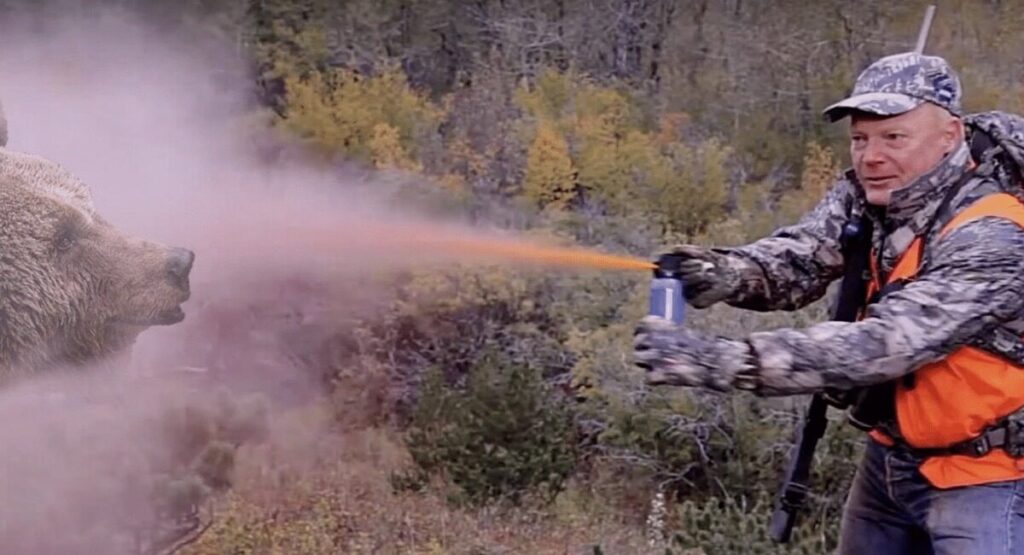
For historical context, I, as a young journalist, was among the first tot write about the creation of “bear spray” in the 1980s that is not only a non-lethal deterrent against bear attacks but an alternative to the mindset that the only way to deal with grizzly encounters at close range is to shoot the bear with a sidearm or rifle.
The latter resulted in lots of dead bears, bears largely disappearing from places they used to be, injured bears and, sometimes, killed or injured humans who got hurt when bullets failed to stop the bear that only got more dangerous as a wounded animal.
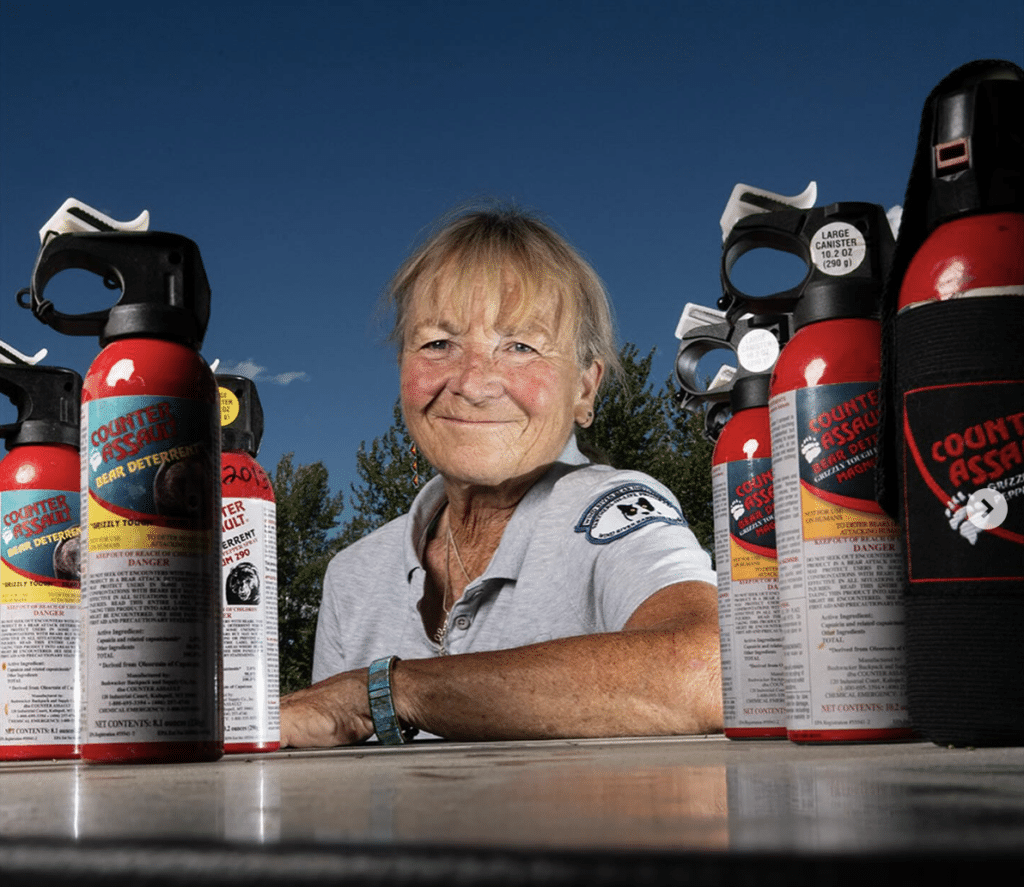
Back in the 1980s, three individuals came together in Missoula, Montana—the late bear guru Dr. Chuck Jonkel, Vietnam war vet and entrepreneur Bill Pounds and a young graduate student named Carrie Hunt, who also spent three seasons as a researcher with the venerated Bozeman-based Interagency Grizzly Bear Study Team. Hunt today is considered the foremost specialist in the Lower 48 with her training Karelian Bear Dogs for livestock protection purposes—another profound innovation that keeps bears, livestock and people alive. The Wind River Bear Institute, which she founded and operates, is world renowned.
Click on this link to learn more about Hunt. In the beginning, she had an idea for “skunk repellent.” Together, she helped field tested a product Pounds was developing—today known as Counter Assault—and at Fort Missoula used captive grizzlies to discover if cans shooting a thick mixture of oleoresin capsaicin—basically a highly potent dose of the stuff found in red peppers—could thwart a bear’s advance if the substance was breathed in and got in its eyes.
Bears, being guided by a keen sense of smell, use their olfactory system as a kind of radar system to identify food and other things on a landscape. Bear spray not only temporarily knocks out that system but the unpleasant effect of the product, which affects its breathing and creates a burning sensation in the eyes, proved to be effective. So much so that after FDA-approved R & D was completed the Interagency Grizzly Bear Committee endorsed the use of bear spray.
Today, Counter Assault and another brand, UDAP, developed by former Bozeman resident and bow hunter who suffered a near fatal mauling, Mark Matheney, are the market leaders in offering cans that pack a volume of spray and that can reach many feet. A study led by Tom Smith at Brigham Young University examined incident reports from human-bear encounters in Alaska, comparing not only outcomes in which bear spray was used but when people opted instead to use guns. Smith and his co-authors found that it succeeded in thwarting attacks most of the time and there was a lower rate of injury among people who carried bear spray vs. those who did not.
Notably, one of Smith’s co-authors was University of Calgary ecology professor, Dr. Stephen Herrero, who authored the seminal book, “Bear Attacks: Their Causes and Avoidance.”
Is bear spray guaranteed to stop a charging grizzly? No, but it has proved to be a generally reliable and easy to use self-defense product for people moving thorugh the backcountry or living in places also frequented by grizzlies. The product also works against mountain lions and coyotes. On this note, Pounds also told me that Counter Assault was used in Africa to wildlife managers to gently haze elephants away from communities and cropland.

Todd Wilkinson: Were you skeptical in the beginning that bear spray would work and did you pay visits out to Fort Missoula where it was being tested on grizzly and black bears?
CHRIS SERVHEEN: I think everyone was skeptical that a spray of something could deter a grizzly bear, but the idea of testing it, as Carrie Hunt did in her graduate project under Chuck Jonkel, was a bold move. The idea was bold because no one thought there was any other defense except firearms. Carrie’s work proved everyone wrong. Bear spray works and Carrie Hunt and Chuck Jonkel were right.
Wilkinson: Over the years in our conversations, you’ve described bear spray as a game changer. How so?
SERVHEEN: Bear spray is a non-lethal way to deter a grizzly bear attack, and it is more effective than firearms because it delivers a deterrent impact without the need for precise shooting in a few seconds while under extreme duress. This means anyone can use bear spray as an effective deterrent. A person does not need to be a gun owner and a very experienced pistol shooter to deter a bear. Bear spray multiplies the safety of people who live, work and recreate in bear country.
Wilkinson: As much as it being a deterrent, it seems that another profound aspect is how it changed and continues to change human attitudes. There’s less anxiety and thus one outcome is recognition of how rare run-ins are and that people have huge influence in prevent negative outcomes. Your thoughts?
SERVHEEN: Bear spray is not brains in a can, nor does it grant people a license to be foolish in grizzly habitat and ignore common ways to avoid bear encounters. It lets people be more confident, but it is very important that people combine carrying bear spray with continual focus on how to prevent encounters and being bear aware. Bear spray will not keep you from getting into an encounter with a bear. Being bear aware and avoiding encounters with bears in the first place is the best way to stay safe. Bear spray is the last resort.
“Bear spray is not brains in a can, nor does it grant people a license to be foolish in grizzly habitat and ignore common ways to avoid bear encounters. It lets people be more confident, but it is very important that people combine carrying bear spray with continual focus on how to prevent encounters and being bear aware. Bear spray will not keep you from getting into an encounter with a bear. Being bear aware and avoiding encounters with bears in the first place is the best way to stay safe. Bear spray is the last resort.”
Wilkinson: In choosing a can, what are the key things to consider?
SERVHEEN: Be sure it is within the expiration date, which is printed on every can.
Wilkinson: Why do we have such exaggerated level of fear about grizzlies that doesn’t come close to aligning with the actual likelihood of having a physical encounter?
SERVHEEN: The chance of getting attacked by a grizzly is very low. There is a common misconception that bears are always looking for a chance to attack people. That is not true. As I said, 99 percent-plus of the time bears will avoid people if they can. Most encounters are surprise encounters, and there are many ways to minimize encounters as I list above.
Even back when Lewis and Clark were traveling through grizzly country and those bears had rarely if ever seen people, they might sometimes be curious but almost always tended to avoid the members of the expedition. One is more likely to be injured or killed in an auto accident on the way to the trailhead than to be attacked and injured by a grizzly bear. Kerry Gunther, the bear manager for YNP, has published a paper where he showed that between 1991 and 2022, there were 1,584 encounters between grizzly bears and people reported on backcountry trails in Yellowstone. Of these encounters, there were 16 attacks in 32 years, which is less than 1 percent of the encounters with grizzly bears on backcountry trails.
Wilkinson: Are there any other datapoints you cite that speak to why the Interagency Grizzly Bear Committee got behind highlighting bear spray relatively early?
SERVHEEN: Not that I am aware of but there was the research by Tom Smith that you’ve written about. People working on bears in all agencies know that it works so this was transmitted throughout the state and federal agencies. That is what got the IGBC behind it.
Wilkinson: Have you ever used it on a bear?
SERVHEEN: No, I have never had to use it, but I am vigilant to try and avoid encounters in the first place, so I don’t have to resort to bear spray. That is the way everyone should be in bear country.
Wilkinson: It’s impossible to share a story on social media about grizzlies, and how lives of people and bears were saved using bear spray without people chiming in, “Well, if a bear ever charges me, I’m gonna use the .44 magnum. It’s macho stuff. You’re a gun owner. When you read it what thoughts come to mind?
SERVHEEN: I tire of the macho BS that only guns will deter a bear. I am a gun owner and used to carry a large pistol backpacking in the backcountry before bear spray was tested and proven. Now, I only carry bear spray and everyone I hike with including my family members all carry bear spray. I carry it because it works and has been proven to work.
Remember, that your best defense against bears is to avoid bear encounters in the first place by being alert, make noise like hand clapping, don’t hike alone instead hike in groups, don’t hike at dawn or dusk, don’t run or ride mountain bikes fast in bear country and always keep a clean camp.
Be aware of your surroundings and any bear sign you might encounter. Be more aware and make noise if you are walking into the wind, or hiking in thick brush, or about to crest a ridgeline, or you are hiking along a noisy stream where a bear might not hear you.
Clap your hands to avoid surprise encounters when sight distance is limited or hiking in the wind or along a noisy stream. Again, 99.9 percent of the time a bear will avoid you if he hears you clap your hands or smells you.
“I tire of the macho BS that only guns will deter a bear. I am a gun owner and used to carry a large pistol backpacking in the backcountry before bear spray was tested and proven. Now, I only carry bear spray and everyone I hike with including my family members all carry bear spray. I carry it because it works and has been proven to work.”
Wilkinson: A high percentage of close encounters and maulings have involved hunters that happens when they are field dressing game animals they’ve shot or due to quiet stalking techniques that actually are counter to the recommendations you make for hikers and outdoor recreationists above.
SERVHEEN: If you are a hunter, I recommend always hunting with a partner and being alert to bear sign. A partner is important when gutting a downed animal so the partner can watch for a bear drawn in by the smell of blood and game meat.
Bear spray is your backup to avoid an injury if being bear smart somehow fails. Bear spray is not your primary way to avoid an encounter with a bear.
Wilkinson: Still, if bear spray is deployed and a mauling still happens, social media influencers will make extrapolations that cast more doubt on bear spray than matches the facts. Why would people want to discredit use of bear spray?
SERVHEEN: I guess some people always want to second guess everything. A bear injury is an event that will get readership and that is what “influencers” are looking for – more readers.
Wilkinson: One would think that the people at highest risk of getting injured by bears would have the highest rates of injuries. This includes researchers with the Interagency Grizzly Bear Study Team and partner agencies, backcountry rangers, outfitters and guides, and ranchers. But that’s not the case. Note: I am not including “hunters” in this. If bears are so dangerous, then why aren’t they getting mauled more often?
SERVHEEN: Bear biologists are the most knowledgeable people about how to avoid encounters with grizzly bears and they are highly trained to maximize safety around grizzly bears in capture and handling situations, when handling bait to capture bears and when hiking in bear country. Anyone on a horse (like outfitters and guides and many ranchers) is very safe in grizzly country. I know of no one on a horse ever being attacked by a grizzly bear.
Wilkinson: Lastly, what’s the most important take-home lesson for people reading this?
SERVHEEN: Bears will do everything they can to avoid encounters with humans. If someone practices bear safety precautions, it is highly unlikely that you will ever have an encounter with a bear. Carry bear spray as an effective defense in such an unlikely event. It is worthwhile to note that in almost all cases where a person has been attacked by a grizzly bear, these people were not following the advice (given above) about how to avoid encounters with grizzly bears. Bear managers make every effort to educate people on how they can be safe in bear country, but unfortunately it is difficult to get some people to take this advice.
Other recent installments of Conversations form the Green Thicket. Do you like our stories. Never miss the latest by signing up for our free newsletter. Please consider supporting Yelllowstonian as a non-profit, public-interest journalist site devoted to preserving wildness in the Greater Yellowstone Ecosystem. We won’t continue to exist without your generosity.