“To those devoid of imagination a blank place on the map is a useless waste; to others, the most valuable part.”
—Aldo Leopold
by Todd Wilkinson
As an American businessman nonpareil, several things distinguish Ted Turner, making him a towering historic figure. Surprising, perhaps, little of it actually has to do with the superficial assessment some make of his larger than life personality. It’s what lies beneath the persona where the essence of the individual resides.
One of Turner’s most potent enigmatic traits has been his entrepreneurial instincts. Another is his curiosity and willingness to challenge status quo thinking, pushing ahead when others might have turned tail. Hence, the essence of his mantra “lead, follow or get out of the way.” A third is his wise penchant for surrounding himself with smart people who, together, create a synergy that has enabled many of his longshot visions to happen. Last but not least, Turner has been a different kind of capitalist. While he believes our economic system rewards innovation and has a been a potent mechanism for helping people improve their trajectories, he knows it is not perfect and stands in need of constant improvement.
The biggest thing is that capitalism is an engine for good, when its net effect is not consuming the natural world but protecting, preserving and, where possible, restoring places that have been impaired. When that happens, profound dividends are realized for humans, wildlife and the economy itself.
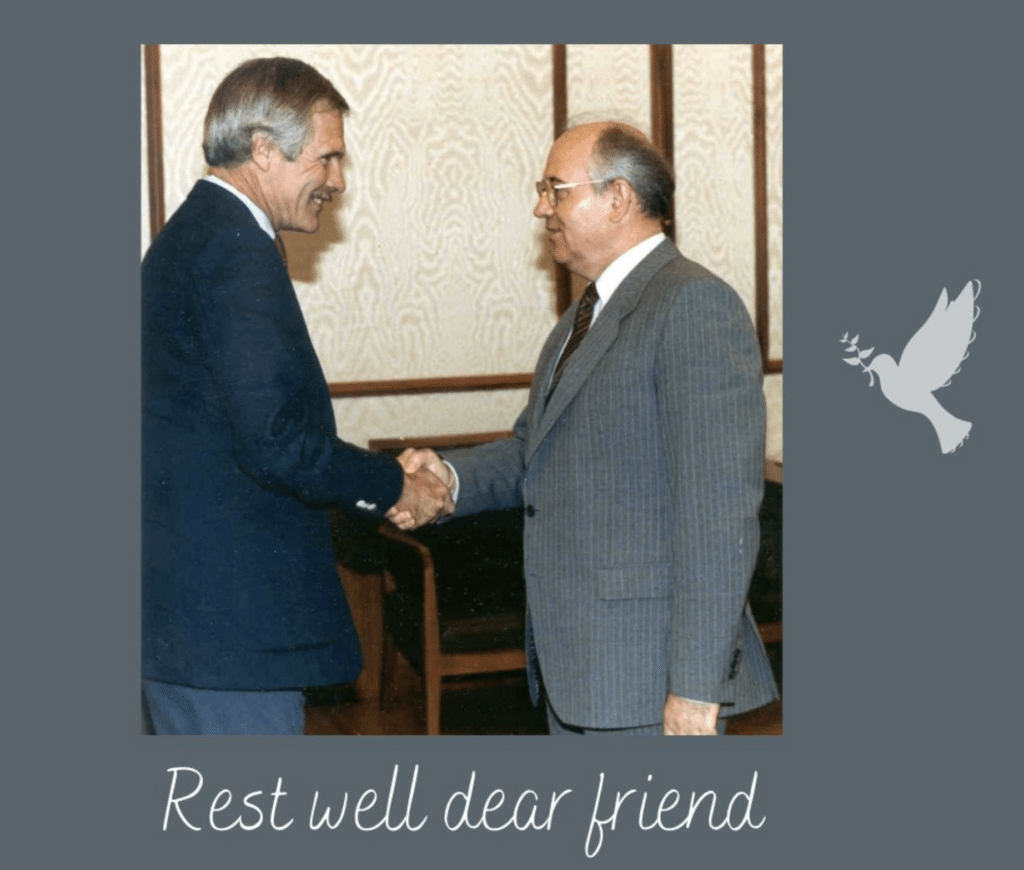
Turner and his associates revolutionized modern media (in what he acknowledges was for better and worse). He and the strategists he enlisted took a mediocre major league baseball team, the Atlanta Braves, and built it into a World Series champion and perennial contender. He twice won the America’s Cup boating race as an underdog. He gave a $1 billion donation to create an entity that acted in support of the United Nations because he knew how unchecked totalitarian regimes and nations not acting in common shared interest led to the great bloodletting of human beings in World War II. He founded the Nuclear Treat Initiative to reduce tensions between nuclear nations on hair-trigger alert and convinced war hawks, including key advisors of Ronald Reagan and Soviet President Mikhail Gorbachev, to embrace his vision of eradicating arsenals or dramatically reducing them.
For Turner, it was never amassing the huge fortune that left him most satisfied but finding meaningly ways to invest his money in humanity, common cause and the greatest passion area of his life, honoring the beauty, diversity and mesmerizing design of nature that functions as the life support system sustaining all beings on Earth. That’s why he had a bumpersticker made that says “Save Everything.”
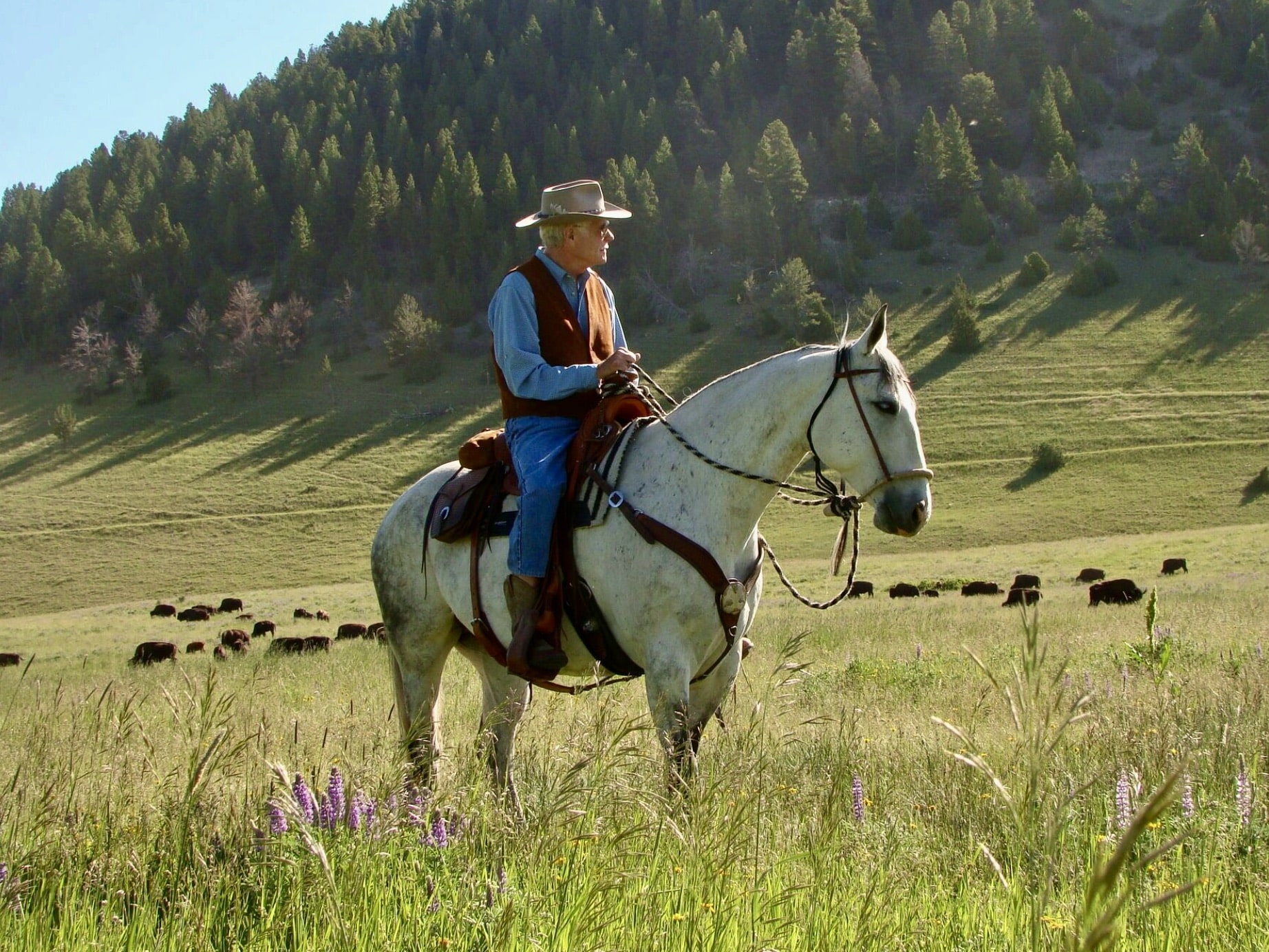
Fortunately, the place where Turner found his true calling for the latter, on an epic scale, was in Montana; more precisely, a former cattle ranch in the Greater Yellowstone Ecosystem just outside of Bozeman called the Flying D Ranch. There, Turner and the cohorts he enlisted in the region, including Russ Miller of Bozeman, used Ted’s resources to buy up huge sweeps of land in the West and repopulate them with bison—Turner’s favorite large native species and the official national native land mammal.
Turner has called bison “great teachers” and over the years taking heed of their lessons, the way the animals utilize landscapes, has contributed to the rapidly emerging discoveries about true regenerative agriculture—how their presences enhances soils, grasses and rangeland to achieve more favorable outcomes for bottom line and bolstering biological richness. It has been a regimen, he says, of constant discovery, not asserting one’s will on the land but bending one’s preconceived and sometimes deeply engrained biases to incorporate new insights and data.
While Turner today is in the twilight years of his life, there are many, including a handful of former Nobel Peace Prize recipients, who told me when I writing a book about Turner, that no other human possesses a business and philanthropic resume as Turner. And while he could say outlandish things, it’s been the net effect of his deeds—what he did with his money—that will be touchstone of what he is remembered for. He was among the first to sign onto The Giving Pledge where participants promise to give away most of their money during their lifetime or through their will to benefit society. Many have since joined the effort and they, who span the political spectrum, are counted among the most noble altruists of our time.
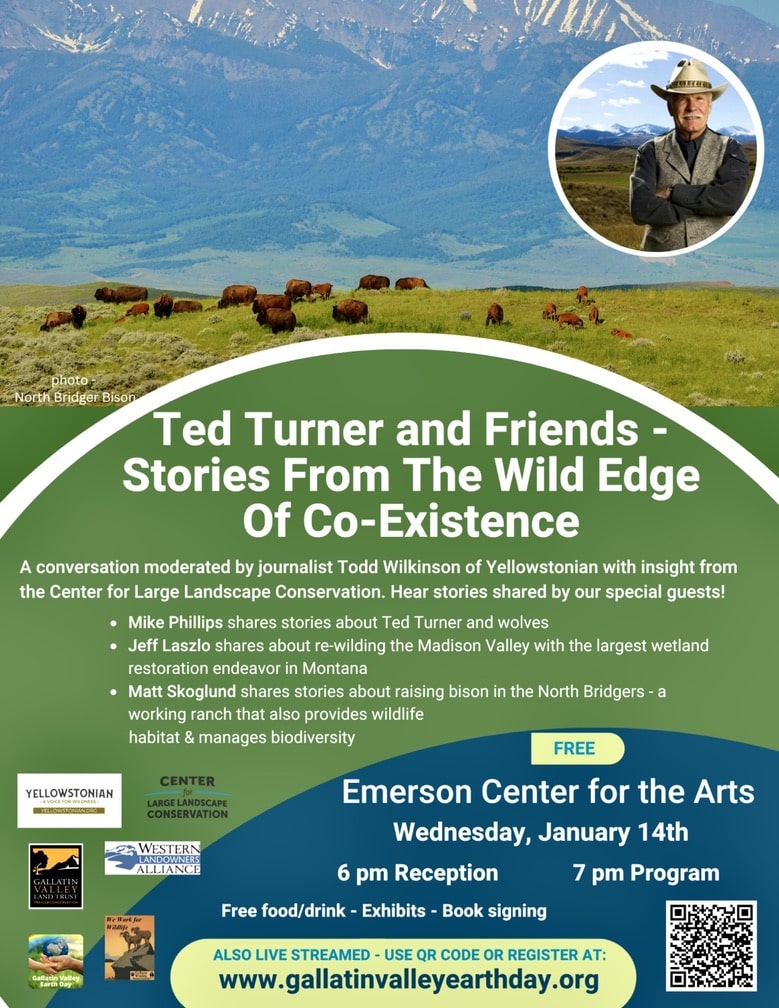
Turner himself cannot attend the special night in Bozeman titled “Ted Turner & Friends: Stories from the Wild Edge of Co-Existence.” Filling in for him will be Bozeman resident Mike Phillips, who co-founded the Turner Endangered Species Fund with Ted after Phillips played a crucial role in helping the government restore wolves to Yellowstone in the winter of 1995. Read the interview with Mike below.
He will be joined by two individuals, two ranchers, Jeff Laszlo and Matt Skoglund, praised in their own right, for the bold actions they’ve taken to demonstrate how ranching can deliver extraordinary spillover benefits for public wildlife and large landscapes including neighboring public land. Before we jump into an interview with Phillips, below, consider this part of Ted Turner’s legacy and symbolic role of the Flying D.

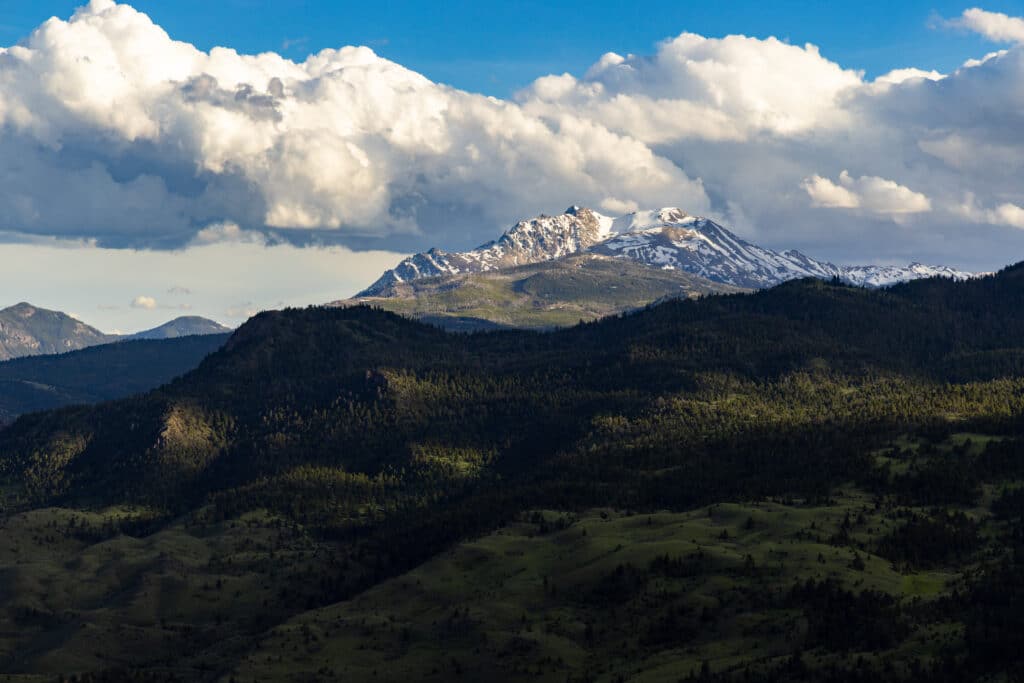
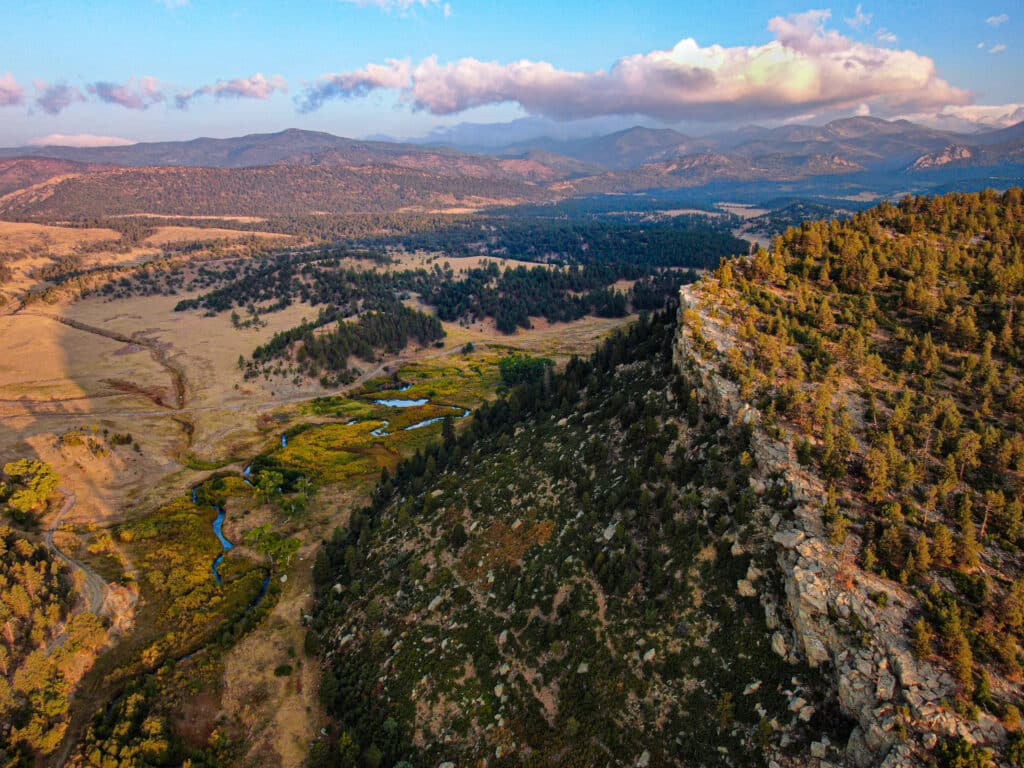
Covering 113,000 acres, the ranch extends from the Gallatin to the Madison rivers, east to west, and from the Spanish Peaks at the northern end of the Madison Mountain Range northward into the Gallatin Valley. Protected with a conservation easement, it will never be covered with sprawl and it will remain important habitat for a wide array of species, from wolves and grizzly bears to elk, pronghorn, mule deer, moose, black bears, wolverines, wild trout, an incredible diversity of birds, plants and other organisms. Turner acquired the ranch for around $20 million and, if he had not chosen to protect it, likely he could have today, applying the mentality of realtors and developers, “made a killing” by selling it for hundreds of millions of dollars, if not far more. He rejected the contemporary prevailing notion, which serves as rocket fuel for the growth in Bozeman, that unless “raw, undeveloped land” is given a human purpose, it is worthless.
Turner believed “the highest and best use” of the Flying D was honoring the irreplaceable things it had been home to for perhaps twelve millennia (12,000 years) and that if he had been the first person to permanently destroy its natural essence would have been the worst expression of avarice.
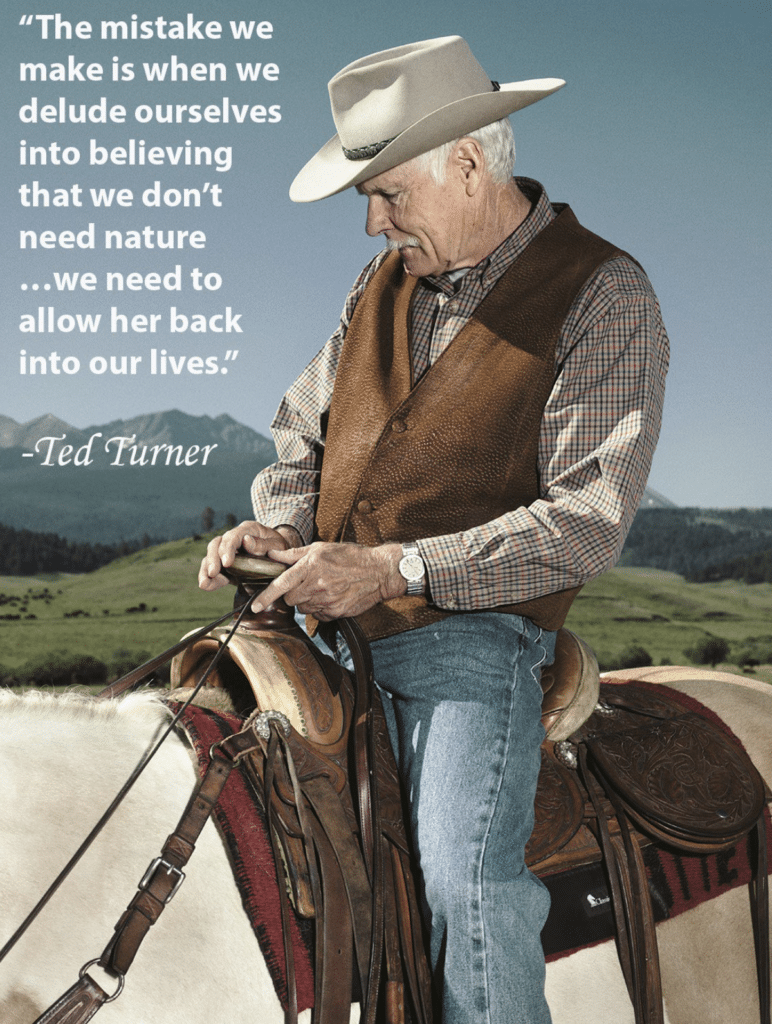
As Ted told me, “how much money you have is not the best expression of who you are or who you were, because in the big picture, it doesn’t matter. If you hoard it, you can’t take it with you when you’re gone. The things I believe in, protecting Mother Nature and letting her inspire others, is hopefully visible in this ranch[the Flying D] and other properties I’ve owned but I never really did ‘own’ them; I was just being their caretaker and trying to pass them along in better condition than I found them.”
It is that magnanimous expression of personal belief that has made Turner a hero to many— and the meaning of his words, applied to his land ethic, will only continue to grow in value. “I believe everyone can be a hero if each of us sets out every morning to do more good things, that add value to our world and not things that take away from it. If the billions of us on the planet did this, together and we had a plan, that effort would add up quickly and we’d change the world we have now for the better.”
The Yellowstonian Interview with Mike Phillips
Todd Wilkinson: I want to begin by embarrassing you a little, since you’re unlikely to mention it, but it’s important because it helps to frame your perspective and credentials. The Wildlife Society honored you with its Aldo Leopold Award, the highest honor given to a professional wildlife biologist based on career contributions. Why do Aldo Leopold and his ecological perspective matter to you and how has it informed the way you think about not only wolf ecology, for which you are best known, but large landscape conservation as a means of confronting the ongoing loss of species?
MIKE PHILLIPS: Leopold mattered because he considered conservation from a systems perspective—the land and its inhabitants as a living organism —and wrote poetically about it. He was a master storyteller. I was inspired by his approach and tried my best to serve as a biologist in like fashion, including advocating for large, protected landscapes where important large-scale ecological processes (e.g., fire, predation by large carnivores) could occur with no or little interference.
Tw: The Flying D has been called “Ted’s flagship” ranch and the most visible example of him raising bison with ecological objectives in mind. Why was conservation easement he put on the Flying D important and what’s important for the public, who might be unaware of Ted and the ranch, to know?
PHILLIPS: The easement ensures that the sprawl of Gallatin County will be resisted by the northern boundary of the ranch. All members of the public should appreciate the magnificent patch of undeveloped and wild nature that is the Flying D and the fact that it generates fluid benefits that extend well beyond its boundaries, e.g., its cold and clean water rushing into the Gallatin and Madison rivers, elk moving across wide swaths of southeastern Montana, the sight of it from downtown Bozeman or Peets Hill. You don’t see the flanks of the ranch covered in yard lights. In many ways it’s nature’s beacon in the valley.

Tw: Let’s go back about 25 years to a winter’s day in January when you and I went to the Flying D and found a line of wolf tracks, among the first seen—this in the aftermath of you leading wolf reintroduction to Yellowstone. And you had gone on to co-found the Turner Endangered Species Fund with Ted. A few years later, a wild pack of dispersing wolves established residence on the Flying D and they’ve been there ever since. Your colleague at TESF, Val Asher, completed years of important research on the wolf population that wasn’t hunted on the ranch or controlled. Another of your valued colleagues, Carter Kruse, carried out several epic efforts to establish and bolster imperiled native trout, and enable the return of beaver to several ranches. He is also the director of the Turner Institute of Ecoagriculture. And along with the keystones of bison and beavers, members of the Turner team have brought back prairie dogs. I have a couple of questions related to this. First, you went to work for Ted because you admired his audacity. He put out a welcome mat for wolves to have a home on the Flying D if they ever research the ranch. How momentous was that action and the message it sent?
PHILLIPS: As the first large landowner in the western U.S. to actively welcome wolves, Ted made clear his love of even the sometimes-difficult aspects of large wildlands. That full embrace was significant and Leopoldesque in nature. Since then, through long-term research we have learned that the Flying D Ranch is the most important tract of private land for wolves in the world. The message sent by these actions—embracing wildness and research—is simple: co-existing with wolves can be a straightforward affair that requires only a modicum of accommodation. Their great power to serve as a totem and inspire action that would not occur otherwise.
TW: Second, what do you more fully appreciate about wolves that you didn’t know when you started your career with the eminent wolf researcher L. David Mech four decades ago, and what are some of the revelations that have emerged from the research on wolf behavior on the Flying D?
PHILLIPS: The most important revelation about the Flying D wolf project is simply that native bison have evolved an ability to resist predation and they are the best type of bovine for ranching in large carnivore country. They are native, they are resilient, they’ve withstood previous climate fluctuations and when their function is witnessed you gain a glimpse of truly re-generative forces.
Tw: You share your late friend, E.O. Wilson’s conviction that we need to rapidly ramp up the level of public awareness and education about how our actions are impacting the natural world. And, in Wilson’s case, he and Canadian conservationist Harvey Locke and forerunning conservation biologist Reed Noss and others, have advocated for protecting half of the still-functioning natural lands that remain intact on the planet. You also successfully ran and got elected to serve in both the Montana House and Senate and, at one time, you were identified a possible candidate to lead the US Fish and Wildlife Service. What now should be our priorities as a society when it comes to environmental protection and how do we act on them?
PHILLIPS: Readjusting laws and regulations so that the consequences of the daily habits of millions of people are not burdensome on nature but rather restorative and affirming.
Tw: In the spirit of Ted, who loved to have dinner and post-dinner conversations about serious issues in the world, let me play Devil’s Advocate again, and pose the question that I’ve discussed with you and others over the years: If you can’t eat them, wear them, sell them, kill them for entertainment or to display them on the wall, use them as alleged medicine, and/or derive some kind of material benefit, why bother bringing a species back from the brink or give them a second chance in places where they were extirpated? This is a ponderance some have who seek to weaken the Endangered Species Act. In their eyes, listing species is too much of a burden or too inconvenient if wildlife are not, foremost, existing in service to human needs. What’s your answer because I know you and Ted Turner are in agreement?
PHILLIPS: Restoration of imperiled species is a direct and effective response to the extinction crisis, and as such should motivate everyone everywhere. We are now firmly in the grip of the 6th great extinction crisis to envelope the planet over the last 500 million years. Notably, the crisis is humanity’s most pressing yet least attended problem. Its redress should matter to everyone everywhere. Why? If you are a person of faith the crisis should matter because how can you love the Creator and not love the Creation? And how can anyone stand by and watch something they love needless destroyed? Or alternatively, if you are a secular humanist and you believe that rather than faith what matters most is logic, data, empiricism, then the crisis should motivate action. The best available science makes clear that the fate of humanity has always been and will always be decided by the ecological health of local landscapes the world over. And yet, the crisis makes clear those landscapes are not the least bit healthy. We know that the survival of one species—losing it—can determine the fate of another. There can be a domino effect. No matter who you are, the extinction crisis and efforts to halt its advance should matter.
“If you are a person of faith the extinction crisis should matter because how can you love the Creator and not love the Creation? And how can anyone stand by and watch something they love needless destroyed? Or alternatively, if you are a secular humanist and you believe that rather than faith what matters most is logic, data, empiricism, then the crisis should motivate action. The best available science makes clear that the fate of humanity has always been and will always be decided by the ecological health of local landscapes the world over.”
—Mike Phillips
Tw: You’re sharing the stage with two people you know and admire—rancher Jeff Laszlo from the Madison Valley and Matt Skoglund who founded North Bridger Bison with his wife, Sarah. They found inspiration in the example set by Ted. How are they vital pieces of the private land stewardship puzzle that that involves Ted and others?
PHILLIPS: Readjusting our relationship to Mother Earth, which is as important as what we do on the policy side, will require grassroots leaders showing the way forward with a notable focus on private land. Jeff and Matt are just such leaders.
Tw: What is Ted Turner’s legacy? It’s one thing to have a building named after you if you’re a philanthropist, but it’s another to have the satisfaction of knowing you did what you could to preserve a living breathing ecosystem, one of the most iconic in our world. When I was writing the “eco- biography” on Ted, you and I made field visits together to his properties. As my research dived deeper into his novel blend of being a media pioneer, entrepreneur, and humanitarian-conservationist, you noted that he has a diverse yet inter-related resume that for its novelty, is unsurpassed. His children and grandchildren are endeavoring to carry on the family commitment to earth-care through the Turner Foundation.
PHILLIPS: His legacy is his work to save everything and it’s not a catchy marketing slogan. He put it into practice and he has acted in ways that have benefitted the planet and society where others have heeded only the incentives of personal enrichment.
Tw: Anything else you want to say?
PHILLIPS: As a private citizen Ted Turner has done more for humanity with a focus on the environment than any other person who has lived. For that, he is richly deserving of the Nobel Peace Prize.
Readers are invited to attend the live public event “Ted Turner & Friends” at the Emerson Cultural Center in Bozeman, Montana on Wednesday, January 14. It features a discussion with Mike Phillips, Jeff Laszlo, Matt Skoglund and Liz Fairbank with the Center for Large Landscape Conservation. It is a celebration of private land stewardship. The event starts at 7 pm but get there early and you can converse with the panelists and meet representatives from a dozen different conservation groups doing great work in the Northern Rockies. You can even enjoy a bowl of bison chili courtesy Ted’s Montana Grill restaurant in Bozeman. Note: if you cannot physically make it to Bozeman, you can tune in via a free livestream by clicking on this link. It is important that you sign-up beforehand. Please let your friends know.