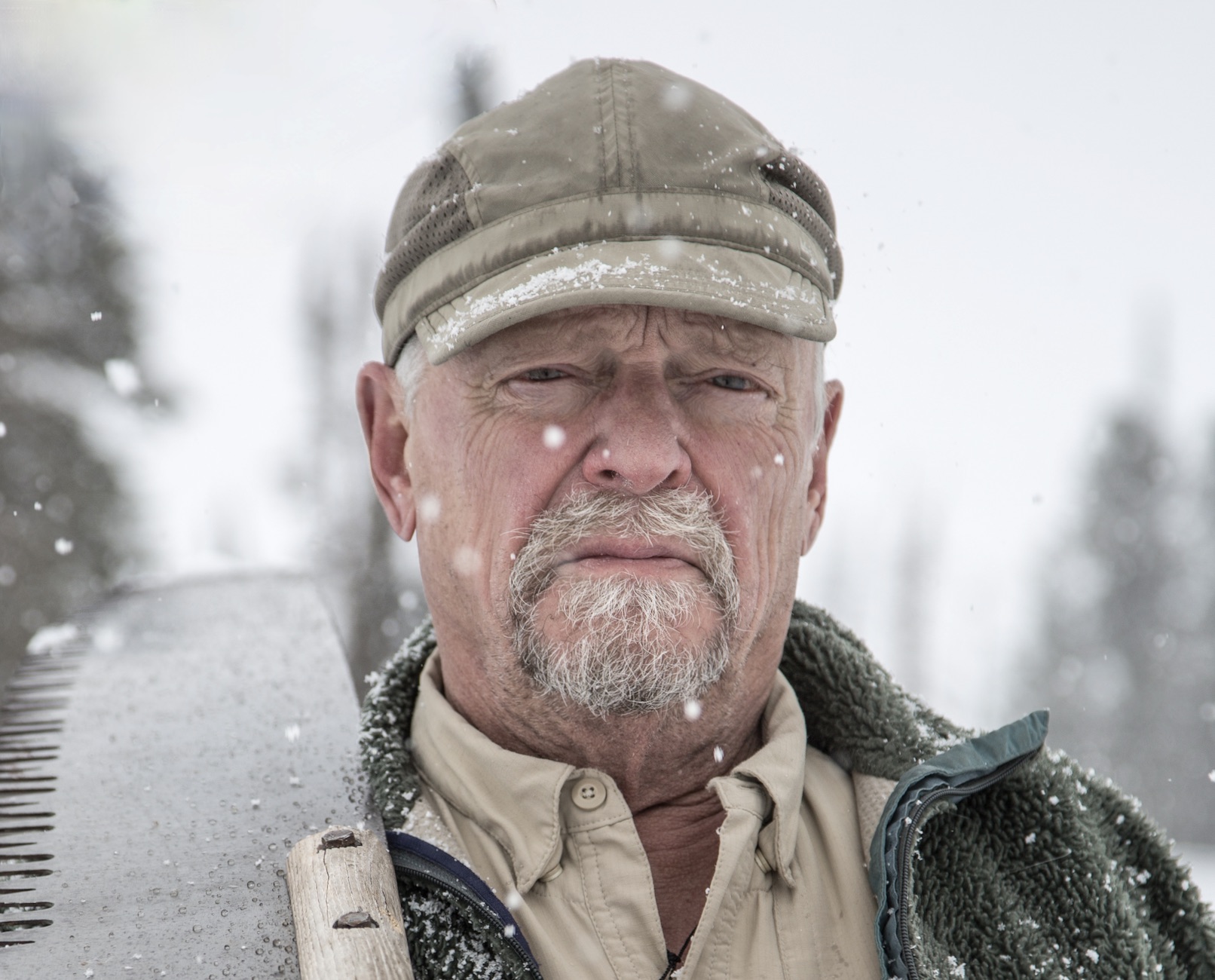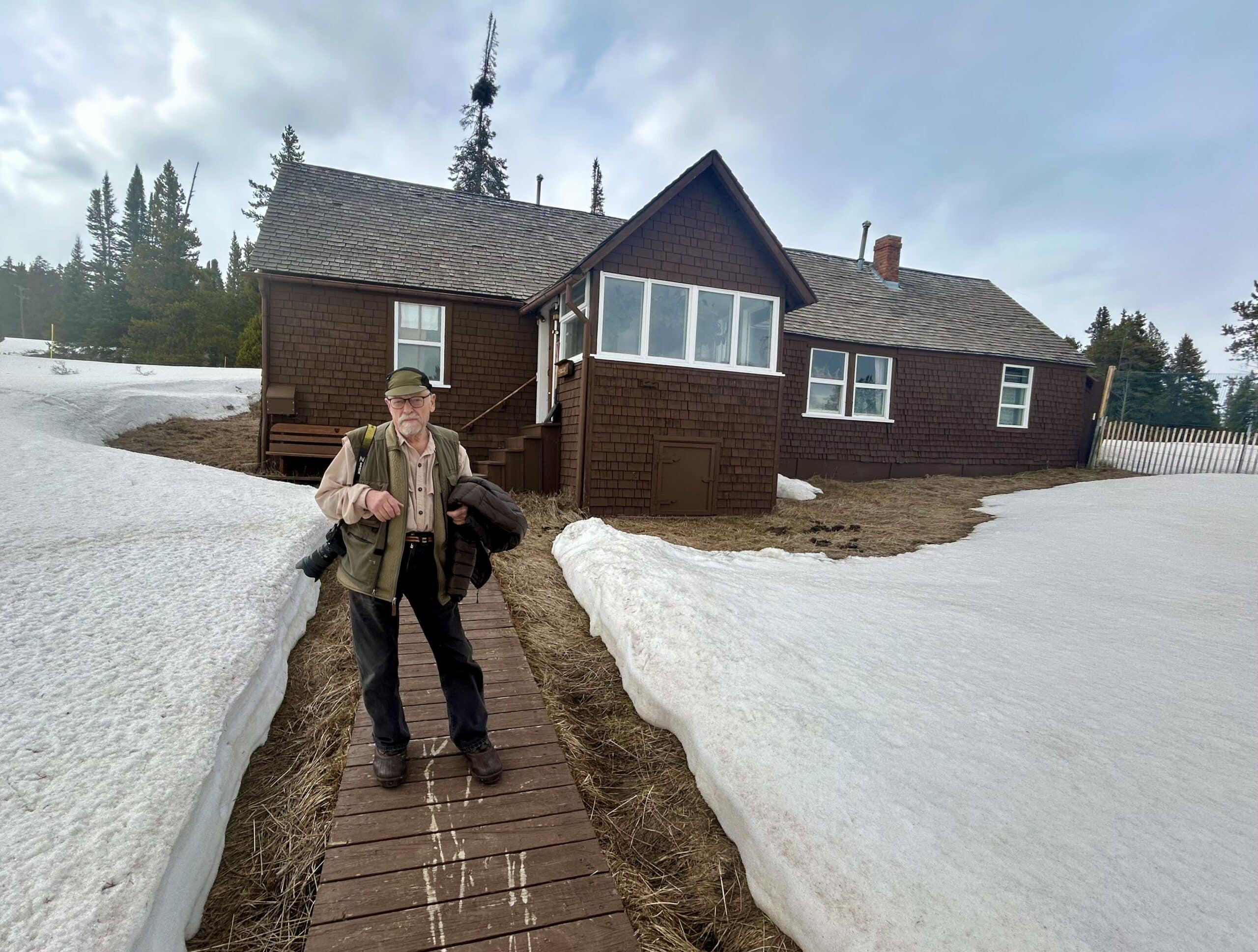
EDITOR’S NOTE: This is the first holiday season, and the first winter in 51 years, that Steven Fuller has not been a winterkeeper in Yellowstone National Park. During his tenure, he documented his rarefied existence daily with a camera in hand. Now living in Livingston, Montana, Fuller needed downtime to reflect upon his long tenure. This marks his first of an ongoing series of reflections that will appear in Yellowstonian. Welcome back, Steve! —Todd Wilkinson
Words and Photos by Steven Fuller
Flashback: A Reflection on December in Yellowstone Pasts
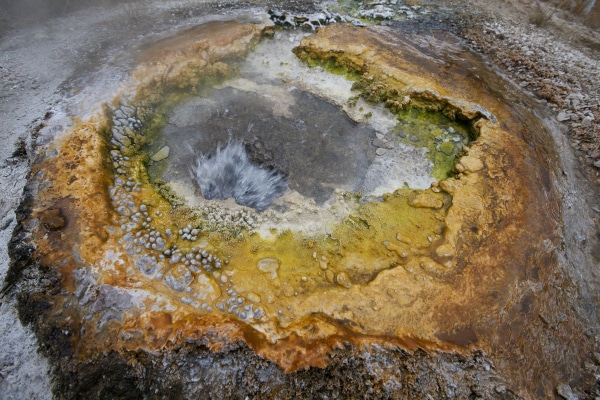
Afoot on my way home in the gloaming of an extraordinary deep cold December day, I was seduced by a known small waterfall plunge pool heated to hot bath temperature by upstream hot springs. Prompted by the cold, I hastily shed layers of clothes down to skin. My frequent breath exhalations hung in the air. At this temperature if you breath too deeply you’ll likely cough.
Comfortably submerged and warmed to my core I watched the gradual emergence of the early stars that began to flicker in the deepening dark sky. Later, when I shifted my position, I was startled then amused by the rattle of the brambly thicket of icicles that has grown in my hair. Oh baby, the cold outside is seriously deepening!
Immersed in a pool of Yellowstone’s own amniotic fluid my mind wandered in dreamy bliss, enfolded within that magic place between wake and sleep where Lewis Carroll dreamt Alice went down the bunny hole to a Curiouser and curiouser!” dimension …when, without warning, my opening doors of perception were shattered by two sharp… gunshots ?
No!, surly not gunshots… My startled re-awakened practical brain recalled in bits and pieces long ago reading Black Elk Speaks whereinthe Lakota called December the “Moon of the Popping Trees”.
My restored Newtonian brain sussed out the mechanics of my startle. During the day the sunny side of the pine trees had absorbed solar heat, while the shadowed side held the cold of the previous night. As the sun set and the temperature dropped the moisture inside the tree froze and expanded until the wood released the stresses with a resounding report.
I found some satisfaction in sorting out the forensics of the incident but Alice would surley have found more whimsy in it.
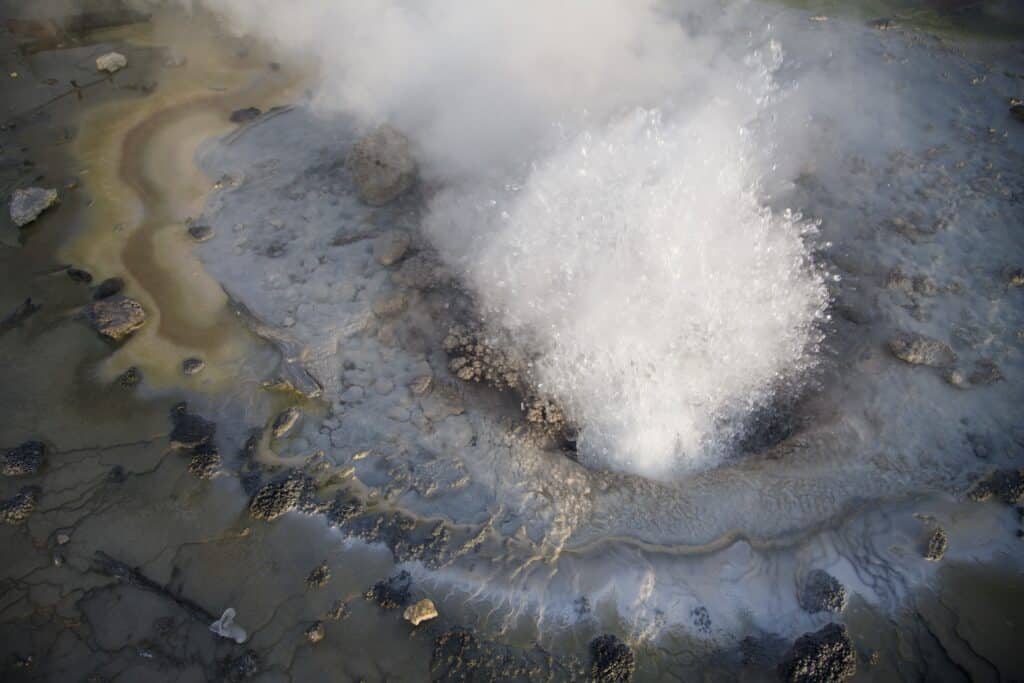
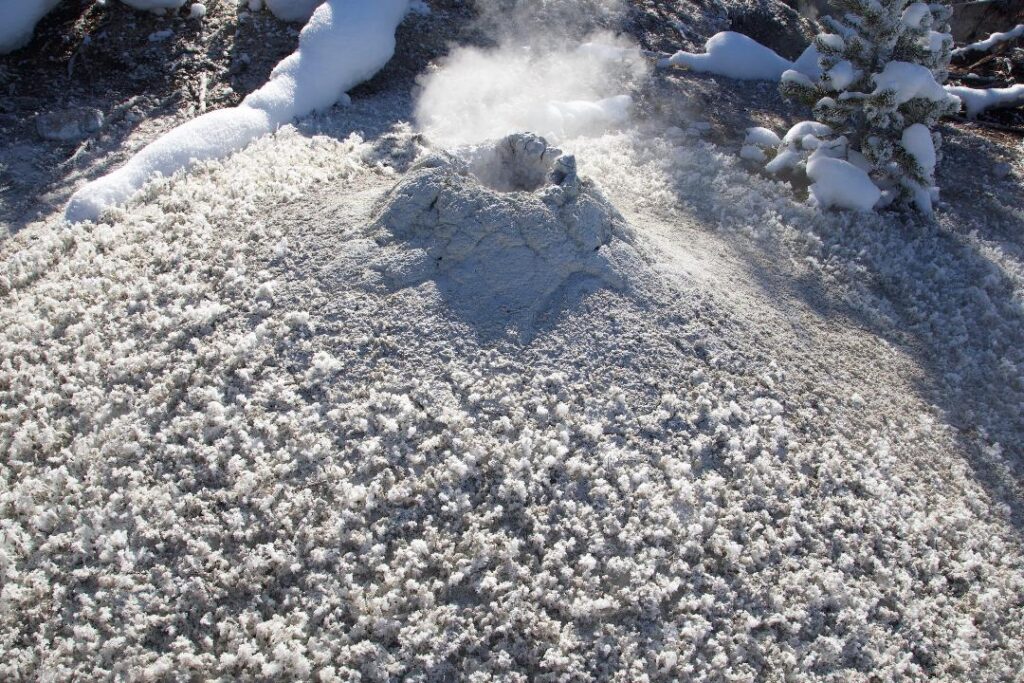
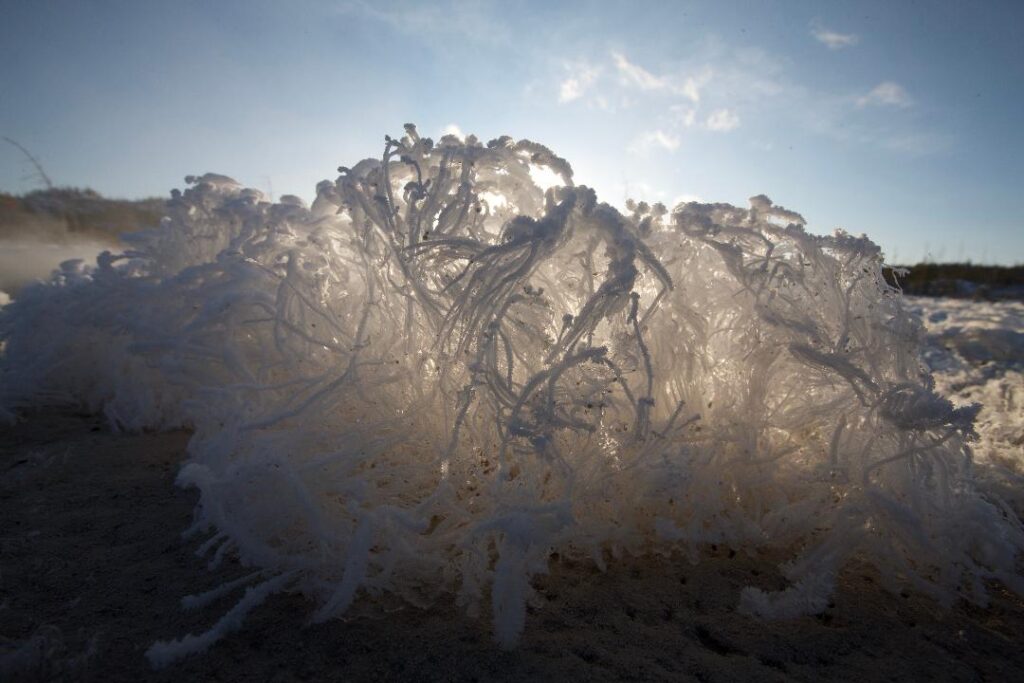
Deep cold and crystals: proliferation and metamorphosis
In Yellowstone the choicest days in December are clear, sunny, and cold, preferably tens of degrees below zero cold. Aerial frost crystals have cleansed the sky of seasonal pollen, dust, and the soot of wildfires. When the steam of hot springs and geysers fills the deep cold crucible of a geyser basin the alchemy creates an incomparable crystalline garden of curiosities. During spells of real deep cold droplets of hot water thrown up in the air by an erupting geyser leave a vapor tail as they fall, freezing before they hit the ground.
At sunrise the still air is a-sparkle with a myriad of frost crystals, floating mirrors that reflect and re- reflect amongst themselves the light directly below the rising sun that creates an intense pillar of light. The world is a crystalline feast of light. A brilliant halo encircles the sun and sun-dogs hang in the void below the rim of the Grand Canyon of the Yellowstone. A plume of water vapor rises above the mostly ice clad face of the lower falls. All is well.
The pristine snow is as dry and light as goose down and poofs with each of my foot falls.
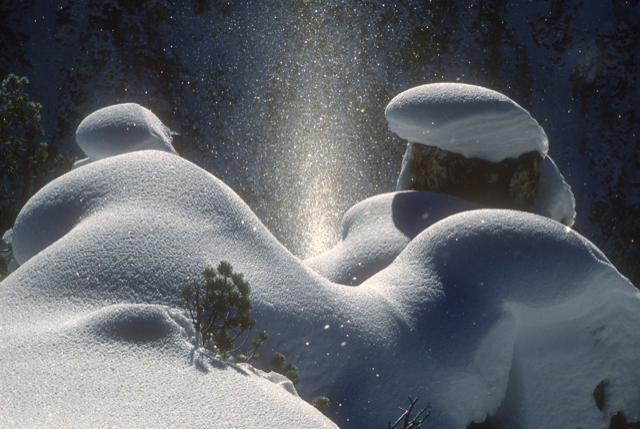
Snow pillows and ice crystals, backlight by solar illumination, create magic along the rim of the Grand Canyon of the Yellowstone. Photo by Steven Fuller
Immersion in this ephemeral world cleansed and renewed is a joy. There is a sense of exuberant vitality in every breath that exhilarates the spirit as well as the body. As the sun gains strength some of the pillows of crystals delicately accumulated on the tree branches overhead topple, their fall leaves a brief meteoritic trail of back-lightened crystals.
The sights of December days are enriched by memories gleaned in the course of the fifty-one Decembers I have had the good fortune to have lived here on the floor of the recent caldera, at 8,000 feet atop the heart of the Yellowstone plateau.
For most of my adult life it was my home world, one in which I came to be ever more confident and comfortable. My secular work, my day job, paid the fare and justified my living there, but the life’s holy meaning was the decades of growing intimacy, the accretion of some understanding of the nuances of the place, its weather, its animals, its seasons, its plants, and its hydrothermal wraiths.
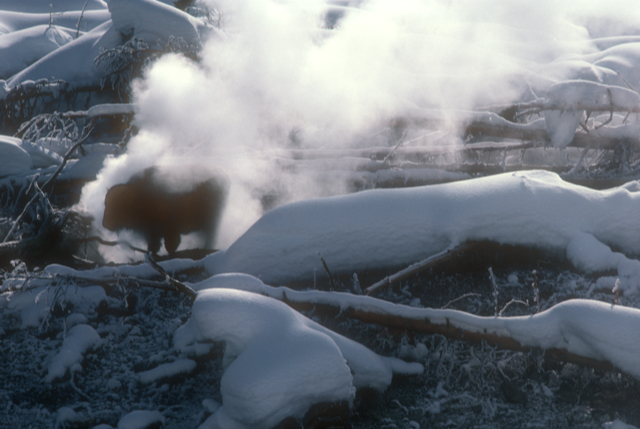
For all those decades I roamed the back country on foot and on skis, and for 25 years on horseback. Millennial old animal trails were my education in the ways of animals and the plateau. Their trails taught me to move in easy harmony with the topography. And, frequently , renewed my recognition of the capriciousness of life and death. Ma Kali is the face of Yellowstone, a beautiful woman who birthed the world but fi on a sunny afternoon devours her children.
Writing of these things, feelings subducted since I left my home world last Spring, has surprisingly plucked at my heart. But my petite feelings of loss have engendered fellow feelings for the countless souls torn more traumatically from their home worlds. Place and home are at the heart of our sense of self and are the roots of our belonging and who among us do not suffer the modern endemic feelings of existential loneliness and despair.
In time I learned to speak buffalo, to defer to the weather, to be a-wary of bears and bogs, to read spoor as well as the treacherous ground on the floor of a geyser basin, to side step being eaten by the Grand Canyon of the YS, and to avoid putting water hemlock in my salad. With a little bit of craft and a great deal of luck I managed to keep out of Lee Whittlesey’s book (Death in Yellowstone) and out of jail.
I was blessed to have found a home for a while, in a world common to my ancient lineage of ancestors, but precious in this twilight time of the natural world. Like all things it is mortal.
EDITOR’S NOTE: Watch the video profile of Steven Fuller below created by The Guardian. Also keep checking back to learn more about a forthcoming special Yellowstonian public evening featuring Fuller and a half century of stories and imagery.