by Todd Wilkinson
Wherever they exist in the 21st century, be it the so-called enlightened and more sophisticated “Old World” of Europe or the “New” American West, wolves have a reputation for causing devastating effects on wildlife. This longstanding cultural bias informs public attitudes and is often invoked to justify policies sanctioning aggressive lethal control.
But is the depiction of Canis lupus accurate, and are the impacts of wolves on wildlife really as severe as they’re purported to be?
As part of a thought exercise, and a test of your own individual ecological knowledge, consider this question:
What would happen, hypothetically, if a small number of wild wolves found their way onto an isolated island, miles from the nearest mainland, and established packs among a single prey species unable to escape the confines? Which one, formidable apex predator or vulnerable prey, would be more likely to wink out first? How long would it take? And what, then, would happen to the survivors?
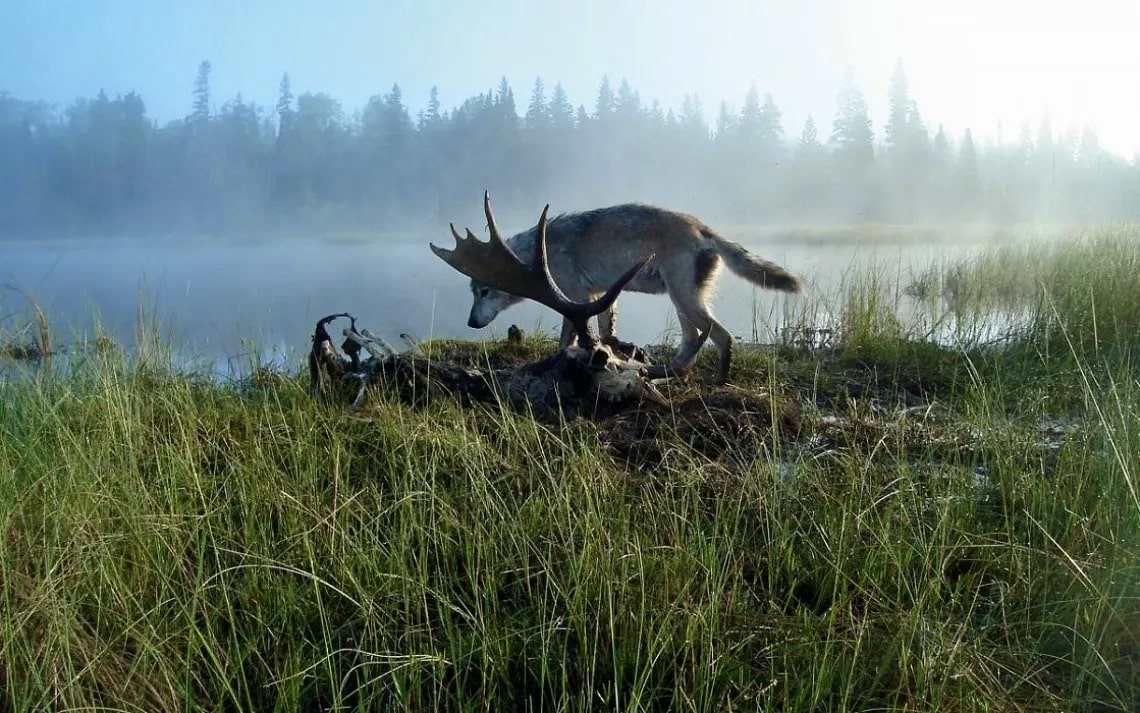
On a rocky spit of land called Isle Royale in Lake Superior (around 15 water miles from the mainlands of Minnesota and the Canadian province of Ontario) this experiment isn’t abstract; it’s been playing out for nearly 80 years. Spoiler alert: to spare readers from waiting in suspense, the answer is that the predators— wolves—not their lone major prey species—moose—came perilously close to vanishing first.
Contrary to common expectation, wolves did not wipe out moose and then, famished and ferocious, begin feasting upon tourists and campers visiting Isle Royale (which is part of the US National Park System).
Isle Royale is, in fact, a most inconvenient reference point that does not conform to tidy narratives promoted by aggressive wolf control advocates. Nor does it cotton to prevailing portrayals of the species that still flourish in hunting magazines and spine-tingling, often spurious conversations featured on the Joe Rogan Show or AM talk radio—and neither is it a reference point in most committee hearings held about wolf management on Capitol Hill and in most rural state legislatures.

As for the central focus of this essay, it is also unlikely that federal and state lawmakers have seriously considered the hard, accruing data of Dr. Rolf Peterson, Dr. John Vucetich and colleagues at Isle Royale.
Vucetich, a longtime wolf researcher and ecologist based at Michigan Tech University, co-leads the renowned Isle Royale Wolf-Moose Project. He began his career studying wolf behavior under Peterson, an eminent mentor and project co-director, who himself studied wolves at Isle Royale along with the eminent Dr. L. David Mech. Both of them received mentorship from the late eminent Dr. Durwood Allen at Purdue University who initiated the Wolf-Moose Project in 1959.
As part of the extended lineage of wolf science, Mech himself is a mentor to recently-retired Yellowstone senior wolf biologist Doug Smith and to Smith’s predecessor who led wolf reintroduction in Yellowstone, Mike Phillips, who not long ago was honored with The Aldo Leopold Memorial Award bestowed by The Wildlife Society. Notably, another product of that intensive wolf research tradition borne in the Upper Midwest is Montana-based biologist Dr. Diane Boyd, who spent decades studying wolves in northern Montana and is author of a recent award-winning book, A Woman Among Wolves: My Journey Through 40 Years of Wolf Recovery.
Giants in the wolf research world, there is half a millennium of field experience between them and their colleagues, and an extensive record of having their analyses published in both peer-review scientific journals and books. Several of the above are also ungulate hunters meaning they are not partial against hunting.
Wolf research conducted at Isle Royale may be lesser known to Westerners in the Rockies but within the scientific community it holds more standing than even the ongoing studies of wolves in Yellowstone which is the most prominent public laboratory and premier place for watching wild wolves in the world. It also rivals the legacy of the Interagency Grizzly Bear Study Team based in Bozeman.
Notably, Isle Royale has been visited and/or its lessons highlighted by the dean of wolf biology in Europe, Luigi Boitani in Italy, Olof Liberg in Sweden, and Lu Carbyn, Paul Paquet, John Theberge, Mary Theberge, Bob Hayes, Chelsea Service, Justina Ray and others spread across Canada. From Phil Hedrick to Sarah Hoy and pilot Don Murray and beyond, Isle Royale has been a field effort unlike any other.

° ° ° °
The canoe-faring Ojibwe (Anishinaabe), whose homeland covers much of the western-upper Great Lakes, had a traditional name for Isle Royale. They call it Minong and tribal elders say it means “the good place” where blueberries are found. To the Ainishinaabe, Ma’iingan (the wolf) is regarded as an ancient teacher, sacred sibling, hunting teacher and symbol of community, social cooperation and balance. In their spiritual stories—no less revered than creation parables in the Bible—humans and wolves walked the earth together in its earliest days and the Anishinaabe consider it sacrilege (and ignorant) to kill wolves other than for reasons of personal protection or necessity.
Montana artist (and Yellowstonian cartoonist) John Potter, who spent many of his young formative years in northern Wisconsin with the Lac du Flambeau Band of Lake Superior Chippewa Indians (Anishinaabe), says the West is unable to shake its anti-wolf prejudices brought here by Europeans
Politicians still peddle deep-seeded portraits of wolves in North America that are actually refuted by oral stories, passed along from one generation to the next, about co-existence between humans and wolves on this continent which are at least six times older than the advent of Christianity in Europe.
“In the years I’ve spent at Fond du Lac with elders, I’ve never heard a story of any wild wolf—that was not rabid, old, malnourished or habituated to eating garbage—attacking a human,” Potter says. “It doesn’t mean it can’t happen, but in a region with thousands of wolves and indigenous people living there for thousands of years, it’s telling, isn’t it, that there is no Indian version of Little Red Riding Hood. Going way way back, humans and wolves enacted a pact to peacefully go their own ways and for the Anishinaabe they are viewed as our closest relative in the animal world.” He notes that Anishinaabe beliefs about wolves are not over-romanticized, Disneyfied or subscribed to by all.
Potter was in Yellowstone on the day in January 1995 when wolves were reintroduced in the and he offered a ceremonial prayer welcoming them back, similar to how other plains people have given thanks for the return of buffalo.

° ° ° °
For more than six decades, Isle Royale has been a living modern laboratory, testing the theory espoused by some humans in the Rockies—that wolf numbers, if left “unmanaged” by lethal human control, will grow ad infinitum, destroying their prey base of elk, moose, deer, and bighorn sheep, and, along the way, eviscerate herds/flocks of domestic livestock and then, after they deplete those food sources, wolves will turn their attention next on school kids waiting at rural bus stops.
These assertions above are not hyperbole. They were actually forecast by founders of an anti-wolf group in Montana, Friends of the Northern Yellowstone Elk Herd, around the time of wolf reintroduction to Yellowstone three decades ago. One of the group’s leaders, the late transplanted Chicago businessman Robert Fanning, who also ran unsuccessfully for governor of Montana, made many bold embellished assertions about wolves that still are cited in the West today. They’re even repeated by politicians.
Such declarations, often unchallenged by the media, still shape public attitude toward wolves. On several occasions in recent years, flaring hostility toward wolves, vented by angry outfitters and guides in the town of Gardiner, Montana on Yellowstone Park’s front doorstep, made biologists with the Montana Fish Wildlife and Parks Department feel unsafe because of the level of intimidating uncivil behavior and shouting. It left civil servants reluctant to host public meetings in order to share information with citizens.
Fanning’s cohorts included fourth-generation hunting outfitter and Friends of the Northern Yellowstone Elk Herd co-founder Bill Hoppe. This past summer, another ad hoc group called the Shepherds of Wildlife Society touted Hoppe appearing in Tom Opre’s controversial film, The Real Yellowstone. “He’s [Hoppe’s] not an actor. Not a talking head. He’s a man who’s lived it—hoof deep in wolf & grizzly country, year after year,” the Shepherds wrote on a social media post. “Bill Hoppe opens up about what it means to live at the edge—where wild meets working land. Where wolves aren’t bedtime stories and grizzlies don’t read trail signs. Bill doesn’t just guide hunts. He defends a way of life. One that’s under siege from politicians, activists, and billionaire lobbyists who’ve never fenced or buried a cow torn apart by predators. This film doesn’t sell you a postcard fantasy. It strips the West down to the bone. Ranchers. Outfitters. Tribal leaders. Biologists. All telling the truth the media won’t touch.”
Another thing not clutched very hard in all of the melodrama is a veracity of fact. Fanning and Hoppe were, three decades ago, among the entities claiming “much larger Canadian wolves”—allegedly belonging to a different subspecies— had been erroneously transplanted in Yellowstone and Idaho by government biologists. Those “bigger wolves,” they asserted, were expediters of carnage on wildlife in America’s oldest national park.
Worth noting here is that Mr. Fanning predicted—and he quoted this to me directly—“the reintroduction of wolves to Yellowstone would result in the greatest biological disaster in wildlife management ever foisted on the American public.”
Shortly after the new millennium began, Mr. Fanning made several bold statements. “The Yellowstone ecosystem has become a biological desert … a wasteland,” he said. “We predict that the largest migrating elk herd on Earth will be completely extinct in three years. We predict that entire communities in Montana will vanish because no one spoke up for social justice for the people who were forced to live with wolves.”
Shortly after the new millennium began, Mr. Fanning made several bold statements. “The Yellowstone ecosystem has become a biological desert … a wasteland,” he said. “We predict that the largest migrating elk herd on Earth will be completely extinct in three years. We predict that entire communities in Montana will vanish because no one spoke up for social justice for the people who were forced to live with wolves.”
[For fun, Fanning and I had a friendly wager. If his predictions on wolf impacts proved to be accurate, I told him, I’d buy him dinner at the Chico Hot Springs restaurant in Paradise Valley, Montana. He accepted. After disaster did not happen by the first date he set, he asked for an extension, and I obliged. When that appended prophecy of wildlife catastrophe also didn’t happen, Fanning went quiet. Full admission: I enjoyed our exchanges, which were, for the most part, jovial, though his claims have been used as justification by lawmakers and politicians to kill thousands of wolves].
In the Rocky Mountain West, people who malign wolves also like to calculate how much meat an average wolf might eat. Applying pen to their napkin, they extrapolate that if a wolf is said to eat this many elk, of given average body weight, then it will only be a matter of time before wolves decimate all the wapiti and start working their way down the rest of the food chain.
It’s arithmetic fit for brazen and loud windshield biologists, but in Nature that’s not how it works. For one, as a well-researched book, Wolves on the Hunt: The Behavior of Wolves Hunting Wild Prey, demonstrates, most attempted wolf predations on wild ungulates—between 80 and 90 percent— are unsuccessful and many result in injury to wolves. According to Montana Fish Wildlife and Parks, human hunting success rates for elk and deer in Montana average between 10 percent and 25 percent—higher if you are an out of state hunter, enlisting an outfitter and guide.
The study of trophic cascades (wolves affecting other plants and animals in Yellowstone and the continent) addresses a process of evolution that is ongoing and subject to scientific debate on how it manifests. One thing is certain: Nature does not bend to accommodate human impatience.
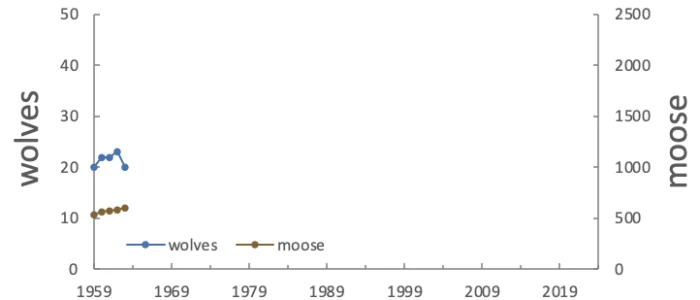
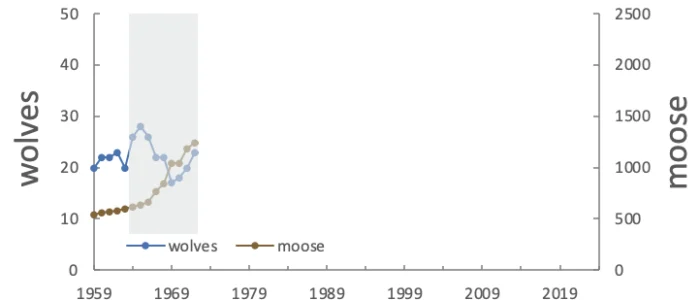
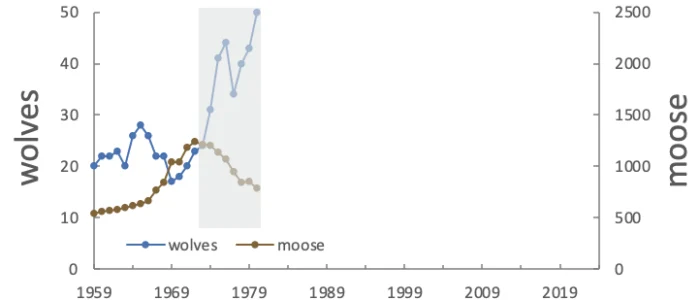
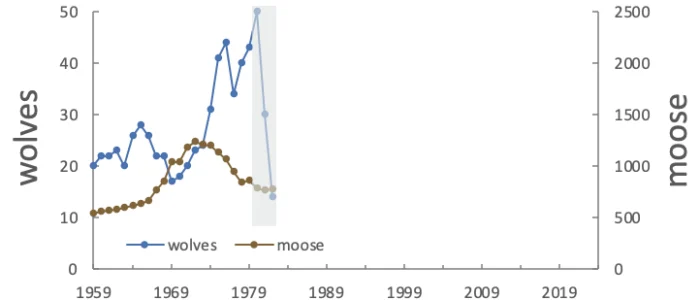
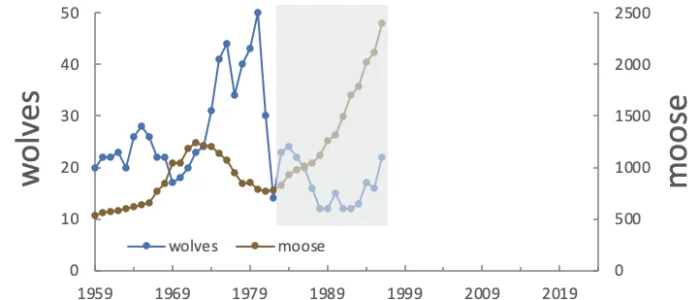
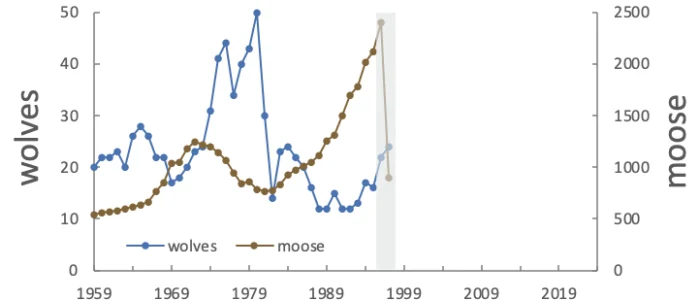
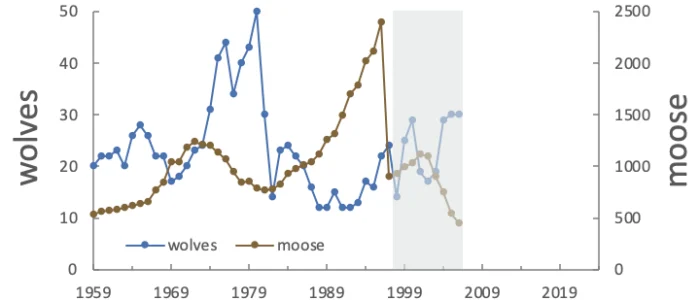
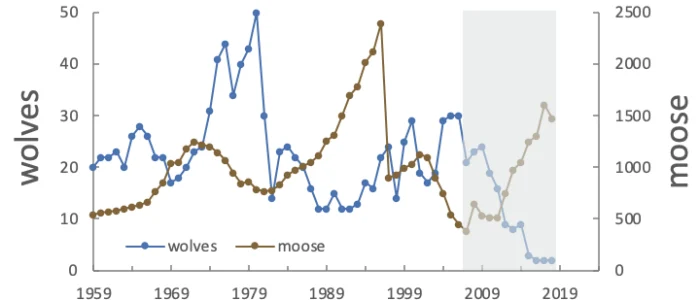
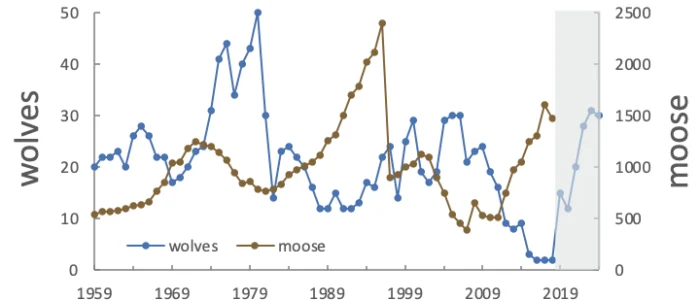
As Isle Royale shows, predator-prey relationships are dynamic, not linear; outcomes are the product of multiple variables, most uncontrolled by people and sometimes not readily discerned by humans. It’s not as simple as an elk hunter counting how many pounds of elk meat are in the freezer, assessing how many meals are there to feed a family and then plotting when the larder runs out.
Today, there are more elk in the wolf-inhabited Rocky Mountain region than there’s been in 150 years and that’s with wolves on the ground. Hunter success rates overall are consistent with what they were before wolf reintroduction. Outfitters and guides still boast on their websites of having return, satisfied clients and they post photos of clients standing next to trophy bulls. Read an analysis about wolf influence on big game animals Northern Rockies prepared by the Center for Carnivore Coexistence at Colorado State University.
States are actually struggling to find ways to reduce elk populations because ranchers complain about elk abundance; i.e. elk eating grass that normally would be available to livestock and elk as carriers of brucellosis, noting wild wapiti have passed it along to domestic cattle herds. (The culprit for brucellosis transmission is not wild bison in Yellowstone and Grand Teton national parks but that is another story). With more sprawl happening on private land, destroying wildlife winter range, more elk gather on undeveloped properties.
Debunking doomsday forecasts made by Friends of the Northern Elk Herd is not opinion, but the hard cold truth of reality. All of the native large wild ungulates present in Yellowstone prior to wolf introduction are still there; wildlife watching is one cornerstone of a multi-billion-dollar nature tourism economy in Greater Yellowstone and the value of wolf watching in Yellowstone alone has been pegged at being worth more than $80 million annually to Park County, Montana where Friends of the Northern Elk Herd was headquartered.
A segue back to Isle Royale is that the same entities, above, are also saying (erroneously with evidence not backed by science) that wolves alone are obliterating moose and elk populations in Wyoming, Montana and Idaho. Minnesota has the largest wolf population of any state in the Lower 48 and declining numbers of moose but the main cause isn’t lobos, research says. For further comparison, read a scientific analysis led by retired Alaska Fish and Game scientist Sterling Miller and colleagues that examined four decades’ worth of data in Alaska involving the state’s argument that aggressive predator control would bolster moose harvest rates by hunters. The variable related to moose abundance and the ability of hunters to kill a moose involves far more than reducing grizzlies, black bears and wolves, the analysis found.
° ° ° °
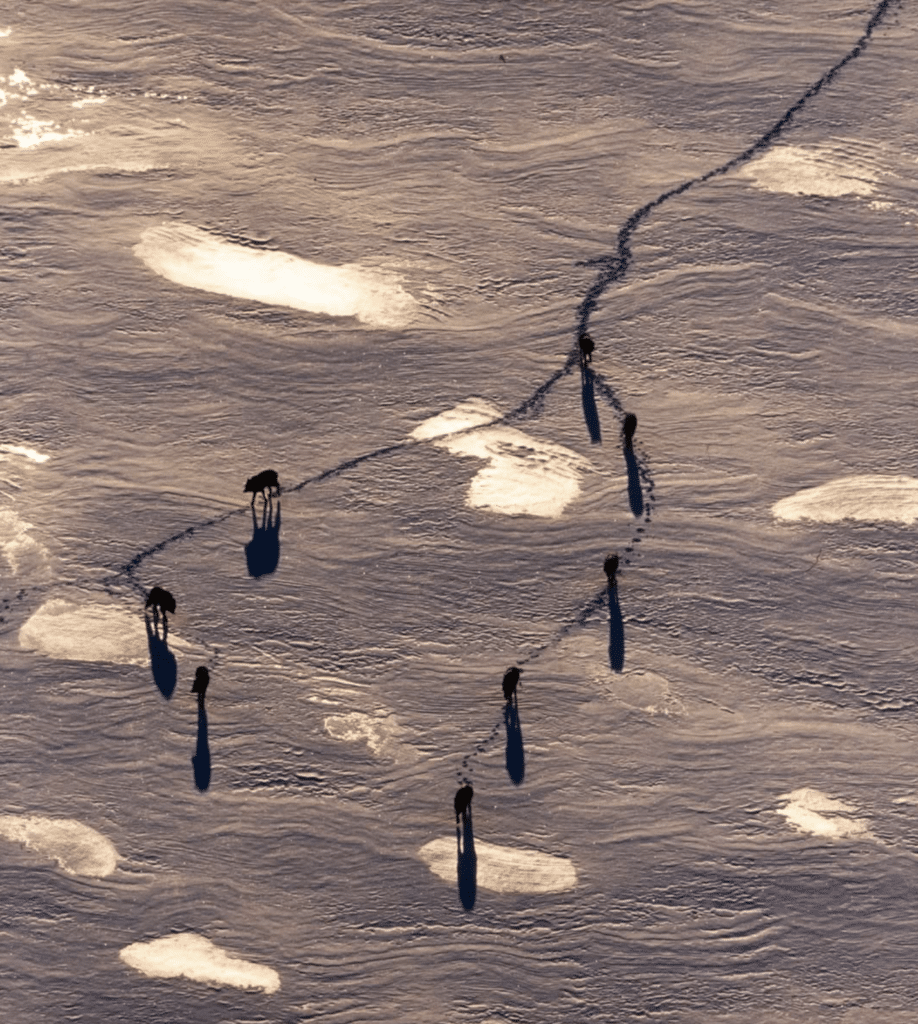
The first wolves, perhaps two or three individuals, arrived on Isle Royale from Canada in 1948, naturally crossing frozen ice expanses of Lake Superior. Yes, “Canadian” wolves. There were resident moose on the island at the time, ecologists say. Lynx and coyotes had been gone—trapped out— since the early 1900s. Woodland caribou also had been present on the island for an unknown period of time but they were killed off by subsistence hunters early in the 20th century. White-tailed deer, once present and widespread on the mainland, also were gone. Further, it’s possible that black bears and cougars, which still live in the region, were present on the island but no evidence confirming that has been found. Another important variable is that beaver, a keystone habitat creator, are present on the island.
Isle Royale is 45 miles long and nine miles wide and includes a patchwork of forest and wetlands encompassing an area of about 894 square miles. That includes the archipelago of the main island and 400 small ones. It is the fifth largest lake island in the world. But it is still inescapably small compared to the Greater Yellowstone bioregion and much larger Northern Rockies. Yellowstone is nearly 3772 square miles; Grand Teton Park is 480 square miles.
Formal scientific study of the interaction between moose and wolves was officially initiated at Isle Royale in the late 1950s through Durwood Allen and his then-young graduate student, Dave Mech, who lived amongst the wolves for three years. He authored the first definitive book, The Wolves of Isle Royale, in 1966 and several others about wolves at other locations. Later, Peterson published his own equal parts natural history/memoir, The Wolves of Isle Royale: A Broken Balance, in 2007. Let us not forget A View From A Wolf’s Eye, penned by Carolyn “Candy” Peterson (wife of Rolf) who has also been an important part of research and support.
Even Allen, Mech and Peterson believed it possible that wolves would wipe out moose.
Vucetich has written an overview of the natural history that reads as if filled with cliffhangers and he’s author of a critically-acclaimed book, Restoring the Balance: What Wolves Tell Us About Our Relationship With Nature. One could intuit as Allen initially did, and based on anti-wolf rhetoric today, that if wolf Armageddon were likely to occur anywhere, it would be in a place where the parameters of geography afford prey nowhere to run.
One could intuit as Durwood Allen (1910-1997) initially did, and based on anti-wolf rhetoric today, that if wolf Armageddon were likely to occur anywhere, it would be in a place where the parameters of geography afford prey nowhere to run.
Moreover, because Isle Royale is a national park, neither moose nor wolves are being hunted by humans and there is no livestock present, so the argument that wolves must be lethally controlled through hunting in order to maintain a healthy moose population is moot.
Making this thought exercise even more compelling is that Isle Royale, compared to Greater Yellowstone, is tightly defined and has a simplified predator and prey dynamic: again, one major predator (wolves) and one main prey animal (moose). It’s the opposite of the GYE.
After the first wolves arrived at Isle Royale, it took awhile to detect patterns. It’s similar to what happened in Yellowstone where, immediately after reintroduction, the number of wolves climbed dramatically to a peak of 174 in 2003, in response to the more abundant prey base, elk (then number 19,000 on Yellowstone’s Northern Range and labeled “too many” by the ag industry). But today, the average population of wolves in Yellowstone is around 125 and the summering population of elk on the Northern Range is between 5300 and 6000. Only about 2,000 elk live year around in that part of the park. The dramatic decline in elk numbers a quarter century was owed to, yes, wolf predation but also ongoing drought and years of liberal hunting seasons in which even pregnant cow were killed in late winter hunts to knock the elk population down.
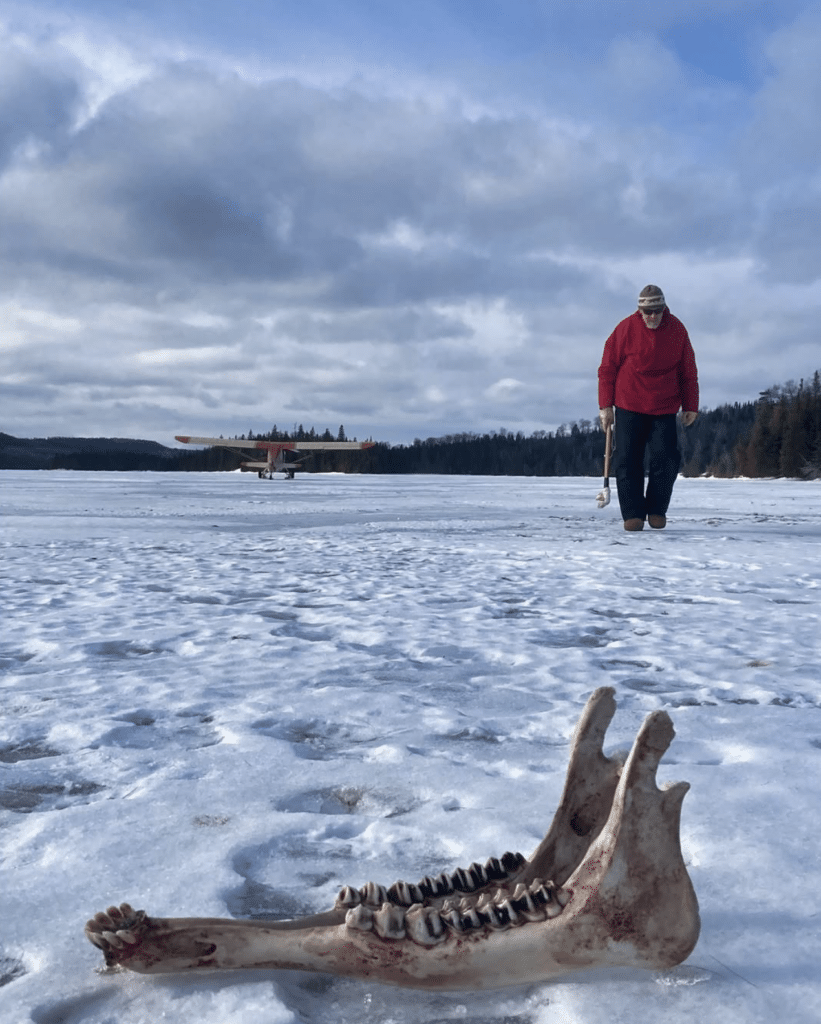
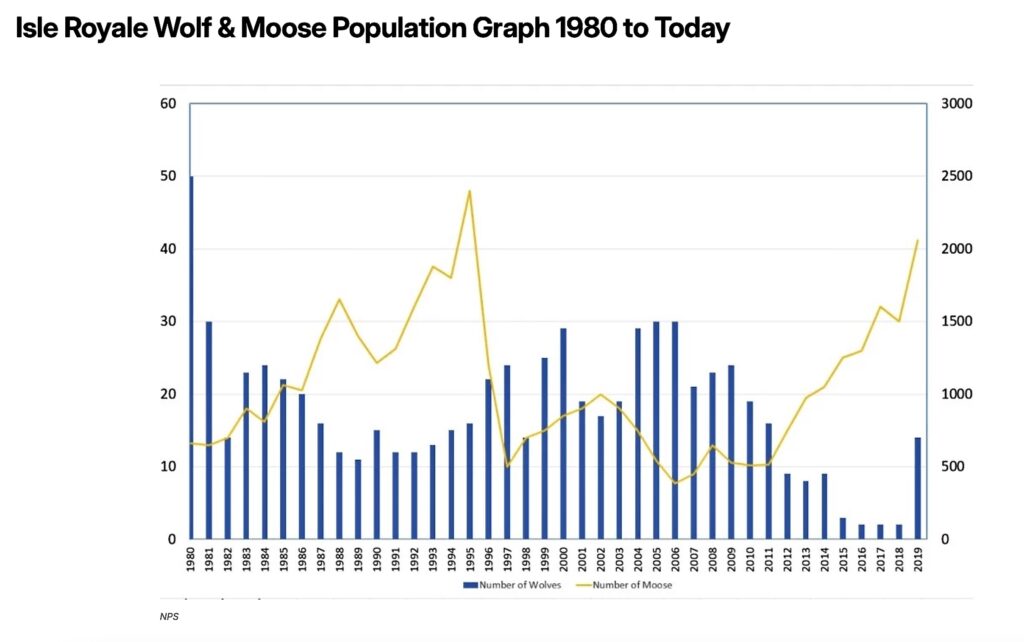
In 1980 there were 50 wolves on Isle Royale, which represented a peak, and around 750 moose.The next two years were dramatic, Vucetich notes, but not in the way anti-wolf observers would suppose and which would make Bob Fanning a winner of any bet.
Wolves plummeted from 50 to 14. Their survival was threatened by an unforeseen event. A visiting tourist brought a domestic dog unknowingly carrying deadly parvovirus. The disease spread throughout resident wild wolf packs. With barely a dozen wolves, extinction was a real concern, Vucetich notes.“The only way to know what would happen next would be to continue observing and not intervene,” he said. Peterson was lead author on a paper titled “The Rise and Fall of Isle Royale Wolves, 1975-1986,” published in the Journal of Mammalogy in 1988.
As a sidenote to dog loving readers, this is why taking your dogs to Yellowstone, Grand Teton, and Glacier national parks and hiking with them in the backcountry of those preserves—which is illegal—is a compelling example of the potential downsides for wildlife in protected areas. Still the fact that thousands of domestic dogs, cumulatively over the course of a single year, often roam off leash with recreationists in adjacent national forests not only causes wildlife displacement but it heightens the epizoonotic disease risk, especially visitors bringing their dogs to the region from other places where there is higher presence of other potentially deadly pathogens. And, as an anecdote, historians say that one of the reasons why Europeans today still carry an imprint of aggressive wolves in their psyche is owed to wolves being infected with rabies during Medieval times when wolves were also feeding on corpses of large numbers of humans dying from Black Plague and other pandemics.
At Isle Royale, wolf population recovered partially during the mid-1980s, Vucetich says, only to decline again. For much of a decade, wolf numbers remained in the low teens. “The low numbers of the early 1990s were difficult to explain because the disease [parvovirus] was gone and the wolves’ food (moose) was abundant. It seemed plausible, but far from certain, that the low numbers were ultimately the negative consequences of inbreeding. All we knew for sure was that Isle Royale wolves are highly inbred and descended from just a single female and two males,” Vucetich writes.
Low wolf abundance provided an unprecedented opportunity – a natural experiment of sorts – to see how moose would respond to reduced wolf predation. With predation low during the late 1980s and early 1990s, moose lived longer and gave birth to more calves, he says.
The moose population nearly tripled to almost 2,400 by 1996. [This was similar to how elk numbers exploded and remained high in Yellowstone in the decades after wolves were exterminated from Yellowstone, with support from the federal government, by the 1940s].
Moose herbivory on native plants was intense and it was accompanied by another unexpected curve ball. During the winter of 1996,forage challenges for moose on the island, combed with an outbreak of moose ticks, and a severe winter, conspired against moose, Vucetich notes. “The winter had been more severe than any in over a century. The moose population collapsed from its all-time high of around 2400 to just 500,” he writes
“Just as the moose population collapsed, wolves seemed as though they would stage a comeback – their abundance doubled in the mid 1990s,” Vucetich explains. “With the collapse of the moose population, food for wolves, hover, was rare, and the timing of their comeback unfortunate. What happened next is something we would not discover ourselves for another 14 years.”
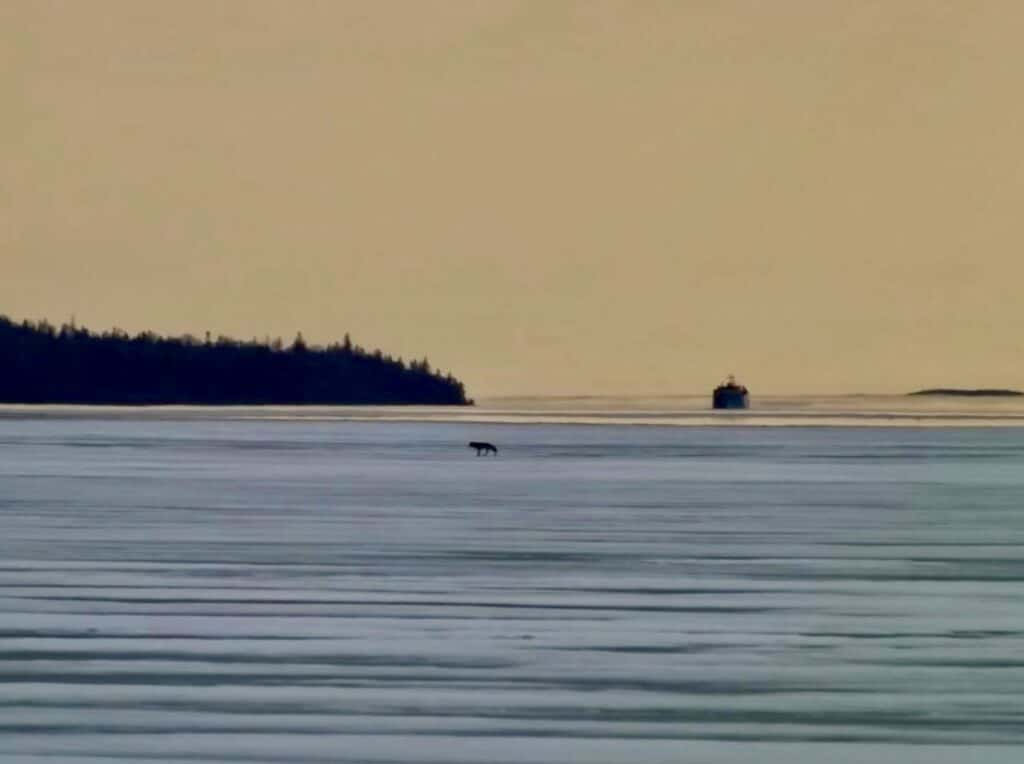
During the winter of 1997, a wolf from Canada immigrated to Isle Royale. “He crossed on an ice bridge that occasionally forms between Isle Royale and Canada. We knew him as ‘the Old Grey Guy.’ He became one of the most successful wolves ever to live on Isle Royale, and he revitalized the population’s genetic diversity,” Vucetich wrote. “ His arrival also explains, in part, why wolves did pretty well from 1998 to 2004, during a time when it was relatively difficult for wolves to capture moose.”
For several years around the turn of this new century, moose seemed to be recovering, Vucetich says. Then, a series of very hot summers struck. “During hot summers moose feed less, as they spent more time resting in the shade. Having fed less, the undernourished moose were less prepared to survive the winters. Warm temperatures also enabled severe outbreaks of moose tick. Weakened by heat and ticks, moose dropped to their lowest observed levels. Wolves took advantage of weakened moose, fueling high rates of predation. During the first decade of the 21st century, the moose population steadily slid to its lowest levels, Vucetich explains.
Vucetich shares this overview of Isle Royale. “The wolf population, with 30 individuals living in three packs, had been thriving until 2006. But with moose becoming increasingly rare, capturing food become increasingly difficult. One wolf pack failed after another,” he wrote. “By 2011, the population was reduced to 9 wolves living in one pack and another half dozen wolves, the socially disorganized remnants of Middle Pack. DNA analysis of wolf scats collected at kill sites indicates no more than two adult females in the population. If they were to die before giving birth to new females, the wolves would be committed to extinction.”
In addition to moose, wolves supplement their diet by eating beaver and snowshoe hare. The presence of wolves resulted in the extirpation of coyotes.
Isle Royale serves as a reference point in the study of island biogeography for many reasons and it holds implications for Greater Yellowstone as its ongoing wildlife health relies upon having functional habitat connections to other ecosystems.
Here, again, are a few more home points important for readers to consider. Weather and climate play a bigger role in controlling prey species than wolves. Winter ticks and a parasite, brain worm (for which white-tailed deer serve as carriers today are proliferating across northern latitudes of North American and negatively affecting moose, even in areas where there aren’t wolves, because a trend of warmer winters (though there are exceptions) aiding the reproduction of those parasites. Moreover, warmer, less moist summers are also drying out wetland habitat and its vegetation that benefit moose. Lastly, Isle Royale shows what can happen when lack of genetic diversity in a wildlife population can hobble reproduction and why, on the mainland, it’s important to have biological connectivity between island populations.
In Greater Yellowstone, the danger of losing intra-ecosystem wildlife migration corridors could essentially leave wildlife populations that must move to thrive instead stranded and transformed into island subpopulations. As Bozeman science writer David Quammen demonstrates in his book, Song of the Dodo, island populations of species suffer from higher rates of local extinction, problems with genetic inbreeding, vulnerability to disease, and trophic collapse.
Right now, Greater Yellowstone is facing a number of converging, mostly human driven forces that stand to fragment the ecosystem and produce many subgroups of localized island populations of ungulates which has huge negative implications for carnivores and scavengers. Those expanding fragmenting forces are private land sprawl, expansion of roads and more intense levels of human activity, including industrial outdoor recreation on public lands.
By far the greatest predators of ungulates, ranking higher than predation from wolves, grizzlies, mountain lions and coyotes, are loss or degradation of habitat; weather (cold winters with deep snows and dry summers), and, more recently, the deepening presence of Chronic Wasting Disease, which afflicts members of the wild cervid (deer) family that includes: elk, moose, deer, and in the Far North, caribou/reindeer. CWD’s advance is a wild card phenomenon that no wildlife managers 50 years ago could have predicted. Other pathogens looming large are avian flu, West Nile virus, and others. Studies and computer models show that carnivores—cougars, wolves, grizzlies, and coyotes—can help slow the spread of CWD by removing infected prey species, even ungulates that do not appear to be sick to humans.
° ° ° °
On Isle Royale, as the crashing wolf population reached the precipice of vanishing, the moose population in 2017 was estimated at 1600. Just two wolves remained. Meanwhile, over-browsing by moose caused vegetation, especially balsam fir, to take a beating and the pressure was transforming the island from forest to brush.
Regarding Canis lupus, wildlife managers were pressed to make a difficult decision: whether to intervene or not.
This question is today a topic of ongoing spirited debate among scientists and conservationists, for it surrounds the question of what should be done as the effects of climate change deepen and habitat disruptions to existing wildlife home ranges puts animals on the move and possibly hastens loss of species?
At Isle Royale, scientists asked: should the declining wolf population be augmented so the experiment can play out longer?
Earlier parallels existed with both California condors and with black-footed ferrets in Wyoming where the number of species known to exist had fallen to double digits or less. At one point, the late conservationist David Brower argued against intervention and said condors should be allowed to wink out with dignity and join Martha the passenger pigeon on the list of lost species.
Instead, in the case of both condors and ferrets, the last survivors were taken into captivity and strictly protected, slowing growing their numbers under controlled conditions and their descendants reintroduced to the wild. Thanks to the Endangered Species Act, which allows for this approach, both condors and black-footed ferrets are, for the moment, examples of why its important to not surrender to the perceived inevitability of extinction.
At Isle Royale, the initial decision, one of several laid out in an Environmental Impact Statement, was to not mount a genetic rescue of wolves. Also, because Isle Royale is part of the National Wilderness System, some argued that Nature should just take her course. Philosophical debates raged.

Just days before he was selected to be superintendent of Yellowstone in summer 2018 by Interior Secretary Ryan Zinke, Cam Sholly signed a record of decision instructing that wolves be (re)introduced to Isle Royale National Park to stave off their extirpation. Photo courtesy NPS
But the decision was reversed after several prominent wolf scientists published a piece making a plea for intervention, in BioScience in October 2017. The person who signed the record of decision authorizing reintroduction was none other than Cameron H. Sholly, then Midwest regional director of the National Park Service and who today, poignantly, is superintendent of Yellowstone, renowned for its wolves. He emphasized the ecological importance of wolves as keystone animals and regulators of moose which are predators of vegetation. Ironically, wolves are necessary to keep the moose population healthy, and a healthy moose population, kept in check, means a healthier forest on the island.
“The introduction of 20-30 wolves may increase the health of the moose population over time as the wolves cull older, weaker, and diseased individuals. This introduction would also decrease the rate of herbivory on the land and slow the rate of change in forest structure and composition. This will be a significant beneficial change from the current condition by restoring the ecological process of predation,” Sholly and advisors wrote.
“The selected action would retain forest components that would otherwise be reduced in the presence of increased herbivory, allowing for forest succession to return to a historical trajectory last ween when predation had more influence in the community dynamics. Overall, the introduction of wolves under the selected alternative will increase the likelihood of reestablishing a functioning top-down, predator influenced system. This will reduce existing stresses on the island ecosystem and many elements of the island ecosystem may be improved.”
Sholly won praise from scientists and the conservation community. Fatefully, a week later, he was tapped by the first Trump Administration to replace ousted Yellowstone Superintendent Dan Wenk.
Not long after Sholly put his signature on the directive, a series of relocations, involving wolves from Canada, Minnesota and Michigan, occurred and they worked. From 2018 to 2019, 19 wolves were reintroduced. Readers can learn more by clicking here. As of 2024, there were around 30 wolves on Isle Royale and about 840 moose.
What Isle Royale demonstrates is that moose declines cannot be blamed on wolves, nor wolf declines pinned on moose. Out West in Greater Yellowstone, it’s a parallel universe involving the cause of high elk numbers and wolves, struggling mule deer herds and mountain lions, an unsustainable number of elk causing damage to native plant communities on the National Elk Refuge, and whatever the factors are in triggering declines of pronghorn across the prairie. As a historic reference in the West, there is always the looming asterisk of what happened on the Kaibab Plateau in Arizona where predators were killed to allegedly protect mule deer. Its a case study of human arrogance and wildlife mismanagement mentioned by Aldo Leopold in A Sand County Almanac and Rachel Carson in Silent Spring.
What Isle Royale demonstrates is that moose declines cannot be blamed on wolves, nor wolf declines pinned on moose. Out West in Greater Yellowstone, it’s a parallel universe involving the cause of high elk numbers and wolves, struggling mule deer herds and mountain lions, an unsustainable number of elk causing damage to native plant communities on the National Elk Refuge, and whatever the factors are in triggering declines of pronghorn across the prairie.
Can Isle Royale serve as a cautionary tale for state wildlife managers, legislatures, governors and state wildlife commission members who adhere to simplistic ways of thinking about predators and prey?
Often, multiple factors were happening at once, making it difficult to tease out exact causality. Things are always set in motion, including assumptions made today that may change as more information comes in tomorrow. Few dispute that the restoration of wolves in Greater Yellowstone hasn’t brought benefits such as reducing elk numbers and corresponding herbivory on aspen and willow. But as on Isle Royale, the system is more complicated than meets the eye.
This is important to note, for its part of future-looking assessments scientists are considering now in pondering the likely future health of wildlife populations in Greater Yellowstone, the Lower 48 and world. It’s the cornerstone of wide thinking adaptive management that results in true resilience. Undergirding it all is true scientific inquiry.
Vucetich says the half century research at Isle Royale has been to better understand the ecology of predation and what that knowledge can teach about wildlife and human relationships in nature. “Much of what we have learned is associated with having been patient enough to observe and study the fluctuations in wolf and moose abundances,” he wrote in a recent overview.
He goes on, “Isle Royale has offered many discoveries… for example, how wolves affect populations of their prey, how population health is affected by inbreeding and genetics, what moose teeth can tell us about long-term trends in air pollution, how ravens give wolves a reason to live in packs, why wolves don’t always eat all the food that they kill, and more. The wolves and moose of Isle Royale also frequently reveal intimate details of their daily life experiences and they have inspired numerous artistic expressions. If we pay attention, they all tell us something important about our relationship with nature.”
Similarly, in Greater Yellowstone, it can be perilous when pandering to seat of the pants windshield biologists who assert that nature operates in order to meet human expectations.
EPILOGUE
Exploiting a widely-held negative perception that wolves decimate big games species in the West, a contention whose veracity is seldom investigated even by the supposedly discerning media, legislators in Montana, Idaho and Wyoming have been successful in enacting laws allowing significant killing of wolves through hunting and trapping. They are joined by vocal anti-predator groups and agriculture interests.
A rough estimate of the current gray wolf population now living in the West is 3,000, a number that many longtime wolf managers say is inflated, yet it is used to justify higher allowable harvest quotas of wolves, plus bounty programs.
Reviewing records, the wolf advocacy group Predator Defense, says at least 8,000 wolves were killed between 2011 and 2019 in seven states, including the Upper Midwest. Predator Defense’s founder, Brooks Fahy, added, “We conservatively estimate at least 2,000 more wolves have since been killed.” Another person, an insider with the US Department of Agriculture’s special division known as Wildlife Services that kills thousands of coyotes and hundreds of wolves each year, says more are being quietly killed because pullbacks in population monitoring outside of protected areas like national parks has enabled more poaching to happen undetected.
Within a 200 mile drive of Boise, Idaho, retired federal and state wolf manager Carter Niemeyer says there used to be more than 10 wolf packs but now there are only two or three. Niemeyer, a longtime hunter of elk and deer, says despite claims that big game herds have been severely impacted, his own harvest success rates have not been negatively affected. Read the Yellowstonian story featuring Niemeyer and titled “Confessions Of A Former Government Trapper.“
These wolf tolls mentioned above by Fahy are additive to government-sanctioned lethal wolf control and wolves taken by bounty hunters to ostensibly prevent or address livestock depredation. On top of it, there is natural mortality and ongoing and, on top of it, there is the ongoing off-the-stat sheet phenomenon of illegal killing and natural mortality.
In Wyoming, it’s open season on wolves in 85 percent of the state. They can be killed 365 days a year, 24 hours a day, by almost any means. Never in the history of the federal Endangered Species Act has an animal whose management was handed back to a state from the federal government been a target for immediate re-annihilation. Both neighboring Idaho and Montana have regulations encouraging around a 50 percent reduction in their wolf populations every year, despite scant evidence wolves are causing major widespread impacts to wildlife and livestock. .
Enjoy an extended recorded interview that Vucetich gave explaining the Isle Royale Wolf & Moose Project, below. and his accompanying essay, “Lessons in Humility About Wolves” up now at Yellowstonian. If you appreciate stories like this, please consider supporting us.
LETTER FROM A YELLOWSTONIAN READER:
Dear Yellowstonian,
I enjoyed reading your article on the Isle Royale wolf studies. Nice work by some able and dedicated biologists over many years. I don’t know if you knew that Adolph, my fathere, studied moose on the island in the 1930s before wolves had arrived, written up in a University of Michigan pamphlet. I don’t recall if he recommended wolves be introduced, but I think he thought they should.
I admire the good work you are doing with the Yellowstonian and earlier defense of the Gallatin area and the Yellowstone ecosystem. Excellent journalism.
Keep up the good work.
Jan O. Murie
Edmonton, Alberta, Canada
NOTE: Dr. Jan Olaus Murie is an ecologist and emeritus professor at the University of Alberta in Edmonton. He devoted most of his career to studying the behavioral ecology of sciurid rodents, primarily ground squirrels, specifically. However, he is praised for his wide-ranging ecological thinking about the Rocky Mountain region (both Canada and the US) which seems to run in his family. Jan grew up in Jackson Hole and is the son of famed American mammalogist Adolph Murie, who published a scientific pamphlet on the ecology of coyotes in Yellowstone, and major books examining the natural history of wolves and grizzly bears in Denali National Park in Alaska. Both of those are considered classics. Jan’s mother was naturalist Louise Murie MacLeod. He is the nephew of pioneering elk biologist and ecologist Olaus J. Murie and naturalist Margaret E. “Mardy” Murie, who were also based in Jackson Hole. His parents and uncle and aunt were outspoken conservationists, and, in particular, advocates for protecting public land as wilderness. Mardy Murie in 1998 was awarded the Presidential Medal of Freedom by President Clinton, an honor she said she shared with other family members.