EDITOR’S NOTE: As scientists in Greater Yellowstone argue about concepts related to “trophic cascades” and the effects that keystone species, like wolves and beavers, can have in affecting ecosystems, often little tolerance is afforded by politicians to scientists navigating uncertainty. In the following essay, Dr. John Vucetich, who is widely hailed for being a big picture thinker about conservation biology, shares some insights
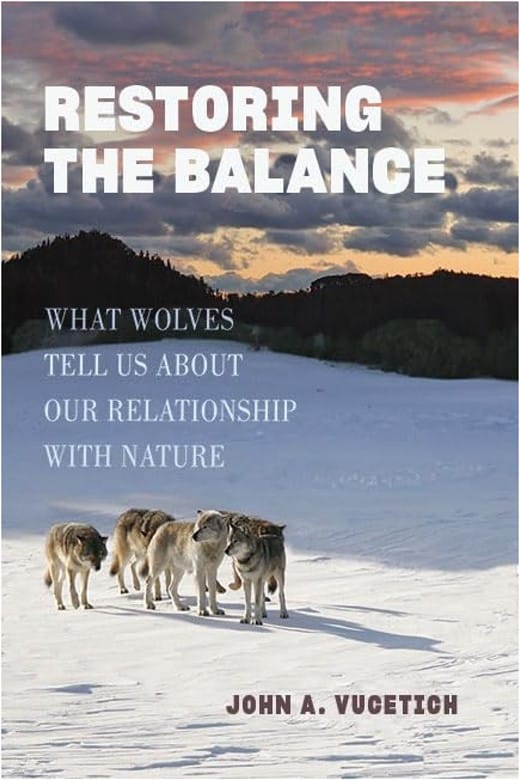
Vucetich is author of an intriguing and provocative 2021 book, Restoring the Balance: What Wolves Tell Us About Our Relationship With Nature published by Johns Hopkins University Press. The piece speaks to some of the terrain he explores. A review of Vucetich’s book, published in the journal BioScience in 2024, was written by Aaron Bott and Matt Barnes who have both been involved with human-wolf co-existence in the West, and Dr. Susan Clark, founder of the Northern Rockies Conservation Cooperative (NRCC) based in Jackson Hole. Clark herself is a wildlife field researcher who had projects around the world and who taught natural resource policy classes at Yale University. Read the review of Restoring the Balance by clicking here. Both Bott and Barnes are research associates with NRCC. “With the potential to reshape the discourse in wildlife management and conservation biology, Restoring the Balance aspires to leave a lasting mark well beyond its final page, inspiring a deeper commitment to environmental ethics and action,” they write.
Apart from his traditional field work, Vucetich, a distinguished professor in the College of Forest Resources and Environmental Science at Michigan Technological University, is known for challenging conventional thinking on what constitutes biological recovery of species, arguments made for why wolves and grizzlies should be hunted, and whether hunting truly does win greater social tolerance for carnivores. A frequent co-author with Vucetich in some of those papers is another friend of Yellowstonian’s, Dr. Jeremy Bruskotter, a professor in the School of Environment and Natural Resources at Ohio State University. In addition, a must-read is the 2024 think piece, “More reason for humility in our relationships with ecological communities,” by Vucetich, Sarah Hoy and Rolf Peterson that appeared in BioScience.—Todd Wilkinson
By Dr. John Vucetich
The wolves and moose of Isle Royale have been of interest for so long because they offer some very important, general lessons. Here is one of the most important—our attitudes about how we should relate to Nature. Some of our abusive relationships with Nature are rooted in convictions that we understand Nature well, and can accurately predict how Nature will respond to our actions.
For more than 50 years, the focused purpose of the Isle Royale wolf-moose project has been to predict and understand a relatively simple natural system.
But the more we studied, the more we came to realize how poor our previous explanations had been. The accuracy of our predictions for Isle Royale wolf and moose populations is comparable to those for long-term weather and financial markets. Every five-year period in the Isle Royale history has been different from every other five-year period – even after fifty years of close observation.
The first 25 years of the chronology were fundamentally different from the second 25 years . And the next five decades will almost certainly be different from the first five decades. And the only way we will know how, is to continue observing. The most important events in the history of Isle Royale wolves and moose have been essentially unpredictable events – disease, tick outbreaks, severe winters, and immigrant wolves.
Don’t misunderstand – it’s not as though we’ve learned nothing. Much insight has been gained, for example, about wolves’ tendency to kill moose that are likely to die from other causes, the effect of climate and forest processes on animal populations, and even the role of ravens in shaping the distinctive social nature of wolves.
The lessons we learn seem to come more from explaining the past rather than predicting the future. For example, we didn’t predict the great population crash of wolves in the early 1980s or the moose crash in the mid 1990s. But afterward we were able to recognize circumstances that had lead to those and other events. Natural history might be much like human history – explainable, but not predictable.
The lessons we learn seem to come more from explaining the past rather than predicting the future. For example, we didn’t predict the great population crash of wolves in the early 1980s or the moose crash in the mid 1990s. But afterward we were able to recognize circumstances that had lead to those and other events. Natural history might be much like human history – explainable, but not predictable.
Isle Royale illuminates one of the oldest questions in all ecology, “Is Nature best understood as the result of predictable law-like patterns that ecologists take as their task to discover?” Or, is Nature better understood as the result of innumerable contingencies, essentially a historical process that can be explained and understood but not very well predicted. Is Nature deterministic or contingent? Is ecological science like the study of physics or more like the study of human history? Does ecological knowledge basically boil down to natural history with lots of numbers and statistics?
With the wolves and moose of Isle Royale, where we are simultaneously and paradoxically impressed with how much and how little we understand. Voltaire was right, “The more we know the less certain we are.”
If we see Nature as a system whose future we can predict, then we will be confident in our efforts to control and manage Nature. If, in Nature, we are more impressed by its essentially contingent, and hence unpredictable character, then our relationship will be more strongly rooted in striving to live within the boundaries of Nature’s beautifully dynamic variation.
Western science has come to understand a great deal about Nature. But pride for our knowledge of Nature, need not become hubris to fuel an obsession with controlling Nature. The wolves and moose of Isle Royale show how it is not so difficult to be proud for all that we’ve learned about Nature, yet humble for knowing how limited our understanding of really is. This is the humility from which a rich relationship with Nature may be rooted.
Also Read: