by Todd Wilkinson
This year is proving to be a big one when it comes to mountain lions given prime billing on theater marquees and public television stations coast to coast in America.
One film, Heart of a Lion, features the research of noted big cat scientist Mark Elbroch who spent many years in the Tetons. Another, Guardians of Yellowstone: The Yellowstone Cougar Project, is focused on decades of field work in Yellowstone National Park. Together they give us the most complete portrait to date of the role that Puma concolor plays in the natural regulation of wild ecosystems. But even more than this, we are given a front row seat to some masterful storytelling and intimate portraits of individual cougars.
Both films are appearing at an important, bizarre time in our nation’s history, when legislators in several states have advanced outdated and widely discredited management positions aimed at wildlife carnivores, be they wildcats, wolves, grizzlies or coyotes. Science is literally under siege, politics is trumping reason and meaningful gains made in human-wildlife co-existence are being erased.
What Heart of a Lion and Guardians of Yellowstone do is use evidentiary science, vigorous field investigation and sensitivity for the real lives of cougars to paint accurate, empathetic portraits—not hyperbolic depictions rooted in fairy tales and fear mongering. They also are reminders of the power of film as a shared social experience be it in a theater which seats hundreds of people or devoting family time in the living room to learning more about the remarkable natural panorama that surrounds us every day in the West.

Together, these projects also position Greater Yellowstone, once again, as a cradle of wildlife conservation in the world.
Jackson Hole itself has long been a basecamp for a distinguished group of filmmakers specializing in making wildlife documentaries. During its earlier heyday, the late Wolfgang Bayer was revered for his own pioneering work and also being a mentor to many young storytellers who landed prestigious gigs with outlets like BBC, National Geographic, WGBH Boston and the rise of cable channels.
Earlier in October 2025, Jackson Wild (formerly the Jackson Hole Wildlife Film Festival) served again as a gathering place for many of the best digital creators in conservation film and all took news of Jane Goodall’s passing hard. Goodall’s stature rose to prominence not only because her naturalistic observations explored the social dynamics of chimpanzees but her discoveries were shared with millions of people around the world during the 1960s and 1970s on TV specials featuring films by the National Geographic Society.
Among many films that have attracted a buzz this year is Heart of a Lion, the a new release from producer Joe Pontecorvo which features the mountain lion research of Elbroch, who formerly lived inJackson Hole and now is based on the Olympic Peninsula in Washington State. He is director of the Puma Program for the renowned global cat conservation organization, Panthera.
A few years ago, Elbroch and his colleagues in our region (which include Jenny Fitzgerald, now executive director of the Jackson Hole Conservation Alliance) uncovered many new insights into mountain lion behavior. Some have been published in scientific journals, and Elbroch wrote about them in his well-received book, The Cougar Conundrum: Sharing the World with a Successful Predator.
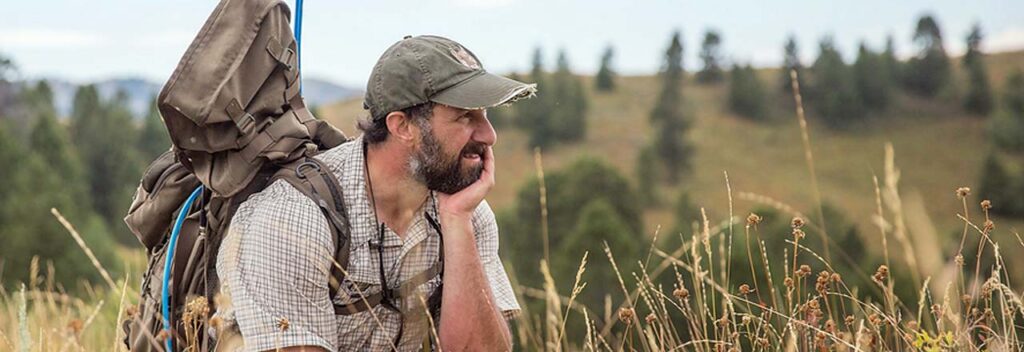
Pontecorvo thought Elbroch’s perspective was not only film worthy but he enlisted him to narrate the documentary. Pontecorvo also knew he needed a veteran co-lensman to get footage of Elbroch’s elusive subjects. Who did he enlist? Answer: another renowned Jackson Hole cinematographer, Jeff Hogan, who has a depth of experience but is best known for his work with National Geographic producing documentaries about the fauna of Yellowstone National Park.
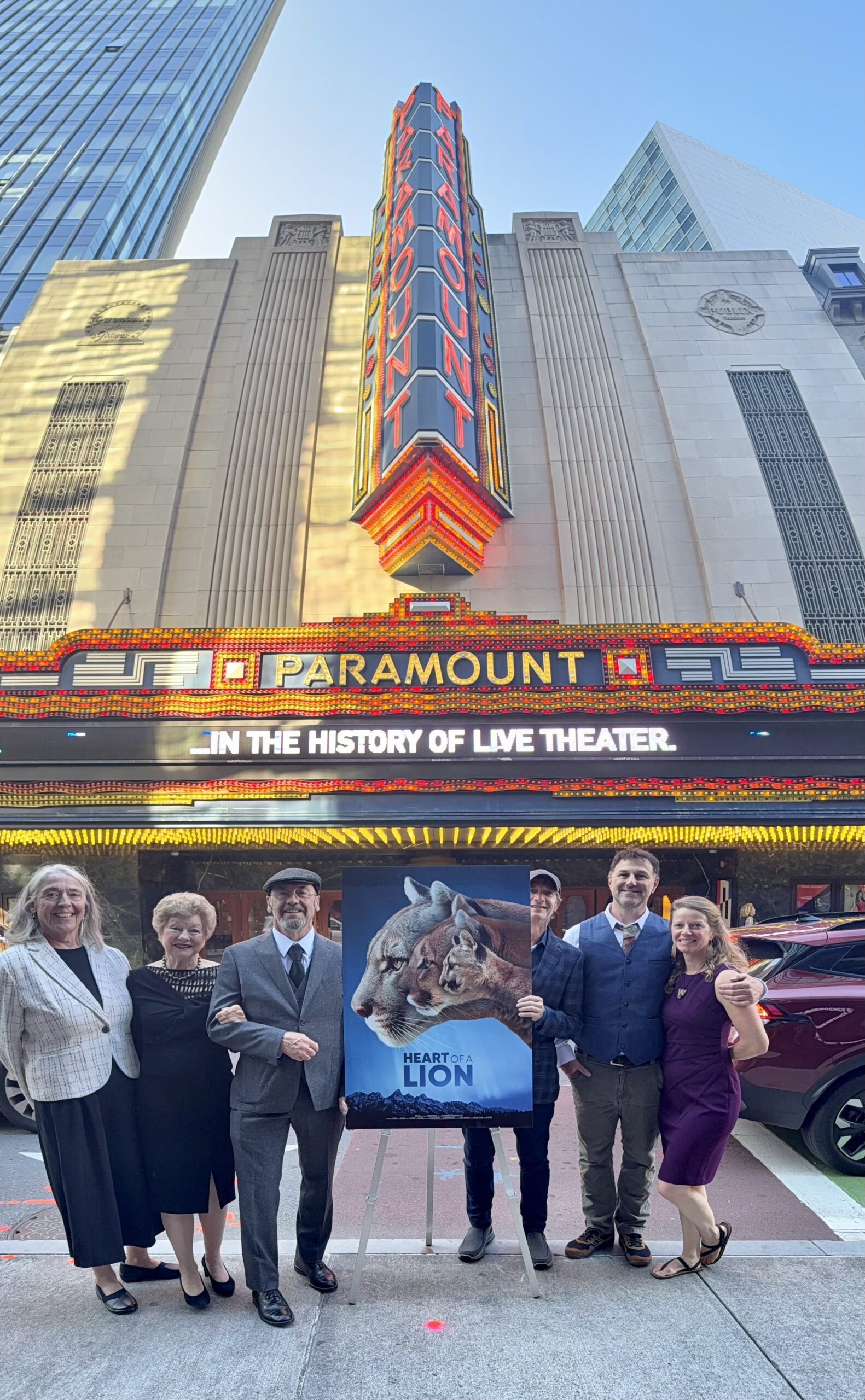
Heart of a Lion was executive produced by Jon Ayers and Dorothy Bahna and made its premier this autumn at the Boston Film Festival where it earned two major awards, one for cinematography and another for editing. You can view a trailer of the film on Instagram by clicking here. Coincidentally, it is gaining acclaim at the same time Guardians of Yellowstone, produced by the fStop Foundation, is making its highly-anticipated debut. That gripping film features years of research from members of The Yellowstone Cougar Project, namely Dan Stahler, Kerry Murphy, Toni Ruth and Wes Binder in and around America’s oldest national park. The filmmaking team consists of Andy Adkins, Max Freund, William Freund, and Jason Wells. View the trailer at the end of this story.
Cougars, because of their cryptic and lower density presence, have dwelled in the shadows of other far more visible carnivores. Found from the Canadian Yukon to the southern Andes in South America, they are the most widely distributed large mammal in the Western Hemisphere. Hopefully, the impact of these two important, artful and dramatic natural history films will open the public’s eyes the same as other projects have elevated awareness about grizzlies and wolves. In fact, cougars as a species have their own vital place in the ecology of Greater Yellowstone and the intimate stories of individual animals are just as intriguing and poignant as those of bears and wolves.
Recently, I had a chance to interview Hogan.
Jeff Hogan Talks About The Making of Heart of a Lion
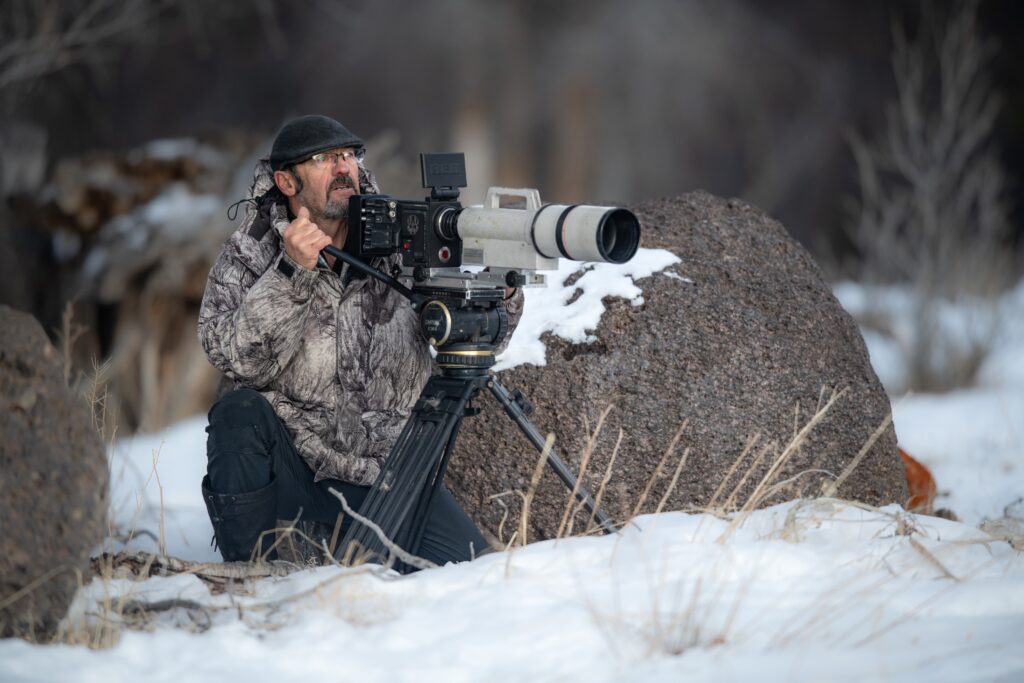
Todd Wilkinson: Good to reconnect, Jeff. You’ve worked on many different high-profile wildlife films over the years. What excited you and Joe Pontecorvo about this one and why do you think viewers will find it impactful?
JEFF HOGAN: Mark Elbroch, a cat specialist who is director of Panthera’s Puma Program, serves as a guide giving us entre into the elusive and largely secret lives of mountain lions aka cougars aka pumas aka catamounts.
Wilkinson: What stands out to you about Mark as a scientist and Panthera as a leading cat conservation organization?
HOGAN: Mark’s passion and dedication along with an incredible work ethic has led to important insight into the most secret details of our cougars lives. His skills as writer delivers to the public these details for complete understanding of how we can coexist with cougars. Panthera as a world renowned big cat conservation organization, has experience with solving human /cat conflicts with a variety of solutions that benefit both cats and people.
Wilkinson: While Mark is based today in the rainforests of the coastal Pacific Northwest, part of this film has roots in Jackson Hole, where he for years oversaw the Teton Cougar Project. As a Greater Yellowstone resident yourself, how do you think differently about mountain lions today than when you got into wildlife filmmaking or even getting involved with Heart of a Lion?
HOGAN: Mark called me a few years ago saying that Panthera was keen on making a conservation film on cougars. Joe and I were working on developing a cougar film and became very excited about this opportunity to make a film that could really help with cougar conservation. Of course, this would require a deep understanding of the cougar and its way of life.
Mark has been studying cougars for 20 years or more so we knew that this was a fantastic opportunity to be working with the most thorough and up to date research. My passion and focus has always been on filming animal behavior. Joe is a genius at putting all the components together as a director, and producer as well as a talented and creative cinematographer. I saw this as the dream team. I first worked with Mark several years ago on our film Big Cats in High Places for BBC.
Wilkinson: Panthera, after it was co-founded by businessman-conservationists Thomas Kaplan and the late Dr. Alan Rabinowitz, gained renowned for assembling a dream team of researchers associated with the study of large wild cats. In addition to Mark, the senior team was led by Rabinowitz and Howard Quigley, George Schaller, John Goodrich, and a new generation of field people. You are legendary yourself for getting footage of beavers. How did you apply that expertise to putting wild backcountry cougars on film?
HOGAN: In the years since Big Cats in High Places aired, Mark moved his work on cougars to the Olympic Peninsula and I continued to film the now-uncollected Teton cougars. Joe lives in Washington so the plan was for him to follow Mark’s work on the West Coast while I continued to follow my favorite mom cat F61. It was the perfect set up for all of us. I had already captured years of footage of F61 and her kitten, Willow, who had grown to have kittens of her own. We would film family groups from both locations and compare the different challenges each had to face. Our film brings the incredible discoveries of Mark’s work to the big screen in a way that the audience could learn and understand the nature of cougars in general and how we can co exist together throughout their range.
Wilkinson: What are a few of your own memorable days in the field getting the footage?
HOGAN: There were so many days in the field that were just absolutely incredible. One time I was walking with Mark, assisted with telemetry looking for our cat F 61 and her two big kittens. The snow was deep, which make for a great bed sites underneath the hawthorns that are buried under the deepest snow, as there can be bare ground under these scrubby trees. As we approached our strongest telemetry signal we figured they’ve got to be somewhere close. The next moment we heard a little grrrrr under the snow beneath our snowshoes.
Sure enough F 61 and her two big kittens were right underneath us. Maybe five feet of snow separated us along with the top half of the hawthorne bush. We just backed away without incident. It just goes to show that these cats can hide from you even when they’re right there under your feet.
Wilkinson: You believe that serendipity is a combination of knowledge, insight and getting out there in the elements. Please share with us an example of that.
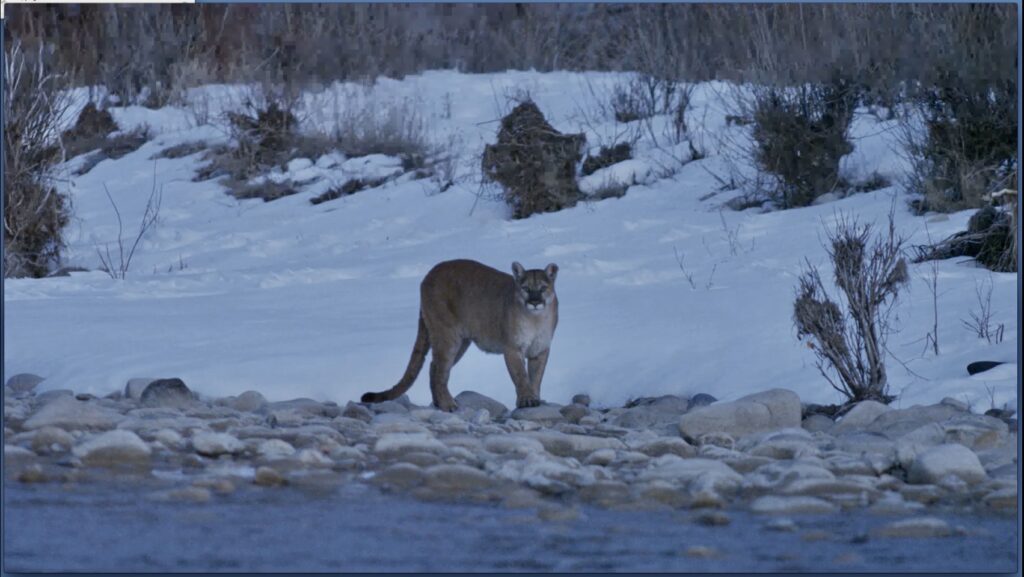
HOGAN: Another time I was out on my own tracking my Cat F 61. The study in the Tetons was over and F 61 no longer had a collar so no electronic assistance to know where she was. I had to learn to follow these cats on my own. As I tracked F 61 through the snow, she came to a stream that was about 15 feet wide. I could see the F 61 jumped the stream with a mighty leap. I thought to myself, “Wow!!! that’s the most incredible thing!!! I need to film it !” So I set up three cameras and crossed my fingers, hoping that she would return to this area and jump the creek again.The next evening she was there and indeed she jumped! Sure enough, all three cameras captured the action. This proved to be one of my most treasured shots. [Hogan shared some raw video footage of F 61 and subadult kitten featured in the film, below].
Wilkinson: Learning how you get shots is great because it allows us to understand how you make magic happen. Please, if you don’t mind, share another story.
HOGAN: Once, I was checking my camera traps and saw that F 61 and her little kitten, Willow, who I’ve been filming on a kill with camera traps, was moving during the early morning light. I set up a blind along the river that night and climbed into it the next morning while it was still dark. As the scene lightened and became bathed in the early morning light, F 61 and Willow appeared, walking up along the edge of the river. They kept getting closer and closer and closer until I’d say F 61 and Willow were about maybe 30 m away. F 61 looked straight at me! My eyes met hers through the lenses of my 300 mm lens. I felt an incredible connection. We locked this gaze for several seconds and then F 61 just looked back towards Willow gave a sharp chirp and Willow came running up to her and they started walking along the river ever closer until they were right across the river maybe 20 m away. This was the closest I had ever been to a cougar. This experience, this connection, really moved my soul.
Wilkinson: Obviously, you weren’t eaten. I say this in jest but it’s interesting that the professionals who spend the most time afield with large carnivores—cougars, grizzlies and wolves—do not often have harrowing life-threatening encounters. Compared, say, to the portrayals of these animals in hook and bullet magazines. So, given that, how does the mythical behavior of cougars differ from reality?
HOGAN: After all these years of filming cougars, the one thing I realized while filming family groups, mom and kittens is just how intimate they are with each other. They may be apex predators all of the time, but it’s only a few minutes a week that they’re actually killing something. The rest of the time they’re moving slowly, quietly, avoiding humans, avoiding detection and when they’re bedded down, they’re playing, or licking each other, or just sleeping using each other as pillows. The intimacy is moving. That’s how I see cougars.
Wilkinson: Cougars remain persecuted in many corners of the West. Along with human fear that sometimes translates into less tolerance, they and some of the species they hunt are being challenged by habitat fragmentation. If people walk away with a few things they can do to advocate for the survival of cougars, what are they?
HOGAN: I believe the first thing someone should do to understand cougars and advocate for their protection is to read Mark’s book Cougar Conundrum and support the work of Panthera. We can all make a difference when understanding the nature of cougar, their needs. and the challenges they face. Then we can create solutions. All can benefit, both people and cougars, from the existence of a healthy population of cougars.
EDITOR’S NOTE: Readers can learn more about Elbroch and Panthera by clicking here, and view the trailer of Guardians of Yellowstone below. Guardians of Yellowstone features discoveries made by the Yellowstone Cougar Project which is underwritten by the non profit Yellowstone Forever.