by Todd Wilkinson
Frustrated that grizzly bears in the Greater Yellowstone Ecosystem remain under federal protection, Wyoming’s lone member of Congress Harriet Hageman vows to force a handoff of their custodial management over to her state. And when, and if, that happens, Wyoming has made it clear that grizzlies will be hunted for sport for the first time since 1974.
Claiming the Endangered Species Act has more than done its job of reviving bear numbers, to the point the population is no longer imperiled, Hageman’s legislative attempt to force delisting sets the stage for one of the most contentious wildlife conservation debates before the American public.
What does it mean to have a “biologically-recovered” subpopulation of a species, especially one that will be capable of withstanding an array of factors threatening its survival?
In support of her argument, Hageman points to numbers of individual bruins now on the landscape in the ecoregion encompassing Yellowstone National Park and to other formulas devised by scientists to gauge bear distribution and reproduction. Compared to the 1970s when the low count of bears was estimated at 136, there is likely more than 1,000 in the ecosystem today.
But Hageman and other proponents of delisting face a conundrum as the federal government is simultaneously taking action to rescind the US Forest Service Roadless Rule and potentially eliminate the vaunted Interagency Grizzly Bear Study Team tasked with monitoring the bear population. Were any of those things to happen, delisting could not move forward and would be subject to legal challenge, says Dr. Christopher Servheen.
Servheen ought to know. Near the end of his 35-year tenure as the national grizzly bear recovery coordinator for the US Fish and Wildlife Service, he and his agency were sued by environmentalists seeking to stop the first attempt at delisting and lost.
Servheen, who wrote the original grizzly recovery plan for the Lower 48 and was intimately involved in setting the stage for handoff of bear management to states, has reversed his position 180 degrees on whether he thinks delisting is a good idea. He no longer does. While a decade ago he believed a viable bear population could be sustained, he now says several converging trendlines have caused him to change his prognosis.
“These Congressional representatives either need to keep grizzlies listed under the ESA forever while they push for the destruction of grizzly habitat, cut agency budgets and personnel and they destroy the laws that allowed us to recover them; or secure grizzly habitat, assure management agency funding and maintain our strong environmental laws before they try to delist them. They can have one or the other, but not both.”
—Former national grizzly bear recovery coordinator Chris Servheen
In an interview with Yellowstonian, Servheen cited several things that give him concern: rising levels of political hostility toward carnivores in rural Western states; massive ongoing and unchecked loss of private land habitat now taking place; record numbers of recreationists inundating public lands and displacing wildlife; effects of climate change altering habitat and important natural foods, forcing bears to range more widely; and new efforts by the Trump Administration to overturn the Forest Service’s Roadless Rule. Individually, and in total, they do not add up an optimistic future for bears, but one rife with more conflict and, he said, more dead grizzlies.
Servheen says no honest, responsible discussion of biological recovery and what will happen to grizzlies post delisting can avoid considering the cumulative effects of the above—on top of bears already dying in record numbers owed to conflicts with livestock, being shot by elk hunters, and an array of other causes of mortality.
He noted in the interview that maneuverings by Congresswoman Hageman and the Trump Administration would undo key safeguards put in place to protect grizzly habitat on public lands, vigilantly reduce mortality and monitor the status of the population. Ironically, these provisions, which set the stage for earlier attempts at delisting, were agreed to by Brian Nesvik, former director of the Wyoming Game and Fish Department who is currently the national director of the US Fish and Wildlife Service.
Not only is Nesvik bound to uphold those agreements in his new post, representing the interests of all Americans, but not complying would undermine the legal framework that would enable delisting to proceed, Servheen says.
Below is a transcript of my interview with Dr. Servheen.
TODD WILKINSON: When you see that the number of grizzly deaths in Greater Yellowstone is on a pace ahead of last year, which set a record, and it’s just now the start of the elk hunting season which often brings a surge of mortality, what kind of thoughts spring to mind?
DR. CHRISTOPHER SERVHEEN: The level of mortality this year already makes me worry given that this is before the start of rifle season when we know there will be more such kills and many that we don’t know about because they are not reported or the bear is wounded and goes off to die and not be found.
WILKINSON: You and others have noted that residential sprawl and outdoor recreation represent triggers for causing additional human-bear conflict and displacement of bears from secure habitat. What do we as a society, conservationists, and professional wildlife managers need to be discussing that we presently are not?
SERVHEEN: The pressures on bears are rapidly increasing with all the people moving into grizzly habitat and all the increasing pressures on bears as they try to stay away from people like recreationists. Compounding that is the abnormal fear people have about grizzlies that makes them tend to shoot when they just see a bear based on a belief it is certain to attack them, which is almost 100% nonsense.
Most bears have to navigate a minefield of human activity every day. They rarely get a day off when they don’t have to avoid a human or several humans. This takes a toll on them in terms of energy and tolerance.
WILKINSON: Many of your fellow scientists and bear advocates have argued there’s a lot that the proponents of delisting are avoiding when they claim “the Greater Yellowstone grizzly population is out of the woods” and it will continue to grow and prosper ad nauseum. You have a different view and in many discussions we’ve had you note that quality habitat necessary to support bear numbers in the future is actually shrinking and will continue to shrink because human activities are consuming it with their presence in ever-greater numbers.
SERVHEEN: We humans rarely speak about the limits to our activities and if and why this might be important. I think this is a discussion topic – do we think we can increasingly fill up wildlife habitat and have the same wildlife in these places 5 or 10 years from now? If we asked the bears or the elk, we know what their answer would be.
The question is how we frame it for public discussion without people getting defensive. Pressures in wildlife because of human activity are real. We need to start talking about it rather than avoiding it.
WILKINSON: One of the many tasks you had as national grizzly bear recovery coordinator for the US Fish and Wildlife Service was making sure that differing federal and state agencies—especially land managers in the Greater Yellowstone Ecosystem—were in agreement so that: essential bear habitat would be safeguarded, causes of conflict and bear mortality would be addressed, and that constant scientific monitoring of the bear population continue in the event bears are removed from federal protection. Please explain what the Conservation Strategy is, what it does, and the rigors that went into crafting it.
SERVHEEN: The Conservation Strategy is the post-delisting management plan. It is supposed to show the legal and operational commitment of all state, tribal and federal management agencies to maintain adequate regulatory mechanisms after the Endangered Species Act (ESA) no longer applies. Grizzly Bear Conservation Strategies have been developed by interagency teams for both Greater Yellowstone and the Northern Continental Divide.
The ESA specifically requires that there be a clear commitment and demonstration that all management agencies will maintain what the ESA describes as all the “adequate regulatory mechanisms” needed to assure that the grizzly bear (or any listed species) remains healthy and recovered after the species is delisted.
WILKINSON: Please provide a few more details.
SERVHEEN: These adequate regulatory mechanisms include: 1) population management such as mortality control by sex and age within specific limits so that the population does not decline in numbers and range within the area designated recovery area for the species; 2) habitat management to assure that the habitat necessary to maintain a recovered population is not eroded by land management changes after delisting; and 3) ongoing science-based monitoring of the vital rates of the species (population trajectory, annual mortality by sex and age and causes and distribution of mortalities, adult female survival, annual cub production and cub survival, distribution of reproducing females throughout the area designated for recovery, mortalities within sustainable limits by comparing reproduction and survival data with annual mortality data, and changes body condition of a sample of the population to assure that foods and habitats remain sufficient to assure population health).
WILKINSON: Let’s address the elements mentioned above that are essential parts of the Conservation Strategy. A key provision involves the US Forest Service and supervisors of the five national forests in Greater Yellowstone agreeing to protect roadless lands, which are critical to bear survival and landscape connectivity for bears and lots of species. In essence, the Forest Service, as part of handing off bear management to states, agreed to treat roadless lands as inviolate. But in recent months, Brooke Rollins, the Trump Administration’s Agriculture Secretary, who has authority over the Forest Service, announced that 45 million of the 58 million acres of lands protected by the Roadless Rule could be opened to roading, logging, industrial and motorized recreation. A few million acres in Greater Yellowstone would be affected and millions more throughout the Northern Rockies. If that happens, is it not a legal violation of the Conservation Strategy?
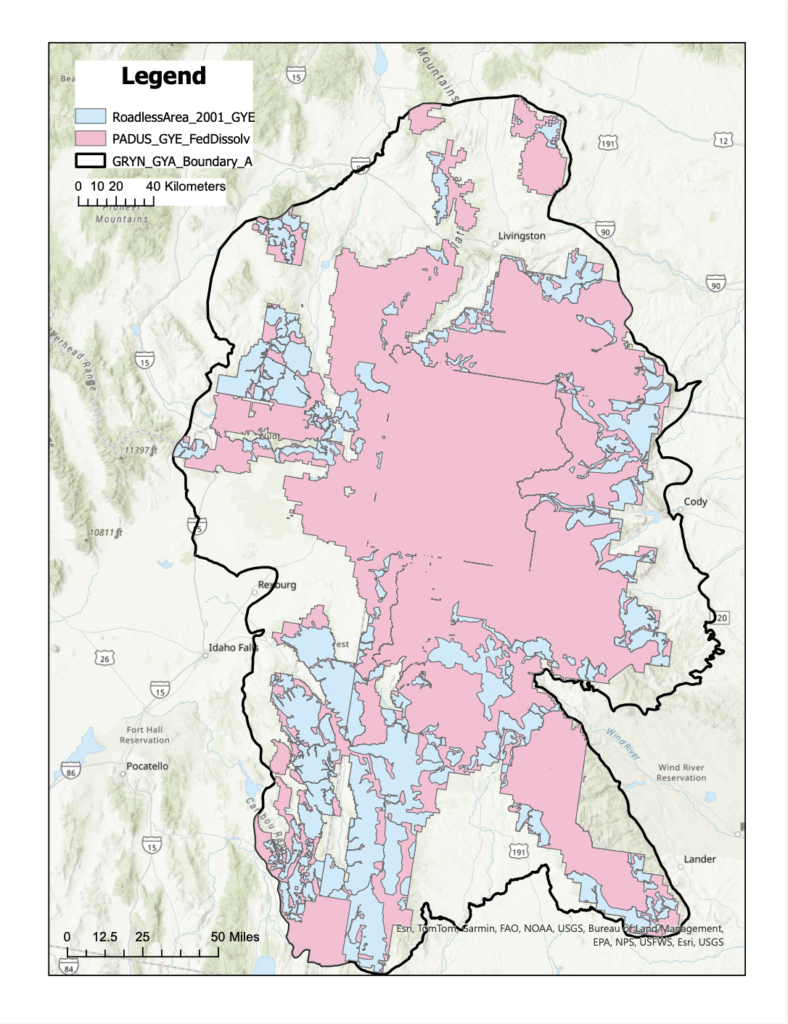
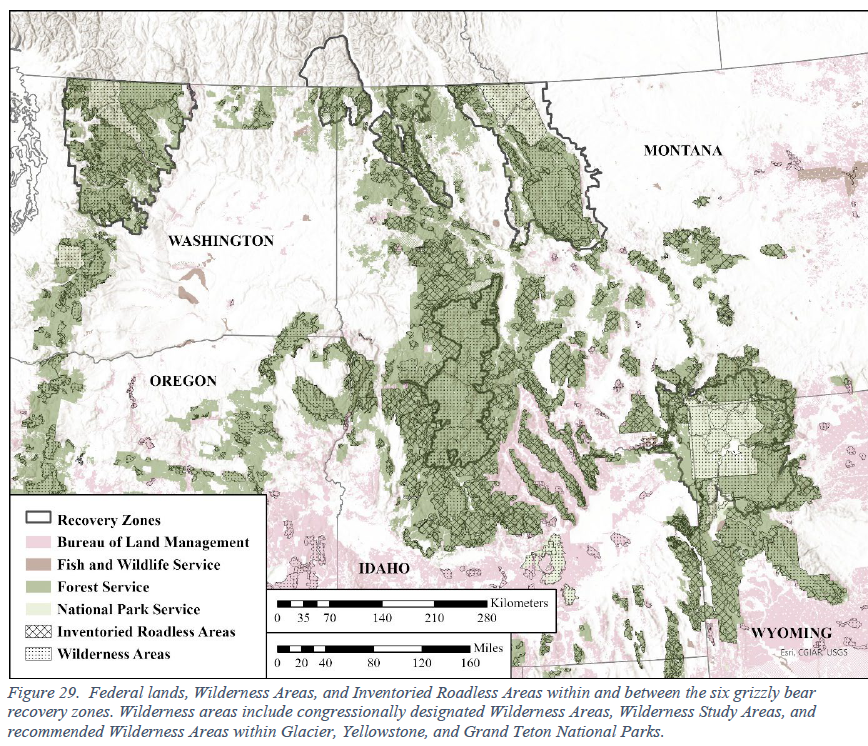
SERVHEEN: Inventoried roadless areas (IRAs) managed under the Roadless Areas Conservation Rule (66 FR 3244, January 12, 2001) make up a significant portion of the habitat of grizzly bears in the Northern Rockies, See the graphic below that was included in the Fish and Wildlife Service’s Species Status Assessment for the Grizzly Bear in the Lower 48 States published in 2024. You can find it on page 109.
Greater Yellowstone is the only area where Roadless areas outside the recovery zone are designated. Note in Figure 29, below, that significant areas of Roadless habitats occur between the designated recovery zones. These intervening areas are critical to achieving eventual connectivity between these ecosystems and eventually achieving genetic, demographic and climate change resiliency.
WILKINSON: Help readers understand what they are seeing.
SERVHEEN: It is also important to note the significant amount of habitat currently protected by the Roadless Rule between the existing recovery areas in the graphic. Grizzly bear distribution and survival will be dependent on maintaining the Roadless Rule in these areas between ecosystems in the Northern Rockies.
The long-term future for grizzly bears in the Northern Rockies will be dependent on the bears being able to connect between the Northern Rockies recovery areas instead of being isolated in island populations. Connecting these ecosystems will provide:
- Genetic resiliency so that males can move and breed between ecosystems and genetic isolation would be eliminated.
- Demographic resiliency so that females can move between ecosystems.
- Climate change resiliency so that as habitats change and with less snow and more fires and bear food distribution and abundance changes as a result, bears can move across the landscape to meet their nutritional needs.
WILKINSON: Again, please elaborate on why that’s important.
SERVHEEN: Genetic, demographic and climate change resiliency will better assure that we will have grizzlies in the Northern Rockies in the next 50 years. This resiliency is dependent on maintaining the Roadless Rule in these areas.
WILKINSON: To be clear so that readers understand, the millions of acres of public roadless lands in Greater Yellowstone and the Northern Continental Divide ecosystems were considered crucial elements of habitat protection necessary to ongoing grizzly recovery. Guaranteeing their protection and the quality of the habitat inside them was a condition that federal land managers and states agreed to uphold in order for delisting to proceed. Is that right?.
SERVHEEN: There were no changes anticipated to the Roadless Rule when the Greater Yellowstone and Northern Continental Divide Conservation Strategies were developed, finalized and signed by all agencies. Because the Roadless Rule was upheld by the Tenth Circuit Court of Appeals in 2011 (Wyoming v. USDA, 661 F.3d 1209 (10th Cir. 2011)), it was thought to be a lasting federal land management policy. Any potential changes to the Roadless Rule or withdrawal of the Roadless Rule would invalidate both of those Conservation Strategies because significant portions of grizzly bear habitat are managed under the Roadless Rule.
WILKINSON: You and I had many discussions over the years about the impacts of roading, logging and motorized recreation on the (Caribou-) Targhee National Forest, one of five national forests that provide essential wildlife habitat in Greater Yellowstone. In fact, multiple successful lawsuits were brought by conservationists that forced forest managers to close roads, reduce logging and address impacts of mechanized recreation. For younger readers and others unfamiliar with the concerns that you heeded and addressed in assembling the Conservation Strategy, please spell them out.
SERVHEEN: Unmanaged motorized access impacts on grizzly bears include:
- Increasing human-grizzly bear interaction and thus increased grizzly bear mortality risk.
- Increasing grizzly displacement from important habitat because many bears avoid areas of motorized activity.
- Increasing grizzly habituation to humans with associated risk of increased grizzly mortality though repeated contact around motorized routes for the bears that do not avoid such areas.
- Habitat displacement around motorized access routes that decreases important habitats where energetic requirements can be met.
The Interagency Grizzly Bear Committee recognized that motorized impacts could be minimized through motorized access management. Motorized access management involves maintaining secure habitat as measured within each grizzly bear habitat unit within each recovery area. Secure habitat is defined as areas more than 500 meters (1,650 ft) from a motorized access route. The GYE Conservation Strategy used the 1998 baseline of the amount of secure habitat as a benchmark to maintain inside the GYE recovery area for grizzly recovery.
WILKINSON: Let’s point out that this also applies to the Northern Continental Divide Ecosystem that includes Glacier National Park and the nearby Bob Marshall and Scapegoat wildernesses and public lands astride of them.
SERVHEEN: The Northern Continental Divide Conservation Strategy used the 2011 baseline of the amount of secure habitat as a benchmark to maintain inside the NCDE recovery area for grizzly recovery. For details on these motorized access management criteria for grizzly bears, see the USFWS Species Status Assessment for the Grizzly Bear in the Lower 48 States below. You can find it on pages 112-122. . 2024. Pp. 112-122 here.
Table 1. Square miles of grizzly bear habitat managed under the Roadless Rule in Inventoried Roadless Areas. Data from the USFWS Status Assessment for the Grizzly Bear in the Lower 49 States. Click here to find.
| Ecosystem | IRA[1]s inside RZ | IRAs suitable habitat[2] | Total IRA areas |
| GYE | 864 | 2,386 | 3,250 |
| NCDE | 1,488[3] | 1,488 | |
| Cabinet/Yaak | 992 | 992 | |
| Selkirk | 350 | 350 | |
| Bitterroot[4] | 7,075 | ||
| North Cascades | 1,978 | ||
| TOTALS | 5,672 | 2386 | 13,155 |
WILKINSON: So, even if Congresswoman Hageman and others succeed in forcing a legislative delisting, the states and federal agencies are bound to uphold those pre-existing legal commitments? They don’t go away just because states may not want to comply with them.
SERVHEEN: In summary, thousands of square miles of grizzly bear habitat in the Northern Rockies are currently managed as secure habitat under the Roadless Rule. This roadless area management maintains habitat security on federal lands to meet the requirements of the ESA to assure that adequate regulatory mechanisms are in place to assure the continued health of grizzly bears.
These adequate regulatory mechanisms have been detailed and agreed to in the post-delisting management plans called the Conservation Strategies for both the GYE and the NCDE and signed by all state, tribal and federal agencies involved in grizzly bear management in each ecosystem. Withdrawing or revising the Roadless Rule will invalidate these post-delisting management plans because the habitat standards in each conservation strategy depend on the implementation of the Roadless Rule as currently written.
Withdrawing or revising the Roadless Rule will change roadless area management, violate the habitat security baselines in each document, and invalidate the adequate habitat management mechanisms detailed in each document. Withdrawing or revising the Roadless Rule will eliminate the ability for the agencies to demonstrate that adequate habitat regulatory mechanisms are in place and therefore will preclude meeting one of the fundamental requirements of the ESA for recovery and delisting grizzly bears.
WILKINSON: There are rumors circulating that US Agriculture Secretary Rollins, at the behest of the motorized and mechanized outdoor recreation industries, may soon seek to overturn the Forest Service’s “Travel Rule” from 2005 that prohibits off-trail cross-country riding in national forests. The rule was first implemented because of serious growing impacts to wildlife and landscapes caused by motorized recreationists going anywhere they wanted outside of wilderness areas. Were the Travel Rule overturned, it would mean a wide range of mechanized users, including mountain bikers, being able to ride willy nilly. Wouldn’t that also violate the standards for habitat protection in controlling access?
SERVHEEN: If true, that would be bad for grizzlies and all wildlife.
WILKINSON: It’s hard for the public to keep track of ongoing efforts to weaken environmental laws pertaining to wildlife, clean water, clean air and hard-won guarantees that the public has the right to review and challenge decisions. It’s part of the reason why US environmental policy is considered the best and most consequential for safeguarding our wildlife heritage. And there’s another issue you deem important because it figures centrally with monitoring bear populations and knowing what’s happening to them amid all of the major landscape changes affecting them.
Earlier this year, the newly created Department of Government Efficiency, aka DOGE, announced that the headquarters of the Interagency Grizzly Bear Study Team in Bozeman could be sold and serious questions were raised about whether the Study Team itself, which is a unit of USGS, would go away. The Study Team is world renowned for its half century old research into grizzlies and what bears need to survive. It is credited with helping to hasten recovery of the species. Part of the Conservation Strategy involves a commitment from both states and federal agencies to continue to monitor bear populations after potential delisting and to base management on the best available science. You’ve said what’s happened with the Study Team is alarming to you as a person who oversaw American grizzly recovery for 35 years. Could you explain why?
SERVHEEN: The entire grizzly bear recovery effort in the Yellowstone Ecosystem is built on the scientific foundation of the Interagency Grizzly Bear Study Team. Without the Study Team we would not have recovered the Yellowstone grizzly bears. The Northern Rockies is changing rapidly compared to the last 40 years of grizzly recovery efforts. Grizzlies face new and increased threats everywhere they go. Continued science-based monitoring of grizzly bears and their habitats and their foods by the Study Team is critical to understand how grizzlies are responding and surviving in this dynamic and increasingly threatening environment. The Study Team needs to be securely funded and staffed if we are ever to maintain the regional Yellowstone population of grizzlies.
WILKINSON: When you look just a few years and decades into the future, what do you see in terms of landscapes grizzly bears will be inhabiting?
SERVHEEN: The future of the grizzly is a dynamic landscape framed by:
- Ongoing climate change and resulting changes to grizzly bears food and grizzly bear distribution.
- Accelerating private land development and resulting increases in human-bear conflicts and bear mortalities. More people are moving into grizzly habitat every day. It gets increasingly difficult to keep grizzlies alive and out of conflict with all these new people in their places they need to exist.
- Increasing recreation pressure in grizzly habitat with resulting displacement of bears from key habitats and increasing energy demands to avoid humans.
- Threats to cut funding for agencies the NPS and USFS and terminate the agency staff people who manage grizzly bears and grizzly bear habitat. Increased recreation pressure and land development require more agency staff, not terminating the very people who can manage these threats.
- Threats to increase road building and timber harvest and oil and gas development in grizzly habitat. Again, these increased habitat threats require more land management staff people and funding to monitor these impacts on bears, not less.
- Proposals to weaken or eliminate the fundamental laws that got us recovered grizzly bears over the past 40 years like the ESA, the Roadless Rule, the National Environmental Policy Act, and the National Forest Management Act. These laws allowed us to recover grizzly bears. If we weaken or eliminate these laws, grizzly bears will again be on the brink of disappearing.
WILKINSON: That’s a sobering overview of threats coming from the person who spearheaded grizzly bear recovery in the Lower 48 and once favored delisting. Grizzly conservation was built on years of carefully choreographed measures aimed at habitat protection and trying to reduce conflict. The states tout themselves as being committed to grizzly conservation yet they seem to be resetting conditions for grizzly management similar to those that resulted in bears having to be listed in 1975.
SERVHEEN: The irony is that the same members of Congress from Wyoming, Montana and Idaho that want to immediately delist grizzlies are the same people denying climate change exists and calling for increased fossil fuel use that will accelerate climate change impacts on grizzlies. These same Congressional representatives also support cuts to the agency staff people who manage grizzlies and grizzly habitat, they support increased road building and timber harvest in grizzly habitat, and they support weakening the fundamental laws that grizzly depends on like the ESA and the Roadless Rule. They can’t have it both ways.
These Congressional representatives either need to keep grizzlies listed under the ESA forever while they push for the destruction of grizzly habitat, cut agency budgets and personnel and they destroy the laws that allowed us to recover them; or secure grizzly habitat, assure management agency funding and maintain our strong environmental laws before they try to delist them. They can have one or the other, but not both.
For Further Reading: