by Todd Wilkinson
Public wildlands in America’s globally-iconic Greater Yellowstone region still exist at the highest caliber of ecological function of any remaining in the Lower 48. It’s a dual distinction that speaks both to the degree of unfragmented landscapes that still remain here, and it also stands in contrast to the magnitude of biological loss that’s happened elsewhere from coast to coast.
Neither happened by accident. However, the still-intact fabric of Greater Yellowstone could be dramatically impaired if President Donald Trump’s Secretary of Agriculture Brooke Rollins moves forward with rescinding the US Forest Service’s “Roadless Rule” that for decades has, also more broadly, protected tens of millions of acres across the West and Alaska.
That’s the general consensus among prominent experts in conservation biology, many of whom have studied the negative cumulative effects of roadbuilding, associated logging and other forms of multiple use activities invading remote places that otherwise provide important habitat security for wildlife.
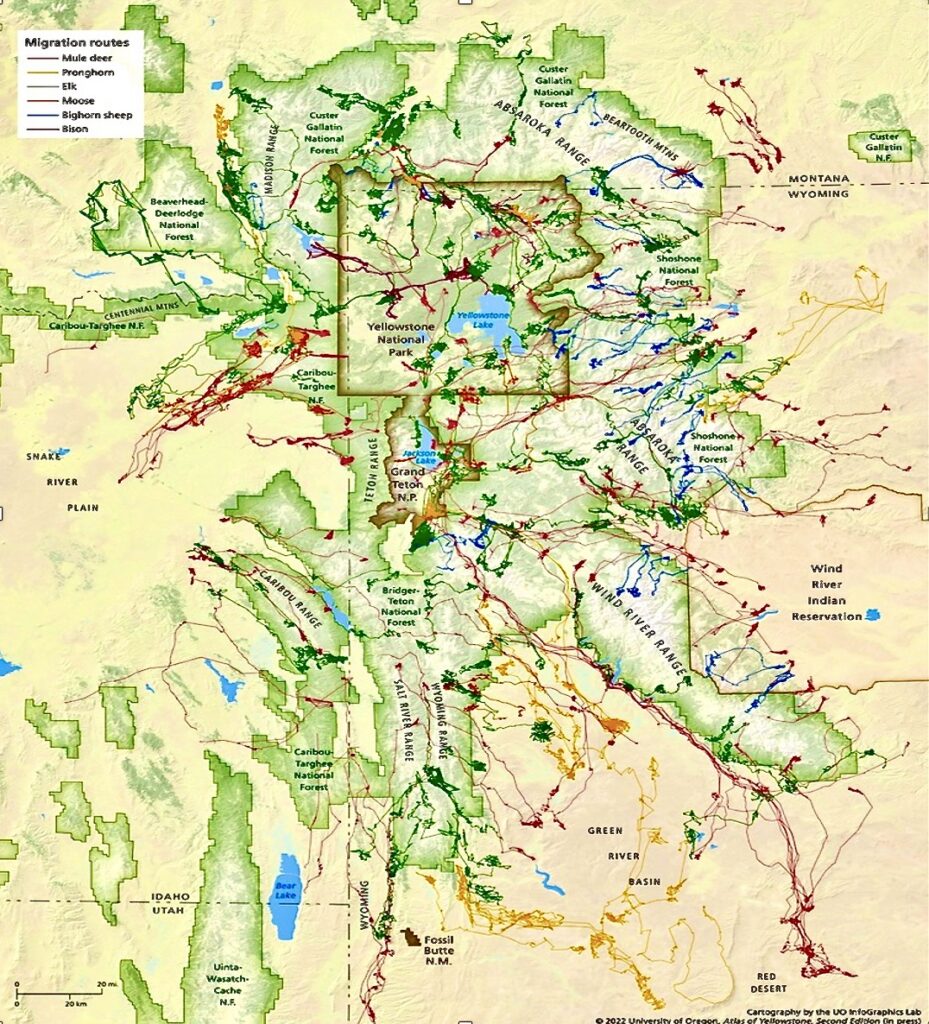
Perhaps nowhere is there more at stake ecologically speaking than in the apron of national forest lands encircling Yellowstone National Park and to sweeps of land in southern reaches of the ecosystem, on Bureau of Land Management tracts, that support epic wildlife migrations and may now come under increasing pressure as the Trump Adminstration seeks to expand energy and other development.
Greater Yellowstone is the only bioregion that has all of the major species, especially large mammals, present here 500 years ago. The potential consequences for Greater Yellowstone is a high profile example of what could come as a result of Rollins’ executive order which she announced this summer and a second newer action taken by Interior Secretary Doug Burgum.
Rollins proposal calls for rolling back the Roadless Rule on 45 million of 58.5 million acres of national forests safeguarded in 2001 and could allow bulldozers to blaze roads into previously untouched areas. In profound terms, it would mean throwing some remote areas open to motorized industrial uses for the first time ever in human history. In all, the 45 million acres represent roughly one fourth of the acres in the National Forest System. Roadless lands in Montana represent about 37 percent of national forests in Montana, 35 percent in Wyoming and 45 percent in Idaho where logging still wields a more prominent presence.
The main impetus for rescinding the Roadless Rule, officials say, is to allow roadbuilding so that wildfires can be better fought and suppressed, and that trees felled can be used to create jobs for timber industry millworkers and the expanded access will accommodate motorized and mechanized users.
The Blue Ribbon Coalition, a central entity in the Wise Use Movement of old and a fierce advocate for motorized access to public lands, says rescinding the Roadless Rule is long overdue. Of the 58.5 million acres covered under the Rule, 28 million acres are in areas at high or very high risk of wildfire according, it says, allegedly citing people in the Forest Service. Blue Ribbon further claims, citing the American Forest Resource Council, that Roadless Rule restrictions have contributed to tens of millions of acres of forest that have burned since the Rule was adopted.
By law Secretary Rollins is required to follow regulations as they apply to the Administrative Procedures Act and National Environmental Policy Act, adhere to a review of potential options going forward and allow for public comment before her actions, which many believe are preordained, before they take effect. The public comment period is supposed to end on September 19 it takes effect.
Noted Bozeman-based environmental attorney Tim Preso of the public interest law firm, EarthJustice, said in an earlier interview that the Roadless Rule stands as the most consequential land conservation action of at least the last half century in the West in protecting public lands still in their natural state. Proliferating human pressures have only given them more value in this ecosystem. Just as the Roadless Rule’s implementation set off protracted multi-year legal battles waged by its opponents, so, too, observers predict, will its attempted undoing bring the same.
The Roadless Rule fight represents an epic generational one all by itself. But on Wednesday, September 10, Interior Secretary Burgum announced that the Public Lands Rule, applying to federal Bureau of Land Management Lands under his command, is also being rescinded.
When that rule went into effect in 2024 at the tail end of the Biden Administration, the BLM, for the first time in the history of the agency, was required to give wildlife habitat protection equal consideration with natural resource extraction that had heretofore dominated the agency’s mission.
In a press release issued by the Interior Department, Burgum indicated that he sees conservation which leaves lands alone and unexploited as being an illegitimate non-use of public land. He stated that consumptive resource extractionists are truer stewards. “The previous administration’s Public Lands Rule had the potential to block access to hundreds of thousands of acres of multiple-use land—preventing energy and mineral production, timber management, grazing and recreation across the West,” Burgum said. “The most effective caretakers of our federal lands are those whose livelihoods rely on its well-being. Overturning this rule protects our American way of life and gives our communities a voice in the land that they depend on.”
Burgum said this decision complements his earlier Secretarial Order 3418, known as Unleashing American Energy, that sets the stage for greenlighting and removing bureaucratic barriers so that oil gas, and coal production can be markedly expanded.
Preso played a leading role in defending the Forest Service’s Roadless Rule for a decade against efforts by states and resource extraction industries. Taken together, and ironically, he and others believe overturning the Roadless and Public Lands Rules undermine promises made by former Trump Interior Secretary Ryan Zinke.
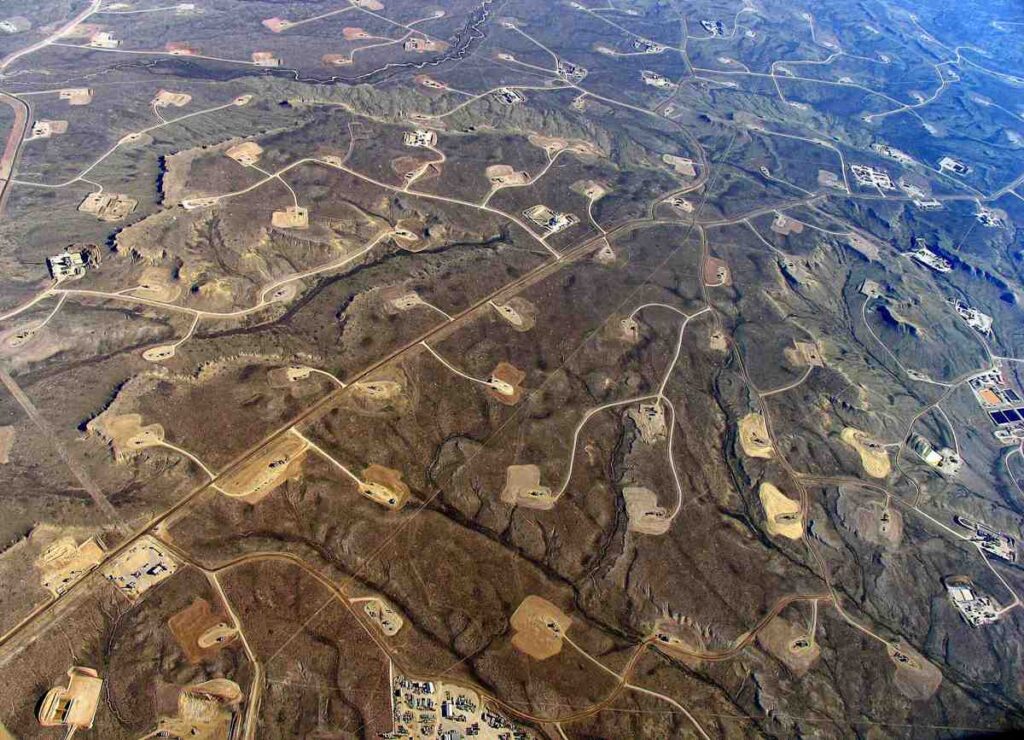
Today a Congressman from Montana, Zinke issued Executive Order 3362 during his tenure at Interior prioritizing protection of big game wildlife migration corridors, which he acknowledged could be imperiled by an onslaught of natural resource extraction that Rollins and Burgum now seem to be championing. Read this scientific analysis led by widely respected researcher Hall Sawyer on how full field gas development on BLM land in Wyoming, like that seen above in the photo, caused a local mule deer population to decline by nearly 40 percent.
Because Greater Yellowstone’s complement of large mammal species is unparalleled in the West, and renowned for being able to migrate long distances across landscapes, what happens with the fate of both rules holds huge, potentially damaging implications, Preso and scientists say.
Chris Wood was a senior policy analyst for Forest Service Chief Mike Dombeck in the latter years of the Clinton Administration. He played a key role in assembling the Roadless Rule and previously he worked at the BLM, mostly on fisheries issues. Today, Wood is CEO of the international angling conservation organization Trout Unlimited.
According to Wood, the Roadless Rule had been 20 years in the making. It followed a Congressionally-manded process carried out in the 1970s of inventorying essentially the natural resource contents of forest lands that did not have roads. Up until that point, drainages with merchantable qualities of timber had already been logged, leaving behind untouched roadless drainages where prospects for timber companies to profit from processing wood were iffy at best. There were also economic issues.
National forests during the 20th century had amassed a logging road system spanning 386,000 miles and an $8.5 billion maintenance backlog with many miles of roads engineered across steep and unstable environs failing. Sometimes, it cost more for taxpayers to build roads into hard to reach places than the net receipts realized from selling timber. It was as much a decision about poor profitability as emerging ecological awareness but those in charge realized it was folly to keep constructing roads that would become a burden. Inventoried roadless lands were thus packaged together into the Roadless Rule. It just so happened, and the Forest Service and scientists knew this, that these undeveloped places served as vestigial refuges for wildlife.
The Roadless Rule attracted 1.8 million comments, 97 percent of which were supportive of its implementation, Wood said. It also withstood 15 different legal challenges over the span of a decade. Some states, seeings it benefits, later customized owns versions of the Roadless Rule, allowably by law, and all national forests had to amend their operating plans to figure out how to uphold requirements. For all the effort that went into making it durable, Wood says it will require equal temerity to unwind it. “You can make a compelling argument that these roadless lands are some of the most valued places for fishing and hunting and finding solace that still remain in our country,” Wood said. “In today’s world, places like those have ever priceless value and they belong to all of us. Many of them were earlier defended against logging and the recent fight over attempts to sell public lands elevated the visibility of this issue.”
For all the effort that went into making the Roadless Rule durable, Chris Wood says it will require equal temerity to unwind it. “You can make a compelling argument that these roadless lands are some of the most valued places for fishing and hunting and finding solace that still remain in our country. In today’s world, places like those have ever priceless value and they belong to all of us. Many of them were earlier defended against logging and the recent fight over attempts to sell public lands elevated the visibility of this issue.”
—Chris Wood, who helped craft the Forest Service’s Roadless Rule and who today is CEO of the national conservation organization Trout Unlimited
A hullabaloo has been created with statements by Rollings and Forest Service Chief Tom Schultz, who earlier had been director of the Idaho Department of Lands, that the Roadless Rule needed to be dialed back in order to allow for massive forest thinning. In fact, Wood said, provisions put into the Rule honor contracts to cut timber that existing prior to crafting the Rule and forest treatment projects can go forth if they are deemed necessary to reduce fuel loads. But because roadless drainages are undeveloped there is, for the most part few or no human structures in immediate vicinity that need defending. Moreover, Wood says, he has no opposition to helping fire-prone communities confront their vulnerability.
By their status, inventoried roadless lands are tracts potentially worthy of be given wilderness status, and wilderness offers the highest standards of protection for species that don’t do well in human dominated landscapes. In a general review provided by Dr. Andrew Hansen, who recently retired as professor emeritus from Montana State University where he oversaw the Landscape Biodiversity Lab, he said those roadless lands alone account for almost 27 percent of the federal public land base in Greater Yellowstone.
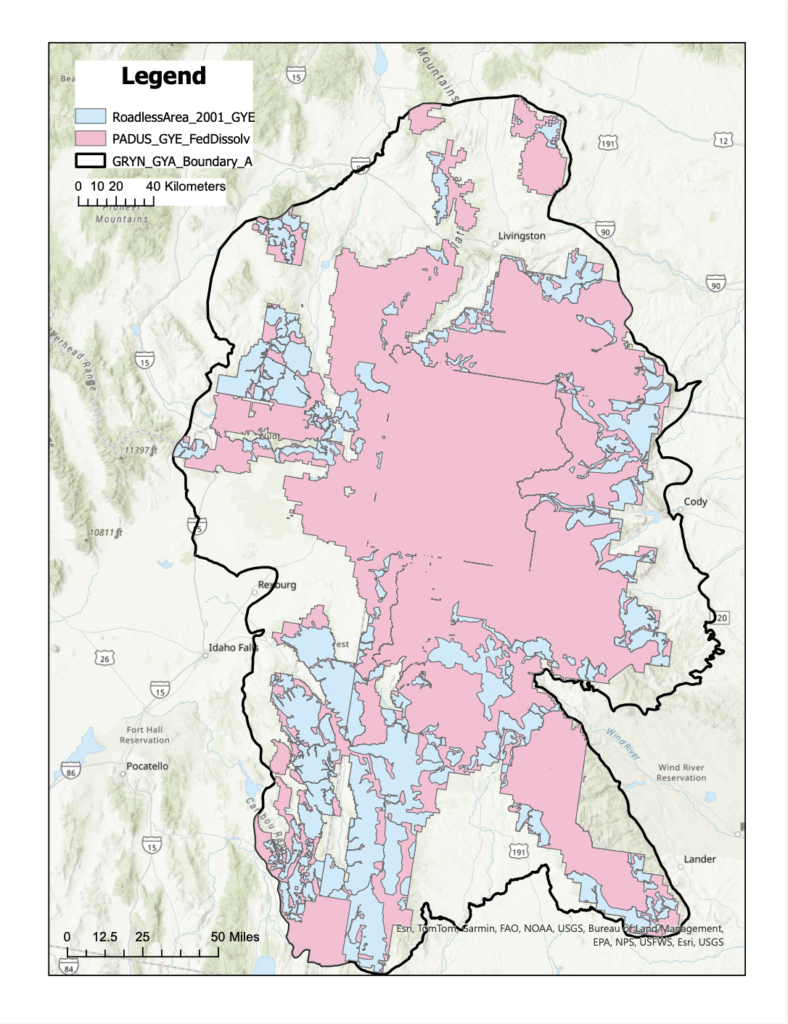
The five national forests that are part of Greater Yellowstone cover the largest percentage of the ecosystem’s nearly 15 million federal acres, and high quality roadless lands account for about four million of those, which is equal in size to two Yellowstone’s or two Wind River Indian Reservations. However, as one can see below, they’re located not in a single mass but scattered around the ecosystem where they serve can important role as buffers against development or help insulate national parks and wilderness areas
Such lands possess highest ecological values in their undeveloped condition but if they are invaded by roads, logging and motorized activity, they would also be precluded from future wilderness consideration. That’s significant on future options that would be removed since 74 percent of all wilderness areas designated on US Forest Service land since 2000 were first classified as Inventoried Roadless Areas; this, according to a 2020 analysis led by McKinley J. Talty and three other authors titled “Conservation of national forest roadless areas” published in the journal Conservation Science and Practice.
Below, the boundaries of Greater Yellowstone are shown in the black perimeter line, public lands in pin and the roadless land component in light blue.
I posed two questions to Dr. Hansen, who has written more analyses about the modern ecological health of Greater Yellowstone than any other scientist. Qualitatively, from his perspective, is there really any difference between inventoried roadless and existing Wilderness and Wilderness Study Areas in terms of their contributive function to habitat security and connectivity of Greater Yellowstone wildlife?
“In the GYE,” Hansen said, “the roadless areas tend to be on the lands surrounding the Designated Wilderness and Wilderness Study Areas. They are generally lower in elevation and likely includes more productive habitats. The roadless areas likely contribute uniquely and substantially to regional connectivity, such as those in the Bridger Mountains, the Gravelly Mountains, and in the Wyoming Range which radiate out from the core GYE towards surrounding greater ecosystems.”
Secondly, I asked Hansen to elaborate on the public misnomer that impacts of roads and trails are only narrowly confined to just affecting the spaces where they have direct physical impact. He noted they affect adjacent areas, sometimes far away. “Many organisms and natural disturbances such as fire move across large landscapes,” he said. “Human activities that alter such movements in one place may influence those elements in adjacent places. For example, grizzly bears are sensitive to roads, and road building in current Roadless areas in the Centennial or Gravely Mountains of southwest Montana many dozens of miles away may reduce movements of bears into or out of the core GYE.”
Not only do the roadless lands provide buffering effects from encroaching sprawl and intense growing outdoor recreation pressure, but in the future as the climate warms they’ll be even more important, says Dr. Cathy Whitlock, Regents Professor Emerita in the Department of Earth Sciences at Montana State University and who lead completion of a series of scientific studies examining the effects of climate change on Montana’s forests, water, agriculture and the future of Greater Yellowstone. Healthy natural lands will be crucial to future landscape resilience and climate will be more of a factor in determining the number and size of wildfires than purported benefits of thinning.
“Rescinding the roadless rule, which tragically seems likely to happen, will open another 552,000 acres of the Custer-Gallatin National Forest to motorized and non-motorized recreational and commercial uses. The outcome will be to further shrink the precious wildlands that define this great ecosystem,” Whitlock wrote recently. “New roads in roadless areas will provide greater penetration and intensified use of the backcountry, putting wildlife, forests, and water resources under ever-greater threat from people and development. Add warmer temperatures, less snowpack, more fires, and more invasive species to the mix and the picture looks bleak indeed.”
Wildlife will need roadless lands as refuges of escape and as accommodating passageways when species must move in search of secure habitat, natural foods affected by drying conditions and less access to water. scientists say. The quality of protection provided in roadless lands has direct and indirect implications for adjacent areas and beyond. The reason is their location.
Nearly a quarter century ago, the vast majority of Forest Service land in the West and Alaska protected by the Roadless Rule was selected because it possessed certain characteristics. One of the most prominent being that they have high ecological value and serve as the headwaters of major river systems, fountainheads of clean water that downstream came within reach of 60 million people.
A decade later, when US Sen. John Barrasso of Wyoming was trying to halt the Roadless Rule from achieving implementation, environmental journalist and sportsman Hal Herring wrote a story for Field & Stream magazine, and he observed: “There is no big game animal that is more susceptible to disruption from motorized access to its summer and winter range than elk, and no big game hunting in North America that is more closely associated with big roadless spaces, hard hiking, and the revered and powerful tradition of ‘packin’ in with horses and mules. Stacks of studies confirm these facts, hundreds of years of collective experience of elk hunters confirm that elk hunting, at its best, is an activity that takes place on roadless lands.”
“There is no big game animal that is more susceptible to disruption from motorized access to its summer and winter range than elk, and no big game hunting in North America that is more closely associated with big roadless spaces, hard hiking, and the revered and powerful tradition of ‘packin’ in with horses and mules. Stacks of studies confirm these facts, hundreds of years of collective experience of elk hunters confirm that elk hunting, at its best, is an activity that takes place on roadless lands.”
—Montana environmental writer and sportsman Hal Herring in piece he wrote in Field & Stream magazine about efforts by US Sen. John Barrasso to overturn the Roadless Rule in 2011
It was owed to such advocacy by sportspeople like Herring, Randy Newberg (who has the largest audience podcast devoted to public land hunting in the country), and others that convinced the Rocky Mountain Elk Foundation to reverse course in initially backing Barrasso’s efforts but then opposing them as it came under pressure from members.
Perhaps the most salient points to consider then, as now, Hansen says, is that the terrain inside roadless lands is both difficult and expensive to build roads into. This matters because the preponderance of roadless lands in the West also do not possess mass commercially merchantable quantities of trees that can be logged and trucked to mills to somehow reinvigorate the timber industry.
This is especially true in the higher and drier mountains of Greater Yellowstone, which get a lot less moisture than on the other side of the Continental Divide where growing conditions for bigger trees have historically been far more favorable. Hansen provided an extensive overview in 2009 of how land disturbance is steadily fracturing the connectivity of Greater Yellowstone when he wrote a lengthy overview that appeared in the journal Yellowstone Science. He isn’t alone.
Dr. Reed Noss is an international authority on the impacts of roads, especially what happens when wild places previously unpenetrated by them, are opened to human pressures. Noss’s extensive scholarship work is credited with laying the foundation for the growing movement to erect wildlife bridges—overpasses and underpasses—across major highways. And he is credited for inspiring creation of the Bozeman-based Center for Large Landscape Conservation and the Western Transportation Institute at Montana State University.
“Nothing is worse for sensitive wildlife than a road. Over the last few decades, studies in a variety of terrestrial and aquatic ecosystems have demonstrated that many of the most pervasive threats to biological diversity – habitat destruction and fragmentation, edge effects, exotic species invasions, pollution, and overhunting – are aggravated by roads,” Noss observed. “ Roads have been implicated as mortality sinks for animals ranging from snakes to wolves, as displacement factors affecting animal distribution and movement patterns, as population fragmenting factors, as sources of sediments that clog streams and destroy fisheries, as sources of deleterious edge effects, and as access corridors that encourage development, logging and poaching of rare plants and animals. Road-building in national forests and other public lands threatens the existence of de facto wilderness and species that depend on wilderness.”
“Nothing is worse for sensitive wildlife than a road. Over the last few decades, studies in a variety of terrestrial and aquatic ecosystems have demonstrated that many of the most pervasive threats to biological diversity – habitat destruction and fragmentation, edge effects, exotic species invasions, pollution, and overhunting – are aggravated by roads. Roads have been implicated as mortality sinks for animals ranging from snakes to wolves, as displacement factors affecting animal distribution and movement patterns, as population fragmenting factors, as sources of sediments that clog streams and destroy fisheries, as sources of deleterious edge effects, and as access corridors that encourage development, logging and poaching of rare plants and animals. Road-building in national forests and other public lands threatens the existence of de facto wilderness and species that depend on wilderness.”
Dr. Reed Noss, international authority on the ecological impacts of roads who has done several analyses in Greater Yellowstone
Rollins’ actions, deemed by some to be as controversial as the attempt by US Sen. Mike Lee of Utah to make public lands available for divestiture to states and private interests, fit a broader pattern to adherence to traditional resource extraction promoted by Congressional delegations and governors in some Western states.
At the dawn of the first Trump Administration, US Sen. Steve Daines of Montana introduced legislation to “release,”—i.e. remove longstanding legal protections for five wilderness study areas located on Forest Service lands in Montana. A year later, then-Montana Congressman Greg Gianforte (today Montana’s governor) introduced two other bills that would have downgraded protection for an additional 24 wilderness study areas, most located inside areas administered by the federal BLM. Had they prevailed the bills would’ve opened those areas to roadbuilding, logging, motorized recreation, and other activities.
IN response to that threat, Dr. Travis Belotte, a conservation biologist working for The Wilderness Society and who collaborated with McKinley Talty and others, was asked to complete an analysis on what those actions would mean for their ecological integrity. He also put it within the context of how those WSAs compare to other lands nationally.
Belotte began his review with the following statement: “Wildlands are increasingly lost to human development. Conservation scientists repeatedly call for protecting the remaining wildlands and expanding the land area protected in reserves. Despite these calls, conservation reserves can be eliminated through legislation that demotes their conservation status.”
The character of finite remaining wildlands, which have stood apart from intensive human manipulation, also can be permanently diminished by executive fiat, as in the executive orders from Rollins and Burgum, with likely many unintended consequences, some that can never be undone or mitigated.
In his peer-reviewed examination of WSAs, Belotte devised five different metrics that he used to assess levels of “wildness” in a given area, and he then contrasted what he found in wilderness study areas with levels of ecological value found national parks and existing federal wilderness areas. Important to note is that all national parks and wildernesses are not equal in terms of their attributes. A national park or wilderness located near, say, southern California or just east of the San Francisco Bay Area is qualitatively different from those in Greater Yellowstone and the Northern Continental Divide ecosystems. Areas incurring high human visitation or located close to population centers have had their wild character diminished and are able to support fewer carnivore species inside them.
The five qualities of wildland values Belotte identified were: wildness, intactness of night sky (i.e. areas not having significant artificial light pollution), lack of human-generated noises, intactness of mammal populations and intactness of mammal carnivores of conservation concerns. Wildness was estimated using the map of human modification based on land cover, human population density, roads, and other available mapped data on ecological condition.
Roadless lands in Montana protected as Wilderness Study Areas yet proposed for having their safeguards removed, were comparable to national parks and wilderness areas with regard to their stable populations of mammals. They also tended to be more highly intact with respect to the survival of a range carnivores. Notably, three WSAs were more ecologically intact than 90 percent of all national parks and wilderness areas combined.
—Travis Belotte, conservation biologist and scientist working at The Wilderness Society in Bozeman
Belotte calculated landscape intactness based on the presence of 10 carnivore species: red wolves (which live in the southeastern US), gray wolves, mountain lions, lynx, black bear, grizzly bear, fisher, wolverines, black-footed ferret, and swift fox. Roadless Wilderness Study Areas in Montana, he found, have the highest ratios of those species being present than anywhere else. Based on his assessment, he determined that removing WSA protections “would functionally eliminate the management direction that maintains the wild character of these places.”
The same conclusions can be drawn from current efforts to remove protections inherent in existing roadless lands. When roads are built into wild country, they are incredibly disruptive to its wild character. They displace wildlife, can cause erosion and landslides that harm streams and fish, often result in invasions of noxious weeds and can result in a lot more people, using mechanized recreation, pouring into the backcountry.
Similar rhetoric to what Daines and Gianforte used in 2017 when they pushed to have WSA’s cancelled and managed as typical multiple use lands informs the motivation of Rollins in rescinding the Roadless Rule, Preso says.
The supreme ecological value of roadless caliber lands is noted in a remarkable revelation in Belotte’s paper. “The targeted WSAs in Montana are comparable to existing national parks and wilderness areas with respect to the intactness of mammal species,” he wrote. “However, the targeted WSAs tended to be more highly intact with respect to the carnivores of conservation concern included here. Three of the five Forest Service WSAs were more intact than 90% of all national parks and wilderness areas combined. These areas still maintain grizzly bear habitat and atleast occasional occupancy and are home to other mammal carnivores such as wolverines, grey wolves, mountain lions, and lynx. Few other areas host such an intact assemblage of carnivores.”
Up in the Northern Continental Divide Ecosystem, Preso notes that 75 percent of the Badger Two Medicine non-WSA roadless area, located just beyond the border of Glacier National Park, the Bob Marshall wilderness Area and considered sacred ground to the Blackfeet, is protected by the Roadless Rule. The protections serve as the cornerstone of a recent agreement reached between the tribe and officials with the Helena-Lewis and Clark National Forest to forbid oil and gas drilling to protect water, wildlife and cultural sites.
Since the 1990s, national forests across the West, in recognition of this, have spent billions of dollars, at citizens expense, mitigating the previous damage of former logging roads, closing them down and trying to restore the ecological function of the places they negatively transformed.
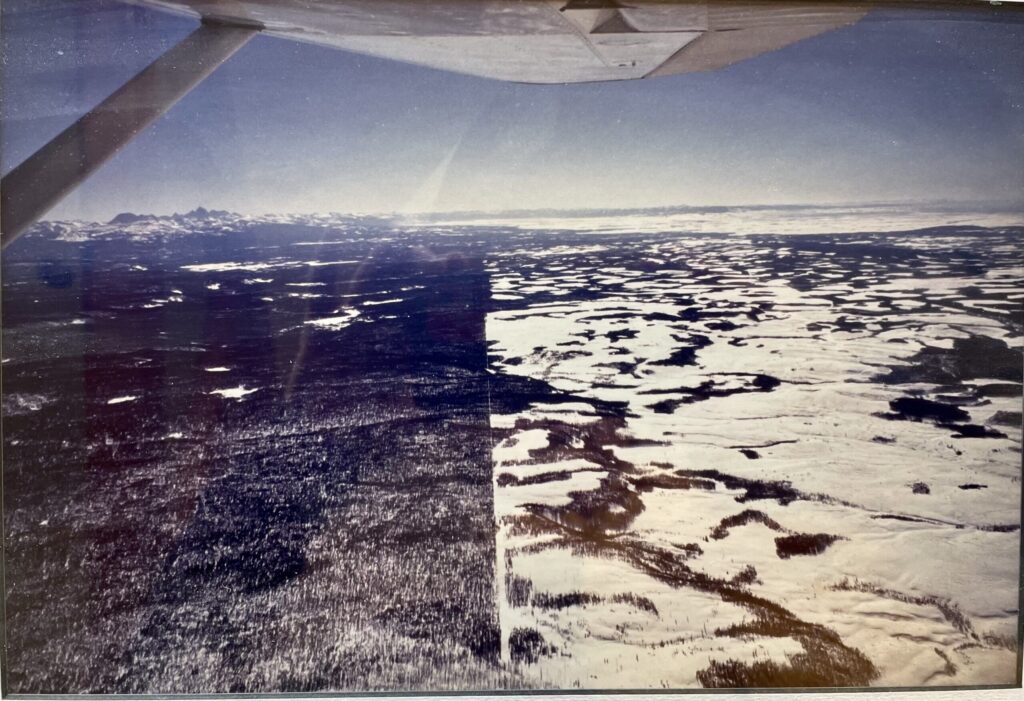
One is the Targhee portion of the consolidated Caribou-Targhee National Forest in eastern Idaho where, in the 1960s, one of the single largest timber sales in the history of the Forest Service was approved ostensibly to halt the spread of mountain bark beetles. The level of unsustainable logging and the network of roads that circuited the Targhee displaced grizzly bears and interrupted wildlife moving in and out of both Yellowstone and Grand Teton national parks. The road network also fueled sprawl pouring into private lands and inholdings.
So vast were the Targhee clearcuts that the end of its administrative line along the western boundary of Yellowstone, where logging occurred right up to the park itself, could be seen decades ago by satellites orbiting Earth. To this day, especially among older public land managers and conservationists, the Targhee has its own place in the lore of earlier Greater Yellowstone conservation battles. It helped spawn an awakening about how thoughtless and damaging the multiple use paradigm, when consequences are not scrutinized, can be.
In 2002, a year after the Roadless Rule was approved, Noss was lead author of a study published in Conservation Biology titled A Multicriteria assessment of the Irreplaceability of and Vulnerability of sites in the Greater Yellowstone Ecosystem.” His co-authors were Carlos Carroll, Ken Vance-Borland and George Wuerthner.
“The GYE is unique in that large core refugia lie in close proximity to a rapidly growing human population,” the authors wrote. One goal of their conservation assessment was to demonstrate the importance of having a contiguous network of protected lands that would be resistance to environmental changes then in place. For reference, this was nearly two decades before Greater Yellowstone came under the current deluge of pressure from sprawl, outdoor recreation pressure and climate change. Catalysts for the first two are roads.”
“The GYE is unique in that large core refugia lie in close proximity to a rapidly growing human population,” scientists wrote. One goal of their conservation assessment was to demonstrate the importance of having a contiguous network of protected lands that would be resistance to environmental changes then in place. For reference, this was nearly two decades before Greater Yellowstone came under the current deluge of pressure from sprawl, outdoor recreation pressure and climate change. Catalysts for the first two are roads.
As part of their analysis, the authors identified biological hotspots in need to protection according to two factors: irreplaceability and vulnerability. Many of the places highlighted in their study in need of protection are today found in roadless areas.
Sportsman Mike Mershon, president of the Montana Wildlife Federation and Jake Schwaller, board member of Montana Backcountry Hunters and Anglers noted in a recent newspaper op-ed that when the Roadless Rule was created in the wake of hundreds of meetings held across the country—including 24 in Montana alone and with nearly two million comments submitted nationwide, 67 percent of Montanans supported its land protection objectives. They echoed what Herring had written a decade earlier.
“Hunters have long relied on these chunks of wild land to disperse pressure and, importantly, hold game. According to the U.S. Department of Agriculture (USDA), fewer roads mean more elk and greater hunter satisfaction,” Mershon and Schwaller write. “So why undo something so favorable to sportsmen? One common argument is that more roads would allow hazardous fuels reduction work. However, research shows that roads actually lead to more fires, either from mechanical issues from vehicles, or simply because more roads mean more people, and people don’t always listen to Smokey Bear. Nearly nine of 10 wildfires are human-caused, and 78% of those start within a half-mile of a road.”
“So why undo something so favorable to sportsmen? One common argument is that more roads would allow hazardous fuels reduction work. However, research shows that roads actually lead to more fires, either from mechanical issues from vehicles, or simply because more roads mean more people, and people don’t always listen to Smokey Bear. Nearly nine of 10 wildfires are human-caused, and 78% of those start within a half-mile of a road.”
Mike Mershon and Jake Schwaller of the Montana Wildlife Federation and Montana Backcountry Hunters and Anglers
The move by Rollins comes at a time when states are pushing to have grizzly bears legislatively removed from federal protection under the Endangered Species Act. A factor that has stalled delisting attempts in the past has been the lack of biological connectivity with other public lands in order to establish a larger population capable of better withstanding human pressure.
Shortly after the Roadless Rule was made permanent, researchers writing in the Journal of Applied Ecology noted how having a tapestry of interconnected healthy lands is critical to sustaining wildlife and they cited numerous scientists from the Greater Yellowstone/Northern Rockies region “Many studies are investigating how species move through landscapes and their use of stepping-stone habitats, especially in fragmented landscapes. Being relatively undisturbed and well-distributed among protected areas, roadless areas are top candidates for the delineation of high-quality ‘habitat connections’ across the northern Rockies, particularly those that target rare or declining species. The loss or alteration of roadless areas may further reduce the movement of species among interdependent island populations located in protected areas and roadless areas, resulting in greater isolation.” They added, “These lands are among the last remnants of biologically productive lands that have not been significantly altered through human settlements, resource extraction and road construction.”
Abolishing the Roadless Rule, conservationists say, undermines the claim by states that they and the federal government are committed to furthering the bear’s biological recovery by embracing safeguards on habitat protection. In several analyses, including a paper he and Linda Phillips wrote that created a Wildland Health Index for Greater Yellowstone, Hansen noted that the public land base was relatively secure even as sprawl encroaches upon its edges and outdoor recreation pressure surges. But rescinding of the Roadless Rule would necessitate recalculation of that premise and, accordingly, it means far less optimism for wildlife.
As the 2025 summer fire season flared, freshman US Sen. Tim Sheehy of Montanavvisited public meetings and met with media representatives, saying that all wildfires need to be fought and suppressed. Sheehy is a vocal supporter of rescinding the Roadless Rule. He claims that forest thinning, enabled through more road building, could revive the fortunes of the timber industry. Such thinking, ecologists say, would return the Forest Service to what is recalled as “the bad old days” in which the whims of natural resource extractionists held sway over conservation considerations informed by science.
I’ve spoken with several different people who have been present at public meetings Sheehey attended and spoke at. The response from wildland firefighting experts and others in the audience is that the senator misrepresents reality. His position may at least partially be informed by the fact that he built a private aviation firefighting company in Bozeman, Bridger Aerospace, whose profits are based on American taxpayers spending billions of dollars each year to battle public land blazes. Since Sheehy founded the company his net worth has swelled to reportedly be valued, according to the Bozeman Daily Chronicle newspaper, at between $100 million and $300 million, making him one of the richest senators on Capitol Hill.
As experts note, a high percentage of the government spending in the business sector where Bridger Aeronautics is positioned, is aimed at firefighting done in the cause of protecting private structures on private land and communities built right up to the edge of public lands. As Wood and his former firefighting colleagues at the Forest Service note, there’s far less of a compelling reason to battle fires if they’re burning in forested terrain far from subdivisions.
“Big Sky, unfortunately, is a tinder box with the Lee Metcalf Wilderness and all the old growth forest.… You guys are sitting in a funnel, so if something hit at the top and with the wrong wind direction, it could be bad. It could be very bad,” said Sam Davis, who became chief executive of the firefighting company, Bridger Aerospace, taking over the reins from US Sen. Tim Sheehy. By Davis’ words, the implication is that the Lee Metcalf Wilderness and its old growth forest—one of the rarest and most important forest types for certain species of trees and wildlife—could use some logging.
Fires today are being engaged that otherwise might not be fought if less construction were happening in the wildland-urban interface. For some companies the cause of opening up public wildlands to roadbuilding, as part of a broader argument to ramp up firefighting budgets, is also part of a shrewd business strategy. Little consideration, however, is being given to the ecological consequences of returning to a 20th century strategy of suppression which paradoxically is partially blamed for starting this new big fire era.
Sheehy stepped away from his company when he ran for public office. His successor at Bridger Aerospace Sam Davis recently made his thinking clear. Bridger Aerospace has been hired to provide an AI detection system for fires that might start in the forested panorama of Big Sky. “Big Sky, unfortunately, is a tinder box with the Lee Metcalf Wilderness and all the old growth forest,” he told Explore Big Sky. “… You guys are sitting in a funnel, so if something hit at the top and with the wrong wind direction, it could be bad. It could be very bad.”
By Davis’s words, the implication is that the Lee Metcalf Wilderness and its old growth forest—one of the rarest and most important forest types for certain species of trees and wildlife—are to blame for the wildfire hazard and could use some logging. While the Lee Metcalf Wilderness is protected by federal law from intensive forest thinning and road building, roadless lands are not. Poignant is that Big Sky today has a spaghetti pattern of roads feeding its expanding sprawl of thousands of structures in the Wildland Urban Interface vulnerable to wildfire and yet those roads have not reduced the fire threat, which the Forest Service says is in the 96th percentile of national fire risk. By being avenues to ever expanding constructer and expanding human presence, roads are considered major fire breaks that will halt blazes driven by winds, but they’ve fueled development and exacerbated the dangers.

Conservationists say that if the Roadless Rule is successfully rescinded, provisions could be put in place allowing local Forest Service supervisors to skirt intensive review of significant national resource extraction presently mandated by the National Environmental Policy Act. That, after all, was the intent of President Trump’s executive order 14192 named Unleashing Prosperity Through Deregulation that would give discretion to local agency managers. Rules already give local forest supervisors the ability to avoid review using categorical exclusion clauses to green light small thinning projects one at a time that can add up to affect significant area over time.
In effect, Preso says, opening up roadless lands would return the agency to the same place it was during the latter half of the 20th century when natural resource extraction, political interests and Forest Service employees sympathetic to heavy handed management, approved controversial projects that, in today’s hindsight, seldom adhered to ecological considerations such as maintaining the integrity of world-class wildlife ecosystems.
As for Montana Congressman and former Trump Interior Secretary Ryan Zinke, is he a real wildland conservationist as he claims to be or a great pretender who has some environmental groups treating him with fawning adoration? Zinke is a launching member of the bi-partisan Public Lands Caucus and in a press release issued in 2025, he said this: “When you grow up in Montana, conservation isn’t just a priority, it’s part of who you are. I want to be able to hunt, hike, and fish with my grandkids in the same rivers, trails, and lakes where my grandpa took me. That’s why these bills are so critical, they ensure that we can pass down that way of life to future generations. Every Montanan knows that public lands belong in public hands, our big game must be protected, and Flathead Lake should remain full for everyone to enjoy. I’m committed to fighting for these bills, pushing them across the finish line, and making sure they’re signed into law, so we can preserve this legacy for years to come.”
Zinke claims he wants to be a champion for wildlife migrations that are symbols of America’s best known ecosystem but many of his positions suggest contradictions.
While it’s true that Zinke was vocally opposed to US Sen. Mike Lee’s attempts to turn over some federal public lands to states or sell off millions of acres, he is the same guy who aggressively moved as Interior Secretary to reduce the size of national monuments and said that civil servants questioning accelerated fossil fuel energy development were considered disloyal. In recent months he has stated his support not only for Burgum’s actions in undoing the BLM’s Public Lands Rule but also Rollings desires to cancel protections for most Forest Service lands whose management is governed by the Roadless Rule.
What Hansen hopes is that elected officials honestly consider science. “It’s pretty obvious how important roadless lands are for wildlife and the natural function of Greater Yellowstone, especially now,” he said. “It’s equally obvious that with roadless lands representing 27 percent of public lands in this ecosystem, that opening them up to multiple use activities could have huge negative impacts.”
Hansen says cause and effect is clear. “We don’t know how or how much of those lands will be developed, and how much will be roaded if the Roadless Rule is rescinded. But it isn’t hard to understand the effects. All of the impacts we currently see on the Custer-Gallatin National Forest near Bozeman in the Hyalite and Bridger mountains under ‘general forest management’ can be expected to occur, and this includes accommodating massive and growing levels of recreationists,” he said.
The Hyalite Canyon Recreation Area, part of the Custer-Gallatin National Forest south of Bozeman, has some of the most intense levels of outdoor recreation in the region and it’s a place of increasing displacement of wildlife and conflict among human users. This includes miles of new mountain biking trails that have been built illegally and the Forest Service claiming it does not possess the resources to stop it. Undoing the Roadless Rule and doing away with Wilderness Study Areas or shrinking the amount of lands they protected, scientists say, could set off transformative effects.
“Let’s not sacrifice the [existing] WSAs to non-wilderness uses when we are facing the prospect of opening roadless areas across the ecosystem,” ecologist and researcher Cathy Whitlock wrote. “WSA protection should be non-negotiable in our larger fight to save public lands. Common sense, our shared love of this ecosystem, and science should guide us toward this broader objective.”
Andy Hansen also offers this: “If Brazil in the Amazon Basin or any other country with high ecological values related to its forests were to do this—to remove protection—people would be outraged and shouting that the country is degrading something of national significance,” he said, noting. “My interest in sharing these thoughts is not to stake out a political advocacy position but to present context on what rescinding the rule might mean for wildlife, based on my work as a scientist.”
For more information on the evolution of the Roadless Rule and its relevance today, listen to this special edition of The Wild Idea podcast, below, featuring a guest appearance by Chris Wood.