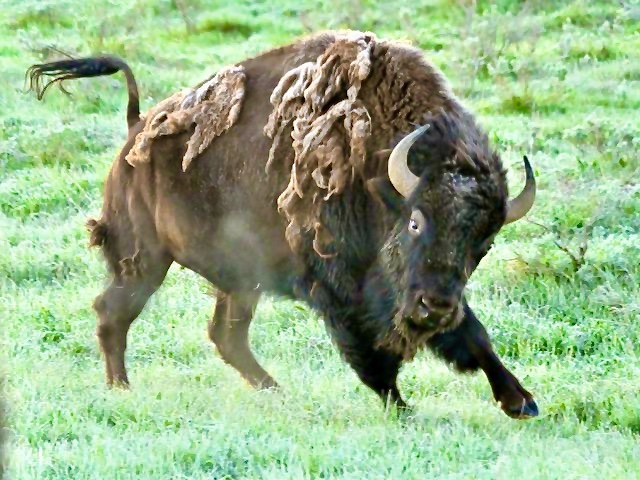
NOTE: When bison were essentially eviscerated in the 19th century, when indigenous languages, cultures and traditions were legally prohibited from being practiced, when only two dozen buffalo still roamed Yellowstone and were under constant daily threat from poachers, the spirit of the animals was not lost in Lois Red Elk’s Lakota/Dakota ancestors.
Bison may have disappeared from the surface of the Earth in vast numbers, but the biocide carried out against them, as part of a larger human genocide, did not halt the oral creation stories from still being passed along across generations. And while today the West still deals with the residue of hatred present in policies aimed at persecuting certain wildlife and attitudes directed toward people who were on the continent for many millennia, Red Elk says that hope, which can never be destroyed, exists in the irrepressible potential of revival.
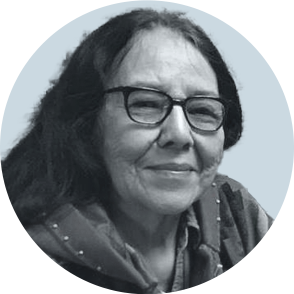
Red Elk, our octogenarian friend, Lakota elder, champion of bison, and free verse lyrical poet, is back with a new work, writing from her home on the prairie near the shores of Fort Peck, a reservoir created by a dam stretched across the flows of Mni Sosa (known more commonly as the Missouri River).
If readers needs a primer for understanding the history and place names mentioned in her poem below, a pair of useful references are Dee Brown’s classic Bury My Heart at Wounded Knee and a related autobiographical work, Lame Deer, Seeker of Visions. Other good reads offering critical retrospection are Custer Died for Your Sins by Vine Deloria, Jr, David Treuer’s The Heartbeat of Wounded Knee.
Welcome back, Lois. We hold you up as a treasure, and our readers do, too. —Todd Wilkinson
Streaming in a Buffalo Dialect
by Lois Red Elk
This is not myth; it all happened in the moon when
June berries became ripe. Tatanka Oyate left hoof prints
from Montana to South Dakota, place of transfer to the
other side. We see it in the distance, we lose our minds
under the rise of Bear Butte and hear the roar of welcome
home; it’s been a long time traveling from Mni Sose,
from the direction where Sitting Bull brought us back from
the Medicine line. We continue southeast until arrival is
just ahead of the descending sun. Oh Grandmother, your
whisper is pulling us closer, closer to our birthplace, this
reality, our place of emergence to this parallel world. You
scold us and whisper in behalf of Wind Cave, come close,
my being is blessed, spirits urged alive. It is time to visit the
place where Tatanka is alive again and being nourished by
similar thinking beings. We visited and watched with care
the taking of one life for another. We learn that others
regard life as precious. I give thanks all day for all the new
knowledge. Now it is time to visit the heart work of a
fellow tribesman who creates art from Buffalo horn. It is at
the edge of the Prairie that we find a council where tribes
revere the buffalo, call him uncle, where the buffalo comes
back into Lakota lives. We are welcomed by Lakota who
write their journey, our life, in books. It is time now to rest
our muscles, minds, spirit and mend for the journey ahead.
The dawn leads us to the ridge where pines grow strong,
a ridge that starts in the North and trails south like a marker
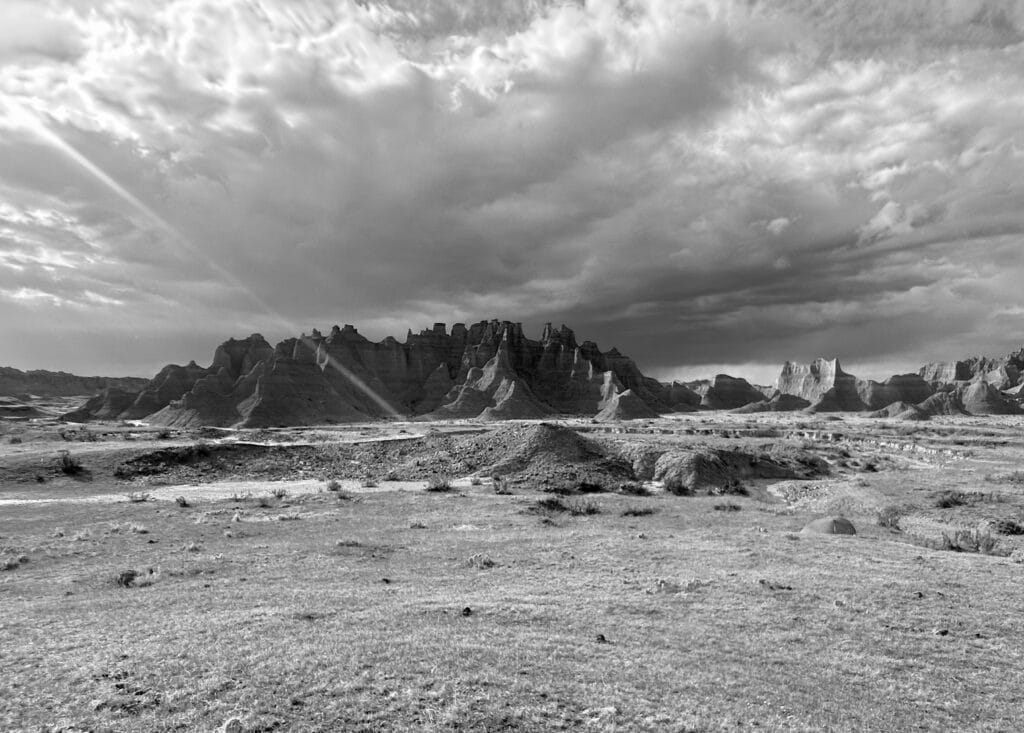
for star travel or escaping. First the badlands pour their soil
into our eyes and mouth, replace the English and fill with
Lakota origins of Maka Unchi. Now we stop and translate
back to where we left the uglisica. We call them Makosica,
only because they are almost without life, full of history,
a maze for losing self or for alluding those who eat fat, who
are determined to end culture, end dancing, end lives. It was
a stronghold, it was safety in Maka Unci, it was for the strong
hearted, that persistence of life. An unkind death happened
there. Now the Bad Lands have been named a national park.
a deleting of history, but cousin Brewer survived and took
up the offer of Tatanka. To sustain a way of life, they work
together to live. Time sends us to where my soul begins to
hurt, rip apart, I feel a wailing as I approach this site, the hill
at Wounded Knee. Monica gave me water, food, sweet grass
for them, the spirits who demand we remember, soul food.
We all bow and are humbled beyond belief for the images
flooding through our tears. Then suddenly, a wind, a kind of
peace sweeps the graves, takes our tears south for healing.
Thunder Valley looms in front and beckons us to a new time.
It is a sustaining community that cares for one another, their
own homes, their own gardens, their own voices for better days.
Blessings. Enter the place called Rosebud. Such a beautiful
image—Rosebud. Sinte Gleska, Spotted Tail, you smile now
at the rise of your people. They don’t ask what we will do with
the buffalo. They ask, instead, what will Tatanka do with us?
First we make an offering, humble selves, then address him as
grandfather.
Tatanka Oyate—Buffalo Nation
Maka Unchi—Grandmother Earth