by Dorothy Bradley
This is going to be a sad autumn.
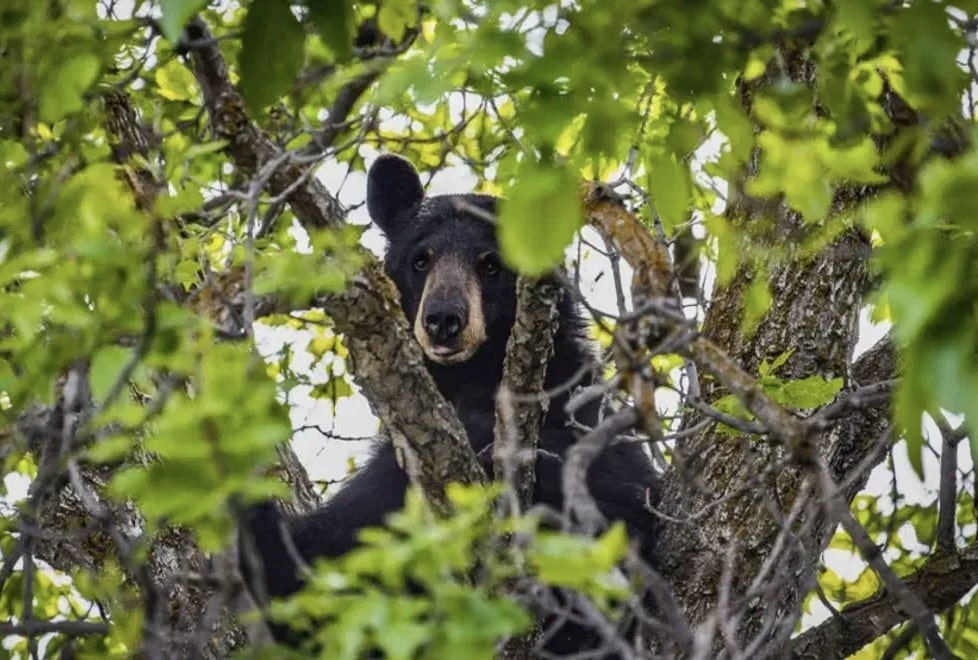
Yesterday a black bear walked by the house, coming out of an almost dry drainage from the Crazy Mountains in the northern reaches of the Greater Yellowstone Ecosystem, and headed up the road. He was just a little guy— funny big feet and a brown nose— a Winnie the Pooh look-alike for sure.
I looked at the landscape he was crossing. The only chokecherry bush with berries, watered in our yard, was already stripped by grackles. The long line of chokecherries on the drive has nothing but tiny sprigs of dry berries, and leaves that are starting to turn red. As for our apple trees, whose last customers of the season are traditionally mom-and-cub one-nighters, they have zero apples this year due to the early spring and late freeze.
One of my favorite Montana communities has already had visits by 12 bears this summer, and had to euthanize eight. Some might think we have too many bears. Think again. The problems are insufficient food, particularly now when they are trying to get fat for the winter, and people attracting bears by not securing food and garbage at their homes.
Constant weather reports this summer warned us about the dangers of the heat, sun, and smoke. We were advised to hydrate, stay inside, wear protective dark glasses and sun block, and take care of our pets.
What about our wild pets—not just the big black and cinnamon ones, but the tiniest flying ones like humming birds that had to fly thousands of smokey miles to get here. Predictions state that a third of our migrating birds are in serious decline.
A climate report in England predicted that sufficient food for that country can no longer be produced in five years because of the dry soil. Evidently the report was hidden by their government because the powers-that-be feared it would cause panic.
Is our government any better? Just a half year ago it removed the Endangerment Finding which, in an oversimplified explanation, guts the framework for federal regulations for greenhouse-gas emissions.
Five years ago we received a CODE RED from the United Nations International Panel on Climate Change. Within a week it became as inconsequential as a blurb in the police reports. Not long after, it was suggested the Planet Earth had reached the tipping point of no return. No unified public outrage came forth that was sufficiently strong to turn around the increasing amount of carbon we are emitting into our atmosphere. And now we continue to decrease regulations instead of strengthening them – this, in the face of Montana’s present massive climate-caused economic losses (that translates to money) particularly in agriculture and tourism.
Maybe starving wildlife will give us a jolt. It could happen big-time this winter. The National Oceanic and Atmospheric Administration/National Weather Service is now predicting there’s more than a 90 percent chance of El Niño strengthening to a Super El Niño bringing a drier and warmer winter which could mean another diminished snowpack headed into spring and summer 2027.
This same government that is stripping us of air quality regulations, is also trying to remove roadless protections in our wild areas. This is where our beautiful wild animals search for food. Their wellbeing is our responsibility. We know that restricting their movement and food-searching will bring their demise. Bears looking for food in our towns, and getting killed, is the most recent dismal chapter – and it’s on us because “a fed bear is a dead bear”.
I was raised by an Episcopalian mother who loved beautiful hymns, particularly accompanied by the powerful pipe organ in our beautiful little stone church in Bozeman. Today the sad refrain that keeps running through my head is, “All is not well, all is not well with my Soul.”
EDITOR’S NOTE: Dorothy Bradley’s piece, above, is about black bears. Watch the advisory, below, from Jeremiah Smith, senior bear management specialist with Montana Fish Wildlife and Parks in Region 3. He speaks about conditions facing grizzlies. Their conflicts typically occur in areas with more exurban and suburban development, unless a community is located right on the edge of public lands. Black bear conflicts are more frequent inside the city limits of many larger towns.