by Todd Wilkinson
A few years ago, Pulitzer Prize-winning novelist Richard Ford gave a lecture at Museum of the Rockies in Bozeman, Montana. He spoke of things people say repeatedly that just aren’t true. But, when such assertions are constantly retold and circulated, and without being challenged or subjected to rigorous scrutiny, they become part of accepted lore and then are embraced as fact.
Some of these are adages are “all growth and development is good,” or “wolves are devastating livestock and big game herds,” or that “living the American dream is equally easy to achieve for everyone.” They do not hold up long to scrutiny yet believing in them has plenty of negative outcomes. In fact, such assertions are shibboleths and can be mobilized to serve hidden agendas.
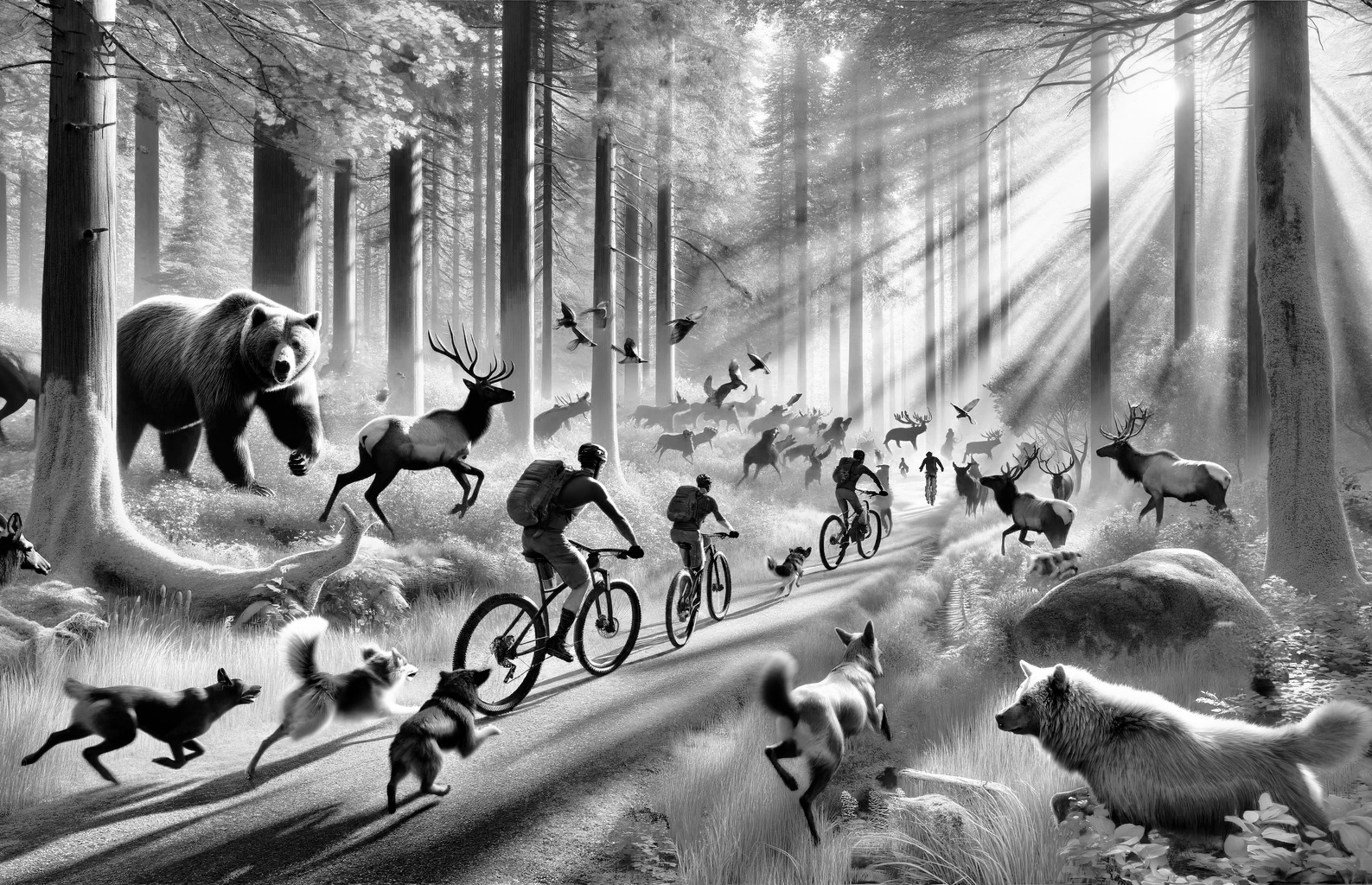
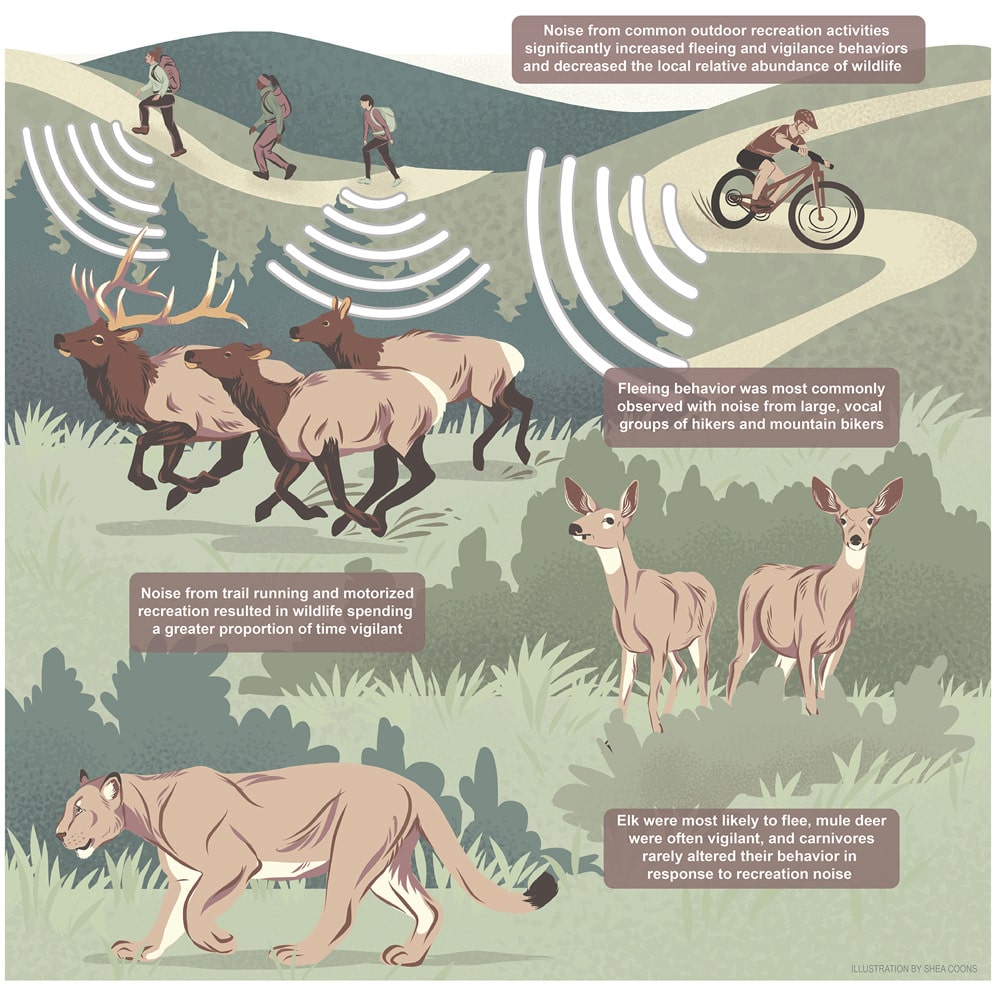
Within the realm of the American West, a more recent assertion is that “outdoor recreation advances wildlife conservation” and it, too, qualifies as another one of those tropes. In truth and through on-the-ground evidence, scientific studies firmly establish that the outcome of recreational impacts is often just the opposite—more people, more trails, more infrastructure built to accommodate it, and more expanded public access into wild places are not benign. Research upon research upon research, study after study cumulatively confirms that when human visitation goes up in a given habitat, the negative impacts on wildlife rise as well. If you add free-roaming dogs, off-leash, to the mix, the displacement is far more dramatic.
It happens in the Northern Rockies with grizzlies, wolverines, songbirds, bighorn sheep, mountain goats, reptiles and amphibians, moose, elk, deer, pronghorn, the list goes on.
Sometimes disruptions can be mitigated, often they are not; usually they aren’t often addressed until damage is done. Despite evidence, the US Congress and Presidential administrations led by both political parties have worked closely with government agencies like the US Forest Service, Bureau of Land Management, National Park Service, US Fish and Wildlife Service, the powerful outdoor recreation industry and, ironically, some well-known conservation organizations and their allied free market environmental think tanks, to dramatically increase the footprint of recreation on all public lands. It’s happening right now.
In some cases, free marketers are aggressively undermining or weakening longstanding legal protections for the most undisturbed of wildlands that remain, including Forest Service roadless areas. Part of the juggernaut, above, involves allowing public land managers who, at their own discretion and in the name of streamlining approval, invoke categorical exclusions which allow them to evade thorough environmental analysis. Were this allowed to occur with logging, mining, energy and other traditional forms of natural resource extraction, environmentalists would likely be up in arms.
But many conservation groups are not when it comes to recreation. Why is that? As you read this, and you’ll learn more about it later, three conservation organizations in Montana—the Greater Yellowstone Coalition, The Wilderness Society and Wild Montana (which used to be called the Montana Wilderness Association and deliberately rebranded to avoid using the word “wilderness” in its name) are arrayed with mountain bikers in a collaborative effort called the “Gallatin Forest Partnership.“
The Gallatin Forest Partnership is promoting legislation that it claims “will better protect” the Gallatin Mountain Range that stretches from the west-central interior of Yellowstone National Park northward to Bozeman and the Gallatin Valley, one of the fastest-growing areas, in terms of development, in America. But better protect what? What one doesn’t find on the Gallatin Forest Partnership web page are references to science that support its contention that setting aside more acres of public land to accommodate outdoor recreation is, in the long run, better for the remarkable assemblage wildlife in the Gallatin Range that still call those mountains home.
A major criticism of the Gallatin Forest Partnership is that it has allowed mountain bikers to have major sway in determining how much of the Gallatin Range should be safeguarded longterm as formal federal wilderness. A growing group of distinguished scientists, former federal land managers, notable figures and citizens are backing a counter proposal from a new group called Montanans for Wildlife & Wilderness. They say wilderness would be the best insurance policy for wildlife in the Gallatin Range holding a richness of biological diversity that doesn’t exist elsewhere outside the Northern Rockies.
The main argument made against the Gallatin Forest Partnership is that it, and the Custer Gallatin National Forest which has jurisdiction over the mountains outside of Yellowstone Park and has a history of not backing significant wilderness designation, has ignored the huge body of evidence relating to the accruing impacts of outdoor recreation on sensitive species. Pretending outdoor recreation is not an issue for wildlife is one that’s also flaring more widely across the Greater Yellowstone Ecosystem, up and down the Rockies and in nearly every other corner of the West.
At this moment, the Bridger-Teton National Forest in Wyoming, that stretches from northern Jackson Hole southward to the Wind River and Wyoming mountain ranges in southern reaches of Greater Yellowstone, is undergoing an update of its forest management plan. And, as with the Custer Gallatin National Forest, the Bridger-Teton stands accused of not adequately assessing the impacts of outdoor recreation on wildlife now, and what they will be in the years ahead with a lot more human use that the plan is promoting. Read this recent story by reporter Mike Kosmyrl of Wyofile titled “Mule deer and mountain bikes: Can modern recreation and world-class wildlife co-exist along the Winds?”
It’s a good story, by a good reporter, but we at Yellowstonian who have been writing about this issue for years nonetheless wonder why national, regional and local media has, with few exceptions and as with the rapid spread of sprawl on rural private land, treated both issues of wildlife impact as if they don’t exist?
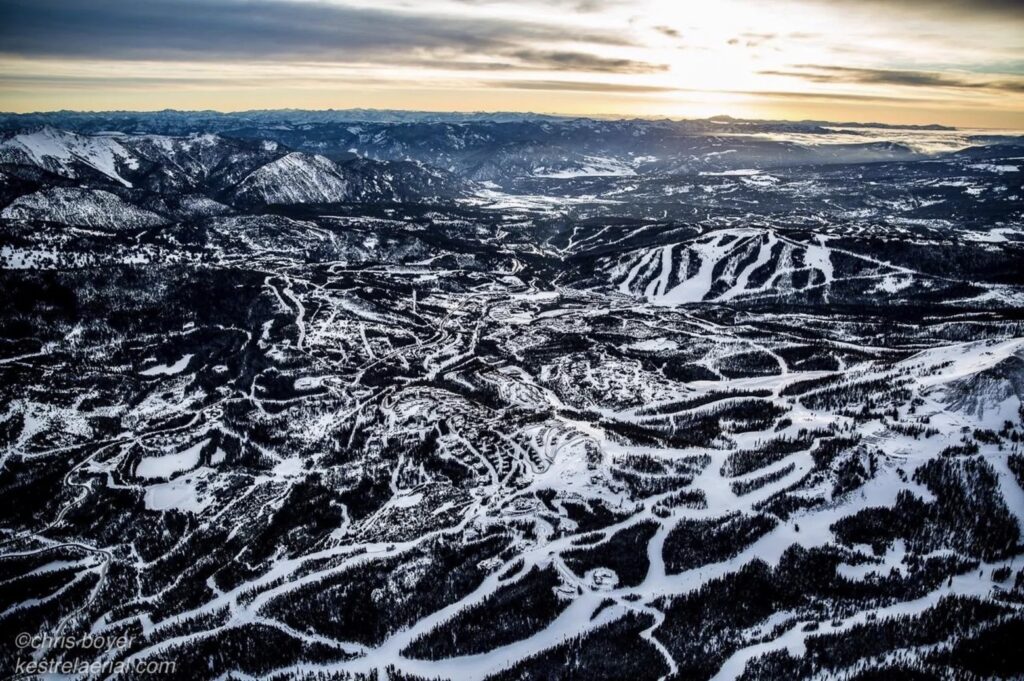
For all of us who say we care about the fate of wild nature, journalists included, we might reasonably wonder: what is the real cost, i.e. the consequences of expanding recreational invasion on the native, indigenous biological diversity of non-human beings living here? Relatedly, maybe, too, it invites serious reflection on this question also facing us all: does perpetuating the survival of wildlife matter, and if it does, then are we as recreationists willing to change our behavior to ensure it persists in healthy numbers and function on the landscape?
Essentially, are we willing to not be takers of habitat and respect the survival needs of other residents? Are we willing to not consciously allow special places we cherish to “be loved to death?”
Recently, I was invited to be on a panel about outdoor recreation that was part of a larger conference sponsored by the Wallace Stegner Center for Land, Resources and the Environment at the University of Utah in Salt Lake City. The two-day event attracted big name speakers, including former US Interior Secretary Sally Jewell who was CEO of REI, policy experts, conservation leaders and others to give keynotes and help make sense of the unprecedented threats public lands are facing as a result of Trump Administration actions.
Most of my panelists touted the economic value of outdoor recreation, its potential to become far bigger and efforts by states and the federal government to rapidly expand its presence. None referenced downsides, though among biologists working for wildlife agencies and in many mountain towns citizens speak of “over-recreation,” crowded trails and “user conflicts.” When my turn came—I was the last person to present on the outdoor recreation panel—I delivered highlights of many of the things you are about to read in this series. Namely, that in the vast majority of discussions being expressed about the future of public lands, concerns about wildlife often get short shrift.
Here is the rhetorical progression I posed: What good is having public lands if the conservation of public lands, to protect the rarest and most priceless aspects of what’s on public lands, isn’t given priority? If conservation is held up as an important objective now and for future generations, then what kind of “conservation” is it if wildlife conservation and perpetuating the survival of species that are still on the land in certain places isn’t highlighted as a barometer to gauge success? What is a wildland without its wildlife?
The great American conservationist Kris Tompkins told me not long ago that landscapes missing their native species have a sense of vacantness, and it ought to be the common cause of conservationists to prevent that from happening.
What good is having public lands if the conservation of public lands, to protect the rarest and most priceless aspects of what’s on public lands isn’t given priority? If conservation is held up as an important objective, then what kind of “conservation” is it, if wildlife conservation and perpetuating the survival of species that are still on the land in certain places isn’t highlighted as a barometer to gauge success?
By now, reading this far, your dander is probably up. You, after all, probably identify as a conservationist. To use the lexicon of the times, you might be feeling “triggered,” and you might think: how could I as a pleasure-seeking human with good intentions and a passion for adventure possibly be part of a problem? Before we proceed further, let’s state what is patently obvious: it’s beneficial for each of us to be physically fit and outgoing; and it’s also good to be conscientious and fully ecologically aware of the wild places we traverse as guests.
“Communing with nature” is what we do to “re-create ourselves,” right? Inspiring self-help books, from those written by noted authors like Richard Louv and Florence Williams tell us what most Westerners who have lived here awhile already know: getting outside benefits us physically, mentally, and spiritually. The problem is that such books are exceedingly focused on promoting things that advantage self-focused humans with little empathetic reflection given to costs of mass recreation on other species.
I live in a wild, largely un-blighted corner of the West because I love to recreate outside. The surroundings inspire me. If you presented me with a checklist of various outdoor recreation activities I have participated in during my life, I would mark the box that says “most of the above.” This includes “muscle-powered,” electric, and locomotion propelled forward by the throttling of combustible engines. It includes hunting and fishing. It includes getting in a work out, and exploration, and reaching far-flung places to indulge my ego.
For a long while, especially during college and in my twenties, I didn’t think much about how my presence might be affecting wildlife, until I began having more conversations with wildlife scientists. To raise common-sense questions about the aggregate, unexamined impacts of industrial-strength outdoor recreation is neither anti-recreation, nor anti-fun, nor is it anti-human; in this case, it is pondered through the lens of being “pro-wildlife.”
Let us also address another assertion that has been advanced by some conservation organizations receiving funding from major foundations: that promoting wildlife conservation on American public lands or more specifically in the Greater Yellowstone Ecosystem is racist, elitist, and part of some alleged conspiracy to prevent people of color from “using” public lands. For longtime wildlife advocates, this has been an insulting premise advanced by promotors of “diversity, equity and inclusion” that rose in the wake of the George Floyd incident.
Creating access for more people to use places where wildlife values are not high is one thing, but it’s another, as some conservation groups have done, demonizing ardent defenders of wildlife who are promoting more wilderness, not to benefit themselves but to insure solitude needing animals can persist amid mounting human pressures.
Read the press release issued by the Outdoor Recreation Roundtable with testimonials praising passage of the Explore Act that, through billions of dollars in new investment, aims to markedly expand public access and bring millions of more people onto public lands.
What could be more elitist than humans of privilege and upward mobility, engaging in the expensive passions of playtime, telling themselves they don’t have to reflect on their own impacts or an industry that puts profits before concern about important bellwethers—species—of planetary and public land health?
Concerns about wildlife and its intrinsic value often are lost within our prevailing, one-way, human-centered orientation toward public lands, and amid public involvement processes designed to decide how such lands will essentially be divied up among different groups of human users and “stakeholders.” In such exercises, seldom is wildlife—or its designated human representatives—given a full seat at the table of collaborative negotiation. This has been a core criticism aimed at the Gallatin Forest Partnership, with some wildlife advocates saying they met with hostility when raising questions about the long-term impacts of outdoor recreation.
In the children’s tale of The Lorax, the symbolic advocate-protagonist for nature speaks for the trees and other living things against the greedy impulses of the Onceler, the businessperson who justifies destruction of the forest, home to other creatures, in order to create more “thneeds,” i.e. products for consumption. The Lorax speaks out because “the trees have no tongues.” By the end of the tale, the forest of truffula trees have been reduced to stumps and the Lorax heads to another haunt, except in real life there are no other wild ecosystems like Greater Yellowstone left in the Lower 48.
° ° ° °
Studies indicate that people who spend more time in the natural elements, whether in an urban green space or remote wilderness, tend to be happier, calmer, more sensitive, caring, and generous. We know, too, that outdoor recreation has generated hundreds of billions of dollars annually for the national economy and billions each year for states in the Rocky Mountains.
That makes outdoor recreation a bona-fide industry and, like all industries in service to the delivery of “thneeds”—including the real estate, development and construction industries—year over year “success” is achieved by pushing for an ever-expanding bottom line made possible by generating more clients who consume more stuff. In the case of outdoor recreation and those closely related industries above, it is premised on the consumption of more of finite nature. And this is what makes it extractive—the same as logging, hardrock mining, extracting coal and public land livestock grazing that results in predators being destroyed to make way for cattle and sheep, experts I’ve interviewed say.
For outdoor recreation companies, they are constantly pressing for more access to generate more product users so that they can sell more of what they make. Usually, they give wildlife only token reference, treating animal presence, in fact, as nuisances or invisibly as if animals don’t exist or aren’t bothered—especially if concern for the well-being of a given species or suite of species means telling humans they can’t “use” a place or have to deal with restrictions.
Much has been touted about the muscled swagger of the outdoor recreation industry and the hero worship of its brand ambassadors, but serious adult reflection is lacking on the consequences of large numbers of people venturing into sensitive wild areas and displacing non-human species that often have nowhere else to go. In fact, the outdoor recreation industry and the makers of gear who claim to possess a green consciousness and ecological awareness have steadfastly evaded acknowledgment of impacts on wildlife. At an unspoken gut level, with even humans in many places being unable to escape growing crowds, we know that if we’re uncomfortable and evade certain public lands, it can’t be good for wild creatures.
This is a modern phenomenon and byproduct of “multiple-use management,” wildlife biologists say, that is a growing problem—an elephant in the room— for a region like Greater Yellowstone. Yellowstone National Park and its sister preserve Grand Teton National Park, and the other public lands surrounding them represent the cradle of American wildlife conservation, where numerous species have been brought back from the brink of extinction.
Never has it contended with the kind of recreation pressure now proliferating in places like the Colorado Rockies, the front range of Utah’s Wasatch and towns like Moab, and cities close to the West Coast. One irony is that social consideration for wildlife doesn’t register in other places because species have already vanished. Not only that, but diminished social tolerance prevents some wildlife from ever being brought back or the odds of successful reintroduction hampered by so many people unwilling to make space.
No other bioregion in the Lower 48 possesses the kind of wildness that characterizes the Greater Yellowstone as reflected in its assemblage of wild native species. Paint this scene in your mind. On a single late summer’s evening you can hear wolves howl, loons trilling, and elk bugling, watch free-ranging bison wallow and bellow, spot a grizzly bear mother with cubs, cast for wild native trout, and soak in a sense of solitude that lets us forget what year it is. Greater Yellowstone is home to all the original, free-ranging wildlife species present 500 years ago prior to the arrival of Europeans. What is the value of such a masterpiece like this?
Here’s the good news offered up front. We still have a choice. Overwhelming evidence demonstrates that when humans reduce or control the size of our individual and collective footprints, as well as the intensity and volume of their activity, wildlife at population levels can be sustained and flourish. But this requires us backing off, deliberately making space, understanding cause and effect, and following the pillar of 21st century conservation—the precautionary principle. It remands preventing the highest quality wildlife habitat remaining from being de-wilded and identifying opportunities where wildlife have been lost owed to thoughtlessness in another earlier era to be re-wilded. Are we capable of that?
Here’s the good news offered up front. Overwhelming evidence demonstrates that when humans reduce or control the size of their individual and collective footprints, as well as the intensity and volume of their activity, wildlife can flourish. But this requires us backing off, deliberately making space, understanding cause and effect. Are we capable of that?
The tenets of the precautionary principle are embodied in the National Environmental Policy Act or NEPA which has been called “the Magna Carter of environmental laws” in the world. What that means is NEPA insures that scrutiny over major development proposed for public lands will be scrutinized. The impacts will be assessed. Under the intent of NEPA, the public has a right to weigh in and this includes citizen Loraxes offering their tongues on behalf of wildlife, water, forests, soils and air.
By law, public land managers cannot go rogue or act as mercenaries in order to appease their superiors who answer to political appointees who are put in place to carry out the agendas of for-profit companies that get people elected and/or pad their wallets. NEPA is hailed for its democratic components, specifically that land agencies must hold public meetings to keep citizens informed on major proposed actions, that they solicit citizen opinion, that they consider it, and that decisions deemed questionable, with questionable scientific underpinning or basis in the law, can be challenged in court. The public lands, in the condition that we still find them today, are not the result of an “over-reaching government” but the fact that citizens, across generations, have held government agencies to account, using NEPA, to uphold federal laws and prevent disasters.
Known colloquially as “looking before one leaps”—always a good idea in any endeavor— the precautionary principle that is core to NEPA requires understanding as many variables as possible to avoid unintended consequences that might be irreversible. Ignoring the precautionary principle already has resulted in huge swaths of the Lower 48 where native species, once present, were eliminated, and never likely will exist in viable populations there again. It is also why water in lakes and rivers is not safely drinkable.
Many treat “public lands” as generic. All national parks, forests and wilderness areas in America possess categorical legal designations, but each one is not qualitatively equal in terms of the natural entities an individual location contains. Some parks and wildernesses are less wild than others and bear the impact of human invasion and spread of non-native species; some are more pristine, in that they still can sustain native plants and animals; and some are undeniably exceptional, like those in Greater Yellowstone, in that they have the full complement of animals there before European settlement.
Right now, as you read these words, the Trump Administration, through Interior Secretary Doug Burgum, Agriculture Secretary Brooke Rollins, Forest Service Chief Tom Schultz, Environmental Policy Agency Administrator Lee Zeldin and their advisors in free-market think tanks boast that they’ve already moved to eliminate four fifths of long-standing rules related to NEPA compliance.
These maneuvers are being carried out on behalf of resource extraction industries that openly deny the well-established scientific evidence of climate change. The same people behind them are in league with the outdoor recreation industry to give public land managers more sway in overlooking or ignoring the impacts of outdoor recreation on public wildlife on public lands. The same forest supervisors who can green light timber sales in the name of thinning allegedly to prevent wildfires, and without assessing impacts on wildlife, are allowed under recent bills signed by Presidents of both parties to bypass scrutiny on the impacts of new trails, more outdoor recreational infrastructure and more people flooding rivers and moving through front and backcountry.
Richard Ford was right and he gave us a lot to unpack. Why are the slogans of hypocrisy pertaining to the Trump Administration unacceptable but the kind uttered by we conservationists about our own favorite pastimes?
The Outdoor Recreation Roundtable recently shared a new estimate offered by the US Department of Commerce’s Bureau of Economic Analysis (BEA), pegging the amount of economic activity generated by outdoor recreation at $1.1 trillion. If the unspoken objective is endless growth and space to accommodate it, what does it mean for sensitive wild areas when that number doubles and triples? What industry, after all, has ever touted the virtue of “enough”?
Outdoor recreation is the most rapidly expanding form of multiple use on federal public lands and yet there is no federal Act that specifically requires land managers to seriously consider the weight of scientific research which has clearly documented how we are pushing wildlife out of habit it needs to survive.
Given this, ponder again a logical progression: if outdoor recreation allegedly supports conservation, then what kind of conservation is it? How does encouraging more people to use/invade the last remnants of wild public and natural private lands benefit wildlife living there?
If that presumption is true, then one could therefore deduce that areas with the most outdoor recreation happening are thriving meccas for the kind of wildlife that still exists in Greater Yellowstone.
There is no study or proof that supports this premise. Not a single major conservation organization in America or Greater Yellowstone, which has one of the highest per capita concentrations of professional staff conservationists in the country, has ever, or is, calling for a cumulative effects analysis on the impacts of outdoor recreation on our most iconic wildlife ecosystem. We’re like a mountain biker accelerating down a steep trail in total darkness.
Our last remaining wildlands (as defined by places able to support wildlife survival) are facing a never-before seen onslaught of humans. On public lands, it is tourism and outdoor recreation being promoted as if wildlife and fish have no threshold of tolerance and carrying capacity when it comes to our species invading their space.
On private lands, it involves lifestyle pilgrims building vacation homes next to public lands and in migration corridors, newcomers invading rural valleys and both of these forces exacting a permanent growing and irreversible footprint of habitat loss. Wildlife are getting crunched between.
Next, in Part 2: A Conservation Biologist Calls Out A Paradox In Greater Yellowstone’s Gallatin Range. George Wuerthner writes about how legislation, authored by three well-known conservation groups allows the outdoor recreation industry, not wildlife scientists, to determine how one of the wildest line of mountains in the Lower 48 will be “protected.”
And, in Part 3: Does outdoor recreation really result in more support for more wildlife conservation and, if so, then why aren’t more recreationists having an impact on stopping the rescission of the Forest Service Roadless Rule, the BLM’s Public Lands Rule, gutting of the Endangered Species Act and National Environmental Policy Act, halting proposed hardrock mining on the front door of Minnesota’s Boundary Waters, moves to eliminate wilderness study areas, and preventing energy development from occurring inside documented wildlife migration corridors in Greater Yellowstone, among a much longer list of examples.
Related: