by Dr. James Hansen and Dan Galpern
Congressional leaders face pressure from the logging industry to bring a deliberately misnamed “Fix Our Forests Act” to the Senate floor. They should resist. This bill is a Trojan horse, pretending to protect vulnerable communities from wildfire risk and improve forest health. It does neither.
Instead, it heeds the command of President Trump’s Executive Order 14225, which calls for the “immediate expansion” of US timber production from lands managed by the US Forest Service and the Bureau of Land Management.
America is blessed with magnificent national forests that are a source of lumber and other resources. An adequate lumber supply is important for the US economy, but most of that is provided by private holdings. Timber production is just one of a range of multiple uses for national forests. Other uses include “outdoor recreation, range, … watershed, and wildlife and fish purposes.” Any “yield” from our national forests must be pursued in a manner that maintains “the various renewable resources … in perpetuity … without impairment of the productivity of the land.”
For those ends, the National Environmental Policy Act and the Endangered Species Act require the USFS and the BLM to safeguard the public interest, including that of future generations, and to protect rare and endangered species. But the bill that the Senate is considering enables land managers to skirt these laws and fast-track otherwise questionable projects under the guise of wildfire risk reduction by vastly expanding allowable “categorical exclusion” zones that are exempt from review.
That would be a mistake. Mandated environmental review allows challenges to wrong-headed proposals. It also insulates conscientious officials from industry pressure, enabling them to do the right thing by considering the wider ramifications of forest-disturbing proposals.
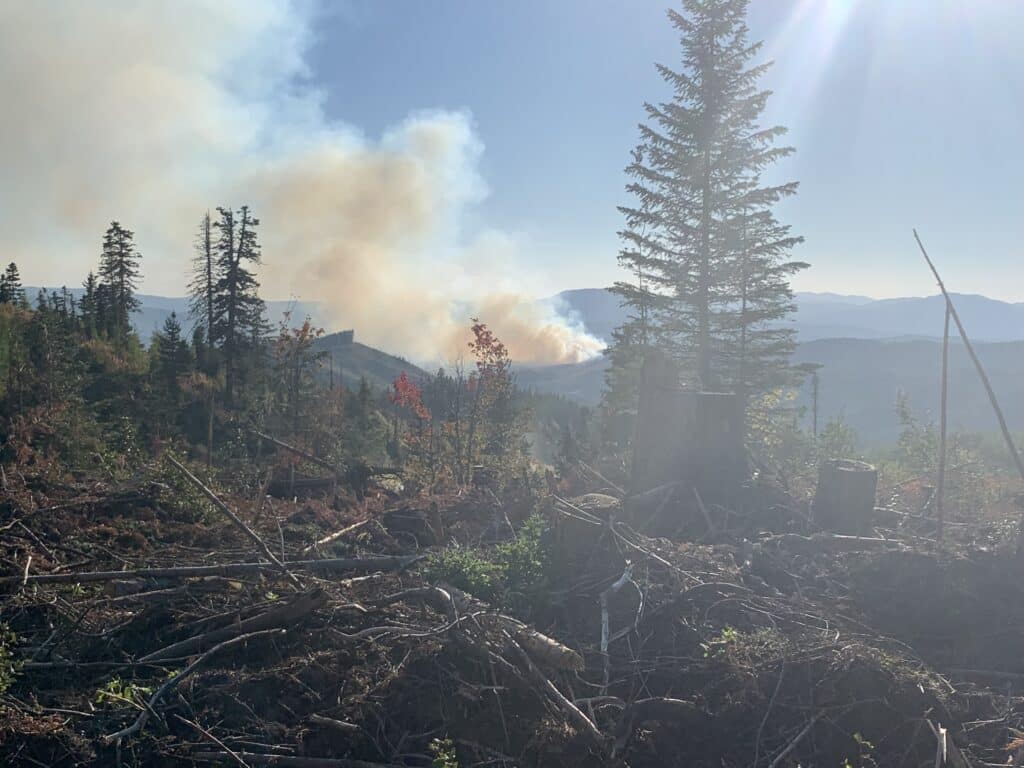
The pretense of the legislation is that deep forest logging will reduce fire intensity, risk to downwind communities, and climate-damaging carbon emissions. This comes at the same time that US Secretary of Agriculture Brooke Rollins in proposing to rescind the longstanding US Forest Service Roadless Rule and open up, potentially, tens of millions of acres of unloaded forests to logging, using the same arguments.
But such “thinning” does not always reduce wildfire intensity. Indeed, considerable evidence establishes that the open conditions created by such logging may lead to lower humidity, higher wind speed, higher temperature, abundant grass fuel, and increased fire intensity. Moreover, thinning may increase forest-derived carbon emissions “by three to five times relative to fire alone,” in part because only a fraction of the carbon in felled trees ends up stored as lumber.
The pretense of the legislation is that deep forest logging will reduce fire intensity, risk to downwind communities, and climate-damaging carbon emissions. But such “thinning” does not always reduce wildfire intensity. Indeed, considerable evidence establishes that the open conditions created by such logging may lead to lower humidity, higher wind speed, higher temperature, abundant grass fuel, and increased fire intensity.
Effective community protection requires planners and policy makers alike to understand “the critical role of individual homeowners and local government.” In brief, in a warming world government at every level needs to help communities become far more ignition-resistant. Updated building codes, neighborhood assessments of fire vulnerability, home-hardening modifications, defensible space pruning, and local government empowerment are all needed, but the Fix Our Forests Act offers none of this.
As to combatting the climate crisis, US forest lands play an important role by storing considerable carbon; moreover, they retain high potential, if left to mature, tosequester much more (as old-growth forests and mature trees durably store more carbon). Recently, the International Court of Justice ruled that, to address global climate change, every nation is obliged not only to constrain exploitation of their fossil fuel reserves but also to preserve their carbon-rich soils and forests. Congress owes it to our children and grandchildren to pay close attention here.
Many citizen-based community groups have noticed FOFA’s chicanery. More than 100 groups issued a public analysis of the measure’s extraordinary conveyance of discretion to the land agencies, enabling officials to approve logging and clear-cuts even in forests of high ecological value — and for a wide assortment of reasons. A few groups based in Washington, DC, appear to have been taken in by FOFA’s sophistry, but they should take a closer look at the relevant wildland and urban fire science.
Congressional leaders should decline to bring FOFA up for a vote, but if the measure makes it to the Senate floor, senators should read its content in light of that relevant science. They then can rise up to strike it down.
EDITOR’S NOTE:
How little we’ve come or perhaps how backward we’ve gone. Below is a 60 Minutes piece that features an interview with Dr. James Hansen of NASA way back in 2006 during the Bush-Cheney Administration.
Also Read:
Broken Promises Could Derail Greater Yellowstone Grizzly Delisting