by Todd Wilkinson
This year Americans from all walks of life came together, rallying against proposed divestitures of federal public lands to states and selling millions of acres off to private interests. The outpouring of citizen resistance in the name of common cause was deemed momentous and potentially historic. It left many loyalists of President Donald Trump and his perceived radical anti-environmental agenda chastened.
But by insisting that public lands be kept in public hands, what exactly is being protected? What, for example, is public land that doesn’t conserve wildness? What is wildness in the absence of healthy wildlife populations? What is conservation if wildlife conservation doesn’t rank as a top priority?
Regarding the latter, is it, a priority?
Or, is the destiny of public lands primarily to be human playgrounds approached with all of the tenderness and reverence as we would an outdoor gym? Relatedly, do public lands in the West really suffer from lack of public access when it comes to outdoor recreation?

A few years ago, shortly after I founded an environmental journalism site different from this one, and also served as its chief writer, editor, investigator, researcher, fact-checker, proofreader, layout person, administrator, fundraiser, spokesperson, cheerleader, and flunky, I handed an assignment to a young college intern brought on board for the summer.
They/them wanted to be tossed into the middle of a major emerging issue. So I gave them the task of contacting the two national parks, five national forests, three national wildlife refuges and BLM field offices—which comprise most of the public lands in Greater Yellowstone—and ask respective public information officers to provide a few simple statistics.
The things I wanted to know, and which seemed simple enough at the time to retrieve, were:
The number of miles of asphalt, gravel and two track roads inside their respective borders.
The number of miles of official recreation trails and how the totals of those might be broken down into number of miles of all-purpose trails, number of trail miles open for mechanized users, and miles that are non-motorized.
After gathering those details, I wanted the intern to then find out what form of monitoring agencies were using to gauge impacts of human uses on wildlife.
Greater Yellowstone is considered vast but there are things that make it feel small. I was curious how much space, relatively speaking, actually exists in and around public lands that doesn’t have lots of we humans regularly moving through it.
As it turns out, many of the agency people were either unhelpful, too busy or unable to provide the figures. In the case of the US Forest Service, the agency overseeing the highest percentage of public land in Greater Yellowstone, I discovered there’s a reason why it’s dodgy and vague in discussing impacts it apparently doesn’t wish to acknowledge are real.
My interest had been piqued by an ongoing series of discussions with the late great independent conservation biologist and friend, Dr. Brent Brock. He had been involved in several different studies examining how high quality wildlife habitat was being eroded, paralleling other examinations led by Drs. Andrew Hansen and Bruce Maxwell at Montana State University.
The nature of my regular conversations with Brock was about discussing topics that few conservation groups or public land agencies pushing expanded outdoor recreation capacity wanted to discuss: their total lack of interest in knowing the baseline status of wildlife and habitat security, how it is being effected by existing recreation trends and what investing billions of dollars in more outdoor recreation infrastructure portends for sensitive species in the future considering current trajectories.
The assignment I gave to the intern occurred before the arrival of Covid which brought an unprecedented deluge of added recreation pressure on public land and local waterways and a corresponding unprecedented boom of exurban sprawl pinching up against the national parks and forests.
Perhaps the only way readers here can understand what prompted the level of interest by Brock and me is to ponder maps. Warning: the information contained in them below cannot be forgotten or unseen—that is if a person has even a modicum of empathy in thinking about how the expanding gauntlet of roads, trails, cars and humans might be affecting wildlife. On top of this, President Trump’s Secretary of Agriculture Brooke Rollins is moving forward with plans to overturn the so-called Roadless Rule that safeguards millions of acres of national forest lands in and around Greater Yellowstone from having roads bulldozed into them.
To start, click on the video Brock created, below (1). It shows levels of land disturbance in the western mountainous part of Montana as it relates to successive overlays of impacts involving main road corridors and those expanding into former working ranches and private natural lands, secondary roads on public lands and finally trails (in blue) circuiting like veins through wilderness and roadless lands. White spaces are where roads and trails are not.
(1) Cumulative Human Land Disturbance in mountains of western Montana
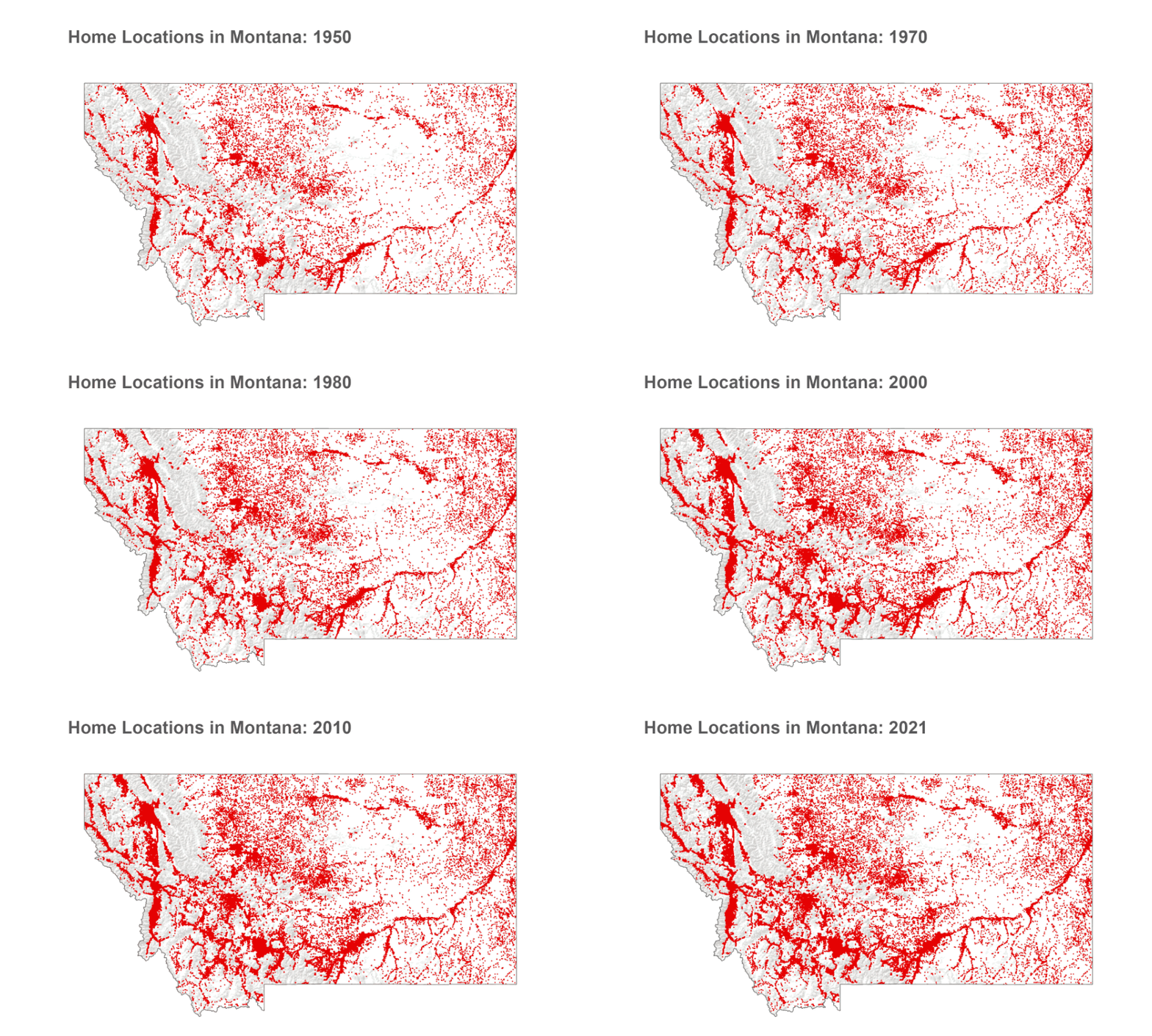
Now click on the gif, below (2), created by Bozeman-based Headwaters Economics showing the viral expansion of new home sites in Montana since 1950. It progresses in time, with the number of dots accelerating in recent decades but stopping in 2021, which is just before the hurricane of new development arrived. Similar patterns are certain to exist in the mountain valleys of both northwest Wyoming and many corners of Idaho.
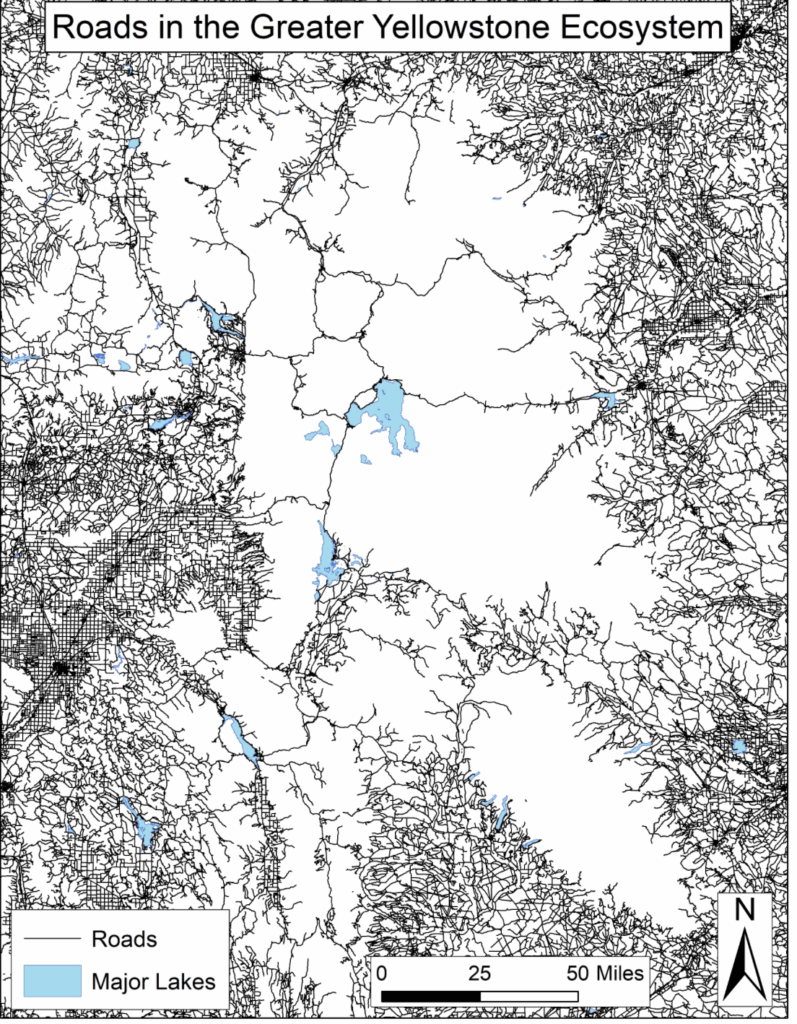
Next, look at the illustration of road locations in Greater Yellowstone created by the USGS (3). Notice how the grid encircles Yellowstone and Grand Teton national parks and federal wilderness areas in the center. Roadkills resulting from vehicle-wildlife collisions, according to Dr. Reed Noss, are just a few of the negative effects associated with more people. The biggest is how habitat quality diminishes and it means a lower carrying capacity for supporting populations of species.
(2) Below: The progression of new homes filling in private lands between public lands since 1950, but not including the eruption new exurban sprawl that has happened since Covid triggered a massive infusion of newcomers
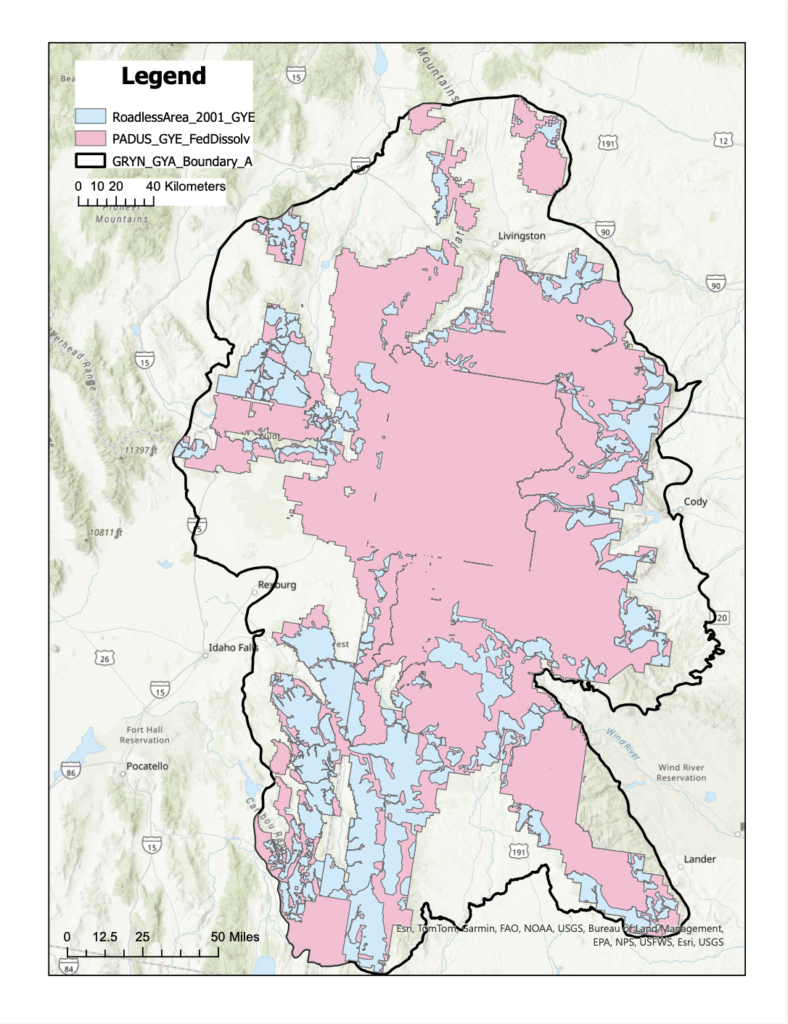
Gaze next at the map of roadless lands in Greater Yellowstone (4) with protections against roadbuilding that could be removed if the Roadless Rule is rescinded.
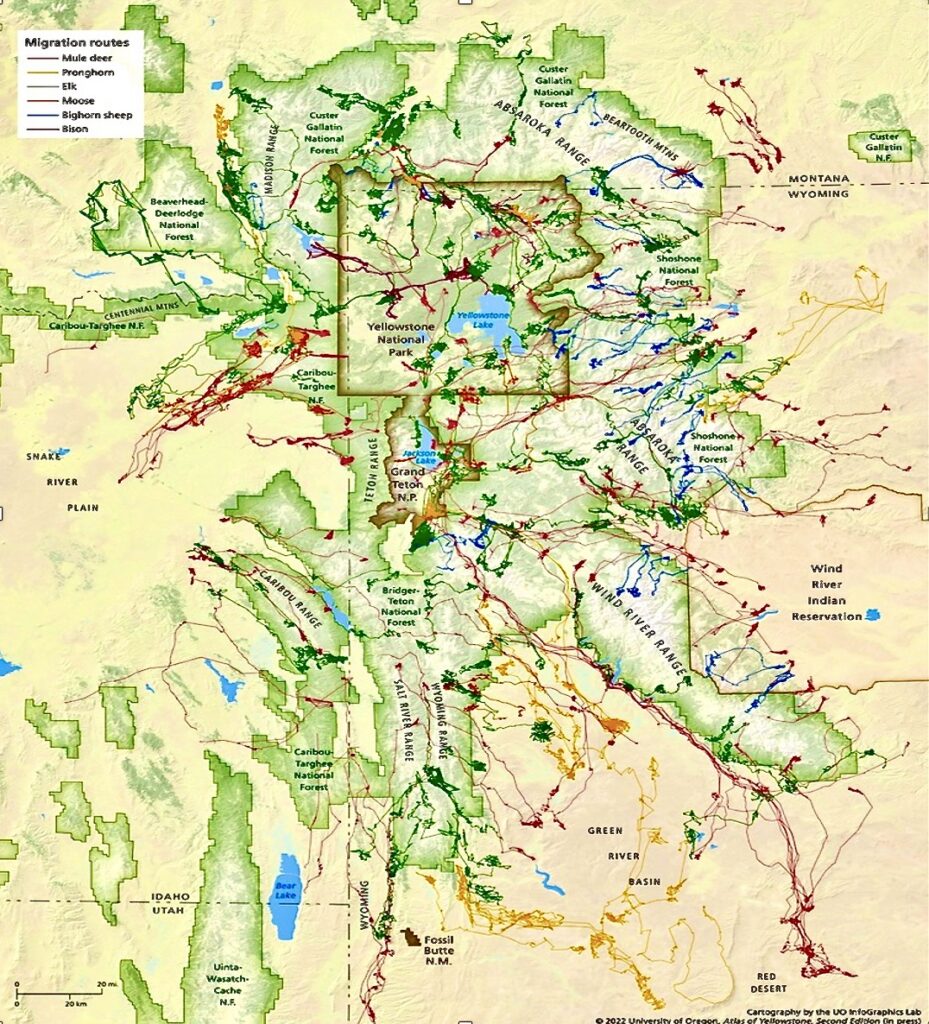
Lastly, (5), ponder the multi-species map of wildlife migrations in Greater Yellowstone created by the Wyoming Migration Initiative. It doesn’t take a PhD level scientist to draw conclusions of how these fracture lines of habitat on public and private lands might be negatively impacting species and what it will mean with growing numbers of people filling in the spaces. Put it all together and it’s apparent how difficult it is for non-human animal to not be confronted by a steady flow of humans behaving unpredictably with each contact being disruptive or potentially lethal to the animal and its habitat.
Not long ago, I put together a lengthy investigative report on what scientific studies have documented about the impacts of industrial strength outdoor recreation on wildlife and wild places—and it is by no means complete. More evidence is constantly emerging, the biggest being that as human use levels surge, animals disappear. Like Robert F. Kennedy Jr. and his positions on vaccines, many outdoor recreationists simply choose to ignore or deny science.
As Brock always reminded, displacement of wildlife isn’t confined to just the scratch-marks of roads and trails; rather, zones of impact radiate outward from them and if there are enough the zones converge and result in places that no longer support wildlife populations, nor are they conducive to migration.
(3) Below: An illustration assembled by the USGS showing the grid and location of roads enwrapping Yellowstone and Grand Teton national parks and public land roadless areas
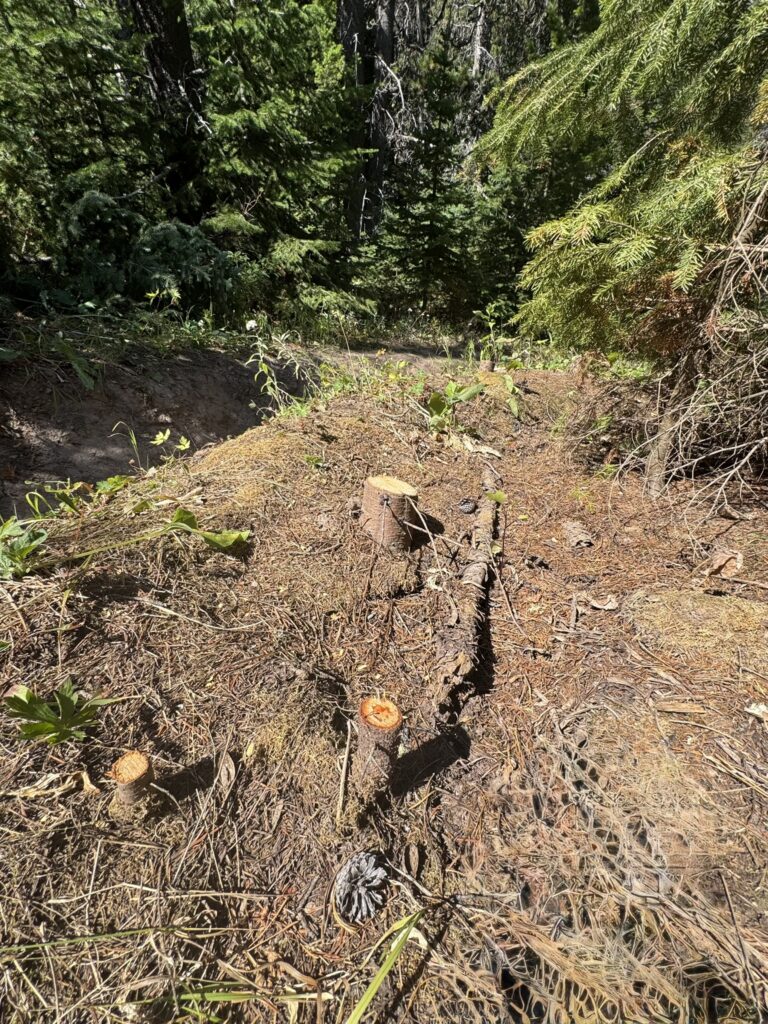
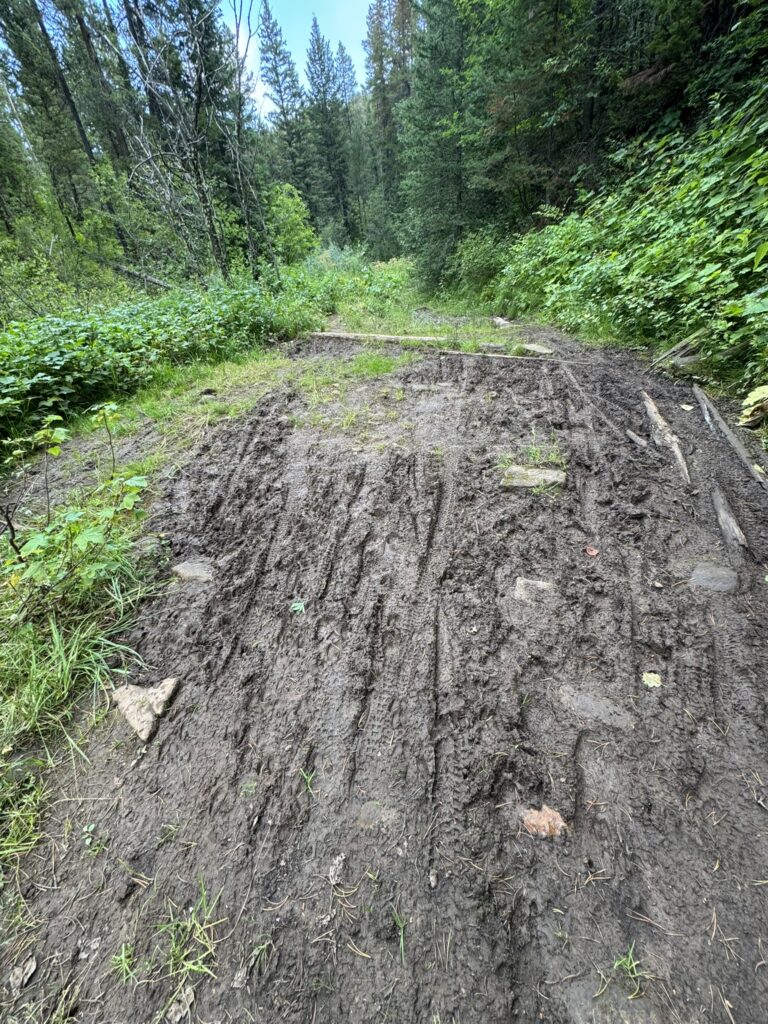
This summer, while hiking in the Gallatin Mountain Range south of Bozeman with a friend, we came to a place where a main trail seemed to fork. We wandered off of it and down a smaller route that had bike tire tracks in the mud. We followed it for a few miles and then noted that it didn’t appear on any official forest map yet it was well compacted by tread marks.
Eventually we reached a stretch where trees were recently felled to widen it. Later as we were headed back down an official trail that this industrial strength “ghost trail” merged with, we encountered another person, bike at his side and armed with a saw, cutting more trees along a path that was left deeply rutted obviously due to mechanized users who had ridden during wet weather. During rainstorms, it surges like a creek.
Throughout the Greater Yellowstone Ecosystem and elsewhere, the Forest Service is enabling mountain bikers to unilaterally make trail improvements and there’s also illegal trail construction happening.
(4) Below: Map created by research scientists showing the locations of roadless lands that could have their protections removed and new roads invading them if the Forest Service’s 24-year-old Roadless Rule is rescinded by US Agriculture Secretary Brooke Rollins. Pink represents all public lands. Light blue represents roadless lands protected by the Roadless Rule and if it is rescinded and those lands invaded by roads they will never quality for wilderness protection again.
The message from the Forest Service seems to be as long as mechanized users are pitching in to maintain them, then it’s okay. And yet the Forest Service has absolutely no idea what the cumulative effects are of increased visitation and carving up of backcountry on wildlife.
The issue isn’t erosion; it’s the proliferation of trails and more people each year going deeper and faster into places where wildlife seldom any more gets a rest.
Not only that, but if you talk with agency folk they admit they don’t have adequate enforcement to halt trail building/improvement and so their response is to look the other way. The predicament has been made worse by haphazard cuts of employees carried out through the unaccountable actions of the Department of Government Efficiency (DOGE).
Still, long before DOGE swung its axe, the Forest Service’s lackadaisical approach to seeking answers about impacts echoed its vague responses when it comes to miles of legal and outlaw trails out there for differing kinds of users; this also involves denial about rising numbers of conflicts and complaints as conditions become more crowded with hikers, people with dogs (on and off leash), trail runners, mountain and illegal e-bikers, motorcyclists and in some places ATV riders.
(5) Below: A map created by the University of Oregon for The Atlas of Yellowstone in junction with the Middleton Lab at UC-Berkley and Wyoming Migration Initiative. It shows some of the multi-species wildlife corridors in Greater Yellowstone which not only pass across public and private land but rely upon those lands to be unfragmented and free of intense human activities and structures
The interests of wildlife seldom have strong representation in so-called consensus and collaboration forums when words such as “stakeholders,” “common ground,” “balance,” “sustainability” and “reciprocity” are bandied about. As a result, wildlife is always expected to surrender more and the attitude from outdoor recreations is there’s never enough human access.
Jaw-dropping was when I spoke with an employee of the Custer-Gallatin National Forest headquartered in Bozeman who said that a significant number of trails were “user-created” and that they didn’t appear on the Custer-Gallatin Travel Map, which is supposed to, ostensibly, give perspective on levels of human use.
I also learned from a Custer-Gallatin employee who said illegally-created trails, often engineered by mountain bikers and motorcyclists, “was a problem” but that the national forest did not have the human resources to enforce prohibitions on such activity. The person also said the forest had no real idea of how the incursion of people was affecting wildlife.
We should remember that the Custer Gallatin not so many years ago had to be sued before its leaders were forced to create a travel plan after it failed to stop illegal incursions of recreationists into the Hyalite-Porcupine-Buffalo Horn Wilderness Study Area in the Gallatin Mountains. Today, some of the conservation groups that sued the Forest Service are allies of the agency along with mountain biking interests making sure a significant portion of the WSA does not become official Wilderness.
What they cannot deny is this: giving those lands strict Wilderness protection and assessing the impacts of outdoor recreation now and anticipating them in the future, scientists say, would be the best foresighted strategy for protecting the Gallatin’s superlative biological diversity which rivals that of adjacent Yellowstone National Park.
The Forest Service in the West actually has a checkered history when it comes to prioritizing wildlife conservation and supporting visionary protection of wilderness. When it has had to embrace it, often it’s only happened against the will of local forest supervisors. The agency’s mantra has been to “serve its clients” because that translates into political support which translates into funding and this, in turn, translates into compliant forest supervisors who do whatever is necessary to not rock the boat of elected officials and associated special interests who often know nothing about conservation biology.
For generations, the agency’s main clients were timber companies and many agency leaders were graduates of timber programs in land grant universities, rewarded with promotions “if they got the cut out.”
In recent years, the Forest Service’s main client has become outdoor recreationists backed by special interest user groups backed by powerful outdoor retailers who sell gear and clothing and whose profitability model depends on getting rising numbers of people to swarm public lands. They claim that by playing we are saving the world and, though they claim it’s true, they never provide evidence that scaling up recreation translates into better wildlife conservation because they know that, while virtuous, it represents a slippery slope of accountability they don’t want to navigate.
In recent years, the Forest Service’s main client has become outdoor recreationists backed by special interest user groups backed by powerful outdoor retailers who sell gear and clothing and whose profitability model depends on getting rising numbers of people to swarm public lands. They claim that by playing we are saving the world and, though they claim it’s true, they never provide evidence that scaling up recreation translates into better wildlife conservation because they know that, while virtuous, it represents a slippery slope of accountability they don’t want to navigate.
Concern for wildlife is almost never mentioned amid the perpetual battle cry calling for more trails and access, bigger parking lots, and better amenities in service to commercial interests, like ski areas straddling public land.
Indeed, the Forest Service attitude seems to be the customer is always right and it’s important to give them what they want, but if questions are raised about consequences, it is best, if you’re a senior Forest Service employee, to stay quiet or risk retribution from your superiors. This fear existed during the era of the timber wars and it’s present with concerns raised about outdoor recreation.
Do we recreationists in Greater Yellowstone really suffer from lack of options and opportunity? There are, in fact, thousands of miles of trails and secondary roads already in this ecosystem, enough to make things interesting and keep any recreationist occupied for a lifetime. “Enough” is not part of the lexicon.
Wildlife habitat, however, is finite and shrinking every single day.
Why is it so difficult for us, not to cut a new road or blaze a new trail, but to cut wildlife a break, or acknowledge that indulging our passions has real negative consequences for species that make our public lands wild and that, when we’re in wild country, the world does not revolve around our rich lives of leisure that are often unsympathetic to the plight of other species?
What’s frustrating as a journalist is when you reach out to public officials they say they are promoting major activities but they really don’t know what the consequences will be. On the Bridger -Teton National Forest, I was once told by a recreation specialist that younger recreationists are constantly pressing for more terrain and “the squeaky wheel gets the grease.”
Why is it so difficult for us, not to cut a new road or blaze a new trail, but to cut wildlife a break, or acknowledge that indulging our passions has real negative consequences for species that make our public lands wild and that, when we’re in wild country, the world does not revolve around our rich lives of leisure that are often unsympathetic to the plight of other species?
I don’t blame the young. Who can? In our mountain towns there is a perpetual unrelenting supply of them. They can’t yet understand the virtue of limits or why rules are put in place to protect things larger than themselves. Most of us who have lived as young people in the West have inhabited that same mental space they do: gung-ho, cocky, self-absorbed, self-indulgent, short sighted, irreverent and taught with devil may care instruction to be defiant of rules which are seen as limits that need to be broken in the name of freedom and liberty. Their favorite emoji is the middle finger.
But most Peter Pans eventually grow up. Unfortunately, many of the biggest promotors of rule breaking and putting self interest before all else are product brand ambassadors and legendary funhogs, many of whom are incredibly careless or ignorant when it comes to pondering the needs of wildlife.
The irony is they could set off a sea change in the brazen attitudes of the turf takers, were they to proclaim from the mountain tops of their vaunted perches, and say that selflessly giving regard to the survival of wildlife can make you a hero.
For many, mid-life brings a shift in perspective when one graduates to maturity, where you move away from pondering only what you can take in order to exercise power or satiate ego. You realize just how small and crowded and fragile the world really is, and you get to realizing how amazing is this wildness that gives you so much pleasure. You then understand it’s possible to pass it along as good as you found it. But it requires that you first marshal the courage to ponder bigger pictures you cannot unthink or unsee.
For Further Suggested Reading for Young and Old Alike: