by Todd Wilkinson
Six million acres of land protected. That equates in mass to nearly three Yellowstone or six Glacier national parks, but if you find that figure to be considerable, then consider this: preventing that amount of acreage from succumbing to loss of natural effects instead imparts direct benefits to tens of millions of additional acres vital to wildlife, water, priceless views, and ways of life for rural people.
It how our ancestors paid forward a gift and how we can do the same to our descendants.
While that alone is ennobling, it only begins to help explain why Montana is a national leader in landscape protection. And, it barely scratches the surface of the profound, inspiring narrative awaiting in a new book, Saving the Big Sky: A Chronicle of Land Conservation in Montana. The volume recently won a National Outdoor Book Award and it makes a compelling case for why support for local and regional land trusts is more critical than ever.
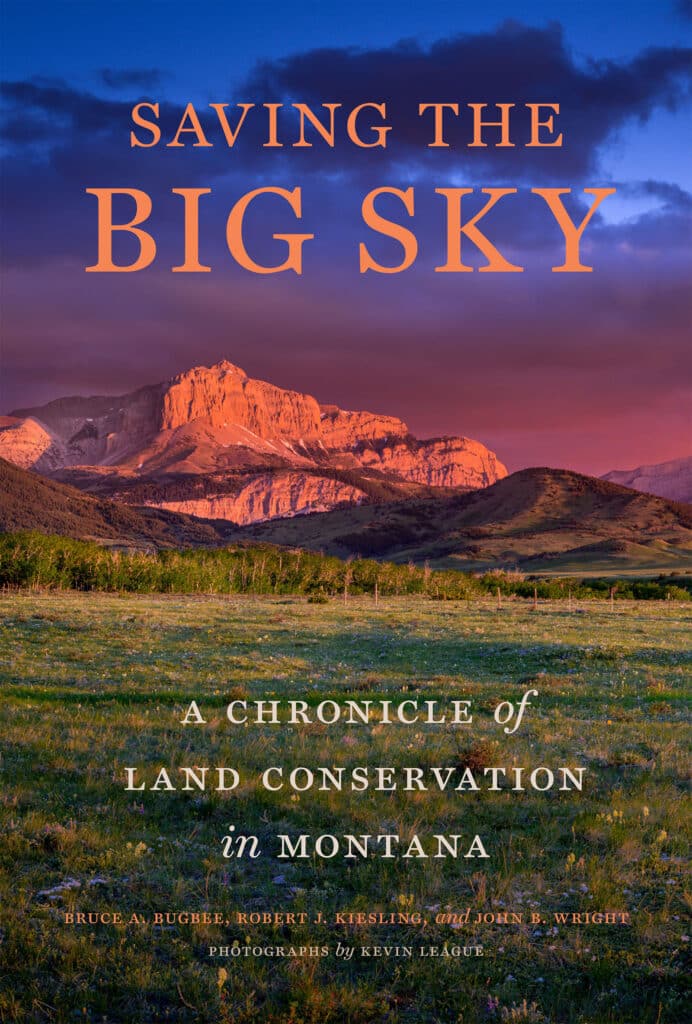
But more than anything, Saving the Big Sky is an example of how visionary thinking prevailed over skeptics in the past who said destruction is an inevitable, unavoidable outcome of change. The three co-editors of the book, Bruce Bugbee, Robert Kiesling and John “Jack” Wright have assembled a convincing rebuttal yet it holds lessons that can be adopted in any state. In the case of Montana, it shows the dividends of refusing to let small-mindedness prevail.
A handsome mixture of solid writing, photographs and maps, it may be the most engaging book about land trusts ever assembled. Bugbee is a land conservation consultant and founder of American Public Land Exchange; Kiesling, a real estate broker, conservation consultant, former executive director of the Montana Environmental Information Center and the Big Sky (Montana/Wyoming) office of The Nature Conservancy; Wright has completed over one hundred conservation easements in Montana and the Rocky Mountain West and is professor emeritus of geography and environmental studies at New Mexico State University. Kiesling was inducted into the Montana Outdoor Hall of Fame in 2020, and Bugbee in 2022.
Below is our interview with Bugbee, Kiesling and Wright
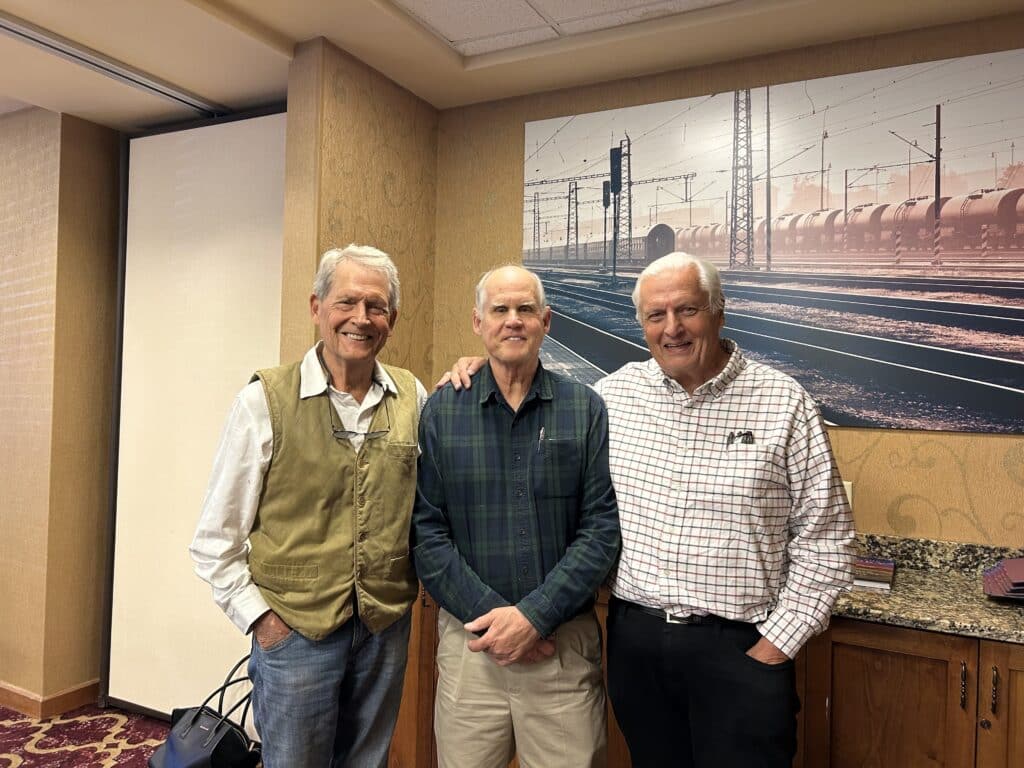
Todd Wilkinson: What was the genesis of this book and how did the three of you converge, by way of professional experience and personal interests
Jack Wright: We met in grad school at the University of Montana in the early 1970’s. Environmental Studies and Geography offered many courses that advanced our calling to conserve ranches, forests, and other ecologically significant lands. Bob is from Havre, Bruce from ag country in California, and I grew up on the coast of Maine, but we shared a goal of applying conservation easements across Montana. It was a heady time for so many people and we are privileged to be part of it.
It’s the subtitle, “A Chronicle of Land Conservation in Montana” that hints at the vital role conservation easements have played in the state but also the role the state has played in in being a visible exponent nationally of how conservation easements can save the character of beloved local landscapes. Do you think people who live in the region, especially young people, are aware of that duality?
Bob Kiesling: Most conservation easement project successes over the years have been quietly achieved. There is seldom much showy P.R. regarding these accomplishments, although that is beginning to change as more land trusts recognize the teach-by-example value of raising public awareness through showcasing conservation stories. So, awareness is increasing, particularly at neighborhood levels. Still, not many people who live in the region are familiar with the extent to which c. easements throughout the state have elevated Montana to national prominence in formal land protection. To date there have never been any state, local or institutional master plans for strategically fostering the use of easements. The rate, pace and extent of easement protections around the state has been more a case of quiet, organic growth. Now that voluntary land protection has reached a tipping point of sorts (as evidenced by this book), it remains to be seen whether public recognition of this conservation legacy becomes a point of cultural pride
“To date there have never been any state, local or institutional master plans for strategically fostering the use of easements. The rate, pace and extent of easement protections around the state has been more a case of quiet, organic growth. Now that voluntary land protection has reached a tipping point of sorts, it remains to be seen whether public recognition of this conservation legacy becomes a point of cultural pride.”
—Robert Kiesling
TW: What makes this book different in how it communicates a message of conservation?
Bruce Bugbee: The message of conservation is shaped by how individual landowners care for their land. Certain land uses preclude sustainability and can be avoided by how the land is owned over time. Creative and rewarding solutions can be offered and many are discovered by examining our private landowner choices over the last fifty years. The majority of this fourth-largest state is in private ownership, the legacy of hopeful homesteaders, miners, and timber companies. That ownership has settled over time, reaching some level of sustainable use, the result of landowners responding to a sense of place and obligation of reciprocity. The question for many is how? The three of us have engaged with the work of practical solutions to this question and how it engages each of us differently.
TW: We’ve known each other a long while. One of the terms you like to invoke, and it’s a good one, is “interstitial spaces,” i.e. crucial spaces between. Were you talking about the human body, we’d be talking about muscles, vessels, arteries, and the breathing passageway between bones and vital organs. How does this book really speak to the crucial parts of landscape, often representing rural private property, especially ranches and farms, between public lands?
Bob Kiesling: The book brings into focus the spatial relationships between private, public, and tribal lands in Montana. It illustrates both narratively and especially with maps the ways in which private and tribal landscape protection efforts so often provide linkage to larger blocks of public land. Connecting lower elevation with higher elevation lands, conserving creek corridors and river valleys with headwaters areas, and protecting known wildlife travel corridors that occur on the interstitial zones between private and public lands are key measures in preserving the integrity of whole systems.
TW: A new and yet very old tour de force rapidly emerging as an ally are the tribes, in the form of tribal governments, traditional members, and scientists bringing added dimensionality to the stewardship equation. What are a few examples of that which stand out?
Jack Wright: The Confederated Salish and Kootenai Tribes (CSKT) wrote their own chapter for the book and their accomplishments are astonishing: the Mission Mountains Tribal Wilderness, the Bison Range, Conservation Areas for Elk, Big Horns, and Grizzlies, Tribal Primitive Areas, restoring bull trout in the Jocko River, and constructing wildlife migration features like the Animal’s Bridge over Highway 93. Shane Doyle of the Crow Tribe explores conservation practices dating back thousands of years. The Blackfeet Tribe has its own land trust. Many tribes are building bison herds and providing conserved habitat. Native American land conservation is what protected Nature long before Europeans arrived.
TW: Please expand upon how the conservation as an ethic is widely embraced.
Jack Wright: A strong sense of place helps explain Montana’s success. People from all backgrounds feel grateful for all the land provides. Food, culture, wildlife, fisheries, beauty, homeland, solace, and joy. People feel the need to give back. Reciprocity and respect are two foundation stones of Montana’s land conservation achievements. Our hearts and our heads both lead us to stand by the land. Native people call this “Two-Eyed Seeing.” Basic insights emerged. The sacred earth is also real estate. Love and financial compensation both motivate landowners. Voluntary land conservation works when we embrace all that we are.
TW: There’s a section of the book that touts the vision of American Prairie and what’s noteworthy is how it illuminates not just the need to better protect wild country that remains, but the opportunities that exist with restoring landscapes that have lost biodiversity but still have incredible potential for recovery through re-wilding or at least healing lands that have been abused. Please explain a little of that dynamic?
Bruce Bugbee: American Prairie’s choice of location is its focus on a rare prairie ecosystem, rare in its size and capability to sustain an ecosystem that can continue to inform us all in what and how this ecosystem can guide us all in a sustainable and diverse future.
TW: What makes Montana Montana to you?
Bob Kiesling: Love of place and home. In my case it’s partly a congenital condition noticeable since birth; partly life-long bonds with Montana landscapes that developed from working and playing in those landscapes; partly reflexive belief that Montana Is also a cultural state of mind.
TW: By your own record as a conservationist, you’ve worked on several land protection projects where a positive outcome, at the beginning, seemed like a longshot. How does one persevere even when the odds of failure are high?
Bruce Bugbee: The odds of failure are dictated by how we perceive the choice. Advocacy is an essential part of examining our choices, but to the extent advocacy precludes the examination of healthy, sustainable individual choice in favor of winning the battle. Successful resolution of individual, sustainable conservation goals requires carefully considered problem-solving and creative solutions. We have been most fortunate to explore and develop satisfying solutions for many individual, corporate, and public landowners.
TW: What lessons from Colorado and New Mexico can be applied to the Greater Yellowstone and Northern Rockies?
Jack Wright: The essential approach used in Big Sky Country has been paralleled in Colorado since the 1980s: respect private property rights, build relationships, listen, find the common ground, then use financial incentives required. New Mexico has a more complex cultural history, but conservation easements are now widely used. A group I helped form, the New Mexico Land Conservancy, now holds easements some 800,000 acres including the 315,000 Armendaris Ranch and, soon, 6,000 acres on Georgia O’Keefe’s Ghost Ranch. Landscape-level conservation in Greater Yellowstone is an exemplar, but thinking big works in New Mexico as well.
TW: How would you describe the level of urgency to protect more land in places in the GYE, where development would negatively affect the conservation achievement that is already in place?
Bob Kiesling: Assembling the conservation legacy in the Madison Valley has taken the better part of a half century. Corroding that legacy could happen ‘overnight,’ but it’s more likely coming through attrition, i.e. the inexorable pressure that comes from landscapes fragmented with rural subdivisions, roads, utility corridors, etc.The explosive growth of the greater Bozeman metropolitan area portends bedroom suburbs, recreation developments and commercial complexes at ever-increasing distances from the city and nearby towns. Add development spillover from Big Sky to the mix and incursions into the Madison seem inevitable. Managing the forces of growth is imperative. The challenge lies not in xenophobically-driven government regulatory responses, but rather combining foresightful growth planning with ramped up efforts for voluntary conservation (easements in particular).
TW: If you were testifying on Capitol Hill and making the case for strengthening the nation’s commitment to keeping conservation easements as a vital tool, what would you say?
Bruce Bugbee: Learn from successful examples of private land conservation. There are many to be found across the United States. More than 60 million acres of private land have been conserved by land trusts, national NGOs, and agencies. Many cattle growers associations now hold conservation easements on ranches. The approach is refreshingly bi-partisan.
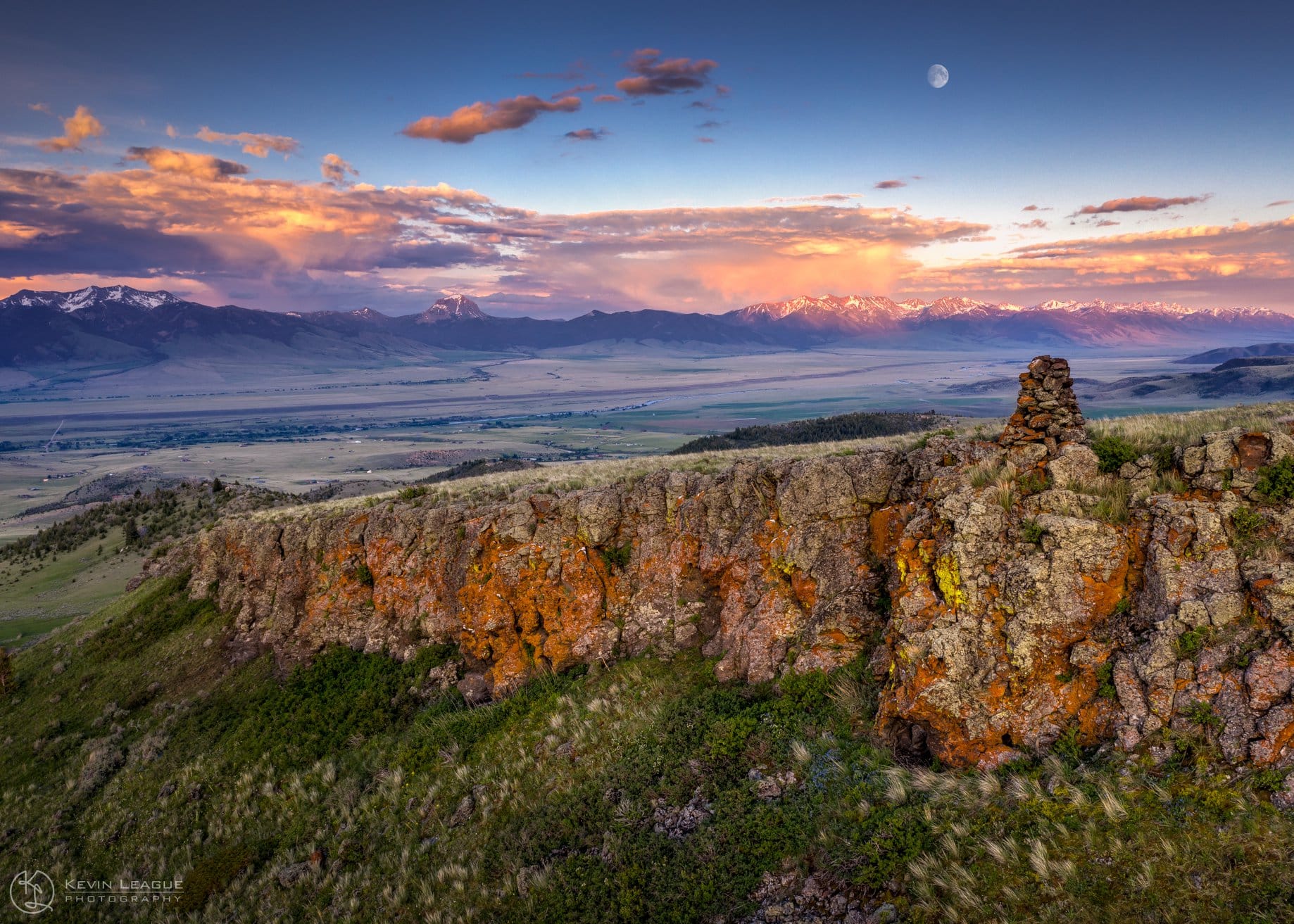
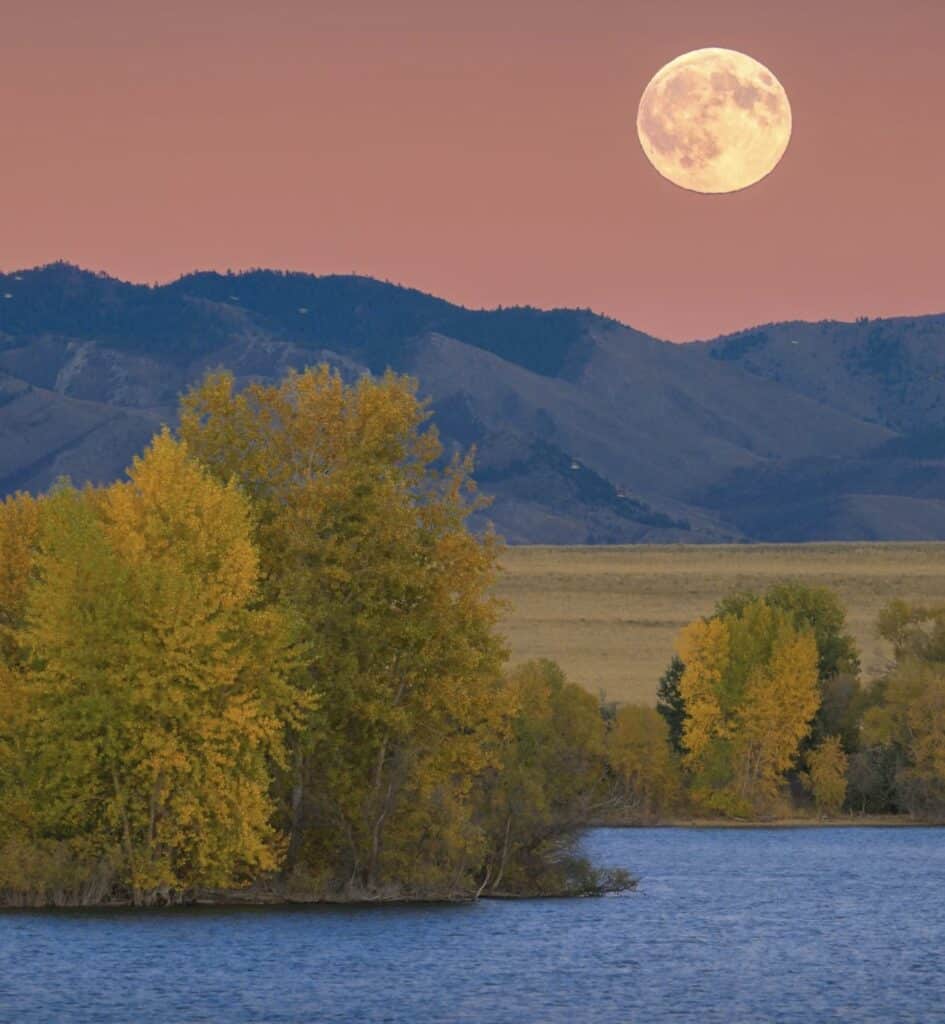
Please say a few words about the images of photographer Kevin League.
Jack Wright: People conserve land that they love. Kevin’s stunning images draw the reader into the emotional story of Saving the Big Sky. Sweeping vistas, wildlife portraits, and quiet scenes work where words fail us. And the maps by Kevin McManigal and Hannah Shafer inspire awe at the scale of land conservation in the state.
TW: Let’s end on a hopeful yet deadly serious note. Hope springs eternal but at least in the western half of the state population-related pressures are fierce and there isn’t a lot of time to make sure we get conservation right in order to withstand negative forces that have left other tranquil places negatively transformed. If you could impart of a couple of bits of actionable advice to citizens who live in the region or like to visit on what they can do to assist, what would they be?
Kiesling, Wright and Bugbee: Three things:
- Support your local and statewide land trusts with your volunteer time and charitable contributions. You can locate your local land trust by clicking here to reach a site created by the Land Trust Alliance.
- Advocate vigorously at local and state levels of government. What the Legislature ‘Doeth’ (passed the Open Space and Voluntary Conservation Act of 1975), it can also ‘undoeth.’ At every legislative session there are lawmakers who mount an assault to repeal the Act, or amend it in ways that would render it ineffective.
- If you know of private landowners who have granted easements, thank them for their generosity, for although such grants achieve private goals, they invariably result in overall good for the public as well.