By Todd Wilkinson
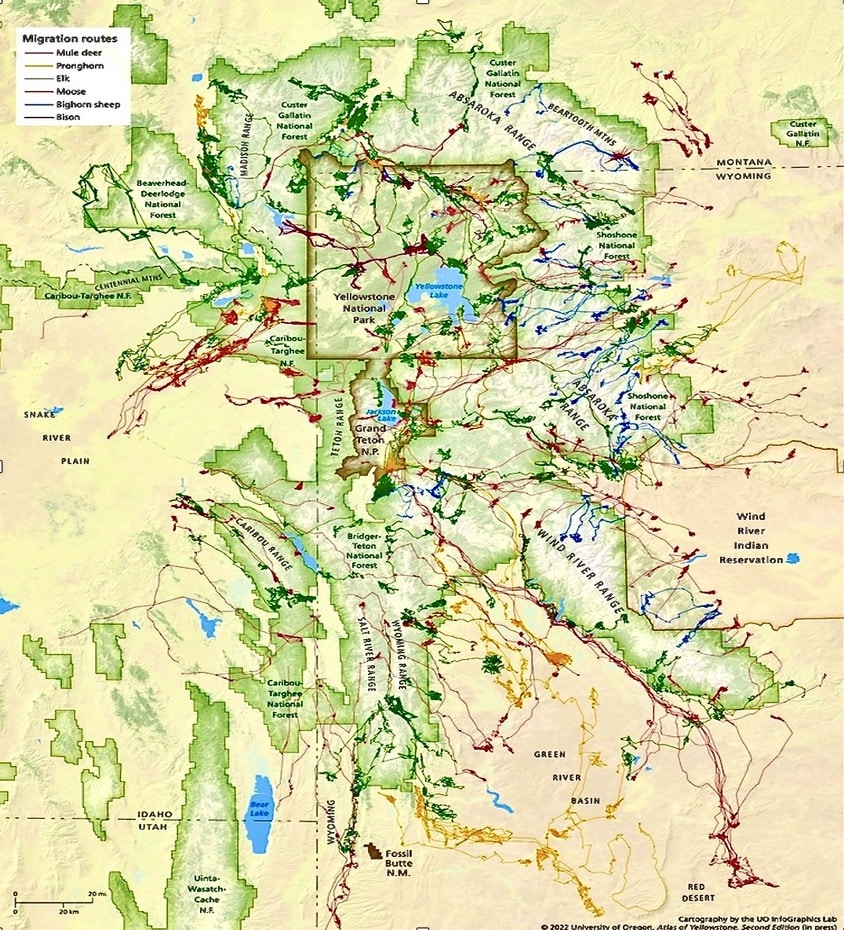
In 2017, after I had just co-founded a different online conservation journalism news site devoted to the Greater Yellowstone Ecosystem, one of my first investigative stories delved into a wicked problem few people wanted to discuss.
The topic was the impact of private land sprawl on wildlife and habitat, open space, local human quality of life, the imperiled persistence of mom and pop farms and ranches, and the economic downsides of growth, including the rising costs of providing services on county and city budgets.
The implication of the above is this: we all are paying to subsidize the very things we don’t want to happen, be it rising taxes, fewer services, navigating traffic congestion and having more stress in our daily lives.
It wasn’t that conservationists in Greater Yellowstone hadn’t confronted sprawl in the decades prior to 2017, but many groups had retreated from advocating for planning and zoning, preferring instead to adopt “softer” approaches to land protection (which have proven to be grossly inadequate amid the pace of change presently upon us).
Another factor was that in earlier attempts to confront growth issues, the unprecedented inundation of people that today is rapidly negatively transforming key Greater Yellowstone valleys—home to world-renowned wildlife migrations— hadn’t yet happened.

Local government officials, federal public land managers, county planning staffs, citizens, realtors, the media and yes, even conservation organizations, existed largely in a state of denial about the bigger hurricane that was looming and about to arrive. My story eight years ago began with a hike up the west side of the Bridger Mountains just outside of Bozeman with a land use planner who had spent decades in the West after growing up in Iowa.
Randy Carpenter was an expert on dealing with urban and rural development issues and he had worked alongside planner Lee Nellis and now-retired Livingston-based community conservationist Dennis Glick, first at The Sonoran Institute and then at an organization they founded with Jen Boyer (today a Gallatin County Commissioner) called Future West, which, sadly, is no more.
A decade into this new millennium, Carpenter had an epiphany, like Paul on the road to Damascus. He realized that while urban growth issues are important and difficult in their own right, they are generic concerns that apply to every region in the world. What sets Greater Yellowstone apart, and needs special attention, is its fabric of wild and natural lands that give us a shared identity of place.
Carpenter threw himself into pondering the impacts of growth on rural areas with a never-look-back tenacity and over the course of the last decades we’ve had many, many, many conversations with a variety of bright conservation scientists, current and former elected officials, traditional land use planners and others. Carpenter also has been a contracted land use planner advising the towns of Manhattan and Three Forks, Montana, which are currently dealing with the huge ripple effects of Bozeman’s sprawl radiating westward across the Gallatin Valley.
If one wishes to see three examples of how not to approach rural land use planning in otherwise inspiring settings, drive the corridor on Jackrabbit Lane from Belgrade, Montana southward to Gallatin Gateway, or take a look at the subdivisions dotting former wheat fields in Broadwater County on the way to Helena, or enter the visual chaos of Big Sky’s human anthill and imagine the caliber of wildlife that used to live in the West Fork drainage of the Gallatin River.
Here’s the thing. It’s startling and if you’re a citizen in Greater Yellowstone who cares about the future of the ecosystem’s biological integrity, you ought to be worried, very worried about the next phases of growth.

Few big picture land use planners—certainly few in county and city governments of Greater Yellowstone—have any wherewithal when it comes to large or local landscape conservation. Neither do elected officials. They are not paying attention or choose to be oblivious to the rapidly coalescing negative impacts of sprawl.
Urban planners don’t “get” or empathize with the needs of wildlife, they are conflict-averse when talking about enforceable planning and zoning (even when they know that voluntary conservation measures on private lands are not adequate enough), and most environmental groups are missing in action, too, because land use planning is hard but essential.
Most groups prefer trying to show they’re doing something by proposing to build more recreation trails but without reflecting on how our expanding maze of people is smothering wildness. And they spend lots of hours and money involved in feel-good consensus and collaboration sessions discussing how more finite land can be divvied up among human users.
Consensus and collaboration, by its inherently flawed design, gives anti-conservation interests veto power over decisions that need bold thinking. And, when it comes to the caliber of land use planning necessary in Greater Yellowstone, it is a naïve and weak-kneed response to intense development pressure and huge amounts of money being invested by outside capital investment firms who view local planners as bumpkins. They [developers] have little respect for wildness, and treat “raw” rural real estate as gold mines there to be exploited as quickly and intensively as possible. Still, it’s supposedly wildlife-loving consumers who are buying their products and living in the wrong places.
Back in 2017, Carpenter said Greater Yellowstone was on a rapid pace—faster than people realized—to become the very other places we claim to be different from: the unsightly, wildlife-challenged Front Range of the Colorado Rockies and the western side of the Wasatch Mountains flanking Greater Salt Lake City. He, of course, was right.
It isn’t that we don’t know better. Apathy seems to reign. Some conservation groups would rather pretend they’re doing important work by planting trees in urban boulevards rather than standing up to developers who are clearing both urban and rural forests; some groups would rather fund grizzly-proof trash cans instead of devoting staff time and resources to stopping sprawl that is destroying crucial habitat for bears and lots of other species. This is not to say that planting trees and installing bear-proof trash containers aren’t important, but groups seem confused about where the real priorities should be. It’s a little like putting up sandbags in an attempt to protect homes unwisely built in river floodplains. It isn’t confronting the cause of the problems.
In a bioregion jam packed with big egos and self-proclaimed adventurers, the sad truth is we lack the will to engage on the challenge of crafting a unifying vision to save the most iconic wildlife-rich ecosystem remaining in the Lower 48 states of America—which is supposed to be the most powerful and innovative country on Earth.
Randy Carpenter this week announced he is retiring from his job as Executive Director of a group called Friends of Park County and after three decades in land use planning. He had the guts to advocate for what people didn’t want to hear, but urgently needed to: we need a unifying regional plan; we need to get serious about land use planning fast; we need people of thick spines, fearless vision and business savvy; and we need to adopt a mantra that guided entrepreneurial-minded businesspeople like Ted Turner (about whom I wrote a biography titled Last Stand: Ted Turner’s Quest to Save a Troubled Planet).
Ted spends a good part of his year in Montana on ranches he protected with conservation easements. Back in Atlanta, there’s a sign that’s been positioned for many years on the desk in his office. It reads: “Lead, Follow, or Get Out Of The Way.” Turner applied that courageous principle to conservation. We need more heroes like him. We need more ecological awakeness in Greater Yellowstone, not more hollow ecologically-ignorant rhetoric of wokeness.
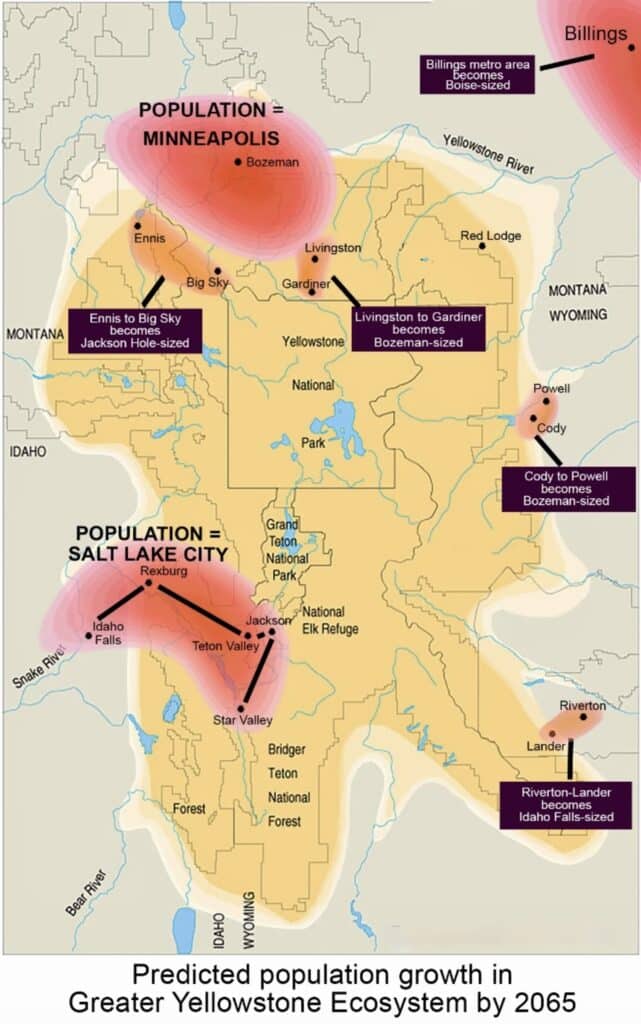
On the day when Randy Carpenter and I ascended into the Bridger Mountains and looked out across the Gallatin Valley toward the Tobacco Roots 40 miles to the west, Carpenter noted how the view is rapidly filling up and most folks aren’t prepared for what’s coming. Eight years ago we discussed the population growth rate in Bozeman/Gallatin Valley. At that time, it was about three percent. Using the Rule of 72, he calculated the implications of that out over the coming decades.
At a three percent population growth rate, it meant it would take 24 years for the population to double in size, to 220,000 people, and along with that would be a hugely-damaging development footprint given lax planning and zoning. In roughly 50 years, at that rate, it would double again, reaching 440,000 people (or roughly the size of Minneapolis proper, not the entire Twin Cities metro area but still huge).
Examining other available hard stats, he said in 2017 that if the growth rate of the previous 30 years continued, the overall permanent population of the Greater Yellowstone region would rise from 450,000 denizens to 677,000 in just a decade and a half. Most important, that translated into adding another 100,000 homes, replete with all of the trappings of impacts they bring individually and combined.
Realtors and developers expressed incredibility when the story appeared, knowing that citizens, when presented with that reality, would be shocked. Developers locally and through their lobbyists in the state legislature have done everything possible to kneecap any attempts at implementing more restrictive land use practices to save the natural character of this place.
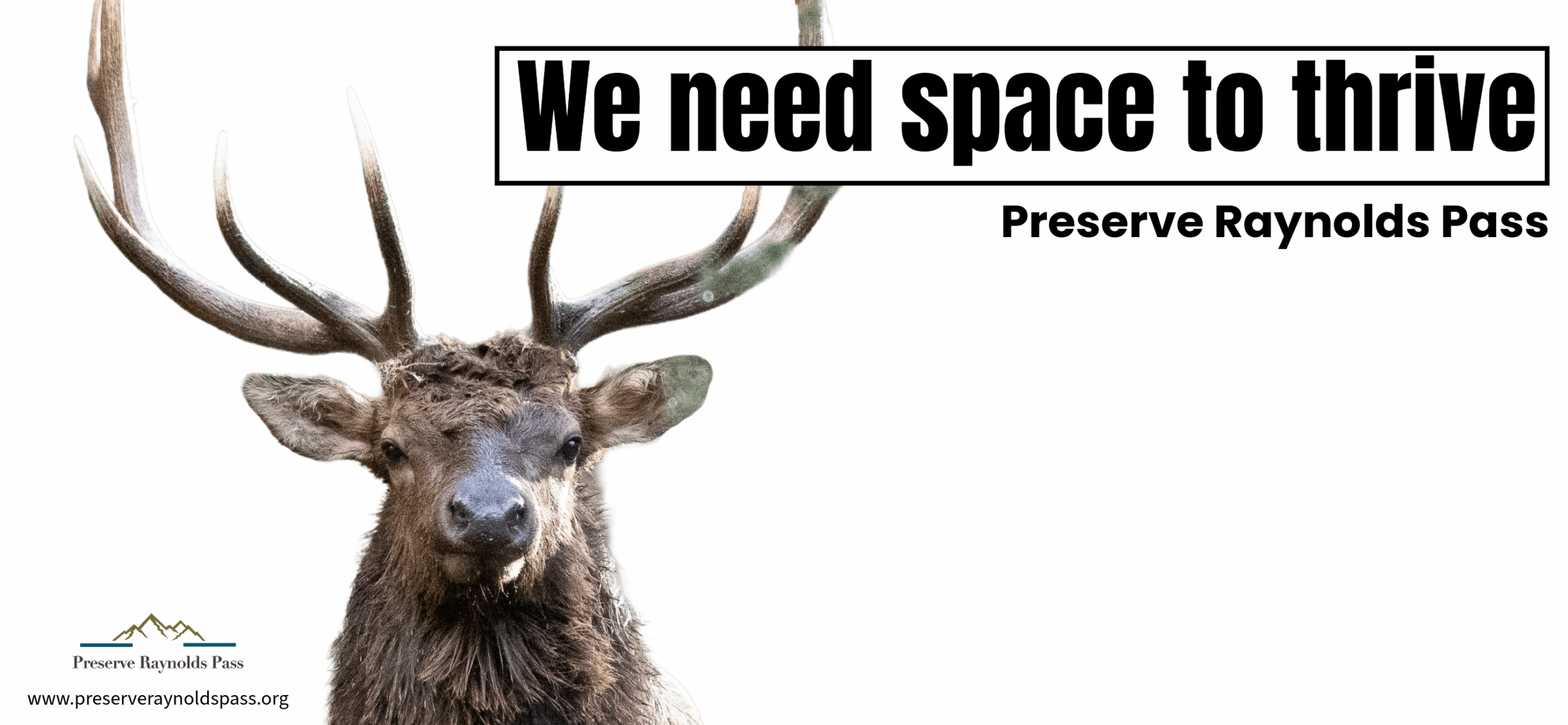
In fact, during Covid, population pressures soared. Inward growth rates surged, reaching 4, 5 and 6 percent in some places, closing the number of years before the population doubled. Parallel pressures arrived in Park County, Montana, Big Sky, Jackson Hole and Teton Valley, Idaho. Sprawl expanded on Raynolds Pass between the southern Madison Valley of Montana andIsland Park/Henrys Lake Flats, Idaho right in the middle of an important multi-species wildlife corridor.
During Covid, inward growth rates surged, reaching 4, 5 and 6 percent in some places, closing the number of years before the population doubled. Parallel pressures arrived in Park County, Montana, Big Sky, Jackson Hole and Teton Valley, Idaho. Sprawl expanded on Raynolds Pass between the southern Madison Valley of Montana and Island Park/Henrys Lake Flats, Idaho right in the middle of an important multi-species wildlife corridor.
But here’s the kicker, Carpenter noted. In many places the number of homes being built has outpaced population growth reflected in US Census figures. That’s because a huge percentage of new structures popping up are recreation and vacation retreats. Even if people only inhabit them for weeks or a few months each year, their physical impact on wildlands, increased vulnerability to wildfires and blighting of beloved views are permanent.
But here’s the kicker, Carpenter noted. In many places the number of homes being built has outpaced population growth reflected in US Census figures. That’s because a huge percentage of new structures popping up are recreation and vacation retreats that don’t show up on population ledgers. Even if people only inhabit them for weeks or a few months each year, their physical impact on natural land and wildlife, increased vulnerability to wildfires, groundwater (because of individual septic systems) and blighting of beloved views are permanent, Carpenter noted.
He added something else: the sprawl that people see today is actually a reflection of the past; it does not represent the filling in that is coming and with new developments waiting to be approved. “By the time people wake up to the visual impact of sprawl, it’s too late and often too expensive to recover what’s being lost,” he said.
Not long ago, Chet Work, executive director of the Gallatin Valley Land Trust, shared that for every acre protected through conservation easements, at least two other acres are being lost to development—on top of what’s already been lost. What that figure doesn’t reflect is that the negative effects of developed land are not confined to just the physical disturbance but result in cumulative zones from which wildlife vanishes.
Carpenter says we are deluding ourselves when band-aid remedies are presented as panaceas that let communities and citizens off the hook from confronting issues that make them feel uncomfortable.
For example, does anyone really believe that by installing expensive wildlife overpasses and underpasses along US Highway 191 near Big Sky, Montana, those structures will offset how nature continues to be trampled by development, and which, according to developers in Big Sky, is only at 65 percent of buildout?
Does anyone really believe that the water quality threat to the Gallatin River, already dealing with warmer, lower flows from climate change and recent algae blooms, will paradoxically go away with more growth? How does this happen with an expanding development footprint, more impervious surfaces channeling more surface runoff into the drainage and more people using more water, flushing PFAS “forever chemicals” down the sinks and toilets that may not be completely filtered out through the treatment process and then, as millions of gallons of treated wastewater, used in snowmaking and cycled back into the environment? Water monitoring will need to be vigilant and happen forever, analogous to water monitoring that happens at hardrock mines where potential release of toxic waste is a concern that never goes away.
What’s different here is that the Gallatin isn’t just any stream. It’s a vaunted river borne in Yellowstone National Park, held up as a world-class trout stream and an important headwater of the Missouri River. Recently, the Greater Yellowstone Coalition and American Rivers gathered with a realtor, outdoor recreation groups and Congressman Ryan Zinke of Montana to celebrate Zinke’s proposed legislation, called “The Greater Yellowstone Recreation Enhancement and Tourism Act,” that would classify a section of the Gallatin River near Big Sky as a federal Wild and Scenic River. Although the status would prevent construction of a dam on the Upper Gallatin (none are proposed), it will have no impact on accumulating development impacts at Big Sky, which far and away represents the river’s greatest threat. So, how much more protection for the river does Zinke’s legislation really offer the river, its fish, wildlife and sense of spirit? And, do the intensity levels of tourism and recreation really need to be enhanced on the Gallatin River?
These are the kinds of issues that beguile Carpenter as a protect-the-environment land use planner.
At Friends of Park County, Carpenter and his plucky board of directors focused on growth issues that extend from Yellowstone National Park’s front door in Gardiner, northward through Paradise Valley and Livingston into the Shields River Valley and flanks of the Crazy Mountains. He enlisted the help of Robert Liberty, who has more than 40 years of dealing with the thorny, legal, and more critically, the tough political issues of protecting rural lands and resources from low density sprawl.
Together, they pointed out, time and again, that fragmented thinking results in fragmented landscapes; and that piecemeal planning is ineffective in protecting the macro things communities value—including agricultural heritage.
Every day we hear from the false prophets of the so-called “free market,” which isn’t free nor pure and the rhetoric they spew is actually misleading and full of hidden agendas. Touting the primacy of individual property rights, it empowers the most ecologically-illiterate and greed-driven landowners to do almost whatever they want without concern given to impacts on wildlife and it often does not yield “better communities.” Often, it defies common sense and undermines the common good, our shared heritage and love of natural settings.
Yes, growth is inevitable, Carpenter says, but dumb approaches to dealing with growth are not.
When it comes to protecting an incomparable ecosystem, the disciples promoting a free market that is anti-regulation and anti-enforceable planning have led us into the mess we’re currently in and it will only deepen unless there’s a course correction.
This does not mean “heavy-handed government regulation” is the answer, but enforceable planning and zoning must necessarily be part of the mix of remedies; so too must taxes and fees imposed on millions of visitors.
These days, only people of significant financial means can afford to move into Greater Yellowstone. Hence, these major consumers of essential habitat and open space should also be paying real estate transfer taxes with the proceeds of those funds being cycled back to incentivize and reward conservation of rural lands and protection of wildlife corridors. A real-estate transfer tax and other initiatives have been employed in other states, including conservative Florida, with great success. In Florida, a tax of seventy cents is assessed for every $100 of home value. A median home sale price in the state—nearly $375,000—translates to a transfer tax of $2600 paid by either the buyer or seller. Note: lobbyists for the real estate industry in Montana advanced a successful ballot initiative in 2010, an amendment to the state constitution, that bans implementation of a real estate transfer tax. Critics say it’s a glaring example of how the agenda of the real estate industry is at odds with environmental protection.
If we want to save Greater Yellowstone we have no other choice but to consider revenue generating sources that can be applied to achieve better conservation outcomes.
Carpenter and others have helped to open my eyes about what’s at stake for Greater Yellowstone if we continue on the present trajectory and it’s one reason why I’ve approached my reporting at Yellowstonian with a heightened sense of urgency. In addition to comprehensive written stories, we’ve been featured on two different influential podcasts with Jack Humphrey of the Rewilding Institute (click here to view that one about sprawl) and another, here, with Jackie Batrus of the WILD Foundation, about the effects of human development on wildlands). We’ve also collaborated with respected groups and thought leaders in hosting public events to help educate citizens.
Journalism is failing to educate readers about the big picture. I’m happy to report that Yellowstonian’s stories have helped catalyze a few emerging grassroots efforts now focused on planning in communities throughout our region.
There are, however, only a handful of public-interest conservation groups working tenaciously on land use planning and holding county and city governments’ feet to the fire, which is the only thing that is going to result in coordinated ecologically-minded land use before it is too late.
Before he leaves, Carpenter deserves to take a bow. It’s time to stop making excuses for why we’re not capable of keeping the miracle that is the Yellowstone ecosystem intact. If you’re not working diligently and vocally to be part of the solution then in your silence and meekness you’re part of the problem. It’s time to rally around our own conservation version of Lead, Follow or Get Out of the Way in crafting a vision for the future.
“Randy’s extensive growth management expertise and experience has made Friends of Park County not only the go to source of information and advice on local planning issues, but also a statewide leader in citizen efforts to preserve what is special about Montana as we grow and change,” said Dennis Glick who serves on the Friends of Park County advisory board. “He will be sorely missed.”
Thank you, Randy Carpenter, for being a person who’s had the fortitude to speak an unpopular truth that must be acknowledged—human restraint in service to a greater public good— if we’re truly sincere about wanting to rescue a region that is America’s national natural treasure.