Book Review and Interview with Nate Schweber by Todd Wilkinson
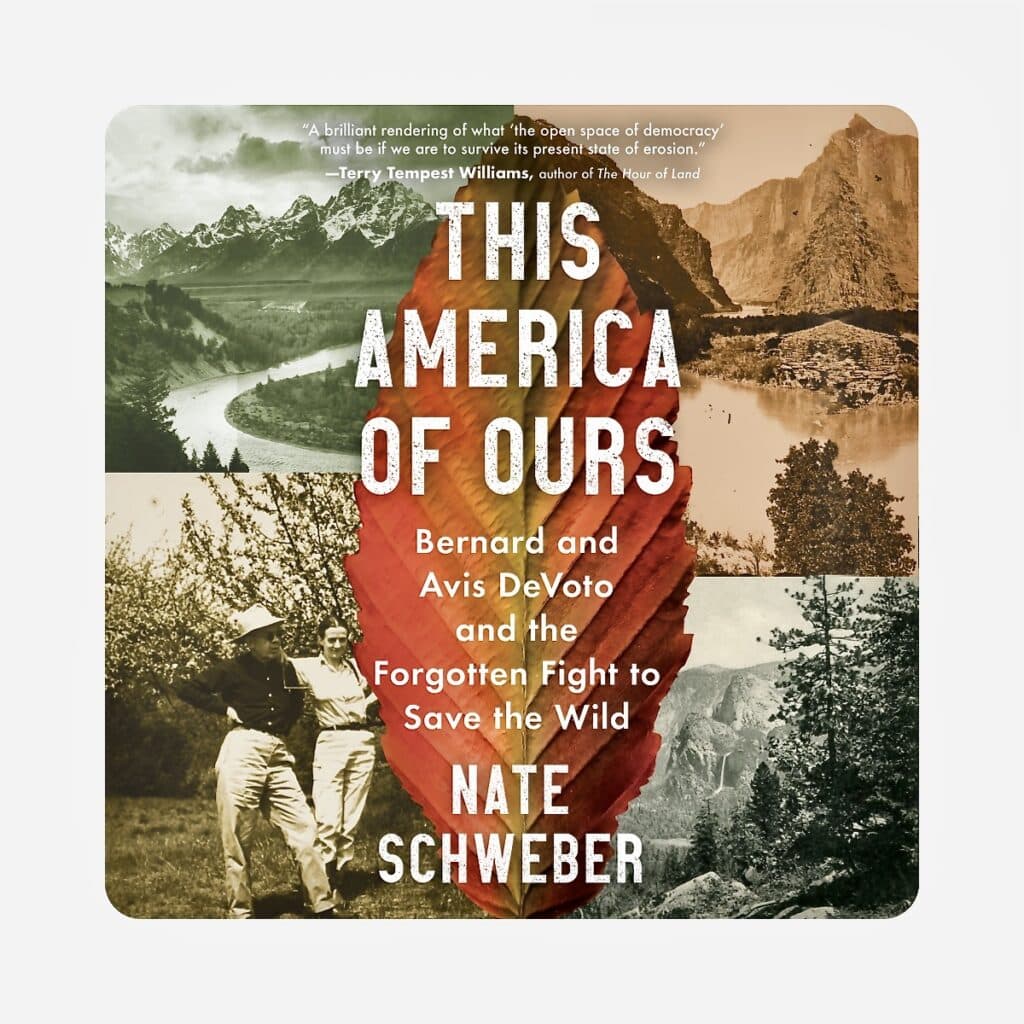
Every once in a while a book of history emerges that, while distilling the past, it more importantly serves as an urgent wake-up call for the present and functions as a warning about the future now being created. Such is the case with Nate Schweber’s recent and award-winning This America of Ours: Bernard and Avis DeVoto and the Forgotten Fight to Save the World.
I’m reading it again, and, amazingly, it becomes more timely with each passing day.
For Americans suffering from bouts of angst over the current plight of our democracy, the great news is the country has faced challenging times before and somehow our ancestors demonstrated common sense and resilience to get through them.
While generations’ past might have confronted adversity with more (perceived) civic unity, higher purpose and spine, the sobering reality is the state we’re in might be unprecedented. Regarding the wildlife and wildlands heritage of America, there are no places with more at stake than the West and Alaska. The superstructure of stewardship is being rapidly unraveled on so many different fronts.
Schweber’s subjects, famous historian-journalist Bernard DeVoto (1897-1955) and his wife, Avis (1904-1989), are two people who exuded extraordinary grit in confronting spasms of extremist ideology. They did not march down streets carrying signs chanting “Hey-hey, ho-ho, environmental plundering has got to go!” and then headed home in a state of self-satisfaction. Tenaciously and tirelessly, they pushed to hold those in power to account.
Schweber, and by him illuminating the DeVoto’s advocacy, trials and tribulations, makes clear, again, that everything about both the reality and myths of the American West come down to having a healthy relationship with the land, and not treating nature primarily as an adversary to be tamed, conquered or monetized.
No one can dispute that public lands, which represent, or at least are supposed to be an expression of uniquely American democratic values, have been a cornerstone of Western identity.
But at this moment, obvious and insidious efforts are underway, maneuverings that were deemed radical, impetuous and lawless by earlier generations of citizens and bi-partisan lawmakers they elected, which stand to dramatically change the way public lands are stewarded.
Among the concerns: talk of divesting public land; gutting, defunding and setting in place schemes to privatize the function of federal land management agencies; weakening federal laws relating to imperiled species, wilderness and roadless land protection, clean air, clean water, water allocation, and science-based protocols; intimidating and muzzling scientists whose evidence does not support ecologically-ignorant political agendas; acting, by fiat, to undermine the right of the public to review and challenge decisions affecting public lands and wildlife that belong to them; and doing away with mandates of transparency put in place to prevent corrupt, brazen crony capitalism whose dictates are handed down by neo robber barons.
Among the concerns: talk of divesting public land; gutting, defunding and setting in place schemes to privatize the function of federal land management agencies; weakening federal laws relating to imperiled species, wilderness and roadless land protection, clean air, clean water, water allocation, and science-based protocols; intimidating and muzzling scientists whose evidence does not support ecologically-ignorant political agendas; acting, by fiat, to undermine the right of the public to review and challenge decisions affecting public lands and wildlife that belong to them; and doing away with mandates of transparency put in place to prevent corrupt, brazen crony capitalism whose dictates are handed down by neo robber barons, some of whom are land developers.
These are just a few of the worries about an epic backslide in an approach to conservation that has been a beacon in the world. One of the consequences has been a traumatic free-fall in the morale of dedicated public land careerists who took their jobs seriously because they love what they do, not because they are paid well. Many, in fact, are overworked and forced to do more with fewer and fewer resources.
The irony is that while those in free-market think-tanks either support or sit silent as the litany of the above plays out, they say that government needs to run more like private businesses. But no sane CEO would ever run a company under the chaotic conditions created by those serving in Congress or nameless, faceless people apparently answerable to no one working for the shadowy agency known as the Department of Government Efficiency (DOGE).
In many ways, the public is unaware of the scale and magnitude of what’s going on. This provides the backdrop for pondering the DeVotos who used their standing to blow the whistle and stand up against attempts to silence them.
Bernard DeVoto, a multiple Pulitzer Prize winning author, is arguably this country’s first major historian who incorporated ecological understanding of the American West into analysis. Together with the charismatic Avis DeVoto, who at the very least was his equal as a deep thinker, they advocated for the conservation of nature, social justice and critiquing the costs of Manifest Destiny. They were a tour de force concerned about the future their kids would inherit. A true delight was learning how Avis was a confidante, friend and assistant to the first TV culinary superstar, Julia Child.

Schweber refers to Avis as “a heroine of American conservation.” It’s not just that the DeVoto’s were impactful, but they still influence a continuing succession of historians and writers—among them Wallace Stegner, Terry Tempest Williams, Patricia Limerick, Vine Deloria, Dan Flores and perhaps the most important conservation minded historian of our time, Douglas Brinkley.
Only pages in, it’s impossible to ignore the “past is prelude” motif that carries readers through till the end, but Schweber is not here to preachily dispense a lecture. Rather, he lets us draw our own conclusions. Still, for any conscious human who is modestly aware of what’s happening, the story of the DeVotos is fascinating, jarring and, in an odd way, reassuring. In their day, the pillars of democracy held though we may never have seen a seismic shake like this before.
In the name of progress, is the American West moving forward or backward? Ponder this question in our interview with Schweber about his important book. It’s a must-have on your shelf. Schweber, a native Montanan who lives in New York and has been a correspondent for The New York Times, is not only a talented freelancer, but he sings in a band and while growing up in Missoula was a tuba player.
Our Interview With Author Nate Schweber
Todd Wilkinson: Your story about Bernard and Avis DeVoto won a well-deserved High Plains Book Award and Best Book of the Year from the Outdoor Writers’ Association. I keep coming back to its pages, because the poignancy of the DeVotos has risen higher as we move through some astonishing times (and I use the word “astonishing” as an aspersion meaning troubling). Decades of hard-won conservation is being erased. Even Theodore Roosvelt’s great grandson, TR IV, a respected lifelong Republican, businessman, hunter, angler, proud conservative conservationist and fan of both Yellowstonian and the Greater Yellowstone Ecosystem, is alarmed and has said he’s compelled to speak up. Given what’s happening, how is the story of the DeVotos helpful now?
NATE SCHWEBER: The DeVotos lived through dark times eerily similar to ours. There was a movement to sell off public lands in the West. A demagogue was the most prominent politician in America. The DeVotos had to figure out how to stop the selloff of public lands and keep national parks from falling to ruin. Amazingly, they did. Their story is inspiring because it gives broad lessons in how to defend public lands: stay vigilant, learn history, educate others, be loyal to each other, build coalitions, contact your member of Congress, and keep faith — especially in hard times. The DeVotos show that not only are conservation victories achievable, they can also have surprising and wonderful ripple effects. The story of how Julia Child became a superstar? It’s a conservation story.
Wilkinson: What was it that originally caught your eye about the DeVotos, inspired you to plunge into their lives, and what were some of the epiphanies you had?
SCHWEBER: I was born and raised in Missoula and after college there I moved to New York City in 2001. I was miserably homesick, which made me feel very surprised and uncool. Because I couldn’t physically live in Montana I tried to mentally live in Montana by reading books about the West. This led me to Bernard DeVoto. He changed my life.
Wilkinson: How so?
SCHWEBER: The way DeVoto could so powerfully explain things I had thought but could not express in Montana made me feel like I had been snagged under a mountain creek and was suddenly lifted into the atmosphere to gasp air. That sounds dramatic, but it gets to how I feel.
“The West Against Itself” is the title of probably DeVoto’s most important conservation essay. When published in Harper’s in 1947 it exposed and thwarted a plot to sell off as many as 230 million acres of public lands. That title summarizes a key DeVoto theme. Westward expansion, as DeVoto revealed it, was a series of natural resource raids: fur, gold, grass, timber, water, oil, land. Wealth was siphoned to the East and the West was left impoverished and in many places uninhabitable. In the nick of time, the federal government protected public lands to keep natural resource wealth and habitable land in the West.
“The West Against Itself” is the title of probably DeVoto’s most important conservation essay. When published in Harper’s in 1947 it exposed and thwarted a plot to sell off as many as 230 million acres of public lands. That title summarizes a key DeVoto theme. Westward expansion, as DeVoto revealed it, was a series of natural resource raids: fur, gold, grass, timber, water, oil, land. Wealth was siphoned to the East and the West was left impoverished and in many places uninhabitable. In the nick of time, the federal government protected public lands to keep natural resource wealth and habitable land in the West
Wilkinson: We try to play the same kind of watchdog journalism role at Yellowstonian. With all due respect to Easterners and others from more populated states, some don’t know what to make of the rural “flyover” wild West. They see it as empty and in its’ perceived vacantness, being ‘good for nothing,’ not doing anything, worthless. And yet, because they have large numbers of people and more representatives in the House, they set policy that can be, at best, uninformed if not misguided. They want to fill up the West with industrial resource extraction to remove commodities, be it oil, gas, coal, grass or through tourism revenue generated through the growing juggernaut of outdoor recreation. But the activity isn’t benign and can have huge negative cumulative effects. I’ve often said, they “don’t get” wildlife and either don’t understand the importance of secure habitat or don’t care.
SCHWEBER: In the DeVotos’ time and going back to the time of Manifest Destiny, some Westerners sided with urban Easterners and demanded to plunder what had been saved. DeVoto called this a “psychic split” and “the West committing suicide.”
He explained that the culture hero that came to represent this psychic split is the cowboy. In whose mouth words like “freedom,” “liberty” and “local control” really mean: “get out and give us more money.” I never learned anything more bracing and clarifying about where I’m from.
“In the DeVotos’ time and going back to the time of Manifest Destiny, some Westerners sided with urban Easterners and demanded to plunder what had been saved. DeVoto called this a “psychic split” and “the West committing suicide.” He explained that the culture hero that came to represent this psychic split is the cowboy. In whose mouth words like “freedom,” “liberty” and “local control” really mean: “get out and give us more money.” I never learned anything more bracing and clarifying about where I’m from.”
Wilkinson: Bernard DeVoto’s life spanned a period of time, 1897-1955, when we as a country were making sense of the raw plundering of nature that happened in Montana, Wyoming and Idaho. His book, The Course of Empire, was published in 1952 and it was assigned as a necessary read during my own history classes in college. He grew up in Utah, gazed awestruck at his native West—and let’s be specific, the public land-rich West belonging to all Americans—but he recognized the finiteness of wild places and the pace at which they were being lost. Was it sorrow that existed inside him as he reflected on what was squandered, anger, what?
SCHWEBER: It was patriotism. Yes, DeVoto felt sorrow and anger when he learned of public land threats. But that came from a place of deep patriotism. He was a Pulitzer Prize and a National Book Award winning historian. America was his subject and his passion. Avis always tried to get him to go to Europe. He drove her nuts, explaining he couldn’t leave the continent until he had seen Independence, Missouri, El Paso, Texas, and the junction of the Green and Colorado Rivers. DeVoto saw the long, hard struggle that led America to becoming the first country on earth to make public lands conservation national policy as among its gifts to humankind. Certainly he adored wild landscapes, starting with his native Utah. The natural beauty of the Rocky Mountains, the High Plains, Southwestern deserts and canyonlands, made his soul sing. But it was a patriotic song. Because to him the protection of these places fulfilled America’s enlightenment ideals.
DeVoto had no illusions that human beings were always, or even often, noble. But he did have faith that people living freely in the American system would, eventually, act wisely. He deeply mourned, regretted, and hated all the wild places and good land that had been wrecked in the slow, democratic process of the country getting to finally protecting public lands. Once achieved, however, he could no more fathom going backward than he could reversing the outcomes of the Civil or the Revolutionary Wars. This is why he— and Avis—were ready to fight for conservation to the death.
“DeVoto had no illusions that human beings were always, or even often, noble. But he did have faith that people living freely in the American system would, eventually, act wisely. He deeply mourned, regretted, and hated all the wild places and good land that had been wrecked in the slow, democratic process of the country getting to finally protecting public lands. Once achieved, however, he could no more fathom going backward than he could reversing the outcomes of the Civil or the Revolutionary Wars. This is why he— and Avis—were ready to fight for conservation to the death.“
Wilkinson: Let’s pause here and point out how the DeVotos were a team. So often in Western history, it’s men who enjoyed the name recognition and received the attention. Share with readers here some of the many things you admire about Avis DeVoto, as passionate advocate for wilderness and wildlife, public lands, civil society and decency.
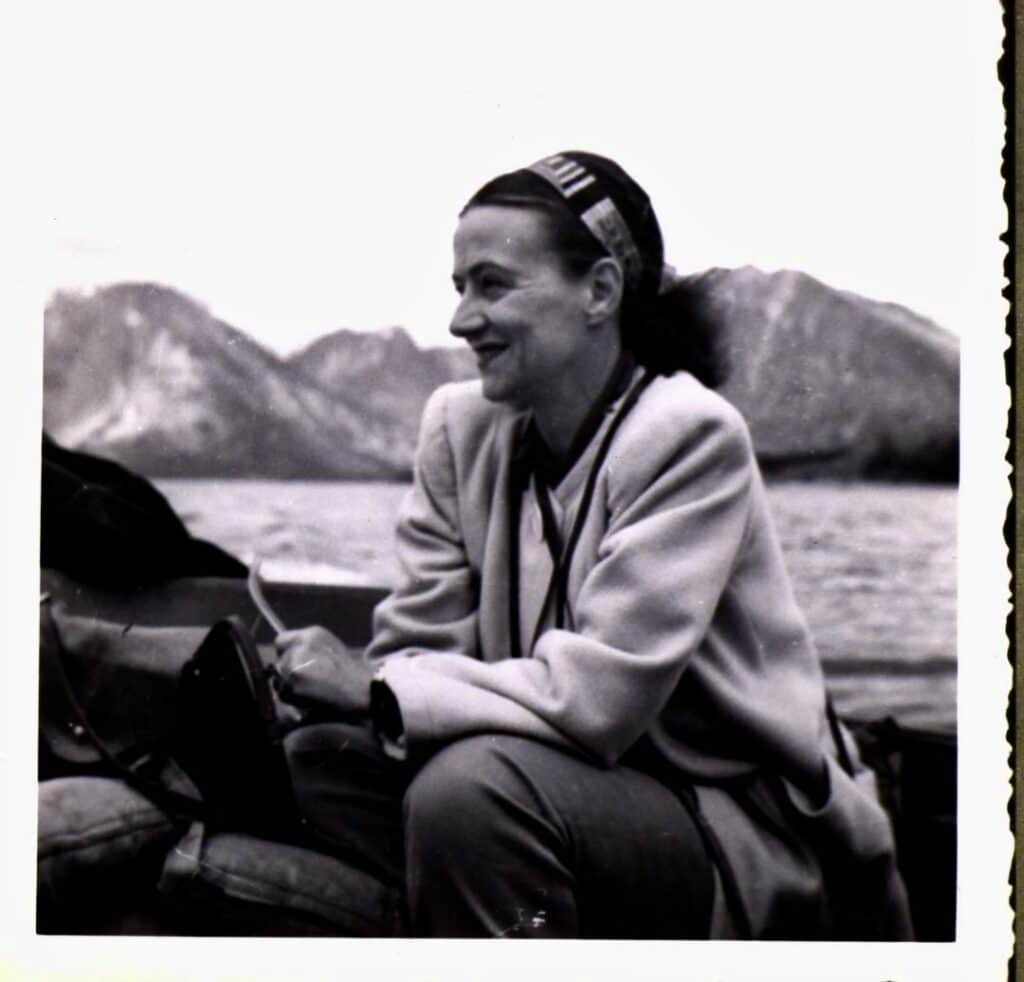
SCHWEBER: With this project I was excited to introduce readers to a heroine of American conservation, Avis DeVoto. The DeVotos’ mutual friend, Wallace Stegner, ranked Bernard up there with Theodore Roosevelt and Gifford Pinchot. Avis should be up there too because without her, there would have been no Bernard. Every word he wrote, she edited. Avis guided Bernard through ideas and structure.
When Bernard went through suicidal depressions, she pulled him through. Avis was as smart and funny as Bernard and by his admission she wrote better prose. They had a great, if sometimes fraught, marriage because they shared a love of books, food, and national parks. One of Avis’ most admirable traits was her toughness.
Wilkinson: Can you elaborate on that?
SCHWEBER: Bernard marveled at how she was so tough. Me, too. FBI agents visited her home. Joe McCarthy attacked Bernard nationwide. It never fazed Avis. She and Bernard continued standing up for public lands, the Bill of Rights, and their friends — even when it could have cost their livelihood and freedom.
Avis suffered great tragedy, but she — to borrow a phrase — persisted. She went from being the indispensable partner of the mid-20th century’s most important conservation writer to being the indispensable partner of the mid-20th century’s most important chef made famous on TV, Julia Child. Avis shows what can happen in a life lived with bravery, loyalty, smarts, toughness, and love.
Bernard DeVoto marveled at how his wife, Avis, was so tough. Me, too. FBI agents visited her home. Joe McCarthy attacked Bernard nationwide. It never fazed Avis. She and Bernard continued standing up for public lands, the Bill of Rights, and their friends—even when it could have cost their livelihood and freedom.
Wilkinson: You are a Montanan living in the East. What is it that Easterners do not understand about the West and why is it mportant they understand now?
SCHWEBER: When DeVoto moved from the West to the East, people thought he had to be a cowboy. A hundred years later, people thought that about me too. Which speaks to a lasting misunderstanding: that cowboyism defines being a Westerner. What cowboyism can define — and the amount that this is misunderstood in the East is rivaled only by how much it is also misunderstood in the West — is exploiting and despoiling. In the 1800s, Western natural resource wealth, liquidated and siphoned away, built Eastern financial titans like Astors and Rockefellers. In the early 1900s farsighted Easterners like Teddy and Franklin Roosevelt enacted public lands conservation to curb that exploitation and monopolization, and disperse the West’s natural resource wealth broadly, sustainably, and locally.
Despite the geographic distance, the East and the West are interconnected in tight, dynamic tension. Wise Eastern politicians allied with masses of the least-powerful Westerners. Rapacious Eastern businessmen allied with a few of the most-powerful Westerners. That’s the tension. That’s the balance. The tools used to keep it from tipping into catasrophie are federal conservation agencies, the Forest Service, the Bureau of Reclamation, the National Park Service, and the Bureau of Land Management. Certainly they’re imperfect. Just as certainly the thriving of tens of millions of people (alongside wilderness and wildlife) in the dry and delicate West today testify to their achieving a miracle. Sustaining this miracle is of obvious importance to Westerners — their survival is at stake. But it’s of equal paramount importance to Easterners. As DeVoto put it right before he died, imagine the Southwest’s water supply shrinks below the needs of its population (as it did in the 1200s to the Ancestral Puebloans). Where do all the refugees go, and who pays for their resettlement?
Wilkinson: What’s commanding your attention these days?
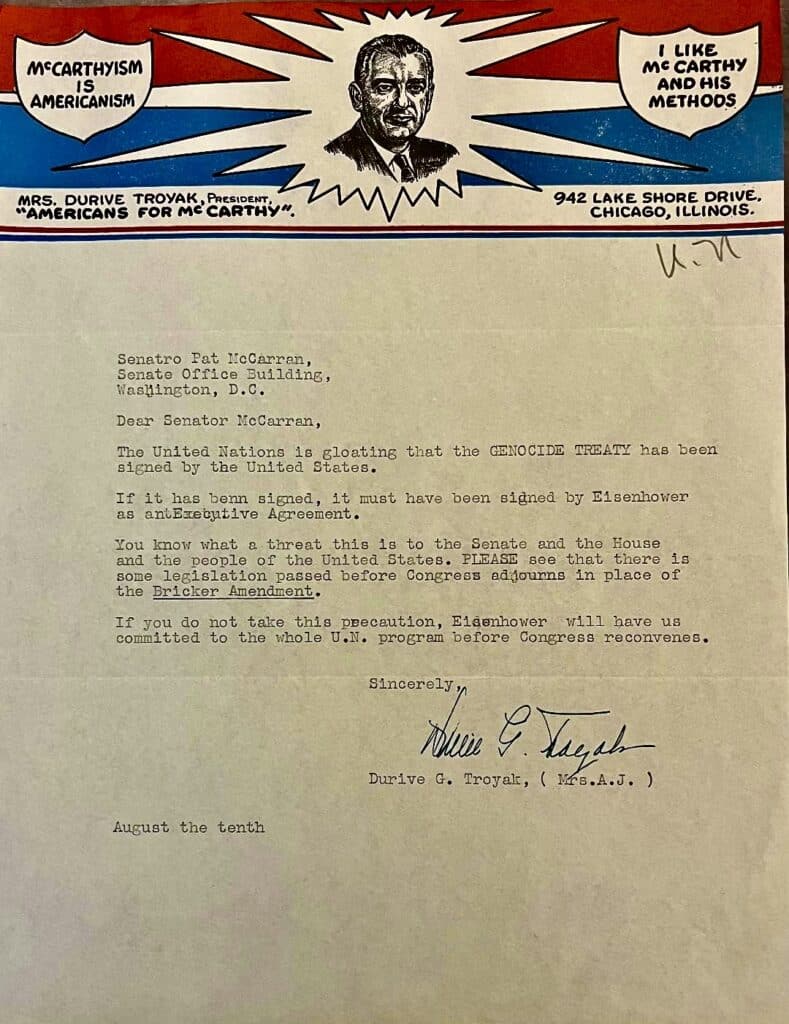
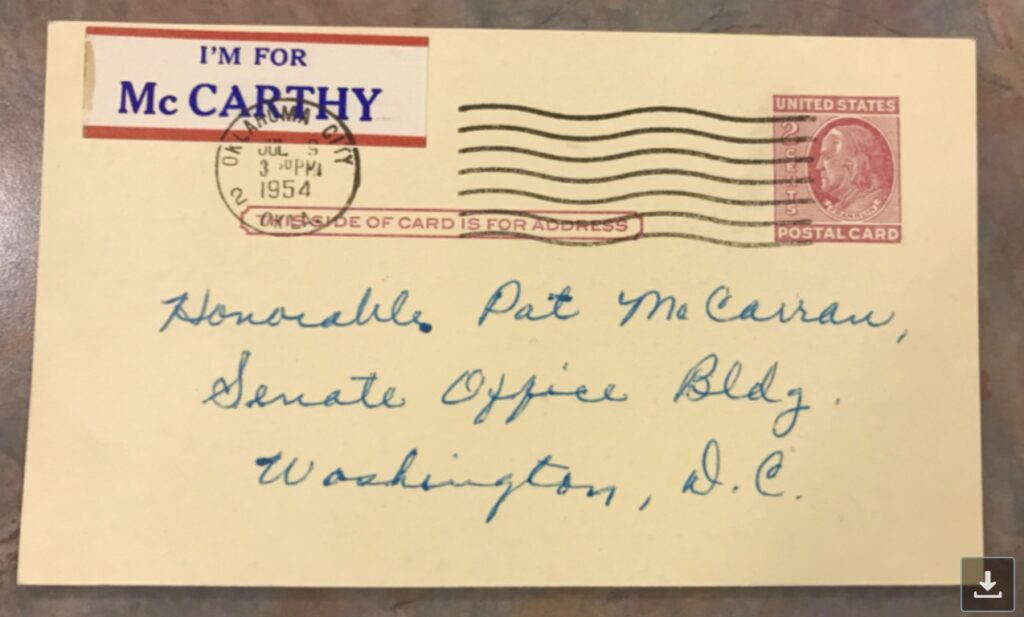
SCHWEBER: Commanding my attention is the zombie legacy of the bad guy in my book, Nevada Senator Pat McCarran, one of America’s great enemies of freedom. It was he who defunded Franklin Roosevelt’s conservation-focused Grazing Service. Its remnants were folded in 1946 into the moribund and historically-corrupt General Land Office to create the industry-friendly Bureau of Land Management — exactly what McCarran wanted. It’s the only destruction of a conservation agency in our history.
But we’re seeing its setup happening again with the terrible cuts to the Forest Service, the Park Service, the BLM, and elsewhere. McCarran had justified his cuts by staging a series of propaganda hearings across the West where he portrayed conservation professionals as a “swivel-chair oligarcy” untrustworthy and undeserving of fair treatment. Those show-trial tactics got picked up by his political godson, Joe McCarthy.
Wilkinson: That’s US Sen. Joseph McCarthy, who carried out the notorious “anti-communist” hearings on Capitol Hill that destroyed lives and careers based on mere rumors and unfounded innuendo. The irony of McCarthy’s tactics is that they were right out of the playbook of Joseph Stalin and were later widely condemned as being oppressive and anti-democratic by President Ronald Reagan when he demanded that Soviet President Mikhail Gorbachev tear down the Berlin Wall separating Eastern and Western Europe.
SCHWEBER: McCarran and McCarthy were just as dishonest in their day calling their dissenters “enemies,” “communists,” and “disloyal” as today’s administraiton is uncreative in parroting their language. It is grimly ironic, considering McCarran’s virulent anti-Semitism, that he was the force behind the 1952 immigration law under which Palestinian activist Mahmoud Khalil was just jailed without being charged with a crime, and the snatching off the street of Tufts student Rumeysa Ozturk for having written in her student paper an editorial the administration doesn’t like. Where does violating the Bill of Rights lead us?
Wilkinson: Your conclusion?
SCHWEBER: When Harry Truman unsucessfully vetoed that McCarran law in 1952 he said that seldom had a bill “exhibited the distrust evidenced here for citizens and aliens alike — at a time when we need unity at home, and the confidence of our friends abroad.” Truman’s diagnosis of what we need should command all of our attention during today’s rank reanimation of McCarranism.
Wilkinson: What do you think the DeVotos would make of the inundation of mountain valleys occurring today, filling up with lifestyle pilgrims, many of whom are ecologically illiterate. What would they make of the impacts of sprawl and intensifying outdoor recreation pressure? Some observers believe that we are now in the throes of land grabs driven by Manifest Destiny 2.0
SCHWEBER: Mercy, I could write accurately what the DeVotos thought right up until they died because of their wealth of published books, unpublished letters, and Bernard’s FBI file.
I really shouldn’t speak for them now in the same way Ray Romano shouldn’t speak for Mark Twain. But think I’m on safe ground saying the DeVotos would be aesthetically dismayed, environmentally worried, and politically angered with the modern West. Bernrard DeVoto spent his life writing about how the West has limits. Specifically: water. Water-gulping, land-wrecking sprawl, in addition to its ugliness, and its isolating of people, represents heedlessness to the West’s natural limits.
Transplants who know only myths about the West are like the boosters of yore who assured that rain followed the plow—not the Dust Bowl. Trophy and non-primary homes represent a hoarding of wealth; especially a 21st-century kind of hoarding of Western wealth: access to public lands.
Wilkinson: This gives the DeVotos remarkable contemporary relevance and a way of pondering how we are not “loving wild places to death;” we are mercilessly using them up to their death leaving behind of vacantness of their wild residents, yes?
SCHWEBER: I imagine DeVoto would feel about destructive recreation similarly to John Maclean, who has called for a permitting system to stop overcrowding on his family’s beloved Blackfoot River. DeVoto was a disciple of Gifford Pinchot, the first US Forest Service chief in 1905, who defined conservation as “the greatest good to the greatest number for the longest time.”
Just before he died Bernard DeVoto tried to set up a meeting to tell John F. Kennedy that America needed “a mid-twentieth century Pinchot.” I’m confident DeVoto would say we need the same for the twenty-first century—and that he would say it emphatically.
EDITOR’S NOTE TO READERS: This America of Ours: Bernard and Avis DeVoto and the Forgotten Fight to Save the World is available wherever books are sold but we highly recommend that you support the economy of your local community by purchasing it from your favorite local indy bookseller.