By Todd Wilkinson
In his famous conversation with writer John McPhee which appears in the book Encounters with the Archdruid, the late conservationist David Brower said:
“Conservationists have to win again and again and again. The enemy only has to win once. We are not out for ourselves. We can’t win. We can only get a stay of execution. That is the best we can hope for.”
Two fitting examples of Brower’s Sisyphean analogy are now writ large: the first involves a push being made by US Secretary of Agriculture Booke Rollins to undo a quarter century of special protection for nearly 60 million acres of US Forest Service roadless lands—public lands valued by hunters and anglers because they’re home to still- healthy fish and wildlife populations, and not bulldozed by roads, carved up by clearcuts and rattled by ATVs.
The other example is a maneuver underway to reverse a ban copper and nickel mine backed by a Chilean company. It would be built on the edge of the Boundary Waters Canoe Area Wilderness (BWCAW) in northern Minnesota. The BWCAW also is hailed by sportsmen, recreationists, tourism officials and generations of Americans who have gone there.
At the forefront of the fight to allow mining in the Boundary Waters headwaters, which is to say, weighing in on the side of a foreign developer, is Rollins, Congressmen Pete Stauber of Minnesota, Ryan Zinke of Montana and a cohort of GOP lawmakers who are making strides to also undo protections for a larger suite of federal lands. Read our recent Yellowstonian story about it here.
What few readers here don’t realize, or might have forgotten, is a connection between the owner of the Chilean mining company, the Luksic family, who want the Twin Metals Mine to proceed, and the Trump family. During the first Trump Administration, the Luksic family rented a building they own in Washington DC to serve as a residence for Ivanka Trump and Jared Kushner, the President’s daughter and son in law.
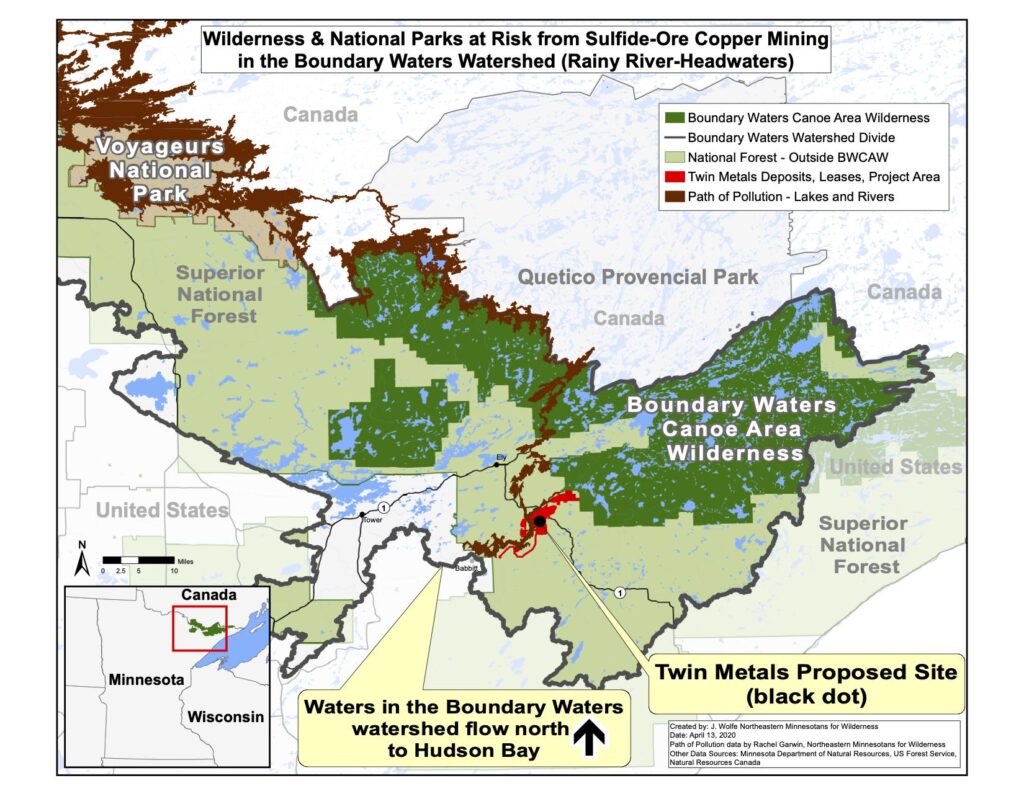
A few years ago, nature advocates thought they had a won a victory for Boundary Waters protection when President Joe Biden implemented a 20-year ban on mining inside a quarter million acres of the Superior National Forest where the Luksic-owned company, Antofagasta, wants to extract copper and nickel. Antofagasta gained controlling interest of the mine in 2015 and operates in the state today as Twin Metals Minnesota. The minerals are found in an ore body known to contain sulfides. Sulfides, when exposed to water, can create sulfuric acid, which is toxic to aquatic ecosystems.
Interestingly, during the first Trump Administration, Luksic family and Antofagasta found an ally in Zinke when he served as Interior Secretary. This week during a phone call with Ted Roosevelt IV, the great grandson of President Theodore Roosevelt, he emphasized that TR would stand opposed to the Twin Metals Mine and the Trump Administration ignoring evidence of how it represents a serious threat to water quality. Ted Roosevelt IV said gambling that harm will never arise to the Boundary Waters from mining is short-sighted, ill-considered and anathema to the notion his great grandfather supported which is that some places on earth should be safeguarded with every precaution taken.
A few years ago, while on a summer trip back to Northern Minnesota and Ely, near where the mine is proposed, I interviewed Boundary Waters advocate Becky Rom, a passionate defender. She is the daughter of a legendary environmental activist and her family operated a canoe outfitting business. They also were friends with writer and conservationist Sigurd Olson, counted among the foremost wilderness advocates of his time, along with Aldo Leopold, the Murie family of Jackson Hole, and Howard Zahniser, who influenced the writing of The Wilderness Act of 1964.
Indeed there are many human connections between the battle in the Boundary Waters and wilderness protectors in Greater Yellowstone and the Northern Rockies.
Three years after Biden was elected in 2020, his Administration imposed a 20-year ban on hardrock mining. Rom expressed hope that the Biden action would result in a permanent withdrawal of mineral leases that had been removed by the Obama Administration then reinstated by the Trump Administration and which Antofagasta needs for its project to move forward.
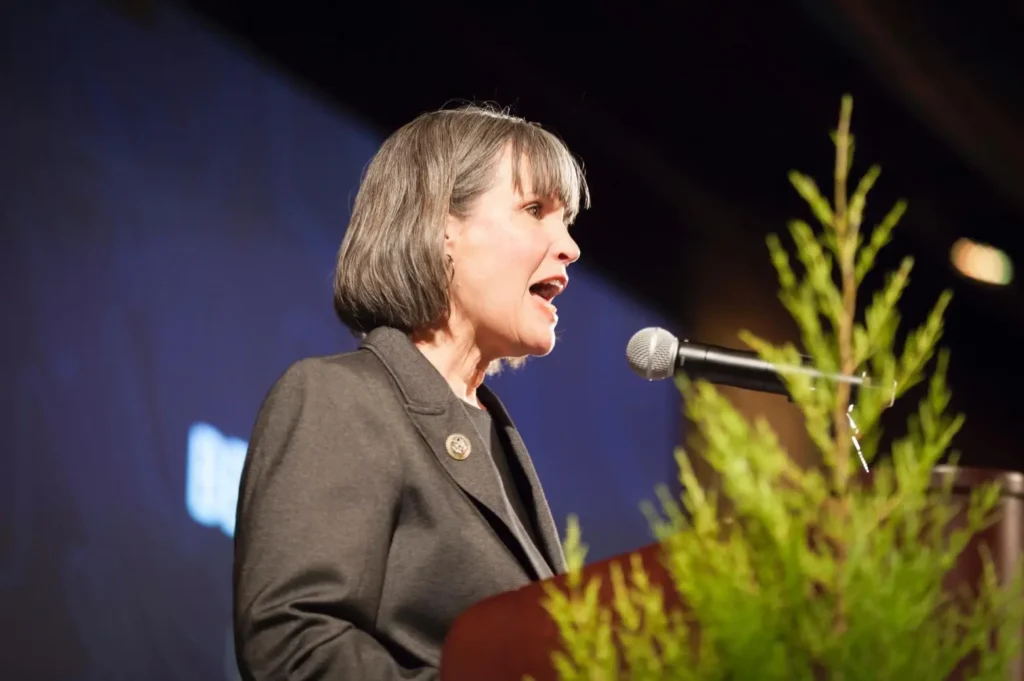
Permanent withdrawal of mineral leases is in a bill authored by outgoing US Sen. Tina Smith (D) and builds on a similar measure introduced to the House by Congresswoman Betty McCollum (D), both of Minnesota.
Rom is worried that the Twin Metals project will be resurrected, and efforts to achieve that are now underway with Zinke and Stauber rallying the House to pass H.J. Resolution 140, using an obscure law called the Congressional Review Act to get the ban overturned. The issue is now before the US Senate. Read what Stauber wrote as his rationale for reversing the ban.
US Sen. Amy Klobuchar (D), Minn. appears to be waffling on whether she will support permanent Boundary Waters protection, despite strong opposition to the Twin Metals project in her state and the fact that her father, the late legendary columnist for the Minneapolis Star & Tribune, Jim Klobuchar, supported safeguarding the BWCAW at all costs. That sentiment is shared by Randy Newberg, a Minnesota native who hosts Fresh Tracks, the most popular podcast devoted to public land hunting and fishing, and by Steve Rinella, founder of MEATEATER and his colleague Cal Callaghan. Both Fresh Tracks and MEATEATER are produced in Bozeman.
Ironically, or perhaps, poignantly, the battle to stop Twin Metals has close parallels with a fight waged in Greater Yellowstone against a Canadian company in the 1990s hoping to build a goll mine just off the northeastern corner of Yellowstone National Park. That project, backed by Noranda Minerals, was halted due to intervention by President Clinton.
My conversation with Rom, below, is just as timely now as it was when originally published. Rom is former chair of The Wilderness Society’s governing board. She also has been active in Alaska public lands issues, serving as a board member of the Alaska Wilderness League and founding and chairing the Alaska Coalition of Minnesota. She also is former president of Twin Cities Community Land Bank, a nonprofit organization that provides a variety of services for urban redevelopment of the Minneapolis/St Paul metropolitan area.
The Wilderness Society, she points out, identified 74 places in the United States that are crucial to sustaining biodiversity in the face of a changing climate. These areas have three essential characteristics: an especially high degree of wildness; connectivity to existing protected areas; and diversity of unprotected species and ecosystem types. The analysis found that the Boundary Waters- Quetico region is one of the top places in the nation with this “Wildland Conservation Value.”
The Wilderness Society identified 74 places in the United States that are crucial to sustaining biodiversity in the face of a changing climate. These areas have three essential characteristics: an especially high degree of wildness; connectivity to existing protected areas; and diversity of unprotected species and ecosystem types. The analysis found that the Boundary Waters- Quetico region is one of the top places in the nation with this “Wildland Conservation Value.”
She is s stickler when it comes to understanding the sometimes arcane language of federal code and regulations. For over 30 years Rom practiced law at Faegre & Benson, a law firm that has engaged in a national public interest practice in public lands and wildlife protection. The Greater Yellowstone Ecosystem, with wild lands that support the last, most diverse assemblage of large migratory wildlife in the Lower 48, is not an island. Its context is framed by erosive forces occurring inside the region and beyond.
Mike Clark, who is mentioned by Rom, led the Greater Yellowstone Coalition when it mobilized a wide array of allies reaching from Cooke City, Montana to the President’s desk in the Oval Office to halt the proposed New World Mine financed by Toronto, Canada-based giant Noranda.
In recent years, Clark has been an advisor to Rom who herself has been leader of the “Save the Boundary Waters” campaign. “Becky illustrates the need for Americans to pay attention to the continuous efforts by mining companies to destroy wilderness and wild country. The lessons of the past seem never to be learned,” Clark notes. “A top mining executive once told me, ‘Mike, mineral deposits only occur in beautiful places. We just wait out people like you!’ Becky Rom puts the lie to these claims. Thankfully, more leaders are emerging like Becky who will fight for dwindling wild country and who do not surrender. We need them all.”
“Becky illustrates the need for Americans to pay attention to the continuous efforts by mining companies to destroy wilderness and wild country. The lessons of the past seem never to be learned. A top mining executive once told me, ‘Mike, mineral deposits only occur in beautiful places. We just wait out people like you!’ Becky Rom puts the lie to these claims. Thankfully, more leaders are emerging like Becky who will fight for dwindling wild country and who do not surrender. We need them all.”
—Montana conservationist Mike Clark
While making a visit to northern Minnesota few summers back, I attended a public presentation Rom made about the proposed Twin Metals Mine in Grand Marais. I interviewed her just as the Biden Administration in autumn 2021 was making a major announcement that, for now, puts a freeze on the mine-permitting approval process that was accelerated by the Trump Administration, which is now pushing to overturn the ban.
You can learn more about what Twin Metals promises by clicking here. This fight is filled with international intrigue that even involves members of the Trump family. The issue also has ties, through connections of people, strategies, and environmental pluck, to the New World Mine in Greater Yellowstone in the form of Mike Clark and Becky Rom. And it speaks to the strong environmental ethics that exist among citizens in both the Upper Midwest and Northern Rockies.
Sometimes, seemingly small “local conflicts” open our minds to pondering larger, more important philosophical questions, such as: should public lands exist to promote the persistence of native species or serve private commercial interests and agendas that seem at odds with protecting native biodiversity?
The Yellowstonian Interview
With Becky Rom of Save the Boundary Waters
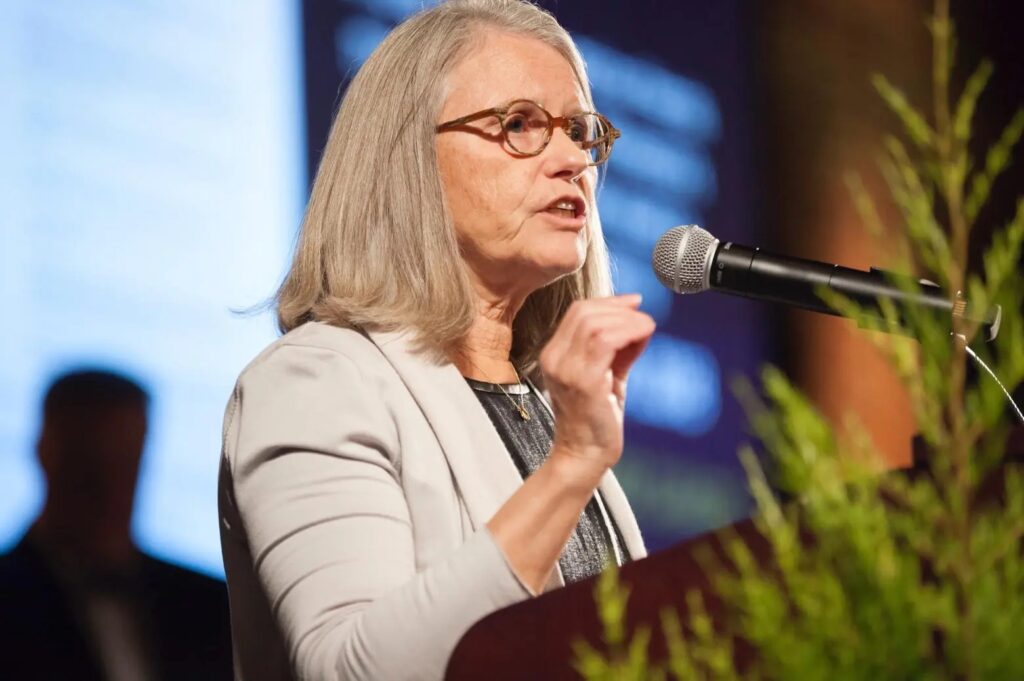
TODD WILKINSON. Becky Rom, thanks for taking the time. Some people who appreciate wild places in the West may have only a vague sense of the Boundary Waters Canoe Area Wilderness and where it is found on a map. What makes it worth knowing about for people in the 21st century, and what are its exceptional ecological features?
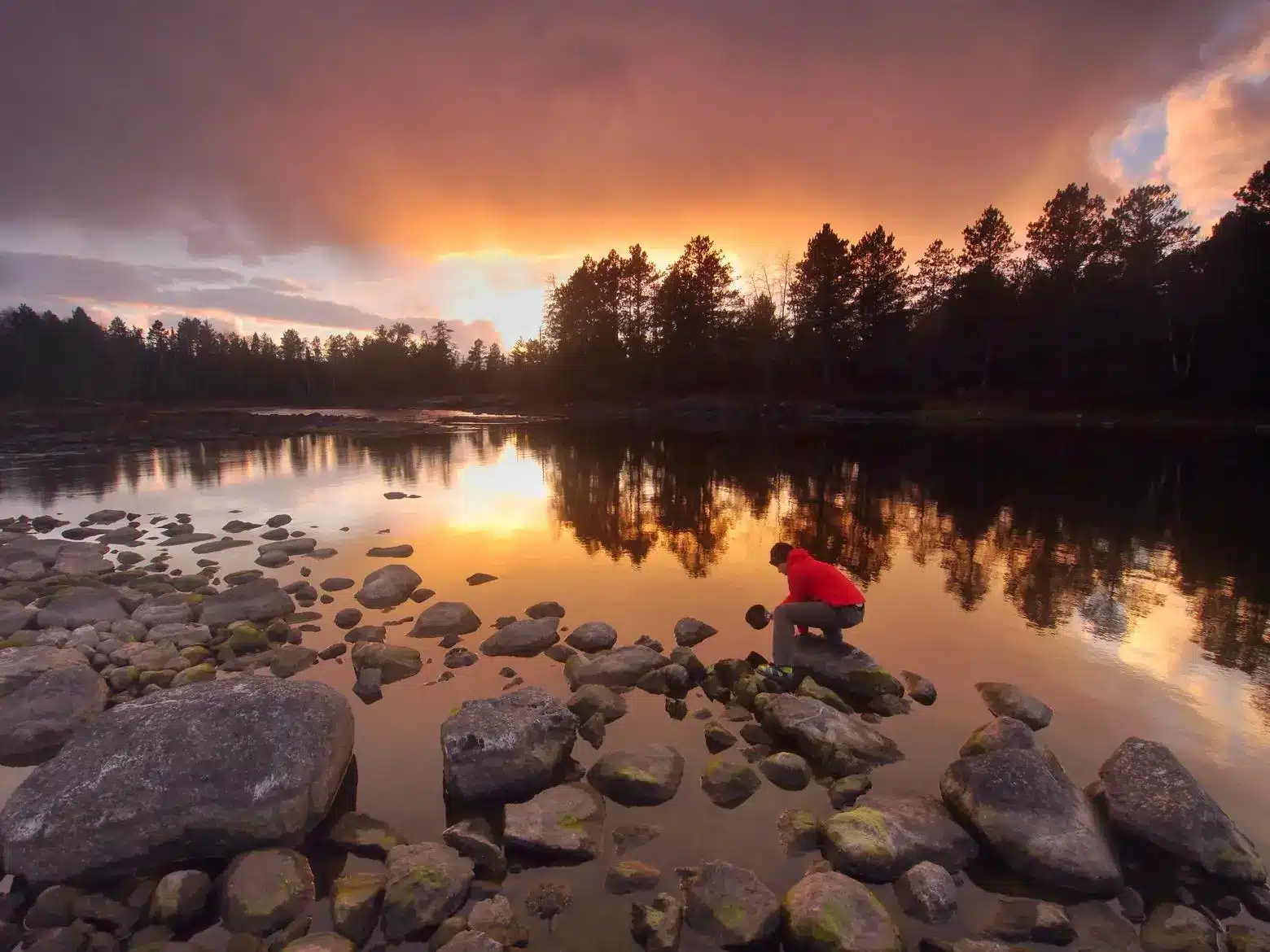
BECKY ROM: The Boundary Waters Canoe Area Wilderness is 1.1 million acres (1,719 square miles) of lakes, streams, forests, and wetlands in Northeastern Minnesota. It is part of the great Quetico-Superior ecosystem, a bigger 4.3-million-acre landscape of lakes and boreal forest that straddles the border of Minnesota and the Canadian province of Ontario. The Boundary Waters are found to the south of Ontario’s Quetico Provincial Park—also 1.1 million acres—which itself lies in the heart of a vast, rich, wild ecosystem. The water quality flowing through it is pristine.
WILKINSON: And there, the water flows in a different direction than the nearby headwaters of the Mississippi do, right?
ROM: All surface waters from the headwaters of the Boundary Waters flow north toward Hudson’s Bay, coursing through the Boundary Waters, the Quetico, and Minnesota’s Voyageurs National Park before turning north at the Lake of the Woods. The waters are exceptionally clean – ‘immaculate’ in the words of the Minnesota Pollution Control Agency. One can safely drink out of the lakes in the Boundary Waters, and at a time when water scarcity is rising as an issue, the water there is abundant. “The waters are exceptionally clean – ‘immaculate’ in the words of the Minnesota Pollution Control Agency. One can safely drink out of the lakes in the Boundary Waters, and at a time when water scarcity is rising as an issue, the water there is abundant.” —Boundary Waters protector and attorney Becky Rom
WILKINSON: Please also explain the federal public land component.
ROM: The Boundary Waters sits within the three-million-acre Superior National Forest. Most Americans might be astounded to hear this but the Superior Forest contains 20 percent of the freshwater in the entire 193-million-acre National Forest System. The Boundary Waters is wild—home to wolves, lynx, moose, loons, warblers, eagles, and countless other creatures. It is the only place in the lower 48 states where wolves were never extirpated. The forest of pine, spruce, cedar, and birch sits on a shallow layer of soil atop granite and other igneous rock. Lakes were carved into this Canadian Shield by glaciers. Travel today is by canoe or dogsled, on boots, skis, or snowshoes, much as the indigenous Anishinaabe and the Voyageurs traveled along the border lakes and then north. This region is often referred to as “the liquid heart of the continent.”
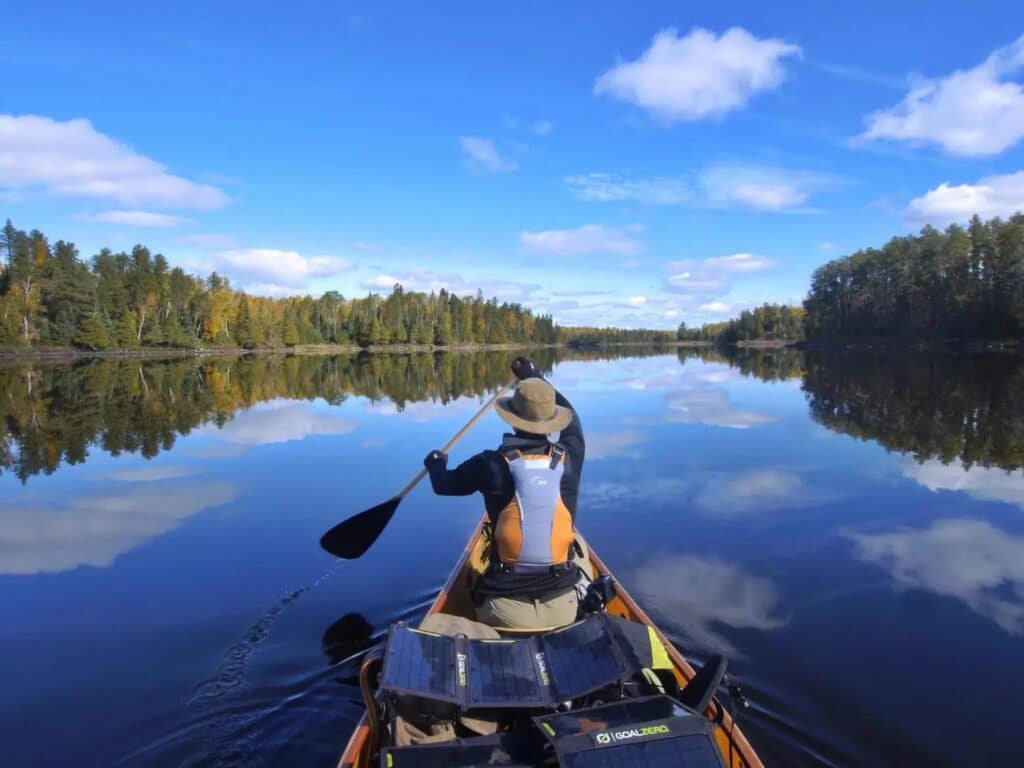
WILKINSON: You’ve been to many wild lands in the US and you’re an admirer of the rare ecological intactness that still exists in Greater Yellowstone. Apart from that, you consider the watery realm of northern Minnesota, which shaped your childhood, as one of the true special corners of the Earth. It’s a place that famed American ecologist E.O. Wilson has mentioned when he says that in order to safeguard the wealth of biodiversity that remains, and to keep ecosystems reliant, half of the remaining wildlands need to be set off limits from intensive development.
ROM: Being in the Boundary Waters is magical. One feels a deep spiritual connection to the land and all life. The same special feel that exists in Greater Yellowstone, in wilderness lands where grizzlies roam, is present here.
WILKINSON: You grew up in Ely, gateway to the non-motorized Boundary Waters Canoe Area Wilderness (BWCAW). What was your childhood like? Tell us a bit about the character named Bill Rom and how the spark of advocacy got lit in your family?
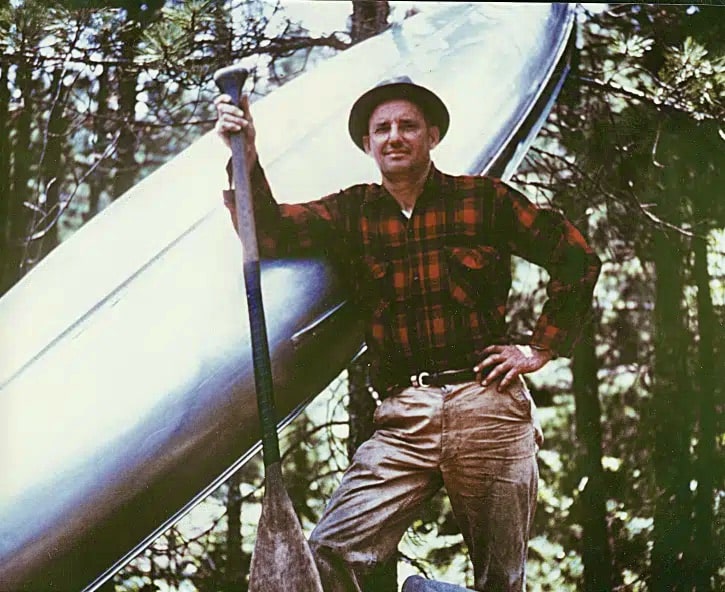
ROM: Yes, my Dad is Bill Rom, owner and operator of a wilderness canoe trip outfitting business (1946-1976) in Ely. For most of that time, Dad, mom, my three brothers, and I lived in an apartment over the outfitting business, which was open from May 1 to October 1, seven days a week, 6 am to 10 pm. The business was my family’s life and everything revolved around it. Thousands of people came to my dad’s business, Canoe Country Outfitters, during the summers. Daily conversations with canoe trip customers led me to appreciate the uniqueness and value of the wilderness. Returning from Boundary Waters trips, they wanted to share their experiences and talk about it all. They viewed the canoe country as an extraordinary gift. Many returned year after year and became family friends. The winters were less hectic but no less focused on introducing the canoe country wilderness to lovers of the outdoors; my father wrote countless letters in response to inquiries about canoe trips and he traveled to outdoor sports shows to market the business.
WILKINSON: How did the Boundary Waters imprint on your identity?
ROM: When my parents could escape from work, we ventured into the Boundary Waters. My first canoe trip was at the age of two. My brothers and I were trained as canoe trip guides; we spent many weeks in the canoe country each year. My first guiding trip was at the age of 14, at a time (1963) when girls did not customarily work as wilderness guides. My dad believed in me and encouraged me to be adventurous. I began flying float planes before I learned how to drive a car.
WILKINSON: Today some who oppose wildland protection say that conservation is elitist but your own family came from humble origins?
ROM: My dad grew up in Ely. The ninth child of Slovenian immigrants, he tagged along behind his brothers as they hiked to lakes and rivers to hunt and fish on public lands in the Superior National Forest.
WILKINSON: Northern Minnesota has produced some conservation visionaries who realized how quickly wild country south of Canada was being lost to industrial mining and forestry.
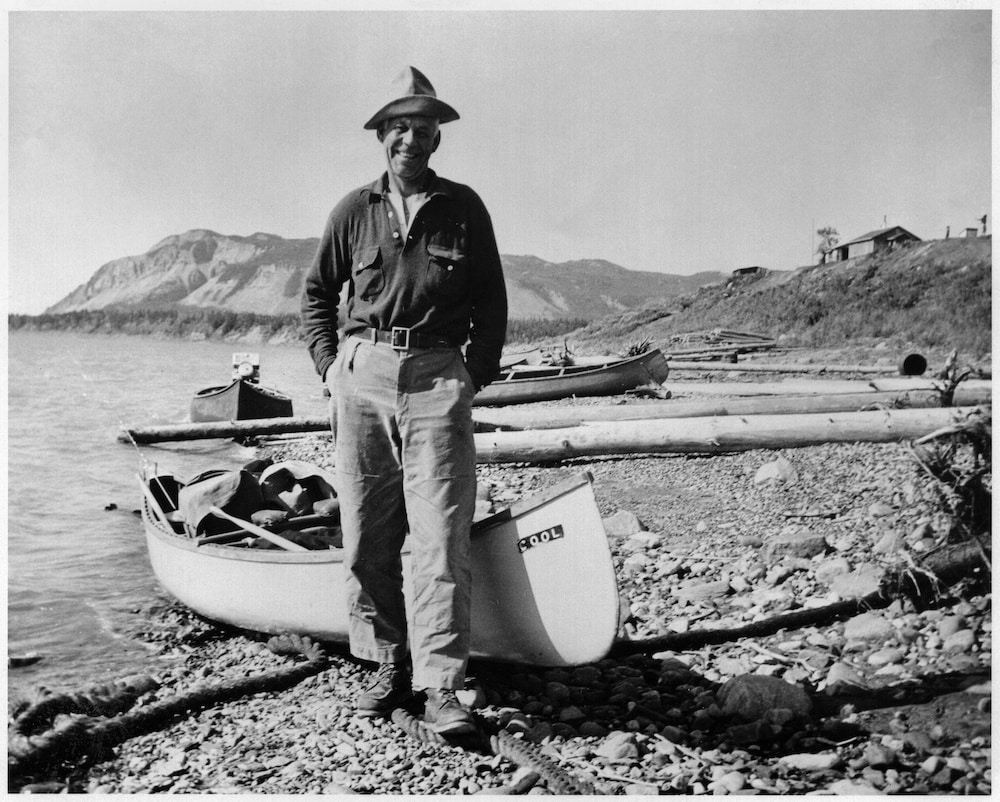
ROM: At Ely Junior College (now Vermilion Community College), my dad met Sig Olson, a biology instructor and dean. Sig took my father under his wing, and mentored him on the importance of conservation. He also successfully encouraged my dad to continue his education at the University of Minnesota. Sig retired early from the college to devote himself to wilderness advocacy, taking up the causes of banning airplanes over and in the Boundary Waters and of buying out private inholdings.
WILKINSON: While many think of the origins of wilderness protection within the context of the West, the Upper Midwest also figured prominently.
ROM: Sig Olson joined the boards of The Wilderness Society and the National Parks Conservation Association. He served as a senior advisor to Interior Secretary Stewart Udall. The work on the legislation that became the Wilderness Act was my first foray into conservation politics. Most of the local community was pitted against Sig and my dad. The threats to the canoe country were discussed around the dinner table in our home. Much to our happiness, the Boundary Waters was included in the first 9 million acres of public lands protected in the 1964 Wilderness Act.
WILKINSON: And for readers unfamiliar with yet another Greater Yellowstone connection, please remind them.
ROM: Mardy Murie, of Jackson Hole, was there at President Johnson’s side along with Sig Olson when the bill was signed. I realized within a few years after the passage of the Act that threats continued to exist or new ones had arisen, and that one had to be ever vigilant and be ready to work tirelessly to preserve the Quetico-Superior region. I was extraordinarily lucky to be the daughter of Bill Rom and a friend of Sig Olson. To me, continuing their advocacy is a sacred mission.
“Mardy Murie, of Jackson Hole, was there at President Johnson’s side along with Sig Olson when the Wilderness Act was signed. I realized within a few years after the passage of the Act that threats continued to exist or new ones had arisen, and that one had to be ever vigilant and be ready to work tirelessly to preserve the Quetico-Superior region. I was extraordinarily lucky to be the daughter of Bill Rom and a friend of Sig Olson. To me, continuing their advocacy is a sacred mission.”
—Beck Rom
WILKINSON: Being ahead of one’s time can actually be a lonely space to inhabit in a small town, with validation/vindication often only coming well after the fact. It’s hard to ponder a future when the most immediate priority is having enough income to put food on the table. Being a prescient conservationist, i.e. a person, who realizes how important and valuable wild places will be for people in the future, was challenging for your Dad and others like Sig Olson. Would you please share the story about the poll that was taken in Ely while you were in grade school?
ROM: When I was in seventh grade, the debate over the legislation that was later enacted as the Wilderness Act was raging in Ely. Most people were angry about alleged federal over-reach and potential restrictions on economic development; that is, economic development in the infrastructure-brick and mortar-roads-logging-extraction sense.
My speech teacher thought it would be interesting for the class to debate the legislation. I was asked to present the pro-wilderness side. The debate took place in the large school auditorium, and all 150 students in my seventh-grade class attended. After the debate, the teacher asked for a show of hands, pro or con. The con won, 148 to 2. My fellow students did not want the Boundary Waters to be protected wilderness. Not long after, when I broke up with my boyfriend, I found that it had become 149 to 1.
WILKINSON: How did that impact you?
ROM: This experience did not shake my conviction that protecting and preserving the canoe country was the right thing to do. If anything, it caused me to sharpen my debate points. Importantly, it did not lose me any friends. I learned that friends could disagree yet still remain friends.
WILKINSON: Greater Yellowstone and much of the West has undergone a transformation from a post-frontier mindset focused on natural resource extraction as sole economic engines to realizing the benefits of conservation. Still, we’re now wrestling with the paradox and the problems of “if you protect it, lots of people will come.”
ROM: Over time, Ely has changed the same way that former mining boomtowns and timber towns evolved. Over the past 50 years, many people have moved to Ely because of the canoe country. It is a great place to live, to have the wilderness next door, to be able to venture out into it during all seasons and weather. As the population has changed, attitudes have changed. We are still a divided community, however, with people who want the mine, but I think if my seventh-grade debate were to occur now, the vote would be equally split.
WILKINSON: That says a lot. The North Woods/Lake Country of Minnesota, as you noted, emanates a special ambiance set apart from the technology dominated world of the Twin Cities. As a young Minnesotan, one thing I was not fully cognizant of was the full historic impact of iron ore mining that had taken place in a water-filled region. It seems miraculous that there weren’t a ton of high sulfide ore bodies ruining more lakes. What is the legacy of mining from the standpoint of pollution?
ROM: Iron ore mined in northern Minnesota is what allowed America’s steel industry to prosper and make us a major economic power in the world. The first iron ore was shipped from Ely in 1888. The last operating mine in Ely closed in April 1967. Ely, together with Tower-Soudan, was called the Vermilion Iron Range. Most of the Vermilion Iron Range mines were underground mines. Two other mining areas, the Mesabi and Cuyuna Iron Ranges, were southwest of Ely. Hematite, high grade iron ore (50-70 percent iron), was mined until depleted in the two decades after World War II.
WILKINSON: In its place was another kind of ore that was mined but in order for it to be profitable required mass excavation and processing of….
ROM: …taconite, a low grade of iron ore (20-30 percent iron) was considered worthless until methods were developed in the 1950’s to commercially process the ore. The taconite mines that operate today in northern Minnesota on the Mesabi Iron Range are open pit mines.
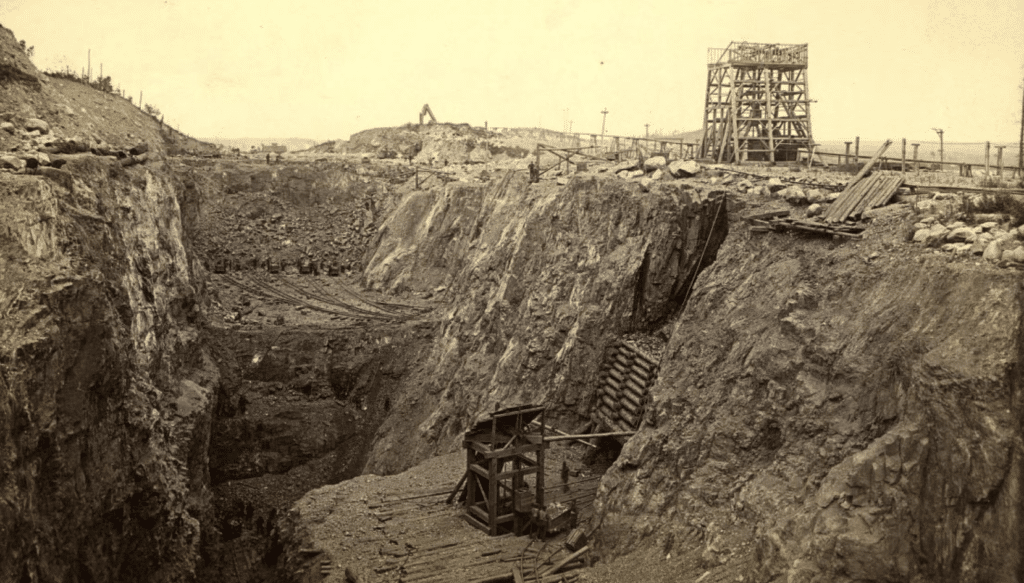
WILKINSON: Sometimes it can take years before problems occur. Recently, the Minnesota Pollution Control Agency identified the waters of Birch Lake near Ely as being impaired with sulfate contamination from historic taconite mining.
ROM: Taconite and iron ore mines have a legacy of pollution and environmental degradation. Massive open pits, tailings, waste rock piles, and processing facilities have destroyed thousands of acres of forests and wetlands. Leachate from tailings and waste rock has degraded water quality over many decades.
WILKINSON: The culture of the Iron Range is strong. Like Butte, Montana, mining attracted a diversity of European immigrants.
ROM: Immigrants were attracted to northern Minnesota because of employment opportunities in mining and logging. My grandfather, Casper Rom, immigrated from the Slovenia region of the Austro-Hungarian Empire in about 1892 and worked in the iron ore mines at Ely until his death in 1918 from a mine cave-in accident. The cultural impact of mining and logging lives on today, with some, especially descendants of hard-working and poor immigrants, taking offense at objections to mining, saying opposition to mining is opposition to “my way of life.”
WILKINSON: Mining as a major job creator but is not the same as it used to be. The mining industry has dramatically changed with technology able to extract a lot of ore while employing far fewer people, parallel to trends in the timber industry. This has set the stage for recent rhetorical battles over how the health of the land creates a context for a sustainable healthy economy. How does the Boundary Waters intersect with ore bodies?
ROM: The iron ore and taconite of the Mesabi and Vermilion Ranges are found in what geologists call the Biwabik Complex. Adjacent on the east is the Duluth Complex, a massive body of sulfide-bearing ore that underlies much of the Superior National Forest, including the Boundary Waters Canoe Area Wilderness, and extends south to Lake Superior. Trace amounts of copper, nickel, platinum, and palladium (less than 1%) are found in this low-grade ore body.
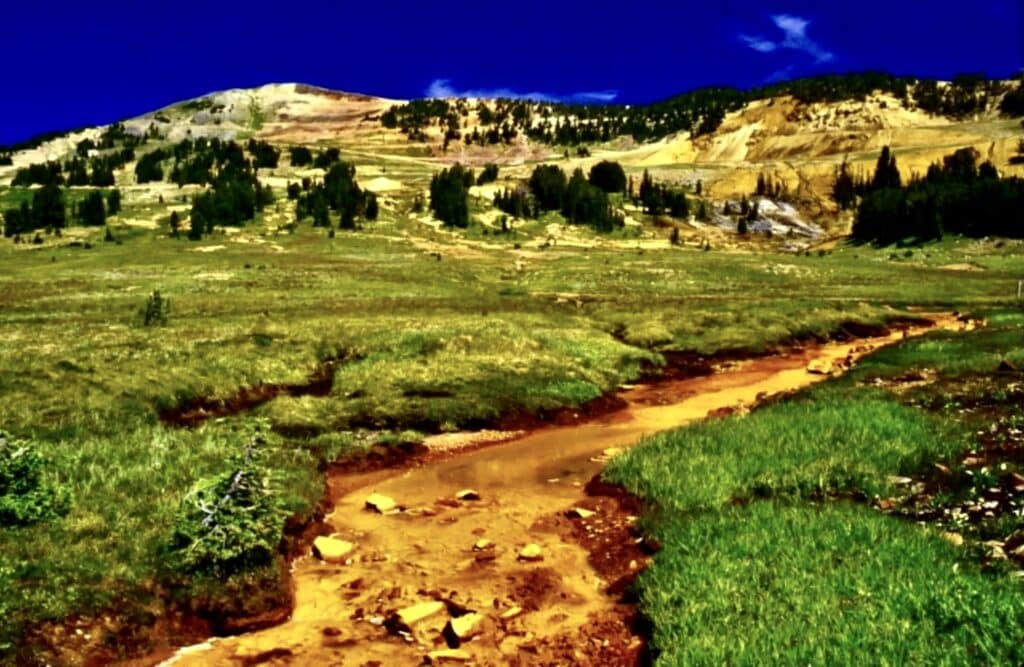
Mining of the Duluth Complex, which has never been done, would present massive environmental risks. The sulfide-bearing ore would create acid mine drainage. Mine infrastructure would destroy thousands of surface acres in the Superior National Forest in one of the most vibrant regions of recreation and economic activity in northern Minnesota.
WILKINSON: When we got together along Lake Superior, you mentioned that conservationist Mike Clark of Bozeman and the perspective he gleaned while battling the New World Mine on the edge of Yellowstone with the Greater Yellowstone Coalition and allies, has been helpful to your campaign. Could you riff on that?
ROM: Mike Clark was immensely helpful to me and others when we were launching the Campaign to Save the Boundary Waters. I had spent decades working on public lands and wilderness issues, but I had never tackled a fight over a mine or a mining district. “What does a mining fight look like?” I asked Mike. He responded: “It looks just like a public lands fight. You are fighting to protect a special wild place, that’s the fight.” That advice gave us a great deal of confidence. This was a public lands campaign to protect the Boundary Waters and the greater Quetico-Superior ecosystem. We knew how to engage in the defense of public lands.
WILKINSON: How did it shape your strategy?
ROM: The Campaign to Save the Boundary Waters has been guided, in part, by seven principles that Mike Clark developed for the Greater Yellowstone Coalition fight against the New World mine.
WILKINSON: What are those seven pillars?
ROM: 1. Defend the economic status quo by having a credible local group explain and advocate protection of existing natural assets and market forces. If you like what you’ve got, SAY SO!·
2. Build the technical capacity to set a high standard of behavior and scientific knowledge so that the agency will have to explain its actions in a transparent way.
3. Know your facts and make sure the agency uses the best possible science to make its decisions. ·
4. Use lawyers to secure a seat at the table. Challenge bad actions, challenge the permitting process, ensure that the company and the agency follow the letter of all relevant laws.·
5. Create a media team to educate the public and decision-makers. Help media people ensure that their coverage hits the leading edge of local, regional, and national exposure.·
6. Build an argument that evokes national relevance and concern, then use that tool to educate Congressional leaders and agency leaders so they will understand how your fight advances their agendas. ·
7. Follow the capital. Who runs this company, who provides the capital, and what kind of return do they want on their investment? What’s a viable exit strategy for your opponents when you win? Metaphorically, cornered animals fight to the death. Injured animals—and entities—look for a way out of a bad situation. Provide options—and messengers who can communicate with all sides.
WILKINSON: Beyond those statements of values that resonate with a lot of people, things have been complicated.
ROM: Our campaign quickly adopted the first six principles. The seventh principle has been tough. The Chilean company Antofagasta has a view that it always wins and gets what it wants. We concluded early on that Antofagasta simply needs to be defeated.
As a result of conversations with Mike Clark and other leaders who were extremely helpful – Tim Bristol of the coalition fighting the Pebble Mine, Gloria Flora of the Rocky Mountain Front in Montana, and Roger Clark of the Grand Canyon Trust – we undertook the Campaign to Save the Boundary Waters with a relentless focus.
“The Chilean company Antofagasta has a view that it always wins and gets what it wants. We concluded early on that Antofagasta simply needs to be defeated.”
—Becky Rom
WILKINSON: Is it accurate to say that you are not willing to compromise the mine into existence?
ROM: Yes, given what is at stake, we’ve been resolved to not allow mines in this place. Our goal is a permanent ban on sulfide-ore copper mining on public lands in the watershed of the Boundary Waters. To achieve that goal, we sought denial of the renewal of the only two federal mineral leases in the Superior National Forest—a 20-year FLPMA mineral withdrawal and a permanent ban by act of Congress.
WILKINSON: You did not allow mine proponents to make it solely a local backyard issue but rather transformed it into a national one. Why has that been effective?
ROM: One important lesson from Mike and his experience fighting the New World Mine on the doorstep of Yellowstone and others was that we should— and we did—seek guidance from around the nation. We weren’t alone in trying to protect and preserve a very special wild place.
Mike and the others have done this before, know a great deal, and are eager to share their knowledge and experience. They wanted the Campaign to Save the Boundary Waters to be successful, just as they were in their campaigns.
WILKINSON: You discovered a complication that reached to The White House and, like a of things with the Trump Administration there was talk of conflicts of interests.
ROM: The Luksic family of Chile, which has a majority interest in Antofagasta that is behind Twin Metals, owned real estate in Washington DC. At the same time The White House had inserted itself into the review process involving a number of different federal permitting agencies, the Luksic family rented a house to Jared Kushner and Ivanka Trump.
WILKINSON: The mine almost happened and there were efforts to fast-track permitting during the Trump Administration. Was there major outrage and does that not represent the most base form of conflict of interest?
ROM: Yes, yet this type of conflict was rife throughout the Trump Administration. Business as usual. We remind our supporters and the media of this Luksic-Trump/Kushner coziness regularly. From documents obtained via the Freedom of Information Act, we learned more about the behind the scenes manipulations in the Department of Interior and the White House. This inappropriate behavior continues to this day.
WILKINSON: How?
ROM: Earlier in 2021, Antofagasta/Twin Metals engaged the Washington, DC law firm for which David Bernhardt had worked and had been advocating for copper mining next to the Boundary Waters.
WILKINSON: Bernhardt succeeded Zinke as Interior Secretary after Zinke’s resignation.
ROM: Bernhardt, as Deputy and then Secretary of Interior, had a hand in overturning protections afforded to the Boundary Waters by the Obama Administration. It reinstated and renewed two canceled federal mineral leases held by Twin Metals. The Obama Administration denied renewal and the leases had terminated but the Trump Administration reversed course
WILKINSON: Apparently, Mr. Bernhardt still has a connection to Antofagasta and other mining and energy companies, which calls into question whether he was ever being objective in weighing the risks to the Boundary Waters when he has had jobs in the private sector advancing the interests of resources extraction industries and working with people who are advancing federal de-regulation.. What else did you uncover?
ROM: Our partner, The Wilderness Society, sued to gain a copy of the draft environmental assessment of the FLPMA study looking at a mining ban on 234,328 acres of federal public lands in the watershed of the Boundary Waters. [FLPMA is an acronym for the Federal Land Policy and Management Act which requires agencies, such as the Bureau of Land Management which reviews hardrock mining in the US, to undertaking environmental review of significant actions proposed for federal lands].
The Trump Administration delivered a 60-page document that was fully redacted except for the cover page. This level of redaction would be appropriate for a document that has highly restricted national security status— not an environmental assessment of a mineral withdrawal in the Superior National Forest. Additional agency documents released in this lawsuit strongly suggest that the direction to cancel the proposed mining ban came from the White House and was purely a political decision.
“The Trump Administration delivered a 60-page document that was fully redacted except for the cover page. This level of redaction would be appropriate for a document that has highly restricted national security status— not an environmental assessment of a mineral withdrawal in the Superior National Forest. Additional agency documents released in this lawsuit strongly suggest that the direction to cancel the proposed mining ban came from the White House and was purely a political decision.”
WILKINSON: Where does the Twin Metals plan stand today. What gives you hope and what is worrisome? [Note to readers: This question was asked four years ago, prior to Trump being re-elected].
ROM: On October 20, 2021, the U.S. Departments of Interior and Agriculture announced the commencement of a federal mineral withdrawal process covering 225,378 acres of federal lands and minerals in the watershed of the Boundary Waters. “Mineral withdrawal” means excluding these lands and minerals from any mineral prospecting or leasing for mining. This withdrawal process is governed by the Federal Land Policy & Management Act and will include a segregation—that is, a removal—of the lands and minerals in the application from any prospecting or leasing for 24 months while the U.S. Forest Service conducts an environmental review of a 20-year mineral withdrawal. Upon completion of the Forest Service’s environmental review, Interior Secretary Deb Haaland could – and hopefully would – direct a 20-year mineral withdrawal.
WILKINSON: But you’re seeking a permanent remedy.
ROM: On Earth Day 2021 U.S. Rep. Betty McCollum introduced legislation that would permanently ban sulfide-ore copper mining on 234,328 acres of federal lands and minerals in Boundary Waters watershed. HR 2794 has 48 co-sponsors. It has not been introduced in the US Senate.
WILKINSON: Public opposition in Minnesota is linked to science.
ROM: In Minnesota, the Minnesota Department of Natural Resources launched a public process to determine whether Minnesota’s nonferrous (that is, sulfide-ore—not taconite or iron) mining rules fail to protect the Boundary Waters. This public process is the result of a lawsuit brought by Northeastern Minnesotans for Wilderness challenging the nonferrous mining rules on the grounds that they are inadequate to protect the Boundary Waters because they do not prohibit the siting of sulfide-ore mines upstream from the Boundary Waters. A successful outcome would be new rule-making that would ban sulfide-ore copper mining in the Wilderness watershed. Finally, a bill in the Minnesota Legislature would ban sulfide-ore mining on state public lands and prohibit the issuance of any such mining approvals in the Boundary Waters watershed.
WILKINSON: Are you optimistic?
ROM: Hope is found in the overwhelming support of Minnesotans for a permanent ban on mining in the Boundary Waters watershed (68 percent). The Boundary Waters is Minnesota’s crown jewel, protected as a national wilderness area and Minnesota’s only state wilderness area. It is also the most visited area in the National Wilderness Preservation System – and has been year after year since it was designated as wilderness in 1964. The Campaign to Save the Boundary Waters is led by Ely -based Northeastern Minnesotans for Wilderness, and includes over 400 conservation groups, hunting and fishing groups, and businesses. It is a priority landscape for protection— 1.1 million publicly-owned acres of forest and water where one travels by canoe in the summer and dogsled, snowshoes, and skis in the winter. Americans are determined not to let it be irreparably harmed by a giant international mining company based in Chile.
WILKINSON: You recently scored a victory yet you still exude cautiousness.
ROM: It is worrisome. Antofagasta is powerful, and it has shrewd political allies. It is playing the long game with a great deal of money and a mindset of always winning and beating down opponents. We must play the long game as well, and we must continue to be vigilant and relentless. We are committed to permanently protecting the Boundary Waters.
WILKINSON: Please respond to the action that was taken by the Biden Administration and what it means?
ROM: The FLPMA application for a mineral withdrawal explained that the purpose of the proposed withdrawal “is to advance a comprehensive approach to protect and preserve the fragile and vital social and natural resources, ecological integrity, and wilderness values in the Rainy River Watershed, the Boundary Waters Canoe Area Wilderness and [downstream Superior National Forest lands].”
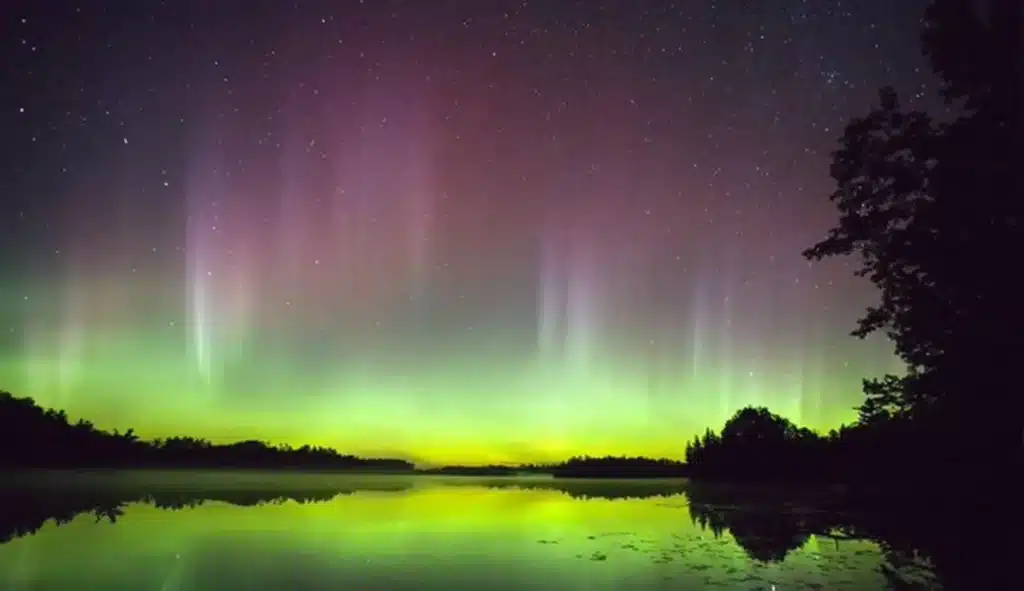
[Note to readers: Donald Trump was re-elected in 2024. In 2025 and 2026, the Administration, members of Congress and lobbyists with resource extraction industries have moved quickly to overturn the mining ban in the headwater of the Boundary Waters and use the Congressional Review Act to undermine protection for federal wilderness, national monuments and other areas on behalf of the energy, timber and mining industries].
° ° ° °
WILKINSON: Apart from the mining issue, the Boundary Waters like every part of America, is dealing with the effects of climate change. This past summer there were forest fires there. What do you make of the threat climate change poses to BWCAW in terms of maintaining its ecological resiliency and was this summer a harbinger?
ROM: The Quetico Superior boreal forest region is historically a fire-dependent ecosystem. Forest management throughout the 20thcentury employed suppression of wildfires, with unintended consequences to the health of fire-dependent forests. The groundbreaking work of forest ecologist Dr. Miron (Bud) Heinselman led to much-needed changes in forest management in the Quetico-Superior region, including allowing wildfires to burn in the Boundary Waters and the adjoining Quetico Park. At the same time, our boreal forests are experiencing rapid change, with a shift in forest species occurring after disturbances attributed to climate change, such as more frequent and powerful windstorms. Harmful insects and diseases that once died out over winter in high-latitude regions now survive with devastating effects on our forests. All of this is to say, our forests are changing and are more susceptible to large-scale hot fires because of drought, spruce bud worm-killed balsam fir and spruce, and fire suppression.
WILKINSON: What’s the big picture?
ROM: I think the more important consideration is this: preserving and protecting the Quetico-Superior ecosystem is part of the solution to the climate and extinction crisis. Preserving this region must include banning destructive sulfide-ore copper mining from the headwaters of the Boundary Waters. The multiple benefits that relate to the climate and extinction crisis are these: preserving carbon sequestration by prohibiting the destruction of thousands of acres of forests and wetlands for mine infrastructure; avoiding the massive energy demand of large sulfide-ore copper mines and thus eliminating major new greenhouse gas sources; and preserving a 4.3-million-acre ecosystem that provides a refuge for species threatened by climate change.
WILKINSON: If you could leave our readers with a parting shot about your beloved watery homeland and its parallel to the wildlands of the American West, what would it be?
ROM: My husband and I and our three sons have separately or together backpacked and hiked in the Bob Marshall Wilderness, the North Cascades, the Arctic National Wildlife Refuge, Denali, Zion, Canyonlands, Yosemite, Yellowstone, the Wind River Range, the Bighorns, the Absaroka-Beartooths, Joshua Tree, and throughout the Colorado Rockies—to list some of our favorite places. These and the rest of our great public lands in the West are ecologically rich and enormously valuable socially and economically. They must be protected, forever. All that is also true of the Boundary Waters Canoe Area Wilderness. But with respect to this great canoe country Wilderness, there’s more.
Nothing else in our National Parks or our National Wilderness Preservation System is like the Boundary Waters. It is utterly unique. Nowhere else is there such a seemingly endless network of lakes, streams, and wetlands—all connected by portage trails through a boreal forest landscape. No other Wilderness is so accessible to people of all ages and abilities—babies in diapers can travel with their parents by canoe in the Boundary Waters. My own babies did. Elderly people and others with physical challenges can, with assistance, spend days traveling by canoe and camping in the Boundary Waters. These are among the reasons that the Boundary Waters is the most-visited Wilderness area in America. There is no other place like this. We cannot and will not allow sulfide-ore mining in its watershed.
° ° ° °
Also read: