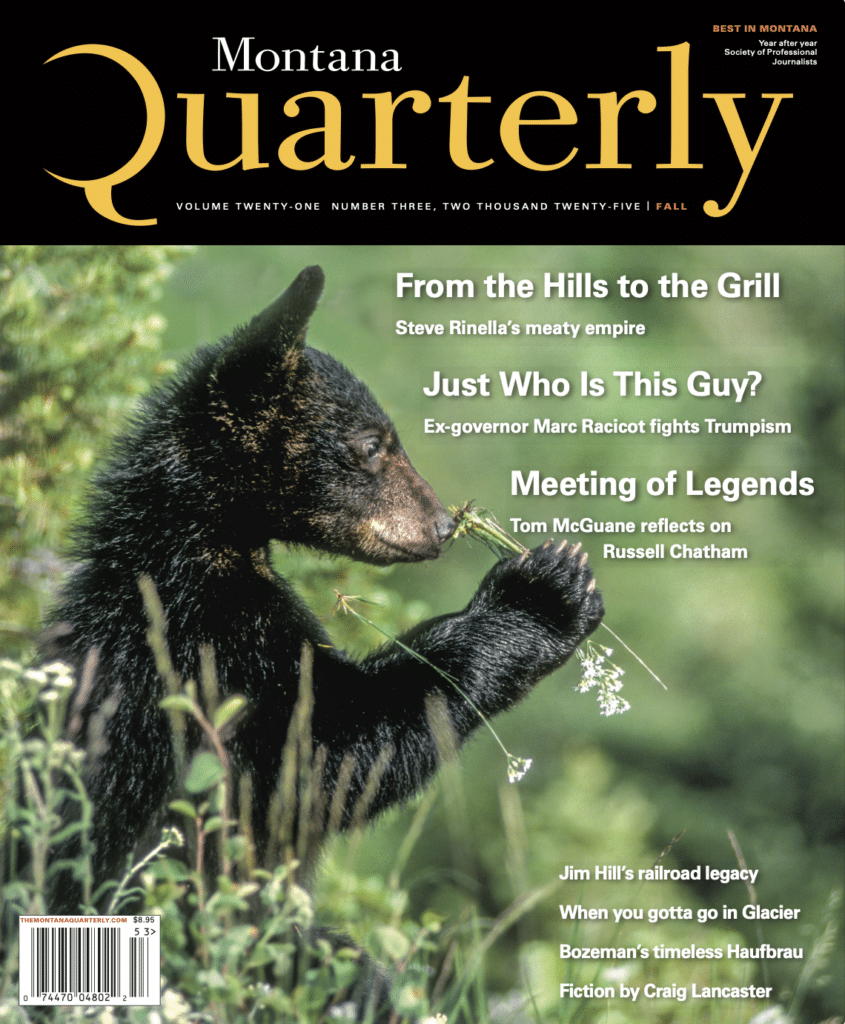
In our annual chat, Yellowstonian founder Todd Wilkinson discusses current events with his old pal, Scott McMillion, publisher of Montana Quarterly. Scott even offers up a free gourmet recipe for elk!
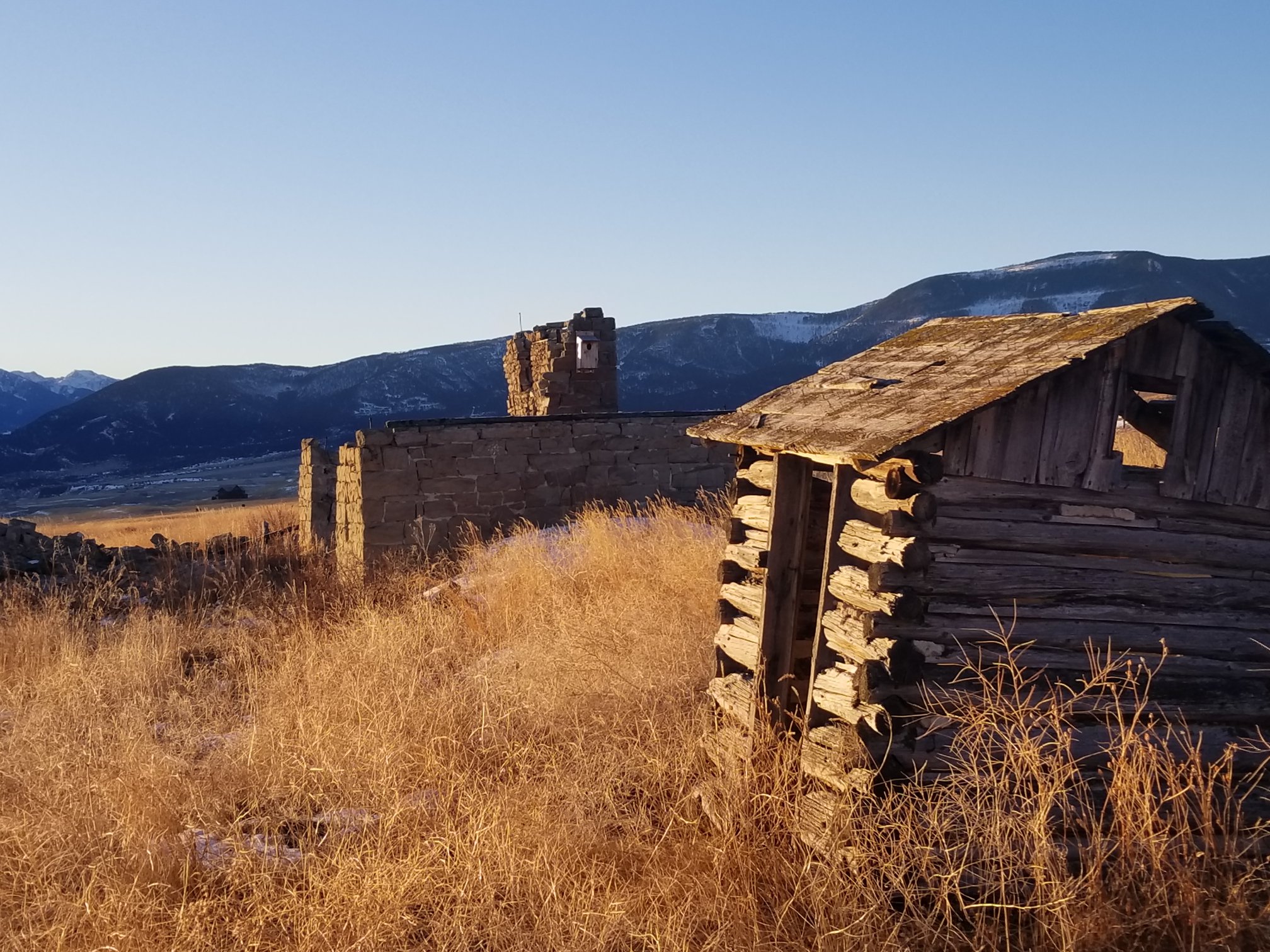
Economists gleefully refer to growth and change as "creative destruction," and sometimes glibly reference loss of scenic beauty, wildlife, and rural culture to sprawl as an unfortunate "negative externality." We call it loss of the places we love. The role of journalism is make readers aware of the consequences of growth. Photo courtesy Montana Quarterly
by Yellowstonian
Whenever Scott McMillion and I run into each other, the expression often crossing our face at the same time is a mixture of mischief, sadness and knowing.
As wizened long in the tooth scribes, it’s hard to explain the kind of bond that comes from chasing stories on tight deadlines—be it dictating a story to a newsroom editor from an outside phone booth at Old Faithful in 1988, moments after a forest fire nearly destroyed the famous Inn; or rocking and rolling in the cockpit of a small airplane while taking an aerial tour of a proposed hardrock mine amid high winds in the mountains or covering the purported end of the world on the day it was forecast by Elizabeth Clare Prophet.
Dating back to the 1980s, when Scott and I were young reporters writing about the Greater Yellowstone Ecosystem when the word “ecosystem” pushed many federal land managers out of their comfort zone, we’ve witnessed a lot of changes. Today, with Scott operating the print magazine Montana Quarterly and me being at the helm of Yellowstonian, it’s become a tradition that we catch up on the state of storytelling.
It also provides a golden opportunity to encourage those who still enjoy sitting with stories delivered on a tactile, portable surface to subscribe to Montana Quarterly. While the stories you read here are free, since Yellowstonian is a non-profit, online, public interest, conservation journalism site, Scott’s operation is not. Montana Quarterly is a perfect holiday gift that serves as a treat for you or other recipient throughout the entire year.
With that, let’s jump in.
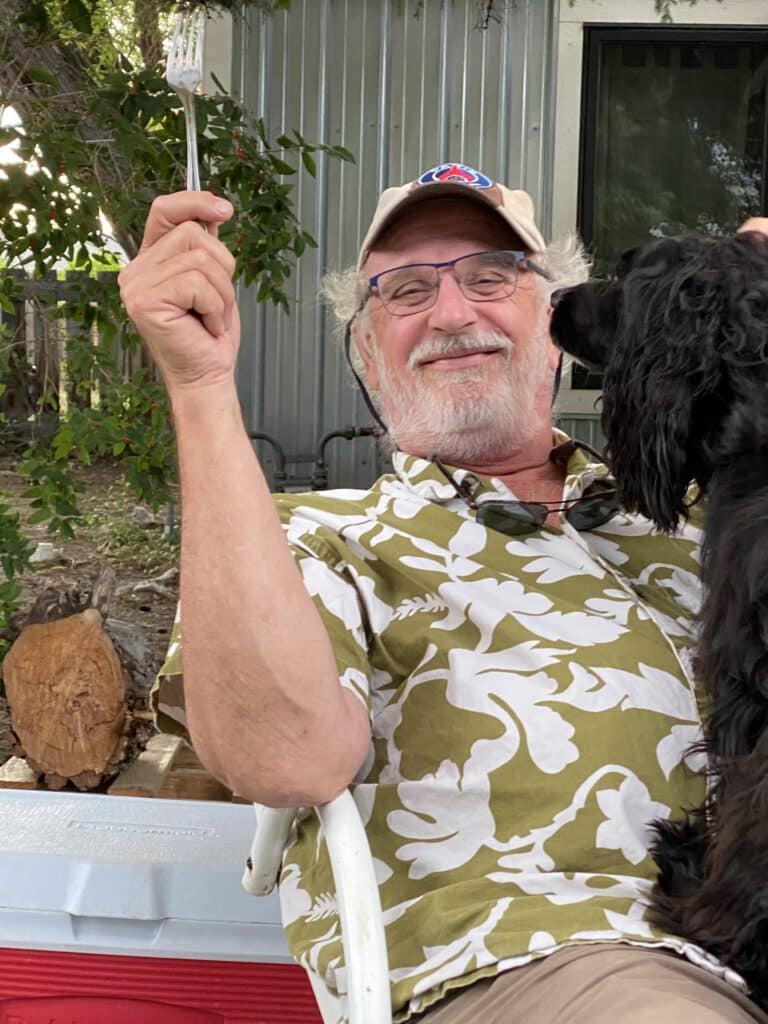
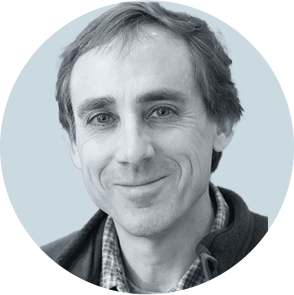
A feaster of words and wild game, Montana Quarterly publisher Scott McMillion at home in the Yellowstone River town of Livingston.
Todd Wilkinson: What’s the greatest challenge of running a magazine that you didn’t ponder when you were a newspaper reporter?
SCOTT McMILLION: The biggest challenges come from the publishing side: dealing with printing companies, making spreadsheets, running circulation, and especially dealing with the US Postal Service. The local people— the carriers and front desk workers —are great. But the system is so hidebound and dense that it often has me snatching at my remaining hairs.
TW: Who is your all-time favorite actual living person in the lore of Montana?
McMILLION: A.B. “Bud” Guthrie was pretty cool. I wish I could have met him. And K. Ross Toole was a giant, as was Mike Mansfield.
But for people I actually knew, that would have to be John Fryer, who died almost exactly two years ago. Though he described himself as a “storekeeper,” he was so much more than that, even though he ran Sax & Fryer until his death. It had been around since 1882 and was probably the oldest continually operating retail business in Montana. I’ve never met a man who had more universal respect, and that’s how he became the patron around here. He cared deeply about Montana and he knew when to back a project and when to stay out of it.
And he gave me the best summation of local politics I’ve ever heard.
“Did you ever notice,” he once asked me, “that whenever a good idea pops up in this town, it’s always the wrong guy that has it.”
TW:Montana Quarterly is headquartered in Livingston, your home town, which flavors the view your magazine presents about Montana. So many of the eccentric characters who have made Livingston and Park County an outpost where fact is stranger than fiction, have passed on. What has been special about the human history of Livingston up to this point in time, and will it remain a haven for create people and social oddball?
McMILLION: We’ve lost a lot of giants in recent years. Some were well known, like Russell Chatham and Gatz Hjortsberg and Jim Harrison and Thomas Goltz, others less so. My river buddy Craig Mielke died a couple weeks ago after a long illness. He’d been a combat medic in Vietnam, then a nurse who tended to the broken. He loved to laugh and he hated war. He reminded me of somebody John Prine might have written about. Now that voice is gone, along with many others. I’m reminded every time I scroll through the numbers on my phone.
But lots of energetic and creative new people are putting down roots here. The Shane Center, with its theater and ballrooms, is busy probably 200 nights a year with some creative endeavor. We’ve got a dozen art galleries, vibrant social welfare and environmental nonprofits, all of them staffed by the next generation, and most of those people came here from somewhere else. I’m glad they found this town.
Livingston has always had a transient population. Ever since the Ice Age, people have seen it as a seasonal refuge, though it was a winter hunting ground back then. Nowadays, the population swells in the summer. But the steady ebb and flow tended to make people more tolerant of outsiders, which encourages a lot of them to stick around. For the most part, we embrace oddballs and characters, which might be why they haven’t run me off yet.
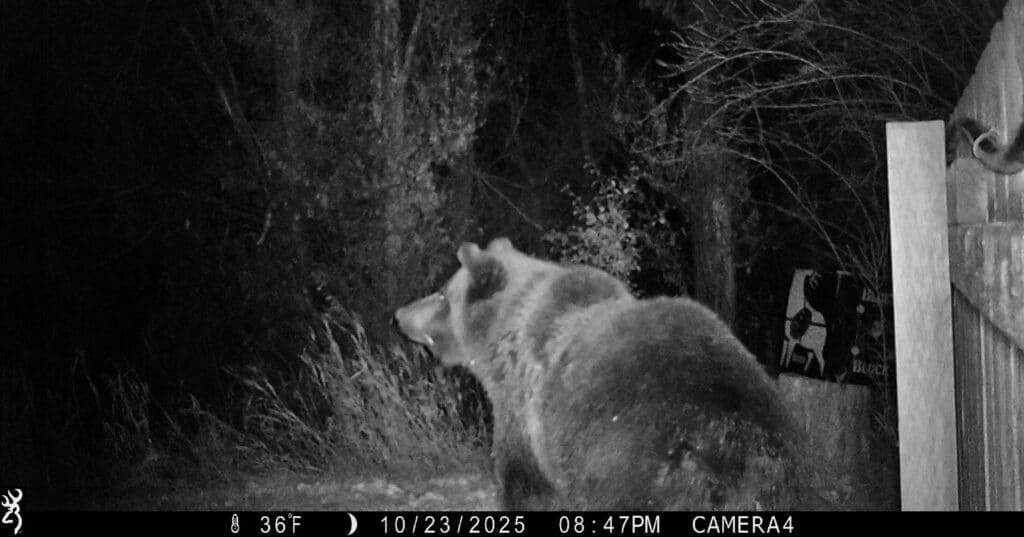
TW: Speaking of transient travelers, the other day, social media lit up with reports of a grizzly wandering through town almost undetected. How did that happening land on you and what’s important for local residents to consider?
McMILLION: I was pretty excited to hear about that bear and I crossed my fingers, hoping he’d get out of town alive. It sounds like it was probably a 3-year-old bear, trying to set up some home turf. He wandered through the edge of town, then moved east. He walked right past a sheep farmed owned by my friends Buth and Kathy Keyes and kept going. At last report he was headed up the Shields. If he can continue to avoid temptations, he might have a future up there.
Then, on the last day of hunting season, a friend sent me a picture of a big grizz track on his property across the river, about a mile from my house. It’s probably a different bear, so people need to pay attention in order to protect themselves and the bears. Stow your garbage, clean up your fallen fruit, and realize that grizzlies aren’t looking for trouble. They’ll move along, if we don’t feed them.
These sightings show that the grizz population is expanding, and that shows that we’ve done something right, as a culture. We’ve given them room and habitat. Continuing to do so will get harder all the time, depending on the positions our political leaders take. The conversation won’t end soon, but I think there’s still room for bears and people, if people make good decisions. They’re heading for the prairie, where I think they could prosper, if we let them.
No trick or treater: this grizzly was caught on a game cam wandering along the Yellowstone River corridor through the town of Livingston a few days before Halloween and the bear wandered northward into the Shields Valley without incident. It did, however, topple a few trash cans along the way, reminding that that minimizing the availability of easy-pickins bear attractants is key to living in grizzly and black bear country.
TW: Many inquiring minds, including me, want to know: Why haven’t you run for city commission, state legislature, governor or Congress?
McMILLION: I always have the same answer to this question. If nominated, I will decline. If elected, I will fight extradition.
TW: There’s the boom-boom western half of Montana filled with mountain ranges and valleys that are filling up. And there are the vast open most treeless environs in the eastern half on the prairie with many counties struggling against de-population. Which version of the state worries you more, and why?
McMILLION: Montana’s economy is evolving in two very different ways. In the west, it’s dominated by tourism and by services ranging from construction to knee replacement surgery. (Shout out to Dr. Dean Sukin!) This is where the wealth tends to accumulate.
In the east, ag still dominates, with an awful lot of mechanized monoculture, which requires a lot fewer human hands. That means populations dwindle, as do local services. It’s getting harder to keep the doors open at schools and hospitals, let alone stores for daily needs. People can’t get what they want, so they drive to a city and stock up, or they order online. I’ve been on more than a few dirt roads where the only other moving vehicle was the UPS truck. It’s not hard to see where this spiral leads.
About half of all Montanans already live in the six most populated counties: Yellowstone, Missoula, Cascade, Gallatin, Lewis and Clark and Flathead and that proportion will continue to grow. So the dividing line that worries me is not so much East/West as it is rural/urban. As urban numbers continue to grow, so does their political clout and economic power. And I fear the level of misunderstanding and resentment between the two cultures will blossom accordingly.
Unfortunately, we have no shortage of politicians on both sides who are eager to exploit resentment, to give somebody a villain to blame for whatever it is they don’t like. And I see a lot of condescension directed toward both city slickers and country bumpkins. My best advice is to listen. Listen more than you talk.
“As urban numbers continue to grow, so does their political clout and economic power. And I fear the level of misunderstanding and resentment between the two cultures will blossom accordingly. Unfortunately, we have no shortage of politicians on both sides who are eager to exploit resentment, to give somebody a villain to blame for whatever it is they don’t like…My best advice is to listen. Listen more than you talk.”
—McMillion on the urban-rural divide
TW: If there were a few words of advice you’d offer to new arrivals who have their minds set on monetizing as much of Montana as they can, aided by some pretty weak planning and zoning regulations, what would it be?
McMILLION: If you want to make a lot of money as a land developer in Montana, bring a fat checkbook, hire some lawyers, and be aggressive. You’ll almost always win in the end. Our development laws are mostly on your side.
But, if you want to stop rural sprawl on private land, or even slow it down, donate to land trusts that install conservation easements for willing landowners. Conservation easements are complicated and expensive to implement, especially for landowners who hold valuable property but aren’t flush with cash. I’d like to see the process get easier for them. Donations can help.
TW: Let’s put a finer point on your reference to supporting land trusts. Here’s the link to a great site operated by The Land Trust Alliance where people can find and support the land trust closest to them or working to protect landscapes they love. All they need to do is click here and type in the name of a local group or area.
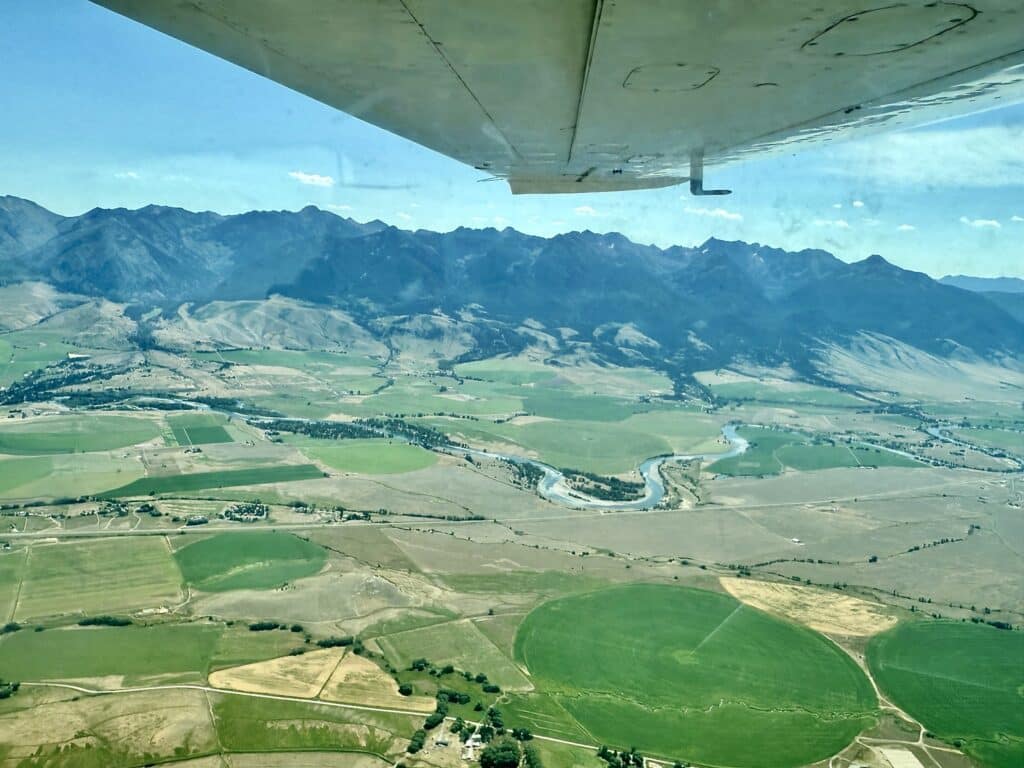
What does the real Paradise Valley look like, not the fictional version portrayed in Taylor Sheridan’s TV melodrama, Yellowstone? It looks like this—wildlife and livestock inhabited ranches and farms flanking the Yellowstone River between the Gallatin Mountains on the east, and the Absarokas on the west. Unfortunately, the kind of development pressure bearing down on the valley, just like in Yellowstone, isn’t made up. In Park County, two different land trusts—the Gallatin Valley Land Trust through its Northern Yellowstone Open Lands Program, and the Park County Land Trust are doing their best to secure conservation easements from landowners who want to be community heroes. Photo courtesy GVLT
TW: Okay, please name a couple of the stories in Montana Quarterly in 2025 that most moved your heart.
McMILLION: For a long time, one of my guiding tenets has been to find people who are smarter than me, which isn’t that hard to do, and listen to them.
Scott Dersam is one of those people. He’s an archeologist who is breaking all kinds of new ground with his research into how Clovis people, the very first Montanans, used the high peaks in and around Park County 12,000 years ago. A day in the field with him popped open my eyes and invigorated my imagination. That story ran in the summer issue.
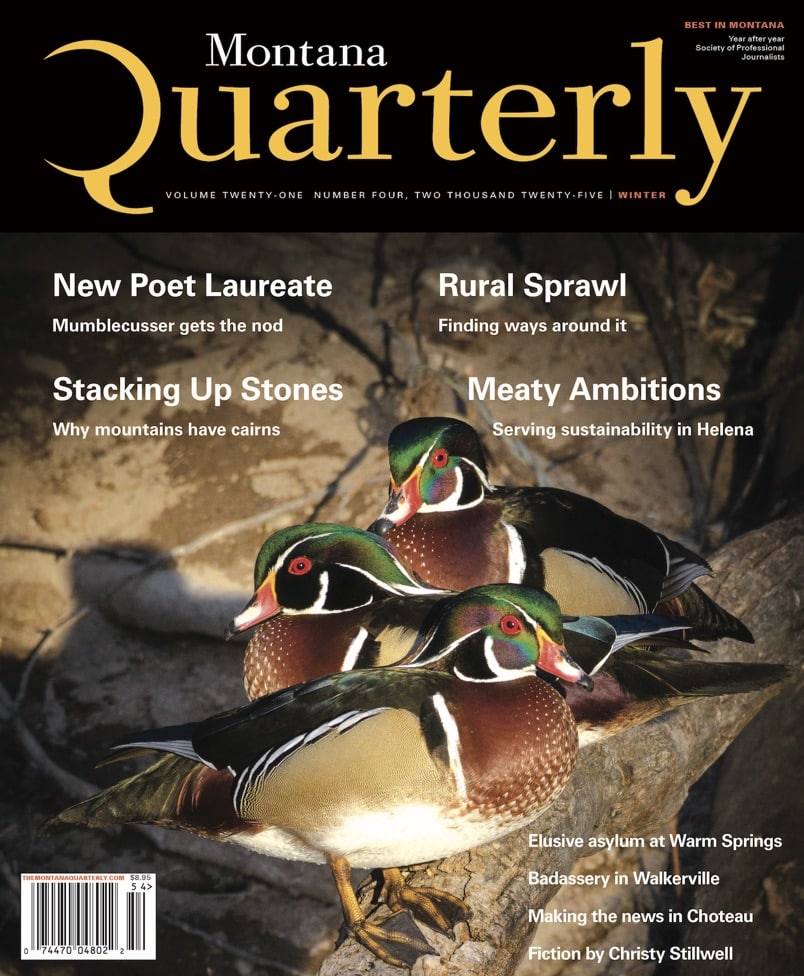
The winter issue includes an Eric Heidle essay nominally about building cairns on mountain tops. But it’s also about mountains themselves, and climbing them and sweating the journey, and feeling their power. It’s a very elegant piece.
We also have an essay about the surprising history of the state hospital at Warm Springs, where we stow the seriously mentally ill. We’ve been doing it there since 1877, the year after Custer died, and Helena writer Brend Wahler outlines how much we have failed to learn in 150 years, how that institution’s cycle of neglect and mismanagement keeps repeating itself.
Screenshot
TW: Allow me to say this again, folks should subscribe to Montana Quarterly. Relatedly, you and I share the conviction that journalism has to do more than engage in just dispensing information, especially uncritical and superficial bothsidesism. It’s important to assess and analyze the veracity of what’s being said.
The late and longtime White House correspondent Helen Thomas said this: “Everyone with a cell phone thinks they’re a photographer. Everyone with a laptop thinks they’re a journalist. But they have no training, and they have no idea of what we keep to in terms of standards, as in what’s far out and what’s reality. And they have no dedication to truth.” Any thoughts on Thomas’ assessment?
McMILLION: Unfortunately, Thomas’ remark about photography contains a grain of truth. Cell phone technology means almost anybody (including me) can take a pretty good photo if they’re in the right place at the right time. Truly excellent photography is another critter. That takes a professional eye, experience and a sense of narrative. That’s why I hire a lot of professional photographers.
Her remarks on journalism also contain an element of truth. When everybody thinks they’re a journalist, it’s harder to know what to believe, or what we’re losing. Still, real journalism is out there, though it is evolving. The old business model, where advertising carried the financial freight, has dwindled and corporate owners have responded by cutting staff and hacking budgets. Luckily, a new business model is evolving, a nonprofit one that relies on reader support and has a free newsletter. Yellowstonian is a prime example. So are Montana Free Press and the Daily Montanan, plus some more locally based groups that take pains to cover the school board and city council meetings, where decisions affect daily lives.
I think that most people are as skeptical as I am about what we see on social media, especially with the new falsehood machine we call artificial intelligence. Real journalism, fact-based and accurate, is still out there. But you might have to poke around a bit to find it, and donate the equivalent of a few cups of coffee to keep it going. It’s pretty important. A free press is the only private industry mentioned in the Constitution, after all. The founders understood its importance.
Wapiti Pièce de ré·sis·tance: Ropa Vieja
TW: Let it never be claimed that our intent is not to offer sustenance for mind and body. Last year we finished our annual chat with you giving me a recipe from you and your close friend, the Livingston artist Parks Reece. The recipe was “High Plains Sashimi with a Wasabi Wash.” What provincial gourmet delicacy are you offering to Yellowstonian readers this year that they might try at home?
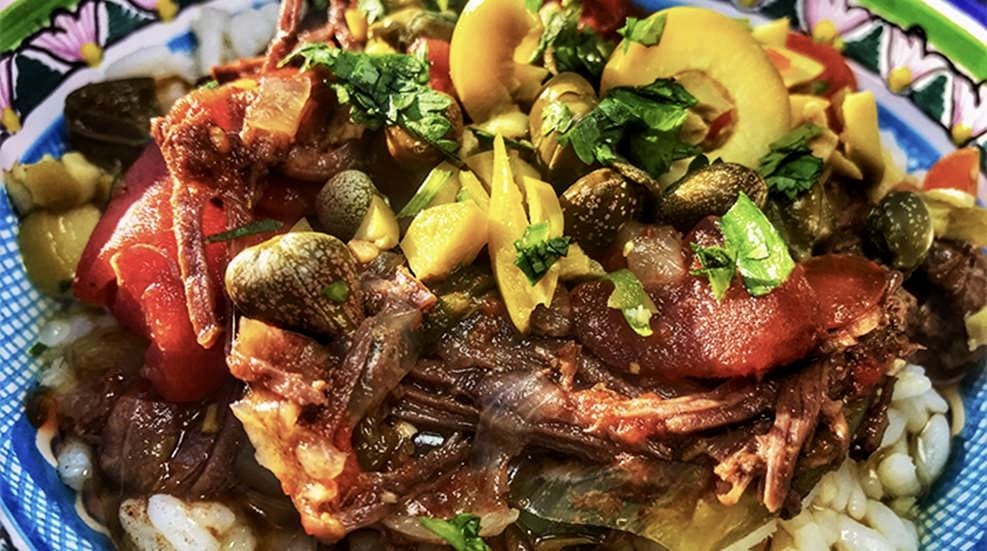
McMILLION: Ropa Vieja means “old clothes” in Spanish, and it might be a good idea to wear some when you’re cooking and eating this. It can get kind of messy. It’s a common dish throughout Latin America, where fatty beef shoulder is usually the main ingredient. I like this Cuban variety, with the salty tang of the pimentos and capers.
I use elk shanks, a piece of the animal that for decades I ground into burger. I regret doing that, now that I’ve figured out how to cook them: low and slow in the oven.
This recipe will feed six people, with probably some leftovers that are good in a tortilla with some chopped green onion and cilantro.
Ingredients and Cooking Instructions for Elk Ropa Vieja
One big can of whole tomatoes.
Three or four meaty elk shanks, cleaned and trimmed.
Two red bell peppers, sliced.
Two or three poblano peppers, sliced.
Two or three carrots, chopped.
One large onion, sliced.
Four or five garlic cloves, sliced.
One small can of tomato paste.
One cup of red wine.
A handful of green olives, pitted.
Two tablespoons of capers.
One small jar of pimentos.
One pound of mushrooms.
Salt
Pepper
Paprika
Mexican oregano
Dried thyme
Cilantro
Directions
Season the shanks with salt, pepper and paprika, then brown them in neutral oil in a big Dutch oven, working in batches if you need to, so you don’t crowd them.
Remove the shanks and sauté the onions, carrots and peppers in the same oil. (You might need to add a little.) Season with salt, pepper and generous oregano and thyme pinches. When they start to caramelize, add the garlic slices. After a minute or so, add the tomato paste. When it begins to caramelize and stick to the pan, add the wine and deglaze your pan, scraping up the flavor bombs on the bottom.
Crush the tomatoes a bit with your hands, then add them and their juice to the pot. Then return the shanks to the pot. You might want to add a little beef stock to just barely cover the shanks.
Cover the pot and put it in a 325 degree oven. Shanks take a while to tenderize, so count on about four hours in the oven, maybe a little more. Turn the shanks once or twice during the process. (If you use other cuts of elk, such as round or shoulder, use large chunks. Small ones won’t shred as well.)
While the shanks cook, slice your mushrooms and sauté them with a little butter and oil. When they start to squeak when stirred, they will begin to brown quickly. When they’re done, set them aside.
When the meat pulls freely from the bone, pull the shanks from the pot and shred the meat. Return it to the pot with the vegetables and sauce. Save the bones to adorn your serving dish, or to feed the marrow to the adventurous.
Timing is important for this dish, as shanks can take a while to tenderize. It’s best to start cooking early Once the dish is complete, you can rewarm it later on the stovetop when your guests are ready. Add the sauteed mushrooms as you reheat it.
Add the pimentos, capers and olives just before serving.
Garnish with cilantro.
Condiments can include sliced jalapenos, sliced radishes, sliced jicama, green onions or hot sauces of your choice. Serve with tortillas, crusty bread, or fresh cornbread.
Todd Wilkinson, co-founder of Yellowstonian, has been an award-winning American journalist for almost 40 years, known foremost for his writing about the environment and his knowledge of the Greater Yellowstone Ecosystem. In addition to his books on topics ranging from scientific whistleblowers and Ted Turner to Grizzly 399 (that book featuring images by photographer Tom Mangelsen) and coffee table volumes on a number of prominent fine artists, Wilkinson has written for National Geographic, The Guardian, The Washington Post, Christian Science Monitor and many other publications. He started his career as a violent crime reporter with the City News Bureau of Chicago. He is also a writing fellow of the Northern Rockies Conservation Cooperative based in Jackson Hole.
The Boundary Waters of northern Minnesota is a beloved American crown jewel—as treasured as Yellowstone, Glacier and the Grand Canyon. So why, millions wonder, is it being put at risk?
In his latest column, Brad Orsted reflects on how the fur is flying in the wolf watching community of America's oldest national park. What's behind it?
Science under siege: If Steve Daines, Tim Sheehy and others prevail in the quest to de-regulate industry on public lands, what will the West look like in another 20 years, on top of the looming impacts of climate and AI? They're afraid to discuss it