by Todd Wilkinson
The great philosopher Arthur Schopenhaur once said that “every man takes the limits of his own field of vision for the limits of the world.”
This is to say that leaders who suffer from personal insecurity or conflict aversion or simply don’t possess the fire in their bellies or imagination in their minds to fight the good fight for causes larger than themselves will, invariably, hold back others willing to venture beyond their own limitations.
Were Schopenhaur alive and pondering what’s in front of us now in the Greater Yellowstone Ecosystem, he might say: “Don’t be held captive by those who suffer from narrow-minded, short-term, provincial thinking and demand instead that we strive to achieve a bigger vision worthy of the global treasure it is.”
There isn’t a person I know, who has lived in this part of the world longer than a decade, who isn’t presently alarmed, if not heartbroken, by the dramatic changes manifesting themselves on the landscape and in our once local quaint communities. There is desperation, frustration, and disillusionment that no entity is stepping forward to chart a different course. A conviction uniting longtime residents of Greater Yellowstone—and by extension, Montana, Wyoming and Idaho— is they never wanted this part of the West to become just like everywhere else.
If they weren’t born here, then they moved into the region because of its wildlife and pastoral, unpretentious character. Humility, modesty, and altruism used to be watchwords expressed in action, but the engine nowadays which seems to be driving unwanted change is that of unfettered greed, total fixation on self-interest, athletic hedonism, short-attention spans, and brazen flaunting of personal wealth.

If one bothers to learn the essential history of how Greater Yellowstone managed to dodge the worst expressions of Manifest Destiny and become the cradle of American wildlife and landscape conservation, then one realizes that it took extraordinary people willing to act in ways that benefitted others beyond their own lives. This is the sub theme of Robert Keiter’s new, voluminous, and eminently timely book Conserving Nature in Greater Yellowstone: Controversy and Change in an Iconic Ecosystem (University of Chicago Press).
What is, and was, at stake with recent maneuverings of US Sen. Mike Lee of Utah to divest federal public lands to states and allow them to be sold off to private interests? Why is the dismantling of federal land management agencies and environmental laws potentially devastating to the West as we cherish it? With private land development and sprawl, combined with unbridled outdoor recreation pressure representing Manifest Destiny 2.0, will these be the years when Greater Yellowstone’s profound achievements begin to, irreparably, unravel?
Back in 1989, I was in Bozeman chatting with Ed Lewis, then executive director of the Greater Yellowstone Coalition and, who, by profession, was an attorney at law. I asked Lewis to peer into the future and predict what lay ahead for Greater Yellowstone, which in those days was still a somewhat vague concept and not readily part of the common public lexicon.
Even agencies like the United States Forest Service stubbornly refused to adopt the word “ecosystem” in their jargon of strange-sounding acronyms. Instead, they would only reference the region as the Greater Yellowstone Area because, God forbid, they wanted to take no chances in having the public mistake their multiple use agenda (then suited to accommodating resource extraction) for the preservation mission of the National Park Service.
Nonetheless, at the time, in the wake of the historic 1988 Yellowstone forest fires, a bold and ambitious plan to protect the ecological integrity of the region was advanced by, mostly, major federal land managers comprising an entity called the Greater Yellowstone Coordinating Committee.
But, citing unsubstantiated, whacky conspiracy theories about alleged plots to advance a One World Government with the United Nations robbing America of its sovereignty, the effort was beaten back by politicians beholden to logging, mining, energy and ag interests who regarded ecosystem thinking as a threat to their power and influence.
Lewis suggested I make contact with a law professor at the University of Wyoming named Robert Keiter. In the short years that followed he would author a book, published by Yale University Press, titled The Greater Yellowstone Ecosystem: Redefining America’s Wilderness Heritage which was not an attack on wilderness but rather a book that made the case for why wildlands protection established Greater Yellowstone as a beacon of modern conservation.
Because I am a wonk, like Keiter, we hit it off immediately. I gravitated toward his grasp of how topography, the interface of public and private lands, the intersection of three states encircling Yellowstone National Park and, of course, the presence of environmental laws, provided a mental superstructure for thinking about Greater Yellowstone.
Keiter, after also publishing an important yet narcolepsy-inducing book, The Wyoming State Constitution: A Reference Guide, went on to become, more prominently, the Wallace Stegner Distinguished Professor of Law at the University of Utah’s Quinney College of Law and also director of the Wallace Stegner Center of Land, Resources and the Environment. He and colleagues have been on the front lines of important issues shaping the West, from mining, water, and timber law reform to gauging the (dubious) veracity of Utah’s attempts to seize federal lands and sell them off.
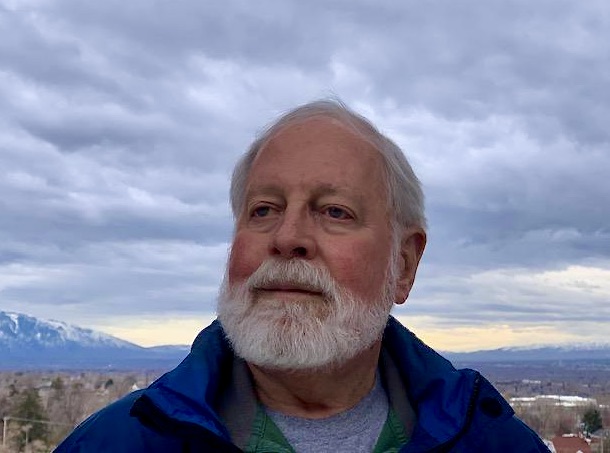
During his tenure in Utah, Keiter has published a number of influential books and papers, including one for the University of Colorado Law Review titled The Greater Yellowstone Ecosystem Revisited.
Ed Lewis was generous in making our introduction long ago. Few others in the world of legal public lands academia have had a bigger impact in gently shaping how I, as a journalist, think about what’s necessary to save this rarefied ecosystem.
Along the way, across years, Keiter himself has realized that the pace of social, political, cultural and physical change happening on the ground demands visionary people and policies to engage it. We have a narrow window of opportunity to get it right; otherwise, the essence that sets Greater Yellowstone apart in the world, he says, will be lost in the same way other once unique parts of this country have squandered their “nature of place.”
Last September Keiter was asked to deliver the keynote at the 16th Biennial Science Conference, hosted by the Greater Yellowstone Coordinating Committee, and held at Big Sky. It attracted hundreds of people involved with conservation.
Keiter previewed what was then his forthcoming book years in the making. Now that Conserving Nature in Greater Yellowstone: Controversy and Change in an Iconic Ecosystem is out and it provides a sobering assessment of how Greater Yellowstone as a concept came into being and the existential challenges it faces, I’m hoping it gets into wide circulation. There’s none other like it and is an important new contribution to the established written canon of conservation.
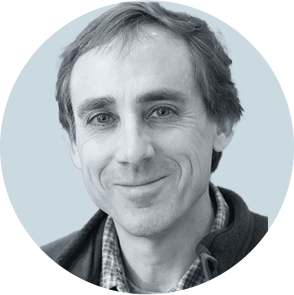
Keiter is not prone to melodrama. He has the demeanor of a serious, well-organized courtroom prosecutor who is methodical in his narrative and laying out of facts. He struggles, however, to be an optimist, though his optimism is based on his belief that we can be visionary in ways we’ve shown ourselves capable of being before, with the establishment of Yellowstone and Grand Teton as examples, for instance. Their creation was met with resistance and claims that they were imposing on freedom, liberty and private property rights. He sees earlier momentous vision with the genesis of a national forest and national wildlife refuge system that took hold here, and with species protection laws that have had some of the biggest consequential impacts in wildlife conservation. Think bison, grizzly bears, wolves, elk, wild native trout, trumpeter swans, and, more recently, the identification and mapping of wildlife migration corridors.
But Greater Yellowstone is in peril as its thresholds of resilience are being constantly tested by a growing human footprint; “the clock is ticking” fast on opportunities to take preemptive or corrective actions, Keiter notes, to prevent these huge achievements, which have made our region a global bellwether, from coming undone.
If there’s a single message intended to emanate from this story, it’s that, for people who are serious about understanding why Great Yellowstone stands apart, then this is among a stack of must reads.
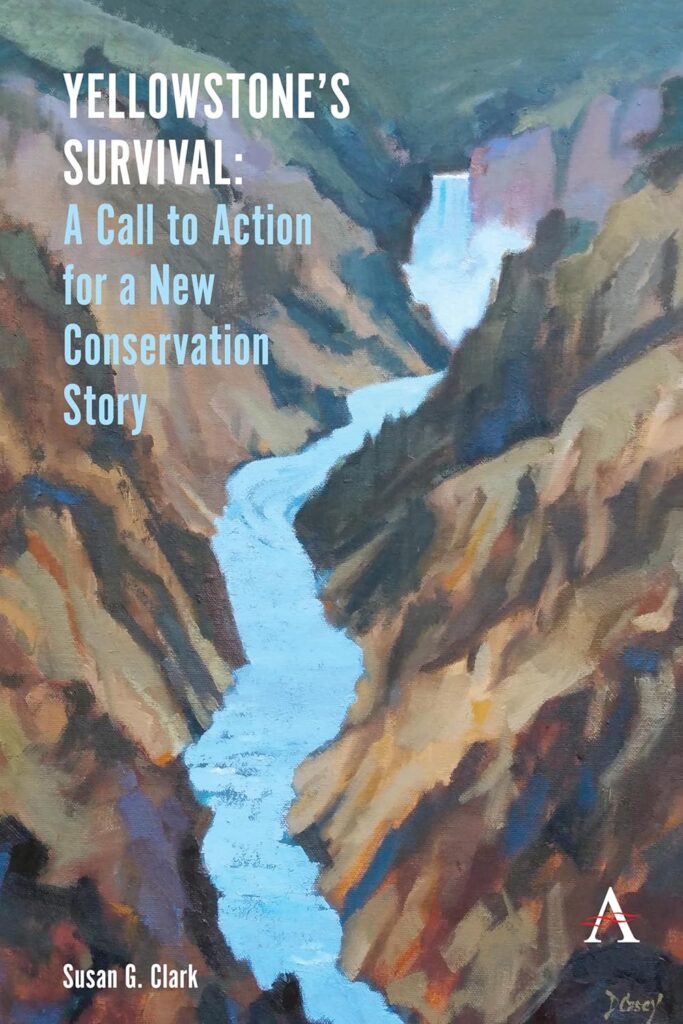
A timely companion book is one written by retired Yale University professor Susan G. Clark titled Yellowstone’s Survival: A Call to Action for a New Conservation Story. Clark is co-founder of the Jackson Hole-based Northern Rockies Conservation Cooperative, a friend of Keiter’s and others troubled by lack of a cohesive strategy for confronting human impacts.
Both of those tomes ought to be required for employees—especially people younger than 40—working for federal and state land management agencies, conservation groups, elected officials in local and county government and, of course, developers, realtors, and tourism industry promotors who are catalysts for what’s happening.
In his book, The Life of Reason, published in 1905, George Santayana, famously said “those who cannot remember the past are condemned to repeat it.” For those in the past who delivered Greater Yellowstone to us, they gave us a region filled with natural wonders, but their heroism did not happen without struggle, conflict, doubt, feelings of alienation and at times having to step up and defy those who didn’t care. Are we worthy of carrying on their legacy?
Keiter’s writing always provides fodder for our contemplation of that question. The publication of his important book also provides yet another excuse for us having an exchange, which you can read below. Both Keiter’s Conserving Nature in Greater Yellowstone: Controversy and Change in an Iconic Ecosystem and Clark’s Yellowstone’s Survival: A Call to Action for a New Conservation Story are available wherever good books are sold
The Yellowstonian Interview With Author Robert Keiter
Todd Wilkinson: What would the American West be like if there was not the presence of public lands?
Robert Keiter: As Wallace Stegner, perhaps our most astute chronicler of the American West, observed: the region is defined by its aridity and public lands. Without the public lands that are owned by all Americans, the West would lose much of its unique character, its horizon-bounded open spaces, its wide-ranging wildlife herds, the sense of solitude that still prevails within the region’s vast landscapes, and the outdoor experiences that are so much a part of western life. The western public lands, in short, embody much of our natural as well as cultural heritage as a nation, which we cannot afford to lose in this fast-changing world.
TW: You’ve been thinking about the Greater Yellowstone Ecosystem for 40 years and pondering, from the standpoint of being a legal scholar, the things that hold it together—public and private lands, government institutions, environmental laws and citizens recognizing the benefits of working together. Where are we today when so many of those things are under siege?
Keiter: By any measure, the Greater Yellowstone Ecosystem is a unique setting that stretches across some 24 million acres of public, private, and other lands, creating a mosaic of ownerships, institutions, and management priorities. At the same time, the region is knit together by its natural attributes—free flowing rivers, migratory wildlife, rugged mountain ranges, and the like. We now recognize these interconnections, widely regard the region as the Greater Yellowstone Ecosystem, and have made significant strides toward protecting its unique character, particularly on the public lands where federal law controls. It is proving more challenging to address escalating private land development concerns where individual landowners often have different priorities and quite different state laws control. It is more important than ever for communities and people to come together around a common vision for Greater Yellowstone, one that acknowledges and seeks to protect its unique natural character and attributes.
TW: How much of the numerous “controversies” you allude to in the title of your book actually relate to policies and cultural attitudes based on mythology and not facts rooted in evidence? We’re still dealing with so many, among them that Nature can be protected without planning and zoning, that wolves are devastating big game herds and the livestock industry, and that public lands would be far “better off” for everyone if they were privatized. Why is such mythology so difficult to overcome?
Keiter: Beginning with the time of European settlement, the West has been regarded as a land of abundance with limitless resources—timber, water, land, wildlife, and much more—all available for the taking. That has proven wrong, however, and in places like Greater Yellowstone we have made real progress toward protecting and restoring these natural attributes by establishing national parks, national forests, wilderness areas, wildlife laws, and more. But pressures persist to open or reopen the public lands to ever more uses and activities, including renewed timber cutting to control wildfires, energy leasing, and motorized access, often to enhance local economies—all predicated on the notion that there’s plenty of space to accommodate these uses. Which overlooks not only the lessons history has taught us but ignores the scientific realities underlying the fragile ecological connections that hold Greater Yellowstone together. We now better understand these ecological realities that, frankly, support the need for some limits on the use of the region’s public lands and some degree of restraint on the adjoining private lands.
TW: Few would dispute the observation that, predominately, conservation efforts have focused on public lands—national parks, forests, wildlife refuges, BLM and tribal homelands—with less attention given to the critical role private lands play—which comprise a quarter of the region. Again, we know so much more about how important protecting them is in maintaining ecosystem health. You live in Greater Salt Lake City where sprawl and human footprint has exacted far reaching negative impacts on nature. What needs to happen in Greater Yellowstone to avoid a similar outcome?
Keiter: Agreed, conservation efforts in the GYE have managed to protect much of the region’s public lands, so these efforts should now focus more on its private lands where development pressures are rampant given the significant population growth we’ve witnessed in the last few decades. Though I live elsewhere, I’ve visited the GYE often enough over the years to witness the sprawl that is occurring as once open ranch lands are converted into ranchettes, malls, and suburban developments, changing the basic character of the landscape and communities. The state laws governing private land use in the GYE are generally weak due to property rights concerns and local political pressures.
This has moved incentive-based strategies such as conservation easement transactions, innovative habitat leases, and the like to the fore, which has helped to strategically protect important winter habitat and migration corridors in some locations. But is this sufficient? Do we have enough money to meet the need? I’d argue we also need to put more teeth into local land use planning and zoning laws and practices to better safeguard the region’s vital ecological sites and connections.
“Conservation efforts in the GYE have managed to protect much of the region’s public lands, so these efforts should now focus more on its private lands where development pressures are rampant given the significant population growth we’ve witnessed in the last few decades. Though I live elsewhere, I’ve visited the GYE often enough over the years to witness the sprawl that is occurring as once open ranch lands are converted into ranchettes, malls, and suburban developments, changing the basic character of the landscape and communities. The state laws governing private land use in the GYE are generally weak due to property rights concerns and local political pressures.”
—Robert Keiter
TW: What’s evident about Greater Yellowstone, both in the way it stands apart with its tapestry of wonders, and with how easily breakable they are, is that current generations have inherited much from previous ones. It’s a bounty that still exists because it was defended, sometimes contentiously. Our forebearers deliberately restrained their activities—namely the extraction of resources—in order to benefit people they would never know. Some would call their attitudes expressions of selflessness as opposed to only being focused on accommodating self indulgent behaviors which seems to drive the modern outdoor recreation industry. The former is the real essence of conservation that delivered us to where we are today. What is it going to take to pass along a healthy, functioning ecosystem to those in the future?
Keiter: It’s always worth remembering the legacy our forebearers left us in the GYE, the vision they brought to the conservation task, and their willingness to put the greater public good first. That spirit still lives in the GYE and elsewhere across the West, but it must be regularly rekindled as we continue to face challenges on the region’s private lands, industrial-scale recreation pressures, climate-related impacts, and more.
To counter these pressures, we must continue building public understanding of and support for the GYE concept that knits the region’s natural features, character, and communities together. We are today’s trustees for future generations, which puts a solemn responsibility on us to keep this special place intact. To do so, we must instill the political will to protect the GYE’s wilderness qualities, open spaces, and wildlife resources by reinvigorating the public commitment to nature conservation. Science, lawsuits, private philanthropy, literature, art, and the like are all important tools in promoting the vision of an entirely intact GYE that, I believe, is necessary to carry the day in the all-important political domain.
TW: I can’t resist this one last question: what role does journalism, academia and science need to play?
Keiter: Knowledge and facts still matter, and that is what journalists, academics, and scientists bring us, enabling us to understand the GYE as a whole, its ecological, economic, political, cultural, and legal dimensions. And that is essential if we are to persuade the public of the need to preserve its outstanding natural and cultural attributes.
ENDNOTE: Below is the book mentioned above authored by Dr. Susan G. Clark of Jackson Hole