by Todd Wilkinson
As part of its cowboy mythology, the American West in most of its rural corners still treats cattle as being the vaunted king of federal land use. Grazing occurs on around 270 million acres of public lands, more than any other commodity activity. That’s equal to 135 Yellowstone National Parks.
Although non-native bovine breeds have inhabited Montana’s grassy ranges for a mere fraction of time compared to the wild native bison they usurped, the US Interior Department in January again bestowed domestic livestock with the equivalent of special sacred cow status on federal public land.
Sonya Germann, state director of the federal Bureau of Land Management Montana-Dakotas office, wrote a letter revoking seven BLM grazing allotments granting the non-profit conservation group, American Prairie, permission to raise bison instead of cattle.
Reversing an earlier decision made by the Biden Administration allowing American Prairie to use those BLM lands in Phillips County, as part of a much larger vision of using bison as a cornerstone of ecological restoration, the move won cheers from bison foes.
Those foes include Montana Gov. Greg Gianforte, Montana’s Congressional Delegation, the Montana Department of Justice, the Montana Stockgrowers Associations and property rights advocates claiming that allowing bison to supplant cattle represented an imminent threat to the cattle industry.
American Prairie, which is privately funded, has a dream of pooling together an interconnected mosaic of private land it owns, public land it leases and the nearby Charles M Russell National Wildlife Refuge along the Missouri River to create an unprecedented landscape devoted to the recovery of species lost from the prairie. In all, its goal to have a reserve that will be more than three million acres or roughly 1.5 times the size of Yellowstone.
American Prairie manages around 900 bison and the amount of acres in those seven BLM allotments is around 63,000 acres.
Not only have American Prairie antagonists sought to subvert those and its larger efforts, but they also have rebuffed other citizen-led campaigns to bring wild bison back to the CM Russell and UL Bend national wildlife refuges in terrain where they were celebrated in paintings by George Catlin and Karl Bodmer in the early 1830s and Russell decades later. Those initiatives were championed by the likes of well respected and legendary conservationists like the late Jim Posewitz, and Joe Gutkoski and Dr. James Bailey through the American Buffalo Foundation.
As has been the case in similar arguments invoked against wolves, grizzly bears, and prairie dogs—three species earlier targeted for eradication on hundreds of millions of acres of public land in the West—the fear-mongering tactics aimed at bison about alleged threats they pose to the livestock industry lack both facts and context. The group, Western Watersheds Project, said Germann’s decision was “a blatant attempt to sabotage” restoration of bison in east-central Montana.
American Prairie CEO Alison Fox called the decision “unfair, deeply disappointing, disruptive, and inconsistent with long-standing public-lands grazing practices in Montana.”
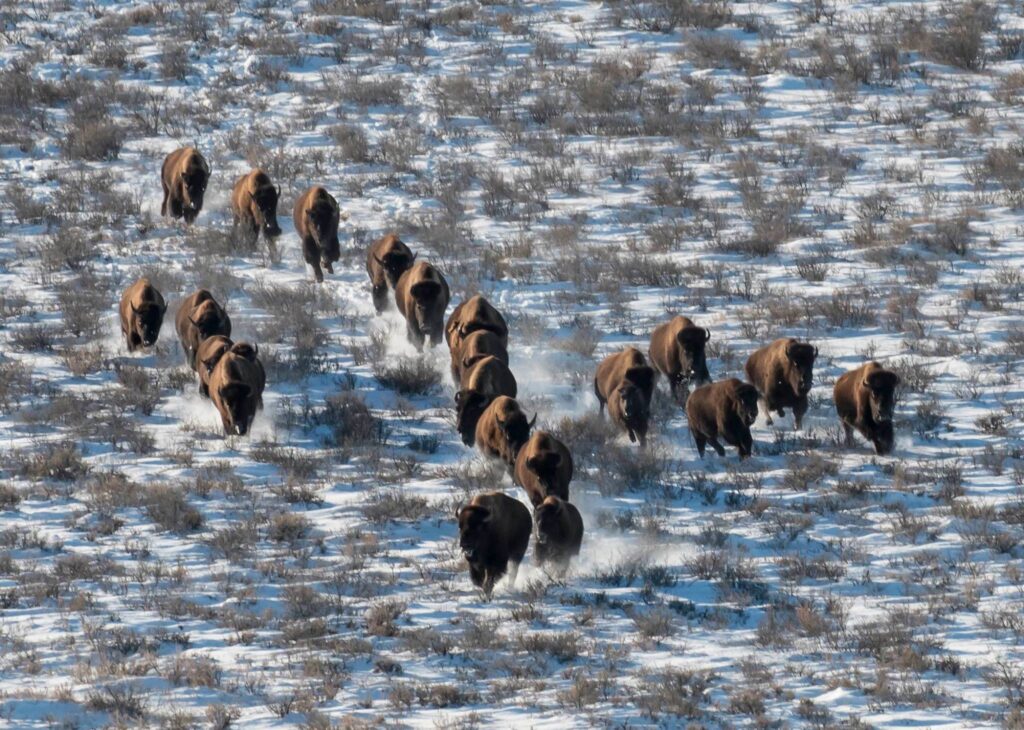
By invoking the 1934 Taylor Grazing Act, which established primacy for privately owned domestic livestock on federal land, refusing to recognize America’s official national land mammal as wildlife, and forcing bison to be categorized as “production livestock” in order to graze on allotments, the Interior Department says American Prairie violated narrowly prescribed parameters of the law.
“There are multiple times wherein by the applicant’s own admissions it is clear that these are not managed for production-oriented purposes and so do not fall within the meaning of the terms livestock and domestic as those terms are used in the applicable statutory authorities,” the BLM’s Germann wrote in her letter. “Reissuing cattle-only permits on allotments where bison or a combination of cattle and/or bison were previously authorized … ensures that the BLM is acting within the limits of its statutory authority.”
A few years ago, the chronically fact-challenged organization, United Property Owners of Montana, wrote: “American Prairie Reserve is on a mission to destroy vibrant Montana communities filled with hard-working families. Their radical plan is to turn the land over to wild animals and the elite class who can pay to pretend to co-exist with them. You and every other taxpayer are forced to subsidize this nonprofit scheme.”
There are a variety of factors creating hardship for farmers and ranchers and American Prairie does not rank high on the list but it is a convenient scapegoat.
Many observers were surprised by Germann’s decision. In her bio on the BLM website, it notes that Germann was born in Montana and raised on a ranch near McAllister in the northern reaches of the Madison Valley. She was the 1993 class valedictorian at Ennis High School. Holding bachelors’ degrees in wildlife biology and liberal studies from the University of Montana in Missoula, she’s worked on state trust lands and served as a biological science technician on the Tongass National Forest in Alaska. She is credited with ensuring the timber cut got out on state forest lands when she served as the Montana Department of Natural Resources first female forester
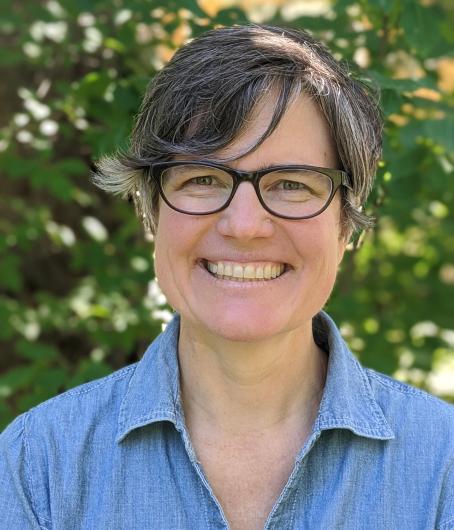
She also spent time as a community rights organizer for the Montana Human Rights Network. She says she’s an avid hiker and boater on Montana’s wild rivers. When she got the BLM post in 2022, the Montana Stockgrowers Association issued a press release praising her hiring. She was appointed to her job, however, by then BLM national director and Montanan Tracy Stone-Manning, who was appointed to her post by President Joe Biden. Stone-Manning today is president of The Wilderness Society. Stone-Manning also approved the decision to allow American Prairie to graze on bison on its BLM leases.
Critics say Germann made a decision that defies common sense and is beyond her own legal depth. Helping her and Interior Department lawyers advance that argument has been Montana Attorney General Austin Knudsen who stated the following in a press release: “I’m pleased to see this proposed decision from the Trump Administration’s Bureau of Land Management today. Canceling the American Prairie Reserve’s bison grazing permit will help to protect the livestock industry and ranching communities in Northeastern Montana from the elitists trying to push them out. For over four years I have been urging the BLM to cancel the permit, and our work finally paid off. This is a huge victory. As Attorney General and the state’s chief legal officer, I will continue to do my part to support Montana farmers and ranchers.”
As part of her controversial 24-page decision, Germann listed a long list of people, including many from out of state, who support the decision. Notably, it has been the modus operandi of many Interior Department agencies in the Trump Administration to dismiss public comments supporting protection of wolves, grizzly bears, maintaining the Endangered Species Act, the National Environmental Policy Act, the Forest Service Roadless Rule, the authority of the Environmental Protection Agency to regulate water and air pollution, challenging the authority of DOGE to terminate federal employees, critiquing the impacts of proposed offshore oil and gas drilling, and other issues.
In essence, in this case, by presenting a rhetorical framework that only allows bison to exist in public lands unless they are managed like domestic cows bound for commercial meat markets, requires that bison not be bison; otherwise, they are prohibited.
The staunchly libertarian Reason Institute, which publishes Reason magazine, called into question the BLM’s rationale. Writer Ron Bailey noted, “Amusingly the Congressional Research Service has just issued a new report on federal grazing regulations that cites a 1976 Department of the Interior’s Office of Hearings and Appeals holding ‘that bison may be considered ‘livestock’ under the TGA [Taylor Grazing Act], where the bison are treated in substantial respects as livestock and have characteristics in common with livestock.’ As it happens, American Prairie arguably meets the ‘production-oriented purposes’ requirement since it actively manages its bison and authorizes annual harvests from its herd.”
Another irony, or what some might call a contradiction or hypocrisy of the Interior Department decision, is that it’s supported by politicians who claim to be adherents of private property rights and free-market approaches to managing America’s public lands. However, many independent proponents of private property rights have vocally supported the efforts of American Prairie, calling its approach innovative and capable of achieving better long-term outcomes for land stewardship.
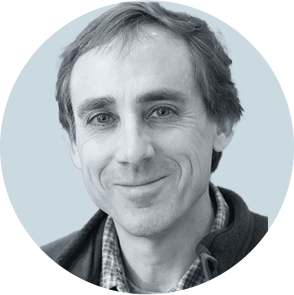
One of them is Holly Fretwell, a conservation economist who previously taught classes at Montana State University in Bozeman. She presently is a visiting fellow at the Hoover Institution based at Stanford University and is a research fellow at the Property and Environment Research Center (PERC) in Bozeman, which supports American Prairie’s desire to graze bison on its federal cattle allotments. One added twist to this drama is that former PERC board member Tim Sheehy is now a US Senator and recently signed a letter in opposition to allowing bison grazing on a BLM cattle allotment to happen.
The BLM now stands accused of usurping American Prairie’s private property rights and ability to innovatively advance freedom and liberty to do what’s right for conservation and biodiversity. In 2025, Interior Secretary Doug Burgum moved to rescind the BLM’s “Conservation and Landscape Health Rule” which allowed conservation to be treated with equal deference as traditional livestock grazing, mining and energy development.
Yellowstonian recently engaged Fretwell in an interview to share her thoughts on the recent Interior Department decision.
The Yellowstonian Interview With Holly Fretwell

Yellowstonian/Todd Wilkinson: When you learned the Interior Department was revoking seven grazing permits granted to American Prairie, nixing its ability to allow its bison to roam on BLM lands, what was your reaction?
Holly Fretwell: My biggest concern is that the decision is taking away a tool to enhance conservation on public rangelands. It discourages the adaptive management approach that is helping ranchers increase both ecological and economic outcomes by treating conservation-focused grazing as suspect, even when monitoring can demonstrate results.
The problem is the precedent it sets. The decision rewards traditional grazing over innovative approaches that are showing increased ecological performance. We are learning that many landscapes can be managed to enhance both production and ecological function. Grazing practices that allow for rest and rotation can improve soil function and increase forage growth. That is good for livestock, ecosystems, and long-term range resilience.
Instead of evaluating grazing based on measurable outcomes, the decision signals that conservation can be pursued only as a side-effect of permitted livestock production. It creates a perverse incentive that rewards commodity production over conservation without considering the added value of conservation and co-benefits it can provide on public lands.
“The problem is the precedent it sets. The decision rewards traditional grazing over innovative approaches that are showing increased ecological performance. We are learning that many landscapes can be managed to enhance both production and ecological function. Grazing practices that allow for rest and rotation can improve soil function and increase forage growth. That is good for livestock, ecosystems, and long-term range resilience.”
—Holly Fretwell
Yellowstonian: You are a research scholar who specializes in the practice and application of what’s called “free-market environmentalism.” This administration, as well as Montana’s Congressional Delegation and its governor, claim to be disciples of the free market. How does this decision represent a contradiction and why, in your mind, does it set a bad precedent?
Fretwell: As a free market environmentalist, I look for economically viable ways to enhance environmental quality and conservation. Doing well by doing environmental good, if you will. Many ranchers across the West are finding that innovative grazing management can strengthen profitability and ecological function because healthier soils and better plant recovery increase productive capacity.
These are conservation tools emerging from ground up, quite literally. It is management that adapts to what is seen on the ground, not dictated from books or policy. It is conservation at its heart, and production that helps make it economical.
Yellowstonian: So, how does this Interior Department decision depart from that?
Fretwell: The contradiction is that the leaders claiming to support free markets are backing a decision that picks winners and losers by administrative definition rather than bottom-up innovation and measurable outcomes. The framing is around American Prairie, but the impact will reach much further. It discourages any permittee managing for conservation outcomes on public lands.
This shouldn’t be about American Prairie. It should be about structuring incentives for better stewardship across the West and encouraging innovative approaches that demonstrate measurable outcomes.
Yellowstonian: I have to ask this question, and don’t want to dance around it. To invoke the rhetoric of President Trump, who claims that anything that doesn’t validate his standing is somehow “rigged” against him, couldn’t it be argued that the laws pertaining to non-native livestock grazing on federal public land are rigged against native wildlife and innovative ways of approaching conservation? It seems that states force bison to be classified as livestock, so they can’t be treated as wildlife—even though they are, after all, our national land mammal—and then states use that classification as a way to preventing bison from being on public land and fulfilling their huge ecological benefits. Bison were residents of the West for more than 12,000 years. What’s your response?
Fretwell: Public land grazing was built around commodity production. That makes it hard for wildlife interests and conservation models to gain traction. In the late 1800s we nearly eradicated bison, the native grazer, and replaced them with cattle across much of the West. Private initiative helped bring bison back from near extinction, and today Yellowstone supports one of the largest free-roaming herds. But the regulatory framework governing grazing on public lands remains largely unconducive to wildlife focused approaches.
“Public land grazing was built around commodity production. That makes it hard for wildlife interests and conservation models to gain traction. In the late 1800s we nearly eradicated bison, the native grazer, and replaced them with cattle across much of the West. Private initiative helped bring bison back from near extinction, and today Yellowstone supports one of the largest free-roaming herds. But the regulatory framework governing grazing on public lands remains largely unconducive to wildlife focused approaches.”
Yellowstonian: In effect, it also forces a once prolific native public wildlife species, the only one not allowed to truly roam free, to be treated essentially as an exotic animal whose restoration must win permission foremost of livestock interests that were behind the species’ original near annihilation. In essence, unless bison are commodities of American meat production, they have no standing.
Fretwell: The current dispute questions how the line between wildlife and livestock is drawn. In Montana, wildlife are free-roaming and unowned, whereas livestock are owned and constrained. The BLM rule adds the qualifier that bison must be used for “production oriented purposes” to be considered livestock. That shifts the delineation from ownership to intent.
Yellowstonian: You have been among the voices saying that Americans who favor conservation ought to have the opportunity, for example, to bid on oil and gas leases and, if they so choose, elect not to develop those lands but protect them from the impacts of energy development. And you apply similar thinking to grazing allotments, arguing that the current system forces land to be developed even if it has high conservation values.
Fretwell: The “production first” framing puts outcome-based grazing at risk. When the system treats conservation as disqualifying, it implies that conservation-focused grazing is not a legitimate use of federal grazing allotments. This shifts incentives away from innovative approaches toward traditional grazing methods.
If the goal is to improve land stewardship while sustaining productive use, grazing leases should allow flexibility for innovation, paired with demonstrated range health.
Yellowstonian: There are many things to say about the Taylor Grazing Act, which was born almost a century ago in 1934 and critics say is incredibly antiquated in that it locks in place worldviews that have not kept pace with modern notions of public lands, markets and ecological understanding. The grazing rate charged for AUMs (animal unit months for one cow and one calf) on BLM land in Montana is just $1.35 and hasn’t risen in human generations. Plus, it’s way below market rates were a cow and calf grazing on private land. This has been an important part of your research—figuring out how taxpayers can get a better return, how uses favor sustainable stewardship and result in more resilient landscapes that, ever increasingly, are becoming hotter and drier. Please elaborate as it’s important for readers to understand your thinking.
Fretwell: The Taylor Grazing Act of 1934 was a response to open access grazing that was degrading rangelands and creating conflict over land use. The Act created boundaries with defined grazing districts and permits that were generally linked to adjacent base properties with ranching operations. The structure clarified authorized use on public lands that were previously grazed in common and helped keep ranching viable in arid regions where private acreage alone was insufficient to support a year-round operation.
Over time, the predictability of using the same allotments year after year led to incorporating the allocation value into the value of ranch properties. Federal allotments continue to be an integral part of grazing plans for many western ranch operations. That history matters. Changing public land grazing policy affects real operations and the long-term stability of working landscapes.
Yellowstonian: What about the assertions made by groups who say the federal government is subsidizing livestock grazing through low rates, and services taxpayers provide such as predator control and even removing grizzly bears that eat private cattle on public grazing allotments. They point out how the rates haven’t changed. Elon Musk, when he created the Department of Government Efficiency (DOGE) claimed that he and his shadowing workers would warn out examples of abuse and economic inefficiency where taxpayers allegedly weren’t getting a fair share of return on investments they are making.
Fretwell: It is true that federal AUM rates are often below private lease rates, but comparisons are imperfect. Permittees often pay significant costs for the infrastructure, maintenance, and management on federal allotments. Private lease arrangements vary widely depending on who provides water, fencing, electricity, and other infrastructure and services. As we learn more about the benefits of adaptive grazing, we are seeing some private range leased at no cost for the forage because the grazing is providing a grassland restoration benefit.
What’s most important is whether the system rewards stewardship that produces healthier, more resilient, and productive rangelands. That’s why more flexibility, not less, matters. Rather than restricting what can be done on the public range, we should be expanding opportunities. Not by undermining existing grazing privileges, but by creating new pathways for permittees to adapt to changing conditions and pursue conservation improvements. The BLM’s proposed rule moves in the opposite direction by narrowing what qualifies as legitimate management on public lands.
Yellowstonian: We spoke about this earlier. I made this assertion: even if American Prairie didn’t exist, mom and pop farmers and ranchers in eastern Montana are going to continue to disappear in the face of hugely challenging headwinds that have nothing to do with bison, predators like wolves or grizzly bears, or even “Liberals in Washington.” Some of those challenges are rising costs of production, uncertainty created by tariffs, lack of intergenerational succession in land ownership, death taxes, and properties being acquired by rich out of state absentee landowners.
Fretwell: The economic headwinds facing ranchers and working lands are real. At the same time, many ranchers are finding ways to strengthen the bottom line while improving land health. They are what I call “enviropreneurs.” Enviropreneurs are entrepreneurs seeking methods to enhance environmental quality and make a profit doing so.
Yellowstonian: This has been a passion area for you in your research. How did it start?
Fretwell: A few years ago, I set out to understand what revenue streams could help keep large working landscapes intact. One consistent lesson is that better ecological function can support better economic production. Many ranchers are improving economic outcomes by increasing ecological function through adaptive grazing management that uses timing, rest, recovery, and targeted impact to build soil health and resilience.
New technology is helping lower the costs of management and improve the ability to measure outcomes. Better metrics help us demonstrate the public and private benefits of well-managed grazing and support smarter decision-making. Tools like virtual fencing, GPS tracking, remote sensing, and camera traps can reduce management costs while providing clearer performance signals. That enhances the bottom line and provides opportunities for new markets and revenue streams.
Yellowstonian: As you know, Yellowstonian has devoted more analysis, scrutiny and investigative reporting than anyone else to the impacts of rural sprawl on wildlife, landscapes, water quality and rural communities comprised of stewards of working lands, e.g. ranchers and farmers. And we in early 2026 co-hosted an event, “Ted Turner & Friends: Stories from the Wild Edge of Co-Existence” with Gallatin Valley Earth Day that highlighted examples of ranchers, including bison ranchers, who are managing for both profitability and preserving ecological and habitat for wildlife. You see their work as examples of what’s possible with a paradigm shift.
Fretwell: I see potential for emerging markets that can support working lands of all sizes. Ranchers can strengthen profitability through adaptive management and by taking advantage of complementary revenue streams, including value-added products, recreation access, and ecosystem services, such as clean water, soil carbon, and biodiversity. Some of these markets exist, some are emerging, and some may never come to fruition. That’s exactly why we should be cautious about one-size-fits-all policies that choose winners and losers.
To keep more families on the land, they need an expanded set of revenue options. This means allowing flexibility that encourages innovation and lets markets emerge. Markets and entrepreneurship are better at discovering what works than political mandates. Enviropreneurs will find a way if policy gives them room to do it.
Yellowstonian: Over the years we’ve had some great back and forth conversations about the virtues and failures of approaches to public and private land management. You’re pragmatic and an honest broker of ideas. You believe in the power and potential of free market environmentalism. But where does it come up short, where can it be improved and when markets fail to adequately protect nature, which in our part of the West includes wildlife and open space, what are the other tools that need to be considered?
Fretwell: Markets are powerful, but they aren’t perfect. They can be slow to respond to non-market goods like wildlife habitat and open space, especially when the benefits are hard to measure, hard to monetize, or accrue to the public rather than the landowner. In some cases, they may never respond. On the other hand, government policies often jump in to support one constituency or another without looking at the full picture, and they can create unintended consequences that are hard to foresee and even harder to unwind.
To me, it is a “compared to what” question. We have imperfect markets and imperfect government actions. The best results often come when the two work hand in hand and policies focus on helping markets work better. This is done by clarifying property rights, lowering transaction costs, and supporting the emergence tools that let people bargain and invest in stewardship.
Yellowstonian: Let’s return to your disappointment in the recent decision to reverse America Prairies use of its legally acquired allotments to graze bison on public land. You see American Prairie as a valuable example of experimentation. The truth is that even if it reaches its goal of three million acres devoted to restoration of prairie species, it’s a small player inside a landscape in east-central Montana that spans tens of millions of acres.
Fretwell: American Prairie is an example of where new approaches can thrive. In an ever-changing world, we need flexibility to innovate, adapt, and respond. New technologies are helping us measure and verify outcomes that used to be largely invisible, such as increased soil carbon, water retention, biodiversity, wildlife habitat, and clean water. These co-benefits from adaptive ranching can complement traditional production outcomes rather than compete with them.
I see a world where those co-benefits increasingly pay for themselves through better measurement, better markets, and smarter institutions. That’s exactly the kind of conservation we should be encouraging, not discouraging.
Yellowstonian: If politicians really want to preserve the rural way of life for Westerners and this includes making them more sustainable and better stewards, what needs to happen that isn’t with the executive action that cancels American Prairie’s allotments allowing them to run bison?
Fretwell: If politicians truly want to preserve the rural way of life and promote better stewardship, the answer is not to narrow the space for innovation on public lands. The better approach is to expand outcome-based opportunities that allow working ranches to stay viable while improving land health. That means clear rules, flexible management, and fewer barriers to voluntary agreements so communities can invest in solutions that fit their land.
Change is inevitable, so policy should enable adaptation rather than trying to preserve the past. The West is changing economically, ecologically, and socially, and policy needs to be open enough to let people respond. When land managers have flexibility, better tools to measure outcomes, and the freedom to respond to consumer demand, they can develop solutions that support both rural livelihoods and conservation.
—————————————
Also read or watch: