by Todd Wilkinson
Once upon a time while interviewing a cryptozoologist—which is to say, a person who investigates creatures of legend who may or may not actually exist—I asked this question: If Bigfoot were to make vocalizations, what would they sound like? Without hesitation, he replied, and somewhat mirthfully: “I think they might resemble the eerie mating wails of a lynx or bobcat.”
Haunting, unforgettable and not commonly heard by human ears, there is no doubt, he said, that for people traveling through forested backcountry and encountering the extraordinary baleful caterwauls of those animals in the dead of night, the cries might well be mistaken for a mythical hominid.
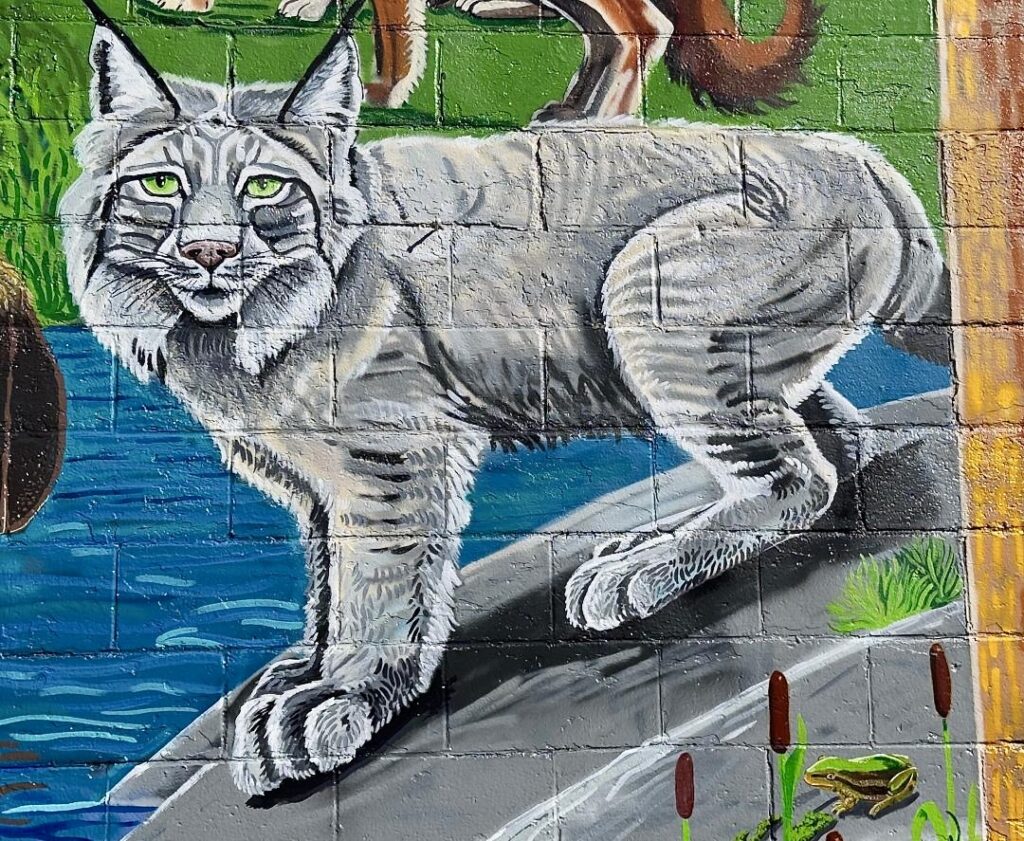
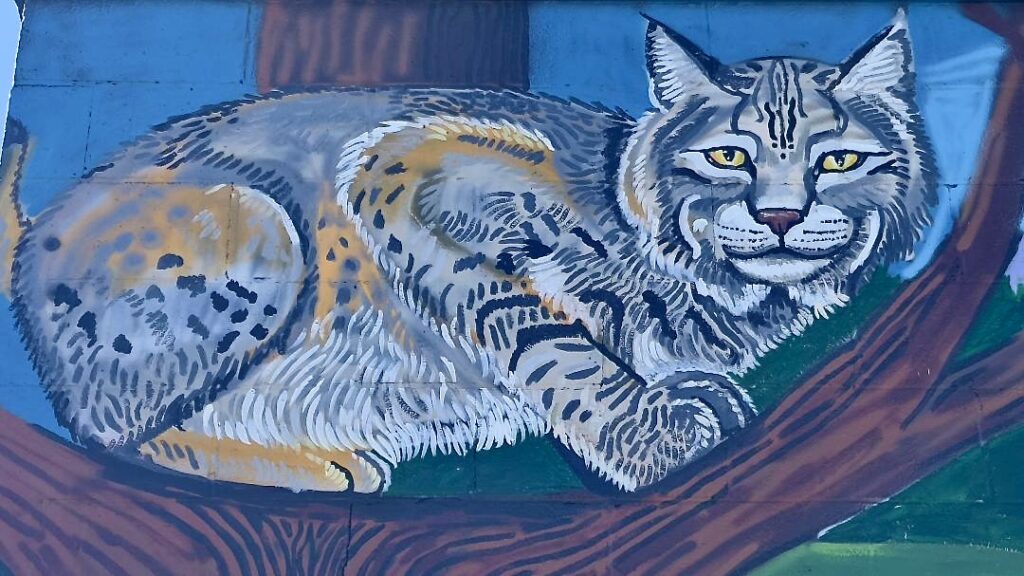
In Helen Seay’s wildlife mural in downtown Jackson, Wyoming, you won’t find a depiction of Sasquatch, but there is a portrayal of two wild lynxians similar in appearance—members of the felid or cat family—prowling a public space that has been described figuratively speaking as “an open air critter cave.”
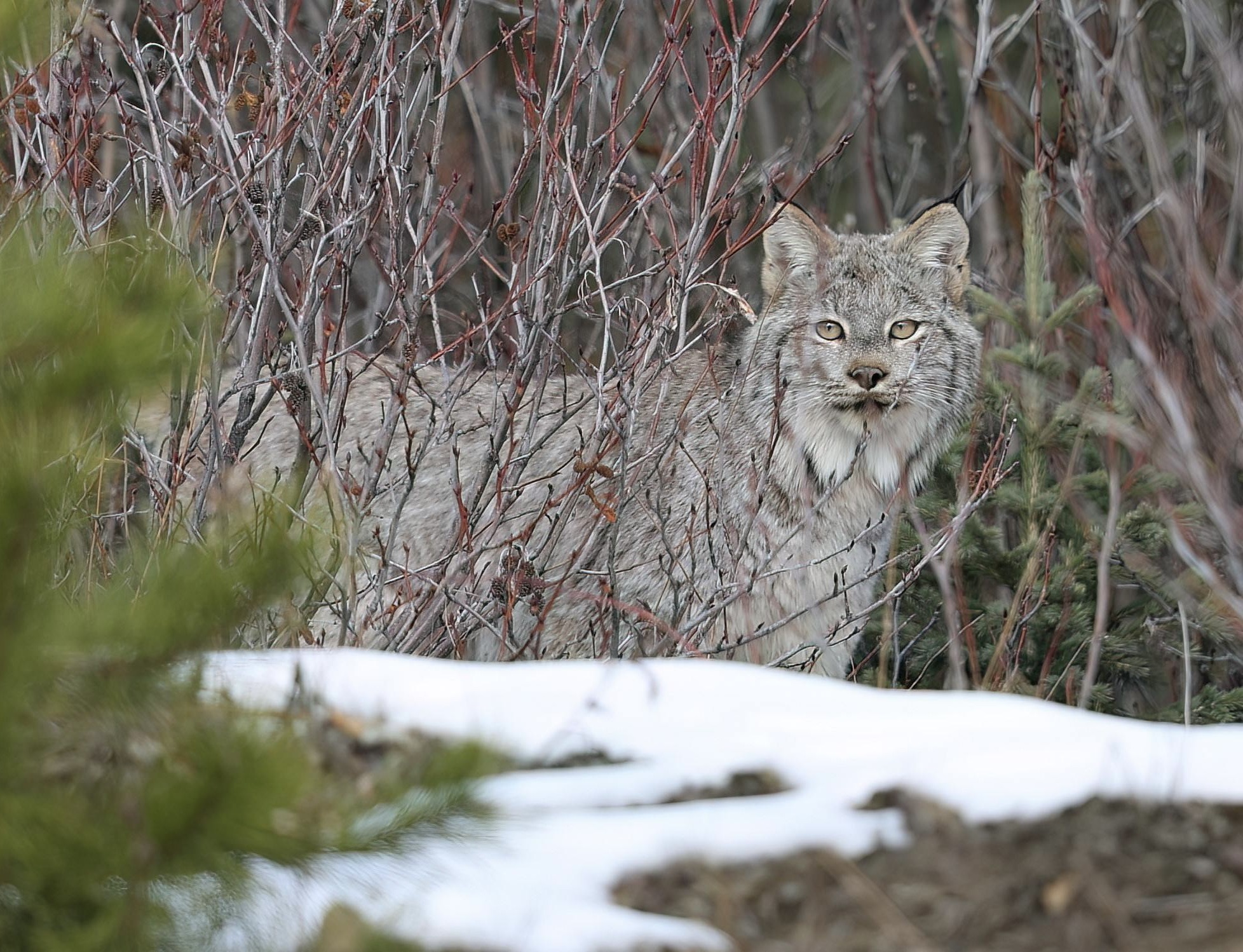
People who’ve been hearing about the mural have been going out of their way to explore it. Seay’s kitties aren’t alley cats; they are among a roster of fascinating native creatures who continue to persist in the wilds of Greater Yellowstone though many are relegated to a second tier status of attention, in part because they are so stealthy, rare and blend in with their physical surroundings. I’m writing here about Lynx rufus, the bobcat (far more numerous), and Lynx canadensis, the Canada Lynx (listed as a threatened species under the federal Endangered Species Act).
As you’ll discover, below, whether an animal is common or imperiled, the value of a species can be assessed in multiple ways—not just within the standard context of our human desire to possess or “harvest,” which is to say, take the life of an animal for fun, profit, or attaining nutritional sustenance.
“Non-consumptive” values exist, too—intrinsic and existential ones– yet seldom are they factored prominently into policy discussions of how state wildlife management in the interior West, based on the sale of hunting and fishing licenses, is conceptualized.
With lynx, there is also the matter of them, like wolverines, pikas and polar bears, being barometers for assessing how the impacts of a changing climate can cast ripple effects throughout the larger web of life.
(Click on the video below to hear a range of lynx vocalizations. Close your eyes and imagine such sounds echoing through the forest at 2 am when you’re camped in the backcountry).
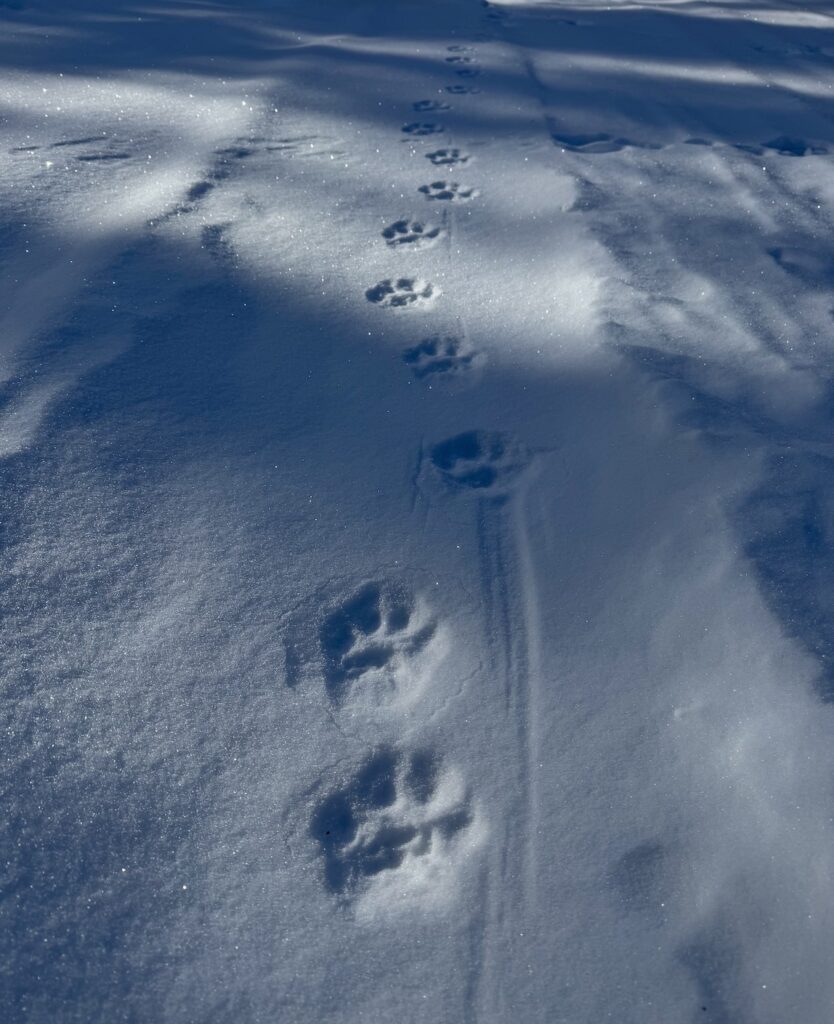
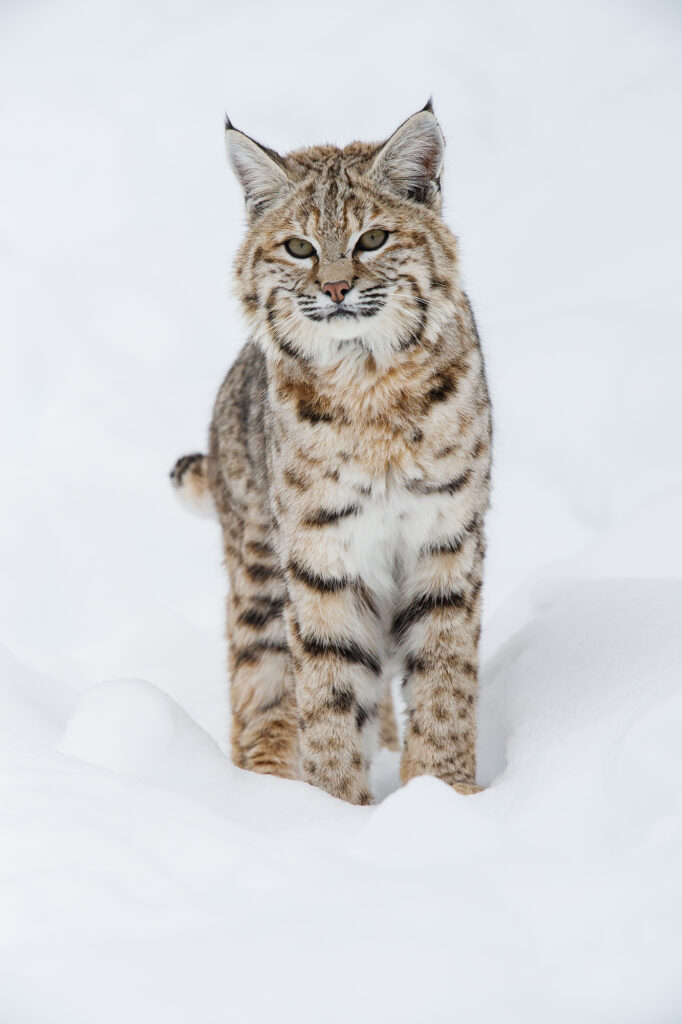
Many readers might confuse bobcats and lynx, mistaking them for oversized tabby housecats. Bobcats and lynx, which can weigh between 20 and 40 pounds, both are known for their mottled pelage, short stubby tails and lynx also have pronounced protruding black tuffs on the tips of their ears. Both leave behind rounded symmetrical tracks that lack impressions of their retractable claws. With padded paws, owed to the fact lynx generally inhabit snowier forested terrain than the more prolific and adaptable bobcats, their prints are larger.
Just as bobcats and lynx are similar yet different, so, too, are these carnivorous wildcats a far cry from feline breeds that have been continuously domesticated going back at least 9,500 years. Yes, these wild felines, like those in our homes, purr, meow, growl and hiss but they also emit what are known as spine-tingling caterwauls. In Greater Yellowstone, the other wildcat species present is the mountain lion (Puma Concolor).
Bobcats and lynx represent two of four members of the genus Lynx and are among 40 different species of wild cats worldwide. On the other side of the Atlantic, there is the Eurasian lynx, and the Iberian lynx, endemic to the Iberian Peninsula in southwestern Europe (Spain). Both are focal points of re-wilding efforts today. Eurasian lynx are generally larger than Canada lynx and they subsist on a different variety of prey, including ungulates.
° ° ° °
Cousins of the Canada lynx, bobcats are native only to our continent, found from the Arctic Circle to Mexico and throughout the Lower 48, from old-growth forests to swampy bayous, from desert and prairie to the coasts, from wilderness to foothill suburbs.
Canada lynx have a thinner band of geographic distribution, prowling only a belt of boreal forest in northern states stretching near the US border with Canada, from Washington State through northern Minnesota and Maine, and in western Colorado, where 218 were reintroduced in 1999 after being wiped out primarily by trappers and poisoning campaigns carried out to kill wildlife carnivores because they might eat livestock.
Like all the other installments in this Wild Journeys series, readers are asked to engage in a little self-reflection. Today we’re confronting this query: what good are bobcats and lynx anyway?
Were they to vanish, would we even notice or care? Would our lives be spiritually poorer? What difference is it to have a landscape with bobcats and lynx inside it versus places where they are not present? For that matter, why do we even bother conserving/preserving anything?
One philosophical explanation may be no more complicated than this: because we can and for moral and ethical people who value life forms other than ourselves, it’s not difficult to grasp. Or, consider this: were astronauts to set foot on Mars or the Moon and spy even the tracks of these cats, such news would be earth-shatteringly momentous and inspiring. But why don’t we feel the same sensations when we know bobcats and lynx are in our wild backyard? In the case of lynx, if we’re in a position to help ensure their persistence, then why not do it?
Were astronauts to set foot on Mars or the Moon and spy even the tracks of these cats, such news would be earth-shatteringly momentous and inspiring. But why don’t we feel the same sensations when we know bobcats and lynx are in our wild backyard?
Of course, lynx and bobcats would not exist on those other orbs because they have surfaces that do not foster complicated ecosystems of life forms and, because of this, they would have nothing to eat.
Scientists like Dr. John Squires, a research biologist with the US Department of Agriculture/Forest Service Rocky Mountain Research Station in Fort Colins, Colorado, provided an overview on the status of lynx at the Draper Museum of Natural History last year in Cody.
According to Squires, lynx are “specialist carnivores” meaning their diet in the Northern Rockies consists mainly of snowshoe hares, which, in turn, find forage and ideal habitat conditions in old-growth fir and spruce. Like lynx, snowshoe hares have broad and puffy paws that enable them to bound across terrain covered in deep snow. In Canada, lynx populations rise and fall in parallel to snowshoe hare populations.
In November 2024, the US Fish and Wildlife Service released its court-ordered recovery plan for lynx in the Lower 48. Just a few years earlier the Fish and Wildlife Service supported efforts being made by states and tribes to remove lynx from federal protection. It had concluded that lynx were expanding some of their range but independent biologists and conservation organizations have argued that cumulative effects related to a number of largely human factors cast doubt on a promising prognosis.
The recovery plan, mentioned above, comes with this stark outlook, almost a concession that lynx in the Lower 48 could vanish from some places where they are presently found. “The Service considers lynx populations…to be vulnerable (predisposed to be adversely affected) to the projected impacts of climate change. Thus, the Service concluded that continued climate warming and associated impacts, particularly decreases in the amount and duration of snow and increased wildfire and forest insect activity, were likely to reduce the amount and quality of lynx habitats, lynx numbers, and the resiliency of lynx populations in the contiguous United States. The Service expects all…lynx populations to become smaller and more patchily distributed in the future due largely to climate-driven losses in habitat quality and quantity, but recognizes the timing, rate and extent of climate-mediated impacts remains highly uncertain.”
Squires said Greater Yellowstone, which is four fifths lodgepole pine, has marginal habitat conducive to both of those predator and prey and that better conditions are found in northwest Montana, Idaho and Washington state. He also noted something else. In Montana, about one third of lynx are killed by mountain lions.
The last valid sighting of a lynx was made in 2022 by a houndsman in Wyoming whose dogs treed a lynx in the southern Gros Ventre mountains and he took a photograph.
Squires has been lead or co-author of numerous papers on lynx, most of them examining their status and outlook in the Southern Rockies where pressures on habitat represent a harbinger of what might await them in the Northern Rockies. Several insights are found in the research.
Among them:when snowshoe hare populations are low, red squirrels account for 70 percent of the lynx diet. That represents a potential benefit for lynx in Greater Yellowstone if snowshoe hares are scarce.
Among some of the research insights: when snowshoe hare populations in the Southern Rockies are low, red squirrels account for 70 percent of the lynx diet. That represents a potential benefit for lynx in Greater Yellowstone if snowshoe hares are scarce
Another discovery is that beetle-affected forests actually serve an important habitat function for lynx in Colorado and New Mexico. Such research is timely and relevant as local national forest supervisors now possess authority to bypass intense review actions pertaining to both forest thinning and approving outdoor recreation infrastructure projects. Some forest supervisors have characterized environmental review, part of compliance with the National Environmental Policy Act, as being onerous especially when proposed actions have been overturned by lawsuits brought on behave of species habitat protection.
“Managers in the Southern Rockies often must consider the need to reduce fuel loadings in beetle-impacted forest to address perceived risk of increased fire. Mitigation efforts that reduce potential ladder fuels for fires also decrease the high horizontal cover from spur and fir subcanopies required by lynx and hares,” researchers note in a study published in the journal Forest Ecology and Management. “These management actions may also be contrary to current lynx management directions and to our observed patterns of [habitat] selection.”’ Lynx are highly sensitive to habitat modification, research suggests, and after wildfires islands of remaining green tree provide important refugia.
The Southern Rockies are located at the farthest southern reaches of normal lynx range and beyond what is considered prime boreal forest habitat. Moreover, that population is not connected to other subpopulations to the north.
Like everything there are ripple effects of one species’ abundance affecting others’, like the loss of whitebark pine in Greater Yellowstone, for instance, negatively affecting grizzly bears, Clark’s Nutcrackers and squirrels.
Relative to the Southern Rockies, Squires et al, wrote as a consequence of mature forest dying from beetles and wildfire that “potentially for decades, Canada lynx are at heightened risk from reduced prey density, starvation, and potential increased dispersal movements until spruce-fir forests attain an age following insect outbreaks that cone-bearing trees are sufficient to support squirrel populations as alternative prey.”
“Human impacts are also heightened by the demand for nature-based recreation that has increased sharply across the same natural landscapes required for conservation of species dependent on public lands in the United States.” Vital, they added, is the existence and protection of roadless lands that help buffer against increasing human pressures.
Research also suggests that in the Southern Rockies lynx have tolerated non motorized and low-density recreation located in crucial interstitial spaces between core habitat.
In another journal article, published in December 2024 in the journal Biodiversity and Conservation, researchers note that “Forest disturbance is compounded by an expanding human footprint that includes high human density, land transformation (e.g., agriculture, urbanization, transportation systems, hydrologic modification), power infrastructure (e.g., sustainable and non-sustainable energy development) and other interrelated factors.”
They note: “Human impacts are also heightened by the demand for nature-based recreation that has increased sharply across the same natural landscapes required for conservation of species dependent on public lands in the United States.” Vital, they added, is the existence and protection of roadless lands that help buffer against increasing human pressures.
At present, lynx in western Colorado can still move between small patchworks of protected areas. However, expanding exurban development, resort development and large fires threaten the viability of corridors. This is considered a prelude for the Northern Rockies.
On top of this, scientists say “fire is likely the greatest threat to lynx habitat over a decades-long timeframe, given the current increase in fire size, severity, and frequency from climate change.” And, they add this, which wildlife advocates might heed as a warning about sprawl that is sweeping across mountain valleys in Greater Yellowstone and others in the Northern Rockies.
“An important caveat is that higher human density in the future could curtail or block connectivity movements for Canada lynx. We demonstrated that lynx exhibit some avoidance behavior to building structures and anecdotal observations from the Northern Rocky Mountains suggest that lynx circumvent rather than cross suburban-type neighborhood developments,” scientists state. “Thus, future expansion of human-caused disturbance from urbanization and resort development in the relatively low-elevation valleys that intersect patches of lynx habitat in the Southern Rockies may threaten population connectivity and persistence, but that disturbance threshold is unknown.”
What effect will new ambitious efforts launched by the Trump Administration, Congress and federal land management agencies to thin forests in order to reduce fuel loads and allegedly prevent large wildfire have on lynx habitat. No one yet knows. The federal lynx recovery plan hints that the above will clash with what’s best for the survival of lynx. “Regulatory mechanisms must address the species’ need for large boreal forest habitats that provide a mosaic of structural stages supporting high hare abundance,” authors of the recovery plan write. “The extent to which regulations and other conservation measures act to avoid, reduce, mitigate impacts to lynx influences the current and future likelihoods that habitats will provide the ecological requirements to support resilient resident lynx populations.”
It may be that in Greater Yellowstone, lynx are only slightly more numerous than Bigfoot. Squires has found no evidence that a breeding pair of lynx exists in this ecosystem but that does not mean they do not exist. At present, besides habit considerations and potential predation, the largest threat to lynx is by fur trappers making leghold and snare sets for bobcats, foxes, coyotes and wolves. Wolverines also are a federally threatened species in the Lower 48 and they, too, are vulnerable to being killed by trappers.
The US Fish and Wildlife Service estimates there might be 1,100 lynx in the entirety of the Lower 48 and possibly 300 wolverines. Looking forward decades into the future and adhering to trendlines already established, mountain snowpack that figures centrally in the lifeways of lynx and wolverines, is expected to significantly decline and remain in the mountains each year for shorter periods of time. Some biologists believe that lynx numbers, rather than growing, could decline as pockets of existing habitat become less viable and local populations are disconnected from each other. Maine has the largest lynx population of any state outside of Alaska but climate change is expected to negatively affect forested habitat the cats need to survive.
In the Lower 48, guestimates of overall bobcat numbers are between two and 3.5 million individuals and one of the metrics used to assess that number is voluntary trapper reporting on animals caught.
Again, ponder the question: what good are these wildcats beyond their worth as “consumptive natural resources”?
A few years ago, noted American biologist Mark Elbroch wanted to provide a gentle reminder of how economic “value” can be ascribed beyond the status quo contention that “natural resources” exist to be wisely used. The North American Model of Wildlife Conservation has an underpinning that animals are there to be “harvested” or have dollar signs attached to them to make them worth saving.
Elbroch, a researcher and leader with the international cat conservation organization, Panthera, was living in Jackson Hole then. He decided to explore the proposition of animals being worth more dead than alive, or vice versa. He selected bobcats as the focus of his thought exercise, though the same could be applied to lynx or wolves or grizzly bears.
To assist with the analysis, he turned to scientific colleague Jenny Fitzgerald, today executive director of the Jackson Hole Conservation Alliance and Lisa Robertson of Wyoming Untrapped Their examination, titled “Contrasting Bobcat Values,”was published as a commentary in the journal Biodiversity Conservation in 2017.
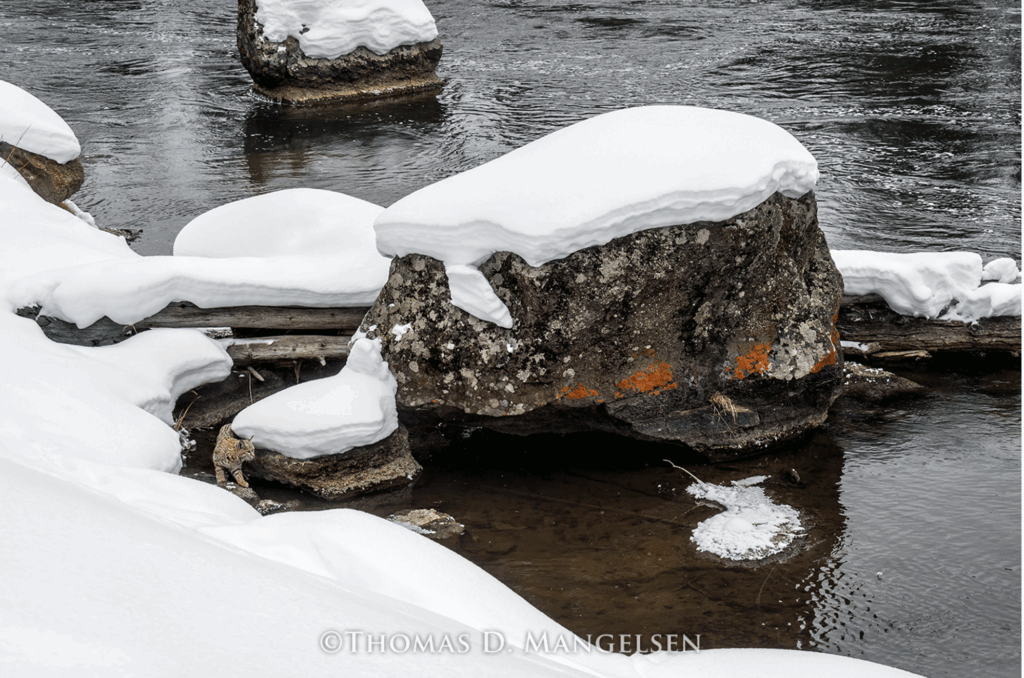
What they did is compute the amount of money generated by fur trappers and hunters who killed bobcats and then sold their pelts. They contrasted this with the amount of economic activity generated by a presence of a single bobcat in Yellowstone that became a magnet for wildlife photographers and others.
“We report a conservative, non-consumptive economic value of $308,105 for a single bobcat in Yellowstone National Park in northwest Wyoming for the 2015–2016 winter season, a figure nearly 1000 times greater than exploitive values of $315.17 per bobcat trapped or hunted in Wyoming in the same season.”
Findings of analysis done by felid biologist Dr. Mark Elbroch of Panthera and a group of scientific and citizen conservation colleagues
When a bobcat is caught and killed, it is a one-time liquidation of the cat’s life and its economic value, yet for a bobcat that stays alive and is visually accessible to humans desiring to observe it, it keeps accruing in value. For the study, the authors looked at the value of bobcat prints created by 13 nature photographers who went to an area along the Madison River in Yellowstone during the winter. The bobcat was regularly seen there, hunting waterfowl, trout and other animals. They weren’t alone. Many others enlisted snow coach drivers or guides to get there—the location was near the roadway—because bobcat sightings are rare. One bobcat generated a lot of commerce.
Ecotourism enhances conservation management, promotes non-consumptive use of wildlife, and increases local community resources over that of select individuals when compared with consumptive uses such as hunting or trapping, they write.
“The bobcat is a cryptic mesocarnivore widely exploited for pelts across North America, and a species increasingly contributing to ecotourism. Here, we report a conservative, non-consumptive economic value of $308,105 for a single bobcat in Yellowstone National Park in northwest Wyoming for the 2015–2016 winter season, a figure nearly 1000 times greater than exploitive values of $315.17 per bobcat trapped or hunted in Wyoming in the same season.
To arrive at the latter figure they combined the $130.53 per bobcat harvested in revenue earned by the state of Wyoming in trapping license sales plus $184.64 per pelt sold by successful trappers and hunters. Note: sometimes, the average sales price at fur markets might be upward of $500 annually, which would add a few hundred dollars of value but the trend over time has been downward, not up. The conservative non-consumptive economic value of the Madison River bobcat was nearly three orders of magnitude greater than the exploitive value of all bobcats legally harvested and sold in Wyoming in a single trapping season.
In 2016, tourism was the second largest industry in Wyoming and generated $3.2 billion, they noted, thought the nature value of tourism to the state has swelled further in recent years. “Our case study emphasizes that current bobcat regulatory policies across North America do not reflect current cultural values, inclusive of both consumptive and non-consumptive use of wildlife,” they write. “Therefore, we recommend range-wide regulatory changes to ensure bobcat management is not just sustainable in terms of harvest, but that all people have access to shared resources held in trust.”
Citizen pushes to have state wildlife agencies give more respect to and emphasis on non-game species have been gaining momentum. However, recent actions by state legislatures suggest a strong bias in favor of consumptive wildlife management, especially with carnivores and even when evidence allegedly supporting larger quotas for killing—claims the animals are severely impacting big game or the livestock industry—is lacking.
The study does not imply that every viewable bobcat would generate that much economic activity. But, as the thought exercise points out, consumptive approaches to carnivores accrue benefits only for a relative handfuls of individuals while wild animals, visible live, are an ongoing source of revenue and a major attraction for tourists.
In their conclusion, the authors write: “Bobcats hold tremendous value to the non-consumptive public as well as fur traders, as shown very clearly by the Madison bobcat. Cultures around the world are changing, and wildlife managers need to think beyond the North American Model of Wildlife Conservation, which prioritizes hunting and trapping constituents over non-consumptive users. We need to ensure bobcat management is not just sustainable in terms of harvest, but that all people have access to shared resources held in trust. Through the implementation of our proposed regulatory changes, wildlife managers will also help spread financial resources and ensure that local communities, rather than select individuals, reap the benefits of healthy bobcat populations through revenues invested by tourists over trappers.”
Will such thoughts factor into Wyoming’s update of its 2017 State Wildlife Action Plan currently being revised and scheduled for implementation in 2027? Forming a backdrop are undeniable national trends in citizen sentiment and spending habits.
Hunting, fishing and wildlife-associated recreation (i.e. watching of live animals) is, according to the Fish and Wildlife Service’s regular survey published in 2022, worth nearly $400 billion annually. Hunting and fishing accounted for $145 billion of the total. Non-consumptive wildlife watching generates $250 billion of the total and the gap between dollars generated between hunting and non-hunting is growing. This was highlighted in an addendum to the report above that focused solely on the value of wildlife watching and noted that in 2022, 148.2 million Americans participated in wildlife watching, most in natural areas close to home.
Some 39 million American participated in fishing and 14 million in hunting, but participation level in the latter had been declining for decades. This is not a condemnation of hunting but simply a statement of facts based on results from the most comprehensive and ongoing survey in the world.
Hunters and anglers, owed to historic excise taxes on gear, equipment and licenses, have contributed billions of dollars to wildlife conservation over the years, namely for habitat protection.
Notably, wildlife watchers and those who play in the outdoors pay local and state taxes on their product purchases and travel related costs but they do not pay special excise taxes as hunters and anglers do. A modest excise tax—which some call “a backpack tax” assessed on the sale of all outdoor gear—could generate significant funding and be a much-need boon for habitat protection, especially as hunting-generated dollars continue to proportionately.
However, the outdoor gear industry has fought a backpack tax in Congress and the hunting industry has been wary of supporting it because of fear there would be less emphasis on state wildlife management focused primarily on game animals.
Here’s a parting thought. State wildlife officials often treat trapping as a third-rail issue and they dismiss concerns about “bycatch,” a word that refers to non-target species caught and killed in leghold, conibear (head crunching) traps and snares. While lynx and bobcats move through landscapes with different nuances, their home ranges can overlap.
Lynx persist, barely, at profoundly low numbers in the Greater Yellowstone region but just a single trap set out for a bobcat could kill one half of a rare lynx mating pair and thereby wipe out reproduction, or the last lynx in the ecosystem could happen into a trap set for its cousin and then die. This would represent the first species since wolves were eliminated by humans 80 years ago to be erased from the lands in and immediately surrounding America’s first national park.
To skeptics who claim it couldn’t happen, consider that in 2024 bobcat trappers in northwest Montana accidentally caught two lynx and one of them died. In Idaho, Montana and Wyoming new liberal allowances for trapping and snaring wolves using baits poses huge risks to imperiled species.
Along with existence value of species, maybe another question to ponder is how important is it, really, to defend the tradition of a pastime that poses huge peril to the survival of an entire species in a given region? What should take highest priority—a trapper’s “right” to notch one more pelt, or an animal’s right to survive when so many accumulating variables are not in its favor?