By Todd Wilkinson
Bozeman isn’t exactly a major “river town” the way other Montana burgs are, like Billings, Livingston and Miles City along the Yellowstone, Great Falls and Wolf Point positioned side-saddle to the Missouri, and Missoula, Deer Lodge and other communities having sprung up on the banks of the Clark Fork.
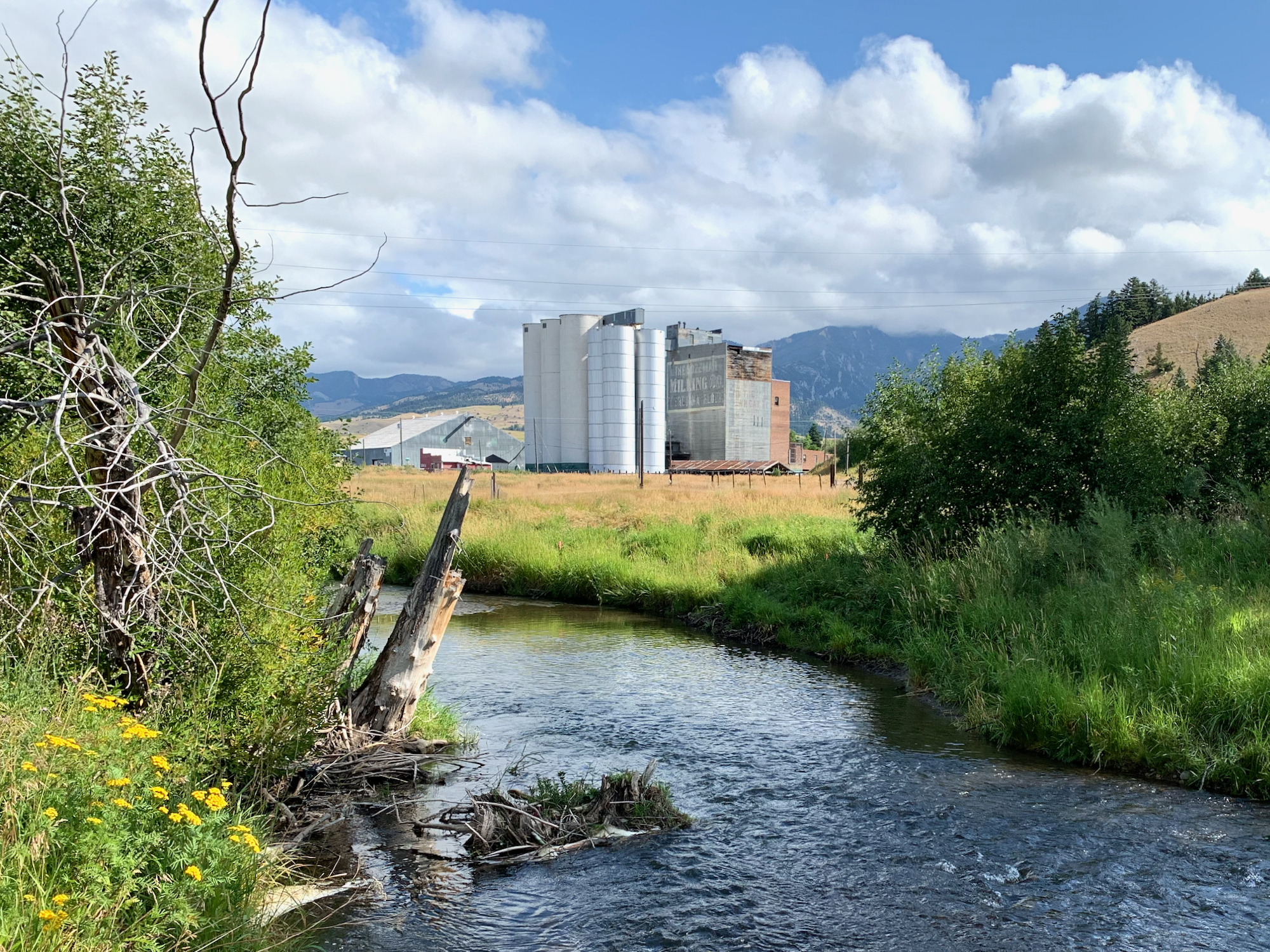
But Bozeman does have a namesake creek that runs through its heart. Born in the rugged Gallatin/Hyalites south of the city, it flows north across the Gallatin Valley, hits the city limit and courses toward today’s downtown, where, for a couple of blocks it disappears, literally, under Main Street before reappearing toward a convergence with the East Gallatin River.
The latter phenomenon, a result of earlier commercial interests putting it underground, created a kind of “out of sight and mind” presence. When the wonders of nature are not held up and valued every day, often they are taken for granted, abused, or squandered. This is the story of waterways, open space, ag lands and wildlife everywhere. Bozeman Creek may not be mighty but it is extraordinary. Grizzly bears, wolverines, native cold-water trout and some of the oldest living trees in Greater Yellowstone haunt its headwaters and the water quality we pass along is our contribution to the Mighty Missouri, yet it’s been treated for generations in Bozeman as an afterthought. This was not lost on former Mayor Tim Swanson back in the 1990s. He and other city commissioners tried to get citizens to reflect on where their water comes from, because many did not know.
Bozeman Creek may not be mighty but it is extraordinary. Grizzly bears, wolverines, native cold-water trout and some of the oldest living trees in Greater Yellowstone haunt its headwaters yet it’s been treated for generations in Bozeman as an afterthought. This was not lost on former Mayor Tim Swanson back in the 1990s He and other city commissioners tried to get citizens to reflect on where their water comes from, because many did not know.
In recent decades civic leaders, conservationists and others have tried to reverse this fate of neglect handed to Bozeman Creek. At one point near the start of this New Millennium, locals staged a “charrette” to discuss ways a new era of public stewardship could begin. But they needed a champion. No organization in recent times has done more to celebrate Bozeman Creek as a symbol and underdog than Mountain Time Arts, an NGO that has, from the start, sought to give the creek a voice as interpreted through the prism of indigenous thought leaders. Along with the usual technical portrayals of Bozeman Creek through lenses of hydrology, flood control and other purely utilitarian goals, i.e. serving human needs, the involvement of people from various tribes have emphasized the spiritual dimensions of water.
Mountain Time Arts, the same entity that helped bring lighted tipis to the top of Peets Hill overlooking Bozeman and with Native American encampments in Yellowstone National Park, has staged a number of theatrical and visual arts events aimed at recognizing the importance of water as spiritual lifeblood nourishing the land.
As a continuation of that, Mountain Time Arts returns this summer with another effort, this one where the city of Bozeman, currently led by Mayor Terry Cunningham, is committing to continue revitalizing Bozeman Creek and have a formal proclamation serve as a cornerstone to new mosaic art installations.
A formal unveiling of the mosaics, created by German artisans, is happening on Tuesday, August 12 from 4 to 5:30 pm in downtown Bozeman and it represents another important step in the creek regaining prominence in local human identity. (Food and refreshments provided).
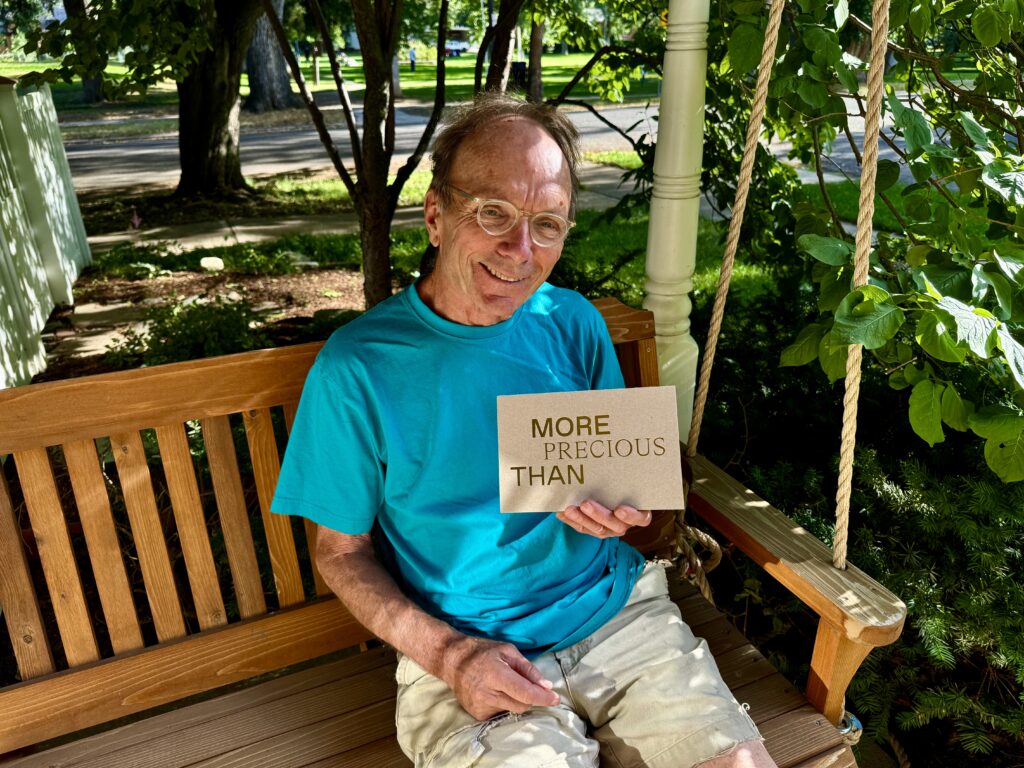
A really cool companion to this year’s project is publication, in limited edition form, of a paperback book, More Precious Than, featuring essays from Lilly McLane, poet Chris LaTray, Laura Ziemer and Karin Boyd. McLane, water restoration director of the Gallatin Watershed Council writes that “Of the over 1,000 miles of streams in the Lower Gallatin Watershed [which includes Bozeman Creek], 40 percent lack any native riparian vegetation, replaced by riprap, livestock, roads, and railways.” Chris La Tray, a member of the Little Shell Tribe (Ojibwe) and who identifies as Metis, has penned a moving tribute poem that serves as a centerpiece.
Not long ago, Yellowstonian interviewed Jim Madden, one of the co-founders and board members of Mountain Time Arts who for decades was a practicing architect and is a fine artist.
Todd Wilkinson for Yellowstonian: First of all, the book produced by Janet Zweig and Mountain Time Arts, is tactlely intriguing. Tell us a bit about it, your goal of putting it into circulation and the differing perspectives brought by Lilly McLane, Chris LaTray, Laura Ziemer, Karin Boyd.
JIM MADDEN: Presenting a “book” to our community as “public art” itself is a unique and maybe unprecedented gesture. We will give away hundreds of copies to government officials, water resource advocates, downtown businesses, property owners along Bozeman Creek, and interested citizens. The distribution is intended to spread the vision of Bozeman Creek revitalization to a wide range of community members. It will reach many more people, well beyond the persons who will experience the physical installation of the two mosaics along the creek downtown. The physical appearance of the book and its tactile appeal is intended to provoke curiosity, wonder, and conversation. The essays and graphics provide insights into the philosophic underpinnings for stream restoration, and inspire introspection about how one relates to our life sustaining waterways and natural resources.
Wilkinson: Innovatively, it presents the community and individual citizens with a conscious choice, which is?
MADDEN: Will one choose generosity over selfishness? By offering the books to the community for free, we enact a gifting that suggests that we can also give back to Bozeman Creek by removing restraints that will better prepare us for the uncertainties of the future.
Wilkinson: The book’s release is paired with the unveiling and it’s important that fans of Bozeman Creek and water turn out. Share a bit more information.
MADDEN: The corresponding public event on Aug 12 at Creekside Park near Bozeman’s City Hall is symbolic in a number of ways and a culmination, at least in this phase, of an ongoing project.
What’s going to happen? On Tuesday, August 12 from 4 to 5:30 pm, the installation of two glass mosaics that bracket the reach of Bozeman Creek downtown will be celebrated at Creekside Park [location near the corner of East Lamme Street and North Rouse Ave]. The public is invited.
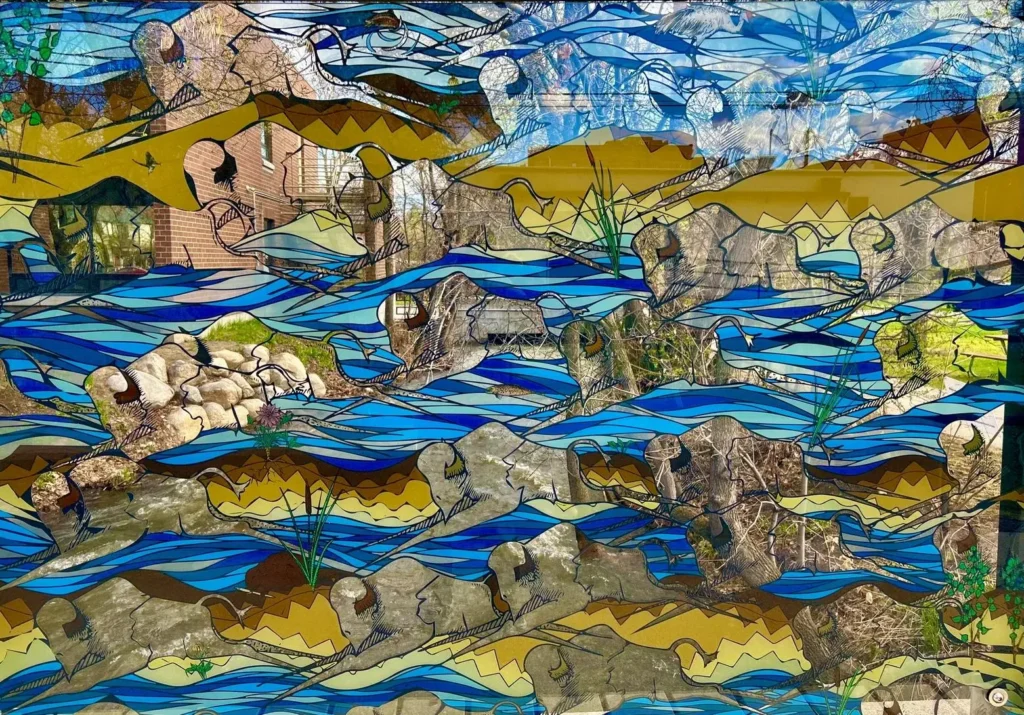
Wilkinson: Mountain Time Arts has hatched some great concepts to heighten awareness and this continues the pattern. A few summers ago, the installation “Revitaliseʌᴉʇɐlǝɹ” was installed downtown on the grounds of City Hall where Bozeman Creek runs through. Native artist Ben Pease said at the ceremony in which it was unveiled: “The purpose of Revitaliseʌᴉʇɐlǝɹ on Bozeman Creek in the city center is not only to inspire the generations that see the water as it is now, but to inspire them to think more deeply about what came before.” As an artist yourself who was a co-created on that project, could you describe the appearance of the mosaics and what they represent for this effort?
MADDEN: The sparkly gold mosaics will be adjacent to the sidewalks above the creek as it passes under streets and buildings. The phrase, More Precious Than, is inscribed in them with river stone. More Precious Than is a continuation of public art installations about Bozeman Creek downtown that was initiated by the Downtown Bozeman Partnership in 2020.
Wilkinson: Some folks might not be familiar with Janet Zweig. What’s important to know about her?
MADDEN: She is an artist who lives in Brooklyn, New York, and works primarily in the public realm. She’s the lead artist who conceived of this tri-part public art installation.
Wilkinson: What’s exciting to you about her design and concept?
MADDEN: The mosaics contain elements that draw passersby towards the mostly obscured water and invite contemplation of values around water and natural resources.
Wilkinson: Novel is your agreement with the city via the City Commission and Mayor Terry Cunningham. Some see this project being foundational for Bozeman being more ambitious in embracing its “nature of place” which extends to wildlife and habitat, fish, and clean water. Let us not forget the preservation, protection and enhancement of our urban forest that has a growing and enthusiastic group of citizen advocates.
MADDEN: The city wants to be a serious partner and collaborator in reversing the fate of Bozeman Creek. A proclamation by Mayor Terry Cunningham speaks to the commitment of the city to work towards revitalizing the creek to become a naturally functioning waterway, community asset, and valuable resource. It also demonstrates the now long term public/private collaboration between Mountain Time Arts and the city.
Wilkinson: What are some of the details of the proclamation, which is featured at the very front of the book?
MADDEN: Conditions are laid out in the Mayoral Proclamation that are published in the book and will be reproduced on a small plaque mounted on the concrete barrier with each of the mosaics. Each plaque will appear on the concrete where one would expect to find artist credits and acknowledgement of funders, etc.
Wilkinson: Looking ahead, how do you hope to build on what you’ve accomplished thus far?
MADDEN: A citizen’s advisory collective is one outgrowth of Mountain Time Art’s work. That entity, SeeBozemanCreek (SBC), is a group of approximately 20 water resource professionals, city staff, conservation NGOs, landscape architects, developers, and business owners who are partnering with the city on public engagement and outreach. SBC’s mission is to keep the community informed and engaged, and to build the community will to follow through and capitalize on opportunities to enhance the waterway as they arise.
Wilkinson: On behalf of Yellowstonian, I just want to add this: The very good news of all of this is that, in some cases, abuses of the past can be undone. And that in terms of perpetuating Bozeman’s “nature of place” it comes down to three things: Holding the line on Bozeman’s sense of wildness, re-wilding where there are opportunities, and conscientiously, through education, preventing the kind of de-wilding that has proliferated in other places. Let’s give Bozeman civic leaders praise with this project where it is due. Please give readers a sense of some of the deliverables coming from the city.
MADDEN: The city is actively involved in addressing the degradation of Bozeman Creek and its one of the nine top priorities of the Bozeman City Commission. It’s on their Two-Year Priorities List for FY’25 and FY’26. The principal objectives are achieving a sustainable environment with a goal of creating a Bozeman Creek resiliency plan.
Some of the related aspects are completing an engineering report to provide alternatives for mitigating flood dangers downtown. Related to this will be a concept plan that builds on the engineering report to visualize what types of improvements are feasible to reduce flood dangers, revitalize the creek and provide public amenities that are assets to downtown. A formal Request for Proposal for this planning contract will go out this fall.
Wilkinson: What’s happening with Bozeman Creek in Bozeman reflects the kind of community spirit that exists in many Greater Yellowstone towns that are backdropped by wild and public lands that are origins of these water tendrils. What Mountain Time Arts is doing is something that we are Yellowstonian are trying to champion: presenting visuals and ideas that readers, once they encounter them, cannot unsee or unthink about.
From Bozeman to Jackson, Teton Valley, Island Park and the Centennial Valley on the west to Red Lodge, Cody/Powell, Lander, Pinedale, Riverton and every human community, really, water is what connects us to the heart of the most wildlife-rich ecosystem left in the Lower 48. Thanks for your time, Jim Madden. If people are interested in obtaining a copy of More Precious Than, what do they need to do.
MADDEN: Reach out to us at Mountain Time Arts.
ENDNOTE: In addition Janet Zweig and Mountain Time Arts, others crucial to the s book and art installation are: Shelly Willis who led project production, the company Mayer of Munich and it’s Mosaic Artist Studio, Thomas Dunning of Meristem Services who is the contractor for the mosaic installation, Lucinda Hitchcock and Cara Buzzell who came up with the book design, and book printer, Die Keure Printing.
Mountain Time Arts and Gallatin Watershed Council are among several local non profit organizations that have been calling attention to Bozeman Creek. Another is The Extreme History Project devoted to shedding light on the many aspects of history that have been overlooked, shoved aside or cast into the shadows. The video below, featuring The Extreme History Project’s Crystal Alegria notes the parallels between the exploitation of humans and Bozeman Creek in the early decades of Bozeman’s growth as a community.