by Luther Propst
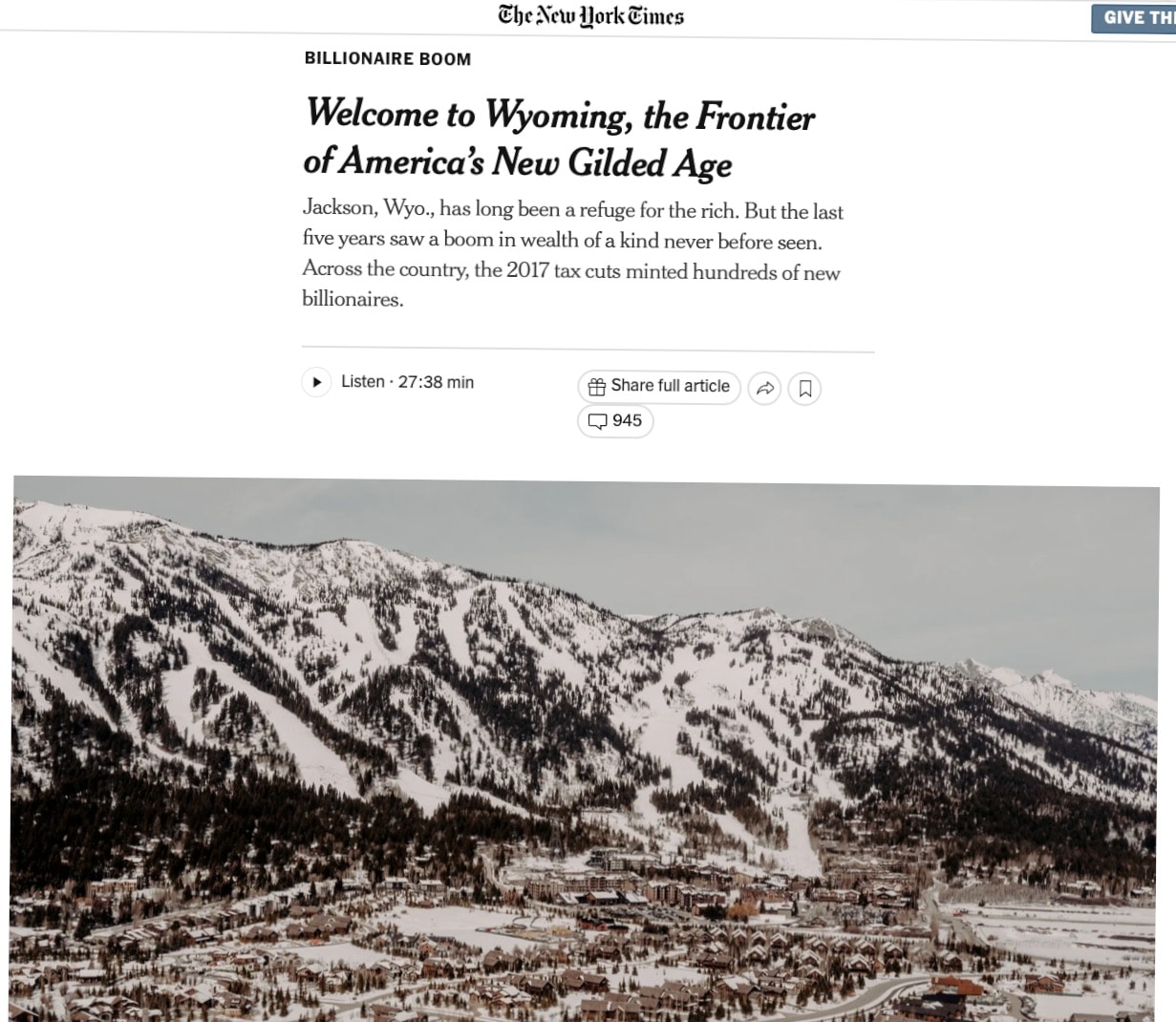
A recent New York Times article cast a national spotlight on Jackson Hole. For many locals, it captured something we increasingly see and feel: a place where extraordinary wealth and everyday community life are pulling apart.
For many residents, the article raised an uncomfortable question: Is the communal contract that has defined Jackson now frayed beyond repair?
For me, the article also highlighted an important distinction. I think of people like the late Gil Ordway – a friend, mentor, and an important supporter in my life and professional career. He was someone of means who fully embraced the community of Jackson and contributed both time and money generously to both community needs and conservation.
Jackson has long welcomed people of means, and many have strengthened this community immeasurably. The concern arises when wealth is used not to strengthen our community, but to work around and even undermine it.
The root word for community is the Latin commūnis, meaning “common, public, shared by all or many.” It is composed of the prefix con- (“together”) and munis (“performing service” or “duty”), reflecting a group bound by shared interests or location.
In Jackson, those shared interests and location are inseparable and interdependent. They are the everyday, public institutions that make life here possible. But The New York Times article highlights an emerging tension: As wealth in the valley grows, so too does the ability for some residents to live largely outside those shared systems.
Some residents can travel by private planes, seek care from private doctors, send their children to private schools, and gather in private clubs.
Most of us rely on and cherish public lands, public schools, public trails, public health services, and public infrastructure such as roads and pathways. When emergencies happen, we rely on public safety professionals: firefighters, dispatchers, deputies, and emergency responders.
These are the systems and pillars that hold our community together. When private interests push policies that primarily benefit themselves—and when well-funded pressure campaigns attempt to influence state policy at the expense of local control— residents begin to wonder whether the balance between private interest and the public good is still holding.
As one resident quoted in the Times article observed, “At some point there’s nothing you can spend money on that actually makes your life materially better, so money simply becomes power. The question for us is not how much wealth we want other people to have, but how much power.”
Local government cannot control how many wealthy folks buy property in Jackson, but it can control – to some extent – how public funds are spent and whether the government works for the community or benefits the few. In places like Jackson, where wealth is highly concentrated, and in Wyoming, where private influence can carry significant weight, the independence of public leaders becomes especially important.
The proper role of local government is to ensure that the systems we share – our schools, health systems, public lands, and infrastructure – remain strong and that the public interest guides decision-making. The test of leadership is whether elected officials withstand pressure when private interests and the public interest diverge.
In a place like Jackson Hole, where some people are accustomed to getting what they want regardless of price, the most important power may simply be the power of elected officials to say no. No to poorly planned proposals based on unrealistic – even fantastical – assumptions. No to projects that unduly compromise water quality, wildlife, infrastructure capacity, or public access to public lands. And no to developments that undermine workforce housing and the community’s long-term interests.
In a place like Jackson Hole, where some people are accustomed to getting what they want regardless of price, the most important power may simply be the power of elected officials to say no. No to poorly planned proposals based on unrealistic – even fantastical – assumptions. No to projects that unduly compromise water quality, wildlife, infrastructure capacity, or public access to public lands. And no to developments that undermine workforce housing and the community’s long-term interests.
That responsibility arises regularly in local government decisions involving development proposals, housing policy, land use, public lands, and infrastructure. Over the past several years, I have tried to approach those decisions with a simple principle in mind: The long-term health of our community and our ecosystem comes first.
That means supporting well-planned policies or proposals that advance our community’s goals. But it also means opposing policies or proposals when they do not.
Jackson’s future will always involve change. But change does not have to come at the expense of community.
Our task is to ensure that the systems we share—our schools, health services, public lands, wildlife, wetlands, and the housing and infrastructure that support daily life—remain strong enough that the communal contract still holds for everyone who calls this valley home.