by Todd Wilkinson
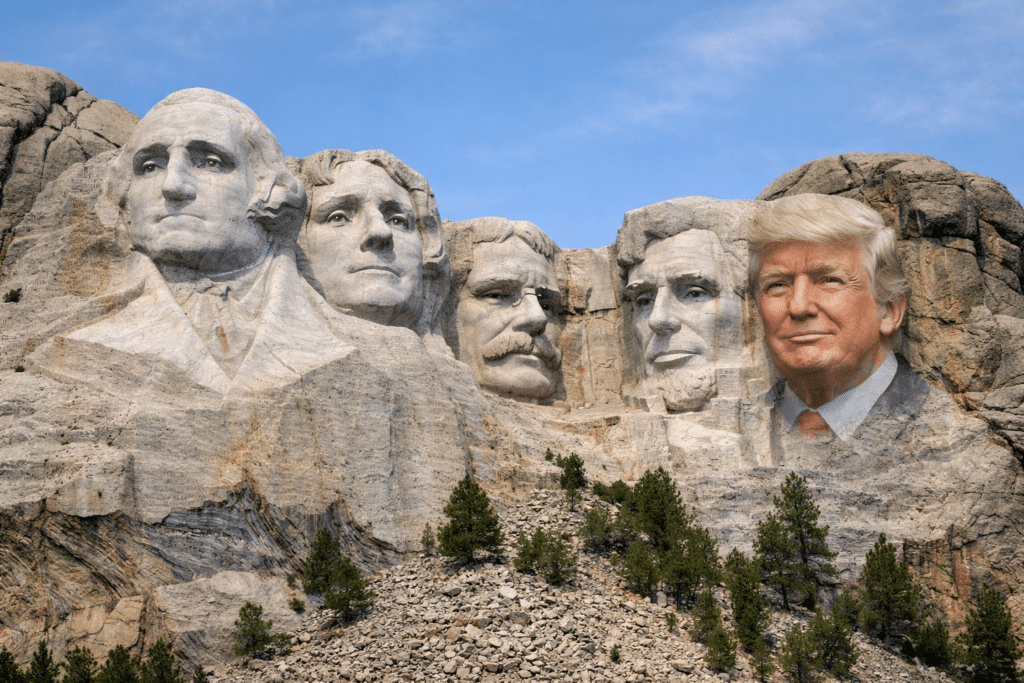
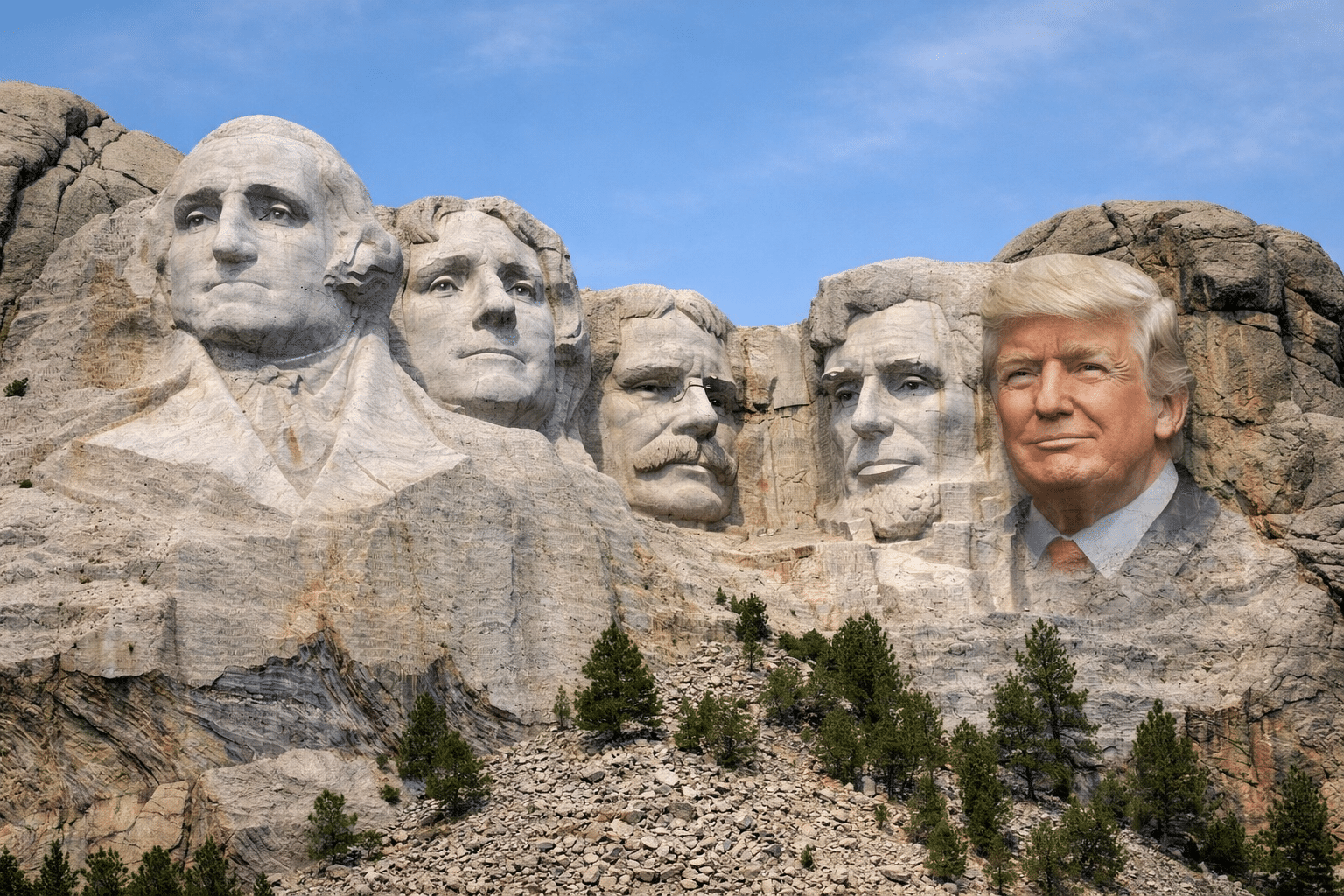
Our President, Donald J. Trump, has fantasized about having his face chiseled into the side of Mount Rushmore, joining George Washington, Thomas Jefferson, Theodore Roosevelt and Abraham Lincoln. He has asserted that his visage deserves to be there since he believes he is the greatest US President ever, just as he says he deserves to win a Nobel Peace Prize for bringing an end to multiple different wars.
Regarding Trump and Teddy, 2026 represents an opportune year for reflection. This summer, as America celebrates the 250th anniversary of the signing of the Declaration of Independence, the brand new Theodore Roosevelt Presidential Library will open in Medora, North Dakota on the edge of the national park that bears TR’s name.
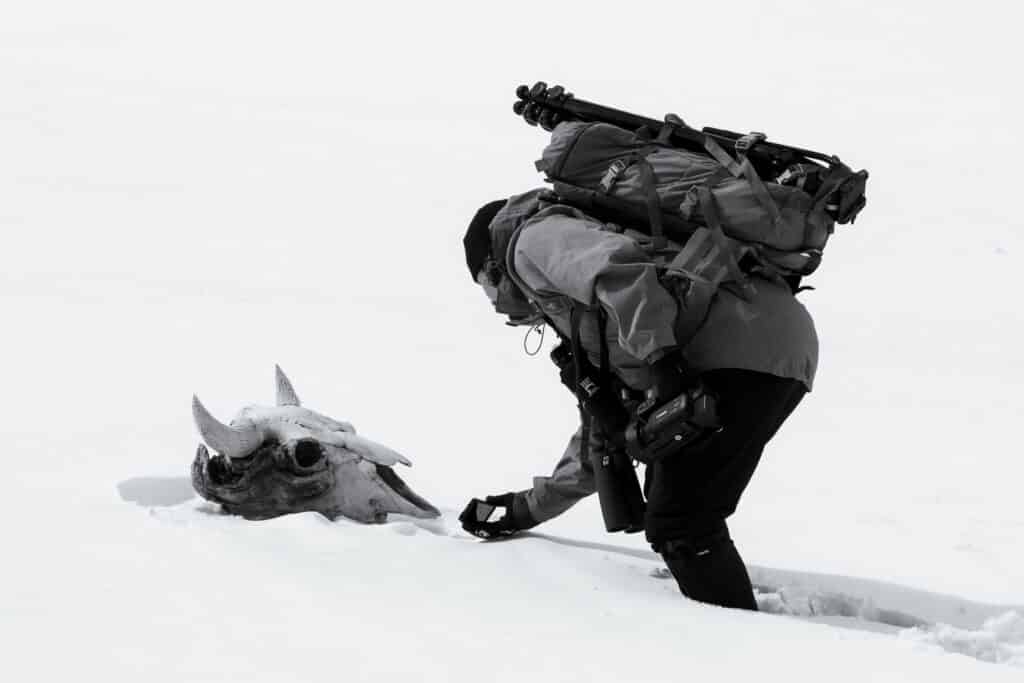
Medora is the place where a young TR went in 1883 to hunt bison before all of the wild ones were gone. A year later, after the passing of both his mother and wife on the same day, he returned West to do some soul searching and operated a cattle ranch.
A few hundred miles to the south of Medora, in the Black Hills of neighboring South Dakota, Washington is commemorated on Rushmore for being the Father of the Our Country and First President who opted not to run for re-election because he did not want citizens to get the impression Presidents should serve as kings.
Jefferson is there for being a principal author of the Declaration of Independence as well as, of course, serving as a President who engineered the Louisiana Purchase and initiated the Lewis and Clark Expedition. In Greater Yellowstone, the Missouri River rises as a convergence of the Jefferson, Madison and Gallatin rivers (the latter two named by Lewis and Clark after cabinet members in the Jefferson Administration).
Lincoln’s there for his leadership as President during the Civil War, writing the Gettysburg Address and hoping to unite the nation behind the principle of all people being created equal.
Lastly, there’s Roosevelt, best known for being the greatest conservation President of all time, who set aside public land to protect it against the self-serving impulses of corporate robber barons of the day. What TR did became the cornerstone for a system of public lands, belonging to the people, that is unrivaled in the rest of the world and never could be assembled today—nor put back together again if torn apart.
What TR did became the cornerstone for a system of public lands, belonging to the people, that is unrivaled in the rest of the world and never could be assembled today—nor put back together again if torn apart
Because of environmental laws subsequently put on the books, reflecting advancement in our ecological understanding of nature, we still have healthy public wildlife, breathtaking vistas, waterways, and in a region like Greater Yellowstone rare epic wildlife migrations.
There’s another key element to the above: Modern codes were passed in bi-partisan spirit by Democrats and Republicans that gave the public a say in how hundreds of millions of acres of public land will be managed. This includes allowing the public to hold agencies, Administrations and business interests accountable, and to sue if they do not follow the law and employ the best available science to prevent or minimize impacts.
To be clear, America’s public lands and superstructure of conservation cradling them was not broken, but that hasn’t stopped free marketeers from insisting that the answer to any manufactured problem is to let market forces run wild. Free marketeers advising Trump, and who are backed by the equivalent of modern robber barons, hate government, hate government regulation, and, in some cases, many of them despise the mere existence of public land.
Roosevelt, as President between 1901 and 1909, initiated protection for 230 million acres of public land, or about 10 percent of the total land area of the US at the time. The roster includes the creation of 150 national forests, five national parks, 18 national monuments, and 55 national wildlife refuges. He also loved Yellowstone and Yosemite and at Yellowstone’s North Entrance is the Roosevelt Arch that he dedicated on April 24, 1903.
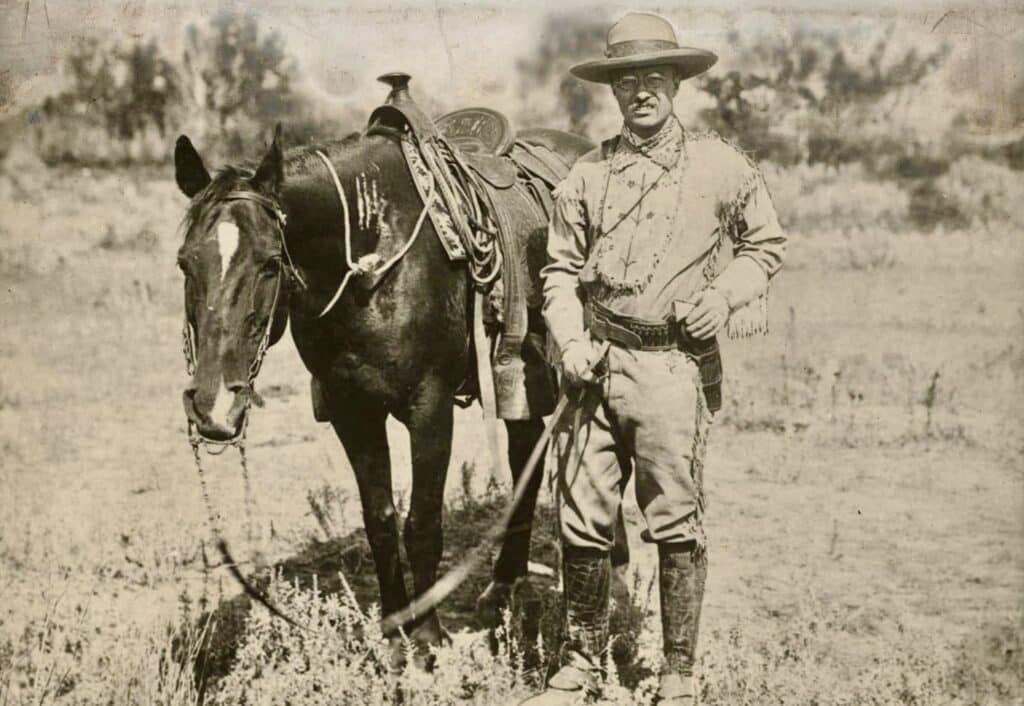
Over time and across generations, those and related public lands have notched hundreds of millions of visits, generated trillions in economic activity, served as priceless touchstones of meaningful human connection for countless families, and they’ve been a source of national pride—hallmarks of American conservation whose chief undeniable exponent is that some things are worth far more than money and not for sale.
Public lands, too, through the way the public—i.e. taxpayers— subsidize many private natural resource industries though sweetheart tax breaks, public services and incentives, including agriculture, have helped companies realize higher profits, which is, in its own way, a form of national socialism. But seldom do we hear free marketeers complain about that.
No one can honestly claim that conservation has made America poorer or, put another way, prevented the country from being prosperous in an enduring way.
Right now, President Trump is on a fast-track to achieve something that no other in The White House has notched, and some might call it an achievement of dubious distinction that Americans now and long into the future will never forget. He is, at present, the all-time champ for un-protecting more public lands, waters and ocean marine sanctuaries than any other President.
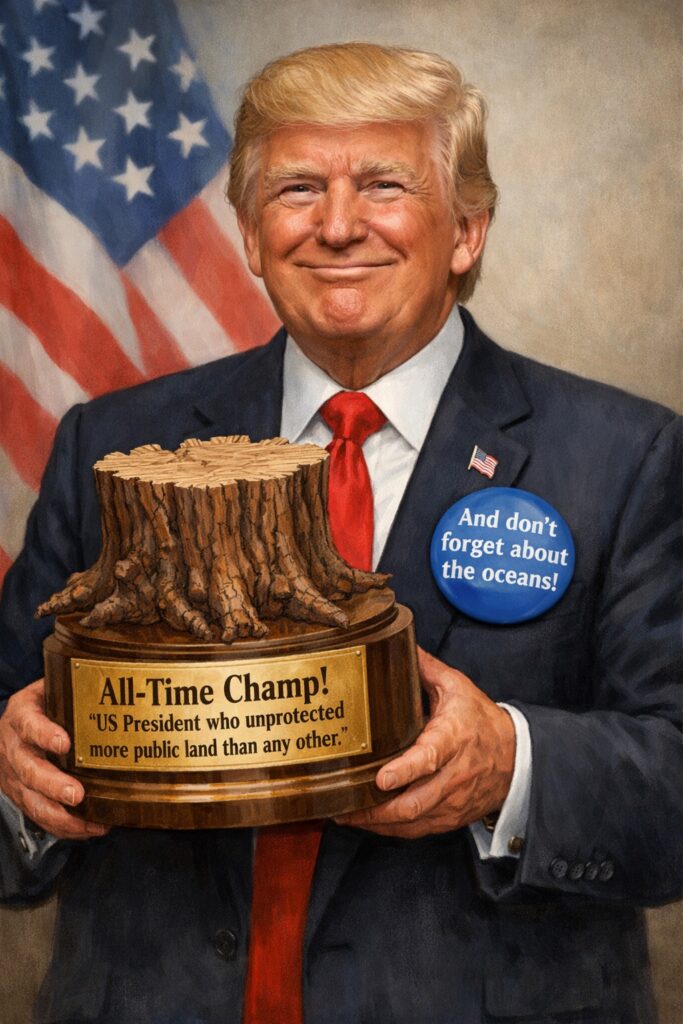
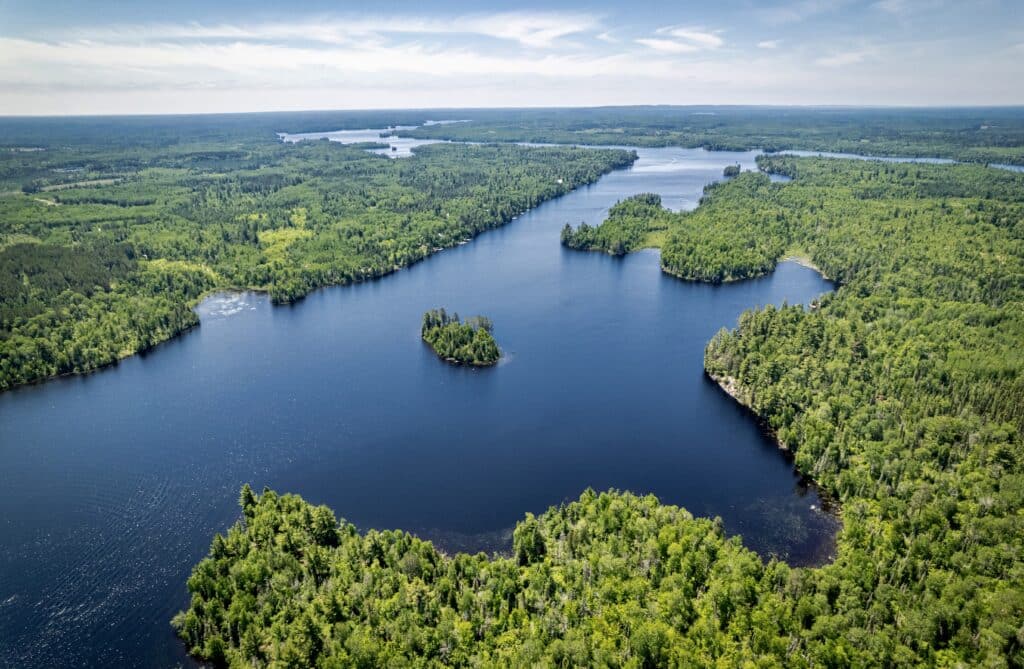
Soon, for example, special protected status applied to nearly 60 million acres of public national forest roadless lands—home to some of the best hunting and fishing remaining in the Lower 48— could be lifted; millions of acres of protection status for national monuments and marine sanctuaries (the latter deemed vital to imperiled fish populations) will be gone; a quarter million acres of special protections put in place to safeguard the headwaters of the Minnesota Boundary Waters from mining on the Superior National Forest could be rescinded; protected coastal waters and the Arctic National Wildlife Refuge will be opened up to oil and gas drilling.
These rollbacks are only part of a longer list assembled by the Center for American Progress. Again, Trump already is without peer. He is, by his own record the most anti-conservation president in history. He isn’t alone in allowing natural resource extraction interests to re-draw the map of American conservation and erase a legacy of protected public lands, initiated by TR, that ironically will be celebrated at the Roosevelt Presidential Library in Medora. He has plenty of accomplices in high positions and their involvement will be fully revealed.
Among the speakers this summer at the Roosevelt Presidential Library opening will be Interior Secretary and former North Dakota Gov. Doug Burgum who is a chief architect behind dismantling the Rooseveltian approach to conservation, including going after national monuments as Trump and former Interior Secretary Ryan Zinke of Montana did.
Who knows, maybe even the President will show up in the North Dakota badlands. Perhaps he and Borgum will even quote TR. Here’s a passage to consider:
“I have always said I would not have been President had it not been for my experience in North Dakota,” Roosevelt wrote.
North Dakota affected him, changed him, healed a broken heart. Why? It was one of the few places left in the West, where because of its remote ruggedness, had not been emptied of its wildlife by humans who had acted pretty much unconstrained by any limits on their insatiable consumption of natural resources elsewhere. Amid total personal freedom and liberty, the pillagers didn’t win the American West; they plundered what was then a lawless free-market Nirvana without rules to protect it.
This is the paradox: Conservation was a response against the free market and capitalism without a social and ecological conscience, and the soulless free market, never in its wildest dreams, would amass or sustain what the Roosevelt vision has given this nation.
North Dakota affected him, changed him, healed a broken heart. Why? It was one of the few places left in the West, where because of its remote ruggedness, had not been emptied of its wildlife by humans who had acted pretty much unconstrained by any limits on their insatiable consumption of natural resources elsewhere. Amid total personal freedom and liberty, the pillagers didn’t win the American West; they plundered what was then a lawless free-market Nirvana without rules to protect it.
For Roosevelt, the near-extermination of bison by market hunters and poachers was not just evidence of market forces out of control, but as he aged it was a metaphor that could be applied more broadly to the impulses of industry seeking to monetize anything that could be bought, sold or traded—to hell with worrying about what future generations would inherit.
Imagine if instead of Roosevelt going to North Dakota as a young man in 1883-84, it had instead been the ambitious and ethically-challenged young Mr. Trump. Imagine what kind of West we’d have today, what kind of public lands and wildlife conservation we’d have now—if they even would exist at all.
The Trump team learned much after his first term, and it is to so thoroughly monkeywrench the underpinnings of conservation and the function of government this time around that some impacts can never be undone.
If Trump gains a place on the granite wall at Rushmore, his presence will definitely serve an important purpose. As a contrast, think of it as shadow set against the goodness of light, reminding Americans of near everything Teddy Roosevelt the conservationist was not.
NOTE: Disclosure: the two illustrations above were created with the help of AI. The amount of electricity used to create them is equal to a 10-watt LED lightbulb turned on for 45 minutes. To offset that electricity usage, we are burning candles for three hours while going through a book of notes taken for the next story.