by Mike Clark
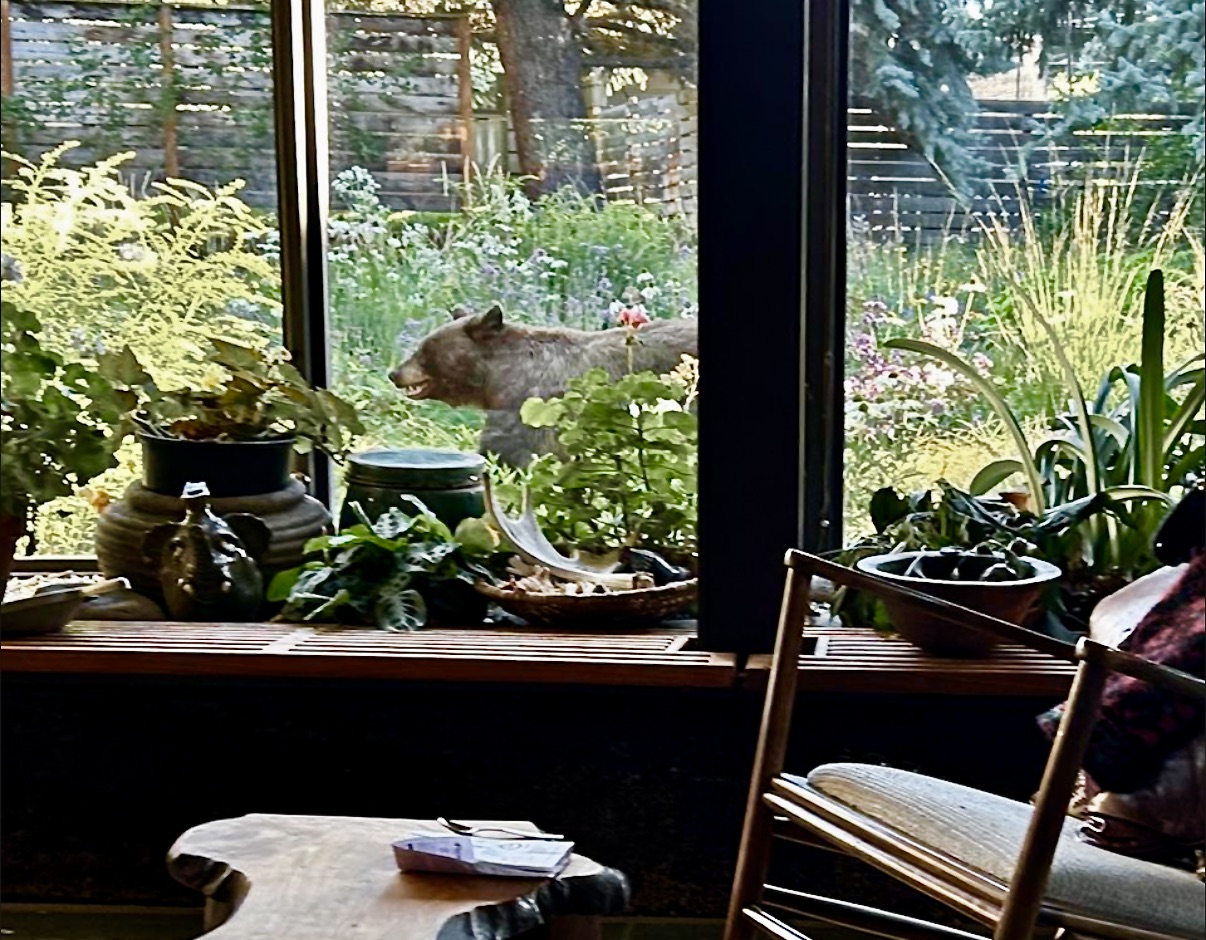
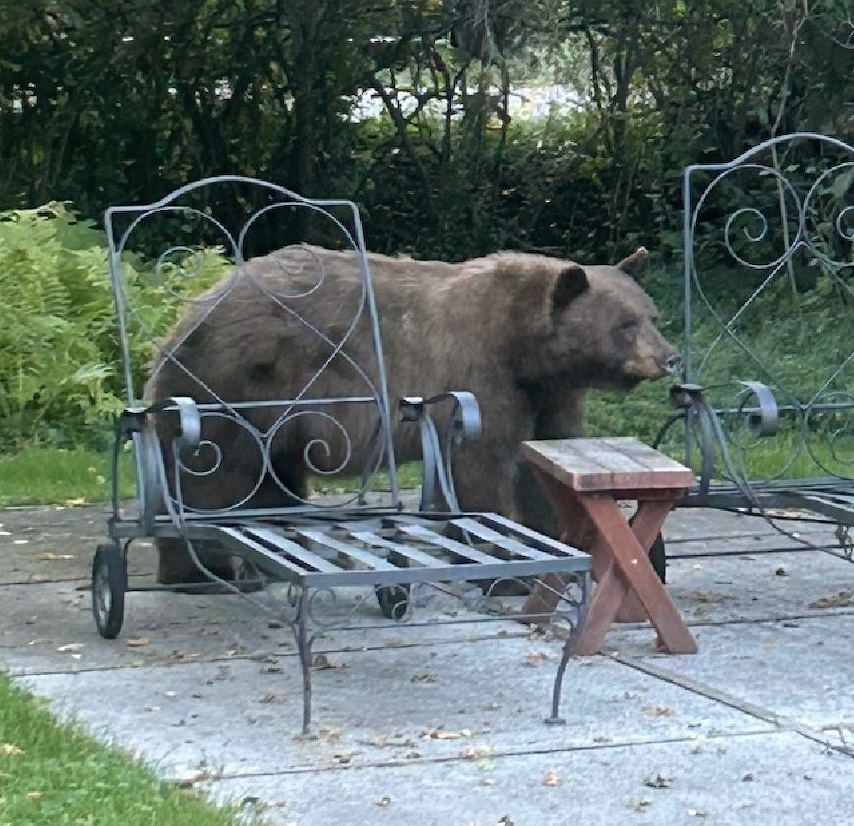
These photos of a visiting black bear, which you see before you now in this essay, were taken in my Bozeman backyard last October when we welcomed an annual visit from a bruin who came to feast on wild plums and crabapples at our home three blocks from the Museum of the Rockies in south Bozeman.
Co-existing here with wild creatures takes discipline and attention to details such as garbage disposal, fruit trees, and plantings around our homes.
Today as I write in my home office a large black bear is sleeping restlessly in a tree 15 yards from where I sit. The neighboring squirrels are outraged by this intruder and are trying to harass the bear. An occasional magpie comes by to investigate and a circling murder of crows are loudly joining the racket. How rare that we can still have this opportunity.
My house was built 60-odd years ago by Ozzie Berg, an architect who specialized in single-story cottages with large glass windows. He was one of several Montana architects who designed and built mid-century homes that were designed to bring the outside in thru the use of glass and careful placement of buildings, trees and shrubs near the small streams that flow out of the mountains south of town. The designs worked. Each year we watch a parade of wildlife stream through our neighborhood located just a few blocks from where 16,000 students at Montana State University matriculate.
All of us who are able to live among wildlife in Montana and the Northern Rockies should take note of the changes happening around us that will severely limit our ability to enjoy our wildlife neighbors.
Bozeman and the Greater Yellowstone Ecosystem are changing rapidly due to increased human populations and the growing impacts of climate change. Each new resident or visitor may limit the abilities of our wild neighbors to live successfully in this region. Each new subdivision built now in Bozeman and valleys that function as crucial interstitial spaces between public land may undercut our ability to live sustainability among the wild creatures with whom we co-habit the Western landscape.
I grew up in wild country in western North Carolina 80 years ago. My home in Haywood Country has the highest relief elevation of any county in the eastern United States, with 13 peaks rising about 6,000 feet. My ancestral home was located less than a mile from the borders of the Shinning Rock Wilderness Area, the first such wilderness in North Carolina and the most visited wilderness area in the eastern United States. It lies just south of the Great Smoky Mountain National Park.
Our neighbors were deer and black bear, but my family and neighbors were hunters who pursued these creatures with dogs and guns. Close and intimate encounters were rare, and usually led to the death of any large wild animal.
So I knew wild country before moving in Bozeman in 1994 to run the Greater Yellowstone Coalition, the largest environmental group in the three state area of Montana, Wyoming and Idaho. But here the rules are necessarily different. Our landscapes are large and very wild. We can choose to respect the habitat and learn to with black bears. What a treat! Moving here meant that I had to learn new ways of thinking about both private and public lands.
Here in Greater Yellowstone, understanding land ownership is vital to anyone who wishes to live here or to visit long enough to enjoy the abundant wildlife which now includes all the major species that were here when Lewis and Clark came here over 200 years ago. Chief among them are the grizzles, wolves, elk, bison, antelope and wild trout that make Greater Yellowstone the wild heart of the Lower Forty-Eight States.
For these creatures to survive we have to think big, we have to protect and conserve large landscapes. This means both public and private lands must be considered. Wild creatures need open land. They do not understand artificial legal boundaries, such as public or private, national park or forest, state or federal that inhibit their access to food and resources.
The national parks and wilderness areas contain the most viable ways in America of protecting wildlands and giving wildlife species a viable home. Key to protection is the need to create and protect as large an area as possible. Wild animals cannot be expected to understand and honor property lines and various degrees of protection. They need to roam.
In my North Carolina home the 18,000-acre Shining Rock Wilderness is seen as a large and viable wilderness entity and it is much loved and aggressively protected by all users. In the western US, such an acreage is seen as a small entity.
When I moved to Bozeman thirty years ago the legacy of checker-bordered lands dominated management in the Gallatin National Forest, especially the Gallatin Mountain Range south of of town.
Much of the Gallatin was divided into alternative, separate, one square mile sections of ownership which inhibited good land management for wildlife and public use. Both private land owners and the conservation community worked with the Gallatin Forest to consolidate the ownership patterns.
These scattered sections of public land were left over from the days of giving railroad companies huge incentives to build the railroads and open up the West. Consolidating the checkerboarded landownership in Montana was a clear goal of the many users of the public lands, including conservationists, ranchers, lumber companies, miners and the general public.
As the head of the Greater Yellowstone Coalition, I worked with The Wilderness Society and the Montana Wilderness Association (now Wild Montana) to fully protect the lands in the Gallatin adjacent to the rapidly growing community of Big Sky. We saw the lands adjacent to Yellowstone National Park in the Gallatin Forest as the finest habitat for big mammals outside the world’s most famous nature preserve.
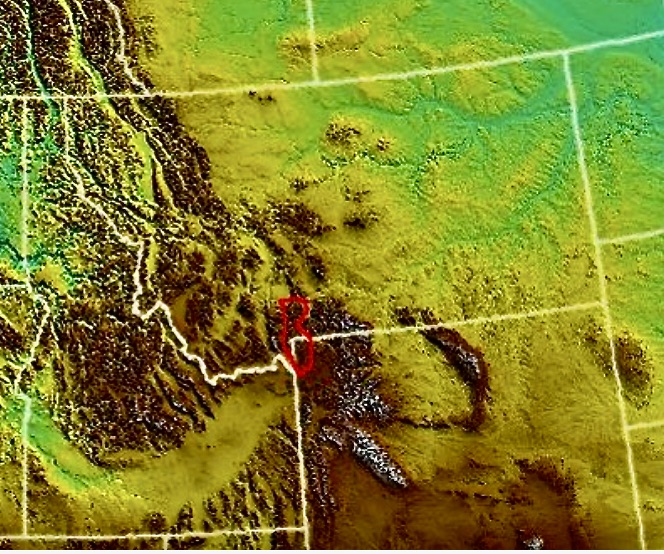
The largest block of private land was owned by Plum Creek Lumber Company which had thousands of acres of land in western Montana. The Greater Yellowstone Coalition (GYC) worked with the Forest Service and other conservation groups to convince the Plum Creek owners, led by Tim Blixseth who founded The Yellowstone Club, to trade lands for consolidation of some of the checkerboard. We focused on lands around Big Sky and the Bangtails.
This led to a successful trade of public and private lands throughout the Gallatin Forest, including key lands around Big Sky such as the Porcupine and Taylor Fork which Blixseth threatened to clear cut if the deal did not go through.
As conservationists, we understood that the lands moving into private ownership would be commercially developed but we had no understanding of the speed and scale of development that would occur. Tim Blixseth quickly created the Yellowstone Club and attracted enormous new capital entities that led to the modern version of Big Sky.
Since then the still unincorporated Big Sky community has turned into a haven for billionaires and corporate leaders who see land primarily as a financial resource to be developed for their benefit. Hundreds of second homes and high-end apartments—thousands of structures in all— now dot the meadows and hillsides. Hundreds more have been proposed. Bozeman faces similar challenges. By growing too big and too fast, we are killing the golden goose that many of us of moved here to enjoy. What is the answer? Enough!!!!
Hundreds of second homes and high-end apartments—thousands of structures in all— now dot the meadows and hillsides of Big Sky. Hundreds more have been proposed. Bozeman faces similar challenges. By growing too big and too fast, we are killing the golden goose that many of us moved here to enjoy. What is the answer? Enough!!!!
Thinking now about threats of the Yellowstone Ecosystem, the most dangerous threats now are not about mining or logging, but about the growing movement to “love the Yellowstone to death” by having it over-run by people who do not place limits on how they interact with the public and private lands.
Over the past 20 years our nation has experienced the pandemic. Fear of disease, and the wave of people seeking solace, beauty and safety, has turned Montana into a haven for thousands of new residents and millions of tourists. The resulting market pressures have fundamentally changed the present and future of the Gallatin, Yellowstone Park, and surrounding communities. And we are not yet facing the threats posed by climate change.
How do we now design communities that can live with bears, deer and the extraordinary assemblage of many species of mammals and birds that soar through our home spaces?
Given the choices, we have to look carefully at how we allow use of the public lands to ensure survival of key species such as grizzlies, wolves and the black bear pictured above. I look now at many of the roads and subdivisions now being built and I shudder at the permanent impact that seems likely for both people and our wild neighbors.
Walking from my home to coffee shops on Kagy Boulevard, I move past a wonderful primary care center which stores an array of small bikes and scooters on its fenced wall. These midget bikes are a wonderful sight and each morning numerous tots can be seen screaming around the protected playpen. They have the freedom to ride but there are clear limits on how far they can go. And I know that these same spaces at night allow for the presence of black bears and deer– and people.
If we are to maintain and preserve the wild heart of America found in the Greater Yellowstone Ecosystem, we have to apply new strategies.
In a time of climate change and a rapidly-growing human population.
We have to place limits on ourselves. We have to create new wilderness areas and safeguard roadless lands. We have to adequately fund the National Park Service and the US Forest Service. We have to protect our rivers from the pollution created by the presence of more people.
We have to place limits on ourselves. We have to create new wilderness areas and safeguard roadless lands. We have to adequately fund the National Park Service and the US Forest Service. We have to protect our rivers from the pollution created by the presence of more people. We have to think in large and long-term ways.
We have opportunities now to improve the wild country of Greater Yellowstone by finally protecting the last big expanse of public land near Yellowstone Park. We have to think in large and long-term ways.
Our federal parks and forests contain the largest and most fertile wildlife habitat in the Lower Forty-Eight States. This legacy should not be shredded by playgrounds for electric bikes and ATVs. Nor allowed to become just another recreational toy for the ultra-wealthy.
Yellowstone and Grand Teton parks and Forest Service wilderness areas have been placed into a high level of protection by the Congress, designating these lands as deserving special protection. In effect, the parks and wilderness areas are regulated so that free market forces cannot open them up for mining or logging and industrial development. Or for the industrial tourism impacts that we are now seeing around the region.
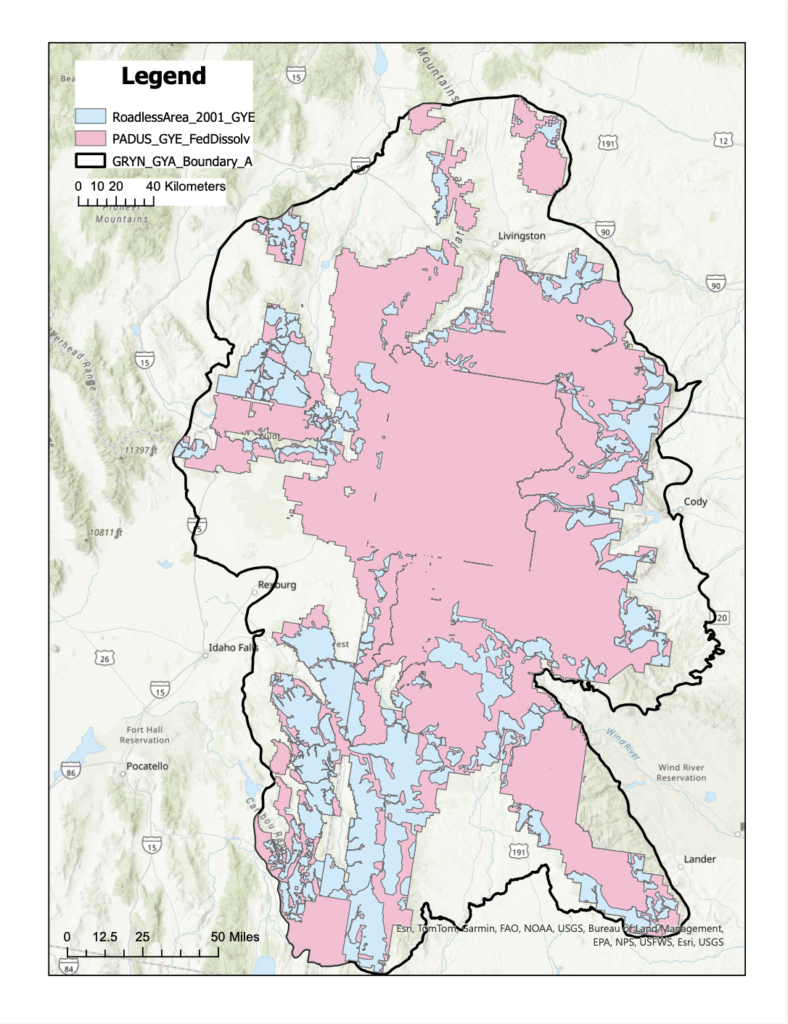
The Yellowstone Region is defined not just by law but by the absence of roads. The science of the impacts of roads is very clear. Roads are good for human development but destroy wild country more than any other force. Look at how this map of roadless areas defines Greater Yellowstone in dramatic terms.
Greater Yellowstone is one of the most studied places on the Earth. But we need to be more creative and more innovative to protect the wild lands of Yellowstone.
We need to consider placing part of the ccosystem off limits to humans except for access by scientists and law enforcement authorities.
We need to ask ourselves what is needed to ensure that the unique collection of wild species now located in Greater Yellowstone can survive for the next 25 years.
We need to ask ourselves what we can do to ensure that 25 years from now we can enjoy, as I do today, the presence of a black bear in my trees who is surely looking forward to the crab apples and berries] that produce such a happy and fat bear that sleeps now a few feet from my desk.
Yes, the bear is back. But next year?
EDITOR’S NOTE: What do you think? If you have comments we welcome you sending them along and we may publish them below. Remember to keep your thoughts on point, civil, respectful, and courteous. You can email them to us by clicking here. Stories that relate to Clark’s essay, below.