by Todd Wilkinson
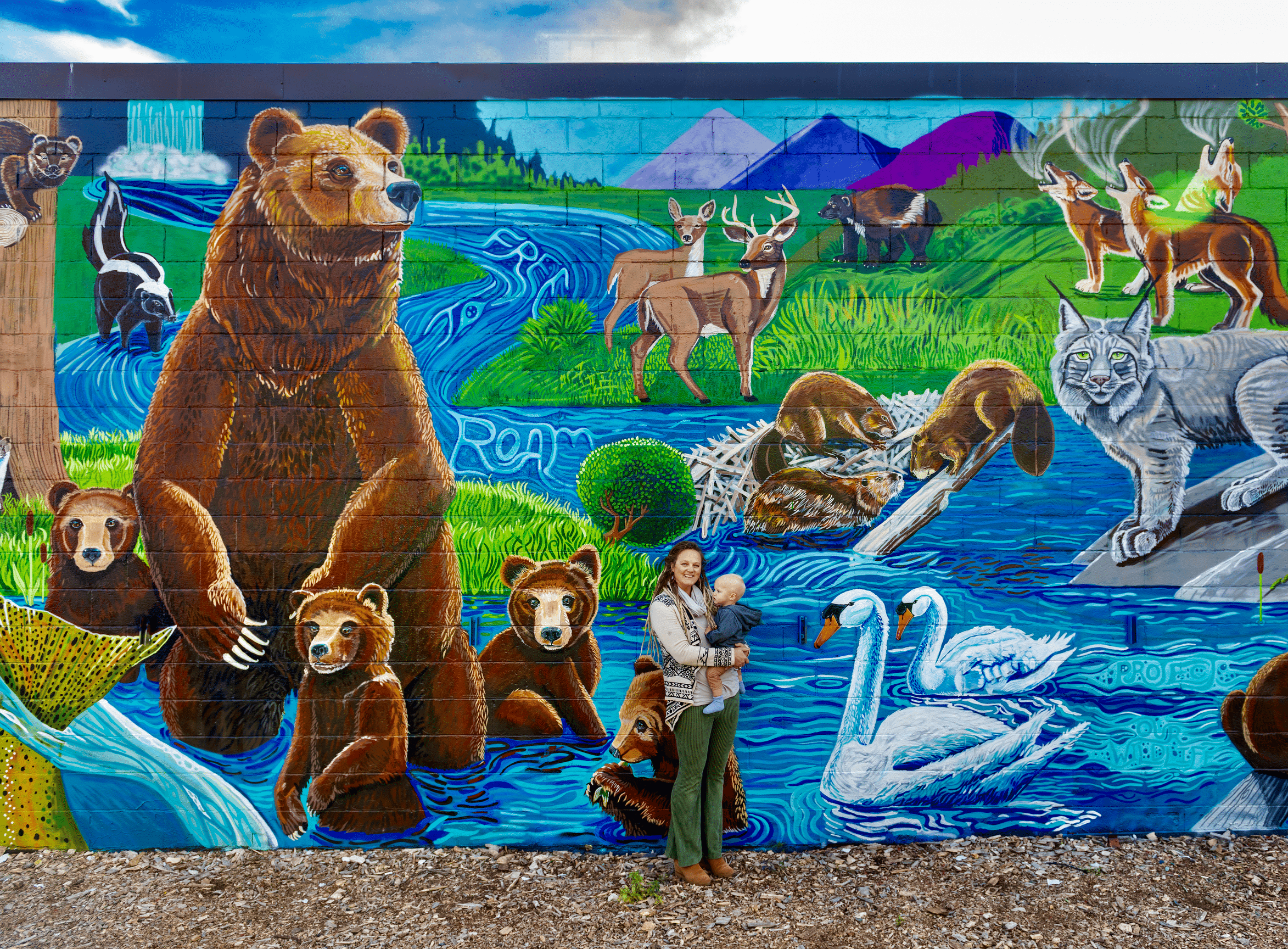
As the third week of October 2024 was settling in, Helen Seay drove over Teton Pass into Jackson Hole from her home in Teton Valley, Idaho. Juggling the responsibilities of being a young mother with toddler in tow and carrying a paint kit in her other arm, she was putting the finishing touches on a multi-month, multi-species project: an outdoor mural, Wild Journeys, located at a spot in downtown Jackson called Pearl Street Alley.
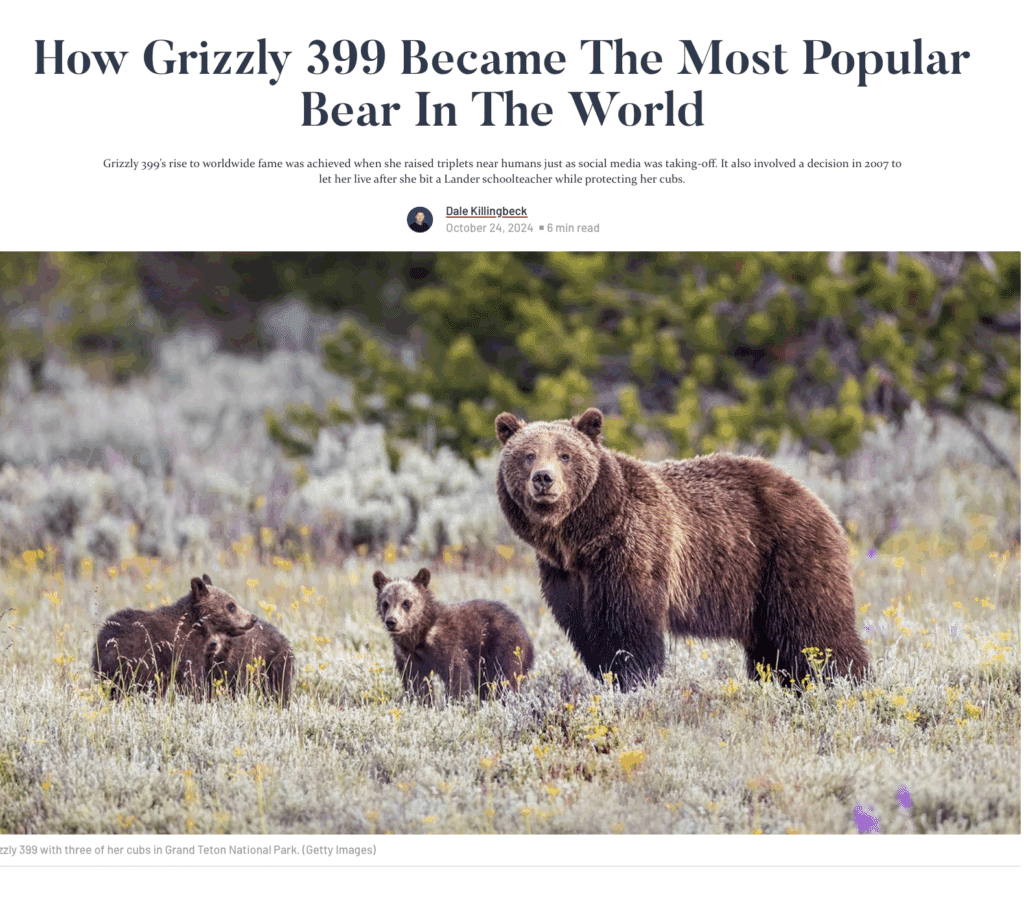
The last major animal among dozens portrayed, and which Seay intentionally had saved for last, was Jackson Hole Grizzly 399, then a 28-year-old mother bear with a brood of quadruplet cubs.
That day, looking at her own two-legged cub, Seay was also thinking about 399’s last cub given the nickname “Spirit.”
Little did Seay, or anyone know, just how hauntingly fateful completion would be. For, on the very day that the last brushstrokes were applied to the cinderblock wall, celebrating the most famous living bear in the world, Grizzly 399 died.
She was struck and killed by a vehicle in the Snake River Canyon along US Highway 26/89 dozens of miles away from the bear’s usual haunts in Grand Teton National Park.
The same kind of grief that millions of individuals feel when we lose a beloved pet was collectively expressed in a form of cathartic mourning. One explanation is how it reflected a larger yearning humans have to connect with nature in a tangible way beyond mere scenery.
Little did Seay, or anyone know, just how hauntingly fateful completion would be. For, on the very day that the last brushstrokes were applied to the cinderblock wall, celebrating the most famous living bear in the world, Grizzly 399 died.
And yet, as this outpouring occurred, perhaps a reflection of the times, there were some who chaffed incredulously at people who talked of loss, labeling it the weak behavior of mere tree huggers.
In late October 2025, I drove to the spot where 399 departed this world, pondering a long span of writing about her that had actually begun an entire human generation earlier. In hindsight, on a distant earlier morning in 2006, the then-head of the Interagency Grizzly Bear Study Team, Dr. Charles Schwartz, took me to a patch of grass—a day bed where the radio-collared 399, then known only to researchers, had slumbered in the woods. The spot we hiked into flanked the Pilgrim Creek drainage that spans both Grand Teton National Park and the Bridger-Teton National Forest.
In subsequent years and only because of her longevity, Jackson Hole nature photographer Thomas Mangelsen and I collaborated on two books about 399 and her family. Tom’s images speak for themselves and so do the thousands upon thousands of other pictures taken by thousands of people that reached millions upon millions of viewers, maybe far more, on social media.
My text for both books was designed to lay out the true natural history of grizzlies, departing from the sensational menacing versions spun by hunting magazines, and by Jack Olsen in his famous account of hikers in Glacier National Park being killed and eaten in Night of the Grizzlies published in 1969.
Olsen’s was a book that, more than any other, stoked fear about Ursus arctos in the imaginations of modern humans heading to the West, Canada and Alaska. It fueled perceptions that in order for the backcountry to be safe, grizzlies had to be put in their place, treated in ways that made them flee from humans, and, with little rebuttal, every female bear with cubs was cast as a lethal death machine ready to explode in a fury of claw and fang.
Much of this was invoked as justification for killing bears, to raise doubts about the virtue of resuscitating the fate of the grizzly population in Greater Yellowstone these last 50 years using the Endangered Species Act to protect them and habitat, and as resistance to the fact that human behavior, attitudes and actions needed to change.
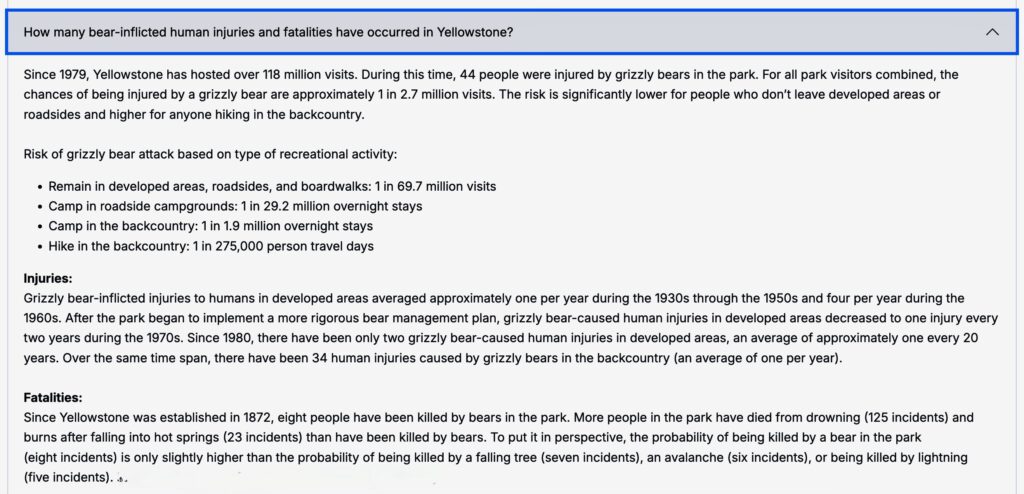
Until 399 came along, grizzlies, with only a few exceptions, roamed as largely nameless, identity-less elusive beings that summoned, in most people, visceral trepidation. Even though in Yellowstone, where millions of people move through the national park with several hundred grizzlies present, the odds of being injured are low—lower still if simple precautions, such as carrying bear spray, making noise and hiking groups, are taken. To understand more, read the scientific paper authored by Yellowstone’s senior grizzly bear specialist Kerry Gunther.
Below, verbatim, is information provided by the National Park Service on grizzlies in Yellowstone. See how the danger of grizzlies compares to other risks.
399’s passing left her last cub, “Spirit,” orphaned. How could the young bear not have been left traumatized by witnessing the loss of its mother and, likely as a still-naïve cub unable to fend for itself and survive in the elements? While bear scientists said it was possible the cub made it through the winter and might emerge in spring 2025, no human has seen Spirit since.
Seay’s portrayal of 399 and cub is not a standalone memorial; rather, it places grizzlies within the context of what Greater Yellowstone is: a whole, still largely complete ecosystem that has all of its wildlife parts. It’s like a landscape painting masterpiece still intact but in need of constant caretaking and renewal as years pass by.
Eventually, someday, the paint in Seay’s mural will weather; it may crack and peel away, unless an effort is made to keep the art in place. Eventually, too, bronze monuments honoring Grizzly 399 will rise in the valley yet over time new generations of Jackson Hole human residents and newcomers arriving on vacation will have no memory of what Grizzly 399 represented. Will all of the progress made in educating the public about the real lives of grizzlies fade too—as—ironically—politicians welcome attacks to be made on science, deligitimizing scientists, the importance of facts, transparency and the ability of civil servants to speak up for natural wonders under their care?
What did 399 do? She shattered perceptions. On the morning after Grizzly 399 was killed, Cowboy State Daily’s Dale Killingbeck engaged me in a chat about the importance of the bruin matriarch. You can listen to our conversation by clicking here.
So often, some people make passing reference to “how the West was won” by settlement and human exploitation carried out on industrial scales, often to serve shareholders in distant cities, yet seldom was there reflection of costs. President Theodore Roosevelt and the first chief of the US Forest Service, Gifford Pinchot, bravely spoke about the costs, and it’s why Greater Yellowstone became a beacon of limits and restraint, with the first national park, first national forest and some of the first national wildlife refuges in the country.
Here is the brutal reality that persists: Hundreds of millions of acres of public land were essentially cleared of native wildlife to make the terrain safe for non-native domestic livestock bred to be docile and lacking the wherewithal of survival that had been hardwired into the native fauna they replaced.
The good news is that many ranchers in Greater Yellowstone should be commended for being creative and adaptive in finding better ways to share lands with wildlife, including carnivores. They’re far ahead of the politicians. What’s happened elsewhere, however, is a harbinger.
Most parts of the Rocky Mountain West still cope with the ongoing ripple effects of ecological ignorance. Ecosystems have been stripped down of their parts, carved up and today, in Greater Yellowstone, the paradox is that our region’s magnificence is igniting waves of sprawl that could be its demise.
The profundity of Seay’s mural is this: species appear in it that are still extant, meaning they haven’t disappeared from this region as they have from others. To have a place on the wall is not an elegy, but a celebration of survival. 399 and Spirit being in the composition is not just literal; it’s them representing their species, with mothers and cubs being the most important biological component of a population that has numbers capable of holding their own.
Not far from Seay’s mural is a different one. This is a painting of the state flag of Wyoming done by a different artist. Side by side, they have the potential to complement each other rather than being icons of incompatibility. Most of the Greater Yellowstone Ecosystem, one of the most iconic in the world, resides in Wyoming and yet there are some politicians who fail to see it as a masterpiece, certainly not viewed in the same light as Parisians proudly display The Mona Lisa in the Louvre.
Squandering what exists as a miracle of Greater Yellowstone would be a mistake, a bold illustration of near and short sightedness—the very definition of myopia.
Below is a multi-media tribute to Grizzly 399 released in November 2024 as a collaboration of Bozeman composer Eric Funk, nature cinematographers Sandy Mell and Greg Balvin and Yellowstonian. We hope you enjoy it just as you will enjoy spending a few moments with the mural Wild Journeys in downtown Jackson Hole.
View more of our stories in the Wild Journeys series: