by Todd Wilkinson
First rule of thumb if you are a professional media PR operative working for a politician or other public figure and you want citizens to get some kind of vague indication your boss is doing something important:
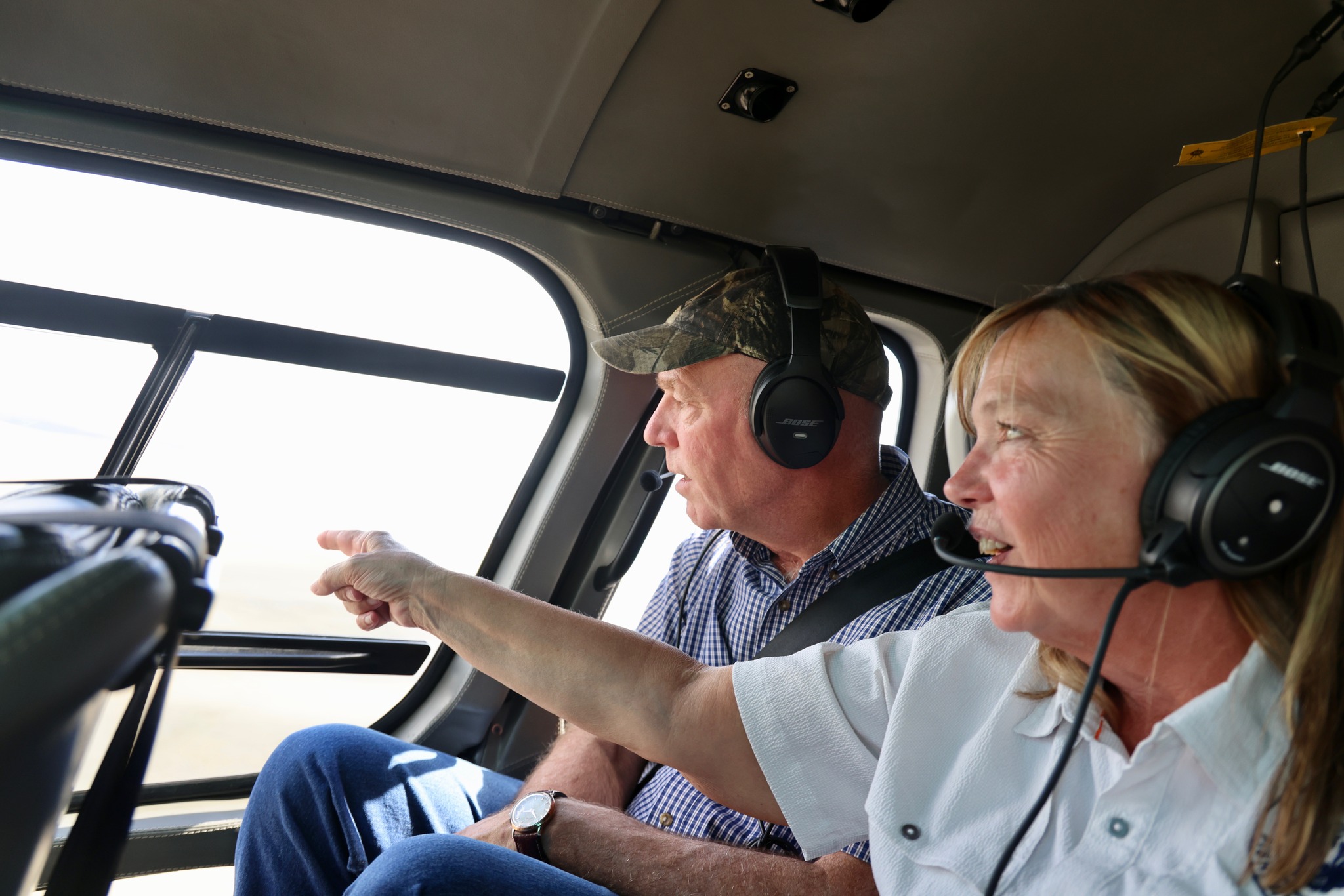
Take a photograph showing them raising their hand and pointing; any direction will do; it doesn’t even matter at what.
The above happened August 21 when Montana Gov. Greg Gianforte shared a photo of himself and his director of Montana Fish Wildlife and Parks Christy Clark. Clark was portrayed pointing out the window of a small airplane while she and the governor flew over the town of Choteau along Montana’s wild Rocky Mountain Front.
The pair reportedly were on a mission to see for themselves “the proximity of grizzlies to town.” Gianforte also shared this observation to his social media post: “Our [livestock] producers and families along the Rocky Mountain Front are seeing an increase in [bear] activity. Montana is ready to manage the species.”
The governor, of course, is trying to wage a not so subtle campaign to gain support for his, and neighboring states’ attempts, to have Congress forcibly remove grizzlies from protection under the federal Endangered Species Act.
One of the key objectives for states assuming management primacy is restoring sport hunting of grizzlies. Overwhelmingly, however, Americans who have shared the larger financial cost of bringing bears back from the brink are opposed to delisting and the return of trophy hunting.
But let’s explore the point Gianforte and Clark are ostensibly trying to make, that grizzlies are being seen in more places on the landscape of the Northern Rockies than they were 100 years ago. That’s absolutely true, yet never mind that a century ago grizzlies were nearly totally eliminated from the West to make the region safe for private cattle and sheep to roam on hundreds of millions of acres of mostly public land.
When grizzlies were listed as a “threatened” species 50 years ago in 1975, they were given federal protection because states were failing to slow their rapid decline and there was grave concern they would totally disappear, even from the ecosystem encompassing Yellowstone and Grand Teton parks.
People are not having Freddy Krueger panic attacks at a mass scale. Gianforte implies that grizzlies need to be delisted so that there can be “bear management” as if its chaos out there now. In fact, grizzlies already are being co-managed by the federal government and states. And state bear managers over the years have, for the most part, done an excellent job.
Some governors, some members of their politically appointed state wildlife commissions, some representatives of state wildlife agencies, some members of Congress, some state legislators, and many leaders of livestock and sportsmen’s groups love to paint pictures of how burdensome it is to have bears, wolves and cougars on the landscape.
Often, the perceptions they orchestrate are based on anecdotal incidents but then extrapolated to create extreme perceptions of commonality. For example, rare bear maulings are repackaged to make them seem routine daily occurrences; rare livestock losses are made to seem constant and devastating even though millions of cattle and sheep are being raised and tens of thousands of cattle and sheep die every year from non-predators; and there’s the vision of an ever present threat to people, especially kids, which isn’t supported by facts.
These portrayals are enormously effective in harnessing the fear which is then used to justify lethal management of those species. The key is portraying brave, gun-toting humans as the antidote to “problem bears,” without reflecting on how or why more bears are being subjectively placed in the problem category.
Gianforte’s and Clark’s overflight of the Rocky Mountain Front is intended to advance that slant, above, which is actually a misrepresentation of reality. Yes, indeed, there are grizzlies living in the outskirts of Choteau, Montana and occasionally a bear might stroll into town. And, yes, occasionally, grizzlies kill livestock and sometimes they kill or injure people in the Northern Rockies.
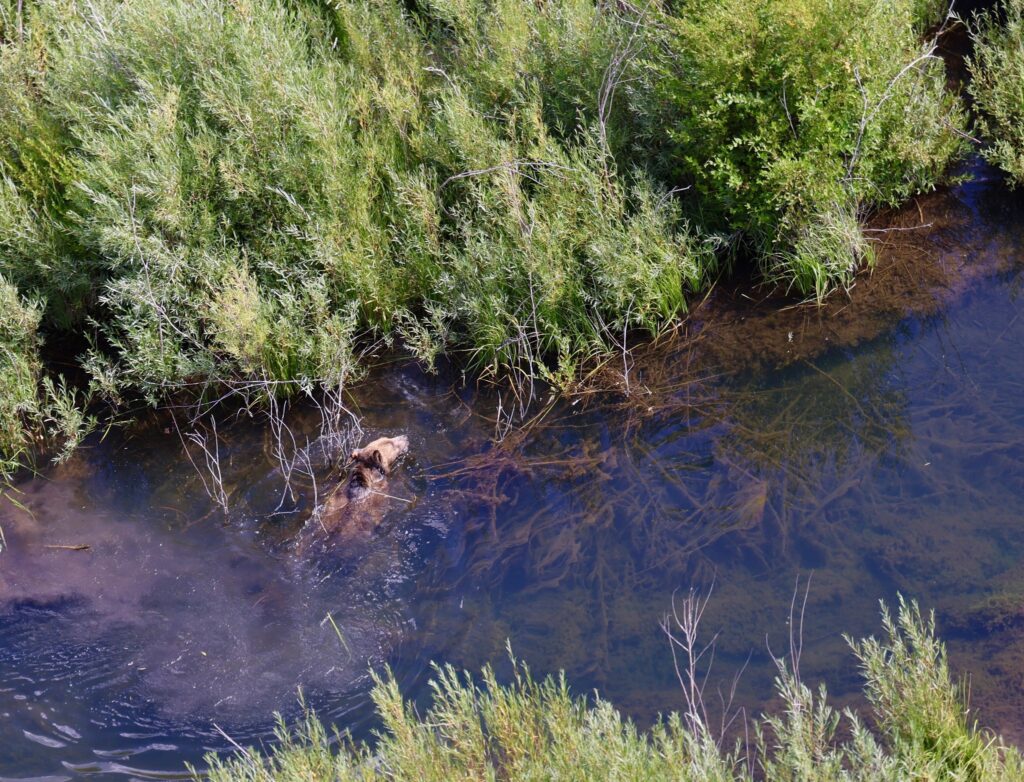
But overwhelmingly, most of the time, they do not. It’s interesting that accompanying the Gianforte-Clark photo showing them pointing and allegedly doing something important, they shared another image, that one of a bear cooling off in water near Choteau on a hot summer day. The picture infers that the bruin was doing something wrong and ominous. The bear was not visiting a public human swimming pool.
Along with Choteau, guess what? Right now, there are grizzlies in the nearby exurbs of Bozeman, Missoula, Butte, Livingston, Cody, Jackson, Driggs, Lander, Red Lodge, Ennis, West Yellowstone, Island Park, Big Sky, Whitefish, Kalispell and Columbia Falls and most humans don’t even know they are there. This realization doesn’t even require an overflight.
People are not having Freddy Krueger panic attacks on a mass scale. Gianforte implies that grizzlies need to be delisted so that there can be “bear management” as if its chaos out there now. In fact, grizzlies already are being co-managed by the federal government and states. And state bear managers over the years have, for the most part, done an excellent job.
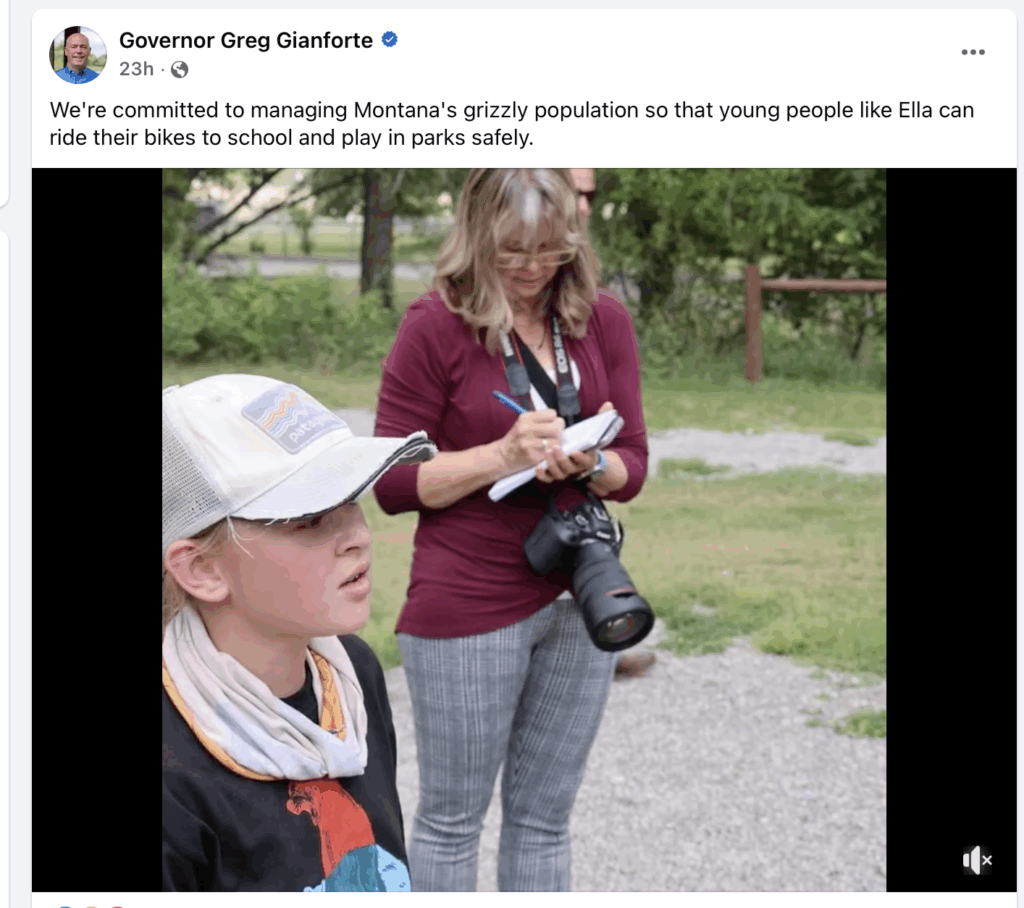
Clark wrote in an essay for the Montana Fish Wildlife and Parks website that her grandkids can’t ride their bicycles to school because there are grizzlies that sometimes roam into Choteau. For sure, towns are not places for grizzlies to live; no grizzly advocate I know suggests otherwise. Dozens of grizzlies already have died this year in the Northern Rockies. This past spring, a mother grizzly with a cub was shot and killed after a pair of mushroom hunters encountered her along a stream corridor near Choteau.
Grizzlies are likely coming into town because they smell human foods and garbage or apples on trees or other attractants, not because they are more aggressive. Grizzlies that venture into towns are trapped and removed and sometimes killed. This has happened for decades, but the phenomenon is not a reason to allege, as Clark does, that grizzlies are invading human settlements. In most cases it’s unregulated, unchecked human settlements pushing into, or the edge of what remains of public wild and private natural lands.
Clark does not have any depth of biological experience in wildlife management. She served in the state legislature but her professional background is in the ranching and construction industries. Growing up in Choteau, she’s from a fifth generation ranching family. Earlier she was Gianforte’s pick to be director of the Montana Department of Agriculture. As one friend of the governor told me, she was selected to head Fish Wildlife and Parks with a singular purpose in mind—to zealously support the governor’s case for removing grizzlies from federal protection.
If Gianforte and Clark truly want to take an educational fact-finding mission, they ought to invite Dr. Chris Servheen into their aircraft. Servheen, who lives in Missoula, was the national grizzly bear recovery coordinator for the US Fish and Wildlife Service for 35 years.
Joining them should be U.S. Congresswoman Harriet Hageman of Wyoming who is leading efforts on Capitol Hill to get grizzlies politically delisted, invoking arguments and rhetoric that often do not hold up to scrutiny. The foursome could do an overflight around Big Sky, Bozeman, Jackson Hole/Teton Valley and Whitefish/Kalispell and they’ll see what the greatest threat to human safety and grizzly recovery is.
It’s happening right now, every day and it’s also affecting the viability of ranchers and farmers exponentially more than the presence of bears or wolves. The biggest predator facing bears is loss of habitat and fragmentation of natural lands, which for some strange reason isn’t being factored honestly into discussions about delisting.
There are an estimated 1,100 grizzlies in Greater Yellowstone and nearby environs and another 1,000 in the Northern Continent Divide Ecosystem but the protected core of those regions are being squeezed by a variety of unrelenting pressures.
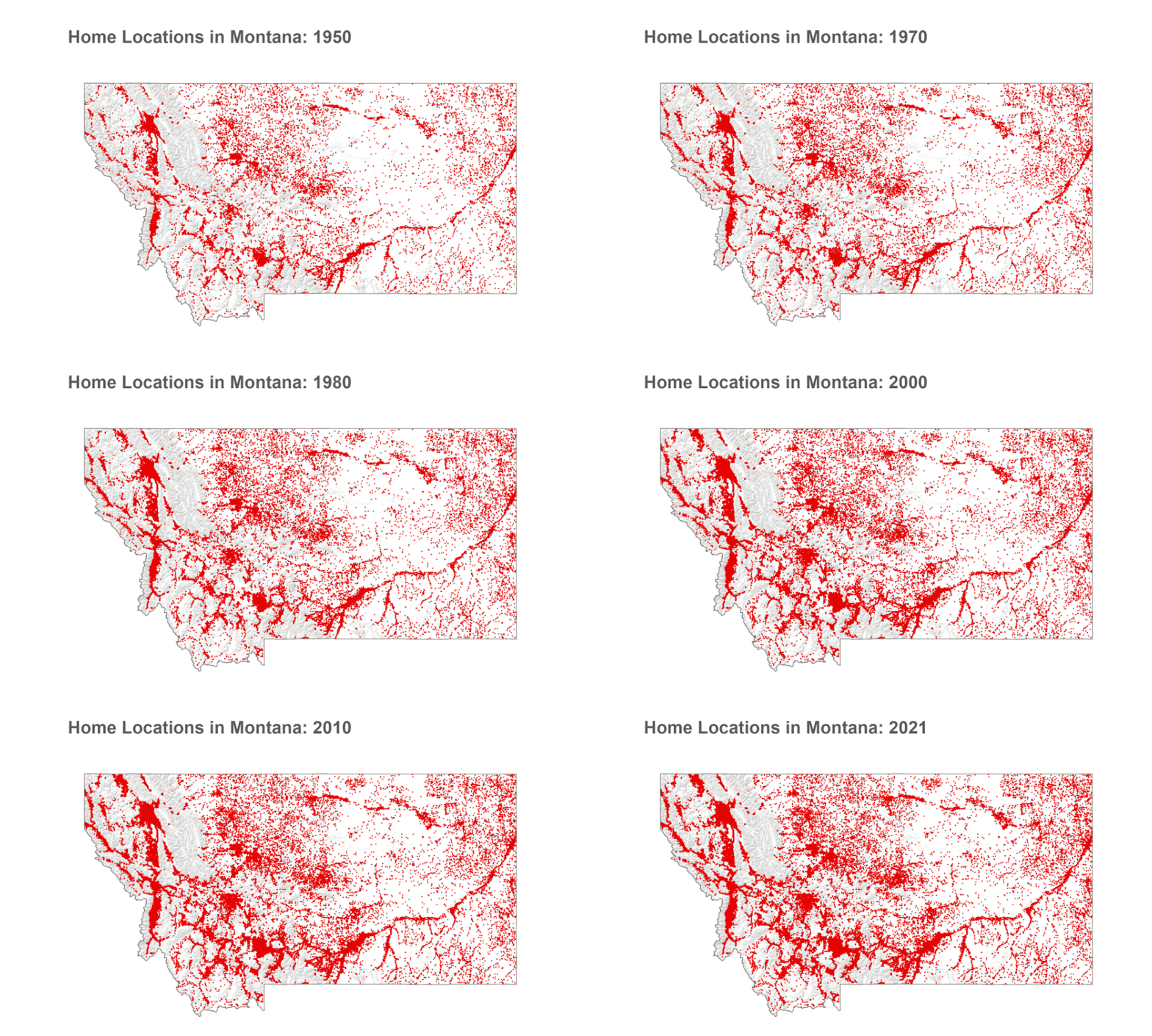
Biological recovery of any species, grizzlies included, is not about taking a snapshot of bear numbers at a given point, but the availability and endurance of secure habitat to support numbers over time. What is the outlook for wildlife habitat in mountain valleys of the Northern Rockies stretching from the Red Desert of Wyoming to the Canadian border? Have a look at the now outdated graphic below produced by Headwaters Economics showing how rural valleys are rapidly filling in with exurban sprawl. The concentration of dots, which resemble the spread of an epidemic, have accelerated since 2021 where this illustration ends. Grizzlies cannot survive in places and adjacent areas with high concentrations of dots, meaning populations will either decline or be severely limited in those places.
Imagine any wildlife species having to navigate labyrinths of busy highways, residential subdivisions with food attractants, low human tolerance, free-roaming dogs, fences, loud noises, and jittery people with guns. It’s why calls to state game departments from citizens to have wildlife removed are on the rise.
For decades, Dr. Servheen favored delisting and was hailed by politicians, like Gianforte and Hageman, as an expert government witness. But he’s switched positions. He thinks delisting now is highly problematic because he sees a perfect storm that has gathered and threatens lasting bear recovery.
This storm has four key converging parts: rampant habitat loss on private lands to sprawl, surging levels of industrial outdoor recreation, hostile political actions toward carnivores taken by states, and climate change that is affecting natural bear food and habitat and will mean all wildlife having to roam farther and farther in order to survive.
The combination of the above sets up lots of bears for unintentionally coming into conflict with humans and being labeled problems by the states, which then can say they are resolving them by enlisting hunters and giving them the opportunity to kill them.
Recently, public radio station WBUR in Boston featured an interview with Servheen and Dan Thompson. Thomson is the large carnivore supervisor for the Wyoming Game and Fish Department.
Thompson told his public radio interviewer that Wyoming annually deals with around 230 grizzly conflicts that involve killing of livestock or human safety concerns and that the number of incidents is increasing, compared to 150 20 years ago. He says much of that is owed to grizzlies showing up in new places; what he doesn’t note—and it might be the most important part— is that a lot more people are moving into grizzly country, places thought secure for bears 20 years ago, but on a daily basis habitat conducive to bear survival is being eliminated, including habitat located between public lands that bears have used to move around. In addition, growing numbers of outdoor recreationists are pouring into grizzly country on public lands, displacing not only bears but lots of wildlife species.
As for Gianforte’s preying on human paranoia and promoting grizzlies as some kind of imminent menace, what are his facts?
Since grizzlies were listed, more than 75 million people, at least, have passed through Yellowstone where a few hundred grizzlies roam in and out of the national park. Tens of millions of people have also visited Glacier and Grand Teton national parks. People come from around the world with the hope of seeing them; they are not staying away in mortal fear. Eight people have died from grizzly maulings in Yellowstone since 1872.
In fact, even though many tourists come to Yellowstone and behave irresponsibly and stupid around wildlife, they are not getting injured and killed in droves. The town of Gardiner on Yellowstone’s northern boundary has as many grizzlies nearby as Choteau but there’s not a public outcry over their presence.
During the extraordinary life of Jackson Hole Grizzly 399 and her many cubs, millions of humans followed her on social media. Wyoming officials say they have spent around $70 million on grizzly recovery since 1975, which sounds like a lot. But consider this: the amount of tourist spending related to visitors’ desires to see 399 in the wild likely surpassed that total in a single year.
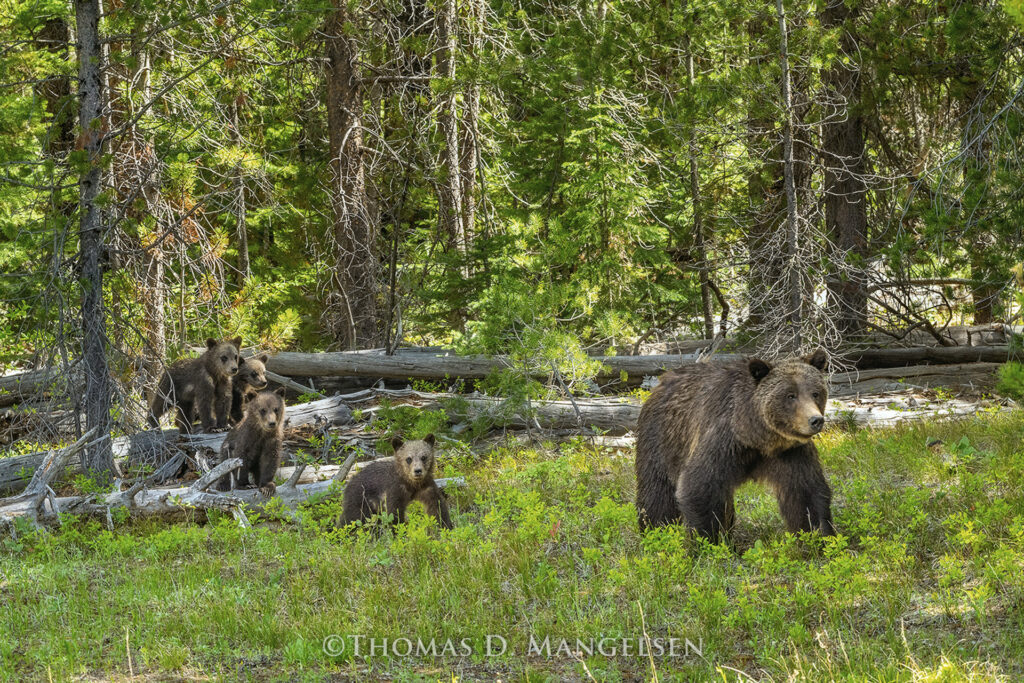
Yea, politicians say tourists “don’t have to live with bears.” That’s true. But the vast majority of ranchers and hunters do co-exist non-lethally with grizzlies and it’s important that we as a society help make it easier for them to do so.
As for livestock producers seeing an increase “in bear activity,”—whatever that means— the truth is that, yes, grizzlies, opportunistically kill some cattle and sheep, not because they’re bloodthirsty but cattle and sheep are bred to be docile, many are unguarded and it’s easy for bears to prey on them. It ought to be the responsibility of producers to make it not easy, and when they do this, depredation by bears and wolves has been proven to drop.
Ranchers who turn their livestock loose to roam public wildlands know they’re going to lose animals to a multitude of causes yet any losses to bears, wolves and mountain lions are deemed unacceptable to politicians like Gov. Gianforte and fear is used as a justification to remove bears, or kill them. Meanwhile, many responsible ranchers realize that having bears, wolves and mountain lions on public lands where livestock graze is a cost of doing business.
More and more, the public is seeing through the politically-driven optics and attempts to engage in fear mongering. Such strategies fall apart when they are scrutinized in the bright lights of facts.
How would grizzly management change under state control? Thompson of Wyoming Game and Fish told the interviewer at radio station WBUR in Boston this: “Honestly, it wouldn’t change a lot on the ground. We were very instrumental in working collaboratively with all the agencies involved with grizzly bears to update the overarching strategy for grizzly bear conservation. We’ve worked on that the last two and a half years, to chart a path forward and to have everything in place to celebrate the success of the recovery of the grizzly bears and move towards that conservation and management. So the on-the-ground work would not change that much.”
Thompson uses that as an argument to delist but it is equally as compelling in arriving at an opposite conclusion. Question for officials in Wyoming: If existing management is working and working well, and if things aren’t going to change much, then why are states in such a rush to delist? Why change something that is getting the job done?
Servheen says challenges to maintaining bear recovery in Greater Yellowstone and the Northern Rockies are never going to decrease. “There’s no finish line, there’s no point at which we can declare ‘mission accomplished and say we don’t have to be vigilant in holding the line on habitat and trying to reduce the hazards that grizzlies face,” he said in a recent interview, one of hundreds I’ve had with him going back to the 1980s. Significant human-bear conflict that already happens with ranchers and hunters will likely remain constant but there will be additive and growing numbers of conflicts related to sprawl—and that equates to more dead bears. As farms and ranches get sold, the likelihood of more conflicts or bear displacement increases with residential subdivisions, he noted.
Newcomers invading rural areas, building dream homes and being naïve about how to co-exist with wildlife represent a major ongoing challenge to bear recovery. Millions of acres are either being directly eliminated, degraded or negatively affected by spillover effects as safe secure places for wildlife to roam due to sprawl, and the viability of those lands will never come back. Habitat is being eroded in a steady war of attrition. Keeping grizzlies on the landscape is tied to success in keeping rural people on the land, too, and their tracts unfragmented, Servheen says.
Sadly, a significant cause of this epic habitat loss, whose effects will be made worse by climate change, is being accelerated by state legislatures in our three-state region weakening the ability of local governments to engage in sensible and foresighted land use planning, Servheen explains. At the same time governors and legislatures are pushing for grizzly delisting, claiming biological recovery has been achieved, they are backing policies that insure meaningful biological recovery will never last.
Sadly, a significant cause of this epic habitat loss, whose effects will be made worse by climate change, is being accelerated by state legislatures in our three-state region weakening the ability of local governments to engage in sensible and foresighted land use planning. At the same time governors and legislatures are pushing for grizzly delisting, claiming biological recovery has been achieved, they are backing policies that insure meaningful biological recovery will never last.
Let it be known that when Gov. Gianforte proposes “management” of grizzlies, observers predict it may be with the same sporting mindset that he, as a hunter, has pursued wolves and mountain lions. In recent years, in Paradise Valley outside Yellowstone, he shot a cougar that had been part of ongoing park wildlife research. The cat had been treed by hounds and held there, unable to flee, until he arrived on the scene to shoot it. He also shot and killed a wolf outside the national park that had been part of park research. The wolf had been caught in a trap he claims to have set, unable to flee and held until he could shoot it. Gianforte attracted widespread scorn, including from hunters devoted to the principle of fair chase.
It would be fascinating if Gianforte, Clark and Hageman could spend just a few months being a grizzly bear mother with cubs, and be dropped into the expanding maze of human activity and sprawl, confronting dozens of menaces every day that could doom their survival. Would they then have more empathy for bears and isn’t empathy what wildlife needs most? Wildlife also needs leaders who choose facts over breathless hyperbole, which might make for better politics but it’s the bane of honorable wildlife management.
Perhaps the governor, Ms. Clark and Congresswoman Hageman could explain what their definition of enduring biological recovery is. Does it mean fating a significant part of “recovered” wildlife populations to having to constantly dodge human hazards and if those animals don’t succeed then being treated as expendable or targets for hunters? That’s a vision which isn’t being highlighted in any political photo op, but it’s the grim reality being created not by facts but myths. And it’s exactly what happened to grizzlies, wolves and mountain lions during the days of the frontier, when real emerging conservation had to rescue them from near oblivion.
RELEVANT AND FOR MORE READING: