
by Todd Wilkinson
It can be spine-tingling sometimes to realize how the fate of special places, or in this case, the destiny of a renowned pastoral American valley that, in turn, is integral to the ongoing health of a larger, world-class wildlife ecosystem, can come down to the actions of just a few people.
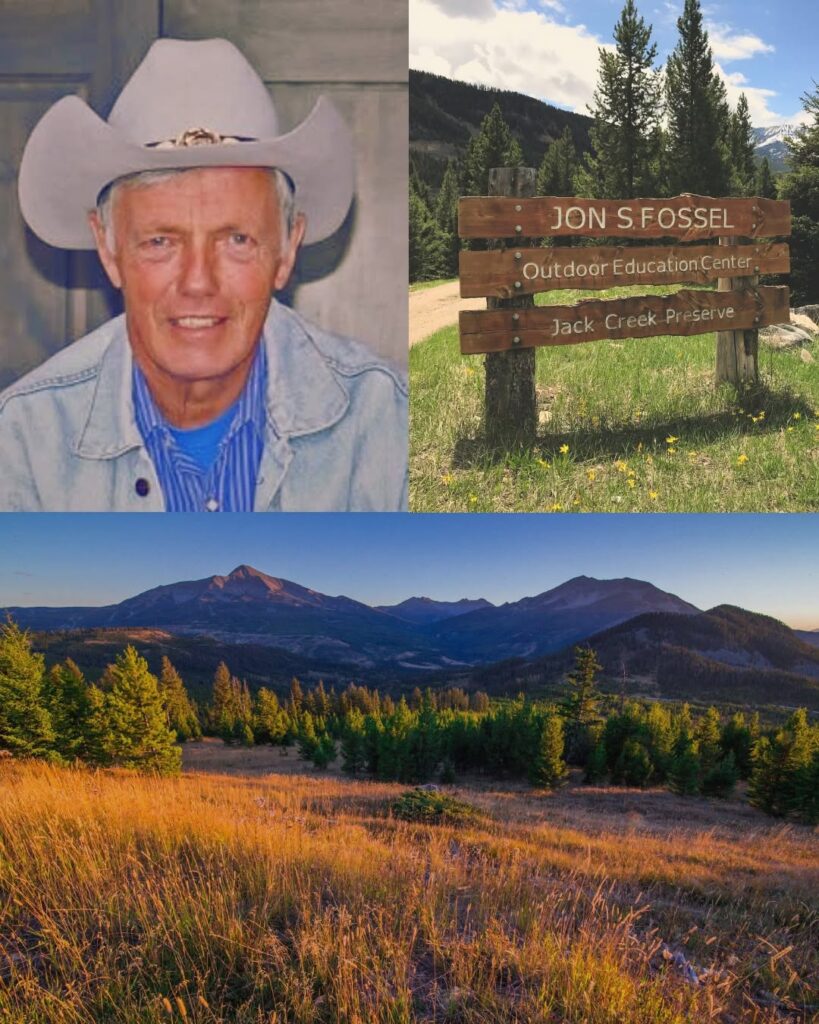
On July 8, 2026, it was announced that Jon Fossel had passed away. Younger readers here may be unfamiliar with his name; even for older longtime residents of southwest Montana there may be only a vague understanding of the contributions Fossel made to safeguarding the Madison Valley, an important part of the Greater Yellowstone Ecosystem. And, for those who knew him as a wizard of mutual funds during his days in the Big Apple, the following might come across as a ray of hope, showing there can be a meaningful alternative to the urban notion of “success.”
Together with his former wife, Dottie, and brother, Scott and his wife, Petria, the Fossels three decades ago purchased 5,000 acres in a drainage called Jack Creek that rises from the western flank of the Madison Mountain Range. Subsequently, Jon and Dottie added another 5,000 acres to their holdings, protecting most of that (4,500 acres) with a second conservation easement crafted through the Montana Land Reliance. It set the stage for creation of a remarkable non-profit entity called the Jack Creek Preserve Foundation.
By its enigmatic example, the Jack Creek Preserve exists in stark contrast to the metastasizing approach to land development and its corresponding irreverence for protecting wild settings that’s been adopted by major developers in neighboring Big Sky. Where the Fossels have adopted an attitude of existing in deference to one of the wildest corners of the West, Big Sky cumulatively has been labeled a destination whose exponent is conquest.
Paul “Rock” Ringling, who served as managing director and then executive director of the Montana Land Reliance for over two decades, and who played a crucial role in securing the conservation easements at Jack Creek, said every easement is critical. However, the deals struck with the Fossels were monumentally consequential.
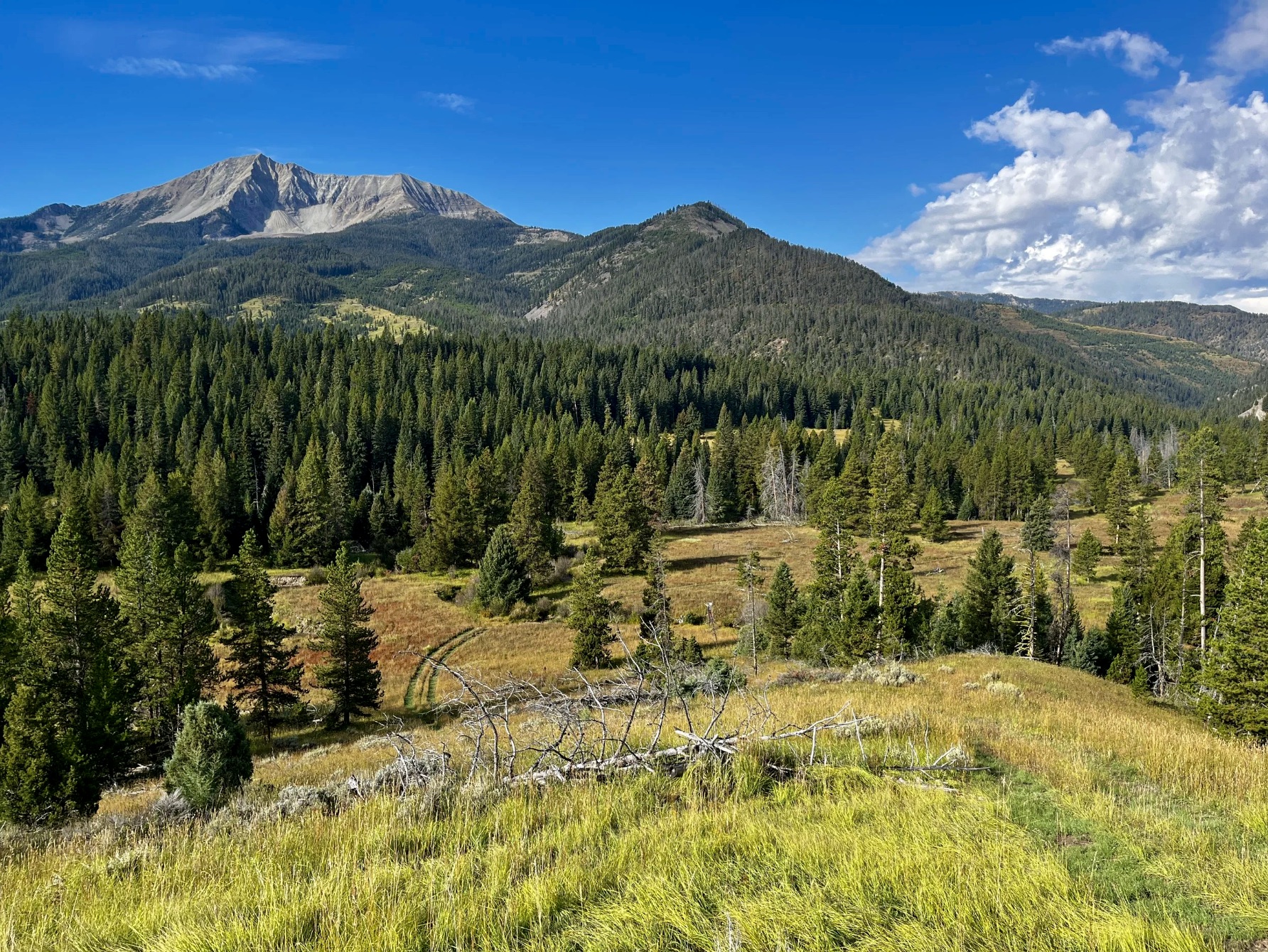
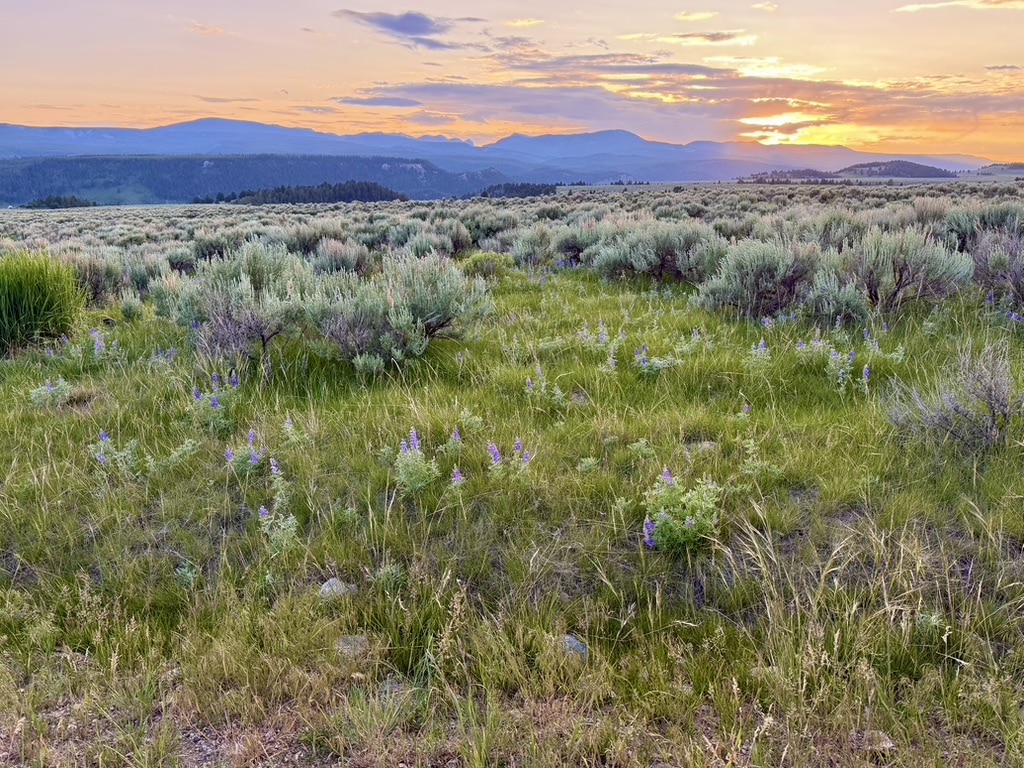
Jack Creek Preserve, prior to its creation, was situated on private land between two different units of the federal Lee Metcalf Wilderness—the Taylor-Hilgard to the south and the Spanish Peaks to the north. Like a critical piece of a puzzle fitting between those wilderness areas, the conservation easements by the Fossels ensures that the extraordinary high values remain intact, namely that wildlife can move freely and it includes safeguarding tributary streams flowing into the storied Madison River.
Today, hundreds of elk, mule deer, grizzly and black bears, wolves, mountain lions, mountain goats, moose, myriad species of birds, and other wildlife find secure habitat in that intersection of public and private land. Native cold water trout inhabit the streams. “The only time I’ve ever seen a wolverine in the wild, and I’ve been here my whole life, was when I saw one walk across the deck at Jon and Dottie’s house,” Ringling said.
Today across northern tiers of the Lower 48 states, there are thought to be only 300 wolverines left.
When the Fossels bought their land, it came with a right of way to use a stretch of the 12-mile Jack Creek Road. Owned by the adjacent development, Moonlight Basin and its parent, Lone Mountain Land Company, the old logging road represents the only potential drivable route for motorized vehicles between Big Sky and the Madison Valley.
Over the years, there’s been chatter that developers in Big Sky relished the chance to bring their wild West approach to real estate development to the Madison Valley, where there are notoriously weak planning regulations in place. There has also been talk of getting the state or Madison County to spend millions of dollars to turn Jack Creek into a wide lane of asphalt. Otherwise, in order to get from Ennis to Big Sky, it requires an 85-mile drive, one way, via US Highway 287 to Norris Road and then down US Highway 191 through the Gallatin Valley and Gallatin Canyon.
Because of the terms of the conservation easement on Jack Creek Preserve, it limits what kind of development can occur on the land. But the easement does not preclude anything having to do with the road—including improving or widening it, allowing it to become a public thoroughfare providing easy short-cut access between Big Sky and the Madison Valley. That is, unless road improvements intrude upon the preserve and the domain of the easement. The Fossels have held firm in saying they would oppose any proposal to make the road public. Moonlight Basin now grants permission and charges a fee for some to drive the road but the number is limited and there’s a speed limit of 25 mph.
How momentous would it be if Jack Creek Road were opened for all public use?
Were that to happen, Ringling said, the sense of biological connectivity that facilitates movement of wildlife would be affected. And, he noted, “you would have a situation analogous to Jackson Hole and Teton Valley, Idaho where development issues and lack of affordable housing have pushed sprawl over Teton Pass into Idaho. Ennis and its outskirts would be a bedroom community for all of the service workers heading to the Yellowstone Club, Moonlight Basin and other parts of Big Sky. Instead of a 45-minute drive down the Gallatin Canyon and Highway 191 from Bozeman, workers and others would pour into the Madison Valley and have a 30-minute drive up ‘Jack Creek Highway’ to Big Sky.”
I asked Ringling to articulate more broadly the consequences of that scenario for the valley. “Well, you would have thousands of daily commuter trips being made that would only grow in number. On the tens of thousands of acres of private land in the Madison Valley where there are now undeveloped lots in 20-acre parcels, a huge percentage would be covered with houses and ranchettes. Meanwhile, the ranches and other lands protected by conservation easements would be surrounded by sprawl, likely killing the wildlife migrations, lining the river and causing lots of concerns about water. The Madison Valley as it exists today would no longer be the Madison Valley.”
“On the tens of thousands of acres of private land in the Madison Valley where there are now undeveloped lots in 20-acre parcels, a huge percentage would be covered with houses and ranchettes. Meanwhile, the ranches and other lands protected by conservation easements would be surrounded by sprawl, likely killing the wildlife migrations, lining the river and causing lots of concerns about water. The Madison Valley as it exists today would no longer be the Madison Valley.”
—Rock Ringling, retired executive director of Montana Land Reliance
Jon Fossel, better than many, keenly recognized how money can be a force for doing good, or when pursued for greed, can have disastrous results. Members of the Fossel clan, as Northeast business and outdoorspeople, had an affinity for the conservative principles of President Theodore Roosevelt. “Teddy Roosevelt was one of Jon’s personal heroes,” Dottie said.
During his earlier professional years, Jon ran and was successfully elected to the New York state assembly as a moderate Republican where his specialty was examining the effectiveness of fiscal spending and policy matters. In 1982 he lost a bid for Congress while continuing his ascent in the investment industry, demonstrating his prowess in thinking about global asset management and helping customers grow their personal investment portfolios. In 1997, he was picked to be president and COO of Oppenheimer Funds and just two years later was chairman and CEO. During his tenure at Oppenheimer, and by the stop he resigned in 1995, its managed assets grew from $8.5 billion to $57 billion.
Make no mistake, Fossel believed in free enterprise, property rights, the Second Amendment, and he said things that could make Liberals squirm. This did not, in any way, inhibit the desire he had to be a protector of nature. Eager to spend more time outdoors, he and Dottie and Scott and Petria Fossel in 1994 bought their first 5,000 acres. A few years later, Jon and Dottie themselves acquired the land that is today Jack Creek Preserve and also under conservation easement. In 2005, they established the Jack Creek Preserve Foundation, on which Scott, a businessman who lives in Jackson Hole, sits on the board.
Had they decided to instead subdivide the 4,500 acres, not create the preserve and allow developers to erect luxury destination developments or trophy homes—following the model of The Yellowstone Club—they could have turned a huge profit. Another aspect of their conservation easements is they kept the historic public access for non-motorized recreation to the Lee Metcalf Wilderness.
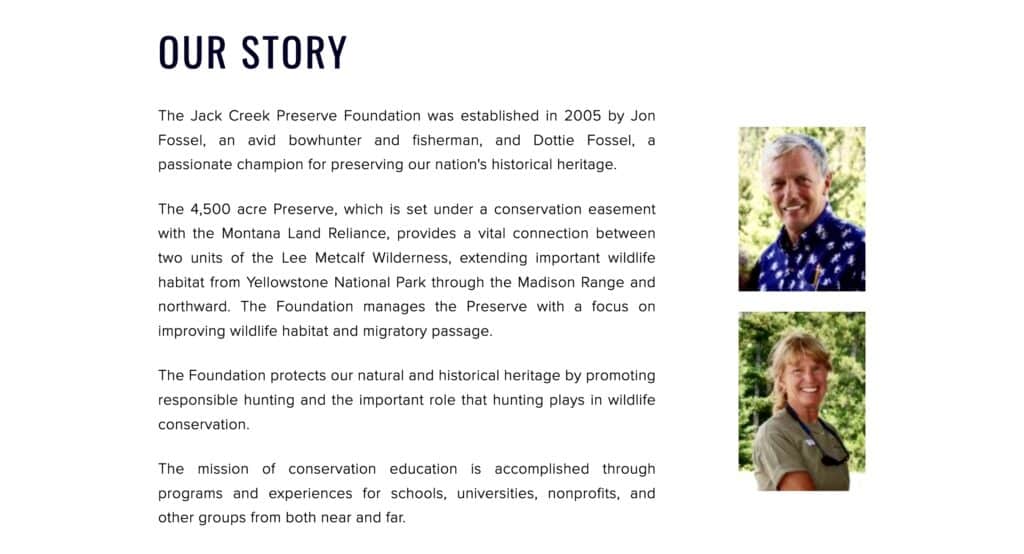
Fossel was an avid bow hunter and fly-fisherman, he served on the board of the Rocky Mountain Elk Foundation and understood keenly the importance of habitat. In almost a cosmic twist, the Fossels have copies of journal notes penned by a guide of Teddy Roosevelt named Charles “Buckskin Charley” Marble who led him on a horse packing hunting trip in 1886. TR was in his late twenties. He and Buckskin Charley traveled literally along game trails through the Jack Creek drainage, onward to Cowboy Heaven in the Custer-Gallatin National Forest and left the Madison Range on what is today the 113,000-acre Flying D Ranch belonging to the late Ted Turner. “They [Roosevelt and Buckskin Charley”] were right here on the same place we walk now. Isn’t that cool?” Jon Fossel remarked.
Turner put the Flying D under a conservation easement and at one point, just prior to the Fossel’s arrival, he had considered buying the land in Jack Creek, but passed largely because it wouldn’t be easy to raise bison there.
“We were thrilled to acquire it,” Dottie said. “Once we had explored it, hiked it, hunted on it and built two small remote cabins, we decided it was too special just for our family to enjoy. We wanted to share it with other people but we also wanted to make sure it would always be protected because of its extraordinary value as a corridor for wildlife.” They also brought back beaver as habitat enhancers using dam analogs, removed barbed wire fences impeding wildlife movement, are monitoring water quality and bird populations, and nurturing native plants. On their radar are 80 different species of concern.
Looking ahead, they thought what better way to engender more respect for wildlands protection in future generations than to allow kids to have immersive experiences, being mentored by passionate scientists, sportsmen and sportswomen teaching hunting and fishing ethics, leave no trace ethics knowing how it feels to experience awe in natural elements?
Through their Jack Creek Preserve Foundation, the Fossels and their team, led by Abigail King, every summer host young people at camps from across the country. Part of the mentoring they receive is learning scientific research techniques including water quality monitoring, respecting wildlife and the habitat it needs to survive. Scott Fossel said the approach of Jack Creek Preserve is like applying recommendations for how to overcome nature deficit disorder that Richard Louv discussed in his best-selling book, “Last Child in the Woods.” Scott and Petria Fossel understand the importance of engaging youth; both have been involved with the Murie Center and Teton Science Schools in Jackson Hole.
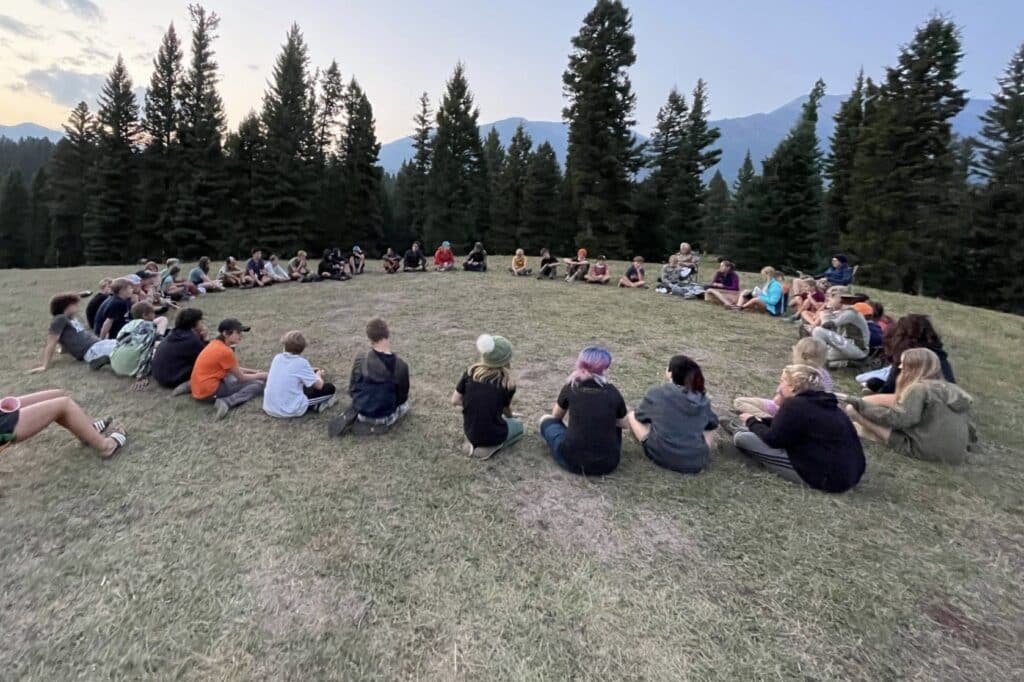
Both Dottie and Scott say Jon derived pride from seeing how young people had a new world opened up to them. He witnessed the power present when they left and went home, knowing that public lands belonged to them and that visiting natural land, or owning it, came with being responsible for the well-being of animals and plants living on it.
Thanks to the big-hearted gestures of dozens of ranchers and property owners, roughly half of the Madison right now is protected by conservation easement that provides a foundation for protecting migrating and resident wildlife. However, sprawl is starting to spread along the Madison River and benchlands.
A few years ago, I wrote this story about the wonder of the Madison Valley, and I mentioned the significance of the Fossels’ conservation work. Within hours of the story appearing, I received a cordial email from Jon and then we had a phone chat and we schemed about potentially getting together at his winter place outside of Prescott, Arizona. That never happened, but our conversation reminded me how devoted he, Dottie, Scott and Petria Fossel were about keeping the Montana that put a spell on them intact. Jon was worried about the impacts of Big Sky and the future of the Madison Valley. What he told me was, “Our intent was to do no harm and leave our land better protected than we found it.”
The outlook for the Madison Valley, many say, is a dichotomy of a glass being half full vs. glass half empty. While there was a recent panic about US Highway 287 being turned into a possible “Trump Interstate,” owed to legislation proposed by US Sen. John Cornyn of Texas, that issue, which now appears dead, shouldn’t distract attention away from confronting an existential transformation happening right now in the Madison, in real time. It includes the loom of possible improvement of Jack Creek Road.
Bob Kiesling, a conservation realtor by profession who held a leadership post with The Nature Conservancy and has been involved with securing many conservation easements in Montana, first of all offers profound praise to the Fossels, Ringling, The Montana Land Reliance and land owners who have made the Madison Valley a national model. Kiesling also is co-author of a recent, award-winning book, “Saving the Big Sky,” about the legacy of conservation easements in Montana
“In terms of protecting the Madison Valley and the wild integrity of both private and public lands in that part of southwest Montana, there were two ticking time bombs that started to be assembled just before the recent real estate booms happened,” Kiesling explained. “The first ticking time bomb of explosive development pressure has already detonated in Big Sky on the Gallatin River side with the effects of sprawl on water quality, wildlife, the Gallatin River and public lands extending from Big Sky north to the Gallatin Valley. The good news is that the conservation easement on Jack Creek Road by the Fossels prevent it from spreading directly into the Madison Valley.”
But there is a second ticking time bomb of sprawl that still looms large over the Madison, and though invisible to the human eye now, the implications if they could be visually illustrated would be jaw-dropping, Kiesling said. “This time bomb has not been significantly defused or de-risked in any significant way and it needs to be addressed.”
During the 1970s and in part precipitating creation of the watchdog non-profit, the Montana Environmental Information Center, unprecedented sprawl was just beginning to take hold in Montana’s Bitterroot Valley between Missoula and Hamilton. “The real estate community was saying, “What’s the problem? All growth is good. If you think there’s a problem, then prove it,’” Kiesling explains.
In fact, the real estate industry has historically been the most vocal force in Montana opposed to sensible land use planning and, where needed, zoning. The root of Montana’s current problems dealing with growth and the loss of “real Montana,” observers say, can be traced to that industry’s constant, ongoing efforts to thwart regulation.
Kiesling said that volunteers with MEIC went to county courthouses and documented how former ag and natural lands were being rapidly converted into subdivided plots of 5,6, 7 and 8-acre parcels. They produced data and presented it to the legislature that the real estate industry could not dispute and they showed how sprawl correlates to higher taxes and rising fiscal challenges for counties having to provide services to rural subdivisions, along with worries about failing septic systems and their threats to well water. They also noted how sprawl hampered the ability of agriculture to keep operating at scale, and, of course it was causing visual blight of valued open space that is part of the identify Montanans share, Kiesling said.
With MEIC delivering a landmark report, state elected officials realized there was a serious problem in some western mountain valleys vulnerable to development pressure and so updates were made to the Montana Subdivision and Platting Act. Specifically, in an attempt to slow the slicing and dicing of open lands, the new regs stated that all development on plats of fewer than 10 acres would be subjected to rigorous county review.
However, Kiesling explains, it set off a wave of unintended consequences. In the interim period between when the new regulations were passed and then going into effect, there was a rush of landowners who raced down to court houses and subdivided their land on paper. Counties are still dealing with this legacy.
In response, the legislature then raised the minimum threshold to 20 acres and a similar thing happened. Lawmakers then raised the minimum limit to avoid county review to 160 acres and this time, it set off a land rush in the Madison Valley where tens of thousands of acres, on paper, today exist as 20 acre lots. During these debates, little regard was given to the consequences on wildlife, especially migratory species. Subsequently, studies have showed conclusively that species ranging from elk to pronghorn and grizzly bears have low tolerance for sprawl occurring in 20-acre parcels spread scattershot across the landscape.
Trying to correct this, the legislature, when it was about to enact the 160-acre minimum, also was set to have a requirement that all county planning staffs and commissions must consider the negative impacts of development on wildlife before granting approval, Kiesling said. But the real estate industry rose in opposition and that requirement was struck from the final bill that passed. Montana Fish Wildlife and Parks has documents that spell out the impacts of sprawl on wildlife, and actions developers can take to mitigate the worst effects, but the recommendations are only advisory and county planning staffs and commissions statewide seldom require them to be heeded.
It’s one of the reasons why the Gallatin Valley in Gallatin County surrounding Bozeman—one of the fastest growing micropolitan cities in the country—is suffering from epic loss of wildlife habitat, severed wildlife migration corridors, a reduction in the biodiversity of species and growing water quality concerns. Jon Fossel told me he was horrified by what Bozeman, once a quiet, quaint and inviting college town, had become and that no longer felt like Montana. He had hope that Madison Valley could avoid that fate.
“With all of those 20-acre parcels sitting out there, on paper down at the county courthouse in Madison County, the Madison Valley has a ticking time bomb and it doesn’t take a lot to set off a chain reaction of sprawl that would bring permanent negative consequences and, as Rock Ringling notes, make the Madison Valley no longer being the Madison Valley,” Kiesling says. “We’re incredibly fortunate that we’ve had individuals like the Fossels and conscientious land owners in the Madison Valley who have acted for the good of nature and the public interest by putting conservation easements on their property. And we owe them praise. But the potential travesty we are facing now is if the impact of their goodwill is diminished because of short-sighted greedy thinking on the part of others with properties not under easement or owners who only want to make a quick buck.”
A few generations from now, it will be interesting to see who is most venerated—Tim Blixseth, founder of the Yellowstone Club who transformed his side of the Madison Range into a vast real-estate play, or the Fossels for what they did at Jack Creek, for what other ranchers in the Madison Valley did by putting conservation easements on their land, and Ted Turner, for putting an easement on the Flying D Ranch at the far north end of the Madison Range.
Jon Fossel was 84 when he passed. He knew he wasn’t perfect but he believed the natural world was. For him, he wanted Jack Creek Preserve to be his epitaph and its words written in the tracks of wildlife as well as young kids who spend time on the property and grow up to be their advocates.
EDITOR’S NOTE:
The story contains a clarification about the conservation easement on Jack Creek Preserve brokered with the Montana Land Reliance. The easement does not prevent any potential improvement of Jack Creek Road by Moonlight Basin and its parent entity, Lone Mountain Land Company, that would allow for mass public use by motorists driving between the Madison Valley and Big Sky.
You may also enjoy: