by Todd Wilkinson
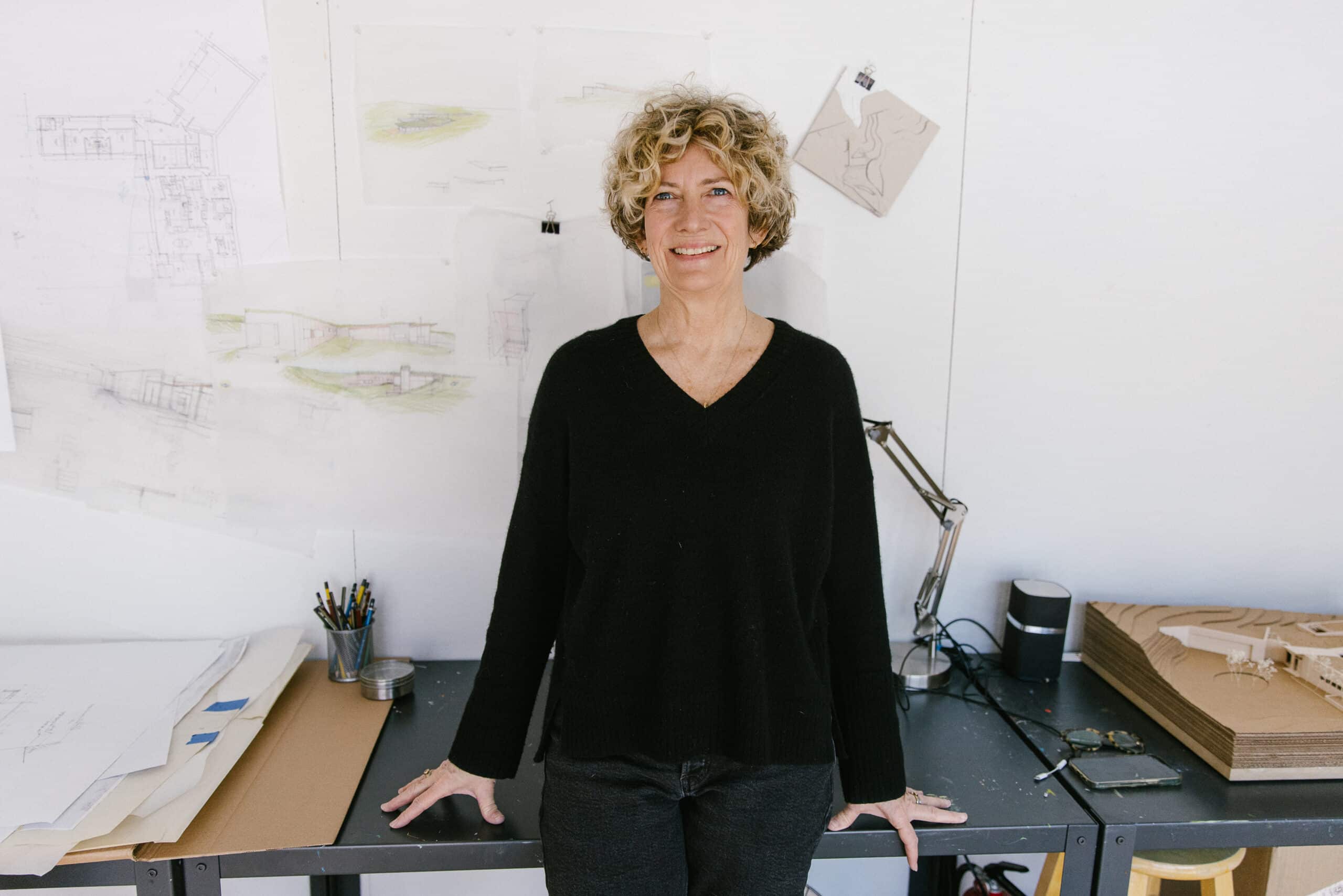
Here’s something faithful readers of Yellowstonian might find shocking: the person who founded Artemis Institute, the 501c3 entity, that allows Yellowstonian to operate as a non-profit conservation journalism endeavor, was trained in architecture at the famed Harvard Graduate School of Design and she’s a painter.
Dr. Lori Ryker over the last 30 years has both designed many structures, including homes for clients, but she also was a tenured professor in the School of Architecture at Montana State University. (She earned her PhD at Texas A & M). As Ryker notes, one of the most consequential decisions a human makes is where new habitation is designed and built. Yet even today the footprint of our impact upon the Earth remains focused on human concerns, disregarding our impact on the other living creatures and the planet. “Our awareness of human impact needs to expand,” she says. A good starting point is pondering beauty.
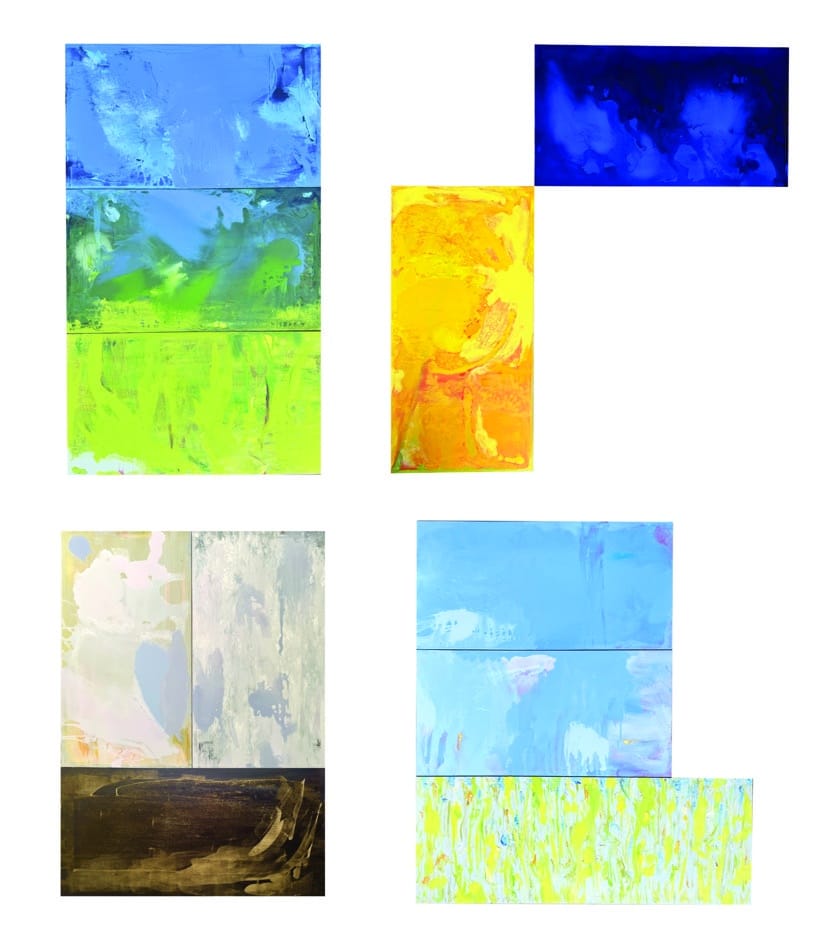
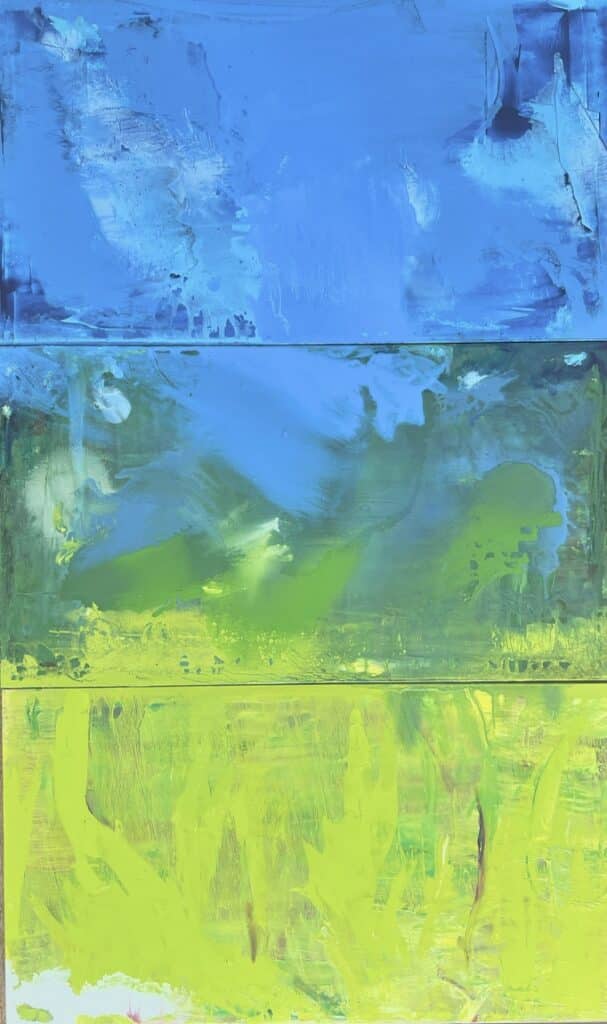
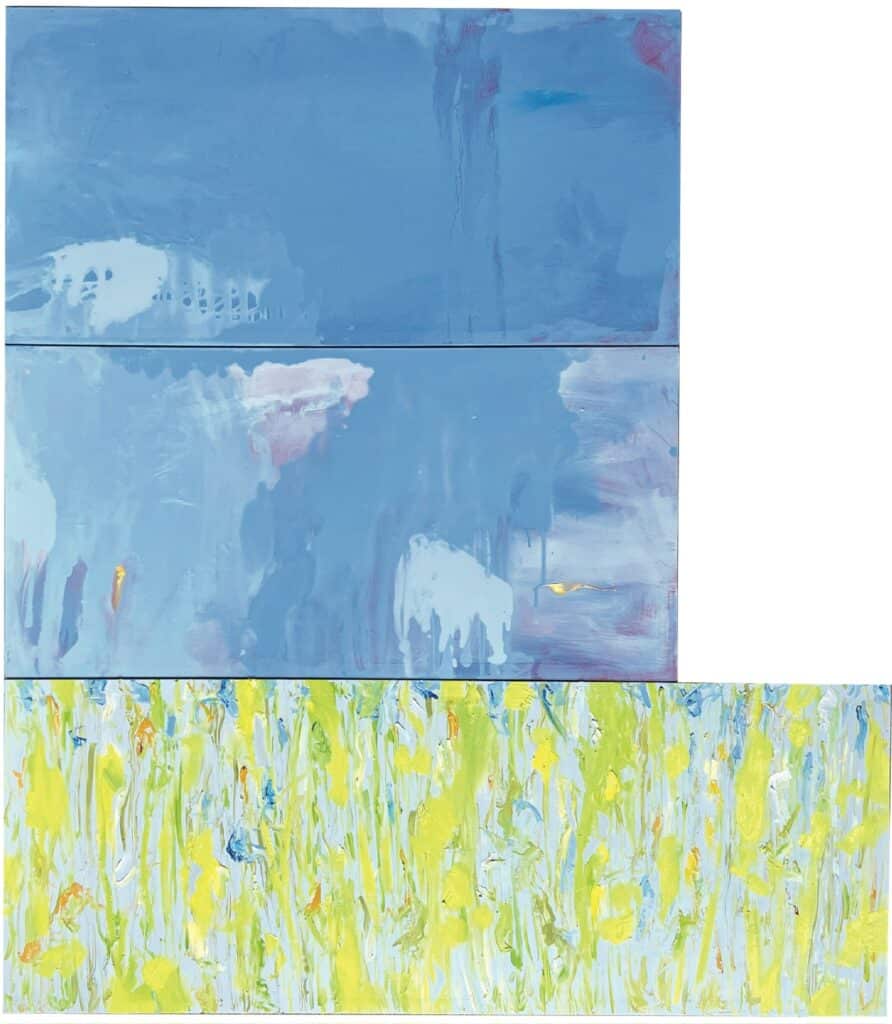
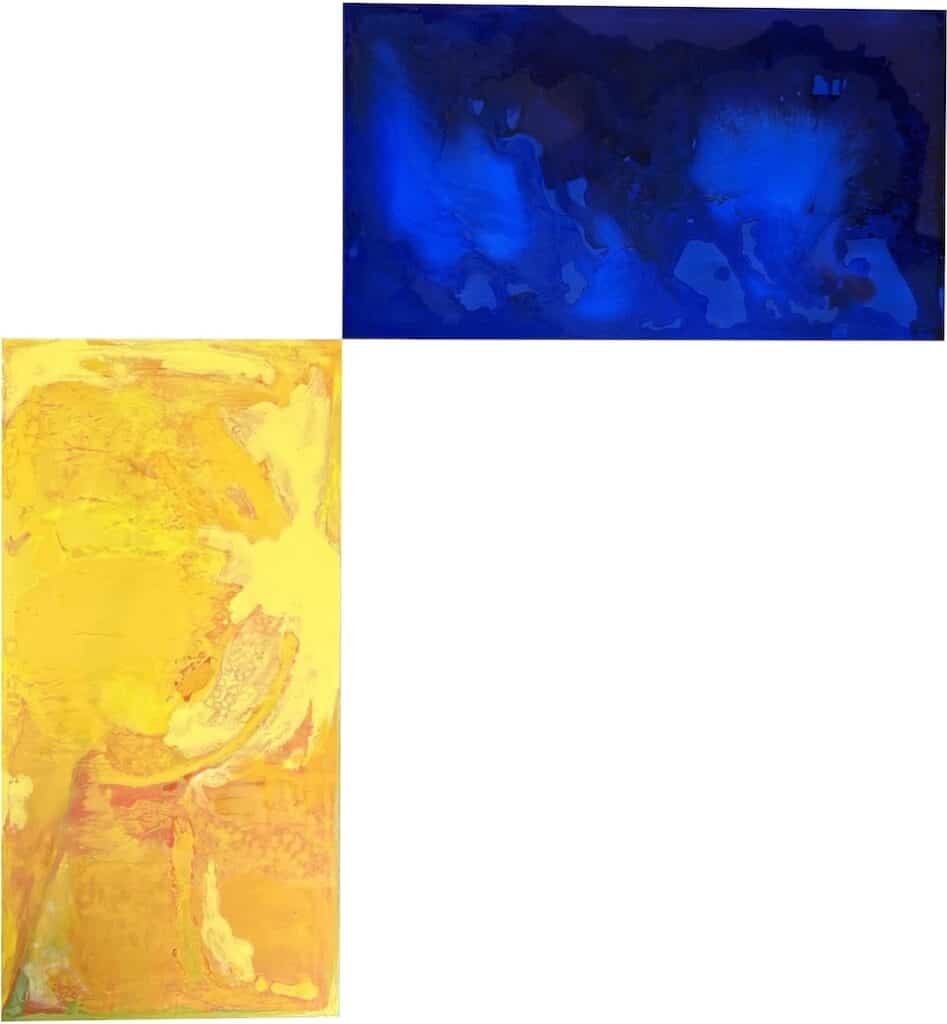
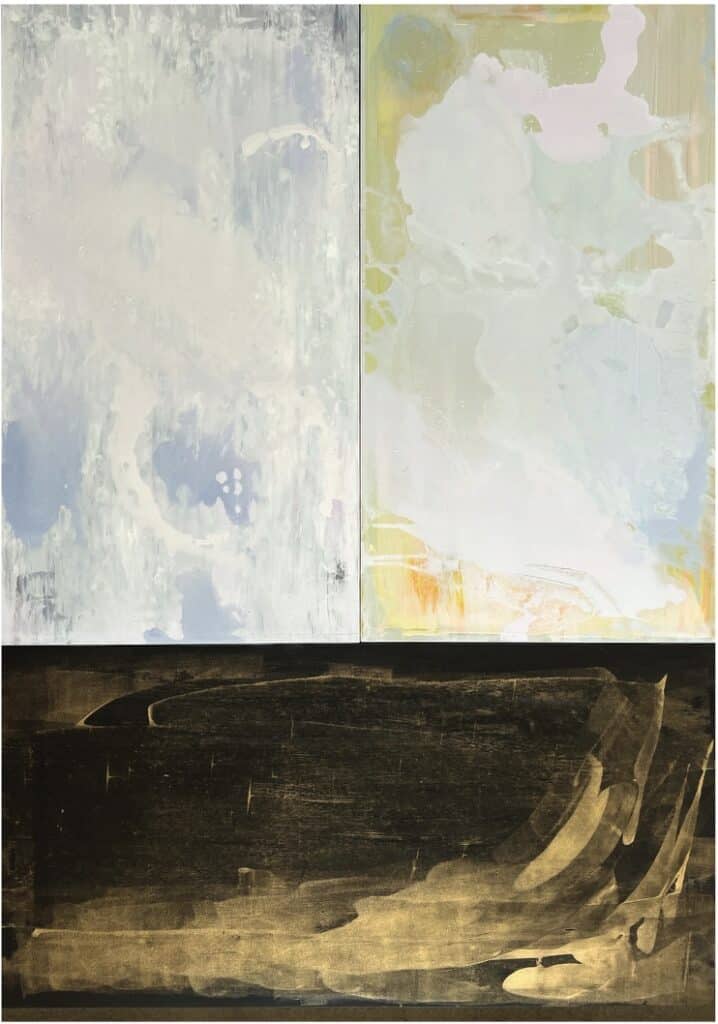
As an introduction, we’re sharing an engaging series of four oil and panel paintings Ryker completed in 2025 called The Four Seasons. “My art explores the ongoing inner-dialogue I have to my relationship with and impressions of the natural world (physical and spiritual),” she writes in an Artist Statement. “I view the work I make as documentation or glimpses into my metaphysical preoccupation with awe, beauty and belonging. The outcome is work evoked by particular direct experiences and collective moments of reflection of the natural world, rather than any aspect of representation of a particular place. Often these expressions, non-objective in form, arrive from multiple experiences of a place or phenomena.”
With regard to her theme, extending across four of the distinct elemental parts of a year, she observes: “Humankind’s recognition of the seasons is an old as human beings will to survive and the drive to communicate. I imagine that ancient cave paintings were stories, narratives or descriptions of seasonal hunts and habitats, and view them as offerings, poetic, and of hopeful outcomes for life. The Four Seasons series is focused on such imagining told through transitions in life through color. These are like experiences of channeling feelings at certain times, episodic in nature.”
Ryker’s architectural designs have been featured in Mountain Living Magazine, Outside Magazine and Western Interiors & Design. She’s also received numerous awards for her creative work, including a grant from the National Endowment for the Arts and a State of Montana Artists Innovation Award. Over the years she’s been included as a mixed media artist in different solo and group shows from Montana to Texas and her work is in private collections.
Co-existence is not an abstract concept for Ryker. She lives not far away from charismatic megafauna, including carnivores.She understands how the comprehensive conditions of architecture and its developed environs must need the forms and ecological function of nature.
Ryker brought that kind of critical thinking to college students who enrolled in her program, Remote Studio, that immersed them in rural landscapes, encouraging them to reflect on how they could build in places without causing harm. Those places included Jackson Hole and Park County, Montana. The program was inspired by another, invented by her mentor, the late Samuel Mockbee, whose Rural Studio focused on relationships that people from all walks of life have with their surroundings. Mockbee was especially concerned with underserved people living in the South.
Ryker reflects on how her paintings and thoughts on architecture overlap. Below is a recent conversation.
Todd Wilkinson: You’ve had a career designing buildings and teaching college students how to be more thoughtful, responsible and sensitive with how they think about approaching human footprints and impacts they create in place. And yet, what many don’t know about you is that you always had a passion for painting. Who were your influences in art and architecture earlier in your life?
LORI RYKER: I was educated in the mid 80s through early 90s – and very interested in personal design theory, i.e. why architects design the way they do, what drives and influence their work. During this period there was a strong emphasis on context and what is often called sense of place. Designing was, as most of it is still, focused on the human place, and environments that influence our experiences, but not so much on a larger living community. My early design influences were Finnish designer and architect Alvaro Aalto, and Le Corbusier’s late phase which was more expressive and less about Cartesian thinking and the machine.
Spring
TW: Who else was part of the firmament of your thinking?
LORI RYKER: Frank Gehry, who just passed, was gaining recognition in the cultural scene and I loved the house he designed for himself and his wife, and a hay barn he designed. The Australian architect Glenn Murcutt who speaks very clearly about context and environment in a larger sense is another. He was not only a great space and experience maker for humans he also has a commitment to considering how to build in wild landscapes where resources are scarce, or wildfire was a common concern. He expressed humility in his design, which I appreciated.
TW: How did art affect your approach to architecture and vice versa?
LORI RYKER: Early on, I had a developing ethos for making more (better design) with less, rather than ostentatious use of materials. As far as early art influences, Mark Rothko, Donald Judd, Helen Frankenthaler, Jasper Johns, Christo, and Georgia O’Keeffe. I used mostly artists for my case study research to illuminate how I wanted to orient my architecture process rather than a list of architects. Georgia O’Keeffe’s life and paintings that were so obviously invested in the place where she lived (they were not general), Donald Judd, similarly, once he moved to Marfa, Texas. He took issue with art being held in museums and away from the environment where they were created. Christo and Judd both had simplified languages in response to the places that they were or were inspired, what most would call modern or minimalist. But I see their work as collaborations with the place that inspires them.
Summer
TW: Please share a few words here about the late Samuel Mockbee and Coleman Coker. For those unfamiliar with them, why do they matter and how can they help us better ponder co-existence with nature and each other in achieving true sustainable communities?
LORI RYKER: “Mockbee and Coker” was with a small architecture firm located in the Deep South— generally Mississippi and Tennessee. They designed custom homes and small public buildings. After graduate school I began looking for architects who were designing outstanding and award winning work in the US, but not situated on the East or West Coasts. I was seeking a mentor to guide me and I wanted to write a book about who I found (Mockbee Coker: Thought and Process, 1995). Their practice was immersed in the social and cultural conditions where they lived in the south and they were the first architects I had direct experience who were influenced by the culture of their place and committed to issues of equality – in a full-depth way. In addition to their own practice they developed affordable homes and worked with students and different universities to help them understand a greater sense of responsibility to the place in which we live, which may be different depending on where you live. Mockbee was also a painter, who died of Leukemia in 2001, told me he felt obligated to pay for the sins of his fathers.
TW: What did he mean by that?
LORI RYKER: In this effort he founded the Rural Studio at Auburn University, amid an immersive education program for architecture students. It was located in Hayle County, the poorest and most rural county in Alabama that focused on designing and building innovative and affordable housing and public buildings for the there. He believed everyone should be able to live with dignity, and pushed back against the cookie-cutter houses that HUD provides to low-income people. Coker, a refined builder educated in fine arts, went on the found his own immersive education program at The University of Texas, Austin and ran his program primarily in the wetlands area of Coastal Texas where he focused on environmental conservation and wildlife habitat through architectural interventions.
TW: This selection of work is about the four seasons. It’s abstract and non-representational. They are not monoliths of color but they invite a mood response that color fields do. Walk us through why you selected this theme and what is represented in each work.
LORI RYKER: While I was in graduate school for architecture in Cambridge, [Mass], I took double studios—in art and architecture at the same time—so that I could study print making at the Carpenter Center. I became interested in monotype, which is essentially painting on a plate and transferring via a press onto a sheet of paper. This process requires more management of technique than painting does due to the pressure of the press on the oil paint. After graduate school I took a long break from print making because I did not have access to a press. But was always making with my hands, site specific installations, water color, pastels, even jewelry. All of this work was always about expressing my inner feelings about an experience of place through form and color.
Fall
TW: Several major magazines published your projects in designing homes and other structures. You also were an architecture professor at Montana State University and you operated Remote Studio, an immersive curriculum for architecture students from the across the country that in some ways was a parallel to Mockbee’s Rural Studio. How and when did you return to art?
LORI RYKER: In 2012 I purchased a press and went on with printmaking while also designing buildings. But I wanted to make larger art work and slowly began a painting practice. With the four seasons series I wanted to try a new expressive painting technique and thought a series could help me better reciprocally learn and reflect. I knew I wanted to focus on sense of place, time, and impressions.
TW: What’s your approach to the motif as an inhabitant of Greater Yellowstone who lives in Paradise Valley with sunrise every day emerging over the serrated ridgeline of the Absarokas?
LORI RYKER: “The Four Seasons” as a concept have been explored for hundreds of years by musicians, painters and poets, which would allow me to contribute to a canon of expression. Each season is also a series of panels rather than one canvas. Their pieces work together like a sculpture or architecture; becoming the essence of what a season feels like to me with translated into a painting. Therefore, the paintings are not a one-to-one expression, it is not realism, because I think that the power we find in nature is at its most profound in its direct experience. The best we can do is honor these experiences by sharing our emotional experience (spirit/ soul) of the world through art. This is the same type of experience we have when we listen to a piece of music and it transports us emotionally, but it is not direct we just feel.
TW: What have you found, personally, are the most effective means of unlocking and unleashing your own awareness of things in the natural world?
LORI RYKER: Awareness for me is two-fold. Immediate experience and observations and reading about the places, systems, wildlife and other people’s thoughts and observations. These readings move between science and poetic. In the same way in which we gain knowledge about ourselves, we learn about the science of our body and how to best keep ourselves physically healthy, and we spend time with the creative pursuits of life, whether being the creator or from others creations – because these experiences feed our spirits and connects us to ourselves and others in profound ways that cannot be achieved through science.
By the way, I also I teach through this belief. I want the thinking, be it of students, clients or even readers of Yellowstonian, to be ground in the truth, as we can best know at the time, of science while also being invested in the poetic power of human creative expression. We cannot ignore one of these without losing the power of our belonging to the Earth as human beings.
TW: You often note that one of the most impactful material decisions we make is how we live. What can people do who care deeply about nature but live in the country and don’t want to be called a hypocrite.
LORI RYKER: I’ve heard you say that you like to, as a journalist, introduce ideas that people can’t unsee or unthink. Sometimes it takes awhile to achieve ecological awareness but it’s never too late to be an advocate and deepen one’s personal understanding of why this region is so extraordinary.
Winter
TW: Agree, wholeheartedly! Looking into the new year ahead, what are some of the elemental areas you want to, artistically, do more exploration in?
LORI RYKER: There are always new creative pursuits in my mind floating around, painting at large scale, site specific art, architecture that is designed through poetry, humility and respect. Maybe write a book through the narrative of architecture about our need to set better boundaries for ourselves that respect the needs of wildlife for retaining remaining wildlands. Certainly it’s something we need to learn as the Northern Rockies’ human footprint is swallowing habitat with little consideration given to the greater consequences for all living creatures. I’m glad Yellowstonian exists because it makes us aware of how we are interconnected within an infinitely inspiring world far bigger and wilder than ourselves.