by Todd Wilkinson
During the 1990s, a new acronym emerged—REP—that turned heads within the constellation of organizations working to safeguard America’s natural world.
The letters stood for “Republicans for Environmental Protection” and following the 1980s when the Grand Old Party in the West was deepening its ties to neo-Sagebrush Rebels, skeptics located left of center characterized REP as a contradiction in terms.
This, despite the fact that the 20th century began with Theodore Roosevelt, a Republican, becoming America’s forerunning environmental president. TR equated conservation with conservative ideals. He brought better protection to a lot of public lands. He challenged unregulated resource extractionists and corporate monopolists who ran roughshod over nature. He promulgated the notion that preserving the best of anything deemed irreplaceable is wise because its value will only continue to accrue greater worth for society over time.
With wildlife, landscape and water conservation it’s a premise that’s never been proven wrong.
Thirty years ago, REP was founded not by diehard sportsmen, but by three women, Martha Marks (a county commissioner from Lake County, Illinois), Kim O’Keefe-Wilkins, today a pharmaceutical company employee who champions cancer drugs, and Aurie Kryzuda, a realtor from California. They didn’t want the GOP’s conservation legacy to become an epitaph spelled “RIP.”
“We are, no exaggeration, at a point of no return to protect the ecosystem.”
—Rob Sisson, Republican conservationist
As legend has it, that wildlife-loving trio converged while attending a conference on endangered species held in Chevy Chase, Maryland. Together, they shared their angst about the then new Republican majority in Congress seeking to weaken the Clean Water Act and other environmental laws that Republican lawmakers in accord with Democrats had helped put on the books. During the Nixon Administration, two decades earlier, landmark laws such as the National Environmental Policy Act, Clean Water Act, and Endangered Species Act were signed into law. On the idea of giving imperiled wildlife and plants a second chance of persisting in places where they fell into steep decline or disappeared, the unwavering, pro-business Nixon said, “Nothing is more precious and worthy of preservation than the rich array of animal life with which our country has been blessed.”
In 1970, attorney and Republican lawmaker William Ruckelshaus (after whom the Ruckelshaus Institute at the University of Wyoming is named) was tapped by Nixon to become first administrator of the newly created Environmental Protection Agency. In 2018, just a year before he died, Ruckelshaus condemned overt maneuvering by the first Trump Administration to fire EPA scientists studying climate change. “If your position is, ‘I don’t believe the science, therefore I’m going to get rid of all the scientists studying this, and let’s not mention it in any public announcement,’ that’s just crazy,” Ruckelshaus said. “What you want to do is more science.” His words proved to be prescient in the wake of recent actions taken by the new Department of Government Efficiency (DOGE).
Let us not forget that Gerald Ford, in his coming of age years, worked as a seasonal park ranger in Yellowstone in 1936 long before he won election to Congress and became a Republican President after Nixon. Fifty years later, in 1989, Republican President George H.W. Bush used Grand Teton National Park as a backdrop for ushering forward improvements to the federal Clean Air Act, some of which today are targeted for repeal.
The same year Bush made his announcement, Bush’s Secretary of State James Baker met with Soviet Foreign Minister Eduard Shevardnadze near the shore of Jackson Lake in Grand Teton to discuss nuclear arms control and economic reforms that became a prelude to the end of both the USSR and Cold War. Baker, who owned a ranch in the southern half of Greater Yellowstone and loved to fly fish with his late friend US Sen. Alan K. Simpson of Wyoming, credited the natural wonder-inducing backdrop of the Tetons with inspiring warm feelings between he and Shevardnadze and reduction of tensions between the superpowers.
Highlighting those elements of Republican legacy, the formation of REP by Marks, O’Keefe-Wilkins and Kryzuda created a big splash. Soon, Marks was overwhelmed with speaking engagement requests. They realized that more than being an ad hoc organization, they were striking a larger resonant chord which had an important niche to fill.
Around the year 2000, Rob Sisson, a Midwesterner from a small town who had hunted and fished his whole life and had two twin sons, came on board as volunteer president of REP’s Michigan chapter. Sisson joined the permanent staff in 2007 (around the time a resident of Teton County, Wyoming also got involved) and he [Sisson] became REP’s staff president in 2009.
In 2012, just before Democrat Barack Obama was re-elected as President, REP took on a new name, ConservAmerica, and distinguished itself, foremost, by being affiliated with a number of Republican lawmakers who took the evidence of climate change seriously—not only the threat it poses to the environment, but to the economy, human health and national security.
For those who have a cliched generalized perspective of “all Republicans,” Sisson defies them. So, too, will that now-former Teton County, Wyoming resident mentioned above, Paul Vogelheim, who went on to be elected as a county commissioner grappling with growth issues and in 2016 was honored as Wyoming’s “county commissioner of the year.” Vogelheim also is a former chair of the Teton County Republican Party.
Sisson stepped away from his staff leadership position with ConservAmerica in 2019, around the time that he and his wife, Theresa, moved to Montana. That year, he was President Trump’s nominee to serve on the International Joint Commission that works to settle water disputes erupting along the 5,525-mile joint boundary shared by the US and Canada. His selection was confirmed by the US Senate.
For five years, while based in southwest Montana and until 2024, Sisson worked on water disputes that involved treaty issues, conflicts related to fisheries, mining, logging, climate change and more. It gave him profound appreciation, he says, for how nature does not adhere to lines drawn on maps and that stewardship is a responsibility that applies to both sides of an invisible boundary.
Over the years, Sisson’s interest in private land conservation—Vogelheim’s too— have only deepened as they realize its vital importance in holding together the tenuous health of Greater Yellowstone, the foremost wildlife bioregion in the Lower 48.
The intactness of landscapes and full diversity of (especially) large mammals makes it a global bellwether, is a mighty engine for the economy, tied to human residents’ quality of life values and is today under siege by rural sprawl and development pressure. They believe that using resonant conservative principles to mount an unprecedented rally aimed at protecting the essence of Greater Yellowstone would be another momentous achievement for the GOP—and a popular one, too.
° ° ° °
On Thursday, August 28 in Livingston, Montana, ConservAmerica is hosting a one-day conference at the Shane Lalani Center for the Arts arrayed around the topic of how to protect private natural lands in a time of profound change with sprawl leaving wildlife corridors and essential habitat fragmented. A thought-provoking line-up of speakers will headline the event. It’s free to the public. All readers need to do is just sign up by clicking here. Many see it as a test of whether species protection is still embedded as a core value of the current GOP or whether its willing to squander a legacy that helped make Greater Yellowstone “the cradle of American wildlife conservation.” The host organization brings conservative creds in a rural interior West that has politically turned deep red. Sisson says advocating for wildlife out to be viewed as patriotic and not unilaterally partisan. See agenda at bottom of this story.
On Thursday, August 28 in Livingston, Montana, ConservAmerica is hosting a one-day conference at the Shane Lalani Center for the Arts arrayed around the topic of how to protect private natural lands in a time of profound change with sprawl leaving wildlife corridors and essential habitat fragmented. A thought-provoking line-up of speakers will headline the event. It’s free to the public. All readers need to do is just sign up.
“ConservAmerica is an important voice,” Vogelheim says. “Statistically, half of America is Republican and half Democrat but 65 to 70 percent are moderates. They value wildlife, they’ve just demonstrated their strong support for keeping public lands in public lands by repelling sell-off attempts by Senator Mike Lee of Utah, and they realize that without responsible stewardship of private lands and habitat protection, we could lose the magnificence of what still exists in Greater Yellowstone—its wildlife—and much faster than we think.”
A short while ago, Vogelheim reluctantly joined the exodus of longstanding conservation-oriented Teton County, Wyoming residents in leaving Jackson Hole and re-settling over Teton Pass in neighboring Teton Valley, Idaho. An influx of newcomers in Jackson Hole has sent already-notoriously-high real estate values soaring higher and along with it cost of living. Replacing the locals who ardently supported conservation is a new generation, many from urban areas, with little knowledge or appreciation for Greater Yellowstone’s irreplaceable wildlife that is an American treasure, Vogelheim says.
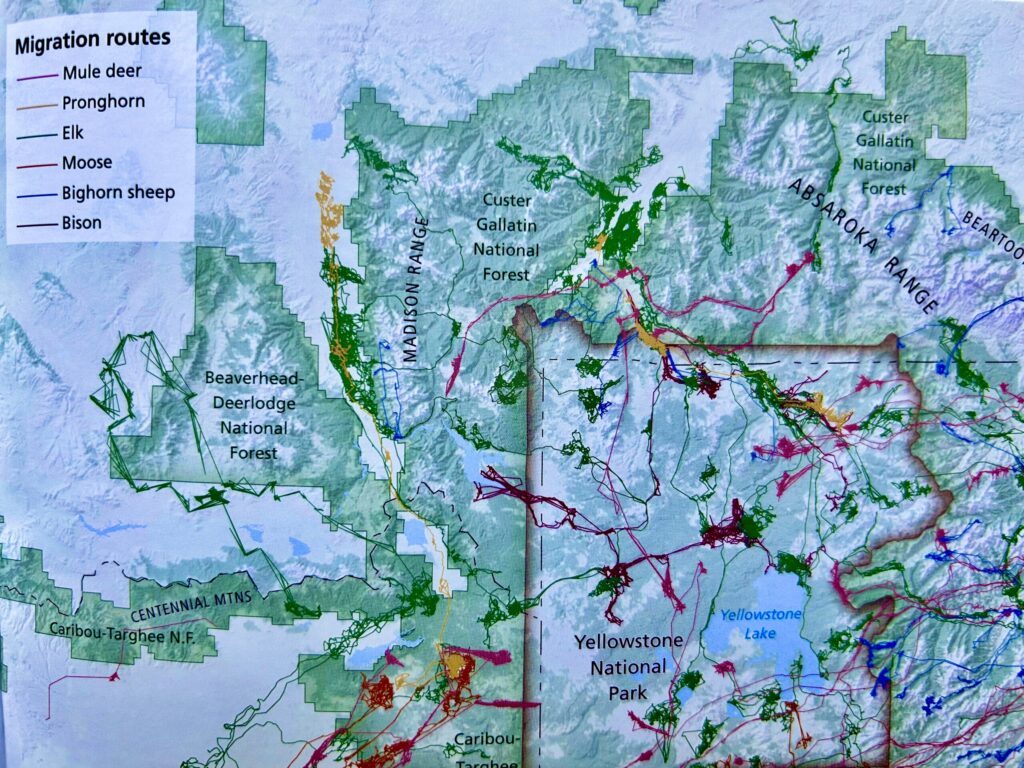
The attitude is becoming ever more pervasive, evident in many high-growth destinations like Montana’s Gallatin, Paradise, Madison and Shields valleys, Big Sky; Island Park and Teton Valley, Idaho; Cody, and in areas south of Jackson Hole, like Bondurant, the Hoback, Star Valley and the Upper Green River Valley which holds famous wildlife migration corridors.
“Statistically, half of America is Republican and half Democrat but 65 to 70 percent are moderates. They value wildlife, they’ve just demonstrated their strong support for keeping public lands in public lands by repelling sell-off attempts by Senator Mike Lee of Utah, and they realize that without responsible stewardship of private lands and habitat protection, we could lose the magnificence of what still exists in Greater Yellowstone—its wildlife—and much faster than we think.”
—Former Teton County, Wyoming County Commissioner Paul Vogelheim who was also leader of the local Republican Party
Because many of Greater Yellowstone’s new large landowners are buying up legacy ranches and using them as recreation retreats, they’re in a position to become true heroes in the eyes of the nation, their family and communities by contributing to the protection of America’s own mini-Serengeti, Sisson and Vogelheim say. The Serengeti allusion is applied to that vast stretch of veld and savannah in eastern Africa where mass numbers of wildlife, including predators and prey, migrate seasonally. Greater Yellowstone and the Serengeti are among only a small handful of places left in the world that still have a full complement of native species, though human impacts are threatening to leave both permanently impaired.
Between pioneering ungulate tracking and wildlife corridor mapping by the Wyoming Migration Intiative, Ryan Zinke’s administrative order 3362 that he issued in 2018 as Trump’s Interior Secretary instructing federal agencies to cooperate in identifying vulnerable passageways, new federal funding that incentivizes corridor protection, more dollars available for constructing wildlife bridges across busy highways, and polling and citizen surveys that consistently reinforce the fact that wildlife perpetuation matters to citizens and the quality of life they value, opportunities abound to do more at exactly the same moment that habitat in some places is most imperiled.
The dilemma facing Democrats is the same one they accuse Republicans of suffering from—entrenched party tribalism that prevents them from seeing their adversaries as also trying to accomplish something good for the nation and bigger than themselves—securing the best of what remains of our wild places before it’s too late to save them and impossible to rescue. On local consequential land use planning issues in the 20 counties of Greater Yellowstone, the truth is that progressive conservation organizations have been as conspicuously absent—reticent even— in demanding better ecologically-minded decision making to benefit wildlife as those with Rs behind their affiliation have been.
Yellowstonian‘s conversation with Rob Sisson
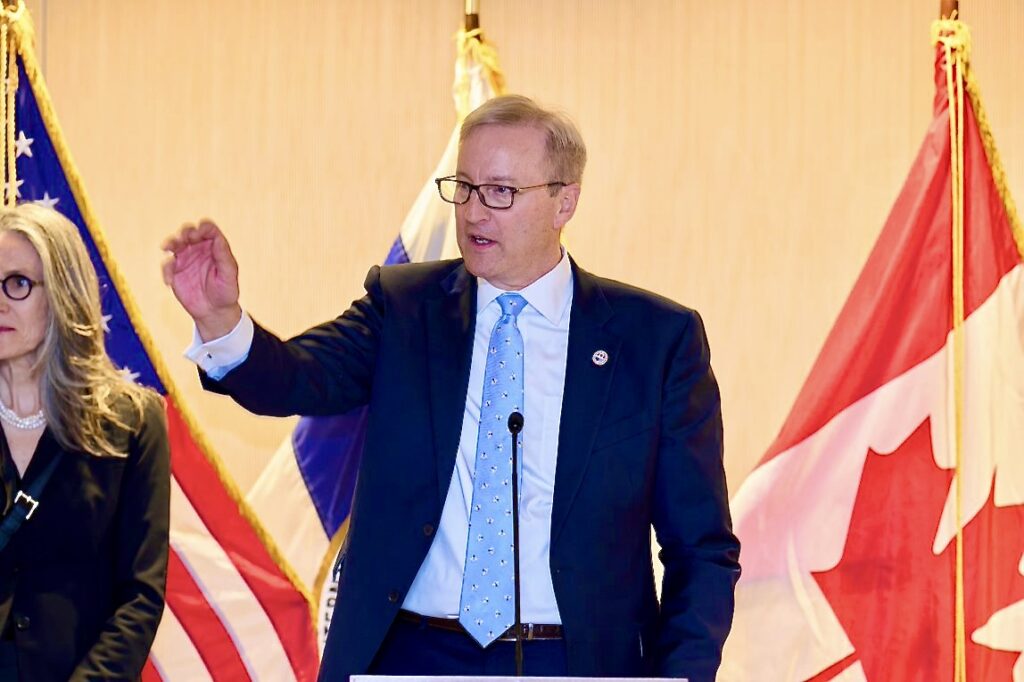
Todd Wilkinson/Yellowstonian: You have a fascinating background: you’re from the Midwest between Detroit and Notre Dame. You became smitten with the West; you were mayor of your small town in Michigan, a businessman who was a member of the local GOP and served on an economic development corporation, you were selected by the Michigan governor to sit on an environmental justice working group, you led a national non profit Republican conservation organization, and prestigiously, until recently, were a White House appointee on the International Joint Commission. You’re also an avid hunter, angler and defender of the scientific method in making societal decisions. You moved to the West with a dream of living in Shangri-la on the near outskirts of Bozeman. What happened? The reason I ask is it gets at the impetus for this conference.
Rob Sisson: My wife and I vacationed in Wyoming and Montana our entire married life. We knew we wanted to retire out here, but when our twin sons enrolled at Montana State, we decided to follow them west. The sheer pace of development here in just the eight years we’ve lived here is frightening–for someone who loves the landscape and its wildlife. I recognize, being a native Michigander who moved to Montana, I’m part of the growth problem we’re experiencing. That’s part of the reason I want to be part of a solution…a solution that helps us understand and manage growth to protect this incredible region everyone—not just Montanans, but Americans and people from around the world—loves.
TW: I have personally witnessed your interest expand in large landscape conservation and you’ve been active in the realm of learning lots of things you can’t unsee or unthink. You’re obviously smart but you learned things you didn’t realize and yours is an evolution in thinking that’s urgently needed in a lot of people. What do you know about the function and importance of wildlife migrations you didn’t know before?
Rob Sisson: Before we moved here, I thought there was so much public land that this region would be perpetual paradise, no matter what happened outside the national parks or forest boundaries. If Yellowstone is the beating heart of the Northern Rockies, then each valley or watershed surrounding it are the arteries. From watching the development and traffic along US-191 south of Four Corners to new subdivisions announced, seemingly every day, to prime mega-fauna habitat being converted into enclaves and golf courses for the uber-wealthy, I’ve learned those arteries are in need of emergency by-pass treatment.
TW: Private lands serve as critical interstitial spaces between public lands rising above river valleys and pathways for wildlife. Many of those private lands are owned by legacy ranching/farming families or, increasingly, by wealthy outsiders who see land ownership as a solid investment and as places to relax and in many cases live closer to nature. Who are a few of your favorite large conservation-minded landowners?
Rob Sisson: Paradise Valley has many ranching families who partner with land conservancies or organizations that brainstorm new ways to coexist with wildlife and habitat (PERC is a prime example). I’m biased, but the man who has mentored me in the ways of elk hunting, Steve Claiborn, has done a super job of conserving his ranch in Park County. Bruce Rauner, former governor of Illinois, owns several large parcels in the region and manages all of them for wildlife. He’s an avid upland bird hunter. As much as we need to prevent destructive development, we need to praise those who are protecting land because it’s the right thing to do. There’s my landlord, Russell Gordy, whose Rock Creek Ranch spreads across the southern face of the Crazy Mountains. In fact, he bought the 700-acre parcel just northeast of Livingston, where I presently live, because the prior owner was planning to subdivide it. Hardly a day goes by when we don’t see several dozen pronghorns, a half dozen mule deer, or a moose or two here.
“As much as we need to prevent destructive development, we need to praise those who are protecting land because it’s the right thing to do. There’s my landlord, Russell Gordy, whose Rock Creek Ranch spreads across the southern face of the Crazy Mountains. In fact, he bought the 700-acre parcel just northeast of Livingston, where I presently live, because the prior owner was planning to subdivide it. Hardly a day goes by when we don’t see several dozen pronghorns, a half dozen mule deer, or a moose or two here.“
—Sisson
TW: You and ConservAmerica are bringing together an influential mix of people for the conference who have devoted a lot of thinking time to land connectivity. Most of them favor the power of the free market and how it can move faster, more efficiently and cheaper than government in achieving conservation goals. The downside, and necessary to point out, is that the same free market has sown destruction. Developers and realtors, taking advantage of weak planning regulations that discount wildlife values, have set off a new land rush leaving behind ecological destruction and sprawl. What is the genesis for this conference?
Rob Sisson: ConservAmerica, which celebrated its 30th anniversary this summer, has been a DC-centric, board-driven organization for many years. One of its programs is to facilitate the Roosevelt Conservation Caucus, a bicameral congressional caucus. With Montana’s own Senator Steve Daines and Rep. Ryan Zinke being strong leaders in that caucus, ConservAmerica looked for opportunities to be more active “Out West.” When I left the International Joint Commission and hung a shingle up with the organization, it provided a toehold here. As you and I’ve discussed so many times over the years, wildlife corridors are under siege and we believe this conference is timely.
TW: Paul Vogelheim believes the GOP and its elected officials in the West are at a moment of truth. We need to acknowledge a widely held perception, by many on the Left and those who identify as moderates. They are skeptical of the intent of Senators Daines and Sheehy of Montana, Senators Lummis and Barrasso in Wyoming and Senators Crapo and Risch in Idaho. Many point to Wyoming’s Congresswoman Harriet Hageman and say she is an extremist zealot who lacks common sense and ignores facts that don’t suit her agenda. They argue that the above have no business claiming that they and President Trump share the values of Theodore Roosevelt. You’ve always said that, in the spirit of TR, land conservation represents true conservatism. What do you mean by that?
Rob Sisson: President Reagan answered that when he said rhetorically, “What is a conservative after all but one who conserves, one who is committed to protecting and holding close the things by which we live…And we want to protect and conserve the land on which we live—our countryside, our rivers and mountains, our plains and meadows and forests. This is our patrimony. This is what we leave to our children. And our great moral responsibility is to leave it to them either as we found it or better than we found it.”

TW: You give a lot of praise to Montana Congressman and former Interior Secretary Zinke for his posture against selling public lands and for his championing of protecting wildlife migration corridors. For those on the other side of the political aisle from Zinke, who might be distrustful of him, what do they need to better appreciate about where he’s coming from?
Rob Sisson: Ryan Zinke, Sen. Daines, and Sen. Sheehy are old fashioned conservation champions. They hunt and fish. Without Daines and Zinke, there would not be a Great America Outdoors Act, which resorted full mandatory funding for the Land and Water Conservation Fund and created the National Parks and Land Legacy Restoration Fund to address maintenance issues plaguing parks like Yellowstone, Grand Teton and other units of the National Park System. We live in an era when partisanship blinds us to admirable qualities in the “other side.” Reagan famously said, “The person who agrees with you 80 percent of the time is a friend, not a 20 percent enemy.” Objectively, I believe Zinke is, at a minimum, an “80% ally” of everyone who cares about healthy lands, clean water and air, and wildlife.
TW: You’ve said it’s important to appreciate the bind that some elected officials find themselves in. They support conservation and have a soft spot for wildlife but they know they will draw flack from constituents if they appear to be associating with any cause connected to the, quote, “environmental left.”
Rob Sisson: We hear that a lot.
TW: Sen. Daines grew up in Bozeman the son of a prominent builder and he knows that Bozeman’s nature of place is what set it apart in the world. There’s no way he can claim the natural character of Bozeman is better because of its growth. I know some friends of Daines who said the national pushback that erupted to the potential selling of public lands was a wake-up call for him. How urgent and necessary is it that a coalescing large vision be advanced for protecting the Greater Yellowstone Ecosystem? What role does the free market play and where there is permanent damaging development that can’t be stopped and threatens to severe the function of corridors forever, what’s the answer? This question is being posed to you, with you being a former elected officials at the local level and as a person—you—who’s been frustrated by the perceived lack of leadership from local county elected officials and planning staffs?
SISSON: We are, no exaggeration, at a point of no return to protect the ecosystem. But, the trend of wealthy investors accumulating large tracts of land gives me reason for optimism because these new owners understand markets and incentives. That’s why our conference is focused on incentives and resources, not regulatory measures, like zoning.
TW: A once in a lifetime visionary conservation achievement like this can’t happen without funding, and some assert that the money shouldn’t come from government. One million dollars won’t even buy you a condo in Big Sky or Jackson or Bozeman these days, and remember the 640-acre Kelly Parcel owned by the state of Wyoming inside Grand Teton National Park in Jackson Hole and purchased by the federal government to protect it sold at the start of 2025 for $100 million. On the other hand, had the Kelly tract been purchased by developers and turned into a busy resort it would’ve been disastrous for wildlife. Still, I’ve heard it said that a few hundred million raised by the private sector could, when leveraged with available public dollars, make a significant contribution, through incentivized conservation, to protecting some of the wildlife corridors of Greater Yellowstone now most vulnerable to being severed. And that a couple of billion which, in the big picture isn’t really a large amount, would be an epic game-changer in countering the rapid accelerating loss of private land habitat, open space, ranches and farms and rural culture being swept away by sprawl. Indeed, a few billion isn’t much if you consider there’s a relatively small number of people in this region with combined net worths easily exceeding $1 trillion and others who have homes elsewhere in the West who love wildlife and Yellowstone and know they can’t take their money with them when they die. Protecting a living breathing ecosystem like Greater Yellowstone and all the species inhabiting it is far nobler and profoundly magical than writing a check to have one’s name on a building.
Rob Sisson: Inspiring things, hope-filled things, are possible if we have the will and we treat conservation as an investment in a better future for the land and society. There are eight owners of large ranches in Greater Yellowstone who’ve signed The Giving Pledge, but have yet to disclose plans for the landholdings. And there are many others with incredible means who can become national conservation heroes in the eyes of their country and children and grandchildren by being bold and visionary. At a minimum, these are civic, charitable minded families who are thinking about their legacies. What better legacy than helping to insure the GYE, one of the most iconic natural landscapes on the planet, remains the American Serengeti for another century?
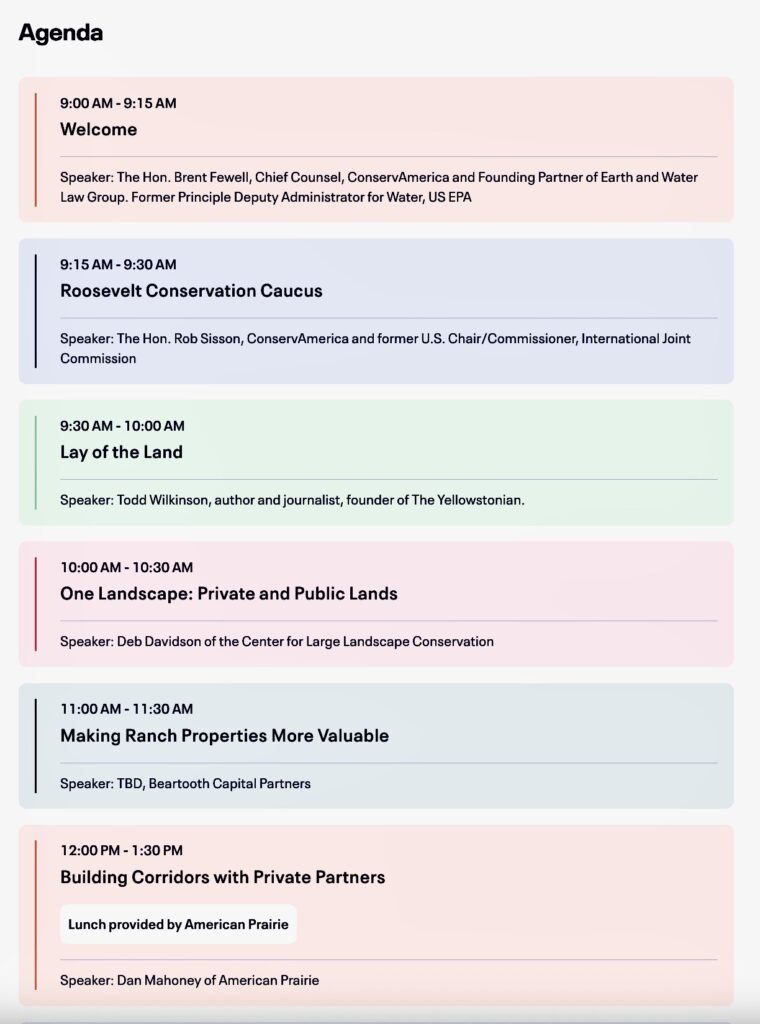
Agenda for ConservAmerica’s Aug. 28 conference “Private Lands & Wildlife Corridors: Best Ideas and Best Practices” being held in Livingston, Montana

President Richard Nixon delivered this message to Congress on the Environment Feb. 8, 1972. Video courtesy Nixon Presidential Library