by Todd Wilkinson
A groundswell of wildlife conservation organizations, landowners, citizens, scientists, tribes and scholars are rallying behind the efforts of American Prairie, which recently had its legally-held grazing rights on Bureau of Land Management allotments in Montana cancelled as a way to prevent it from running bison instead of cattle.
The much-anticipated decision was announced by the BLM in early May and backed by Interior Secretary Doug Burgum, who claims the Taylor Grazing Act of 1934 only permits “production for-profit” grazing of livestock on federal BLM allotments.
Last week, American Prairie issued a statement condemning the revocation of its leases, which it has held for 20 years. “This final decision by the BLM makes it clear that this is an all-out attack on conservation. It is a textbook example of the government moving the goal posts and changing the rules in the middle of the game to reach a predetermined outcome,” said Mary Cochenour, attorney for American Prairie. “There have been no grazing violations, and the administrative record contains objective evidence showing that rangeland conditions have improved over the last two decades with bison on the landscape.”
On June 4, the public interest conservation law firm, EarthJustice and its attorneys Jenny Harbine and Emma Shahabi, together with Cochenour, filed a formal appeal to the US Interior Department’s Office of Hearings and Appeals. And then, on Monday, June 8, Western Watersheds through attorneys Peter Frost and Sarah McMillan with the Western Environmental Law Center filed a separate appeal to the same office. American Prairie also plans to file a challenge to the BLM’s ruling in federal district court.
“This final decision by the BLM makes it clear that this is an all-out attack on conservation. It is a textbook example of the government moving the goal posts and changing the rules in the middle of the game to reach a predetermined outcome. There have been no grazing violations, and the administrative record contains objective evidence showing that rangeland conditions have improved over the last two decades with bison on the landscape.”
—Mary Cochenour, attorney for American Prairie
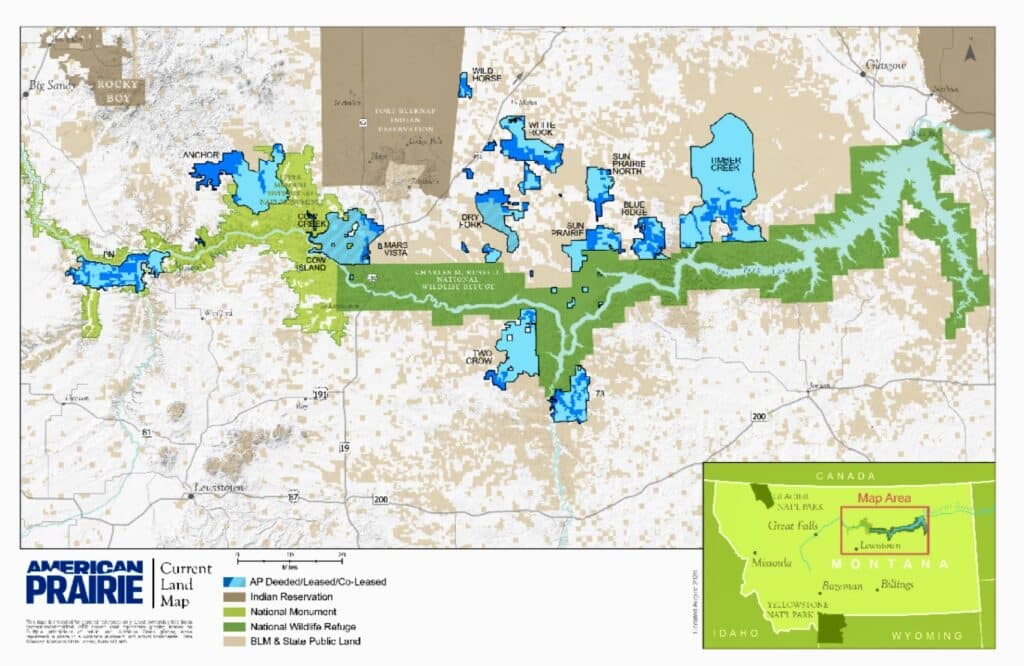
In 2022 during the Biden Administration the BLM approved American Prairie’s desire to use its 63,500 acres on seven allotments to run around 900 bison, but it faced opposition from some landowners and Montana Gov. Greg Gianforte who have claimed it was “federal overreach” that would lead to the ruination of cattle ranching culture.
Bison in Montana are by law officially classified as livestock. Because American Prairie is managing its animals for conservation purposes—to advance the restoration of biodiversity on the prairie—and does not send animals to the commercial meat market, Burgum claims American Prairie does not meet the letter of the law. His decision was cheered by Gianforte.
“We have always said that the law is clear: grazing permits under the Taylor Grazing Act are for domestic livestock production, not for creating a massive nature reserve that displaces families who have stewarded this land for generations,” the governor said in an earlier statement. “I am grateful the agency has taken a hard look at the facts and corrected this error. We must ensure that public lands remain accessible and productive, rather than being locked away for the vision of special interests.”
Bison, whether in a public herd or privately owned, are America’s official national mammal and one of this country’s truest wildlife icons, admired around the world. In and near the places where American Prairie’s dream of creating a three-million-acre preserve for native species, famous artists like Karl Bodmer and Charles M. Russell painted wild bison before they were eliminated and, as a species, pushed to the brink of extinction. They are as closely tied to the mystique of Montana as its mountains. In fact, the Charles M. Russell National Wildlife Refuge, flanking the famed Missouri (River) Breaks is a neighbor.
Critics of Gianforte, who re-presents “re-wilding” almost as a kind of environmental wu-wu, accuse him of engaging in political hackery. They say he is shamelessly trying to exploit wording in an antiquated law to defy common sense, innovation, modernity and even free-market principles of property rights. They also note that the decision is about more than American Prairie and bison, but a a power-play attempt to cement cattle grazing on hundreds of millions of acres in the West as a top priority on federal land.
Burgum, they say, is relegating considerations about conservation, safeguarding imperiled species, promoting co-existence with carnivores, and acknowledging that social values have shifted, to second tier status.
“This decision abandons decades of consistent federal policy and extends far beyond American Prairie,” said Alison Fox, American Prairie’s CEO. “By reversing decades of precedent, BLM is creating uncertainty for tribal buffalo restoration, conservation partnerships, and public lands grazing management nationwide. The agency’s action is arbitrary, shortsighted, and contrary to its own longstanding interpretation of federal grazing law.”
Many are standing beside American Prairie not only in support of its mission which has been likened to an idea as bold as Yellowstone Park’s creation in 1872, but because it is also viewed as a litmus test issue, part of the Trump Administration’ ongoing push to overturn or weaken environmental laws and gut land management agencies in what represents an unprecedented negative domino effect.
In Montana, US Sens. Steve Daines and Tim Sheehy as well as Congressmen Ryan Zinke and Troy Downing have sided against American Prairie.
Western Watersheds Project said the BLM action defies decades of settled law, and contradicts the agency’s own prior decisions.”BLM’s new interpretation has no basis in law and contradicts its own findings,” said attorney Frost. “BLM reversed itself due to politics, not the law, nor the need to restore prairie grasslands.”
Indeed, Western Watersheds claims the US Forest Service defines livestock under the Taylor Grazing Act as “…animals of any kind kept or raised for [any] use or pleasure.”
In the other appeal brought on behalf of American Prairie, EarthJustice implies (seemingly bemusingly) that the BLM is confused or perhaps doesn’t understand the very words—”production” and “livestock” it amateurishly uses to try and re-promulgate a new interpretation of the Taylor Grazing Act.
The EarthJustice brief states: “The apparent source of BLM’s new ‘production’ requirement is a convoluted parsing of dictionary definitions. To arrive at its decision, BLM split the closed compound into two words—’live’ and ‘stock’—and consulted Black’s Law Dictionary to define the word ‘stock’ as ‘a merchant’s goods that are kept for sale or trade.’ 2026 Final Decision at 3 (citing Black’s Law Dictionary (12th ed. 2024)). But BLM’s acrobatics were unnecessary, because Black’s Law Dictionary provides a definition of the whole word ‘livestock’ as it appears in the Taylor Grazing Act. In Black’s, ‘livestock’ means ‘[f]arm animals; specifically, domestic animals and fowls that (1) are kept for profit or pleasure, (2) can normally be confined within the boundaries without seriously impairing their utility, and (3) do not normally intrude on others’ land in such a way as to harm the land or growing crops.’ Black’s Law Dictionary (12th ed. 2024) (defining ‘livestock’). While BLM declined to reference this definition, ‘livestock’ is not limited to animals raised exclusively for production, undermining BLM’s interpretation.”
BLM’s 2022 decision found that privately-owned bison are domestic livestock under the Taylor Grazing Act, the Federal Land Policy and Management Act, and the Multiple-Use Sustained Yield Act—a conclusion consistent with Montana state law, which consistently treated American Prairie’s bison herd as “livestock,” by levying taxes and imposing disease testing requirements, litigants note.
According to Montana state legislators Tyson Running Wolf (Blackfeet) and Tom France, the negative implications of Burgum’s move reach deep into Indian Country. In a joint essay for Writers on the Range, they claim it is an attempt to stymie the restoration bison to the plains with the most visible exponents being tribes, more than 50 in all, that now building or hope to start herds. They’ve also been part of movement to someday bring back free-ranging public herds. Running Wolf and France say American Prairie, which is located near the Fort Belknap and Fort Peck native communitie, that has received bison from Yellowstone, has provided both technical expertise and buffalo to tribes. They say the US government violated established treaty rights by not consulting with them.
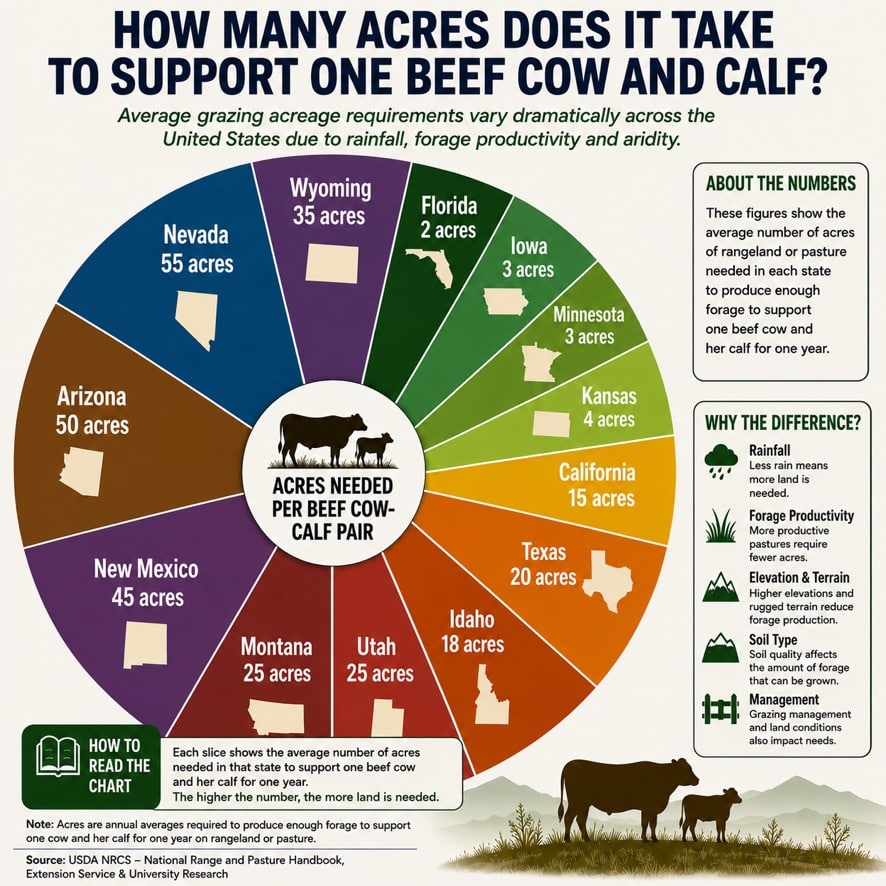
Public lands livestock grazing is one of the industries most heavily subsidized by taxpayer dollars in America and no other industry has wielded more influence over public land management in the West. Some of the opponents of American Prairie have received huge amounts of public subsidies. In the arid West, it takes 10 times more acreage to support the beefing up of a cow and calf pair in Montana than Florida and the acreage increases in states where average temperature rises.
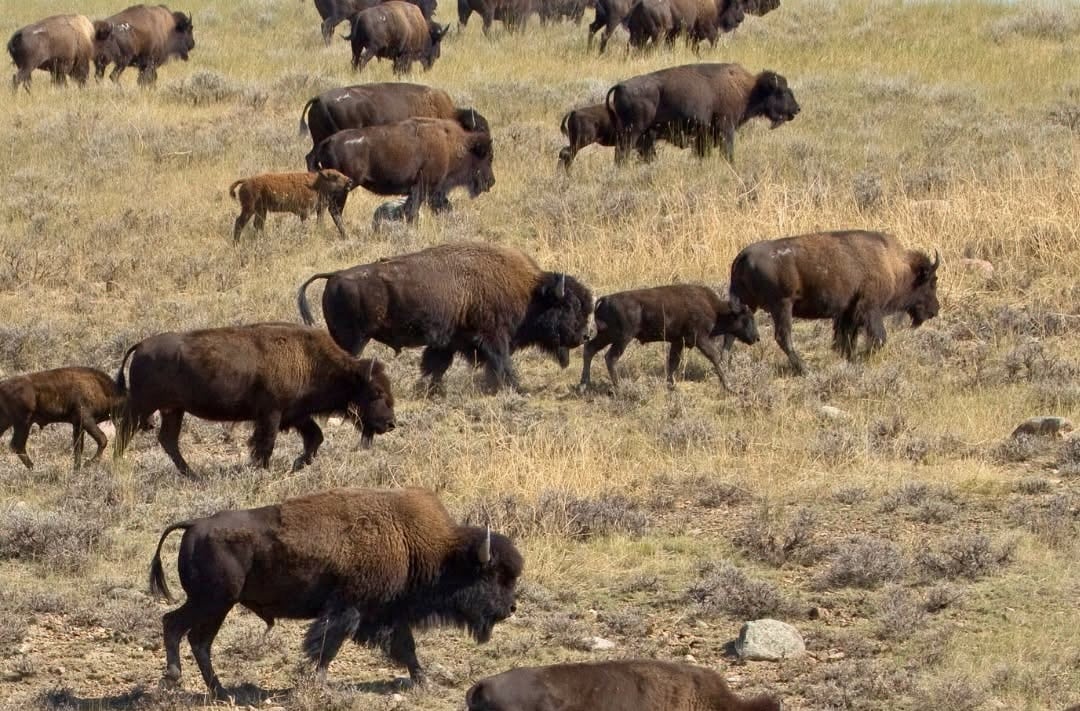
The presence of cattle have often come at the expense of native species, and while the cattle industry says that its animal can achieve the same kind of positive grazing benefits as bison, proponents of bison say they are hardier than cattle, are resistant to predators, do not generally require water being diverted out of streams to grow alfalfa, and, despite claims, can be can contained inside perimeter fences. A prime example are the bison operations of the late Ted Turner.
“The Trump administration’s revocation of these bison grazing permits is beyond bizarre because bison evolved with High Plains ecosystems and are better for land health, better for wildlife, and better for the public than cattle,” said Erik Molvar, executive director of Western Watersheds Project. “Tribes also have bison herds for cultural, ecological, and subsistence purposes, which this permit revocation would threaten if it went through.”
In 2022 after American Prairie won approval to use its allotments for bison, Montana Attorney General Austin Knudsen and the Montana Stockgrowers Association mounted a challenge. EarthJustice defended American Prairie. At the time, Pete Geddes, American Prairie’s vice president and chief external relations officer, said: “We’ve heard from thousands of people; hunters, small businesses, biologists, Native Americans, and citizens across Montana who share a commonly held view that bison have a right to graze and restore the health of our nation’s public lands. That’s why we plan to defend the Bureau of Land Management’s grazing decision.”
Geddes stated then that American Prairie had confidence the BLM would be consistent in exercising its authority to approve bison grazing. “By getting involved, we aim to create more opportunities for future generations of Montanans to access and explore our shared public lands and to protect the public’s right to legally restore native wildlife,” he said.
Attorney General Knudsen praised the Trump Administration’s recent action. He stated in a press release: “The decision by the Trump Administration to cancel the American Prairie Reserve’s bison grazing permit is a huge victory for Montana farmers and ranchers. As someone who grew up farming and ranching in Northeast Montana, I know how important this decision is to protect the hardworking livestock and ranching communities in that region and keep the elitists from destroying their livelihood.”
Meanwhile, Montana Stockgrowers Association President Lesley Robinson, who runs the Lazy JD Cattle Co, a commercial cow/calf and yearling operation, with her husband, Jim, near Dodson, sounded applause, too. She’s been an outspoken critic of American Prairie. Once a Phillips County commissioner, Robinson ran on the same ticket with gubernatorial candidate Gianforte in 2016 to be lieutenant governor but they were defeated by Democrats Steve Bullock and Mike Cooney.
After Robinson was elected to be president of the Stockgrowers in 2020, she described the challenges facing ranching: “Some of issues we face today were most likely on the agenda in 1884 when [the Montana Stockgrowers Association) was organized. We have been hosting meetings across the state listening to producers directly to find out what challenges they face. Estate taxes and estate planning came to the top over and over. Other things like simplification of government programs that available to ranchers, obstacles for new ranchers just starting out or trying to expand and generational transfers were spoken of often,” she wrote. “With all the dispersions happening across the state and the nation it’s important to keep agricultural land in production and ranchers in business. More and more people are understanding the importance of it for the health of the land, wildlife and communities. I look forward to…continuing our work on all the issues that affect ranching while building relationships with other ag groups and agencies.”
In its appeal, American Prairie addressed some myths, namely that it is opposed to having fences to contain animals or that it is, somehow, anti-cattle. In a statement, it says, “American Prairie emphasized that its bison herd currently stands at around 940 animals, and the program has operated under rigorous management standards, including fencing, disease testing, and coordination with neighboring landowners and agencies. At the same time, the organization works directly with local cattle producers, leasing the majority of its land, more than 500,000 acres to 25 ranching families who run approximately 8,000 head of cattle.” Yes, it has allowed neighbors to lease its deeded lands as places to graze their cattle.
Ag is lifeblood of local communities and their cultural identity. No one I spoke with disputes this or was unsympathetic to the plight of rural America. However, within the large scheme of things, how Gianforte, Knudsen and Robinson can claim American Prairie’s raising of bison on BLM land is destroying the livelihoods of farmers and ranchers, or represents an existential threat to the accessibility of private cattle to public land grazing, or that it is resulting in large sweeps of public lands being “locked away” from cattle growers, is a mystery lathered in rhetoric but not substance.
Consider: In addition to privately-owned ranchlands, the BLM in Montana and the Dakotas makes 8.3 million acres available for livestock grazing. Montana allows an additional 4.2 million acres to be available on its state trust lands for grazing and agricultural purposes. And then there are millions of acres of grazing allotments on national forests in the state. The Malta, Montana office of the BLM administers more than one million acres as grazing allotments in Phillips County, where American Prairie is located, meaning that its 63,500 acres of allotments are barely a blip within the state of Montana and a fraction even in the county.
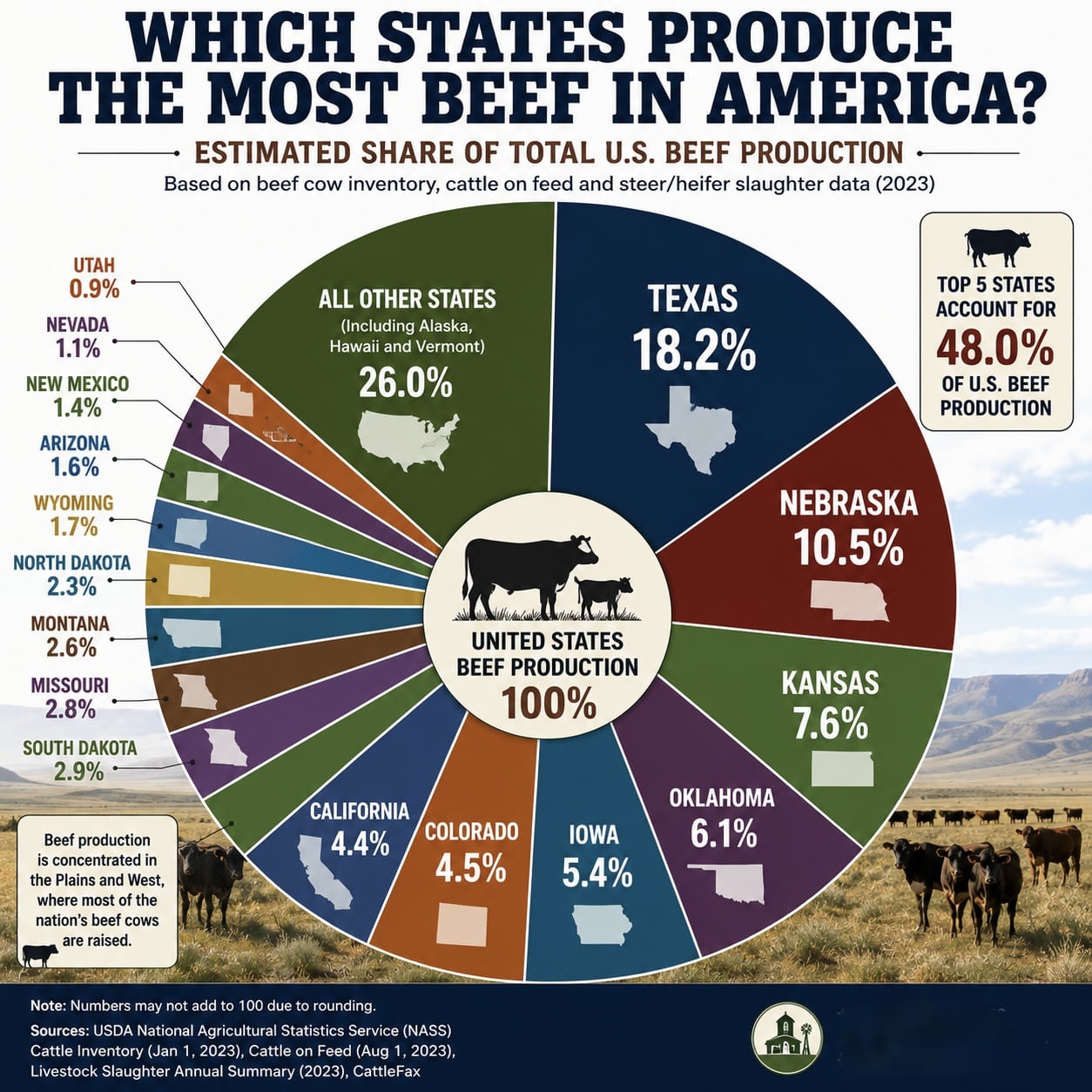
That’s a lot of public space in a big state devoted to producing just 2.3 percent of the nation’s beef supply—and done with huge reliance on taxpayer subsidies, at a cost to native species and to the exclusion of the original keystone grazer.
Western Watersheds and its legal team say a Congressional Research Service report published January 22, 2026, further underscores the weakness of the Trump Administration’s position, noting that 88 percent of BLM grazing authorizations are for cattle, yearlings, and bison, and reaffirming the longstanding Interior Department conclusion that bison qualify as livestock under the Taylor Grazing Act.
“The political origins of this reversal are clear,” Molvar stated. “As reported by Public Domain, the 2022 bison grazing decision was appealed by ranching groups represented by Karen Budd-Falen—now one of the highest ranking officials at the Department of Interior. Further, Sec. Burgum personally intervened to direct BLM to reconsider, ultimately producing the outcome Budd-Falen’s former clients sought.”
The permit revocation, he predicts, is the first step in a broader effort to lock cattle and sheep interests into permanent dominance over public lands grazing—just days following the decision, the agency released proposed grazing regulations containing the same “production-oriented” requirement. If finalized, those rules would frustrate and obstruct the restoration of bison on public lands on 155 million acres across the western US.
Western Environmental Law Center and Western Watersheds Project say they will pursue all available administrative remedies and, if necessary, file suit to prevent the unlawful eviction of bison from these public lands.
Burgum and Gianforte often resort to the term “federal overreach” in describing the BLM’s earlier approval of native bison having a place, albeit as “livestock” on public land. Does the term also apply to the generous federal subsidies, including below market value grazing rates for cow and calf pairs—about $1.69 per Animal Unit Month—charged by the BLM? These are rates that haven’t substantially changed in the nearly 100 years since the Taylor Grazing Act of 1934 became law.
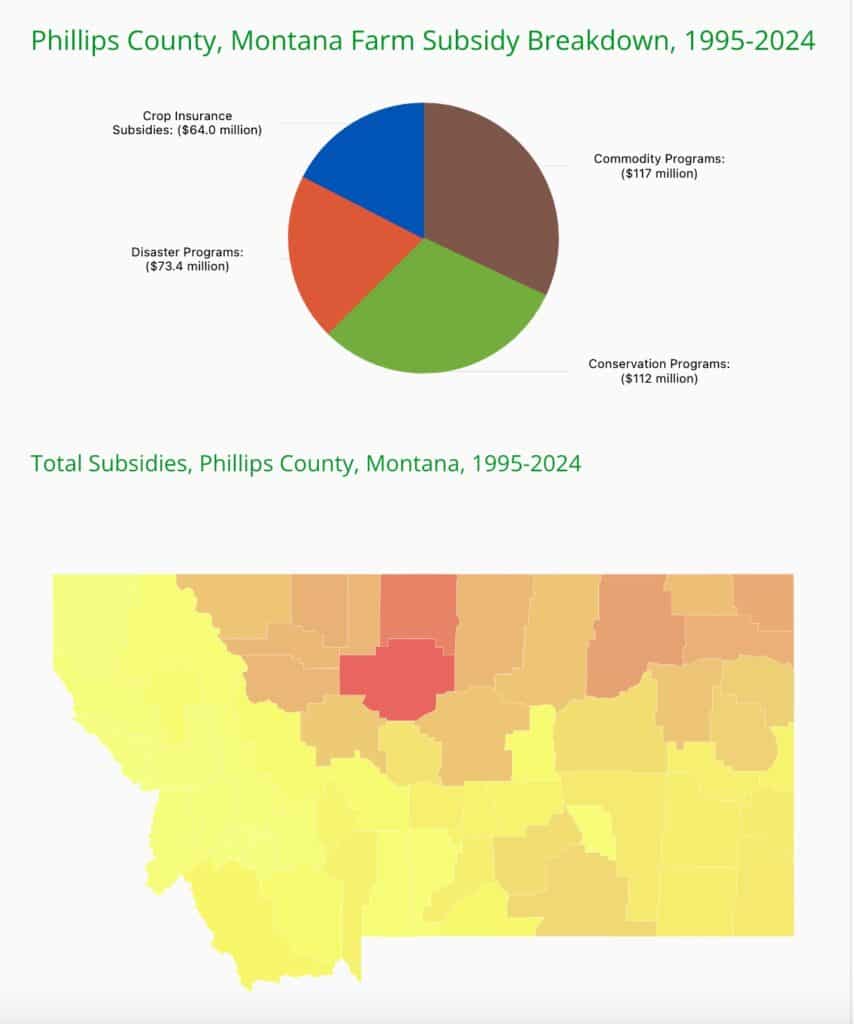
The public-interest conversation organization, Environmental Working Group, has for more than 30 years assembled a national database, drawn from official government agency statistics, that tracks federal agricultural subsidies down to the granular county level. Between 1995 and 2024, EWG says farmers and ranchers in Phillips County, identified in red below, received $366.8 million in federal subsidies through a wide variety of payments. See graphic below.
During that three decade window, American Prairie received a total of $308,223. Several major critics of American Prairie, who have claimed it is a drain to local communities, have taken home, in some cases, two, three, four or more times that amount in taxpayer subsidies. The amount individual producers receive can be viewed by clicking here. It does not account for the full range of government services. After you arrive at the link, find the search feature at top upper right of page and type in a local zip code, property owner or name of ranch.