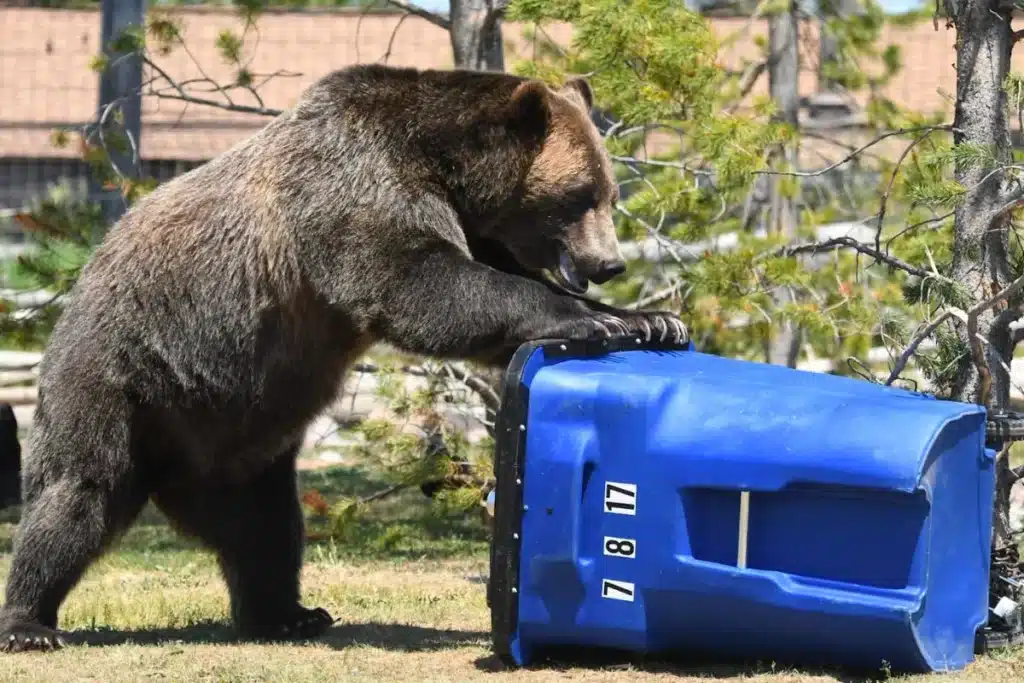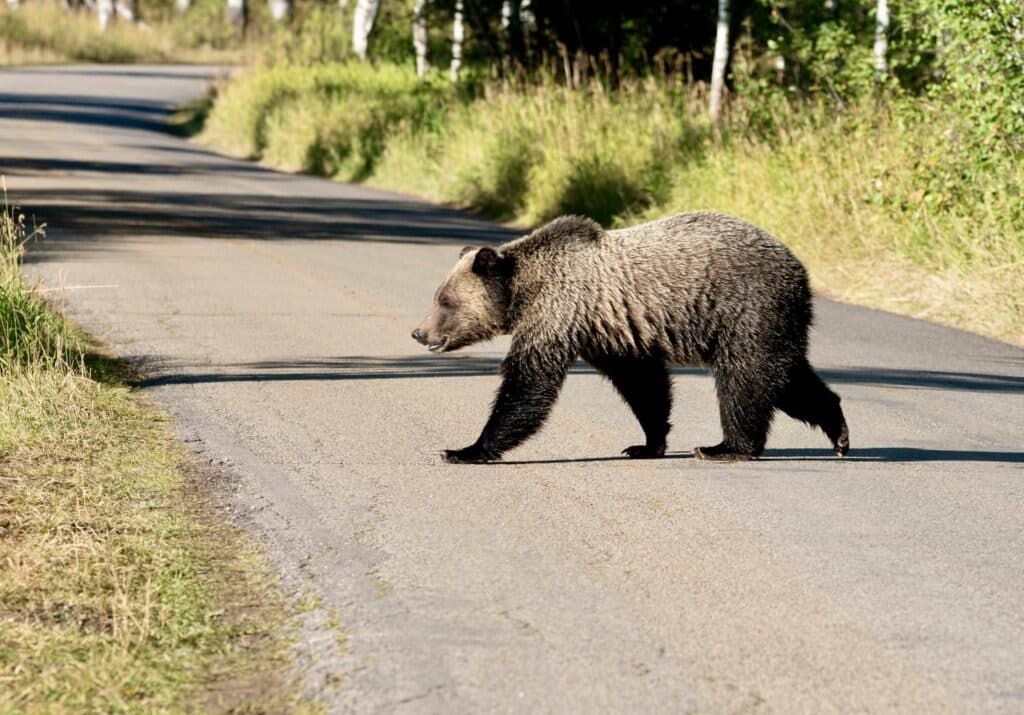
by Todd Wilkinson
Few Americans will ever have a federal law named after them. In the case of Canyon Mansfield, catalyst for one such code, it’s a teenage memory which spurred legislation that he tries every day to forget.
“Canyon’s Law,” introduced as a bill in both the US House and Senate—and blockaded each time by Western partisans in Congress—is not a source of pride for young Mr. Mansfield, but pain and trauma.
Nine years ago, while the-then 14-year old was out frolicking with the family Labrador, Kasey, on federal Bureau of Land Management land near their backyard in Pocatello, Idaho, he and his pet encountered what is colloquially called a “cyanide bomb,” also known as an “anti-predator device,” “coyote-getter,” or simply an “M-44.”
By any description, the strangely-enticing contraption is ultra lethal, and Canyon had never encountered one before on the hillside he often roamed. There were no warning signs that day, no notification and more importantly, experts say, no compelling reason for it to be there.
M-44s are a weapon employees and affiliates of the federal agency, Wildlife Services—a unit within the US Department of Agriculture’s Animal and Plant Health Inspection Service (APHIS)—have long used to kill coyotes, foxes, bobcats and other wildlife species that might possibly prey on domestic livestock.
This “tool” has been widely deployed on public and private land in Western states, and for a couple of years its use has been restricted—in part because of public outrage generated from a notorious incident involving Canyon and Kasey. Likely, however, many readers here have never heard of M-44s.
On March 16, 2017, Canyon Mansfield saw something protruding from the ground that he took to be some kind of out-of-place sprinkler head. When he inspected it, an orange powder erupted, getting into his eyes, on his clothes and into the face of his canine companion. It was sodium cyanide, a toxic chemical used by the mining industry to extract gold and silver but also effective as a “pesticide.”
As Canyon’s eyes burned, he rushed to a pile of snow and tried to wash out the agent. He also called for Kasey but heard the dog whimpering before quickly going into convulsions. The animal he considered his best friend died in his arms.
By dint of a miracle, Canyon’s contact with the poison in the M-44, illegally planted on a ridge by a government trapper within full view of his house, did not kill him, nor his father, Mark, a family physician, who arrived on the scene and intended to try and revive the canine. Canyon’s mother, Theresa, not long afterward, told me the whole family was devastated.
As Canyon’s eyes burned, he rushed to a pile of snow and tried to wash out the agent. He also called for Kasey but heard the dog whimpering before quickly going into convulsions. The animal he considered his best friend died in his arms. By dint of a miracle, Canyon’s contact with the poison in the M-44, illegally planted on a ridge by a government trapper within full view of his house, did not kill him, nor his father, Mark, a family physician.
Between then and today, the push to get M-44s permanently banned in the US, bolstered by support from members of Congress, law enforcement officials and a wide range of scientists and wildlife conservationists gave rise to the writing of legislation named after Mark and Theresa Mansfield’s son. Canyon’s Law was first introduced by US Rep. Peter DeFazio, D-Ore., who served in Congress until 2023 and did not seek-re-election.
M-44s are a favorite of some livestock operators because of their ability to make unwanted public wildlife go away, but there’s a wariness among government trappers assigned to handle them because one false move and there can be mortal consequences. After the Canyon Mansfield incident, which put a human face on an issue Wildlife Services was skilled at evading, the use of M-44s is supposed to be prohibited everywhere in Idaho. In three other states—California, Oregon and Washington— voters enacted resolutions outlawing M-44s on private and public land within their borders.
During the Biden Administration, the federal BLM with Montanan Tracy Stone Manning at the helm announced that it was forbidding use of M-44s on all of its 245 million acres and restrictions were supposed to be in place on other federal public lands. M-44s are illegal in national parks and wildlife refuges. The US Environmental Protection Agency, during the first Trump Administration and under pressure to more tightly regulate it, identified two dozen conditions that must be met in order for M-44s can be deployed.
All of these things, implemented over resistance from the livestock industry and allied lawmakers, were considered momentous incremental progress, according to Brooks Fahy, executive director of an Oregon-based conservation group Predator Defense that has been pushing to reform predator control in the US for 35 years along with a coalition of allied organizations representing millions of Americans.
But now, he says, a quiet push is being made behind the scenes by the Trump Administration, using arcane procedural maneuvers and encouraged by livestock interests in the West, that could allow M-44s to be deployed again on a purely discretionary basis. They still are not banned on national forests.
Now a quiet push is being made behind the scenes by the Trump Administration, using arcane procedural maneuvers and encouraged by livestock interests in the West, that could allow M-44s to be deployed again on a purely discretionary basis.
Fahy says early this year he heard rumors that overturning the ban on BLM land was being considered but could not get them confirmed because of an atmosphere of fear inside federal agencies. In early May, after weeks of inquiries he obtained a digital copy of a Memorandum of Understanding reached between the BLM and Wildlife Services. The document’s existence was not announced on public platforms per usual protocol.
Where once M-44s seemed to be fading into history as crude relics of a human war waged against nature—along with other controversial biocides invented earlier to kill public wildlife maligned by the livestock industry—the MOU “appears to be an attempt to allow M-44s to be put back into use again,” he said.
Yellowstonian attempted but did not reach a spokesperson for either the Interior and Agriculture Departments nor BLM to get a comment. But an Interior official told reporter Jimmy Tobias on the Substack site Public Domain the drafting of the MOU is not necessarily an actionable document—an assertion Fahy says challenges reason and warrants rigorous scrutiny.
“Why else would an MOU even be written if there wasn’t an intent—an ulterior motive—in mind?” he asks. “And why would certain lawmakers and the livestock industry respond so instantly favorably and not appear surprised it was being considered?”
According to Fahy and others, the Administrative move to bring M-44s back fits within a larger pattern of Trump Administration maneuvers to roll back regulations pertaining to land, water, wildlife protection and even public safety. Likely, Fahy believes, the rationale pertaining to M-44s is that it would give the BLM, which oversees the most federal public land grazed by private livestock in the US, and Wildlife Services cover because otherwise officials sanctioning its use, as well as field personnel deploying the cyanide bombs, would be in violation of federal law.
M-44s, because of the high danger level associated with exposure to sodium cyanide, has a menacing reputation. Sodium cyanide is the same chemical that American cult leader Jim Jones put into a soft drink and served in mass to his disciples in Guyana in 1978, killing over 900. It is supposed to be tightly regulated pursuant to the Federal Insecticide, Fungicide, and Rodenticide Act (FIFRA) and by the EPA, the latter describing sodium cyanide as “highly toxic to warm-blooded animals” and places it in the highest category of chemicals of concern. The federal Centers for Disease Control and Prevention posts warnings about exposure.
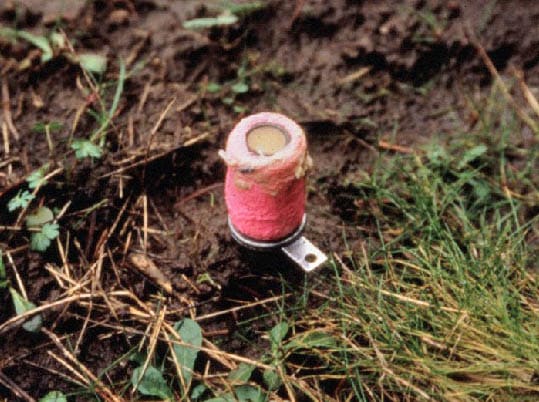
Remarkably, M-44s are easy to deploy and favored because the contact-to-kill rate is high and, by tradition, they don’t require a lot of intensive human resources to manage. To set up an M-44, a small pipe is driven into the ground and loaded with an ejector holding a sodium cyanide capsule. The top of the ejector is wrapped with an absorbent material coated with scented bait to attract animals. When a curious creature pulls on this material, a spring ejects the sodium cyanide into their mouth and face, and they suffer an agonizing death often accompanied by seizure.
“M-44s have a notorious reputation not only because of their lethality but how they’ve been deployed in predator control,” Fahy explains. “They are installed on public and private land, and left unattended with the hope that a ‘target’ animal is attracted to the scent. But M-44s do not discriminate in who or what comes in contact, as the instance with Canyon Mansfield and his dog, Kasey, demonstrates. Anything that wanders upon an M-44 can die and records, as incomplete as they are, show how thousands upon thousands of non-target species, including bears, wolves, mountain lions, eagles, wolverines and thousands of dogs have been killed.” A comprehensive timeline of efforts to ban M-44s can be found here.
Lisa Robertson, co-founder of Jackson Hole-based Wyoming Untrapped, which has called attention to the legacy of biocides in her state, pressed for justice in the Cody Roberts case, tried to have the practice of snowmobilers running down coyotes and wolves outlawed, sought to eliminate coyote killing derbies and has advocated hard for prohibiting leghold traps and snares especially from areas near hiking trails. She also has called out the hazards of M-44s. Less than a week before the Mansfield case, two family pets were killed near Casper, Wyoming when, while in the presence of their human owners, stumbled upon an M-44 100 yards inside the boundary of private land.
“The Wyoming public has previously taken action to remove these cyanide bombs that kill and endanger people, pets and wildlife from our landscapes. Legalizing M-44s again is unconscionable,” Robertson says. “Wyoming is one of the most dangerous landscapes for wildlife, littered with human-caused hazards. We expect a big public pushback on this.”
Interior Department officials insist that resurrecting expanded use of M-44s would come replete with full public disclosure and review, per provisions of the National Environmental Policy Act (NEPA) and other statutes like the Endangered Species Act. Fahy says there’s no need to explore whether M-44s are dangerous or not because evidence already proves that’s the case. It’s why restrictions are in place and Canyon’s Law exists as proposed legislation to ban M-44s entirely.
The idea that the Administration will allow NEPA to fulfill its mission as a shield and watchdog for protecting the public interest, Fahy says, is farcical. So, too, he says, is the promise that M-44s will be carefully used so as not to result in the death of species protected under the ESA. Since the dawn of the Trump Administration’s second term in 2025, both Interior Secretary Doug Burgum, Agriculture Secretary Brooke Rollins and other political appointees, including Forest Service Chief Tom Schultz, have openly boasted of how they, using forms of executive authority, have removed NEPA compliance regulations pertaining to a list of multiple use activities on public lands by up to 85 percent. The Administration and its free-market allies, acting on behalf of extractive industries, are also trying to “reform” the ESA to weaken the “take” provision that punishes companies or individuals for “accidentally” killing protected animals.
In addition, Fahy notes, due to actions carried out by the short-lived tenure of the Department of Government Efficiency (DOGE) headed by Elon Musk and backed by those cabinet secretaries above and members of Congress, the ranks of career civil servants in a number of land management agencies, including APHIS, have been reduced by firings or veterans pressured into early retirements.
“People in those agencies who might otherwise raise objection to what is being potentially planned for M-44s are gone,” Fahy says. “On so many issues in so many agencies, those who have remained are afraid to speak up or they’ve sworn allegiance to the whims of this Administration, vowing, in order to keep their job, to make sure anything their superiors propose gets implemented, whether its moral, ethical and adheres to the law or not. That does not bode well for the public interest.”
“People in those agencies who might otherwise raise objection to what is being potentially planned for M-44s are gone. On so many issues in so many agencies, those who have remained are afraid to speak up or they’ve sworn allegiance to the whims of this Administration, vowing, in order to keep their job, to make sure anything their superiors propose gets implemented, whether its moral, ethical and adheres to the law or not. That does not bode well for the public interest.”
—Brooks Fahy
Back in 2017, shortly after the M-44 incident in Pocatello, Idaho, I wrote one of the first lengthy stories about what happened to Canyon Mansfield and Kasey for National Geographic and the story went viral. I’ve been writing about predator control since the 1990s. Canyon, who is today 23, and I spoke again this week. He is now a junior at the University of Utah in Salt Lake City pursuing a degree in cinematography and animation, hoping to make films about issues important to society.
He’s worried that what happened to him and Kasey could occur again and again if M-44s make a comeback. During the last decade, Canyon has received quite a lesson in participatory American civics and how truth-telling is thwarted in service to political agendas and economic self-interest. Twice he has traveled to Washington DC and met with members of Congressional delegations. Sometimes, staffers hearing his story about Kasey, have been moved to tears.
His parents, Mark and Theresa, who never set out to be activists, took up the cause of trying to bring reform to predator control, making trips with Fahy to testify and while they’re praised for their courage and tenacity, it’s a cause that has left worn them out. Their saga is featured in the documentary Lethal Control by Jamie Drysdale. You can watch it at the end of this story and read an interview between Drysdale and animal behaviorist Dr. Mark Bekoff, published in journal Psychology Today.
A long list of groups stand with Predator Defense at the forefront of trying to reform predator control in the US. They include the Center for Biological Diversity, Western Watersheds, Animal Wellness Action, Project Coyote, Footloose Montana, Trap Free Montana, Wyoming Untrapped, Wildlife for All, Wyoming Wildlife Advocates, WildEarth Guardians, Gallatin Wildlife Association, Wilderness Watch, Wolves of the Rockies, Public Employees for Environmental Responsibility, Endangered Species Coalition, Alliance for the Wild Rockies, Washington Wildlife First, Apex Protection Project, Mountain Lion Foundation, Wolf Conservation Center, Yellowstone to Uintas Connection, Humane World for Animals (formerly the Humane Society of the US), Environmental Information Protection Center, Voices of Wildlife, Friends of the Clearwater, Nevada Wildlife Alliance, Northeast Oregon Ecosystems, National Coalition to End Wildlife Killing Contests, Western Wildlife Conservancy, Klamath Forest Alliance, Animal Welfare Institute, Western Environmental Law Center and the renowned conservation law firm, EarthJustice.
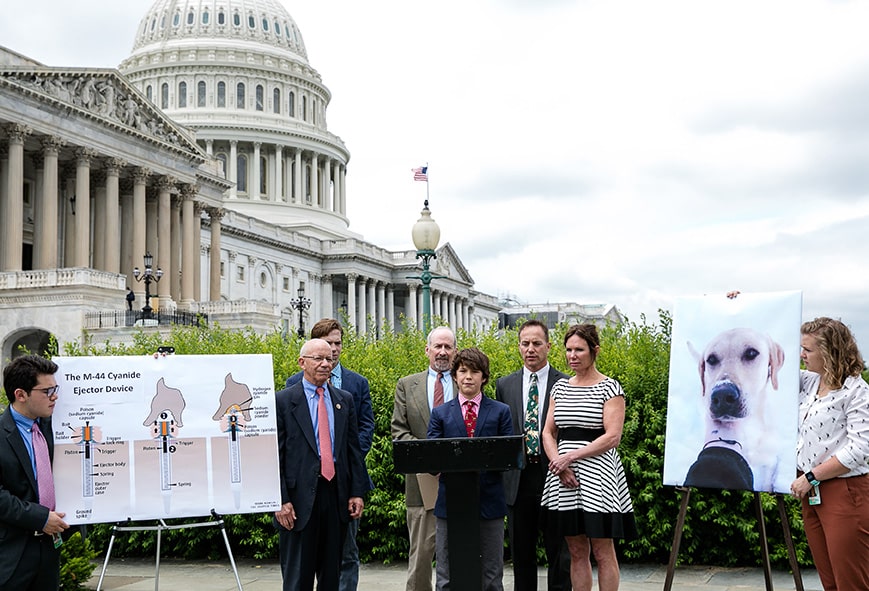
Two different petitions, one submitted to the Forest Service and another to the BLM to prohibit M-44s were signed on by 60 and 70 different groups, respectively. Playing a key role in helping to organize the groundswell has been Collette Adkins, carnivore conservation program director at the Center for Biological Diversity, and wildlife biologist Erik Molvar, executive director of Western Watersheds Project.
“I consider the Mansfields to be reluctant heroes and Canyon to be an exceptional, conscientious young man,” Fahy says. “They were your typical Northern Rockies family loving the great outdoors. They didn’t go looking for trouble, Heartbreak found them in of all places, near their own backyard, on federal public land, that should be safe welcoming places. They lost their golden lab, but they just as easily could have lost their son and now the Trump Administration seems prepared to re-authorize use of these risky deadly gadgets that should be banned.”
Noteworthy is that prior to the tragedy involving Kasey and related close call with Canyon and Mark Mansfield attending to the dog, Wildlife Services routinely resisted claims that M-44s were a serious threat to human health and pets in need of total prohibition. The agency insisted personnel were acting responsibly, that they kept the public well informed and their people were accountable.
Yet for decades, as this journalist can attest, Wildlife Services and its parent, APHIS, have been less than forthcoming with statistics and acknowledging that predator control campaigns often are carried out with little scrutiny and oversight. A common complaint is that some representatives are rogue. Fahy has a file cabinet full of cases, which never reach public light, in which people narrowly escaped death by M-44s and dogs died. If the public has heard of Wildlife Services at all, it is because it plays a key role in controlling bird populations to prevent strikes with aircraft at commercial airports and assists in prevention of wildlife diseases like rabies.
When I wrote the story for National Geographic in 2017 and interviewed a member of the local sheriff’s office in Bannock County, Idaho, he said law enforcement had no idea that M-44s were being placed in areas close to residential areas and expressed anger.
A panel assembled in 2019 by APHIS/Wildlife Services to conduct a peer-review analysis of M-44s concluded there are no problems with the devices. That same year, the Trump Administration’s EPA announced more than two dozen new mandates for M-44 deployment. Four of the rules were that M-44s cannot be placed within 600 feet of a private residence, except if, on a private property, the landowner allows it. Secondly, the distance from public paths and roads where M-44s can be used was increased from 100 feet to 300 feet. Third is a requirement of two elevated warning signs, in English and Spanish, that face the two most likely directions of approach, within 15 feet of M-44 devices. Back then, only one sign was required, at a distance of 25 feet from the device. Fourth is that M-44s are not supposed to be set on public lands where recreation occurs.
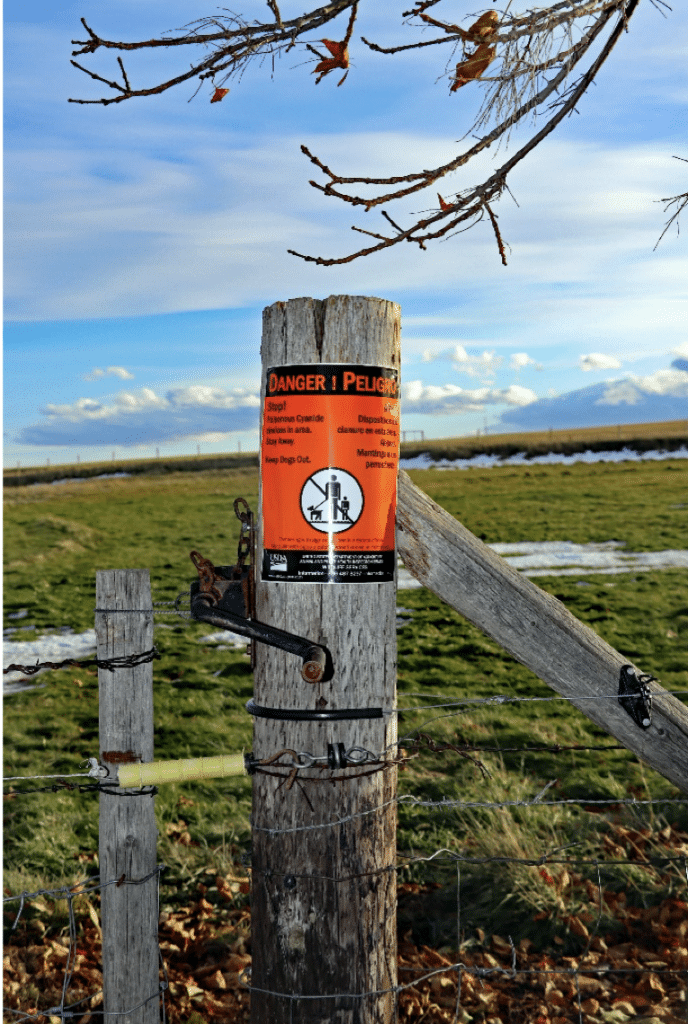
Incredulous, Fahy says public lands are frequented by lots of people who walk off trail and might miss signs, plus dogs don’t read, nor do non-target imperiled wildlife baited into the scent.
The Mansfields’ dog, Kasey, died around 300 yards away from their home. Critics say the loom of lethality doesn’t go away with those EPA advisements, that they are arbitrary and that better signage, and relying upon land users to see it and read it, is like saying, “Danger, you, your children or your dog may unsuspectingly encounter unattended loaded firearms in this field. Do not touch.” Warning citizens to stay off public lands in order to avoid deadly contraptions enables special interests to essentially privatize them and kill public wildlife that the public values as part of healthy ecosystems.
Fahy also claims EPA, which issued the recommendations, is nothing like it used to be even in 2019. A lot has changed in even the past year. “With M-44s, EPA is now the missing ingredient because it’s being dismantled. Can it be counted upon to do its job as a regulator when the whole point of this Administration has been to weaken its capability?” Fahy asked.
He went on, “As we’ve witnessed on a larger scale, it no longer acknowledges that carbon dioxide linked to the human burning of fossil fuels is a contributor to climate change that needs to be regulated. EPA isn’t alone in how it’s backing away from much-needed oversight of private industry. Any regulatory and enforcement agency has been gutted and leaders who were committed to accountability removed. Anyone sympathetic to conservation being an important institutional value, rivaling resource extraction, has been fired or encountered such hostile conditions that they have to leave.”
There’s an undeniable irony with the federal government wanting to greenlight more M-44s. Were a private citizen to lay out an ultra-lethal poison in a public space and leave it unattended with intent to cause harm to any living creature that happened upon it, they would be considered a terrorist and/or chastised for being grossly irresponsible, Fahy says.
That’s why other chemical biocides—Compound 1080, strychnine and earlier iterations of M-44s— were banned from federal lands through an executive order from President Nixon in 1972 after scientists demonstrated the toll they took on public wildlife and other unintended targets including pets.
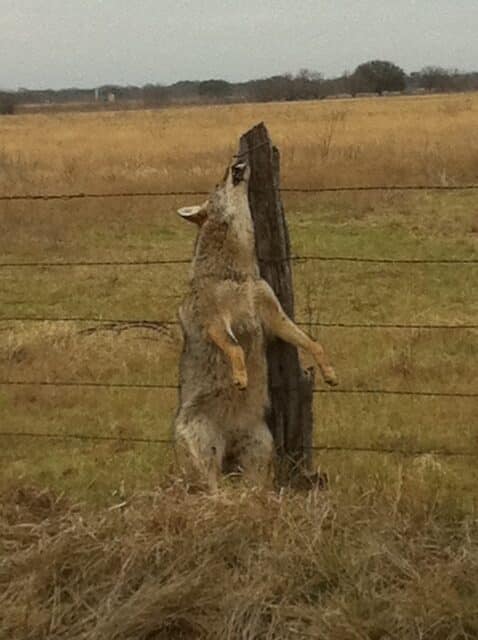
At the behest of the livestock industry, Compound 1080 and strychnine were scattered across the landscape in the form of millions of baits—sometimes poison layered into the carcasses of cattle, sheep and horses—intending to eradicate wolves and coyotes but they killed Bald and golden eagles, California Condors, black-footed ferrets, other raptors, bears, mountain lions, foxes, wolverines, Canada lynx and likely thousands of pet dogs in the decades after the end of World War II. They were major contributors to grizzly bears vanishing from much of their former range, the near-total elimination of wolves in the Lower 48 and, through poisoning of prairie dog towns, the near extinction of black-footed ferrets, the most imperiled land mammal in North America
But Compound 1080 and M-44s persisted. Compound 1080 was engineered into livestock collars worn primarily by sheep and if a predator bit the neck it was killed but it was a sloppy method. Wyoming, in particular over the years, has continuously fought restrictions on biocides aimed at killing carnivores.
The US Department of Agriculture estimates that over 200,000 sheep and lambs, and 40,000 cattle and lambs are lost to predators each year; the number one in the West being coyotes. It says that between three and four percent “of the total US sheep inventory” is killed by carnivores annually and in some areas predators allegedly accounted for a third to half of all losses. Nationwide, livestock losses to predators allegedly tally nearly $240 million each year, but many are speculative and not verified with hard evidence on the ground.
More than 60,000 coyotes are officially killed each year in the US via taxpayer-subsidized predator control and more for sport but experts who have investigated livestock losses say they are often exaggerated and studies by Fred Knowlton, Robert Crabtree of Bozeman and other ecologists show that coyote control paradoxically results in hardier expanding populations of Canis latrans.
Note: wolves and grizzlies rank far down the list of proven livestock killers. One study found that 97.6 percent of all cattle losses were not owed to wildlife predators but other causes including disease, sickness, old age, blizzards, drought, injury, eating poisonous plants, and feral dogs.
One of the keepers of data related to predator impacts and cited by Congress is the US Department of Agriculture’s National Agricultural Statistics Service. But its assessment of livestock loss is based on periodic, voluntary, nationwide-user surveys of farmers and ranchers. The take home message? There’s a huge incentive for producers, who don’t want any possible threat to exist from public wildlife to their livestock on public land, to inflate their losses and then use the figures to get sympathetic members of Congress to support more vigorous predator control. The reinforcing feedback loop earns elected officials votes. In essence, it’s created a self-serving dynamic where members of Congress are too afraid to speak the truth and challenge radical assertions they know are false. Lacking today is not access to facts but courage to speak them. It’s prevalent in nearly every aspect of politics. What the public wants—and needs—is leadership.
There’s a huge incentive for producers, who don’t want any possible threat to exist from public wildlife to their private livestock on public land, to inflate their losses and then use the figures to get sympathetic members of Congress to support more vigorous predator control. The reinforcing feedback loop of self-interest earns elected officials votes. In essence, it’s created a self-serving dynamic where members of Congress are too afraid to speak the truth and challenge assertions they know are false.
Randal O’Toole, a well-known conservative public policy expert, once did an audit of Wildlife Services (when it was called “Animal Damage Control”) for the Thoreau Institute and referred to the agency as a pork barrel project that benefits narrow special interests, especially a relatively small number of livestock producers that enjoy taxpayer subsidized privileges of grazing their private animals on public lands. He pointed out how the reporting system, as explained above, is deeply flawed. He said Wildlife Services needed to be shut down. “The only reason that the program continues is political: [It] is pork barrel. Although [its] constituency is tiny—fewer than 30,000 ranchers enjoy most of the benefits of the livestock program—Congress finds it easier to maintain wasteful programs than to cut any of them, no matter how tiny the constituency.”
Since 2000, estimates are that Wildlife Services has spent $1 billion on predator control, mostly in the West. Aerial gunning, which is the most expensive, can cost between $100 and $2000 per coyote killed. Wildlife Services needs clients. Agents have been known to volunteer to kill coyotes and other carnivores even if predation isn’t a problem. A common ploy, to justify predator control, has been to use photos of cattle and sheep fed upon by wolves, coyotes, lions and other animals in order to justify more killing. Some agrarians I’ve interviewed say they consider their lost animals to be just like members of their family—except that the livestock are being raised as commodities, to be loaded up on trucks and shipped to slaughterhouses.
Texas has arguably the most aggressive predator control program in the country and President Trump’s Agriculture Secretary Brooke Rollins, who has APHIS, Wildlife Services and the Forest Service under her command, hails from the Lone Star State. She also is behind the push to rescind the Forest Service Roadless Rule and remove protections from 43 million acres of national forest habitat important to wildlife. Rollins, an attorney who got a degree in “agricultural development” from Texas A & M, is a devoted advocate of free market policies and reduced federal regulation. She is not known for possessing a depth of knowledge about how wild ecosystems function. And, likely, she has little direct experience seeing with her own eyes the negative impacts of M-44s.
Wildlife Service veterans, now retired, aren’t surprised by any surreptitious efforts to bring back M-44s. US Sen. John Barrasso, one of those who has opposed Canyon’s Law, in 2024 co-authored a letter to the US Department of Agriculture with Congressman August Pfluger of Texas demanding that it roll back its ban on purchasing and deploying M-44s. They claims predators in Wyoming account for 47.3 percent of all sheep losses and said coyotes in fiscal year 2023 killed 1500 sheep in Montana. Co-signers of the letter include US Sens. Cynthia Lummis of Wyoming, Steve Daines of Montana, and Ted Cruz of Texas.
Recently, Barrasso issued a statement saying he applauds any move that allows M-44s to be put back into wider application. He claims they are valuable tools for cattle, sheep and goat growers. In Wyoming, wolves and coyotes can be killed by almost any means, 24 hours a day, 365 days a year in 85 percent of the state. They can be trapped, snared, shot from ground, gunned from airplanes and helicopters and poisoned. Animals, including pups, can be burned in their dens with gasoline and, as recent controversy has shown, they can even legally be run over with snowmobiles on both private and public land as long as they die.
In the wake of the Cody Roberts incident involving a young wolf that made international news, livestock officials and legislators in Wyoming used their power and influence to prevent the state from banning the widely condemned “sport” of using snowmobiles as weapons, which was strongly condemned by The Wildlife Society, whose membership includes the leading professional wildlife managers in America. State Rep. McKay Erickson of Afton (a small town in the southern reaches of Greater Yellowstone) called referred to the practice, without providing compelling evidence, as a necessary component of predator control.
“This M-44 cyanide bomb, set by the U.S. Department of Agriculture’s Wildlife Services program, stole a cherished member of my family, an irreplaceable piece of my son’s innocence, and my entire community’s sense of security…Canyon experienced excruciating headaches for over a month, all day and through the nights without relief for five weeks with nausea, vomiting, numbness in his hands, and crushing insomnia. We did everything we could to bring him comfort, but there are no tests for a sublethal dose of sodium cyanide and there is no effective treatment for the irreversible physical effects of cyanide poisoning, much less the accompanying emotional and psychological trauma.”
Mark Mansfield, MD, family physician and father of Canyon Mansfield in Congressional testimony
Carter Niemeyer was a professional predator control agent and is author of two books that offer an insider’s perspective. He says predator control has a valid purpose and is needed, but lethal application should be surgical. What exists today he describes as “gross overkill.” If Wyoming sheep growers really are suffering such high losses from predators, which he doubts, then producers ought to consider being in a different business because plenty of techniques and effective non-lethal tools exist to reduce losses. The idea that a suite of species—native carnivores—should be indiscriminately killed on vast sweeps of public land in order to boost profits for private interests is wrong, he says.
Niemeyer insists that describing M-44s as being essential for livestock protection, as Barrasso and the livestock industry imply, given the myriad ways to kill predators already at their disposal, is absurd. Congress could appreciably benefit producers not by pushing for expanded use of M-44s but investing more on non-lethal services, including guard dogs, electric fencing, fladry and demanding more vigilance. Read recent story by Ben Goldfarb in High County News.
The fact that Barrasso is a medical doctor, who should be an advocate for public and ecological health, makes his position even more spurious, he notes. Rhetorical question: has the senator ever, doctor to doctor, father to father, conservative to conservative, had a chat with Mark Mansfield? Has Barrasso ever ground-truth his political assertions by listening to a career predator control specialist, known for being very good at his job, like Carter Niemeyer?
“I spent decades supervising government trappers who used M-44s,” explains Niemeyer, who retired from the agency after being a district supervisor for Wildlife Services in Montana and had worked on predator control teams in other states. “They [M-44s] are totally unnecessary. When I say this country does not need sodium cyanide in its arsenal of predator-killing methods, it is from first-hand experience. Many trappers refuse to use them, for fear of what could happen. They know that if their dog triggered one, they were dead. Personally speaking, I couldn’t sleep at night if I still had an M-44 out. I don’t believe M-44s should ever be used on public lands. If farmers and ranchers insist they be used on their private lands, then the legacy responsibility for any indiscriminate death falls on their heads. But ideally, these devices should stay part of the past, as they have no place in a modern humane world.”
“M-44s are totally unnecessary. When I say this country does not need sodium cyanide in its arsenal of predator-killing methods, it is from first-hand experience. Many trappers refuse to use them, for fear of what could happen. They know that if their dog triggered one, they were dead. Personally speaking, I couldn’t sleep at night if I still had an M-44 out. I don’t believe M-44s should ever be used on public lands…ideally, these devices should stay part of the past, as they have no place in a modern humane world.”
—Carter Niemeyer who spent a quarter century as a specialist on the front lines of taxpayer-subsidized predator control which has killed millions of animals to make the West safe for livestock
To the points of Fahy and Niemeyer, at the same time the Trump Administration is opening the door for more investment in, and wider use of, M-44s, budget cuts are hobbling the field monitoring capabilities of Wildlife Services.
Fahy, who over the years has received death threats related to his wildlife advocacy, asserts that trying to bring change, when mythology seems to be valued more than science, statistics and common sense in the halls of power, can bring not only fatigue but cynicism.
No one understands that better than former Congressman DeFazio of Oregon, the longest serving House member in that state’s history. DeFazio was a force in the US House of Representatives from 1987 to January 2023 and admits that he became frustrated at dysfunction that has come to permeate that legislative body. He authored the first iteration of “Canyon’s Law.”
Its latest was made in 2023 by US Rep. Jared Huffman of Calif., who serves as minority chair on the House Resources Committee. All to no avail, with Congressional Republicans not only stymying full public debate involving independent scientists and objective analysis but allowing it to go to a vote.
In a letter to the House Natural Resources Committee Chair Huffman, Fahy cited APHIS/Wildlife Services statistics reporting that 246,985 animals, many of them non-target species, were known to have been killed by M-44s between the years 2000 and 2016, including at least 1,182 dogs. “The number of non-target animals that have been killed by Wildlife Services’ M-44s is completely unacceptable given the ineffectiveness of this form of predator control, the availability of alternatives, and the ecological harm associated with haphazardly killing wildlife,” he wrote. “These incidents, though shocking, only reveal part of the problem. APHIS reports are often incomplete, notably missing data concerning deaths of domestic animals, pets and livestock known to have occurred during the reporting period.”
Controversy surrounding M-44s, however is just part of a multi- decades’ battle waged by conservation and animal rights groups to halt or restrict the activities of Wildlife Services that has existed as an organized division of the federal government for almost a century. It formalized what had existed since the late 19th century as an effort by the livestock industry in the West to eradicate any native wildlife that posed a threat to non-native cattle and sheep on millions of acres of public land. The same mentality viewed bison as unwanted competitors for grass.
Fahy started advocating against M-44 use as a citizen, the same age as Canyon Mansfield is today, during the Reagan administration. “Reagan was the one who brought back M-44s after their prior banning in 1972, via an executive order by Richard Nixon,” he says, adding that former U.S. Senator Mark Hatfield, an Oregon Republican, was against the use of poisons, like M-44s, for control of predators. In the early 1980s his team enlisted Fahy to help him champion a successful nonlethal proposal in Oregon- that made the case for federal funding to launch one of the first livestock guard dog programs in the US.
DeFazio says America has gone backwards in its approach to wildlife management—in particular with how it approaches carnivores—wolves, bears, mountain lions, coyotes, bobcats and others. Much progress was made in using non-lethal approaches to protecting livestock but the Trump Administration and several states, especially those in the Northern Rockies, restored predator control that does not conform to the standards of professional wildlife management. Bringing back bounties, allowing liberal and almost unlimited killing of wolves.
In all, prioritizing commercial livestock production led to the near total elimination of wolves, bears, mountain lions, bison and other species. “It’s as if, with this Administration and some Western states, we’ve gone back to the bad old days of the 1930s,” DeFazio said.
DeFazio explains how the issue first crossed his radar screen. Back in the early 1980s, while serving as a Lane County Commissioner in Oregon, he and other elected officials were contending with declining timber revenues. As a consequence, they reviewed all budget items and one of them was spending on predator control. Lane County encompasses the city of Eugene and reaches across agricultural lands to the coast.
“We reviewed every expenditure line by line and one of them involved county payments to the federal agency known today as Wildlife Services but it was known in those days as Animal Damage Control,” he said. “We said we couldn’t afford to keep paying a special subsidy to kill wildlife on behalf of ranchers and farmers. We told livestock producers that if they want to protect their sheep and cattle then invest in special cattle and sheep dogs or take other measures. A few sheep ranchers predicted horrible predation problems and said they’d lose hundreds of lambs and be driven out of business. Do you know what happened? Nothing. The predation did not go up and this was 50 years ago. The public should not be subsidizing the killing of public wildlife, especially on public lands, in order to protect private interests. And it definitely shouldn’t paying for horrible things like M-44s.”
Evading public disclosure about M-44s and other government agency actions during the Trump Administration fits within a larger pattern involving lack of transparency and accountability—something highlighted by Christina Bromley Bruner who served in the US Interior Department of Interior’s Office of Solicitor General, a watchdog on corrupt activity. She delivered a keynote address in Jackson Hole at Northern Rockies Conservation Cooperative’s Conservation Symposium.
Fear permeates federal agencies. Longtime career civil servants are worried they will be fired if they express concern about policies they believe violate their legal, ethical and moral job responsibilities. This includes speaking with the public. Following the purge of federal workers carried out by the short-lived Department of Government Efficiency and political appointees that resulted, within some agencies upwards of a third of workers being terminated, the Trump Administration has created a new culture in which loyalty is demonstrated through carrying out questionable activity, complicity or silence.
“The Trump Administration might say they are being responsible by touting a checklist of two dozen different things an agent of Wildlife Services needs to do before putting out an M-44, but it’s a logistical nightmare and there are so many added uncontrolled variables, including more people and their pets being out on public lands,” Niemeyer said. “Sometimes predator control is needed. When done responsibly, it can withstand honest scrutiny and minimize the toll on non-target species but it needs to be predictable. Using M-44s is the opposite of that. It’s why Wildlife Services field personnel, if they’re allowed to be honest, don’t want to have anything to do with them. And it raises the question of if bad things happen, and they will—and god help us if it’s a human who gets killed—then who should be held responsible?”
Niemeyer says M-44s, in addition to killing a person, can kill cattle or any large creature and he says it’s certain that if M-44s are sanctioned for use in range inhabited by grizzly bears and wolverines and Canada lynx and Bald and golden eagles and California Condors and black-footed ferrets (though M-44s are banned from use in prairie dog colonies), all of those animals will become casualties.
Regulatory agencies refer to M-44s as a “pesticide” but it is an anodyne word that cloaks the level of danger, Fahy says. He doesn’t trust Wildlife Services nor the agencies like BLM enlisting its services. President Trump’s selection to head the BLM, former New Mexico Congressman Steve Pearce, has been a vocal proponent of allowing more aggressive predator control.
“The guidance they [Wildlife Services and land management agencies] provide for using M-44s didn’t mean anything before and now especially it doesn’t mean anything. It’s a bunch of gibberish procedurally,” Fahy says. ” What matters most is that there’s no clear motivation for why the return of M-44s is even being considered when the debate has been settled for years and there is no compelling justification. Warning flags abound. As former Congressman DeFazio says, “it is only a matter of time before a person dies as a result of coming in contact with M-44s.”
Adds Niemeyer, “Why this is even an issue is nonsensical.”
After Canyon Mansfield watched Kasey die, he has struggled with sleep problems, nightmares, migraine headaches and tinges of guilt for taking his dog to the same place where they bonded and never anticipating what might await them there.
I asked him what he has learned from interacting with elected officials who are supposed to be leading two of the most consequential and deliberative law-making bodies in the world. “I hope our nation’s actions can restore my previous faith in our society, that we can trust the people we put in office will represent public safety and our shared interest,” he said, sounding as wise as any adult three times his age. “Their mission is protecting American people, but their actions don’t match what they say. When I think about it, it just leaves me sad.”
ENDNOTE: Jamie Drysdale’s documentary, Lethal Control, about the Canyon Mansfield tragedy in losing his dog also dramatically explores the deeper questions surrounding M-44s. You can watch it below.