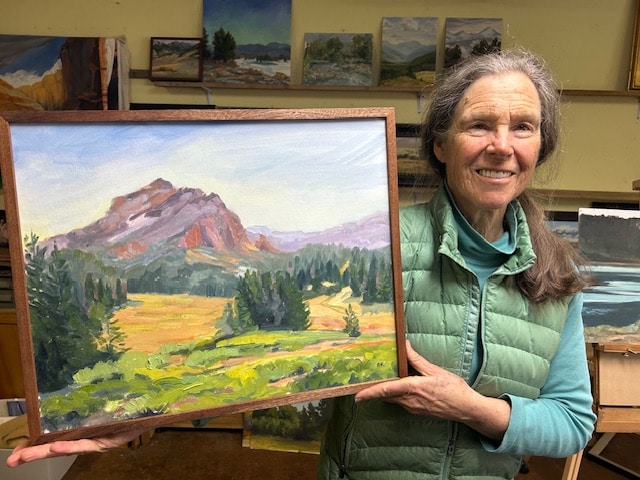
EDITOR’S NOTE: Natural beauty is undeniable, and, at the same time, landscapes without their leaving, breathing parts are vacant. Barbara Rusmore’s solo exhibition “Of Space and Timeless Places” runs from May through Summer Solstice at the Myrna Loy Center in Helena, Montana. Based on her visits to wild places throughout the Northern Rockies across decades, Rusmore, a Bozeman resident, hopes the mix of plein air and studio pieces will remind viewers what’s at risk of being lost. In the essay below, she writes about her inspiration. Reflecting on her careers as a conservation organizer, she has, as a painter, highlighted places protected on public and private lands. To get a taste of that, you can also read this piece I wrote in 2019. Thanks to Montana writer Beverly Maglee for assisting in putting this package together. Rusmore was a 2022 inductee into the Montana Outdoor Hall of Fame. For fun, check out the roster of inductees over the years. —Todd Wilkinson
By Barbara Rusmore
Painting provides the chance to just do nothing but observe and engage with a landscape in a nonverbal way. Everywhere I look I see beauty in living things. Nature is a refuge for me; you could say that it’s like an altar.
I used to slip out the window when I was a kid, oh yeah, and I always loved getting out early to see how the day was. My window swung open all the way from the ceiling; when you were a kiddo in bed, you could climb right out and nobody would know you’d gone.
Painting gives you license to sit there and look, and then to take a brush and load it up with some medium and then take your whole arm and just start working the whole canvas. My first teacher would say nothing is precious or perfect and that’s what taught me to love to paint. She taught me that the process is what was important, more than what the painting came out to be.
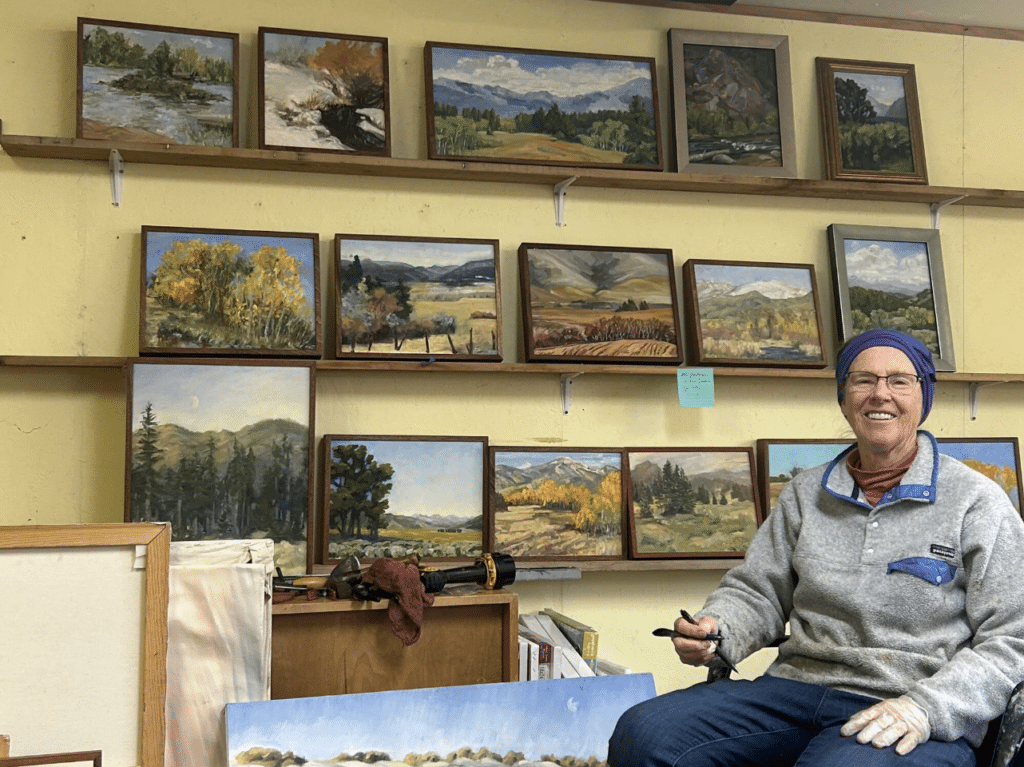
The cool thing about landscape painting is it’s just about every color you could think of. I like to start my paintings with a little bit of a sketch-out just to get some proportional feelings, like, what’s the relationship of the sky took to the ground to the mountains to the water? What’s going on here? I take some colors and load up the brushes and just start making shapes with colors. Some are very light paint and turn out a color or an idea of what connotes the feeling of the place rather than it being an exact replica but usually people can say “oh yeah, that looks like a swamp,” “oh nice, trees,” so usually I can tell when I like it right away. It’s a puzzle and sometimes it’s beautiful. That is not guaranteed most of the time. What’s true is that when it’s beautiful, it’s because I stopped trying to make it beautiful.
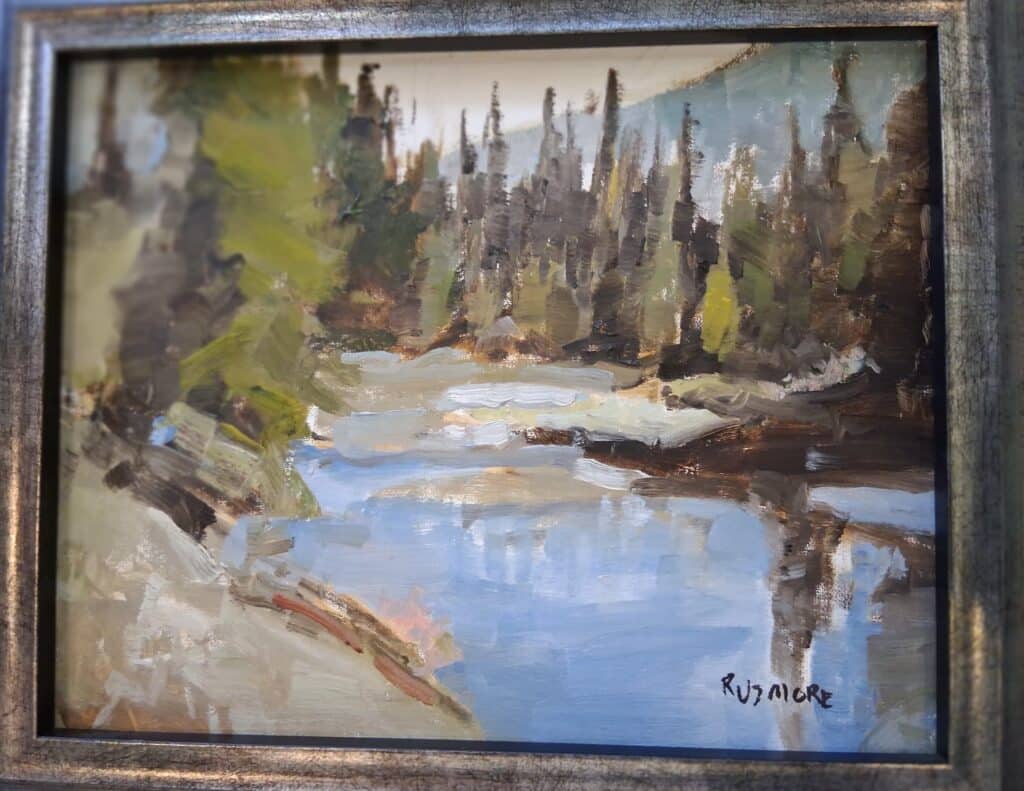
There’s a rhythmic thing that happens with the brush in the canvas, in the oils, and it’s kind of like a jigsaw puzzle except that all the pieces aren’t there—you have to make them up.
Shadows are underappreciated. Shadows give us a sense of place because shadows mean shape; something is taking place here that blocks the light from this other place, so it’s about paying attention to the tic-tac-toe of light. It’s part of what makes a painting interesting as opposed to making it clearly a tree. You know, making a perfect rendition of this swamp that we’re sitting here looking at, it would drive me freaking crazy, but I can imagine painting this, cattails and all, but it might not be the same place that you thought you were looking at.
I’m grateful that I grew up in the San Francisco Bay area at a time when there were some wild painters out there. Oh yeah, you can do this kind of painting or you can do that kind of painting so that the paint is a conversation with whomever is looking at it, so for one person it’ll mean sort of the same or it might be wildly different. It’s really simple: ABC. Apply Brush to Canvas.
Ann Hogle was one of my wonderful teachers. She commended a lot of other artists for their expression and willingness to step outside the boundaries.
I spent a lot of time running western rivers, especially on research trips in the Grand Canyon. I was fortunate to be at river campsites for 3 to 5 days. Oh my God, do you know what a gift that is? I could take my canvas and my paints and go hiking. I made a couple of pretty interesting paintings then.
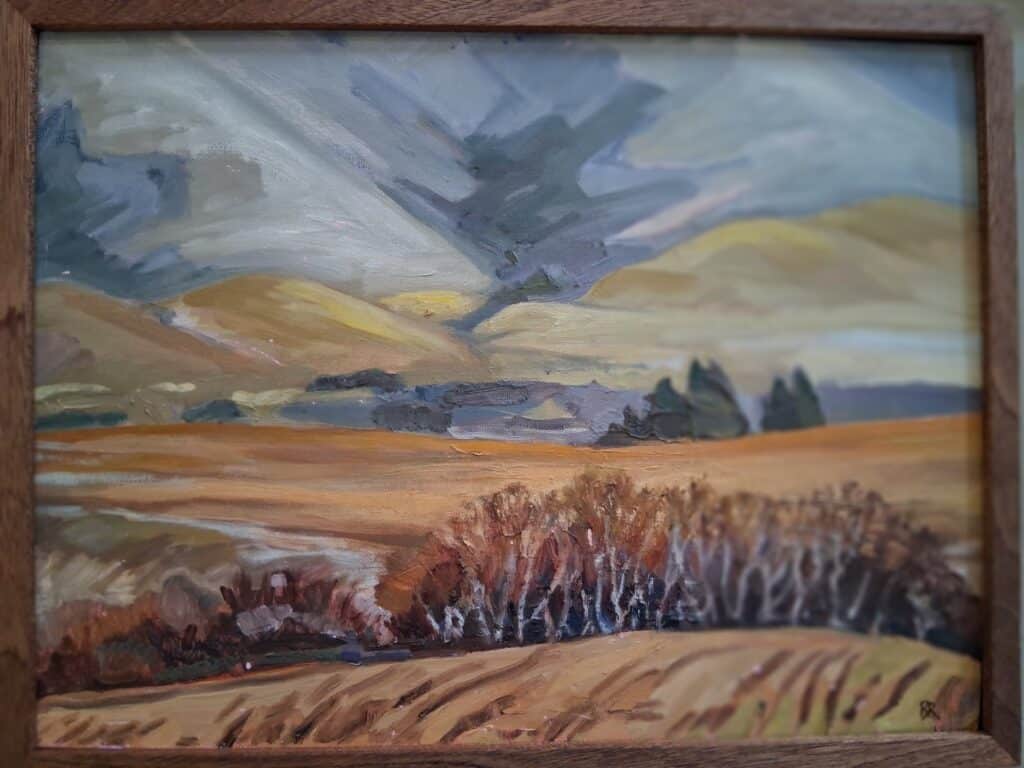
Paintings have many different origins. One started out as a study for a multigenerational ranching family near Canyon Ferry. The area is starting to get built up and so they were working on putting together a conservation easement, and they ultimately did quite a nice job of that. They asked me to do a painting of their ranch and I chose this particular view because it has black light in there, it shows the tension between conservation and art, and the fact that there are too many of us. This family’s fourth generation is now on this place and they love it dearly so I was honored that they asked me to do this painting. These whitish marks are the backs of sheep. The gate leads to the farmhouse that’s out of sight. This is what I like about painting. It doesn’t have to be perfect. This family uses really good conservation practices, living on the land in a way that is durable over time.
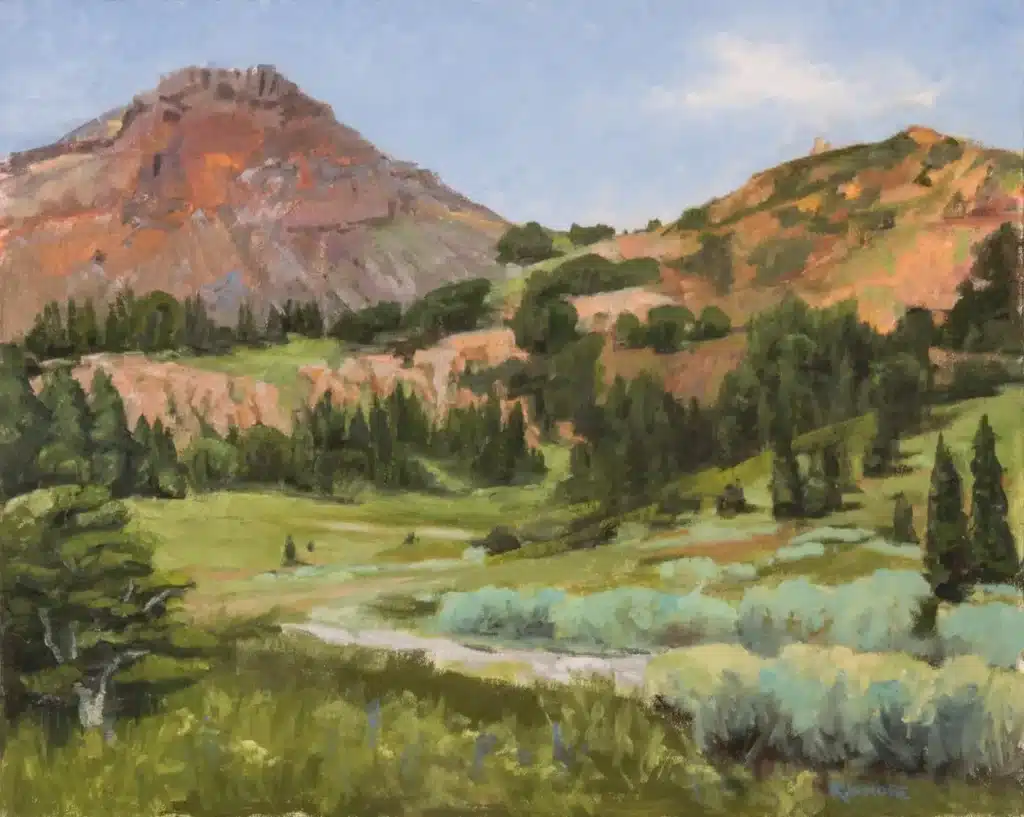
Another work was really important to me because it’s where a gold mining project was proposed and this exact place is where the mining equipment would have been stored in a giant paved parking lot. We camped here in this pristine meadow to recharge and reinvigorate after working so hard to protect the Beartooths.
The sheer open beauty of that valley just takes you away out of yourself. It’s a great place to watch animals because they also love it. It’s a very nurturing site in many ways for us and for the critters. What are the bison doing up here in the mountains? Somebody thought they could be safe here in the park when millions of bison were being slaughtered outside the park. They are an extremely adaptive, durable animal. We wouldn’t have that opportunity to save a speices if it weren’t for public land, a valuable central component of our democracy.
“Never say never” because it just might be a good idea.
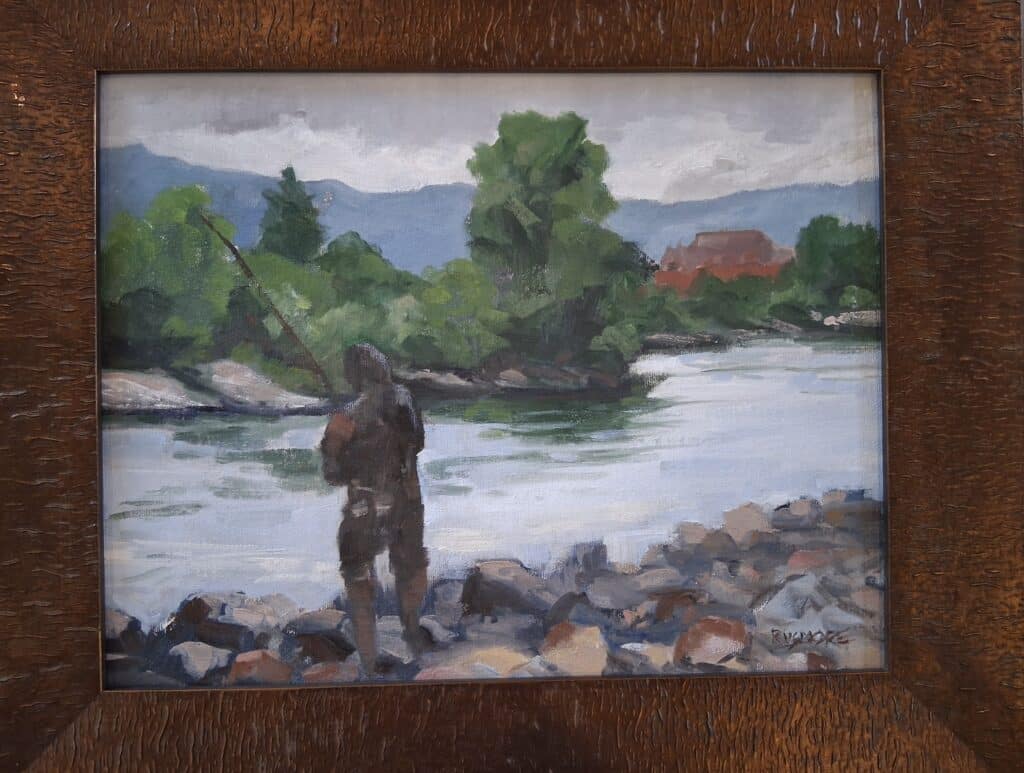
Some works make me laugh because of their hidden virtues. You think it’s out someplace in the wonderful wild, right? Oh my God, look at that view, look at those colors look at that big sky. All these absolutely gorgeous colors — warm, hot, bright yellow, oranges, and then you have deep purple and blue sky out there above Baldy Mountain.
But I wasn’t in the wild. I was out hiking urban trails in the middle of Bozeman and saw this so I ran home for my easel and came back and set up just four feet from the sidewalk, near a parking lot. Beauty reigns anywhere if you look for it.
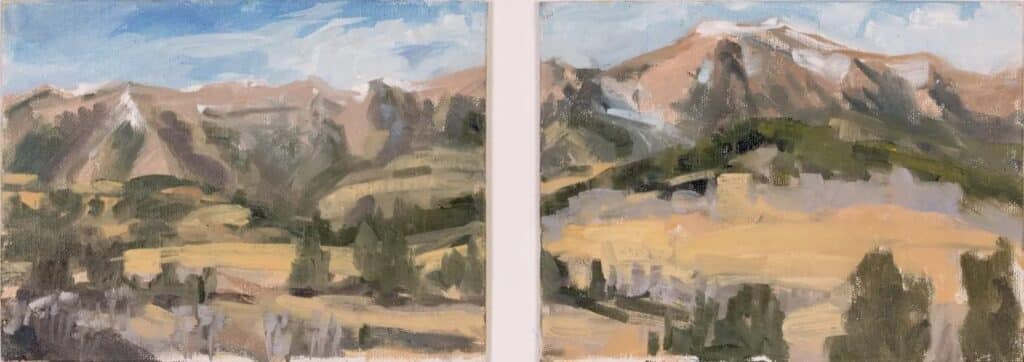
You know this is a plein air landscape because you can see those fast fast brush strokes where I had to get it on the canvas before the light went. Plein-air painters have to grapple with so much because you don’t have much time, you’re huddled under an umbrella or getting bitten by bugs or freezing your feet. You know what I mean, it’s a nut thing to do, but why not, it’s the classic plein air tradition, you see something you like, you stop, you put up an easel and just get after it.
There’s a transition between observation and the kind of dynamic shape and color that you see in this painting. There’s a long tradition, going back, you could say, to people in the cave marking things like little shamanistic leopards. I think that there is the desire to represent a meaningful place or a meaningful animal that is part of our physiology and so it matters to paint a mural on the wall.
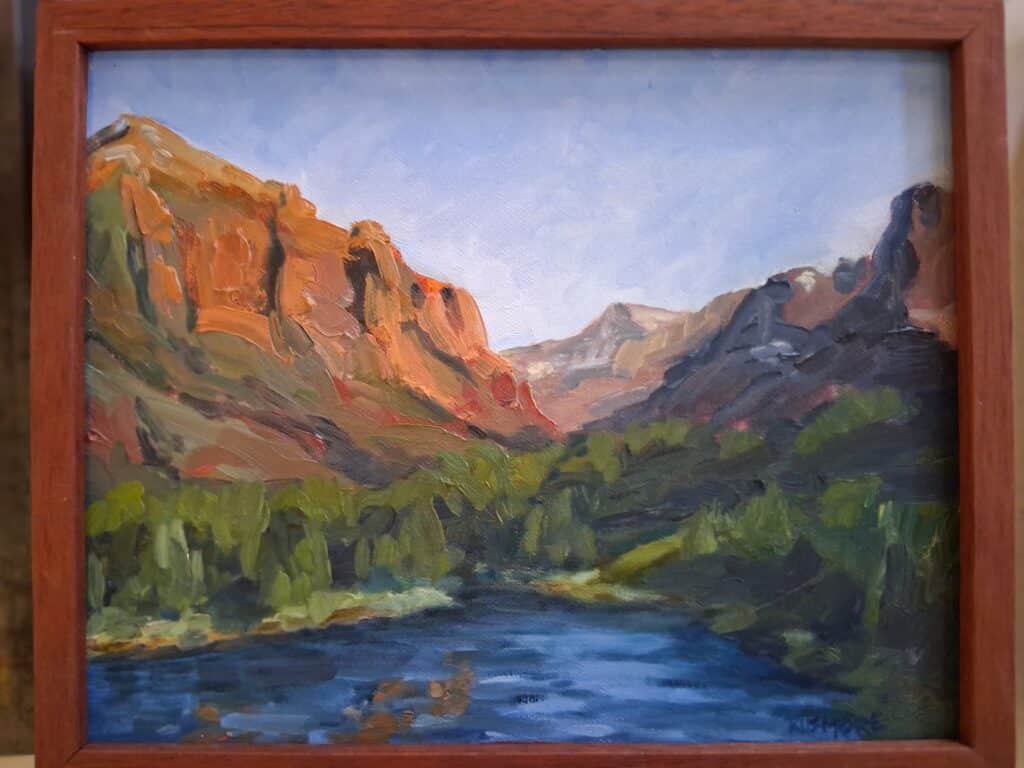
I was awarded an opportunity from the Forest Service to go stay along Granite Creek on the edge of Glacier Park. The Forest Service has a rickety cabin there and they sponsor this project that allows artists and writers to have an immersive experience in the wild. One of the paintings in the show is a view right from the front door, almost at dusk so you’re still getting a little alpen glow up on the top.
I had heard many stories about the Forest Service’s restoration projects. That piece is a reminder—a very important one right now—about the public good of having public lands. We need some serious warrioring up, protecting the people who protect the land and protecting the land itself is not happening. I am not typically in the warrior category in terms of my actions, but I can remind people that our world is beautiful. If people can’t go and see what’s beautiful, they won’t protect it, so I hope some of my paintings help.
“We need some serious warrioring up, protecting the people who protect the land and protecting the land itself is not happening. I am not typically in the warrior category in terms of my actions, but I can remind people that our world is beautiful. If people can’t go and see what’s beautiful, they won’t protect it, so I hope some of my paintings help.”
—Barbara Rusmore
You know how the winter tends toward spring, you get these snowfields that begin to dissolve and disappear down into trickling streams. Then there’s a blizzard and it all changes. In the meantime, the most fabulous color things are happening with the willows and all these branches and stuff in the white white snow getting high contrast. It’s just really cool. This piece has a lot of snow shadow concentrate on the dark side. Snow has black layers and shadows.
Why do I paint? Because it’s fun. There’s no other place in my life to just stop and appreciate. Hang out. The very fact of painting creates a concentration of mind, hand and spirit, which is quite pleasurable and it’s not a drug. I have a need to be in beautiful places. I find it quite essential and so I structure my days to require me to go to things that are artistic: dance and art and beauty and music.
About Barbara Rusmore: Of Space and Timeless Places—A Retrospective and New Works
BIOGRAPHY
Barbara Rusmore has completed residencies at the Vermont Studios, the Artist-Wilderness Connection with the Bob Marshall Foundation, and attended a plein air artist retreat in the Italian Dolomites. Since 2009, her paintings have been exhibited at the Holter Museum, Hockaday Museum, Dana Gallery, Emerson Center, Bozeman Library, and Myrna Loy Center. She is a 2022 inductee of the Montana Outdoor Hall of Fame, and co-founder, in 1978, of the Montana Land Reliance.
ARTIST STATEMENT
Barbara’s oil paintings, created on location—en plain air—explore Montana’s dynamic skies and landforms, and declare her love of nature’s intimate, deep peace. Painting arise from focused observation, immersed in the spirit of the day and place: birdsong, sun angle, insects, and often, wind, rain, and snow. Her studio work takes this experience into deeper explorations of design, and translations into larger works. Her quest is to draw the viewer into greater appreciation of not only the natural world, but of that sweet spot between realism and the abstract, that place that lures one into wonder and appreciation.
To learn more about the kind of private land conservation work that Rusmore has helped over the years, read more below in the award-winning book, Saving the Big Sky, that celebrates the work of land trusts in Montana and is edited by Bruce Bugbee, Robert Kiesling and John Wright.